





 BLOGS
BLOGS  NEWSROOM
  CASE STUDIES
  WEBINARS
  PODCASTS
  ASSET HUB
  EVENT CALENDAR

























TL;DR
- Generic EHRs struggle with ASC workflows because they are designed for hospital appointments, not surgical block scheduling, implant tracking, or rapid patient flow.
- Evaluate vendors on six surgical workflows, including block time management, UDI-compliant implant tracking, anesthesia integration, surgical checklists, CMS reporting, and patient flow.
- No single commercial platform excels in every area, so the right choice depends on your workflow complexity, integration needs, and growth plans.
- Purpose-built ASC EHRs are often the right fit for smaller centres, while larger, multi-site surgical networks may achieve a better long-term ROI with a custom FHIR-native platform.
- Compare three-year total cost, workflow fit, and compliance readiness, not just feature lists or licence pricing.
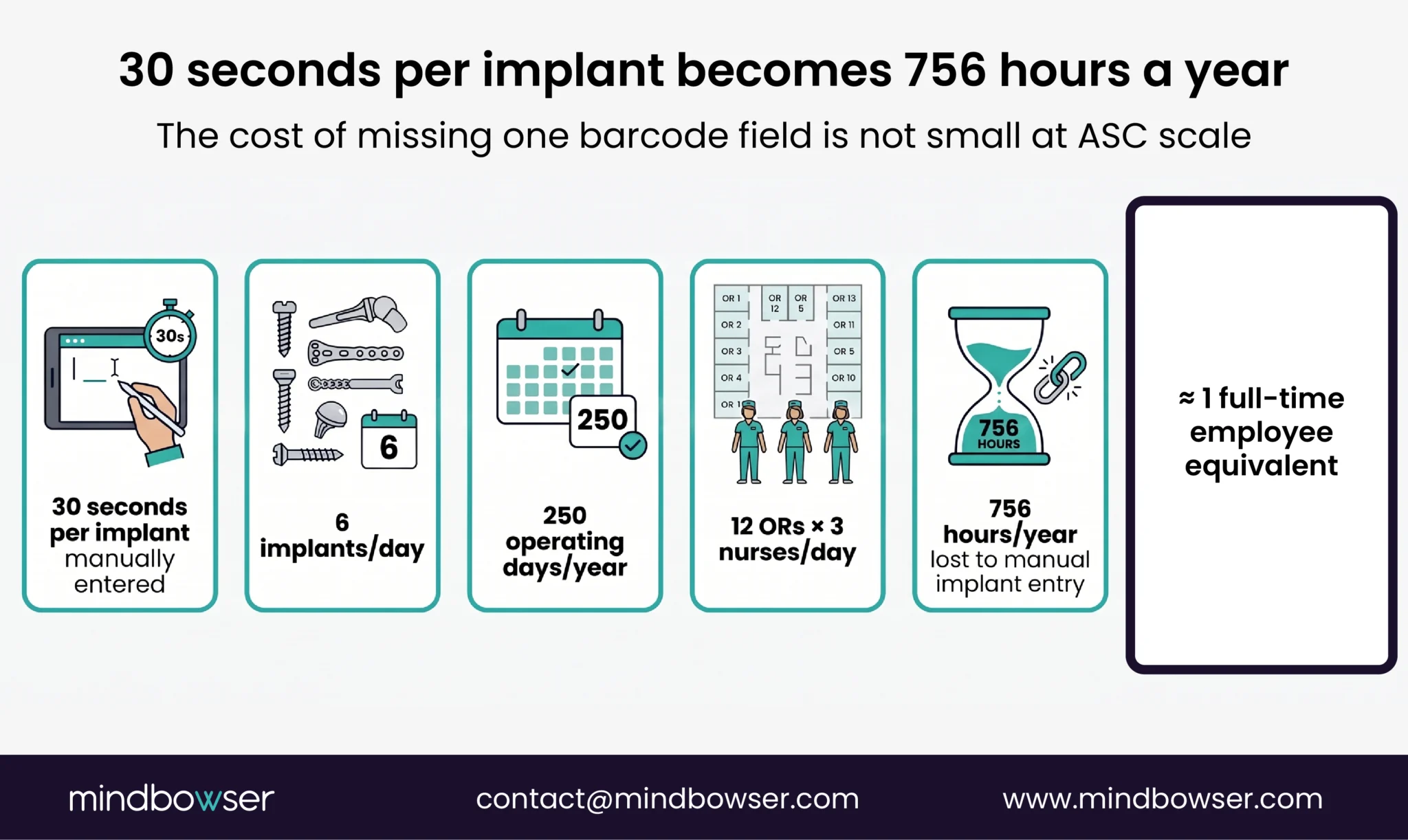
It’s 7 a.m. in pre-op. A circulating nurse is standing at a workstation trying to scan a titanium implant’s barcode into the EHR. The system doesn’t have a barcode scanner field. So she’s hand-typing the lot number into a free-text field in the chart. Thirty seconds per implant. Six implants that day. Five minutes lost to what should have been 10 seconds of work.
That five minutes repeats 250 days a year. That’s 21 hours of manual data entry annually, per nurse. At a multi-specialty ASC with orthopedic volume (where implant-heavy cases are the norm), you can reach 756 hours annually across the nursing staff, the equivalent of one full-time employee, spent typing lot numbers that should have been scanned.
I’ve watched this happen at fifteen different ASCs over the last seven years as an engineering leader. I’ve also watched the same scene play out across OR scheduling, surgical checklists, anesthesia documentation, and patient pre-op intake. Generic EHRs were designed for hospital workflow. Ambulatory surgery centers run on different rules. The mismatch costs time, introduces error, and turns simple processes into workarounds.
This guide walks through what actually matters in an ASC EHR, scores six platforms honestly on those criteria, and shows you the math on when building a custom platform makes financial sense. If you want the broader specialty EHR landscape first, our specialty EHR development guide and cardiology EHR comparison cover adjacent use cases in the same series.
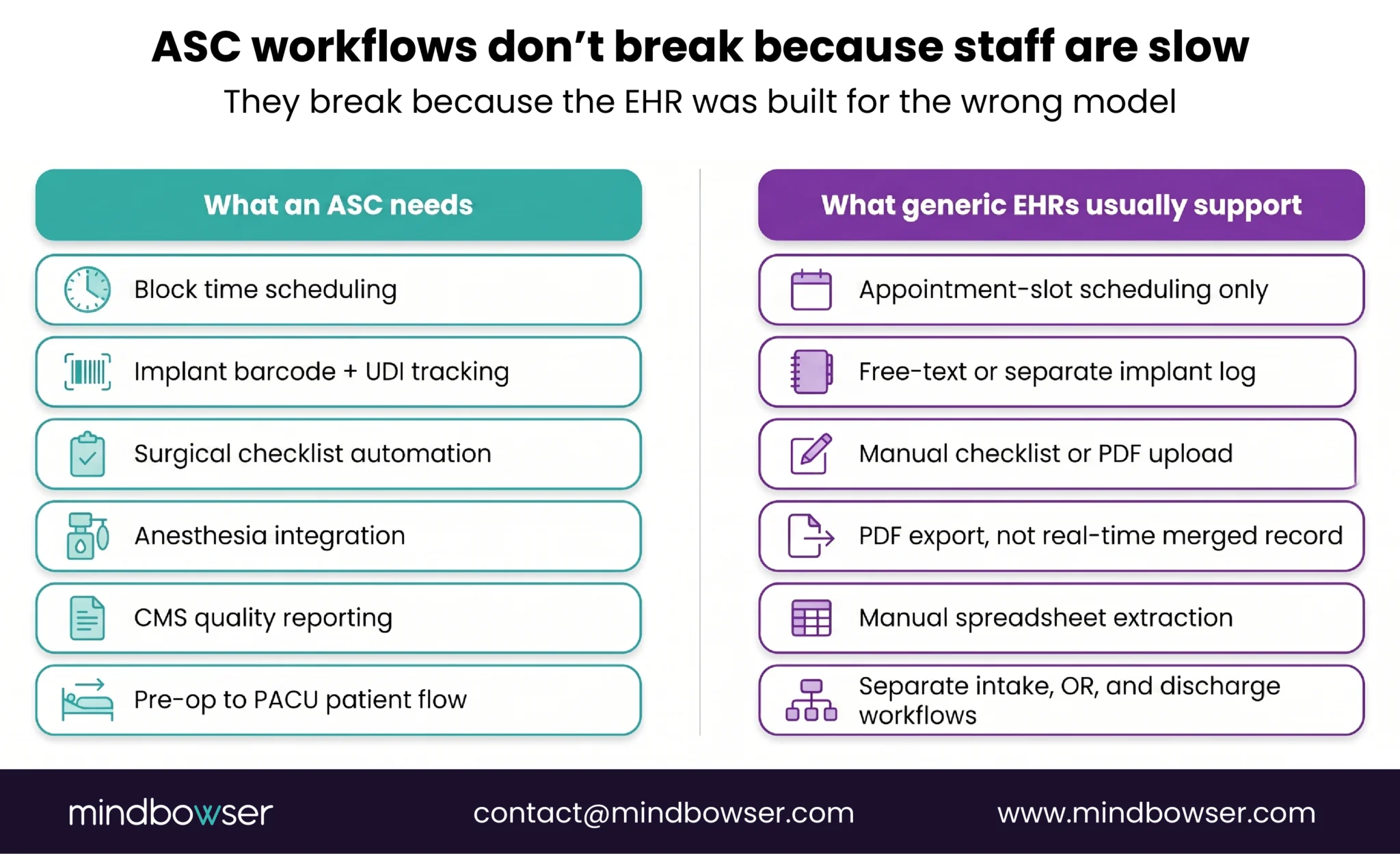
I. Why ASC Workflows Break Generic EHRs at Four Specific Points
The Block Time Problem
Hospital EHRs are built on appointment scheduling. You book a patient for a time slot. The system reserves that slot. Done.
ASC scheduling is different. You don’t schedule appointments. You schedule block time. A surgeon reserves a block, say, 10 a.m. to 1 p.m. on Tuesday and Thursday. Within that block, cases get scheduled and rescheduled based on patient availability, complexity, and cancellations. If a case cancels at 10:15, the next case in the queue moves up. Turnover time between cases is tracked separately from procedure time.
Generic EHRs don’t have block time. They have appointment slots. When you try to force block scheduling into an appointment slot system, you get spreadsheets alongside the EHR. I’ve seen ASCs where OR scheduling still runs on Excel because the EHR can’t handle the workflow.
CMS and accrediting bodies (AAAHC, AAAASF) don’t require EHR-based scheduling. So vendors don’t prioritize it. The result: most ASCs use their EHR for documentation and compliance, then schedule in a separate system.
The Implant Tracking Problem
Federal law requires it. The FDA’s UDI (Unique Device Identifier) Rule, 21 CFR Part 830, mandates that every implantable device used in a procedure be tracked to a specific patient record using the device’s UDI code.
Most generic EHRs don’t have a UDI field. Some have added one in recent years, but implementation is spotty. More commonly, ASCs track implants in a separate implant management system, then manually reconcile with the EHR for compliance audits.
The compliance exposure is real. An FDA audit finds a discrepancy between the implant log and the patient record, and you’re facing a potential warning letter. It happens. I’ve seen it drive ASCs to rebuild their implant tracking from scratch.
The Anesthesia Integration Problem
The anesthesiologist documents in a separate system. The surgeon documents in the EHR. These two records never fully merge.
Why? Most EHRs don’t have native anesthesia documentation templates designed for ASC workflows. So the anesthesiologist uses a dedicated anesthesia information system (ASIS), proprietary software that tracks vitals, medications, airway management, and adverse events. The surgeon’s EHR gets a PDF export of the anesthesia record, if anything.
In a hospital, you live with this friction. It’s built into the workflow. In an ASC, it’s a pain point that runs counter to the whole point of ASCs: efficiency and simplicity.
The CMS Quality Reporting Problem
ASCs participating in Medicare must report a set of quality measures annually under the CMS ASCQR Program. Non-reporting triggers a 2% payment reduction. The core measures include:
- Wrong surgery events (wrong patient, wrong site, wrong side, wrong procedure, wrong implant)
- All-cause unplanned hospital transfer or admission
- Patient burn events
- Prophylactic antibiotic timing and selection
- Healthcare personnel influenza vaccination coverage
- Safe surgery checklist use
- CAHPS for ASCs (patient satisfaction, distinct from HCAHPS, which is inpatient-only)
- And additional measures added under annual rulemaking.
Each measure requires specific data elements in the patient record. Most generic EHRs can’t auto-populate these. ASCs end up manually extracting data at year-end, compiling it in a spreadsheet, and submitting it to CMS. It takes weeks.
A properly wired ASC EHR auto-maps clinical data to each measure, flags missing required elements before submission, and generates a compliant file ready for CMS upload. The same FHIR API integration layer that handles payer prior auth can expose these measure exports, so you’re not building two separate pipes.
Seeing these gaps in your current system? we’ll map your surgical workflow against your current EHR
II. What Does an ASC EHR Actually Need to Do? (6 Capabilities That Actually Matter)
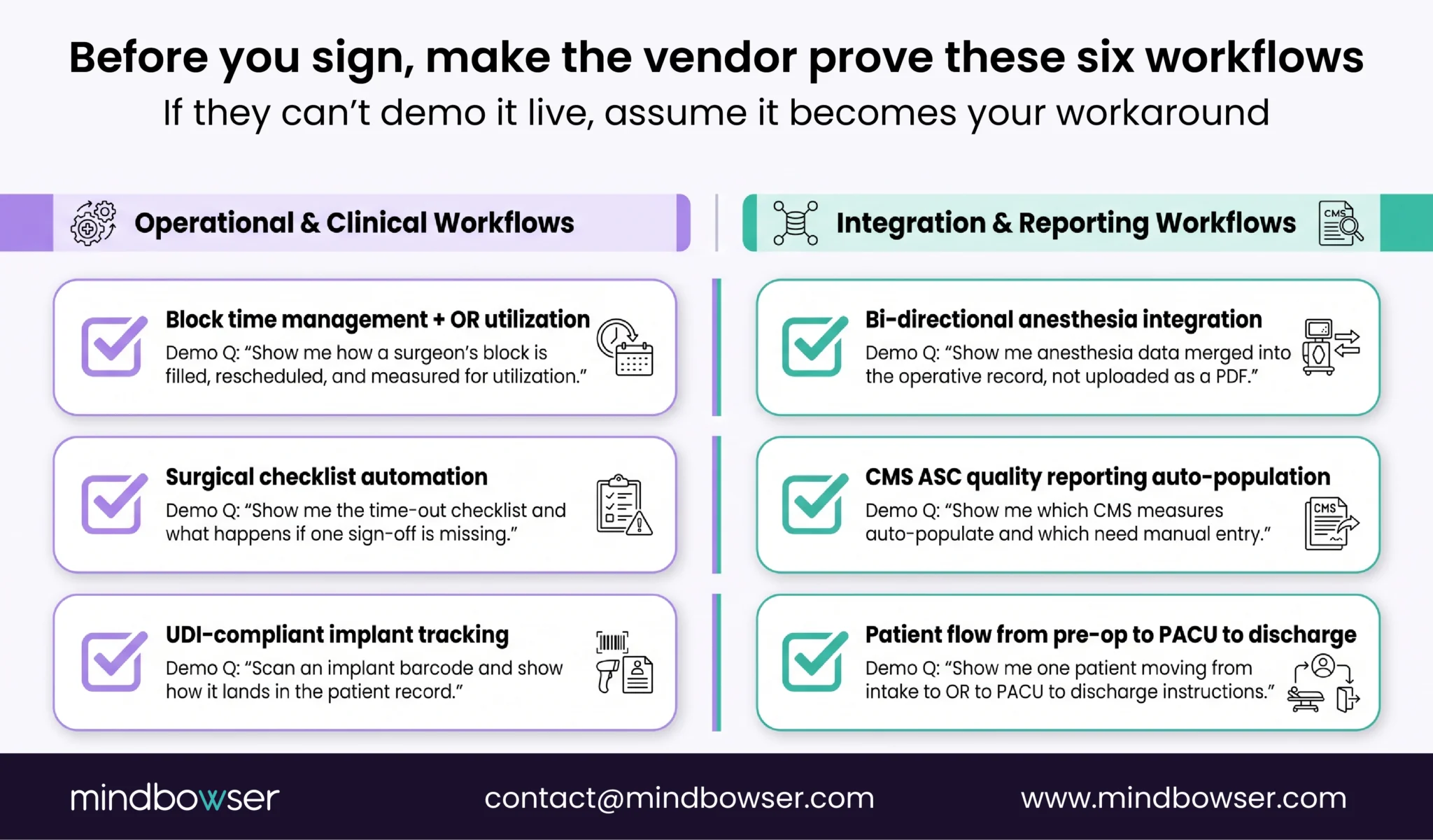
I evaluate ASC EHRs using six filters. If a platform nails four of these, it’s worth a trial. If it nails all six, it’s rare enough to bet on.
1. Block Time Management + OR Utilization Tracking
Not appointment slots. Block time. The system should:
- Let surgeons reserve specific time blocks (e.g., “10 a.m., 1 p.m., Tuesdays and Thursdays”)
- Allow cases to be scheduled and rescheduled within those blocks
- Track turnover time automatically (case end time to next case start time)
- Show OR utilization in real time (how many minutes of the 180-minute block are filled)
- Alert when utilization falls below a target threshold (e.g., <70% utilization = revenue leak)
2. Surgical Checklist Automation
WHO Safe Surgery Checklist or AAAHC equivalent. The system should:
- Display the checklist at time-out automatically
- Require sign-off by the surgeon, anesthetist, and nurse before the case proceeds
- Lock the record if the checklist is incomplete
- Track which items were flagged as risks or abnormal
- Generate a compliance report for accreditation audits
3. UDI-Compliant Implant Tracking
The system should:
- Have a dedicated implant tracking module (not a free-text field)
- Accept barcode scanner input (standard USB barcode readers)
- Auto-populate implant details from the UDI database (name, manufacturer, lot number, expiration date)
- Require manual lot-number entry only if barcode scanning fails
- Generate a UDI compliance report for FDA audits
- Alert if an expired implant is scanned (hard stop: case cannot proceed)
4. Bi-Directional Anesthesia Integration
Not a PDF export. Real integration. The system should:
- Accept anesthesia data directly from the ASIS (anesthesia information system)
- Merge anesthesia findings into the patient’s clinical record in real time
- Display anesthesia complications in the surgeon’s view (not as a separate PDF)
- Allow the surgeon and anesthesiologist to comment on each other’s findings
- Generate a single unified operative report (not separate documents)
5. CMS ASC Quality Reporting Auto-Population
The system should:
- Map clinical data fields to each active ASCQRP measure automatically
- Flag missing required elements in real time (before discharge)
- Generate a submission-ready file in CMS’s required format
- Track historical compliance rates (to show trending to CMS)
6. Patient Flow: Pre-Op Digital Intake + PACU Status Board + Discharge Instructions
The system should:
- Have a patient portal for pre-op questionnaires (medical history, medications, allergies, consent)
- Display a real-time status board showing which patients are in pre-op, in the OR, in PACU, and ready for discharge
- Generate discharge instructions automatically (based on procedure type and complications)
- Send discharge instructions to the patient’s phone (SMS or app notification)
Related read: Best EHR Systems Explained: Cloud, On-Premise, Specialty & More
III. Top 6 ASC / General Surgery EHR Systems (Honest Scorecard)
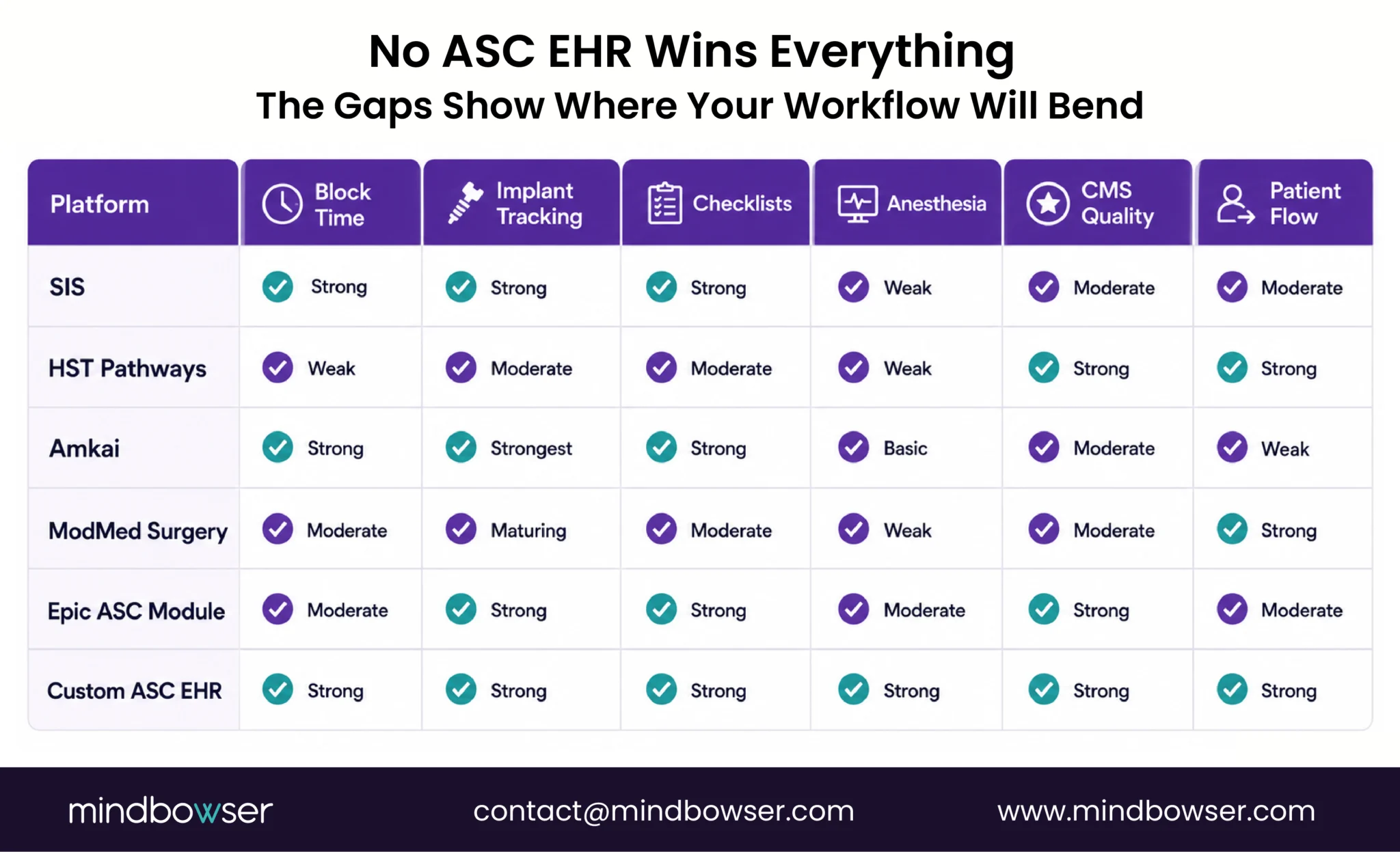
I’ve seen six platforms in production at surgical practices. Here’s how they score.
SIS (Surgical Information Systems)
- What it does well: Purpose-built for ASCs. Strong block time management. Excellent OR utilization tracking. Good implant tracking (barcode scanner compatible). Surgical checklist automation. Strong vendor support for ASCs specifically.
- What it misses: Weak anesthesia integration (still mostly PDF export). Limited FHIR compliance (relevant if you’re trying to share data with payers or post-acute networks). User interface feels dated.
- Best for: ASCs that prioritize workflow over interoperability. No plans to integrate with hospital system data.
- Cost: $18K, $28K per surgeon per year, $150K, $250K implementation.
HST Pathways
- What it does well: Cloud-native. Best patient experience layer (mobile-friendly patient portal, excellent pre-op intake). Strong patient flow from pre-op to discharge. Good CMS quality measure auto-population. Growing implant tracking module.
- What it misses: Block time management is weak (still appointment-slot-centric). Anesthesia integration limited. Less mature than SIS at pure surgical workflow.
- Best for: ASCs that want modern UX and don’t mind re-training staff on block-time workarounds.
- Cost: $15K, $25K per surgeon per year.
Amkai
- What it does well: ASC-native. Excellent implant tracking with barcode integration (best-in-class). Good block time management. Surgical checklist automation strong. Small install base, but surgical practices love it.
- What it misses: Anesthesia integration is basic. No real patient portal (pre-op intake is paper-based). Limited CMS reporting sophistication.
- Best for: Surgical practices prioritizing implant compliance and OR workflow over patient digitalization.
- Cost: $16K, $24K per surgeon per year.
ModMed Surgery
- What it does well: ModMed entering the ASC market with a strong product. Cloud-native. Good workflow automation. Growing surgical feature set. Moderate learning curve.
- What it misses: Implant tracking still maturing. Anesthesia integration not fully baked. Smaller ASC install base means less battle-tested for high-volume ASCs.
- Best for: ASCs willing to be early adopters of a platform with strong backing and likely feature roadmap.
- Cost: $14K, $22K per surgeon per year.
Epic ASC Module
- What it does well: Integrated with Epic’s hospital EHR (if you’re an IDN). Strong surgical documentation. Strong anesthesia integration (Epic’s anesthesia module is solid). Well-staffed vendor support for large systems.
- What it misses: Block time management is weak (hospital DNA, surgery templates layered on). Overkill for standalone ASCs. High cost. Heavy implementation burden.
- Best for: ASCs owned by hospital systems or IDNs already on Epic.
- Cost: $30K, $60K per surgeon per year, $400K, $800K implementation.
Custom Build (FHIR-Native)
- What it does well: Designed for your specific workflow. All six capabilities nailed. Future-proof (FHIR for interoperability, headless architecture for scale). Owns the code.
- What it misses: 16, 20 month build. Requires surgical partner + engineering team. Upfront capital.
- Best for: Large ASCs (12+ surgeons), surgical networks, or practices with specialized procedures no vendor supports.
- Cost: $350K–$500K upfront, $80K–$150K annual support. Break-even vs licensing: End of Year 1.
Thinking About a Custom ASC EHR Build?
IV. What ASC Directors and Surgeons Actually Say About Their EHR
- We use a spreadsheet for block scheduling because the EHR can’t handle it. Every Monday morning, someone manually moves cases around in Excel, then re-enters them into the EHR one by one. OR Director, 6-OR general surgery ASC
- The anesthesiologist documents in a separate system and the record never makes it to the surgeon’s note. We end up with two parallel records and no way to reconcile them during an audit. General Surgeon, 8-physician group practice
- Implant documentation is a person. Their whole job is entering lot numbers into a free-text field. We tried to scan barcodes, but the EHR doesn’t have a barcode field. So she types them manually. 30 seconds per implant, all day. ASC Administrator, orthopedic + general surgery ASC
- CMS quality measure submission takes us three days every quarter, manually. We pull data from the EHR, aggregate it in a spreadsheet, then submit it to CMS. No automation whatsoever. Practice Manager, independent 8-OR ASC
V. The CMS Quality Reporting and UDI Burden: Where ASC EHRs Lose You Money
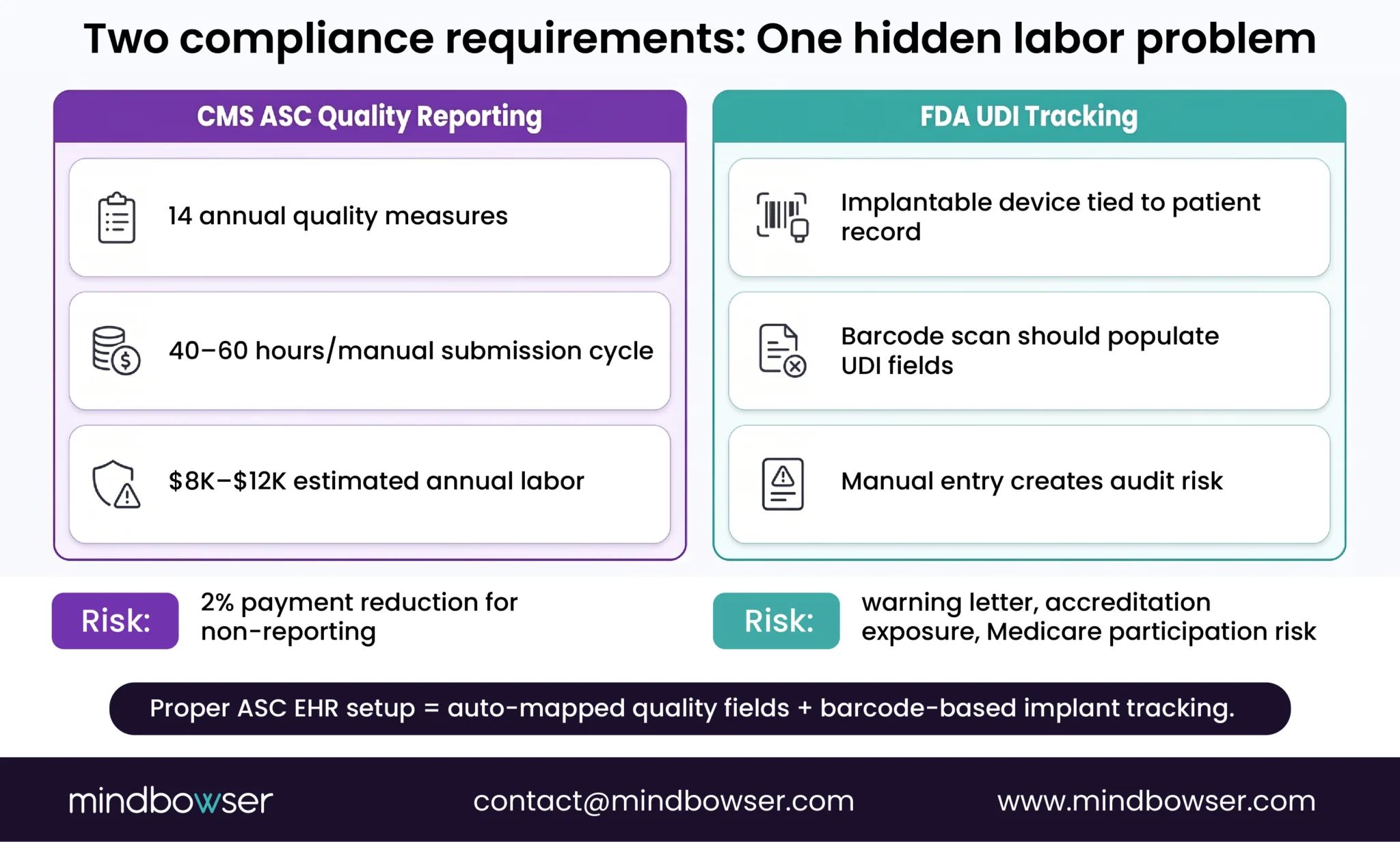
Two federal mandates hit ASCs hard when the EHR can’t handle them automatically.
CMS ASC Quality Reporting
ASCs accredited by CMS (not physician-owned standalone facilities, but those participating in Medicare) must report 14 quality measures annually. Non-reporting triggers a 2% payment reduction. Late reporting adds more penalties.
The 14 measures:
- 30-day unplanned readmission
- 30-day unplanned return to OR
- SSI (surgical site infection) rate
- HCAHPS patient satisfaction
- Anesthesia complications
- Serious fall/trauma events
- Medication errors
- Retained surgical items
- Appropriate prophylactic antibiotic
- DVT/PE prophylaxis (for high-risk cases)
- Appropriate VTE assessment
- Transfer to hospital rate
- Unexpected complications rate
- Patient-reported outcome measures (emerging)
Each measure requires specific data elements. If the EHR doesn’t auto-map, you’re re-documenting. A 12-OR ASC running 50 cases per week is touching 2,600 cases per year. Manual extraction and aggregation takes 40–60 hours per submission cycle. At $50/hr labor cost, that’s $2,000–$3,000 per quarter, $8,000–$12,000 annually.
A properly wired EHR: zero manual hours. The data is pre-populated. You hit submit.
FDA UDI Rule Compliance
Every implantable device must be tracked by UDI. The rule has been in effect since 2018, but enforcement ratcheted up in 2024. An FDA audit finding a discrepancy between your implant log and the patient record can result in a warning letter or consent decree.
ASCs without native UDI fields have two options:
- Use a separate implant tracking system and manually reconcile with the EHR for audits.
- Have staff hand-enter lot numbers (which we established costs $1,500+/year in labor at a typical ASC).
The cost of a compliance failure: regulatory action, loss of accreditation, loss of Medicare participation. Not theoretical.
When Does Building a Custom ASC EHR Beat Buying One?
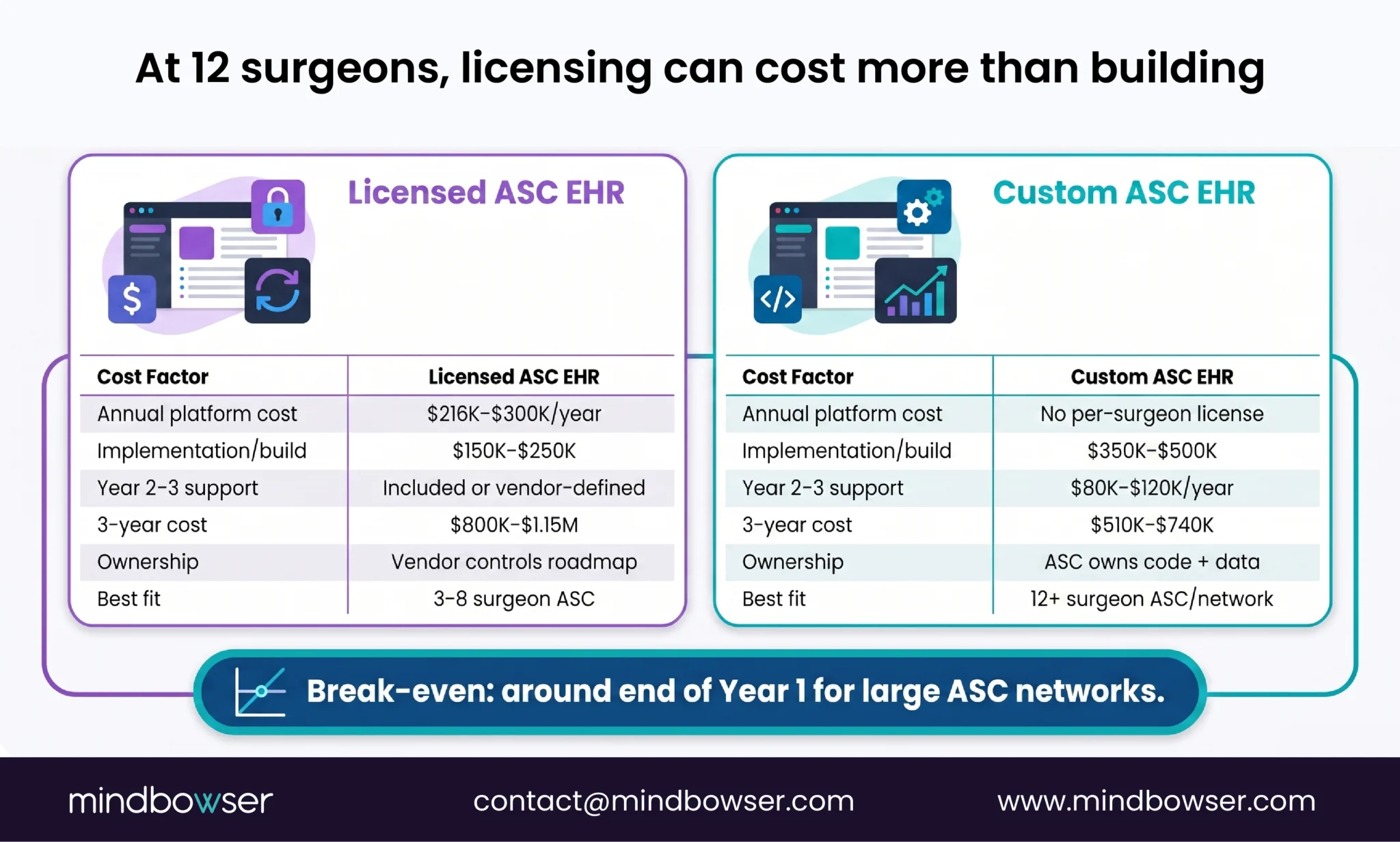
Licensing model (SIS / HST / Amkai / ModMed):
- Per-surgeon cost: $18K–$25K/year
- For a 12-surgeon ASC: $216K–$300K/year
- 3-year cost: $648K–$900K
- Implementation: $150K–$250K (one-time)
- Total 3-year cost: $800K–$1.15M
Custom build (on FHIR-native foundation like Medplum):
- Initial build: $350K–$500K (16–18 months)
- Year 2–3 support + enhancements: $80K–$120K/year
- Total 3-year cost: $510K–$740K
Break-even: End of Year 1. After that, the custom build is cheaper.
When Does the Build Make Sense?
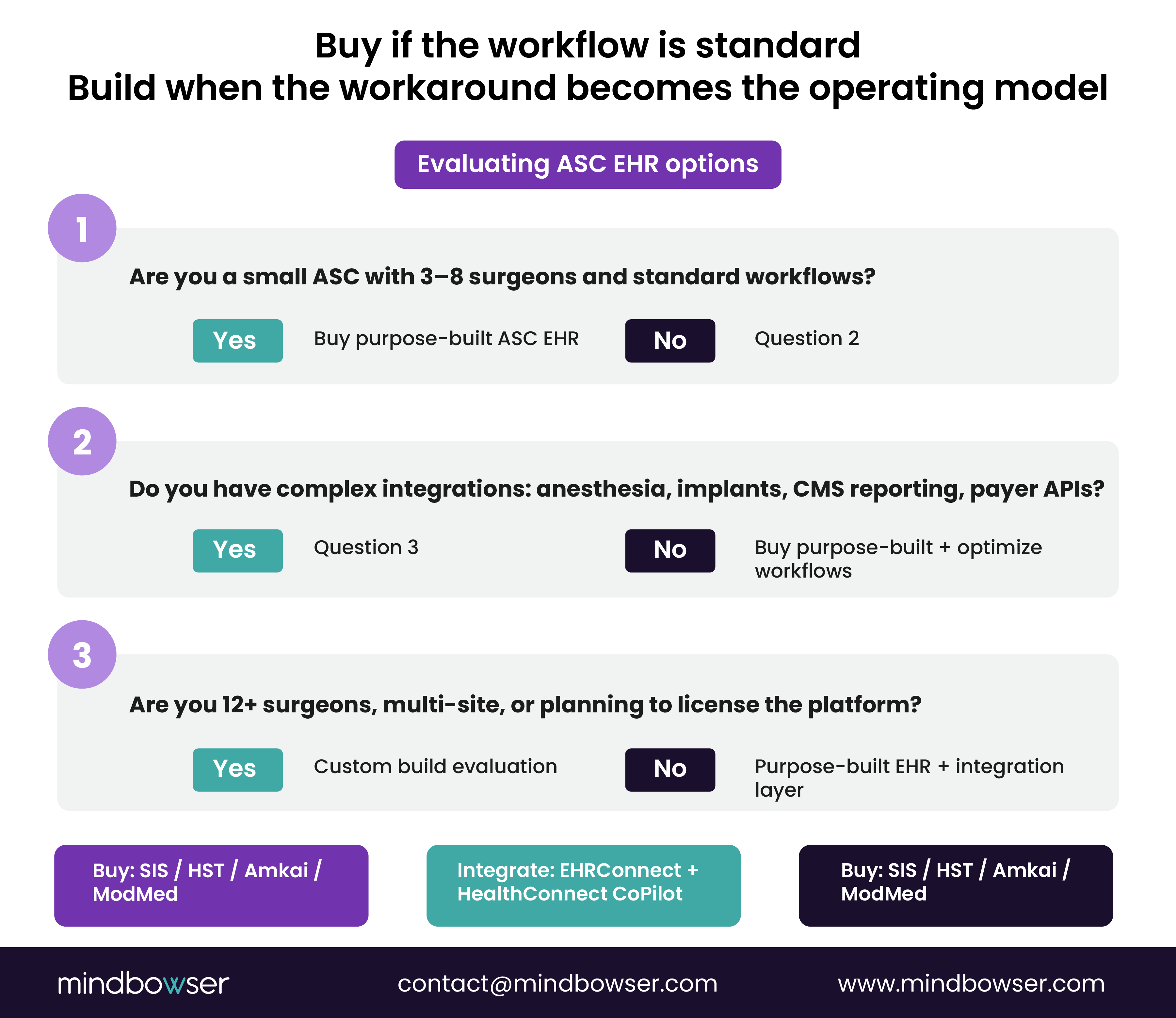
Build if:
- You’re a large ASC (12+ surgeons) so the per-surgeon build cost is low.
- Your surgical mix is specialized or unusual (specialty ASCs break generic EHRs more often).
- You plan to scale (open more ASCs or license the platform to others).
- You’ve been hitting the same ceiling with vendor products for 18+ months.
Buy if:
- You’re a small ASC (3–8 surgeons).
- Your workflow is standard (general surgery only, no complex integrations).
- You need to go live in 4–6 months.
- You don’t have internal engineering resources to manage ongoing development.
A Real ASC Build: US-Based Wellness Provider EHR
A mid-market US-based wellness provider needed a custom EHR to unify fragmented patient records, support physician-defined treatment workflows, and coordinate care. No off-the-shelf product supported their combination of customizable clinical protocols, telemedicine, and billing workflows in a single system.
We built a dual-portal EHR on a FHIR-native foundation. The result: customizable treatment workflow templates, role-based access control, e-prescription, telemedicine, integrated billing. The practice owned the platform outright no per-user annual license, no vendor-imposed workflow constraints.
The financial outcome: post-launch, they reduced time-to-referral by 40%, improved care coordination metrics by 35%, and cut billing cycle time in half. They owned the codebase. No recurring per-surgeon tax.
How We Build Custom ASC EHR Software
When an ASC decides to build, the timeline looks like this.
Phase 1: OR Workflow Mapping (2–4 weeks)
We observe actual surgeons and nurses working. Not interviews real observation. We map:
- How block time is managed (or should be)
- Implant tracking process (current state + compliance requirements)
- Anesthesia handoff workflow
- Surgical checklist workflow (current gaps + requirements)
- Patient pre-op and post-op flow
- Compliance reporting needs
Out of this: a detailed process map and a requirements document that names exactly what the system needs to do.
Phase 2: Architecture (4–6 weeks)
We design the data model:
- FHIR-native core: all clinical data in standard FHIR resources
- Custom ASC schema: block time, surgical procedures, implant UDI tracking, anesthesia integration, CMS quality measure mapping
- Integration layer: ASIS (anesthesia) system connectors, implant vendor APIs, CMS submission APIs
Phase 3: MVP Build (12–16 months)
Core features launch:
- Surgical case documentation
- Block time scheduling
- Surgical checklist
- Implant tracking (barcode + manual entry)
- Anesthesia data merge
- CMS quality measure auto-population
- Patient pre-op digital intake
- PACU status board
Phase 4: AI and Advanced Features (Months 12–18, overlaps MVP)
- AI Medical Summary: ambient documentation in the OR (microphone captures the surgeon’s verbal notes, AI transcribes and structures into the operative report)
- Surgical Risk Prediction: ML model flags high-risk patients for proactive post-op monitoring
- Infection Prediction: model flags SSI risk based on patient factors, procedure, antibiotic timing
Phase 5: Interoperability (Months 18–22)
- ConnectHealth: integrates with external EHRs (if patients are also treated at a hospital) and connects to payer APIs for pre-authorization and real-time eligibility
- FHIR API: allows post-acute partners (home health, physical therapy) to access discharge summaries
Phase 6: ONC Certification (Months 22–24, optional)
If you plan to sell or license nationally:
- USCDI v3 compliance
- FHIR API certification
- SOC 2 Type II audit
- Full documentation and attestation
The Best ASC EHR Is the One That Protects Surgical Flow
An ASC EHR should do more than document the case. It should protect the flow of the center, from block time and implant tracking to anesthesia records, CMS reporting, PACU visibility, and discharge. For smaller ASCs with standard workflows, purpose-built platforms like SIS, HST, Amkai, or ModMed may be enough.
But for larger surgical networks, complex specialty mixes, or centers paying too much in per-surgeon licensing and manual workarounds, a custom FHIR-native platform can become the smarter long-term investment. The decision is not simply build versus buy. It is whether the system can support the way your ASC actually operates without turning your staff into the integration