BLOGS
BLOGS  NEWSROOM
  CASE STUDIES
  WEBINARS
  PODCASTS
  ASSET HUB
  EVENT CALENDAR

















TL;DR
Most companies ranking for “wellness app development” are generic app-dev shops with a wellness page bolted onto their services list, not healthcare specialists. This piece covers two genuinely distinct builds that get lumped together under “wellness app”: consumer mental/emotional wellness apps, and corporate wellness programs sold to HR and benefits teams. Different buyer, different integration requirements, different compliance bar. I’ll walk through both, plus where clinical validation actually matters and where it doesn’t, and where general fitness/diet app development belongs instead (it’s not this piece).
Most of This Market Is a Generic App Shop Wearing a Wellness Skin
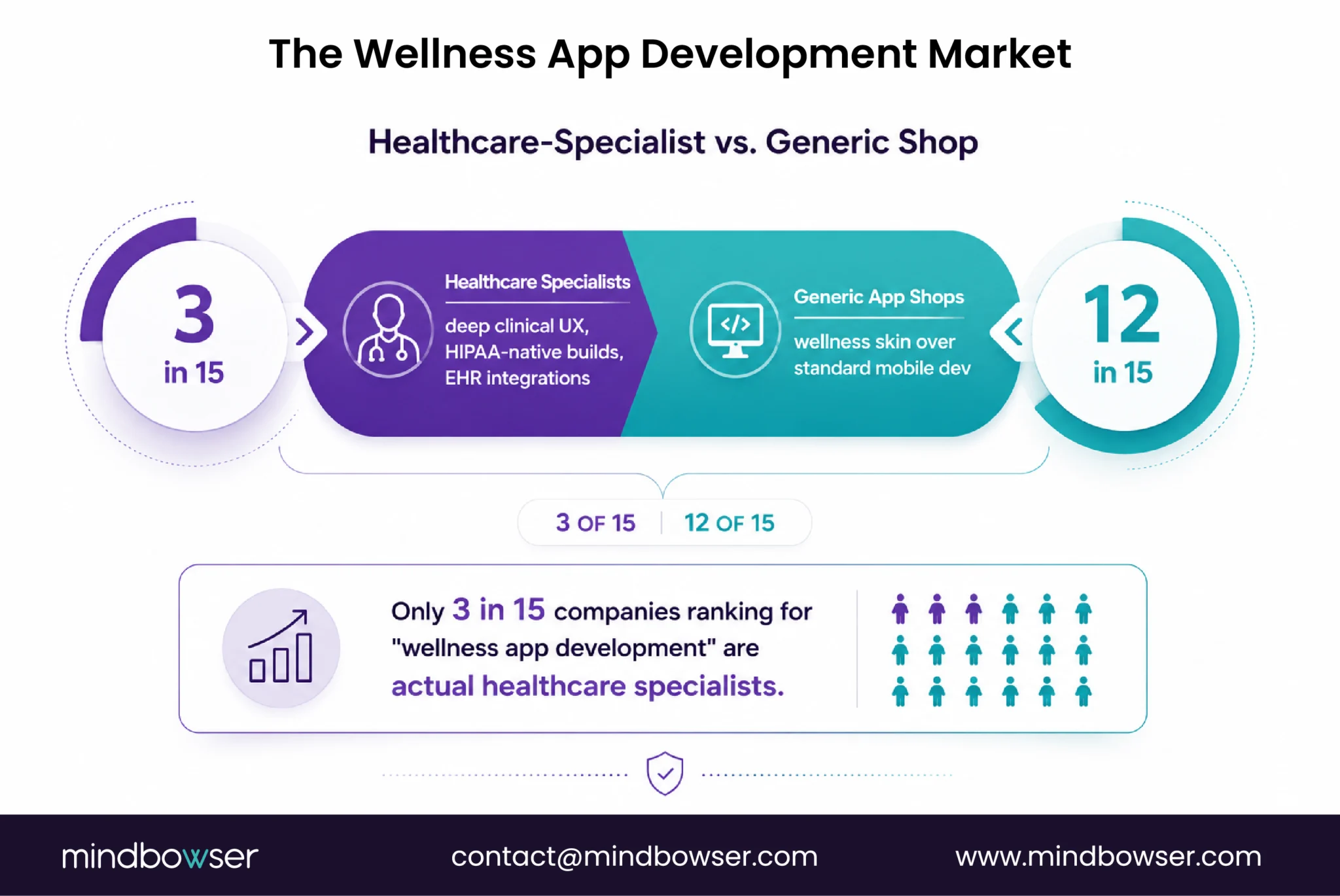
I looked at who’s actually ranking for “wellness app development” before writing this, the way I do before scoping any build. Out of roughly fifteen companies showing up across the top searches, three had real healthcare specialization. The rest were general app-dev agencies with a wellness services page that reads almost identically to their fintech page, their logistics page, and their retail page, just with different stock photos.
That’s not a knock on those shops’ engineering. It’s a scoping problem for the buyer. A wellness app that touches mental health screening, medication adherence nudges, or anything an App Store reviewer might flag as health-adjacent needs a team that’s built through App Store and Google Play’s health-content review process before, understands where clinical validation is actually required, and knows the difference between a feature that’s fine to ship fast and one that needs a clinician’s sign-off first. I’ve been on both sides of that gap, shipping fast on features that didn’t need a second look, and slowing down hard on the ones that did, and the difference matters more than most founders scoping their first build expect.
What “Wellness App” Actually Covers, and Where This Guide Draws the Line
“Wellness app” gets used as an umbrella term for everything from a step-counter to a corporate EAP portal, and most guides on this topic treat it as one undifferentiated category. It isn’t. I’m drawing a specific line here: this piece covers mental and emotional wellness apps (stress management, resilience building, self-guided coping tools, workplace mental-health support) and corporate wellness programs (the B2B build sold to HR and benefits teams, not directly to consumers).
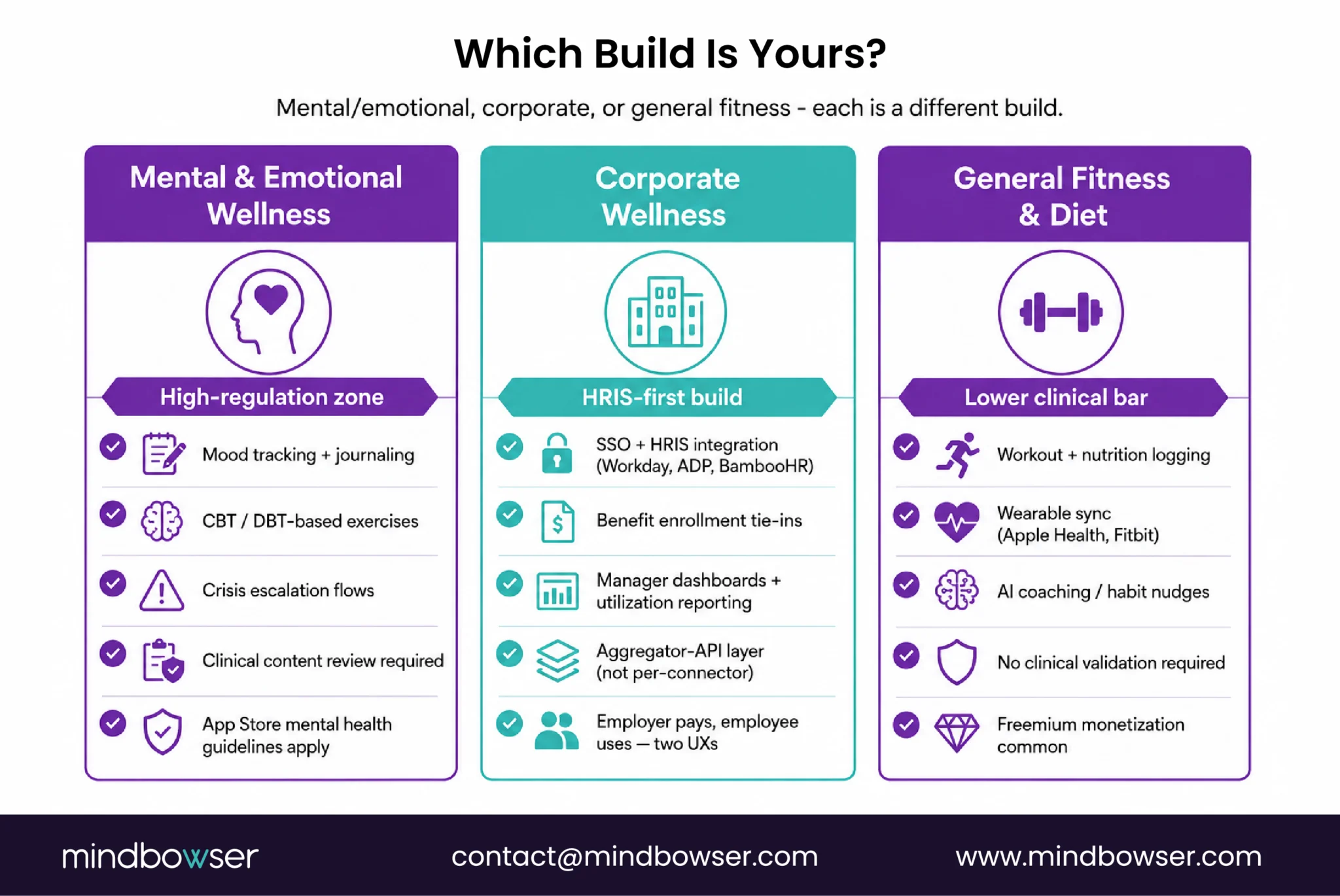
The conflation happens because all three categories, fitness, mental/emotional wellness, and corporate wellness, share surface-level features: a content library, progress tracking, some kind of reminder or nudge system. But the actual engineering priorities diverge fast once you start building. A fitness app’s hard problem is wearable and sensor integration, syncing step counts, heart rate, and sleep data from a dozen device types reliably. A mental/emotional wellness app’s hard problem is content and engagement, keeping someone opening a stress-management exercise on a bad day without it feeling clinical or like homework. A corporate wellness app’s hard problem is neither of those, it’s identity and eligibility: knowing which employees are covered, syncing that from a benefits system nobody on the product team controls, and making enrollment invisible to the end user. Three different technical centers of gravity, one marketing category.
General fitness tracking, diet and nutrition apps, and workout/gym platforms are a different build with a different compliance profile, wearable integration being the dominant technical question there rather than clinical content or workplace-benefits integration, and Mindbowser’s mHealth cluster covers that territory directly. If that’s your actual build, start there instead. If you’re building something closer to meditation specifically, we’ve also covered that ground. This piece is for the mental/emotional-wellness and corporate-wellness builds specifically.
The Engagement Problem Every Wellness App Has
Every wellness app, regardless of which sub-category it falls into, fails or succeeds on the same axis: does anyone keep using it after week two. I’ll be direct about where my proof comes from here, because it matters. A clinical mental health app we built to 250,000 active users is a clinical mental health product, not a general wellness app, so I’m not going to pretend it’s a one-to-one case study for a corporate stress-management tool. What it does show, in an adjacent but not identical domain, is that the specific engineering choices behind retention (bitrate-adaptive streaming so content doesn’t stutter and lose someone mid-session, notification timing that respects when someone actually wants a nudge instead of blasting a generic reminder) are the same kind of choices that tend to determine whether a wellness app survives past its first month, regardless of exactly what wellness problem it’s solving.
The honest version of this section is: I don’t have a named case study for a pure corporate-wellness build in this cluster yet. What I have is direct, transferable engineering experience on the exact problem, engagement architecture, at real scale, in an adjacent domain. I’d rather say that plainly than stretch that case study into a claim it doesn’t quite support.
App Store and Google Play Health-Content Compliance for Wellness Apps
I covered the current App Store and Google Play health-content compliance timeline in detail in our mental health app development piece, so I won’t re-derive it here; the short version is that both platforms tightened health-content review meaningfully through 2025 and into 2026, with organization-account and medical-device labeling enforcement now active. What’s worth adding specifically for wellness apps: a mental/emotional-wellness app that stops short of diagnostic claims (stress-tracking, coping-skill libraries, mood journaling without a clinical scoring instrument) generally sits in a lighter review lane than a clinical mental health app. Once a wellness app adds a validated instrument, PHQ-9 style screening, for instance, it typically crosses into the same review posture as a clinical app, and the build needs to be scoped for that from day one, not discovered at App Store submission.
Build a Wellness App That Employees Actually Use
Corporate Wellness Programs Are a Different Build Than Consumer Apps
This is the section most “wellness app development” guides skip past, and it’s where the buyer is genuinely different. A corporate wellness app isn’t sold to the end user, it’s sold to an HR or benefits team, deployed to an employee population, and judged on utilization and program ROI rather than app-store ratings.
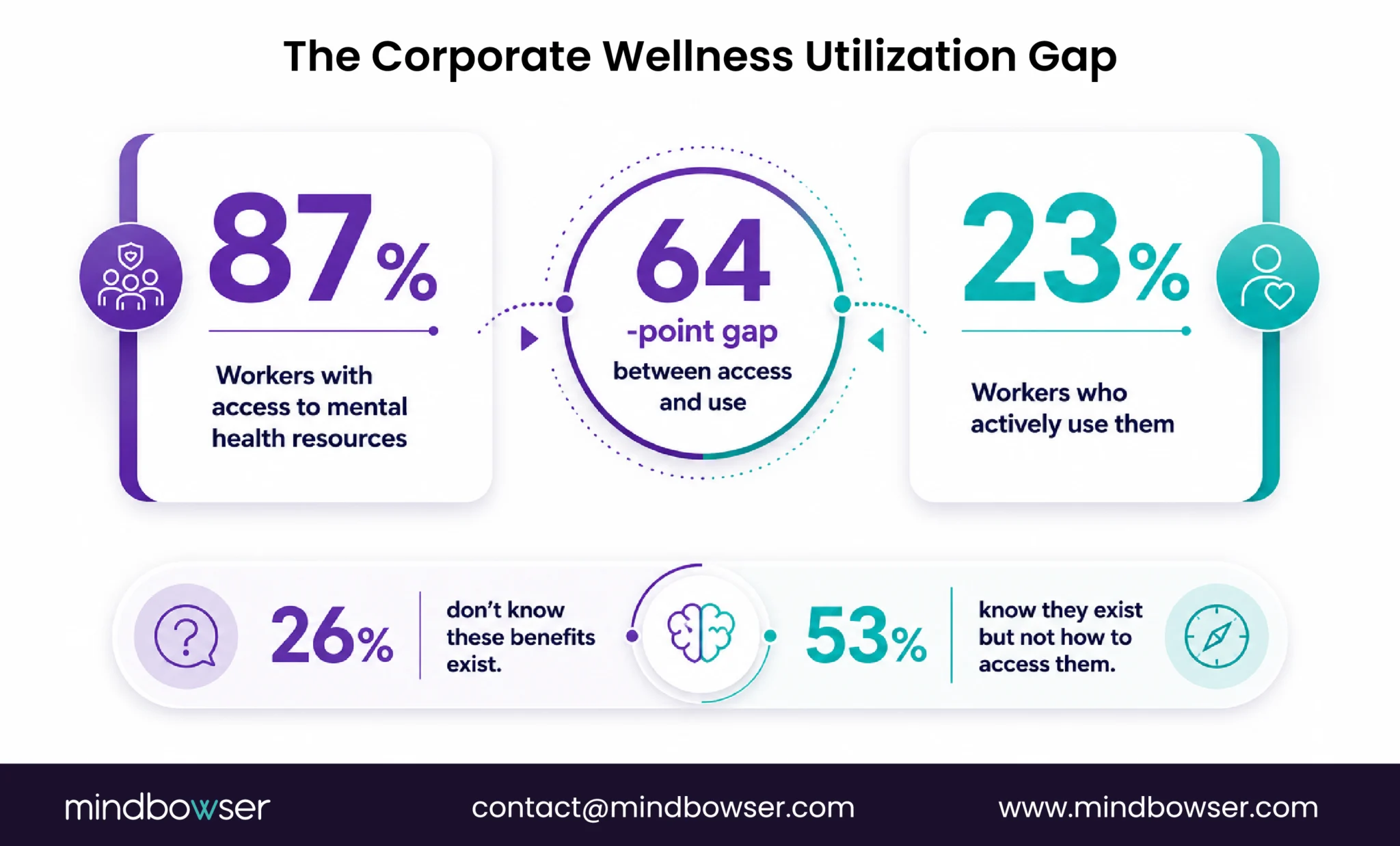
The market itself is sizeable and inconsistently measured, worth flagging honestly rather than picking whichever number sounds biggest: IBISWorld puts the US corporate wellness services industry at $12.8 billion in 2026, a narrower scope than the broader “global corporate wellness market” figures some other firms report in the $50-70 billion range, those broader numbers include categories this piece isn’t about, so I’m using the narrower, more defensible figure. What’s more useful than the market size, honestly, is the utilization gap underneath it. NAMI’s annual Workplace Mental Health poll, conducted with Ipsos among full-time employees at large employers, found that 26% of employees don’t even know if their employer offers mental health benefits, and only 53% know how to access what’s offered. Separately, industry benefit-utilization compilations put the gap even starker: roughly 87% of workers report having access to some mental health resource, but only about 23% actively use it.
That gap is as much a product problem as it is a benefits-communication problem. If a corporate wellness app requires an employee to remember a separate login, work through a portal nobody explained, or figure out eligibility on their own, the utilization numbers above are close to a best case, not a worst case. The technical piece that actually moves this number is integration with whatever HRIS or benefits-administration system the employer already runs, Workday, ADP, BambooHR, and others, so eligibility and enrollment happen automatically rather than requiring a separate signup. There’s no single named integration standard for this the way FHIR standardizes clinical data exchange; the current real-world pattern is an HR-data aggregator API (tools like Finch play this role, similar in concept to Merge or Rutter for other verticals) that unifies dozens of HRIS platforms behind one integration, rather than building and maintaining a separate connector per platform.

Clinical Validation Without Overclaiming
Here’s where I’d push back on both directions founders tend to go. Some teams over-clinicalize a wellness app that doesn’t need it, adding a validated screening instrument to a stress-management tool because it sounds more credible, and then inherit the compliance and review burden of a clinical product for a feature that didn’t need to carry it. I’ve seen this specific mistake firsthand: a founder wanted to add a PHQ-9 style mood screener to what was otherwise a straightforward coping-skills library, purely so the pitch deck could say “clinically validated.” That one instrument pulled the entire app into a stricter App Store review lane, added a requirement for a clinical oversight process the team hadn’t budgeted for, and delayed launch by roughly six weeks, for a feature that never shipped in the end because the team couldn’t support it operationally.
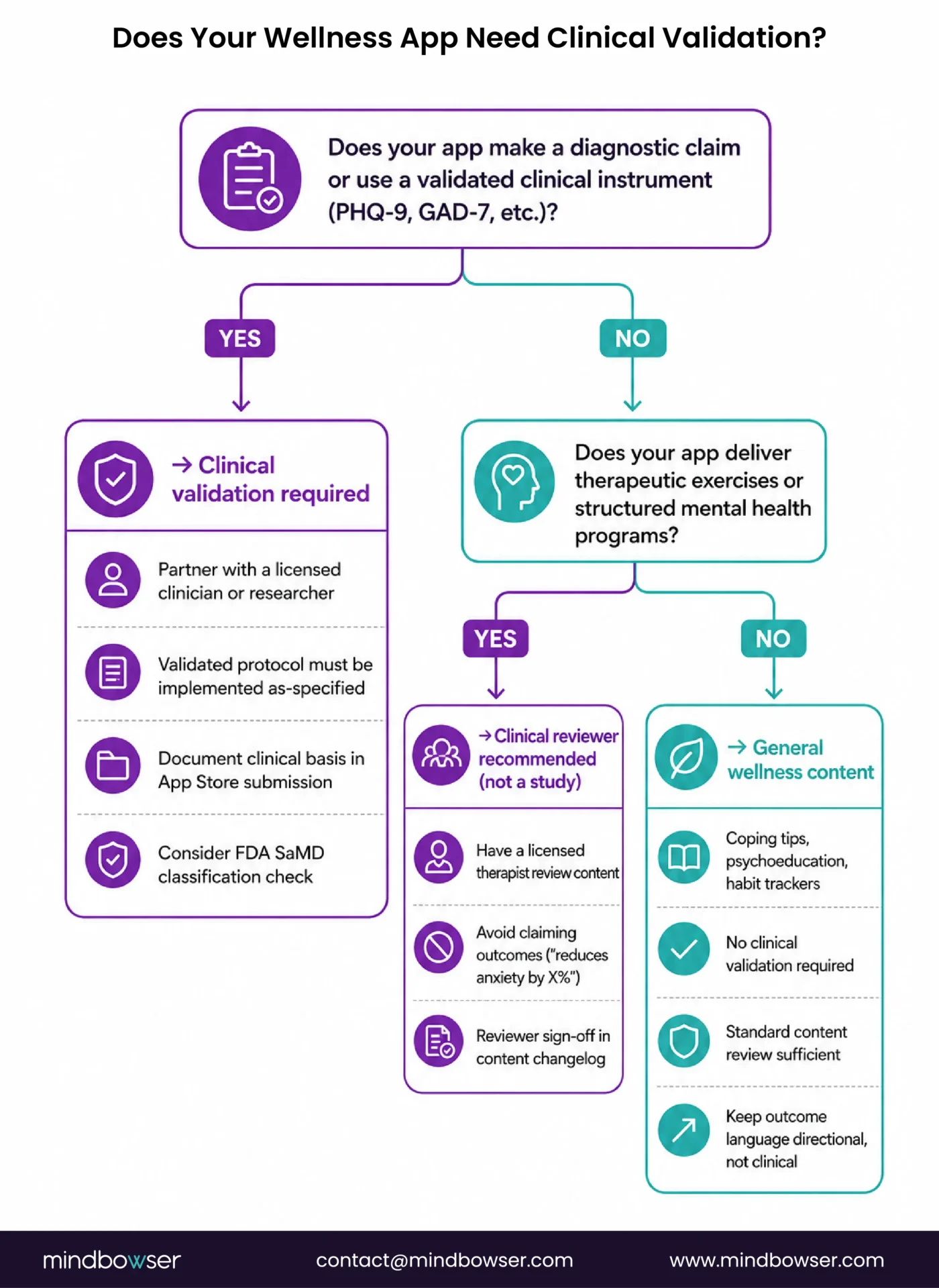
Other teams under-build, shipping mood-tracking or coping-skill content with zero clinical review at all, on the assumption that “it’s just wellness, not treatment.” That’s its own risk, not a compliance one necessarily, but a trust one: a breathing exercise or journaling prompt that a licensed clinician would flag as poorly worded or, worse, actively unhelpful for someone in a bad moment, ships to real users because nobody with the right background looked at it before launch.
The actual line: if the app is tracking a validated clinical measure, making any claim about diagnosis or treatment, or positioning itself as a substitute for professional care, it needs real clinical input and the compliance posture that goes with it. If it’s offering coping tools, psychoeducation, or general stress-management content without diagnostic framing, it doesn’t need a clinical validation study, but it does need a subject-matter reviewer, a licensed clinician or health educator, sanity-checking the content itself, because “not clinical” doesn’t mean “unreviewed.”
Psychoeducation and Content Delivery at Scale
Both consumer wellness apps and corporate wellness programs run into the same content-delivery problem at scale: a library of coping techniques, stress-management content, or benefits information that needs to reach people in different languages, at different literacy levels, without a human rewriting it for every segment. Take a distributed manufacturing employer rolling out a stress-management benefit: the same core content needs to land differently for a shift-worker reading on a phone during a break than for a desk-based manager reading at a laptop, and differently again for a Spanish-speaking or lower-literacy segment of that workforce, without the HR team commissioning a dozen separate versions of the same library. EduCare AI handles exactly this, personalized, on-demand instructional content adjusted by condition, language, and literacy level, and in the deployments we’ve measured it improves comprehension by about 36% while cutting the staff time spent re-explaining the same material by roughly half.

What EduCare AI doesn’t do: the HRIS integration work described above. That’s genuinely custom per employer, since which benefits platform, which eligibility rules, and which data an employer is willing to share all vary, and there’s no way to build that generically until you know which systems a specific corporate buyer already runs.
How Mindbowser Helps
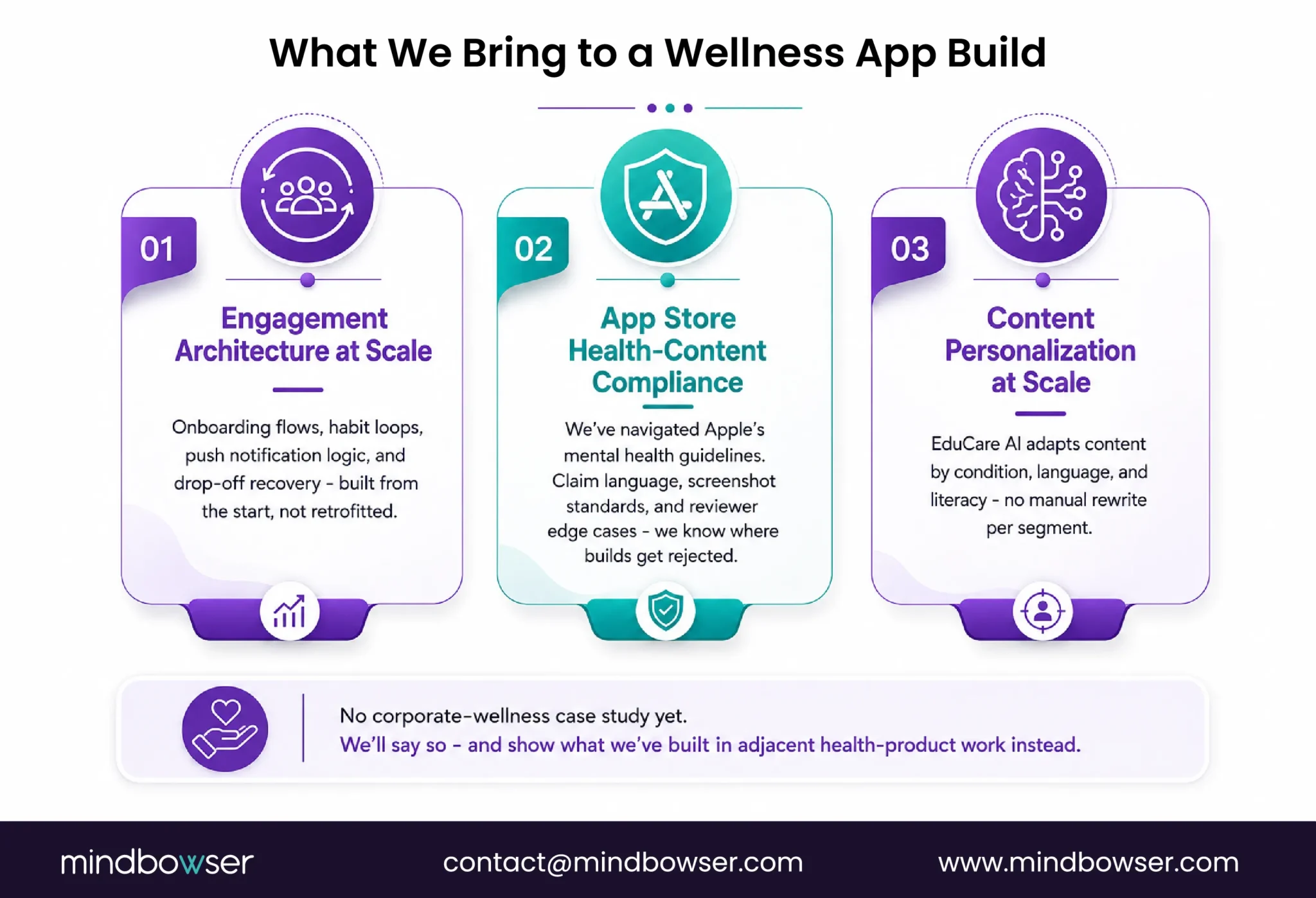
We’ve built the engagement architecture problem at real scale (a clinical mental health app we built to 250,000+ active users), we’ve built the App Store and Google Play compliance experience the health-content review process now demands, and EduCare AI covers the psychoeducation and content-personalization layer both consumer and corporate wellness builds need. What we don’t have yet in this cluster is a named corporate-wellness case study, and I’d rather tell you that directly than manufacture false specificity. If you’re scoping a build in either direction, mental/emotional wellness or corporate, that’s exactly the kind of conversation worth having before committing to a shop that’s never actually shipped through a health-content App Store review.
If your build is general fitness, diet, or activity tracking, our mHealth team covers that territory directly. If it’s mental or emotional wellness, or a corporate program you’re scoping for an employer, request an assessment and we’ll walk through what your specific build actually needs.
A mental health app typically involves clinical screening tools, diagnostic framing, or treatment claims, which trigger a stricter App Store/Google Play review posture. A wellness app, in the narrower sense this piece uses, offers coping tools, stress management, and psychoeducation without diagnostic claims, and generally sits in a lighter compliance lane, until it adds a validated clinical instrument, at which point it crosses into the same review category as a clinical app.
Not strictly, some ship as standalone apps with manual enrollment, but utilization data suggests that’s a mistake. When employees have to remember a separate login or figure out eligibility themselves, usage drops well below already-low industry benchmarks. Integrating with the employer’s existing HRIS or benefits platform for automatic eligibility and enrollment is one of the most consequential technical decisions in a corporate wellness build.
Only if it makes a diagnostic claim, tracks a validated clinical instrument, or positions itself as a substitute for professional care. Short of that, it still needs a subject-matter reviewer checking the content, but not a full clinical validation study.
It depends heavily on which build this is. A consumer mental/emotional wellness app with standard content delivery and no clinical instruments costs and ships faster than a corporate wellness platform requiring HRIS integration, which carries real upfront integration work that a standalone consumer app doesn’t.