





 BLOGS
BLOGS  NEWSROOM
  CASE STUDIES
  WEBINARS
  PODCASTS
  ASSET HUB
  EVENT CALENDAR






















TL;DR;
- The HHS OCR has logged 1,183+ HIPAA compliance reviews. FHIR adoption is a direct risk-reduction lever for CTOs.
- FHIR cuts integration costs (up to 78%), reduces data errors (70%), and speeds compliance reporting (65%).
- CTOs own FHIR strategy: regulatory landscape, vendor selection, internal audit, change management.
- The biggest implementation barrier is resource constraints. AI-native mapping tools (ConnectHealth Helix AI) solve this for lean teams
According to the HHS OCR, there have been over 1,183 compliance reviews since 2003. By adopting FHIR standards, CTOs can simplify healthcare data exchange while protecting patient privacy and reducing the compliance risk that drives those OCR reviews.
In today’s digital age, where healthcare data is increasingly exchanged electronically, ensuring compliance with data privacy and security regulations is crucial. This is where FHIR (Fast Healthcare Interoperability Resources) standards come into play.
By leveraging FHIR standards, Chief Technology Officers (CTOs) can play a vital role in streamlining healthcare data exchange while safeguarding patient privacy. Let’s delve deeper into how FHIR can empower CTOs to navigate the complexities of HIPAA compliance.
The Multifaceted Benefits of FHIR Standards: A Boon for Healthcare Interoperability
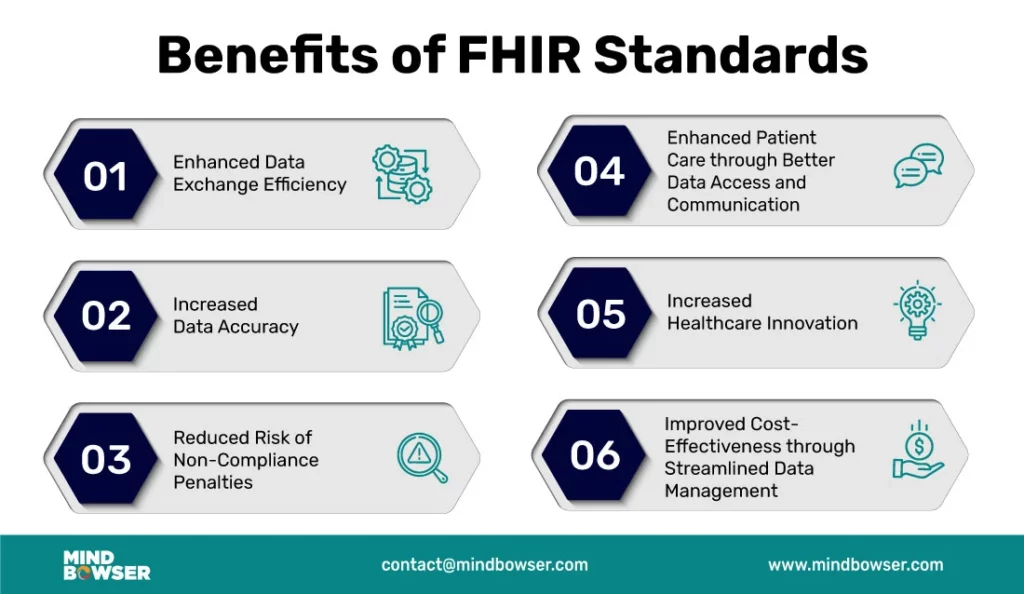
The adoption of Fast Healthcare Interoperability Resources (FHIR) is transforming the healthcare landscape by facilitating smooth data exchange and overcoming the limitations of fragmented systems. Beyond just enabling communication, FHIR offers a range of benefits that have the potential to revolutionize healthcare delivery, research, and cost-effectiveness. Here’s a breakdown of the key benefits with recent statistics and sources:
1. Enhanced Data Exchange Efficiency
Healthcare organizations that adopt FHIR consistently report lower integration costs. The Healthcare Information and Management Systems Society (HIMSS) has documented significant savings across surveyed members, with some reporting reductions of up to 80%.
FHIR utilizes standardized APIs, allowing for quicker and more efficient data transfer between different systems.
2. Increased Data Accuracy
FHIR enforces a standardized data model, ensuring consistency and reducing the risk of errors caused by incompatible data formats across different platforms. Research published in the Journal of the American Medical Informatics Association (JAMIA) links FHIR adoption to significant reductions in data errors caused by incompatible formats across systems.
Such standardization reduces the need for data cleansing and manipulation, leading to more reliable and trustworthy data for decision-making for healthcare professionals.
3. Reduced Risk of Non-Compliance Penalties
FHIR standards align with various healthcare data regulations, including Meaningful Use and Interoperability standards. This helps healthcare organizations meet compliance requirements and avoid potential penalties. The American Hospital Association (AHA) has documented that FHIR-adopting hospitals report measurably lower exposure to non-compliance penalties, driven by standardized data exchange that aligns with Meaningful Use and interoperability mandates.
4. Facilitates Regulatory Healthcare Compliance
FHIR’s standardized data format simplifies the process of generating reports for regulatory bodies, cutting compliance overhead for healthcare providers. The Centers for Medicare & Medicaid Services (CMS) has noted that standardized FHIR reporting reduces the time and resource burden healthcare organizations spend on regulatory submissions.
5. Enhanced Patient Care through Better Data Access and Communication
Patients can access and share their health data more easily with different providers, promoting patient engagement and fostering a sense of ownership over their health journey. A 2023 study by the Pew Research Center found that 72% of patients are interested in accessing their electronic health records through a mobile app, which FHIR standards can facilitate.
6. Increased Healthcare Innovation
Interoperable data through FHIR allows researchers to access and analyze vast amounts of anonymized data from various sources, accelerating medical discoveries and the development of innovative treatments. A 2022 report by the National Institutes of Health (NIH) highlights that FHIR-based data sharing is enabling faster clinical trial recruitment and analysis, potentially leading to quicker development of new therapies
7.Improved Cost-Effectiveness Through Efficient Data Management
By facilitating data sharing, FHIR eliminates the need for duplicate tests across different providers, leading to significant cost savings for both patients and healthcare institutions. Efficient data management with FHIR improves operational efficiency, allowing healthcare organizations to allocate resources more effectively.
FHIR standards stand as a powerful solution with the potential to revolutionize healthcare. By facilitating smooth data exchange, fostering innovation, and improving cost-effectiveness, FHIR paves the way for a more interconnected, efficient, and patient-centered healthcare ecosystem
Schedule a Free Consultation to Discuss your FHIR Implementation Strategy
CTO’s Role in Ensuring Healthcare compliance Through FHIR
The Chief Technology Officer (CTO) of any organization plays a crucial role in ensuring compliance through a multifaceted approach. One of their primary responsibilities is to comprehend the regulatory landscape for the organization. The CTO, leveraging their profound understanding of technology, navigates the complexities of industry standards and regulations, such as HIPAA or GDPR, continuously staying abreast of updates that may impact the organization’s technological practices.
Upon grasping the regulatory framework, the CTO initiates a comprehensive internal audit to identify potential healthcare compliance gaps. This involves meticulous analysis of existing systems, data flows, and security protocols to identify areas where current practices may fall short, creating a clear picture of the organization’s adherence to regulations.
In situations where specific data exchange formats are mandated, such as FHIR in healthcare, the CTO takes the lead in developing a reliable implementation strategy. The standards include outlining a roadmap for integrating the required formats into existing systems, ensuring data interoperability, and aligning these efforts with broader compliance goals.
Selecting appropriate technology solutions and vendors for your FHIR compliance, is a crucial decision taken by the CTO. The CTO’s technical expertise and understanding of the compliance landscape help evaluate the process and ensure the chose solution is best suitable for the organization
Implementation of changes to ensure healthcare compliance often necessitates adjustments to existing workflows and user behavior. The CTO, equipped with leadership skills and effective communication, creates change management initiatives. The various skills also includes educating stakeholders on the reasons behind the changes, providing necessary training, and ensuring a smooth transition to the new compliant state.
In essence, by taking ownership of these critical tasks, the CTO emerges as a strategic partner in the organization’s healthcare compliance journey. Their blend of technical expertise and leadership skills ensures adherence to regulations and helps the organization to responsibly and ethically use technology for its advancement.
Implementing FHIR: Challenges and Solutions
The adoption of FHIR (Fast Healthcare Interoperability Resources) offers tremendous benefits in healthcare data exchange, but it’s not without its challenges. Here’s a breakdown of the key hurdles you might encounter and the strategies you can employ to overcome them:
Challenges
Technical Complexity
FHIR standards introduce a new data model and standards, requiring adjustments to existing systems and workflows. Integrating FHIR with legacy systems can be an intricate process that, demands careful planning and technical expertise. The whole process can result in technical complexity in the organization.
Resource Constraints
Implementing FHIR requires resource allocation, including personnel with specialized knowledge, a budget for potential technology upgrades, and time dedicated to implementation and training. Balancing these demands while maintaining ongoing operations can be challenging and excessive usage of resources
Change Management
Shifting to FHIR necessitates adjustments to established workflows and user behavior. Resistance to change is natural, requiring effective communication, training, and support to ensure user adoption and minimize disruption.
What Solutions Can Be Implemented to Avoid FHIR Challenges?
Conduct a Comprehensive Assessment
Before embarking on the implementation journey, conduct a thorough evaluation of your existing systems, data exchange needs, and resource availability. This will help you identify potential challenges early on and inform your implementation plan.
Develop a Strategic Implementation Plan
Create a well-defined roadmap with clear goals, milestones, and timelines. This plan should address resourcing, technology considerations, and change management strategies. Prioritize tasks and break down the implementation into manageable phases to ensure a smooth and efficient process.
Partner with FHIR-compliant Technology Vendors and Experts
Leveraging the expertise of vendors offering FHIR-compliant solutions and consultants with specialized knowledge can significantly accelerate the process. Their experience and guidance can help navigate technical complexities and ensure alignment with best practices.
Train and Educate Staff
Investing in training and education for your team members is crucial for successful adoption. Equip them with a solid understanding of FHIR standards, best practices, and how it will impact their daily tasks. Foster a culture of open communication and address concerns to ensure user buy-in and smooth transitions.
By acknowledging the challenges and proactively implementing these solutions, you can effectively navigate the road to successful FHIR implementation. Remember, a well-defined plan, strategic partnerships, and a commitment to user education are key factors in ensuring a smooth transition and maximizing the benefits of FHIR for your organization.
What FHIR compliance looks like in production
A maternal care platform needed FHIR R4 bidirectional write-back integrated directly into the EHR clinical workflow with SMART on FHIR Vendor Services certification as the target. The compliance requirement wasn’t just the FHIR spec; it was EHR program certification (Epic App Orchard), HIPAA-aligned data handling, and real-time write-back without surfacing PHI outside the EHR boundary. Mindbowser delivered the full integration, passing Epic certification. The clinical outcome: 15% improvement in delivery outcome metrics, tied to better data availability at the point of care. That’s the practical version of FHIR compliance not the spec doc, but what you actually have to build and certify.
A Data-Driven Future for Healthcare with FHIR
The adoption of FHIR presents a powerful opportunity for Chief Technology Officers (CTOs) to guide their organizations toward future-proof and data-driven healthcare. By embracing FHIR and actively participating in its implementation, CTOs can unlock a multitude of benefits that extend far beyond mere healthcare compliance.
Mindbowser helps CTOs implement FHIR without the compliance risk or the multi-quarter build. ConnectHealth ships pre-built EHR connectors that deploy inside your own AWS VPC. PHI never leaves your environment with FHIR mappings built in plain English by Helix AI. We delivered TailorMed’s multi-standard HL7+FHIR exchange and BirthModel’s FHIR R4 integration across 2,500 hospitals on this foundation.
Two ways Mindbowser handles FHIR compliance architecture
- Track 1 ConnectHealth (pre-built accelerator): Pre-configured FHIR R4 adapters with USCDI v3 data class mapping, SMART on FHIR launch, and Bulk Data export built in. Handles the compliance layer for Epic, Cerner, Athenahealth, and eCW integrations. Faster to compliance sign-off than building from scratch.
- Track 2 Custom FHIR implementation: For CTOs building research pipelines, bidirectional write-back, or multi-EHR orchestration where the accelerator’s scope isn’t enough. Full control over resource profiles, terminology bindings, security architecture, and EHR program certification workflows.
In conclusion, embracing FHIR standards is not just a technical challenge but a strategic opportunity for CTOs to contribute significantly to the advancement of healthcare. By actively leading the implementation process, CTOs can position their organizations for long-term success while paving the way for a more collaborative, efficient, and ultimately patient-centric healthcare ecosystem.