













 BLOGS
BLOGS  NEWSROOM
  CASE STUDIES
  WEBINARS
  PODCASTS
  ASSET HUB
  EVENT CALENDAR

























TL;DR
Marriage and family therapists and mental health counselors could not bill Medicare at all before January 1, 2024. Section 4121 of the Consolidated Appropriations Act, 2023 changed that, creating them as new Medicare provider types for the first time. This piece covers what actually changed, the rate math (75% of the clinical psychologist rate, not a rounder number some sources cite), the specific billing codes involved, and what it means for a practice’s technology and documentation requirements now that a whole provider category is newly eligible.

A Provider Category That Didn’t Exist for Medicare Until 2024
Before January 1, 2024, Medicare recognized psychologists, clinical social workers, psychiatrists, and psychiatric nurse practitioners and physician assistants as behavioral health providers. It did not recognize marriage and family therapists or mental health counselors, sometimes licensed as LPCs, at all. Not at a lower rate, not with extra restrictions, simply not eligible to enroll as Medicare providers or bill Medicare directly.
Section 4121, Division FF of the Consolidated Appropriations Act, 2023, signed into law December 29, 2022, changed that, establishing MFTs and MHCs as new Medicare provider types effective January 1, 2024. CMS estimated roughly 400,000 MFTs and MHCs became newly eligible to enroll. That’s a meaningfully large provider population that simply didn’t have a Medicare billing pathway two years ago.
The Rate Math Is 75%, Not a Rounder Number
Here’s a detail worth getting exactly right, because I’ve seen it stated imprecisely elsewhere. MFTs and MHCs are reimbursed at 75% of the clinical psychologist rate under the Medicare Physician Fee Schedule, specifically 80% of the lesser of the actual charge or 75% of the psychologist-equivalent payment amount. As a reference point, CPT 90837 (a 60-minute psychotherapy session) pays around $167 nationally in the non-facility setting for 2026, up from $154.29 in 2025, before any locality adjustment. That $167 is the psychologist-equivalent base the 75% differential applies against, not what an MFT or MHC actually collects: an MFT or MHC billing that same code gets roughly 75% of it, not the full amount. That gap is worth building into a practice’s revenue projections precisely rather than assuming parity with psychologist billing.
These codes are billable under the new provider type: the standard psychotherapy set most behavioral health practices already use, 90832, 90834, 90837, 90846, 90847, and 90853, plus the behavioral health assessment and intervention codes, 96156, 96158, 96159, 96164, 96165, 96167, and 96168. Our behavioral health RCM guide covers how these codes fit into claims routing and denial patterns for behavioral health billing more broadly, if you’re evaluating your system beyond this specific rate change.
Simplify Medicare Billing for MFTs and MHCs
The Incident-To Nuance That Trips Practices Up
MFT and MHC services can be billed “incident to” a supervising physician or non-physician practitioner under general supervision, which sounds straightforward until you get to the actual requirement: per CMS’s incident-to billing guidance, the billing practitioner, meaning the physician or NPP, has to personally perform the initial evaluation and formally initiate the course of treatment before an MFT or MHC’s services can be billed incident-to. A practice that assumes any supervising physician’s general oversight satisfies this requirement is setting up a documentation gap that shows up during an audit, not before one.
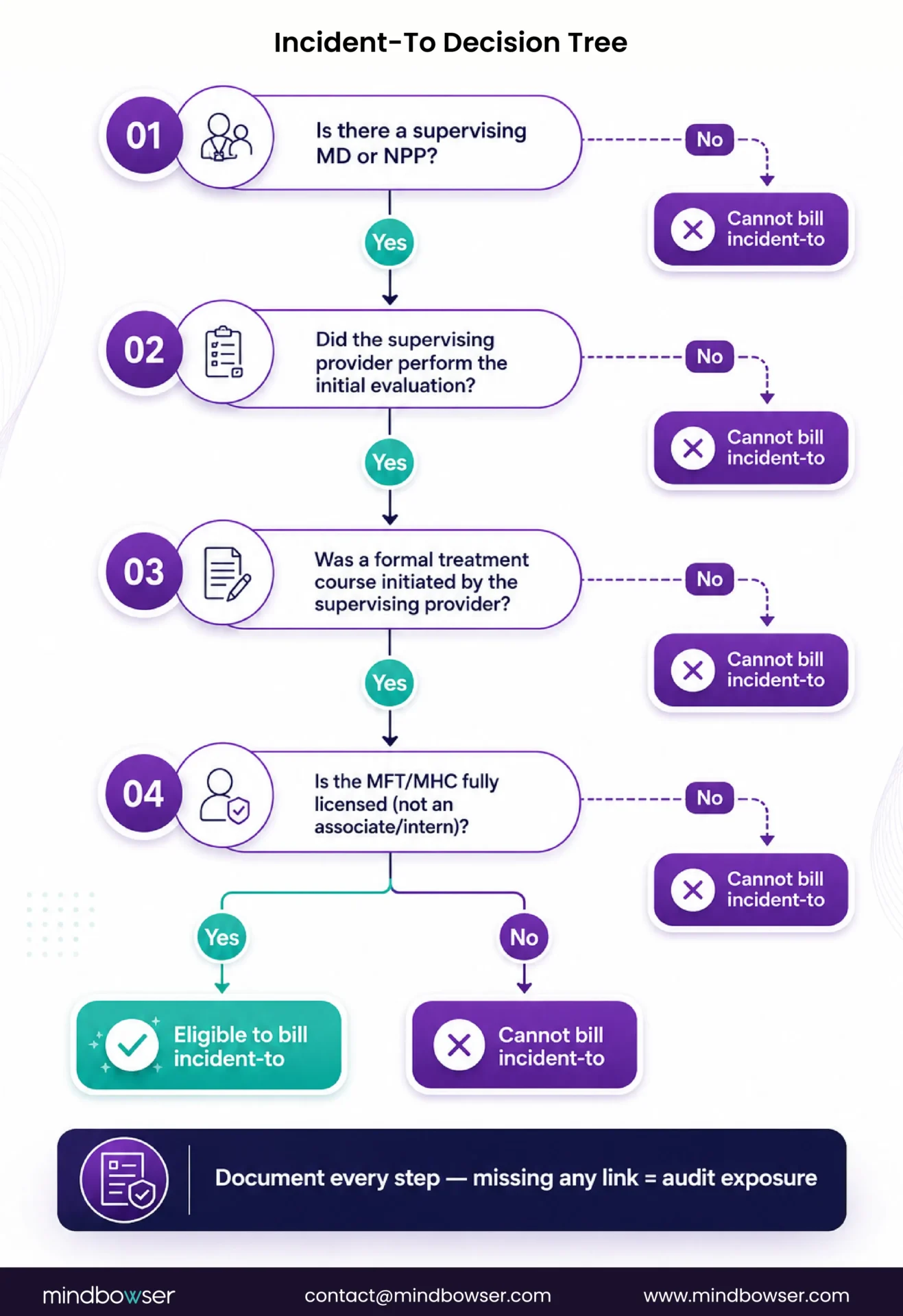
Separately, and this catches new practices off guard specifically, MFT and MHC associates, interns, and students are not eligible to enroll as Medicare providers themselves. Only fully licensed MFTs and MHCs qualify.
What This Actually Means for Your Practice’s Technology
A newly Medicare-eligible provider category means a practice’s billing system has to correctly route MFT/MHC claims at the right rate, distinct from how it handles a clinical psychologist’s identical CPT code, and has to track the incident-to documentation chain, who performed the initial evaluation, when treatment was initiated, correctly rather than assuming a blanket supervision relationship covers it. Practices running a behavioral health billing system that hasn’t been updated for this provider type may not have this rate logic built in, since MFTs and MHCs didn’t exist as a Medicare provider category when many of these systems were first configured. Some vendors have already added it. Check which side of that your system is on rather than assuming either way.
I’ll be honest about a data gap here rather than filling it with a guess: I could not find a reliable, current figure for how many of the roughly 400,000 newly eligible MFTs and MHCs have actually enrolled as Medicare providers since January 2024. CMS provider enrollment data would have that answer, but I’m not going to cite an enrollment number I can’t source directly.
Ready for MFT/MHC Medicare Billing?
How Mindbowser Helps
Billing logic that correctly applies the 75% rate differential and tracks incident-to documentation requirements by provider type is the kind of configuration work a behavioral health billing system needs updated for, particularly if it predates the 2024 change. That’s a real, scoped technical requirement, not a philosophical positioning point, and it’s worth checking directly against your current system rather than assuming it’s already handled correctly.
If your billing system’s rate logic and incident-to documentation tracking haven’t been checked against this provider category specifically, request an assessment and we’ll walk through what your system currently handles.
January 1, 2024, per Section 4121 of the Consolidated Appropriations Act, 2023, which was signed into law December 29, 2022.
75% of the clinical psychologist rate under the Medicare Physician Fee Schedule, specifically 80% of the lesser of the actual charge or 75% of the psychologist-equivalent amount.
No. Only fully licensed MFTs and MHCs are eligible to enroll as Medicare providers. Associates, interns, and students are not eligible.
The supervising physician or non-physician practitioner must personally perform the initial evaluation and formally initiate the course of treatment before MFT/MHC services can be billed incident-to under general supervision.