










 BLOGS
BLOGS  NEWSROOM
  CASE STUDIES
  WEBINARS
  PODCASTS
  ASSET HUB
  EVENT CALENDAR
















TL;DR
Three things that change your platform decision:
- Medplum and Healthie solve fundamentally different clinical data model problems. A startup CTO who evaluates them as interchangeable is planning for the wrong build and will hit the ceiling within 12-18 months.
- Canvas Medical just won the 2026 Best in KLAS, the first major headless EHR industry award. This category is no longer experimental. Enterprise buyers are moving in.
- The “or custom” decision has a specific threshold. Below it, headless wins every time. Above it, custom is the defensible call. The math startups get wrong: treating custom as the fallback instead of the decision.
I. Why Does the EHR Platform Decision Make or Break a Digital Health Startup’s Clinical Roadmap?
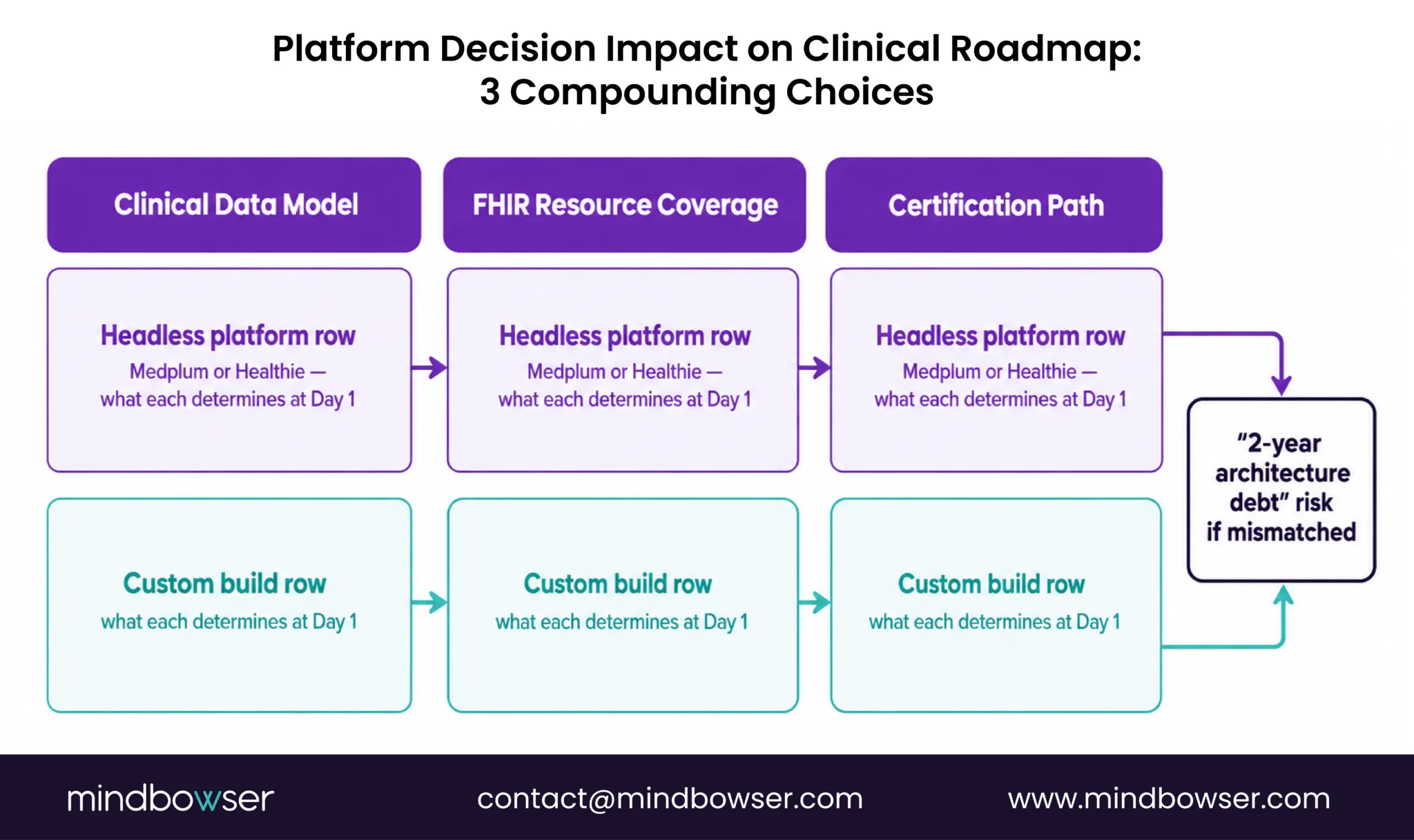
A clinical platform decision made at Series A without enough information about where each platform’s data model breaks isn’t a vendor preference. It’s a 2-year architecture debt.
Startups that rebuild their entire clinical data model at Series B typically chose a platform at seed that didn’t support the FHIR resource types their specialty workflow needed. The rebuild isn’t the worst part. The worst part is that the clinical data already collected doesn’t migrate cleanly into the new model, and that’s the data the AI product roadmap was supposed to train on.
Three decisions compound fastest:
- Clinical data model: what FHIR resource types you can use, and whether the platform’s schema fits your specialty workflow
- FHIR resource coverage: which resources are pre-built vs. which you have to define and maintain
- Certification path: ONC USCDI v3 compliance (mandatory since January 1, 2026 per HTI-1, 89 FR 1192) requires certified health IT to expose FHIR R4 APIs. If your platform isn’t on this path, you’re adding 6-12 months of certification work to your roadmap.
Two versions of the same mistake show up repeatedly. One: “We tried building from scratch, and it’s taking 3x longer than planned.” The other: “Most EMRs add AI on an old system, like remodeling an old house, adding a kitchen, adding a bedroom.” Both are the same problem. The platform choice set a ceiling that the clinical roadmap couldn’t clear.
The Canvas Medical Best in KLAS 2026 win signals something structural: the headless EHR category is now enterprise-validated. You’re not choosing between an established category and an experimental one anymore. You’re choosing between headless platforms and between headless and custom.
II. What Is Medplum Actually Built For, and When Is It the Right Foundation?

Medplum is infrastructure, not a product. That sentence tells most of what you need to know about whether it’s right for your startup.
FHIR R4 native, open-source, TypeScript/Node.js. The clinical data model is schemaless at the FHIR resource level, which means you can model any specialty workflow without fighting the platform’s assumptions. 47+ FHIR resource types out of the box: Patient, Encounter, Observation, DiagnosticReport, MedicationRequest, CarePlan, and the rest of the core clinical resource set.
The production-readiness signal that matters most: the CDC has deployed on Medplum. That’s not a marketing reference. That’s a credibility anchor for enterprise procurement conversations.
For a startup building a women’s health platform in the fertility space, Medplum served as the clinical data layer with a custom specialty workflow UI built on top. Every clinical event fertilization records, lab results, and medication protocols stored in a structured resource that feeds directly into the AI training pipeline. Six months from the first commit to a working clinical product.
Medplum’s ONC certification pathway means a startup building on it has a cleaner route to certification than starting from a blank slate. HITRUST certification is on their 2026 roadmap: if achieved, that adds enterprise-grade trust signals for health system contracts.
Medplum is the right foundation when you’re building complex clinical workflows (labs, orders, clinical decision support), you need FHIR-native storage for AI training datasets, or your specialty workflow requires a data model that no platform pre-constrains.
Build services: Medplum Integration Services.
III. What Is Healthie Actually Built For, and When Is It the Right Foundation?
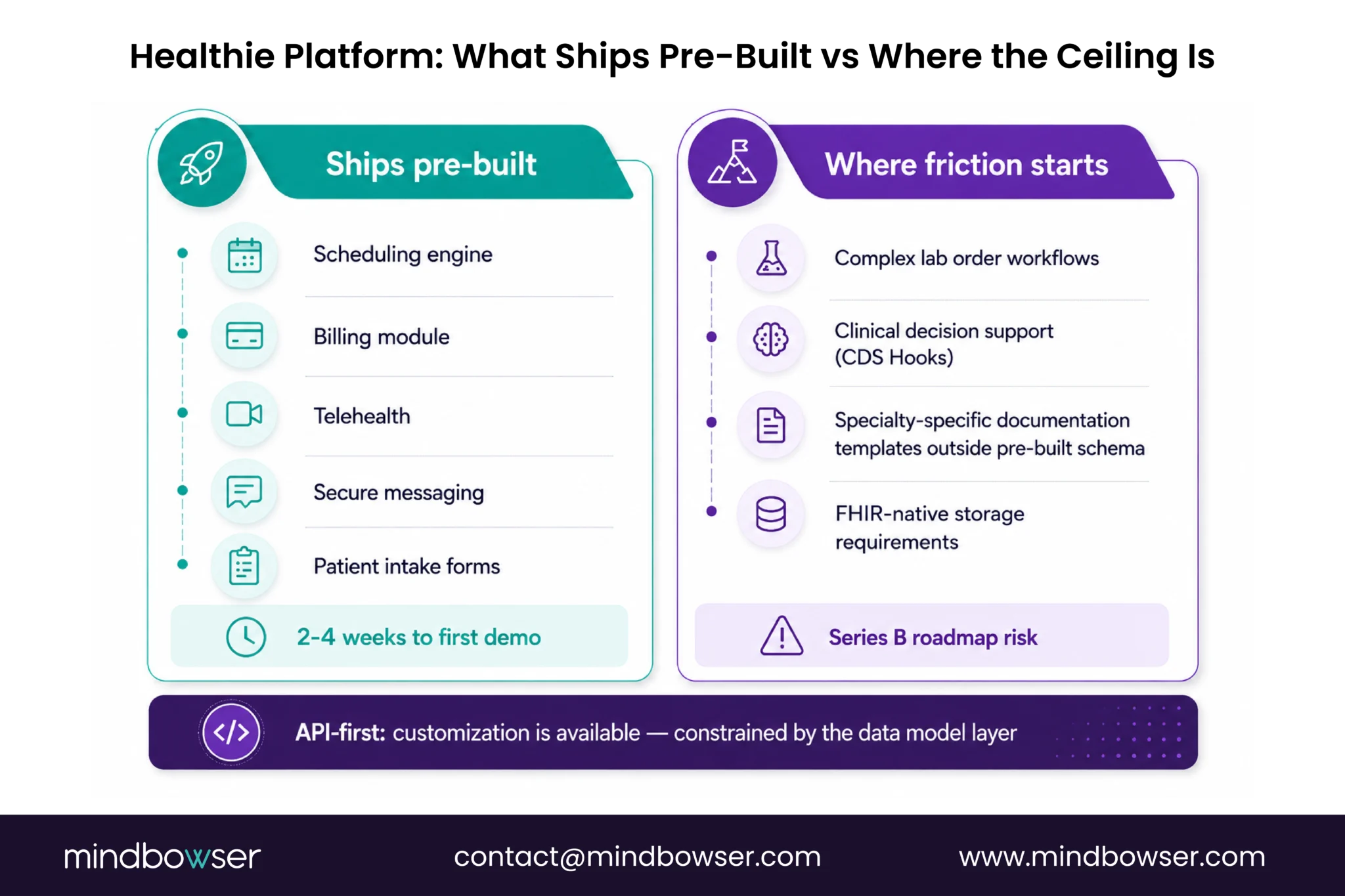
Healthie is a product, not infrastructure. It ships with scheduling, billing, telehealth, secure messaging, and patient intake pre-built. If those are the problems your startup is solving, Healthie is faster than Medplum. If they’re not, you’ll be fighting the platform.
47K+ providers are already on Healthie (2026). A Series A startup can have a working demo in 2-4 weeks. On Medplum, that same demo takes 2-4 months because you’re building the infrastructure layer before you build anything clinical.
The technical distinction that matters: Healthie is API-first, but the clinical data model is more constrained than Medplum. FHIR export is available, but FHIR is not the core storage model at the resource level. That’s fine for direct-to-consumer care delivery: coaching, nutrition, behavioral health, women’s health without complex lab ordering. The pre-built billing, telehealth, and scheduling layers eliminate months of integration work.
Where the ceiling shows up: complex clinical decision support, lab order workflows, specialty-specific documentation templates that don’t map to the pre-built schema. At Series A that’s workable. At Series B, when the workflow needs to do something the platform didn’t anticipate, the cost is a migration or a parallel system.
The question that determines the answer: if your first question is “can I model a custom clinical workflow?” Medplum. If your first question is “Can I get scheduling plus billing live in 4 weeks?” Healthie.
API-level depth: Healthie API and Custom EHR Workflows.
IV. How Do Medplum and Healthie Compare on the Decisions That Actually Matter?
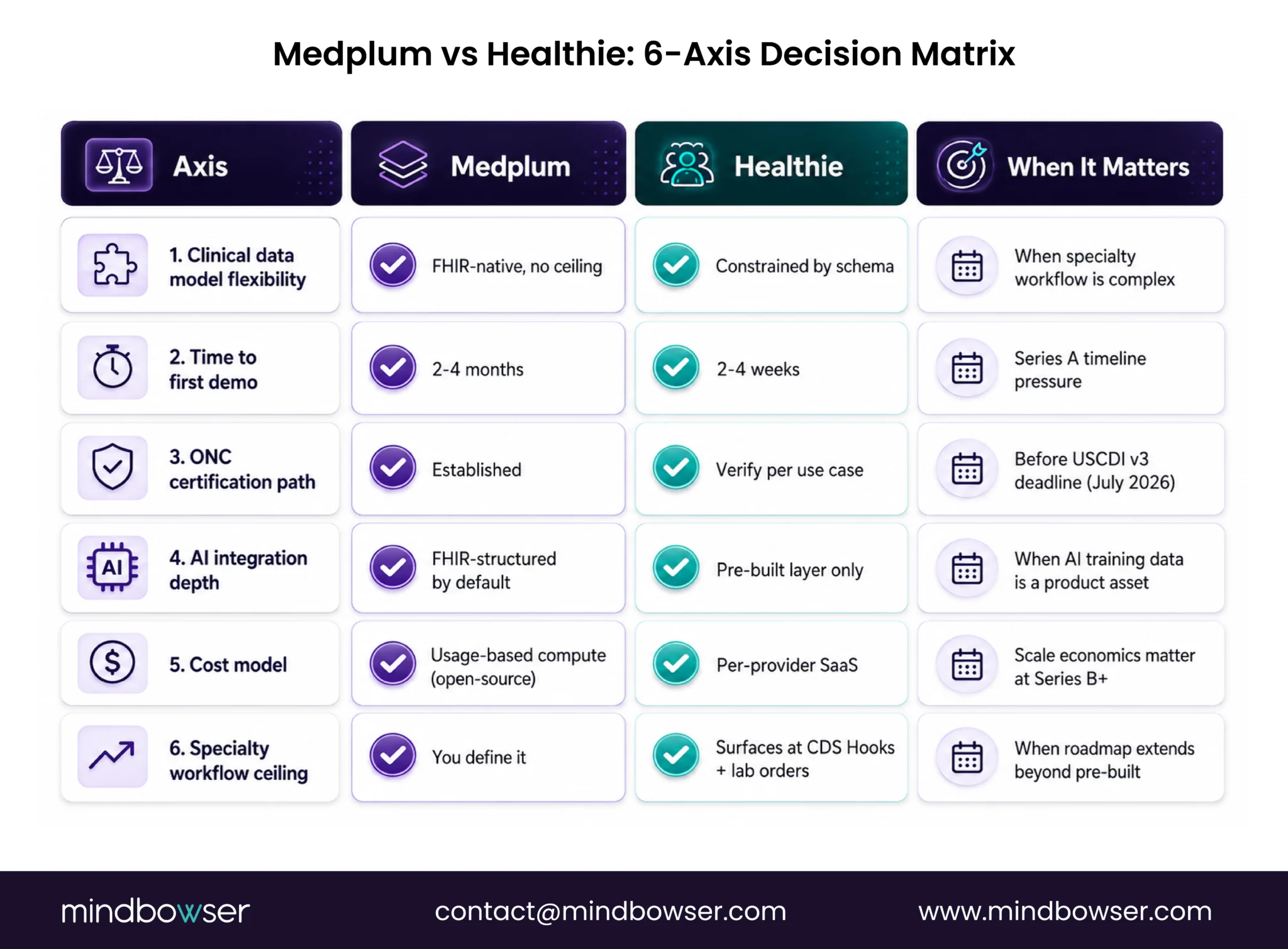
The comparison that matters isn’t features. It’s which architectural assumptions align with your clinical workflow. The wrong answer here costs 12-18 months and a Series B pivot.
Six axis the ones startup CTOs actually get wrong.
Axis 1: Clinical data model flexibility.
Medplum: FHIR-native, schemaless at the resource level. You define the ceiling.
Healthie: more constrained. The pre-built schema shapes what your workflow can do.
Axis 2: Time to first working demo.
Medplum: 2-4 months minimum.
Healthie: 2-4 weeks. SaaS layer ships ready to demo.
Axis 3: ONC certification path.
Medplum: existing ONC certification pathway. Cleaner route.
Healthie: verify per use case. Less defined.
Axis 4: AI integration depth.
Medplum: FHIR-native storage means training datasets are FHIR-structured by default. Cleaner for RAG pipelines and predictive models.
Healthie: AI agents work on pre-structured data (scheduling, billing, messaging). Strong for workflow automation, limited for clinical reasoning.
Note: all major headless platforms are shipping agentic AI in 2026. The differentiator is customizing those agents for your specific clinical workflow.
Axis 5: Cost model.
Medplum: open-source, usage-based compute. Cheaper at scale.
Healthie: per-provider SaaS subscription. Predictable.
Axis 6: Specialty workflow ceiling.
Medplum: You define it.
Healthie: surfaces at complex lab orders, CDS Hooks, specialty-specific documentation.
Related read: Headless EHR Comparison
Not sure which fits your clinical model?
V. When Does Neither Platform Work, and Custom Build Is the Right Call?
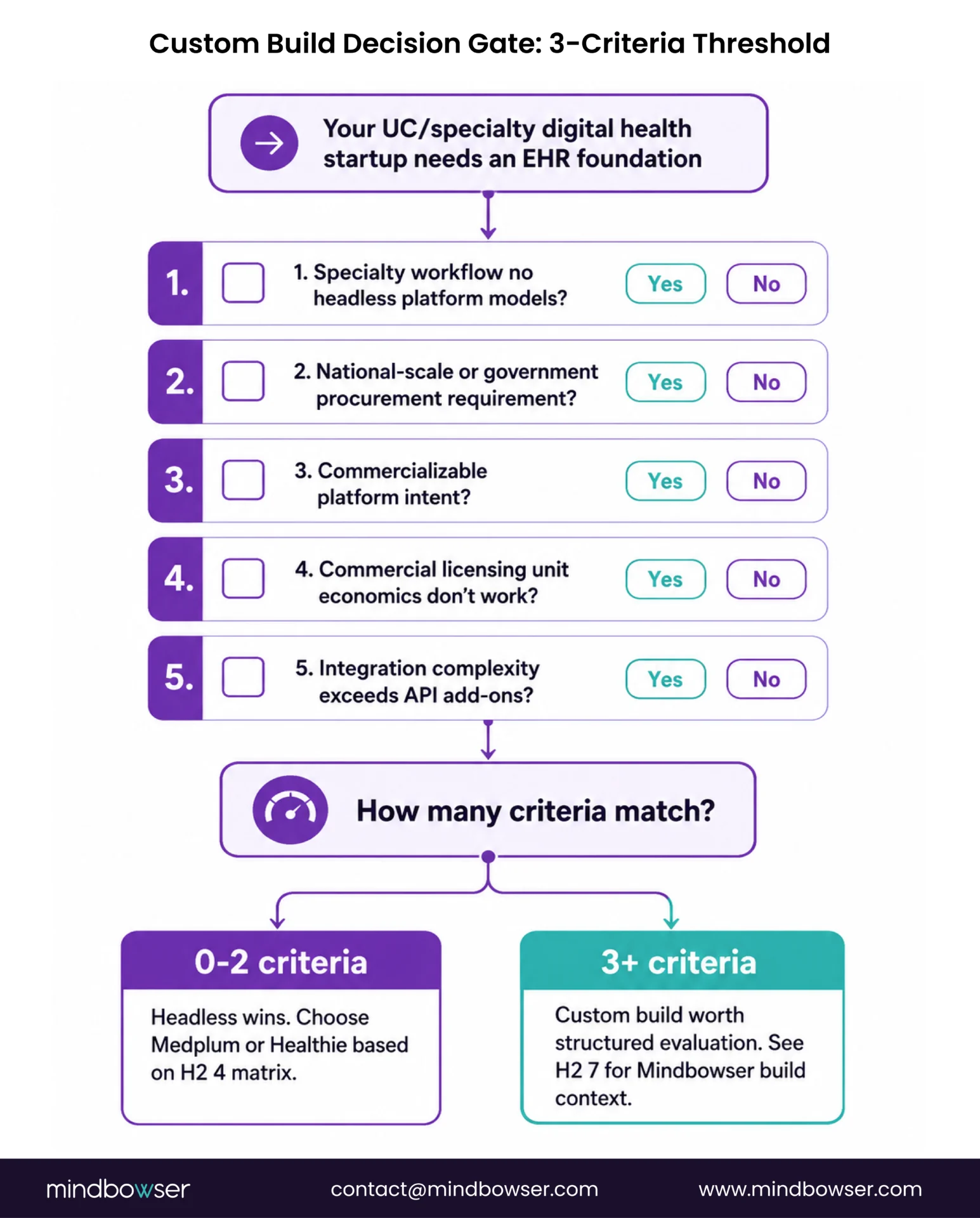
Custom isn’t the premium option or the fallback. It’s the decision that’s defensible when your clinical workflow crosses a specific threshold. Below that threshold, headless wins every time.
The threshold: meet any 3 of these 5 criteria, and a custom build is worth a structured evaluation.
Criterion 1: Specialty workflow that no headless platform models.
Fertility cycle tracking. Surgical oncology care coordination. Rare disease registry with custom phenotyping. National-scale population health with proprietary risk scoring. If the workflow is the product and no platform ships it pre-built, you’re adding workarounds that compound.
Criterion 2: National-scale or government procurement requirement.
A real build: a national EHR for a government-led healthcare program. Country-scale custom build. Government ministries often require data sovereignty and local hosting that off-the-shelf platforms don’t support in their procurement framework.
Criterion 3: Commercializable platform intent.
If you’re building to sell clinical software to other practices, the platform that serves you as customer #1 becomes a constraint for customers #2-100. If you’re building to sell, you’re building custom.
Criterion 4: Workflow economics that don’t work with commercial licensing.
One startup CTO put it plainly: “Epic charges $27 for each note using AI. For a 25-bed hospital, that’s ridiculous.” When commercial licensing doesn’t survive the unit economics of your workflow, a custom build is the math that works.
Criterion 5: Integration complexity that exceeds API add-ons.
Lab, imaging, pharmacy, employer portal, and payers all need real-time bidirectional data. Some integration patterns require a clinical data layer that you own end-to-end.
Build-vs-buy framework: Choosing Between Ready-Made and Custom EHR Solutions.
Cost structures: EHR Software Cost Guide.
VI. What Does AI-Native Architecture Look Like on a Headless EHR Platform?
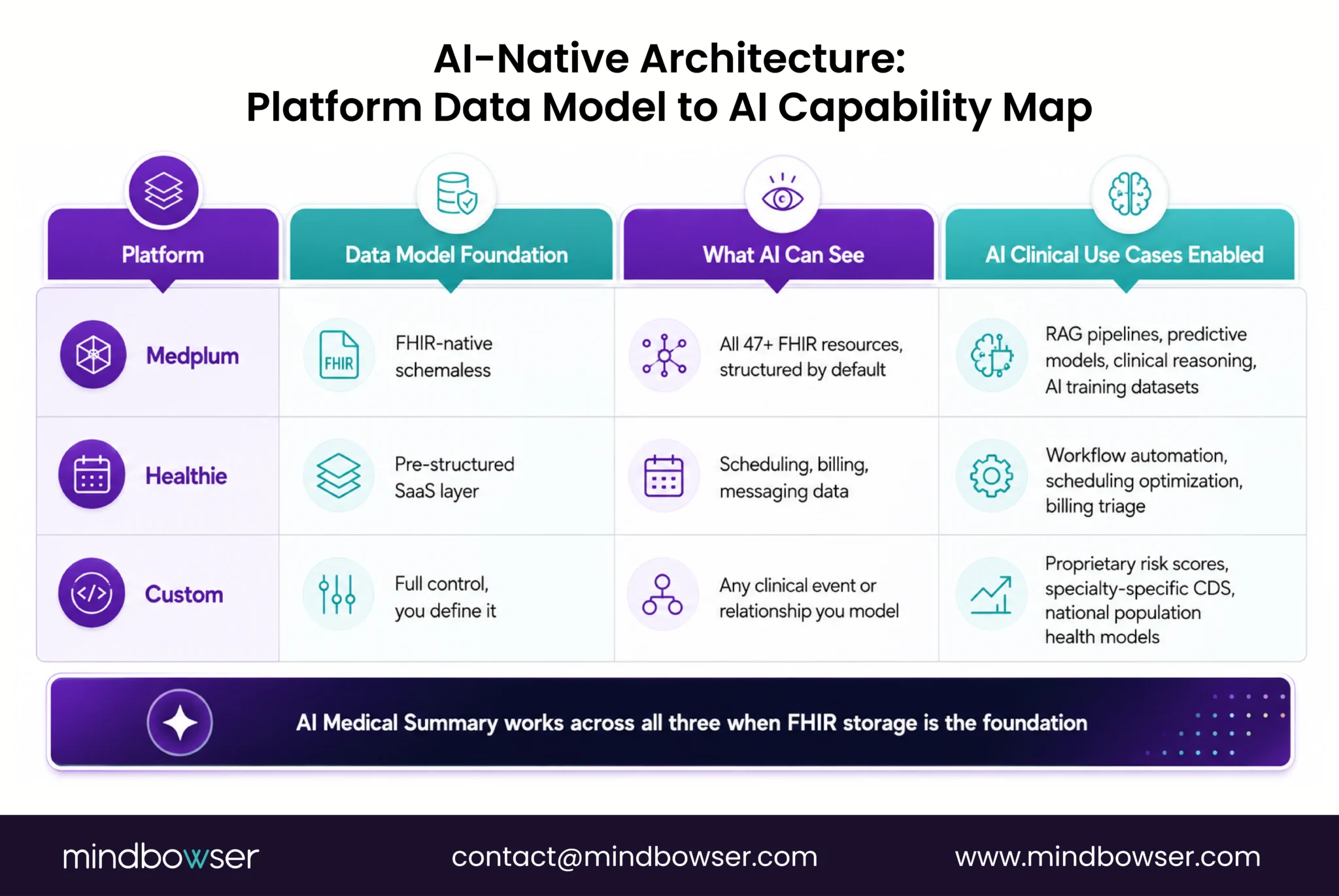
Every headless EHR platform is shipping agentic AI in 2026. The platform determines what your AI can see. The customization determines whether it’s clinically useful.
- Medplum: FHIR-native storage means AI training datasets are FHIR-structured by default. RAG pipelines work with clinical resources that already have the right schema. No ETL step. The AI can reason on Observations, DiagnosticReports, CarePlans, and MedicationRequests as first-class objects.
- Healthie: AI agents work on the pre-structured layer: scheduling optimization, billing automation, patient messaging, and triage. Valuable for workflow efficiency. For clinical reasoning beyond the pre-built layer, the data model limits what the AI can see.
- Custom builds: full control over the data model. If your clinical product is a proprietary risk score, that score’s inputs need to be modeled in the clinical data layer. Custom gives you that.
One accelerator that works across all three foundations: AI Medical Summary reduces documentation time by 50% and improves chart accuracy by 45% in production deployments. Ambient AI captures the encounter, auto-populates structured FHIR fields, flags documentation gaps, and routes the chart to billing review. Works on top of any FHIR-based platform.
Regulatory check: ONC USCDI v3 requires AI-assisted documentation to write to USCDI v3 data classes to be interoperable (HTI-1, 89 FR 1192). Platform choice affects whether your AI output meets compliance requirements from day one.
VII. How Does Mindbowser Build Clinical Platforms on Medplum and Healthie for Digital Health Startups?
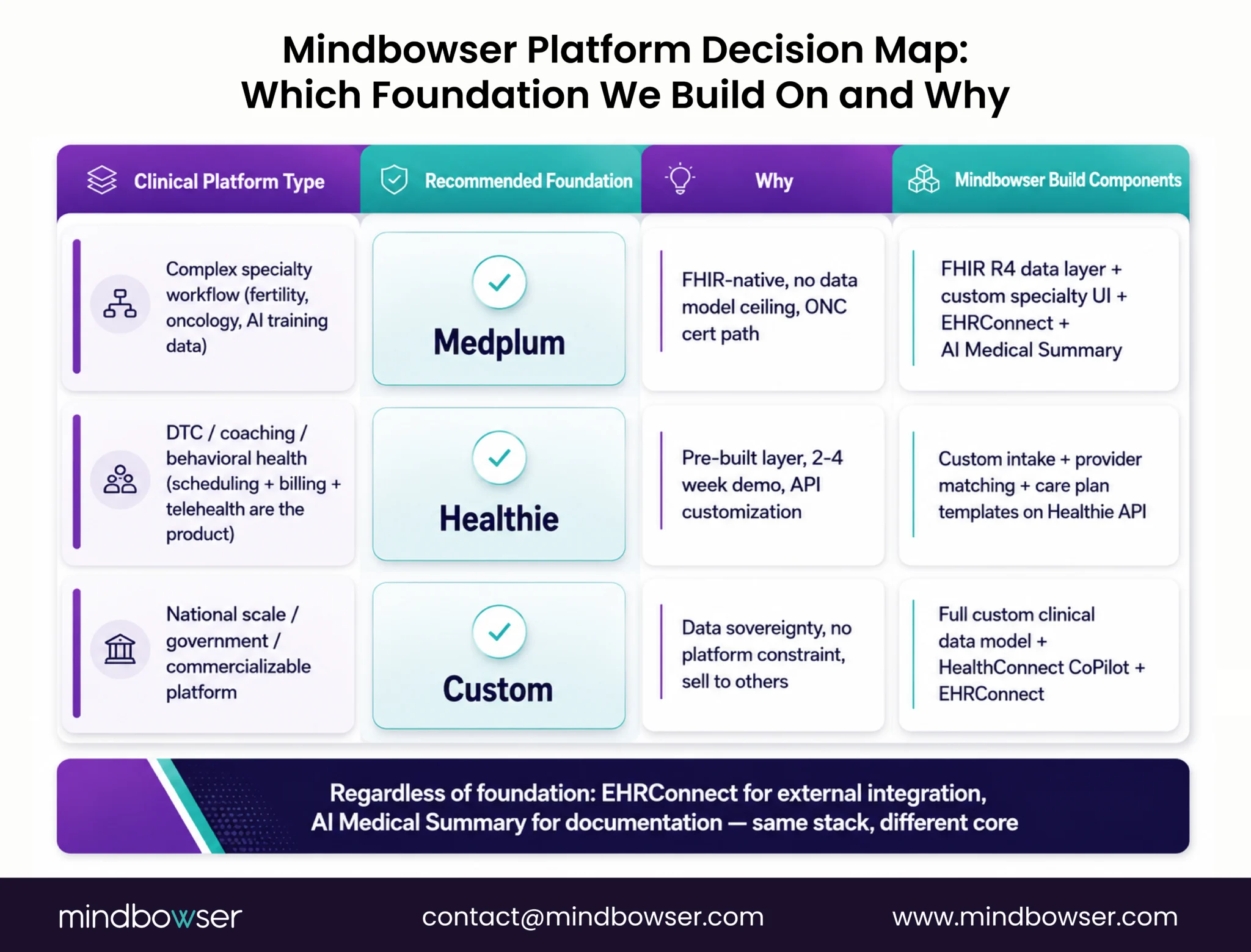
What we build on changes based on what the clinical workflow requires. Not a default stack.
Medplum builds: For a fertility and surrogacy platform, we built the clinical data layer on Medplum’s FHIR R4 foundation, added custom specialty workflow UI on top, and wired the EHR integration layer for lab and imaging connectivity. Six months from first commit to a working clinical product. FHIR-native data model means the AI roadmap has clean, structured training data from day one.
Healthie builds: For behavioral health and coaching platforms, Healthie’s pre-built scheduling, billing, telehealth, and patient messaging layer eliminates 2-4 months of foundational development. We customize on top of the API layer for specialty-specific intake workflows, provider matching logic, and care plan templates. First demo in 2-4 weeks.
Custom builds: For a government-led national EHR program, the clinical data model had to be built to national health ministry specifications: data sovereignty, local hosting, multi-facility record management. Country-scale custom build.
ConnectHealth is the integration layer that consistently appears regardless of which foundation we use: it handles EMR-to-payer/lab/employer integration via HL7/FHIR translation, compressing 6 months of work into 6 days. The external integration problem is the same whether the core is Medplum, Healthie, or custom. ConnectHealth connects custom clinical builds to external EHRs and payer systems the same way.
Startups on our pre-built stack skip 6-9 months of from-scratch integration and reach live workflows in 90-120 days.
Evaluating a development partner: How to Evaluate an EHR Development Partner.
VIII. What’s the Honest Verdict on Platform Selection for Your Digital Health Startup?
Platform choice is the clinical data model choice. Make it based on where your workflow needs to go in 24 months, not what ships fastest in 4 weeks.
Three paths:
Path 1: Complex specialty workflow, FHIR-native data requirements, AI training data is a product asset.
Medplum. Budget for 2-4 months of infrastructure build before your first working demo. The ONC certification path is cleaner. The AI pipeline runs on FHIR-structured data from day one. The ceiling is yours to define.
Path 2: Direct-to-consumer care, coaching, behavioral health, nutrition. Scheduling, billing, and telehealth are the core products.
Healthie. First demo in 2-4 weeks. The pre-built layer does most of the work. Watch where the data model ceiling is before you scale: specifically, whether your Series B roadmap requires FHIR-native storage or complex lab ordering that the platform doesn’t support natively.
Path 3: National scale, government procurement, commercializable platform intent, or a specialty workflow no platform models.
Custom build evaluation. Use the 5-criteria threshold: meet any 3, and the build-vs-buy math changes. Custom isn’t the expensive fallback. It’s the defensible call when the platform’s constraints become more expensive than the build.
Startups choosing Healthie for speed can hit the data model ceiling at Series B. Startups choosing Medplum who underestimate the infrastructure build time can run out of runway before the first demo. The platform matches the workflow. Not the other way around.
Choose the EHR Foundation That Supports Your Next Stage
Medplum, Healthie, and custom EHR development are built for different startup needs. Medplum offers greater control over complex clinical workflows and FHIR-native data, while Healthie helps teams launch scheduling, billing, telehealth, and patient engagement workflows faster. A custom build becomes the stronger choice when specialty workflows, integration complexity, scale, or platform economics exceed what a headless EHR can support.
The right decision should reflect where your product needs to be in the next 24 months, not only how quickly you can launch today. Mindbowser helps digital health startups evaluate the tradeoffs, select the right foundation, and build a scalable clinical platform around their workflow, compliance, interoperability, and AI roadmap.