BLOGS
BLOGS  NEWSROOM
  CASE STUDIES
  WEBINARS
  PODCASTS
  ASSET HUB
  EVENT CALENDAR
























TL;DR
Generic EHR systems often fall short for specialized practices. This guide covers how to build a medical specialty EHR from development and testing to deployment and maintenance. It also explores key challenges (integration, compliance, user adoption) and future trends like AI, telehealth, and personalized medicine.
Medical specialty EHR software development is reshaping how healthcare providers manage patient information and workflows. Unlike one-size-fits-all EHR systems, specialty-specific solutions are built around the daily routines and clinical demands of disciplines like cardiology, orthopedics, dermatology, and mental health. These systems offer targeted tools, from diagnostic templates to specialty-relevant charting, that align with how each practice delivers care.
What sets medical specialty EHR software apart is its precision. Developers work closely with clinicians to design interfaces, automate documentation, and integrate diagnostic data in ways that make sense for the specialty.
The result is faster decision-making, fewer administrative headaches, and better clinical outcomes, all while staying compliant with standards like HIPAA, HL7, and FHIR. As 2025 unfolds, customized EHRs are no longer a luxury, they’re becoming the norm for practices aiming to deliver focused, efficient, and high-quality care.
I. Why Choose Specialty-Specific EHR Software?
Medical specialty EHR software development isn’t just about building another digital tool, it’s about creating something that works the way your team already does. Whether you’re in dermatology, cardiology, or orthopedics, your day-to-day workflow, patient data, and treatment plans are unique. A specialty-specific EHR is designed to reflect those differences, helping you run smoother and deliver better care.
Let’s break down why this matters.
A. Customized Workflows
Generic EHRs often force teams to jump through hoops just to complete basic tasks. That’s not efficient. Specialty-specific EHR software is built around how your specialty operates: your forms, checklists, data points, and patient interactions.
Say you’re running a dermatology practice. You’re not logging vitals the same way a cardiologist does. Instead, you need high-res image capture, lesion tracking, and visual documentation tools. Specialty EHRs give you exactly that, cutting down on workarounds and making the whole experience smoother.
B. Improved Patient Care
With the right specialty EHR in place, you’re not just managing records; you’re actively supporting clinical decisions. Built-in templates, treatment plans, and diagnostic tools are made specifically for your field.
A quick example, think of ophthalmologists using EHRs that come with built-in visual field charts and IOP tracking. It’s all right there on the dashboard. No switching tabs, no manual entry. That kind of setup helps cut down on mistakes and keeps care consistent. Your team moves faster, and your patients get the right treatment without delays.
C. Regulatory Compliance
Compliance is a big deal. Medical specialty EHR software development includes guardrails for HIPAA, HL7, and FHIR from day one. You don’t have to think twice about whether your system is secure or compliant; it just is.
Features like access controls, encrypted communication, and detailed audit logs are baked into the system. So whether it’s a privacy check or a government audit, you’re covered.
D. Enhanced Data Management
Each specialty deals with its kind of data. In oncology, you’re tracking tumor staging and chemo cycles. In orthopedics, it might be imaging comparisons over time. A specialty EHR understands this and structures the interface to support it.
You get fast retrieval, smart filters, and meaningful data layouts that save time and reduce errors. You’re not just storing data; you’re using it.
Specialty-specific EHRs aren’t a nice-to-have, they’re a must-have for modern practices. If you’re serious about improving efficiency, accuracy, and patient experience, investing in medical specialty EHR software development is the right move.
Related Read: Benefits and Challenges of the Electronic Health Record
II. Key Features of Specialty EHR Systems
Medical specialty EHR software development isn’t about creating a one-size-fits-all system. It’s about building tools that work the way healthcare providers do, based on their specialty, their workflows, and their patients. Here’s a closer look at the must-have features that make specialty EHRs practical and powerful for clinical teams.
A. Specialty-Specific Templates
Every specialty speaks its language, and documentation should reflect that. Specialty-specific templates are pre-built forms designed to capture the exact data each specialty needs. For example, a cardiologist doesn’t need dermatology notes, and vice versa.
These templates speed up charting, reduce documentation errors, and keep records organized in a way that makes sense for the clinical team. No more wasted clicks or irrelevant fields, just smart, intuitive layouts that match how doctors work.
B. Integration Capabilities
No system operates in isolation. A specialty EHR should connect effortlessly with labs, imaging tools, billing software, and any other platform in your care ecosystem.
With solid integration capabilities, test results show up where they’re needed, orders get sent automatically, and information flows between systems without constant manual effort. That means fewer delays, smoother workflows, and a clearer picture of each patient’s health without switching screens or digging for data.
C. Customizable Dashboards
Data matters; but only if it’s easy to access. Customizable dashboards give providers a clear, real-time view of what’s important to them.
Whether it’s upcoming appointments, flagged results, patient trends, or billing insights, the dashboard can be shaped around each user’s role and preferences. This saves time, improves focus, and supports quick decision-making when every second counts.
D. Advanced Security Measures
Patient data needs protection at every step. A well-built specialty EHR comes with advanced security baked in, from encryption and access control to audit trails and user permissions.
It’s not just about meeting regulations; it’s about earning trust. Security measures ensure that sensitive information stays private, only accessible to those who should see it. Whether you’re handling behavioral health records or oncology treatment plans, peace of mind should come standard.
Related Read: Choosing Between Ready-Made and Custom EHR Solutions
III. How to Build a Custom Specialty EHR: A Step-by-Step Guide
Developing a custom specialty EHR software system involves a structured process to ensure it meets the unique needs of your medical practice. This guide outlines the essential steps in medical specialty EHR software development, providing clarity on each phase.
A. Step 1: Needs Assessment
Identify the specific requirements of the specialty practice.
Begin by thoroughly understanding the workflows, documentation needs, and regulatory requirements specific to your medical specialty. Engage with clinicians and administrative staff to gather insights into daily operations and challenges. This collaborative approach ensures the EHR system addresses real-world needs effectively.
B. Step 2: Design and Prototyping
Develop user interfaces and workflows that align with clinical processes.
Translate the gathered requirements into a functional design. Create prototypes that reflect the intended user experience, focusing on intuitive navigation and efficient workflows. Incorporate feedback from stakeholders to refine the design, ensuring it supports clinical tasks seamlessly.
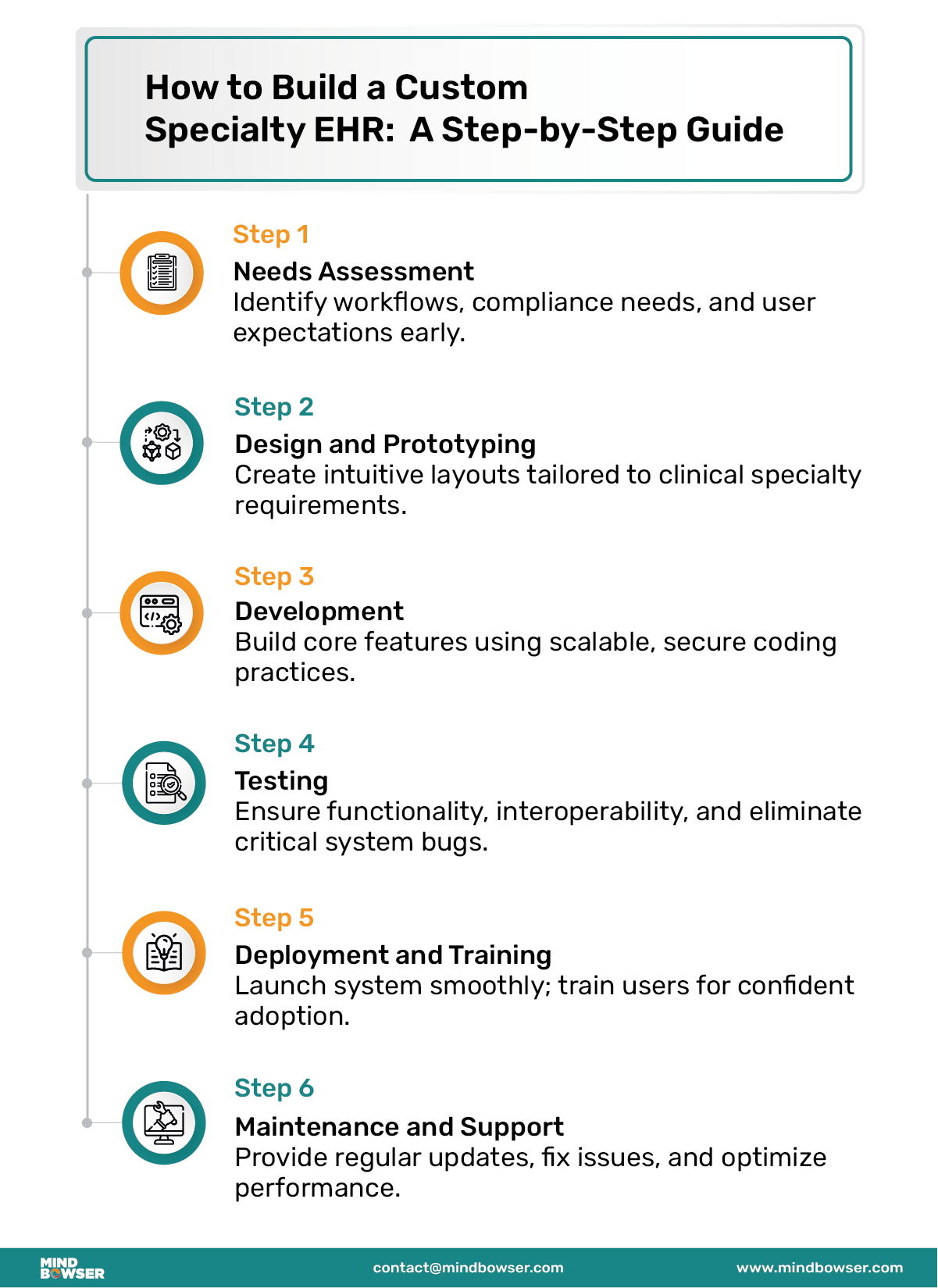
C. Step 3: Development
Build the system using appropriate technologies and frameworks.
With a validated design, proceed to develop the EHR system. Choose technologies that support scalability, security, and interoperability. Implement features such as patient records management, appointment scheduling, and specialty-specific modules. Ensure the system complies with healthcare standards like HL7 and FHIR.
D. Step 4: Testing
Conduct rigorous testing to ensure functionality, security, and compliance.
Perform comprehensive testing to validate the system’s performance. This includes unit testing, integration testing, and user acceptance testing. Verify that the EHR system operates reliably, maintains data integrity, and adheres to regulatory standards. Address any identified issues promptly to ensure a robust solution.
E. Step 5: Deployment and Training
Implement the system and train staff for effective use.
Deploy the EHR system in a controlled environment, monitoring its performance closely. Provide comprehensive training sessions for all users, focusing on system navigation, data entry, and workflow integration. Offer ongoing support to address questions and facilitate a smooth transition.
F. Step 6: Maintenance and Support
Provide ongoing support and updates to adapt to changing needs.
Post-deployment, establish a maintenance plan to address software updates, security patches, and system enhancements. Maintain open communication channels for user feedback and support requests. Regularly assess the system’s performance and make necessary adjustments to meet evolving clinical and regulatory requirements.
Related Read: The Challenges and Benefits of EHR Integration for Health Tech Companies
IV. Navigating the Challenges in Medical Specialty EHR Software Development
Developing EHR systems tailored for specific medical specialties isn’t just about coding features, it’s about understanding the unique workflows, data needs, and compliance requirements of each specialty. Let’s delve into the primary challenges faced in this domain.
A. Understanding the Unique Requirements of Each Specialty
Every medical specialty has its own set of workflows, terminologies, and data requirements. For instance, the documentation needs of a mental health provider differ significantly from those of an oncology practice, or an obstetrics platform focused on birth prediction and delivery outcome tracking, which needs highly specific data models for prenatal risk scoring and labor progression. Capturing these nuances accurately is crucial to ensuring the EHR system supports clinicians effectively.
B. Integrating with Existing Systems
Healthcare providers often use a mix of legacy systems and modern applications. Ensuring that a new specialty EHR integrates seamlessly with existing systems like lab information systems, imaging software, and billing platforms is a significant challenge. This integration is vital for maintaining data consistency and avoiding workflow disruptions.
C. Ensuring User Adoption
Introducing a new EHR system requires clinicians and staff to adapt to new workflows and interfaces. Resistance to change, lack of training, and perceived increases in workload can hinder adoption. It’s essential to involve end-users early in the development process, provide comprehensive training, and gather feedback to refine the system for better usability.
D. Staying Compliant with Evolving Regulations
Healthcare regulations like HIPAA, HL7, and FHIR are continually evolving to address new challenges and technologies. Ensuring that the specialty EHR remains compliant requires ongoing monitoring of regulatory changes and updating the system accordingly. Non-compliance can lead to legal repercussions and compromise patient data security.
Addressing these challenges requires a collaborative approach, involving clinicians, IT professionals, and regulatory experts. By focusing on the specific needs of each specialty and maintaining flexibility to adapt to changes, developers can create EHR systems that truly support healthcare providers in delivering optimal patient care.
Ready to build an EHR that truly fits your practice?
Medical specialty EHR software development is rapidly evolving to meet the unique needs of various healthcare domains. Emerging technologies such as artificial intelligence, telehealth integration, mobile accessibility, and personalized medicine are reshaping the way healthcare providers interact with electronic health records (EHRs). These advancements aim to enhance patient care, streamline workflows, and support individualized treatment plans.
A. Artificial Intelligence: Enhancing Decision Support and Predictive Analytics
Artificial intelligence (AI) is becoming a cornerstone in medical specialty EHR software development. By incorporating AI, EHR systems can analyze vast amounts of patient data to provide predictive analytics and decision support. This enables healthcare providers to identify potential health risks, recommend preventive measures, and tailor treatment plans more effectively.
B. Telehealth Integration: Supporting Virtual Consultations and Remote Monitoring
The integration of telehealth capabilities into EHR systems is transforming patient care delivery. Medical specialty EHR software now supports virtual consultations, allowing providers to connect with patients remotely. Additionally, remote patient monitoring features enable continuous tracking of patient health metrics, facilitating timely interventions and reducing the need for in-person visits.
Related Read: Challenges of Telemedicine and Their Potential Breakthroughs
C. Mobile Accessibility: Enabling On-the-Go Access to Patient Data
Mobile accessibility in EHR systems empowers healthcare providers to access patient information anytime, anywhere. Mobile applications designed for medical specialties allow clinicians to review records, update treatment plans, and communicate with patients on the go. This flexibility enhances responsiveness and supports more efficient care delivery.
D. Personalized Medicine: Tailoring Treatment Plans Using Genetic Information
Personalized medicine is gaining traction in medical specialty EHR software development. By integrating genetic information into EHRs, healthcare providers can develop individualized treatment plans that consider a patient’s unique genetic makeup. This approach improves treatment efficacy and reduces the likelihood of adverse reactions, leading to better patient outcomes.
VI. How Mindbowser Can Help You With Medical Specialty EHR Software Development
Building an EHR system that truly fits your specialty practice takes more than just code, it requires deep healthcare understanding, compliance expertise, and the ability to customize workflows down to the last clinical detail. That’s where Mindbowser comes in.
At Mindbowser, we specialize in medical specialty EHR software development that’s tailored to your domain; be it cardiology, dermatology, orthopedics, or any other specialty. Our team doesn’t just deliver software, we work closely with providers to create intuitive, regulation-compliant platforms that support better outcomes and smooth day-to-day operations.
Here’s what you get when you work with us:
A. Specialty-Centric Customization
We build from the ground up with your workflows, documentation needs, and treatment protocols in mind; no generic templates or one-size-fits-all solutions.
B. AI-Ready Architecture
Want decision support or predictive analytics integrated into your EHR? Our team can incorporate AI models that help you catch red flags early and optimize treatment plans.
C. Integrated Telehealth & Remote Monitoring
We enable secure video consultations and real-time health data tracking from wearables, connecting your EHR directly with patients, no matter where they are.
D. Mobile & Cross-Device Support
Need on-the-go access? We develop mobile-friendly EHR modules so you can view, update, and manage patient information anywhere.
E. HL7, FHIR, and HIPAA Compliance
Our platforms are built to comply with healthcare standards from day one, ensuring your software is future-proof and ready to integrate with major EHR systems.
F. Smart Development Roadmaps
From MVP to full-scale rollout, we guide you through each stage of development, ensuring faster time-to-market without compromising quality.
We’ve helped healthcare startups, clinics, and enterprise health systems bring specialty EHR ideas to life, focusing on what matters most: better workflows, fewer clicks, and happier patients.
Conclusion
Investing in medical specialty EHR software development is essential for practices aiming to improve efficiency, patient care, and compliance. By focusing on the unique needs of each specialty, these systems offer tailored solutions that generic EHRs cannot provide.
As healthcare continues to evolve, specialty-specific EHR systems will play a pivotal role in delivering high-quality, patient-centered care. Embracing these technologies ensures that healthcare providers are well-equipped to meet the demands of modern medical practice.
Specialty EMR is an electronic medical record system built for a specific medical field, like cardiology, dermatology, or orthopedics. It includes templates, workflows, and features that match the day-to-day clinical tasks of that specialty.
The best EHR software depends on your practice needs. Top-rated ones include Epic, Cerner, and Athenahealth for general use, while systems like Modernizing Medicine or DrChrono offer strong specialty-focused features.
In software development, EMR (Electronic Medical Record) refers to building systems that store, manage, and track patient health data digitally. Developers focus on compliance, data security, and clinical workflows.
Specialty software is built for a niche industry or task. In healthcare, it refers to tools designed for specific specialties like oncology or pediatrics, offering targeted features that generic systems don’t provide.
Yes, EMRs come in different types, general EMRs, specialty-specific EMRs, cloud-based systems, and on-premise solutions. Each serves different needs based on practice size, specialty, and workflow.