












 BLOGS
BLOGS  NEWSROOM
  CASE STUDIES
  WEBINARS
  PODCASTS
  ASSET HUB
  EVENT CALENDAR






















TL;DR
- Traditional FFS primary care and Direct Primary Care have fundamentally different billing, patient communication, and workflow requirements. Most EHR listicles don’t separate them.
- For FFS: athenaOne leads on managed billing. eClinicalWorks leads on AI documentation and cost. Elation Health is the only option designed ground-up for primary care rather than assembled from ambulatory modules.
- For DPC: Hint Health handles membership billing natively. Elation Health covers the clinical side. No single vendor does both perfectly. That gap is where DPC practices lose time.
- Three practice profiles where custom-built outperforms both lists: ACO/population health platforms, multi-location DPC franchise chains, and physician-founders building commercializable primary care products.
Primary care EHR software has a category problem that vendors don’t advertise: a traditional fee-for-service practice and a Direct Primary Care practice need almost completely different software.
I’ve watched primary care practices pick the wrong EHR for the wrong reasons for 15 years. The most common mistake isn’t choosing a bad vendor. It’s choosing the right vendor for the wrong practice model.
I. Why Most EHR Guides Get Primary Care Wrong
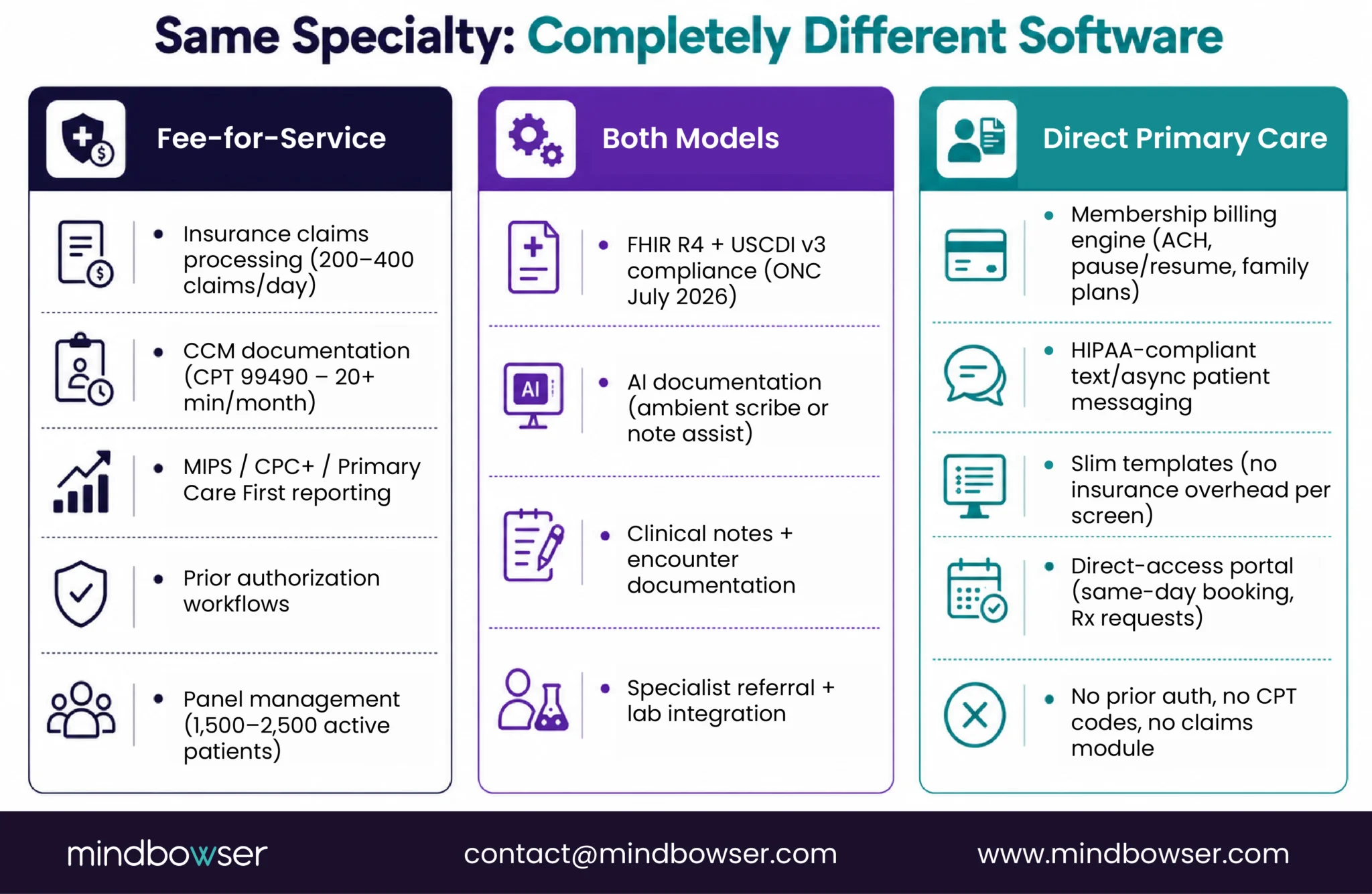
Vendors market “primary care EHR” as a single product category. The workflows, billing models, and patient communication requirements for a 10-physician FFS group practice and a 3-physician DPC practice are so different that recommending the same software to both is like recommending the same accounting software to a hospital and a subscription box company.
The split is cleanest at billing.
Direct Primary Care practices operate on direct membership contracts between physician and patient. Typically $75-150 per month per patient. No insurance billing. No prior authorization. No CPT codes. No MIPS reporting. The entire claims workflow that dominates traditional EHR design is irrelevant to DPC.
Fee-for-service primary care practices are the opposite. They bill 200-400 claims per day. They need CCM documentation for CPT 99490. They run panels of 1,500-2,500 active patients and need population-level reporting for MIPS/VBC contracts. Prior auth is a daily operational burden.
The overlap in clinical documentation is moderate. The overlap in billing is nearly zero. Recommending the same EHR to both is a vendor convenience, not a clinical one.
There are an estimated 2,000+ DPC practices in the US as of 2024 (DPC Alliance), growing at roughly 10% annually. Most EHR guides still treat them as a footnote.
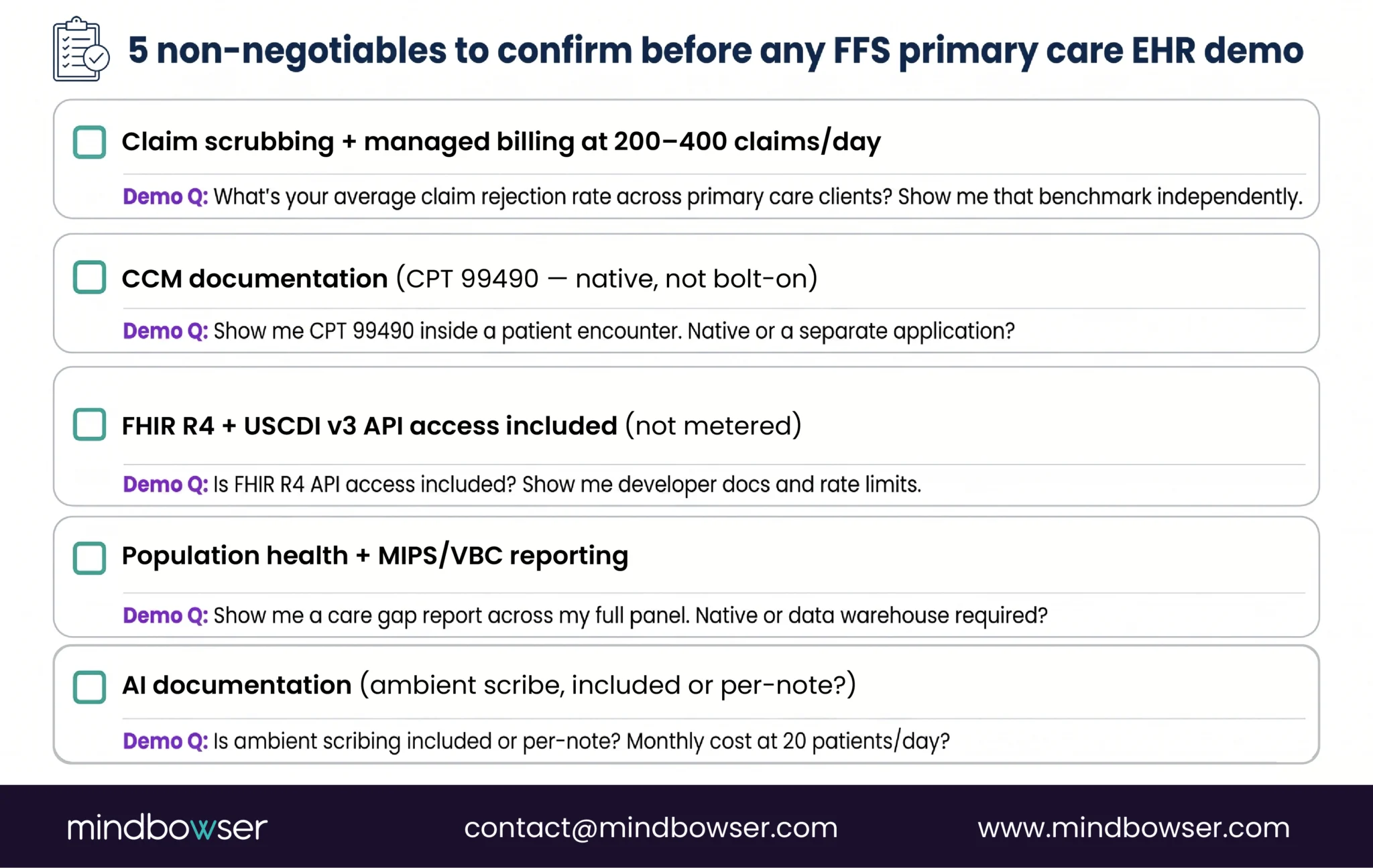
FFS primary care is operationally complex in ways that general EHR “primary care modules” often underestimate. Five requirements separate genuinely capable platforms from the ones that create workarounds.
- Claim scrubbing and managed billing: Primary care groups billing 200-400 claims per day can’t absorb rejection rates above 5% without a cash flow problem within 30-60 days. The EHR’s billing module, or its integrated RCM partner, is not optional.
- Chronic care management documentation workflows: CPT 99490 requires 20+ minutes per month of documented non-face-time care coordination per eligible patient. Primary care is the largest CCM billing segment. Most generic EHRs have no CCM module, bolt-on only. For practices with chronic care management software built into their clinical stack, this workflow collapses significantly.
- FHIR R4 and USCDI v3 compliance: USCDI v3 has been mandatory since January 1, 2026 (HTI-1, 89 FR 1192), requiring EHRs to expose FHIR R4 APIs aligned with USCDI v3. USCDI covers primary care data, medications, allergies, labs, and social determinants. Any EHR that doesn’t expose these APIs will be out of certification compliance. For practices adding virtual visits, telemedicine software needs to plug into this same data layer, not run in a separate silo.
- Panel management and population health reporting: Managing 1,500-2,500 active patients under MIPS/CPC+/Primary Care First contracts requires population-level reporting that most EHRs can’t produce natively. They export to a data warehouse and reconstruct it.
- AI documentation (ambient scribe or note assist): Primary care physicians average 2 hours of EHR documentation for every 1 hour with patients (AMA 2024). Every EHR either has native ambient scribing or charges $25-35 per note. AI Medical Summary reduces documentation time by approximately 50% and improves accuracy by approximately 45%.
III. What a Direct Primary Care Practice Needs That Is Completely Different
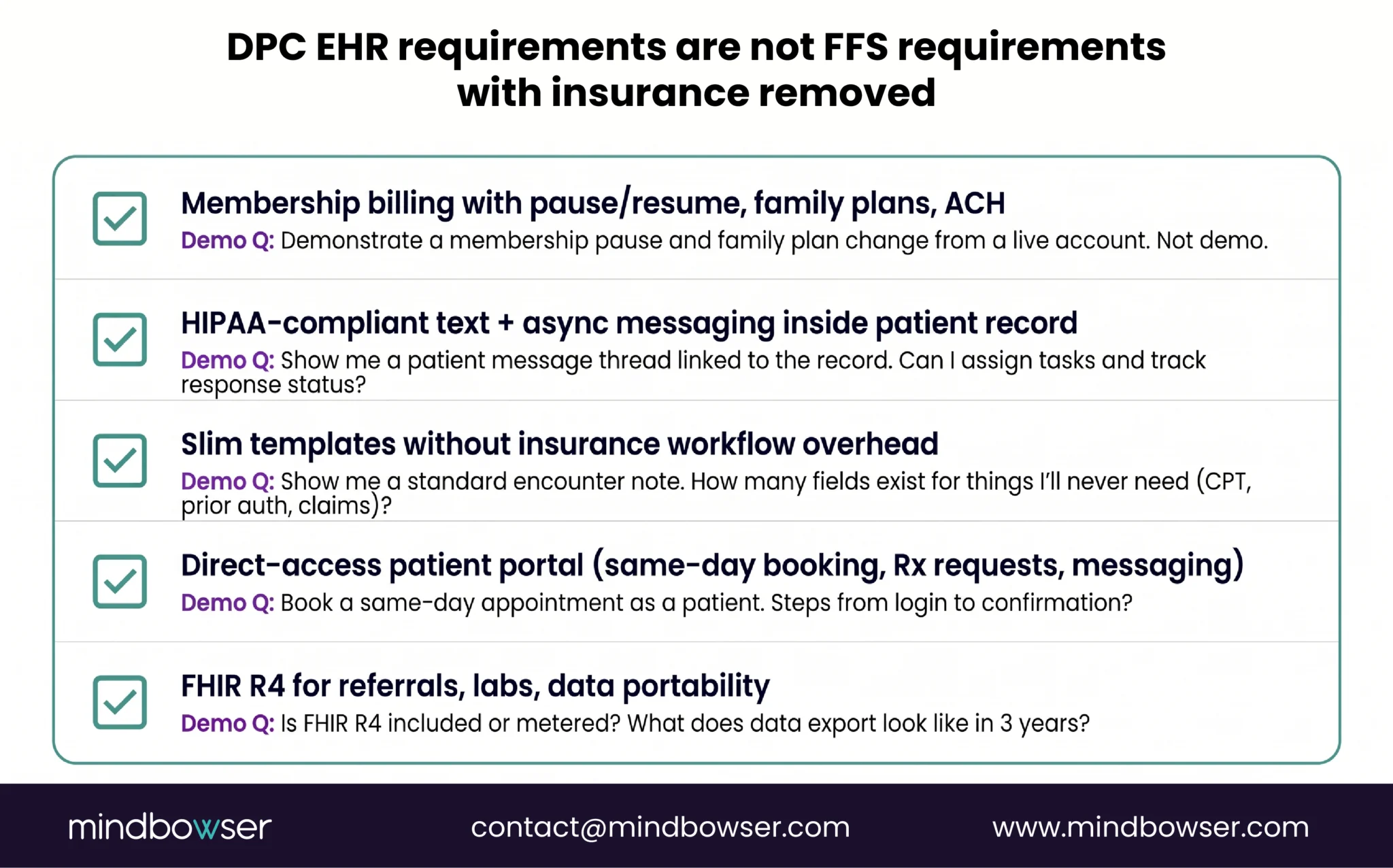
DPC has no insurance billing. That sentence alone eliminates most EHRs on the market.
- Membership billing engine: Monthly subscription per patient, billing automation, pause/resume, family plan pricing, ACH integration. This is not medical billing, it’s closer to SaaS subscription management. Most EHRs are built for fee-for-service. The bolt-on membership billing options perform poorly. Practices end up managing subscriptions in a separate tool.
- Text messaging and asynchronous care: DPC physicians are directly accessible. The EHR needs HIPAA-compliant text and email messaging, task assignment, and response tracking inside the patient record. In most satisfaction surveys, this is the top driver of why patients stay with DPC practices. Patient Questionnaire Form handles digital intake with real-time FHIR validation and EHR submission, fitting the DPC patient-first access model without a separate intake platform.
- Slim clinical workflow without insurance overhead: DPC notes can be shorter because there’s no insurer to satisfy. Templates need to reflect the actual clinical encounter, not a CMS documentation standard for claims. This is the most common reason DPC physicians say they feel trapped in their FFS-optimized EHR.
- Patient portal for direct booking and messaging: Same-day booking, direct physician messaging, prescription requests from the portal. Standard EHR portals were designed for managed care workflows. DPC patients experience them as friction that contradicts the access model they’re paying for.
- FHIR R4 compliance: DPC practices still need FHIR APIs for external referrals, specialist communication, and patient data portability under USCDI. No insurance billing doesn’t mean no compliance floor.
IV. Best EHR Options for Traditional FFS Primary Care (2026)
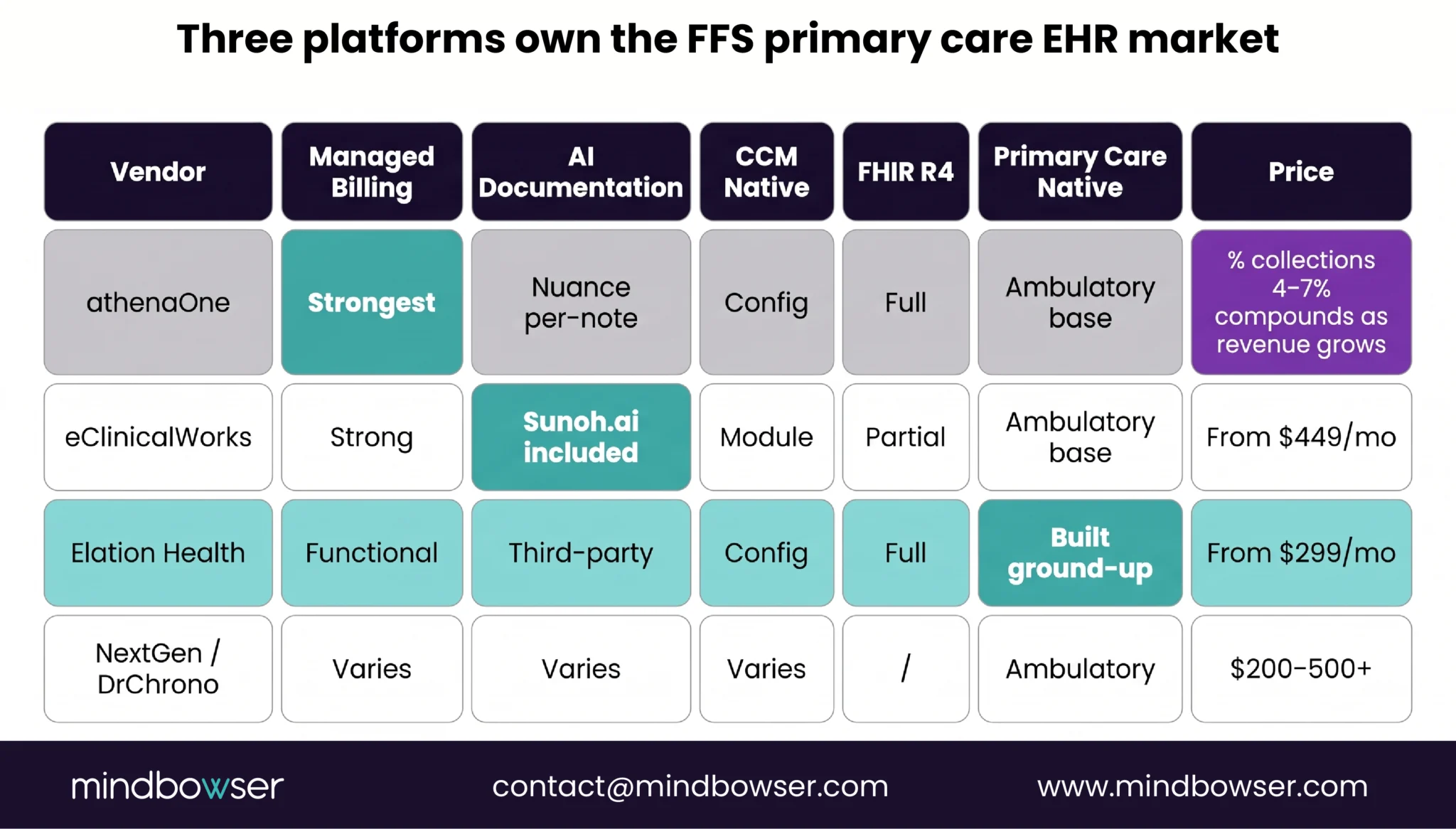
Three platforms own the FFS primary care EHR market. Everything else is specialty-adjacent or requires significant customization.
athenaOne: Strongest managed billing and revenue cycle in ambulatory EHR. KLAS top-rated for multiple years. CCM module requires configuration but exists natively. AI note assist via Nuance partnership, per-note pricing. Priced at percentage of collections (4-7%), which compounds as revenue grows. Best fit: billing-efficiency-first practices.
eClinicalWorks: Largest primary care install base in the US. AI documentation via Sunoh.ai ambient scribe, included in the license rather than per-note. Strong population health reporting. KLAS 75.2/100 (2023). Limitation: interface complexity and training curve. From $449/provider/month. Best fit: AI-forward practices wanting ambient scribing without per-note fees.
Elation Health: Purpose-built for primary care (family medicine, internal medicine, pediatrics). Not an ambulatory EHR with primary care modules. Built from the ground up for primary care workflow. Has a DPC bridge with membership billing add-on. FHIR R4 API included, not metered. From $299/provider/month. Best fit: care-workflow-first independent practices or anything hybrid FFS/DPC.
Related read: EHR Systems for Small Practices Vs Custom Builds
V. Best EHR Options for Direct Primary Care Practices (2026)
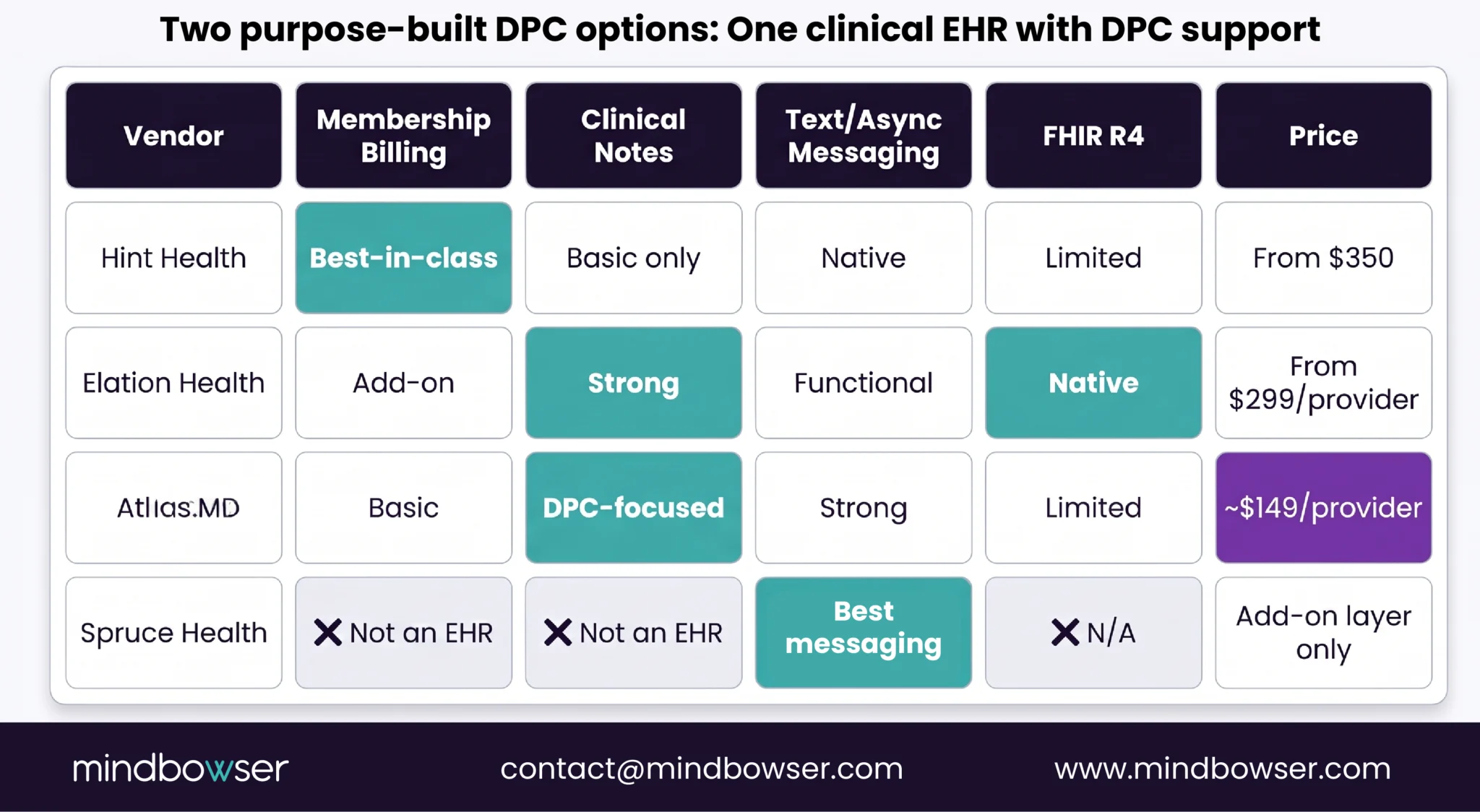
The DPC EHR market is small and honest. Two purpose-built options and one strong general EHR that bridges the gap.
Hint Health: Purpose-built DPC platform. Best membership billing in the DPC space, ACH, bank draft, family plan pricing, pause/resume, automated patient communication. Limitation: clinical documentation is functional but basic. Most DPC practices pair Hint for billing with a separate clinical EHR. From $350/month.
Elation Health: DPC-friendly primary care EHR with a membership billing module add-on. Not as strong as Hint on subscription management, but the clinical workflow is considerably better. The only single-platform option that handles both reasonably. FHIR R4 native.
Atlas.MD: Built by DPC physicians. Strong text messaging, simple interface, lower cost (approximately $149/provider/month). Limitation: smaller vendor, limited population health reporting and multi-location support.
What most DPC practices end up doing: Hint for billing, Elation for clinical notes. Two platforms, one patient record challenge. This is the DPC software gap that no vendor advertises. The integration is functional but not seamless.
If you’ve already decided to build, the EHR development partner evaluation guide is where to start.
VI. Elation Health vs athenaOne: The Two Options That Span the Widest Range

These are the two names I hear most in primary care EHR conversations. They solve different problems.
Choose athenaOne when: Billing throughput and revenue cycle efficiency is the primary constraint. Your claim rejection rate is above 5% and collections are lagging. You have a large panel needing MIPS or value-based contract reporting. You want the strongest managed billing infrastructure in the category.
Choose Elation when: Care workflow quality and documentation simplicity is the primary constraint. You run a hybrid FFS/DPC model or are considering DPC. You want FHIR R4 APIs included without metering.
Neither is “better.” They solve different bottlenecks.
VII. When Off-the-Shelf Fails and a Custom-Built Primary Care EHR Makes More Sense.

Three practice profiles where none of the options above solve the actual problem.
ACO or population health platform (20+ primary care physicians, value-based contracts): A unified population registry, custom risk stratification, VBC reporting to multiple payers simultaneously, and care gap workflows across all physicians. Off-the-shelf EHRs require three to four data warehouse integrations to produce this. A platform built on FHIR R4 handles it natively. ConnectHealth compresses 6 months of EHR-to-payer integration work down to 6 days when standing up a new ACO contract on a timeline.
DPC franchise chain (10+ locations): Unified membership database across all locations, cross-location patient records, consolidated billing, physician messaging across all sites. Hint breaks at this scale. Elation’s multi-location support has real limits above 5-7 sites. A custom-built platform solves the architecture structurally rather than through workarounds.
Physician-founder building a commercializable primary care platform: If you’re building something to sell to other DPC networks or primary care groups, off-the-shelf is not a product foundation. You need source code ownership, clean FHIR APIs, and white-label capability. Mindbowser has delivered primary care platforms on Medplum in 60-90 days at comparable scope. Custom EHR development is the path when the end goal is a product, not a practice tool.
Documentation efficiency applies to all three: AI Medical Summary reduces clinical documentation time by approximately 50% and improves accuracy by approximately 45% as a native feature rather than a third-party per-note charge. Connect Health handles the HL7 and FHIR integration layer for lab, specialist, and payer connections without building each integration from scratch.
For groups weighing this, this comparison of ready-made vs custom EHR and the EHR development cost guide are the two resources I point practices to first.
Custom build cost: $150,000-$500,000+ depending on scope.
- CCM documentation [FFS]: “Show me your CCM workflow inside a patient encounter. Not a separate module.”
- AI documentation pricing [Both]: “Is ambient scribing included in my license or per-note? Monthly cost at our volume?”
- FHIR R4 API access [Both]: “Is FHIR R4 metered or included? Show me the developer documentation.”
- Membership billing [DPC]: “Show me a pause, plan change, and ACH setup from inside the platform. Not a demo account.”
- Implementation [Both]: “Realistic go-live timeline for our size? Three live references, please.”
- Data portability [Both]: “If we leave in 3 years, format, timeline, cost for data export?”
IX. Primary Care EHR Strategy Starts With FFS vs DPC
The primary care EHR category splits cleanly at the billing model. FFS and DPC are not the same practice type. They need different software evaluated on different criteria.
- For FFS: athenaOne for billing-first, eClinicalWorks for AI documentation volume, Elation for care-workflow-first or hybrid.
- For DPC: Hint plus Elation is the most common combination. No single platform has solved the full stack.
- For ACO platforms, DPC franchise chains, and physician-founders: off-the-shelf is not the starting point.
The right EHR decision starts with the billing model. Everything else follows from there.
See the EHR cost guide and the partner evaluation framework for practices further down the custom path.
Choose a Primary Care EHR Based on Your Practice Model
The best EHR for primary care depends first on whether the practice operates under fee-for-service or Direct Primary Care. FFS practices need claims management, CCM documentation, population health reporting, and revenue cycle support, while DPC practices need membership billing, direct patient communication, and simpler clinical workflows. athenaOne, eClinicalWorks, Elation Health, Hint Health, and Atlas.MD each solve different parts of that equation, but ACOs, multi-location DPC networks, and physician-led platforms may eventually outgrow standard software.
The right decision is not about choosing the most popular EHR. It is about selecting an architecture that supports the practice’s billing model, clinical workflows, integration requirements, and long-term growth.