











 BLOGS
 NEWSROOM
 CASE STUDIES
 WEBINARS
 PODCASTS
 ASSET HUB
 EVENT CALENDAR























TL;DR
- G0402 is the Welcome to Medicare visit (IPPE), billable once, only inside the patient’s first 12 months of Part B.
- G0438 is the initial annual wellness visit, billable once in a patient’s lifetime, only after those first 12 months.
- G0439 is every subsequent annual wellness visit, and it is the code you will use most.
- The code is chosen by where the patient sits in their Medicare enrollment timeline, not by their age.
- The four denials that actually happen are all eligibility and timing problems, and all four are preventable before the appointment is booked.
A denied annual wellness visit rarely looks like a mistake at the time. The clinical work is fine, the note is thorough, and the remittance comes back weeks later saying the patient had already reached the benefit maximum for the period. Nobody in the room did anything wrong. The decision that caused the denial was made at the front desk, before the patient arrived, by somebody checking a calendar instead of checking eligibility.
That is the pattern worth building a workflow around: almost every annual wellness visit denial is a scheduling decision that already happened. It is why the code tables come first on this page and the scheduling workflow comes last, rather than the other way round.
This is written for the practice. If you are choosing between G0402, G0438 and G0439 for a specific patient, working out what has to be in the note, or trying to understand why a clean visit got rejected, everything you need is below.
During a recent discussion with a potential customer, we uncovered key challenges in handling annual wellness visits and presented a structured AI-powered solution to cut administrative time and boost care quality.
Which AWV code applies, and when
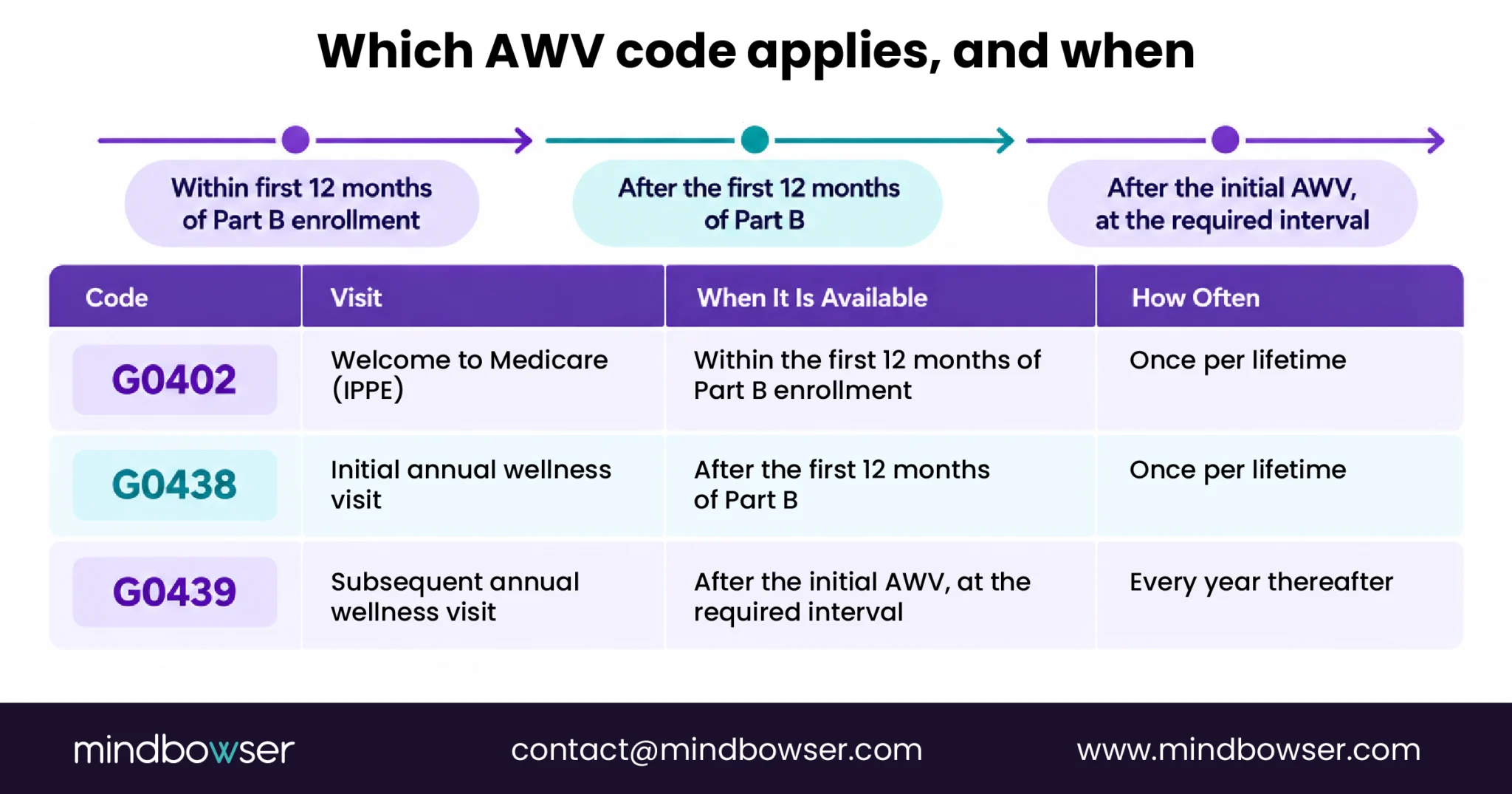
Staff usually ask me some version of “which code for a 72-year-old.” That is the wrong variable to start from. All three codes track one thing: how long the patient has had Medicare Part B, and what they have already used.
G0402 covers the Initial Preventive Physical Examination, the visit most patients call Welcome to Medicare. Available only during the first 12 months of Part B enrollment, once in a lifetime. Miss the window and it is gone. There is no appeal for it.
G0438 is the first annual wellness visit. It opens up once the patient is no longer within 12 months of the effective date of their Part B coverage. Like the IPPE, once per patient, ever. Two details that trip people up. A patient who never had a Welcome to Medicare visit still qualifies for G0438 once that first year is behind them. And where the patient did have one, CMS is explicit: do not bill G0438 or G0439 within 12 months of billing G0402 for the same patient.
G0439 covers every annual wellness visit after the initial one. Over a patient’s life you will bill G0402 at most once, G0438 at most once, and G0439 for the rest.
Sequence runs one direction only. You cannot bill G0439 before G0438, and you cannot bill either one inside the IPPE window. If you want the coverage conditions in the payer’s own wording, the CGS Medicare AWV fact sheet, published by a Medicare Administrative Contractor and revised February 2025, states them directly.
What each code requires you to document
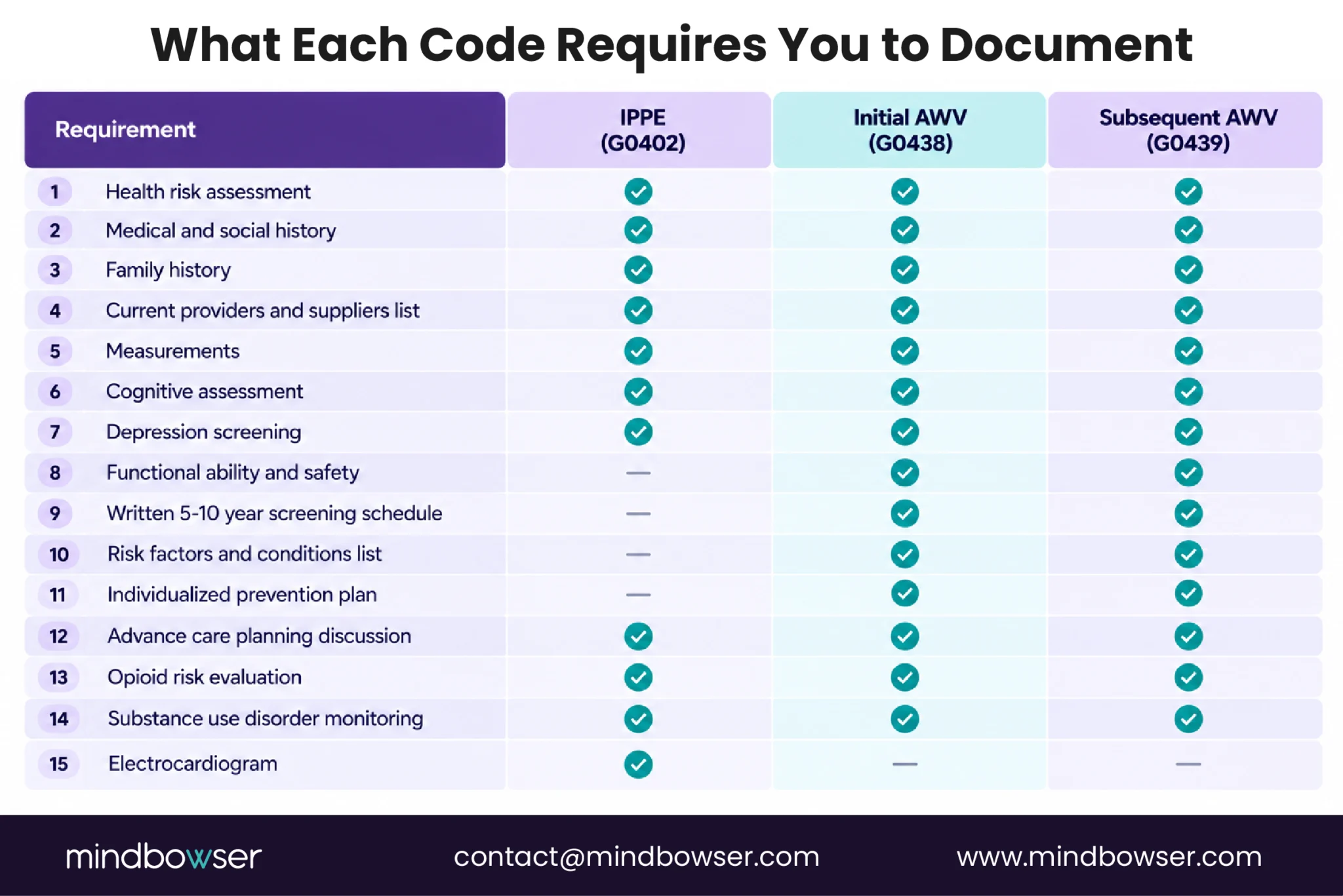
A code asserts that something happened in the room, and the documentation is the only evidence that it did. That is where most of the risk sits.
The initial AWV asks for the heaviest lift: a complete health risk assessment covering self-reported demographic, psychosocial and behavioral information along with activities of daily living, a full medical and social history, family history, a list of current providers and suppliers, height, weight, BMI and blood pressure, a cognitive assessment, a depression risk assessment, a functional ability and safety review, and a written personalized screening schedule covering the next 5 to 10 years built on USPSTF and ACIP recommendations.
Subsequent visits are lighter. Lighter is not the same as light. Most elements move from establish to review and update, and the 5 to 10 year screening schedule has to be revisited annually rather than written once and filed.
IPPE is a different shape again. It carries measurements the AWVs do not, including balance, gait and visual acuity, plus a one-time screening electrocardiogram where indicated. It does not require a structured health risk assessment.
Two elements apply across all three: an opioid risk evaluation where the patient is on an opioid prescription, and substance use disorder monitoring.
What Medicare pays, and why your number will be different
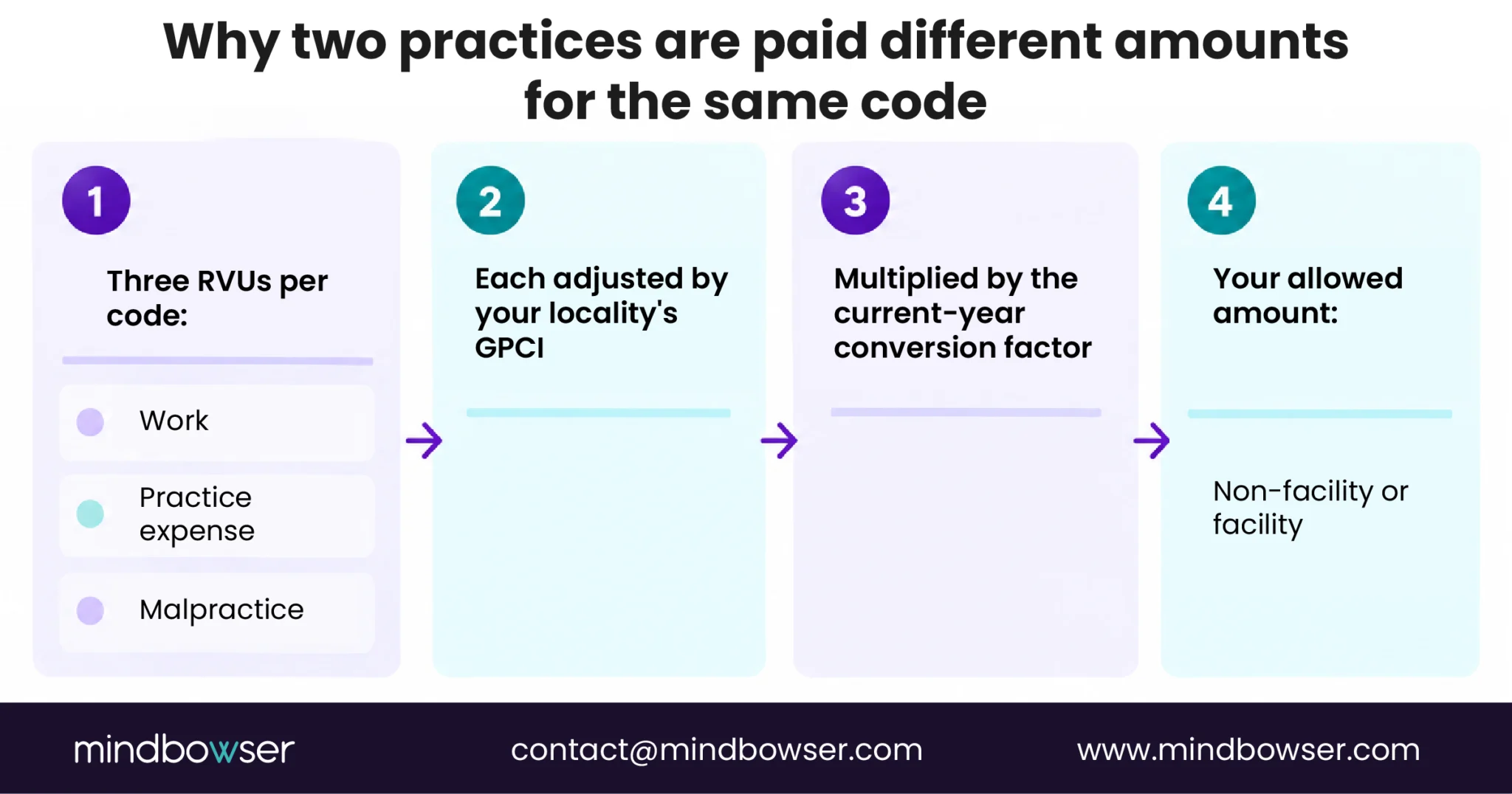
Coding guides skip the money. I understand why. There is no single national number to quote, because the amount you are paid is the output of a calculation that runs on your locality.
Payment for each code comes from three relative value units, one each for physician work, practice expense and malpractice. Each is adjusted by a geographic practice cost index for your specific locality, and the total is multiplied by that year’s conversion factor. Two practices billing G0439 on the same day in different states are paid different amounts, correctly. A national average tells you roughly what the service is worth. It does not tell you what you will be paid. Those are different questions.
The initial AWV pays materially more than the subsequent one, and the IPPE sits close to the initial AWV. You will find specific national-average figures quoted in vendor billing guides. Treat them carefully: most are undated, and almost none state whether they are facility or non-facility amounts, which is a difference large enough to matter when you are modeling a panel.
Yours is the number that matters, and it takes about two minutes to get. Open the CMS Physician Fee Schedule Look-Up Tool, enter the HCPCS code, select the current year, choose your MAC locality, and read the non-facility amount if you are billing from an office setting.
If you are modeling this across a panel rather than a patient, the same locality logic applies to every code your practice bills, which is one reason it belongs in your billing workflow rather than in a spreadsheet that ages out every January. One thing stays fixed regardless of locality: when the annual wellness visit itself is billed correctly, the patient owes no coinsurance and no deductible for it. Read that precisely. It applies to the visit, and not automatically to everything billed alongside it. Several of the add-on codes carry their own conditions, and the waiver on those holds only once per year and only when they are billed with the AWV. That distinction is the usual cause when a patient who was told the visit was free calls about a bill, and the add-on section below sets out the conditions.
An AWV is not an annual physical, and billing it like one gets denied
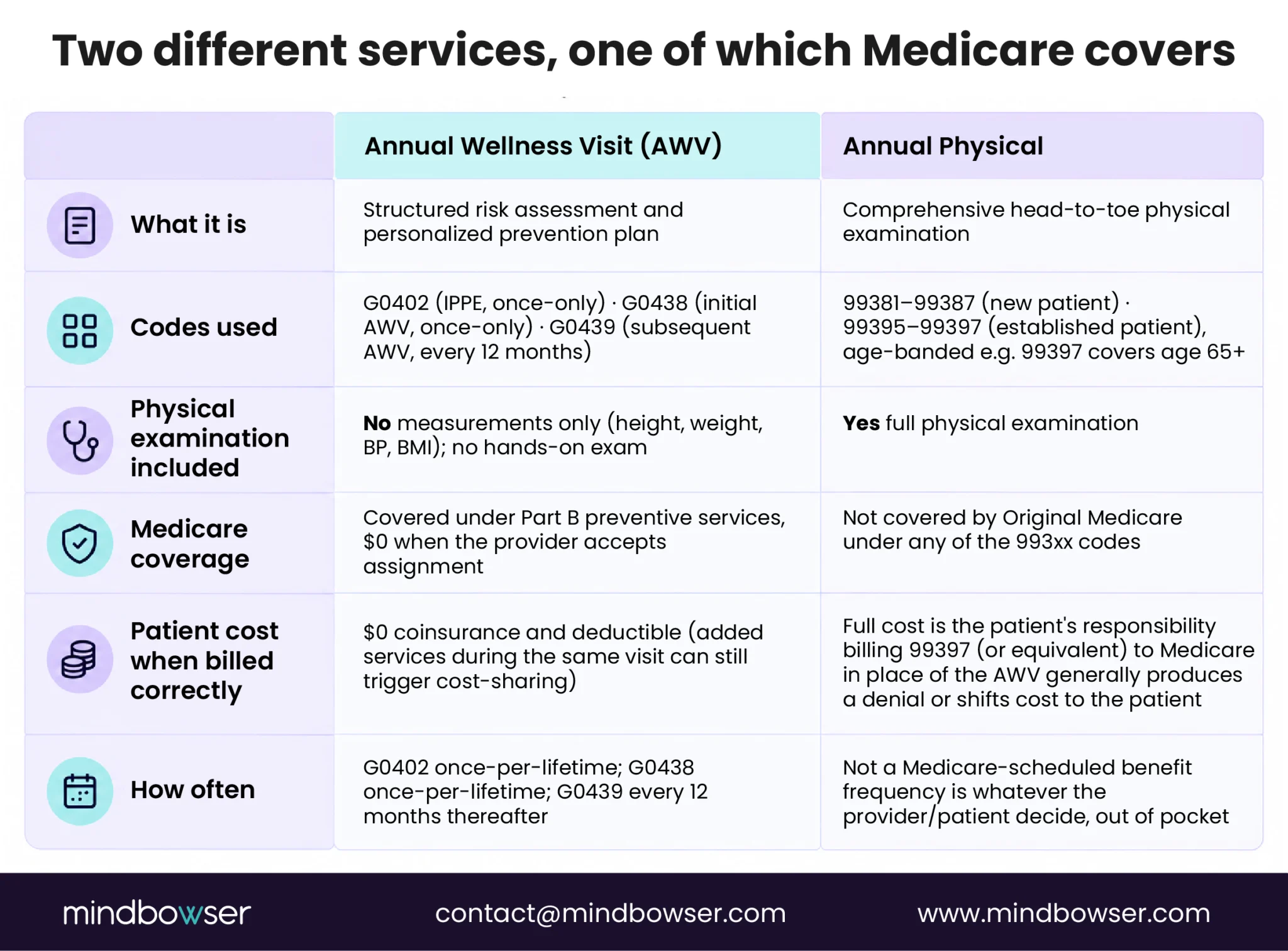
This is the single most common question on this topic, so here is the answer first: the annual wellness visit and the annual physical are different services, and Medicare covers only one of them.
Preventive medicine codes, 99381 through 99387 for new patients and 99395 through 99397 for established ones, describe a full head-to-toe physical examination. Medicare does not cover them. Not any of them. Billing one in place of a Medicare wellness service generally produces a denial or shifts the cost to the patient, which is the phone call described above.
An annual wellness visit is not a physical examination. There is no head-to-toe exam in it at all. It is a structured risk assessment and a prevention plan, which is why the documentation reads like an inventory rather than an exam note. Patients frequently expect the physical, so the mismatch is worth setting up front at booking.
This also answers the age question. People search for the AWV code by age because the preventive medicine codes genuinely are age-banded: 99395 covers 18 to 39, 99396 covers 40 to 64, 99397 covers 65 and over. The Medicare codes are not. G0402, G0438 and G0439 apply on the enrollment timeline no matter the patient’s age, including patients under 65 who qualify through disability or end-stage renal disease. What varies with age and risk is which screenings happen inside the visit, not which code is billed for it.
See How Our AI-Driven Solution Can Streamline Your Medicare Wellness Visits
Billing an E/M on the same day: modifier 25 and the note that stands alone
Real visits do not stay inside one category. A patient comes in for a wellness visit, mentions their breathing has been worse, and now there is genuine clinical work happening alongside the prevention plan. That is normal.
You can bill both. Report the annual wellness visit code, then report the evaluation and management service with modifier 25 attached, which identifies it as a significant, separately identifiable service performed on the same date.
One word there is doing all the work: separately. The E/M documentation has to stand on its own, independent of everything that satisfies the AWV components. If the only support for the office visit is material that was already required for the wellness visit, it is not separately identifiable, and that is exactly the pattern auditors look for.
A worked example. A patient presents for a subsequent AWV. During the visit the physician identifies breathing difficulty, examines the patient, reviews a prior chest CT, diagnoses a COPD exacerbation, prescribes prednisone and orders a chest X-ray with a one-week follow-up. That supports G0439 plus 99214 with modifier 25, provided the COPD assessment is documented as its own clinical account rather than folded into the prevention plan.
One caution. Guidance on this varies by payer, and some documents still circulating say no modifier is needed when a wellness visit and a physical share a date of service. Check your own payer’s current policy rather than a general article, including this one, before changing how you submit.
Do not confuse modifier 25 with modifier 33. Modifier 25 is what identifies a separately identifiable E/M service. Modifier 33 identifies a preventive service, and Medicare has its own specific use for it on the AWV claim, which the advance care planning section below covers. Different questions. Not interchangeable.
The four denials that actually happen, and what CMS audits
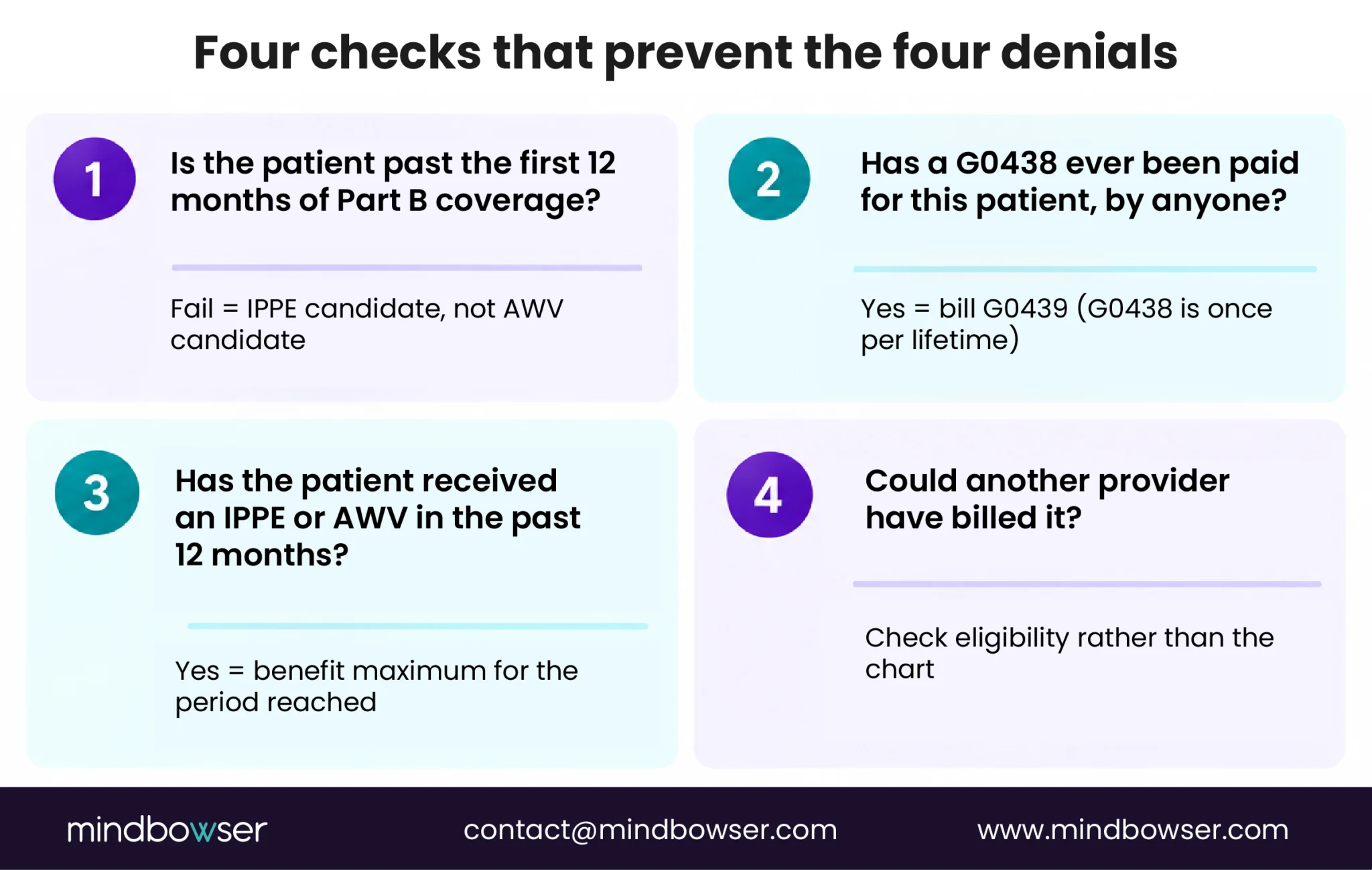
If you read one section, read this one. In practice, AWV denials cluster into four causes, and none of them is about the quality of the care delivered.
One. The patient already had their initial AWV. G0438 is a once-per-lifetime benefit. Submit it for a patient who has a paid G0438 in their history and it will be rejected on that basis, whichever provider billed the first one.
Two. The patient is still inside their first 12 months of Part B. Medicare covers the AWV only for a beneficiary who is no longer within 12 months of the effective date of their Part B coverage. During that first year the patient is an IPPE candidate, not an AWV candidate.
Three. Not enough time has passed since the last visit. CMS is direct about the consequence: do not bill G0438 or G0439 within 12 months of billing G0402 for the same patient, and “we deny these claims with messages indicating the patient reached the benefit maximum for the period”.
Four. Another practice already billed it. The coverage condition is written around the patient. It turns on whether they have received an IPPE or an AWV in the preceding period, whoever provided it. If another provider got there first, your claim is denied, and this is the one your front desk cannot see from your own chart.
I have deliberately not printed claim adjustment reason codes against each of these. They are quoted confidently across a lot of billing content and are worth reading off your own remittance advice and your MAC’s current guidance rather than off an article, because the pairings are revised on their own cycle.
That last point is why the workflow section sits at the end of this page rather than the beginning. Three of these four are invisible from inside your own records. You cannot fix what you cannot see.
It is also worth knowing what CMS itself looks at. The Recovery Audit program lists the annual wellness visit as an approved audit topic twice: Annual Wellness Visits: Excessive Units and Annual Wellness Visit: Incorrect Coding. Excessive units is the frequency problem above, seen from the auditor’s side. Incorrect coding is the sequencing problem. These are not predictions about what might be reviewed. They are CMS publishing what it does review.
Frequency: 11 months, calendar years, and why your plan says something different
Two people in the same practice will quote different frequency rules and both sound certain. Both can be right. They are describing different products.
Under Medicare fee-for-service the spacing is a rolling interval, not a calendar one. The coverage condition, as the MAC states it, is that the patient has not received either an IPPE or an annual wellness visit within the past 12 months. That is a coverage condition, not a guideline. Booking on a loose reading of it is denial cause number three above.
You will also see practices book at 11 months rather than 12. That is a scheduling margin, not a separate rule, and it exists because a visit booked at exactly 12 months has no room for a rescheduled appointment. Whichever interval your system uses, the thing being tested at claim time is the 12-month coverage condition.
Many Medicare Advantage plans apply a calendar year benefit instead, meaning one visit per member per calendar year. Under that rule a visit in November and another the following January can both be allowed, and a visit in March followed by one in December of the same year is denied, with the plan naming an annual wellness visit limit as the reason.
This is a scheduling problem that presents as a billing one. Two of the payer coding sheets currently ranking for these terms state the calendar year rule without noting that it is a plan rule rather than a universal one, and one of them was published in 2020. Check the specific plan, not the general rule.
Who can perform an AWV, and what direct supervision actually limits
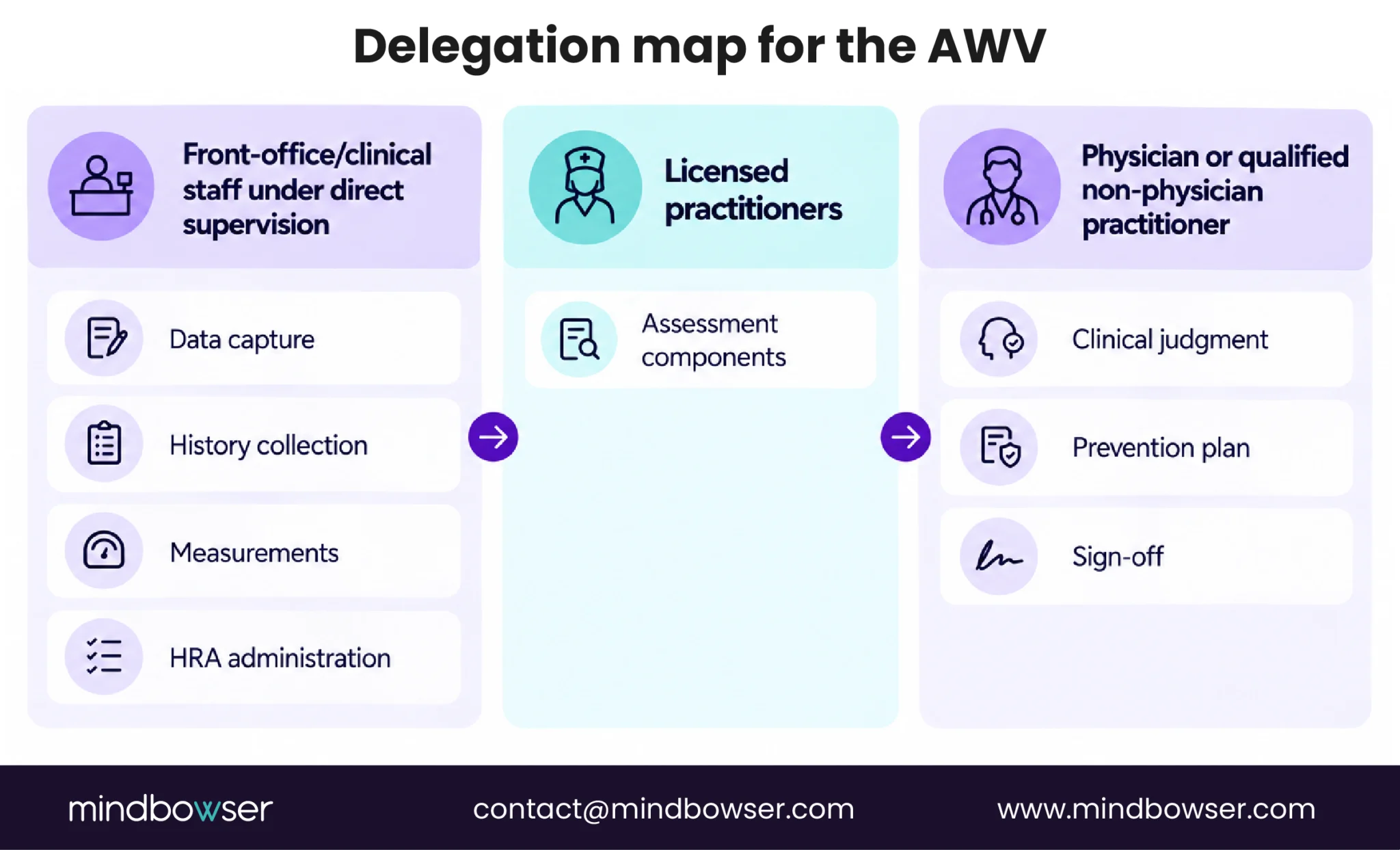
Most of this visit does not require the physician. That is the only reason practices can run it at volume.
The visit may be performed by a physician, a physician assistant, a nurse practitioner or a clinical nurse specialist. It may also be performed by a health educator, registered dietitian, nutrition professional or other licensed practitioner, or by a team of such professionals, working under the direct supervision of a physician.
One limit gets missed almost every time, and it is where delegation plans go wrong. Staff who are not authorized may not perform any part of the visit that requires independent clinical judgment, or the making of clinical assessments, evaluations or interpretations. Collecting a health risk assessment response is data capture. Deciding what that response means for the patient’s prevention plan is clinical judgment. The first delegates widely. The second does not delegate at all.
When I train teams on this, the practical test I give them is: could this step be done wrongly in a way that changes the patient’s care plan? If yes, it needs the clinician.
The codes that ride along with the annual wellness visit
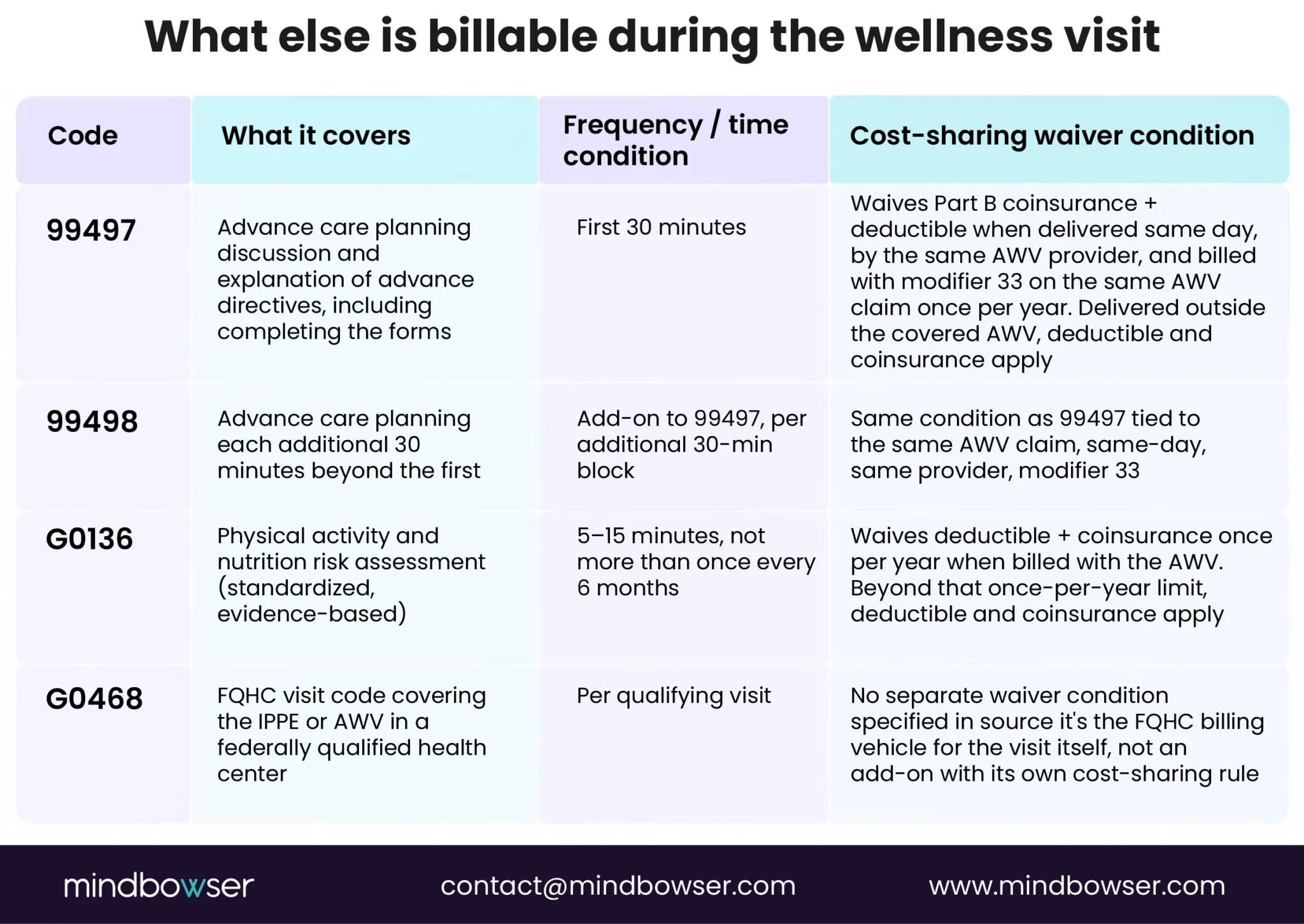
The AWV is undervalued in a lot of practices because it is treated as one code. It is better understood as a container for several separately billable services that are clinically appropriate during the same encounter.
Advance care planning, 99497 for the first 30 minutes and 99498 for each additional 30 minutes, covers the discussion and explanation of advance directives, including completing the forms when that happens. There is a time threshold and the documentation has to support it.
The billing conditions are specific. Get them right, because this is the add-on most often left on the table. CMS waives both the Part B coinsurance and the deductible when the ACP is delivered on the same day by the same AWV provider and billed with modifier 33 on the same AWV claim. That waiver applies once per year alongside the AWV. Deliver ACP outside the covered AWV and the deductible and coinsurance apply. Separately, and usefully, CMS states there is no limit on how many times ACP can be reported for a patient in a given period, so the once-per-year rule governs the cost-sharing waiver rather than the service itself.
G0136 is the one to look at again this year. CMS now carries it under the heading physical activity and nutrition risk assessment, with the descriptor “Administration of a standardized, evidence-based assessment of physical activity and nutrition, 5-15 minutes, not more often than every 6 months“, and flags the code as recently updated. It moved there from a social determinants of health framing, so a coding reference that predates the CY2026 Physician Fee Schedule final rule will describe it wrongly, and several currently do.
Read the cost-sharing rule carefully. It is conditional, not blanket. CMS waives the deductible and coinsurance for this assessment once per year when it is billed with the AWV. Bill it beyond that once-per-year limit and the deductible and coinsurance apply.
Depression screening is where I would be most careful. Reviewing the patient’s potential depression risk factors is a numbered component of the AWV itself, so it is part of what the AWV code already pays for. Whether a separate screening code may also be billed alongside the visit, and in which year, is answered differently by different payers, and at least one widely circulated tip sheet stating a firm rule on it dates from 2018. Read your own payer’s current instruction before you build that pairing into a template. If a positive screen routes the patient into ongoing behavioral health care, that program has its own billing rules again.
G0468 is the FQHC visit code covering the IPPE or AWV in a federally qualified health center.
Each of these has more depth than one section can carry, and the advance care planning and add-on codes have their own pages coming in this cluster.
Check Every Code That Belongs on Your Medicare AWV Claim
The claim itself: diagnosis codes and the fields that get it paid
Once everything above is right, the claim itself is easy.
No specific diagnosis code is required for the annual wellness visit. Practices conventionally use Z00.00, an encounter for general adult medical examination without abnormal findings, or Z00.01 where abnormalities are found, adding codes for anything identified during the visit.
Five things need to be right on submission: the correct HCPCS code, the diagnosis code, the date of service, the place of service, and the rendering provider’s NPI.
One correction worth making, because it appears in coding guidance that currently ranks well. G0402 and G0468 are procedure codes, not diagnosis codes. At least one payer tip sheet still in circulation files them under a diagnosis heading. If your internal cheat sheet was built from a source like that, it is worth a look.
Getting the visit right before the coder ever sees it

Everything above resolves into one operational point, and it is the argument this page has been building toward: every denial in the four-denial list is a scheduling decision that already happened.
Run the eligibility check before the appointment is booked, not after the visit is coded. Verifying the patient’s Part B start date, their AWV history and whether another provider has already billed the visit this period, through your MAC’s provider portal or the HETS eligibility system, removes three of the four denial causes outright. A minute per patient. It is the single highest-return change most practices can make here.
Same for the health risk assessment. Collecting it during the appointment consumes the clinical time the visit is supposed to create. Sent ahead through a portal or captured on a phone call, it arrives as structured data the clinician reviews rather than gathers. The same pattern works for the medication review that often runs alongside it.
The missing information splits three ways, and it is worth splitting it deliberately, because this is fundamentally a care team workflow question rather than a billing one: what a portal or a phone call can collect asynchronously, what front-office staff can capture at check-in under direct supervision, and what genuinely requires the clinician. Most practices treat all three as the same bucket and hand the whole thing to the provider.
Documentation belongs in the record the first time. When the components are captured as structured data rather than free text, the note supports the code without anyone reading it back afterwards to confirm that it does, and the result is written back into the same EHR the care team already works from rather than into a second system nobody checks.
Practices generally have three ways to get there. You can rent a point AWV platform, which is quick and generic and leaves the logic with the vendor. You can configure something already built, which is where most practices land. Or you can build it, usually by extending what your medical billing software already does so the eligibility rules sit beside the claim rules rather than in a separate tool.
The middle option is worth being precise about, because the useful version of this is not the flattering one. The connective parts of the workflow are the parts that already exist: pulling eligibility, ingesting a returned questionnaire, capturing components as structured data, and writing results back to the EHR are all standard integration work, handled in production by pre-built components rather than written from scratch. What is not pre-built is the part this page has been about. Enforcing “this patient had a G0438 in 2023, another provider billed in March, this plan runs on a calendar year” is a rules engine, it sits outside the integration model that ConnectHealth covers, and on current evidence it is a custom build in every implementation we have seen. Budget for it as one.
What the annual wellness visit tells you about the rest of the patient’s year
here is a second reason to run this visit well. It has nothing to do with the visit’s own reimbursement.
Once a year, this is the one encounter where a practice systematically learns what else a patient qualifies for. A health risk assessment that surfaces two or more chronic conditions has identified a candidate for chronic care management or advanced primary care management. Functional or musculoskeletal limitations point toward remote therapeutic monitoring, and where the patient needs physiologic data captured between visits, automated patient monitoring is the adjacent program. A positive depression screen points toward behavioral health integration, which has its own code family and documentation rules.
In most practices that handoff never happens. Nothing routes it. The findings sit in the note, the visit closes, and the patient’s eligibility for a program that would have supported them all year goes unnoticed until the next annual visit surfaces it again. This is the same break that shows up in care continuity generally: the information exists, and nothing carries it forward.
Practices that treat the wellness visit as the intake point for their whole care management program get a different result. Which conditions qualify is a question worth answering systematically rather than case by case, the code families involved have their own rules about what can run alongside what, and some combinations, such as remote monitoring alongside chronic care management, are billable together when documented properly. Treated as a system rather than a series of visits, this is also the most reliable way to close care gaps at scale, because the wellness visit is the only encounter that reviews the whole patient on a schedule. Whether you run that in your EHR or in dedicated care management software matters less than whether the routing happens at all. One visit becomes the front door to a year of managed care, or it stays a visit.