













 BLOGS
 NEWSROOM
 CASE STUDIES
 WEBINARS
 PODCASTS
 ASSET HUB
 EVENT CALENDAR



























TL;DR
- 2026 national averages, varying by locality: 99497 pays $86.84 in a non-facility setting and $65.80 in a facility. 99498 pays $78.16 and $63.46. On 99497, office-based pays 9.1% more than it did in 2025 and hospital outpatient pays 9.2% less. 99498 rises more and falls less, 13.4% up and 7.5% down. Work RVUs did not move on either code; practice expense did.
- The billing threshold is 16 minutes, and CMS publishes the full time table. Under 16 minutes, the time moves into an E/M service instead. Over 45 minutes adds 99498.
- The cost-sharing waiver has four conditions, not one. Same day as a covered annual wellness visit, same provider, modifier 33, same claim. Miss any one and the patient owes coinsurance.
- Medicare fee-for-service sets no limit on how often you can report advance care planning. A widely used code reference says once per year. It is wrong, and believing it costs money.
- 99497 and 99498 are both on the CY2026 Medicare telehealth list, subject to the telehealth conditions in force at the time of service. Two widely read references say advance care planning cannot be done by video at all. They are wrong.
The $33 million gap, and the one-in-four problem
I pulled the CY2024 Medicare claims file to size advance care planning as a service line, expecting a boring answer. Two numbers came back that should have been closer together than they were.
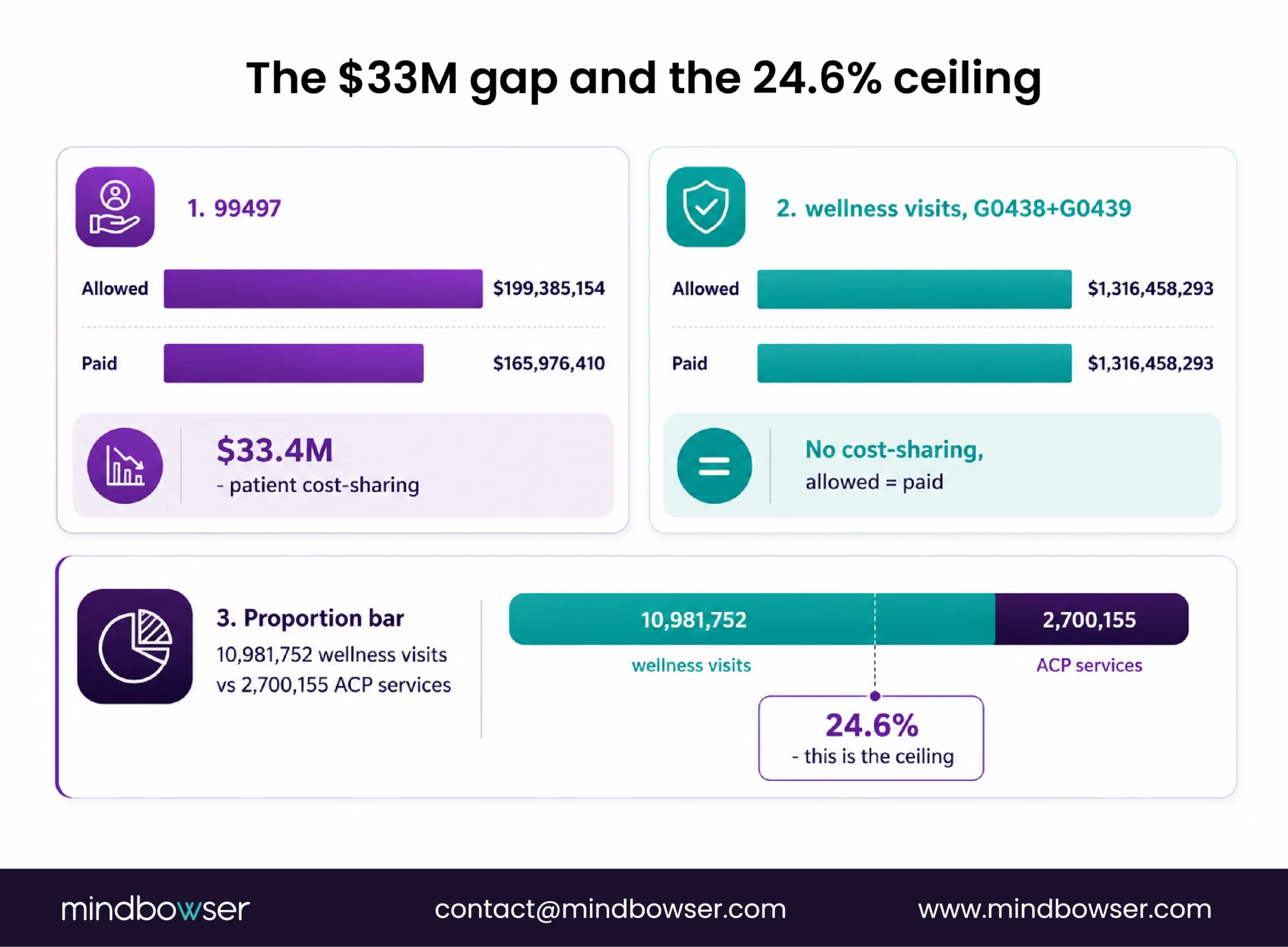
Medicare allowed $199,385,154 for CPT 99497 across 2,700,155 services. Medicare paid $165,976,410. The $33.4 million difference is patient cost-sharing: the coinsurance and deductible that practices billed to patients rather than collected from Medicare. Some of it was collected. A good share of it, on the collection rates most practices actually run on patient balances, was not.
Part of that gap is avoidable, and it matters which part. CMS publishes a mechanism that waives the patient’s deductible and coinsurance entirely, but it only reaches advance care planning delivered alongside a covered annual wellness visit. Advance care planning billed as a standalone Part B service carries normal cost-sharing and always will.
One thing the file does show, and it points in a useful direction. Medicare paid 83.2% of allowed on 99497, where a service carrying standard 20% coinsurance from end to end would pay 80%. Something is already pulling that ratio above the floor, and the waiver is the obvious candidate.
I am not going to turn that into a percentage of services. Unmet deductibles push the same ratio down, and you can see that effect elsewhere in the file: the cognitive assessment code 99483 pays 75.0% of allowed, well under the 80% floor. So 83.2% is a net figure with forces working in both directions inside it, and backing a clean share out of a 3-point residual would be arithmetic dressed up as a finding. What it supports is the direction: some organizations are already doing this, and most are not.
Look at what happens one line up on the same claim. In CY2024 Medicare allowed $1,316,458,293 for the annual wellness visit codes G0438 and G0439, and paid $1,316,458,293. Identical to the dollar. The wellness visit carries no coinsurance and no deductible, so allowed and paid are the same number. Advance care planning can be brought inside that same protection, and when it is, the patient owes nothing and the practice collects the full allowed amount.
Now the part that turns this into a workflow question. There were 10,981,752 annual wellness visits in CY2024 and 2,700,155 advance care planning services. That is 24.6%, and it is an upper bound, because a meaningful share of those advance care planning services were separate Part B encounters that had nothing to do with a wellness visit. At best, one wellness visit in four carries an advance care planning conversation on the claim.
For scale: advance care planning paid $170.7 million across both codes in CY2024. Principal care management, behavioral health integration and remote therapeutic monitoring paid $88.9 million between them, computed from the same CY2024 dataset across the 13 codes those three programs bill under. This one conversation code is worth roughly 1.9 times all three of those programs combined, and it gets a fraction of the attention.
What 99497 and 99498 actually cover
Start with what the codes actually say, because most published summaries paraphrase the descriptor and lose something in it. From CMS MLN909289, Advance Care Planning, March 2026:
99497 is “advance care planning including the explanation and discussion of advance directives such as standard forms (with completion of such forms, when performed), by the physician or other qualified health care professional; first 30 minutes, face-to-face with the patient, family member(s), and/or surrogate.”
99498 is the same service, “each additional 30 minutes,” listed separately in addition to the primary procedure.
Two phrases in that descriptor carry more weight than they look like they do.
“With completion of such forms, when performed.” Completing the paperwork is optional. The service is the conversation. It cuts the other way too. Since the billable act is the explanation and discussion, a form filed without a documented conversation has no service behind it. Payers say this out loud where CMS leaves it implied. Providence Health Plan’s coding policy, effective 1 January 2025, puts it bluntly: if the patient “simply fills out a POLST form (or any other written advance directive form), and the form is filed in the chart without documentation of a discussion with the physician, an additional code may not be reported.”
“Family member(s), and/or surrogate.” CMS describes advance care planning as a discussion between the practitioner and “your patient or their family member, caregiver, or surrogate (as appropriate),” and separately notes that where a patient is incapacitated and unable to receive the information, the practitioner may give advance directive information to the family or surrogate in accordance with state law. What “as appropriate” covers is not defined in the fact sheet, and I am not going to define it on CMS’s behalf. If your model routinely bills advance care planning for conversations the patient did not attend, that is a question worth putting to your MAC in writing before the volume builds.
CMS names four documentation elements, and they are short enough that there is no excuse for missing one:
- that the visit was voluntary
- an explanation of advance directives
- who was present
- the time spent discussing advance care planning during the face-to-face encounter
Bill the service more than once for the same patient and CMS asks for one thing more: a documented change in the patient’s health status, or in their wishes about end-of-life care, or both. That is a low bar for a patient whose condition is moving, and it is the bar an auditor will check. If your documentation templates do not capture those four elements as discrete fields, they should, because that is what turns a defensible service into documentation that survives an audit.
The time bands, including the one most guides drop
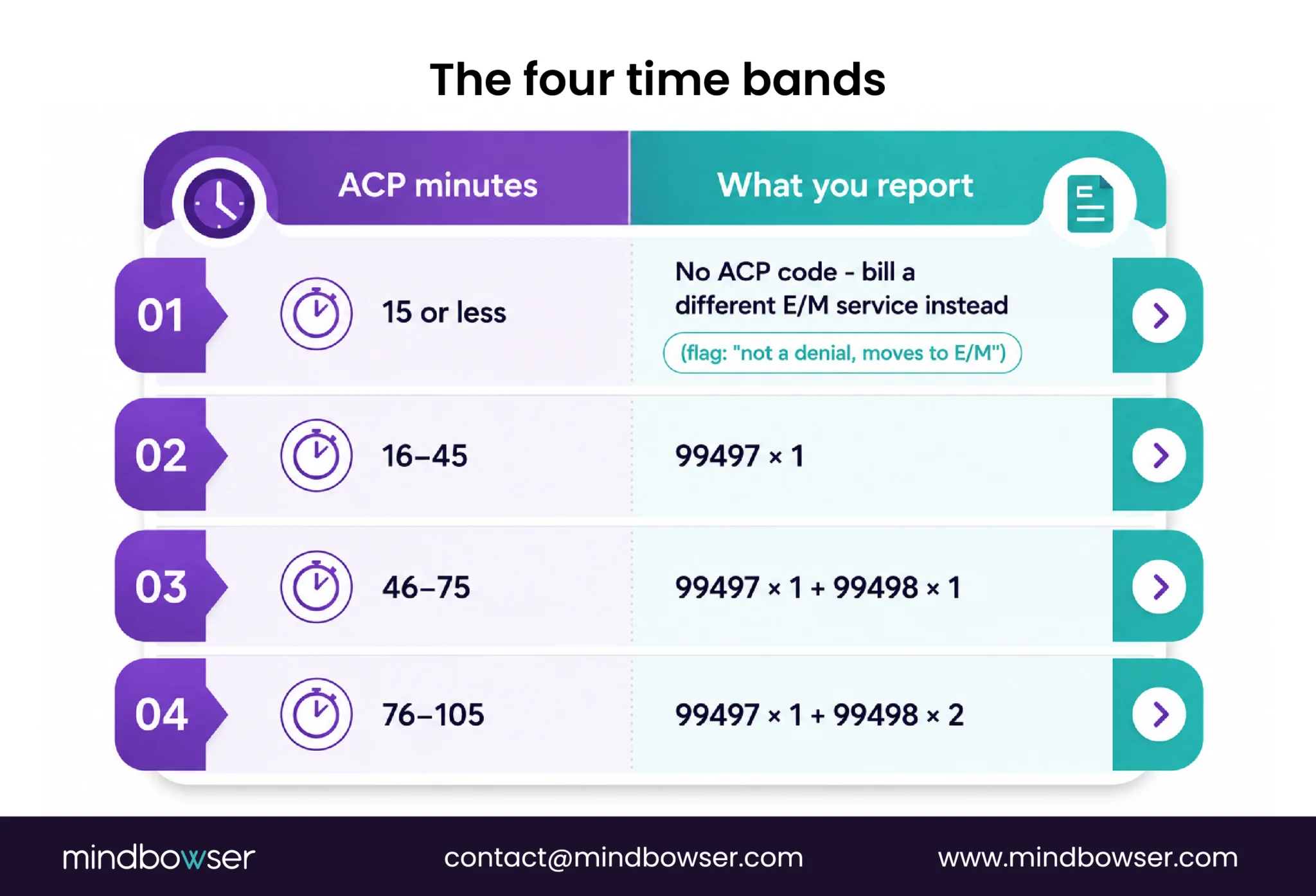
Most published guidance paraphrases the time rule. CMS sets it out as a table, so there is no derivation to argue about here. From MLN909289: “A unit of time is billable when the midpoint of the allowable unit of time passes.”
The midpoint of the first 30 minutes is 15, so the service becomes reportable at 16.
The first row is the one that gets written up wrong, and the error is a familiar shape. Under 16 minutes is commonly reported as a service you cannot bill. What CMS actually says is: “Bill a different Evaluation and Management (E/M) service, like an office visit, for an ACP discussion of 15 minutes or less.” The minutes move into the E/M, where they count toward that code’s time. A 12-minute goals-of-care conversation is billable. It is billable as E/M time.
The last row goes missing from most summaries entirely: above 75 minutes, 99498 goes to a second unit. Note that CMS’s published table stops at 105 minutes. Applying the same midpoint rule beyond it gives a third unit of 99498 at 106 minutes, and a fourth at 136. That is extrapolation from CMS’s stated logic rather than CMS guidance, so document it as such and check it with your MAC if conversations of that length are routine for you.
Worth knowing before you build a workflow around the upper bands: almost nobody reaches them. In CY2024 there were 91,226 units of 99498 against 2,700,155 of 99497. 3.4%. The 46-minute band is largely theoretical in practice, and the 16-minute band is where essentially all of the money is. If you are designing a time-capture prompt, design it for the 16-minute threshold and treat the rest as an exception path.
One practical note on maintenance: these bands do not change, but the rates attached to them change every January. Anything you print and pin up needs a November review when the following year’s fee schedule is published.
What Medicare actually pays in 2026, in both settings
Two of the most-cited references get this wrong, and the reason is worth a sentence, because in both cases the underlying source is real and the reader is the one who gets misled.
One widely used fee-schedule reference publishes what look like rates for 99497. Its numbers are commercial payer averages (United at $106.76, Cigna at $143.46, Aetna at $92.78, BCBS at $96.92) with no facility and non-facility split, no relative value units and no conversion factor. Those are real numbers about real payers. They are not the Medicare rate, and a reader looking for the Medicare rate leaves with UnitedHealthcare’s.
A frequently cited payment one-pager answers the question “how much do payers reimburse for these codes?” with “99497 = 1.5 RVUs, 99498 = 1.4 RVUs.” Those are the work RVUs. They are one of four inputs that produce a payment. The document is from 2016.
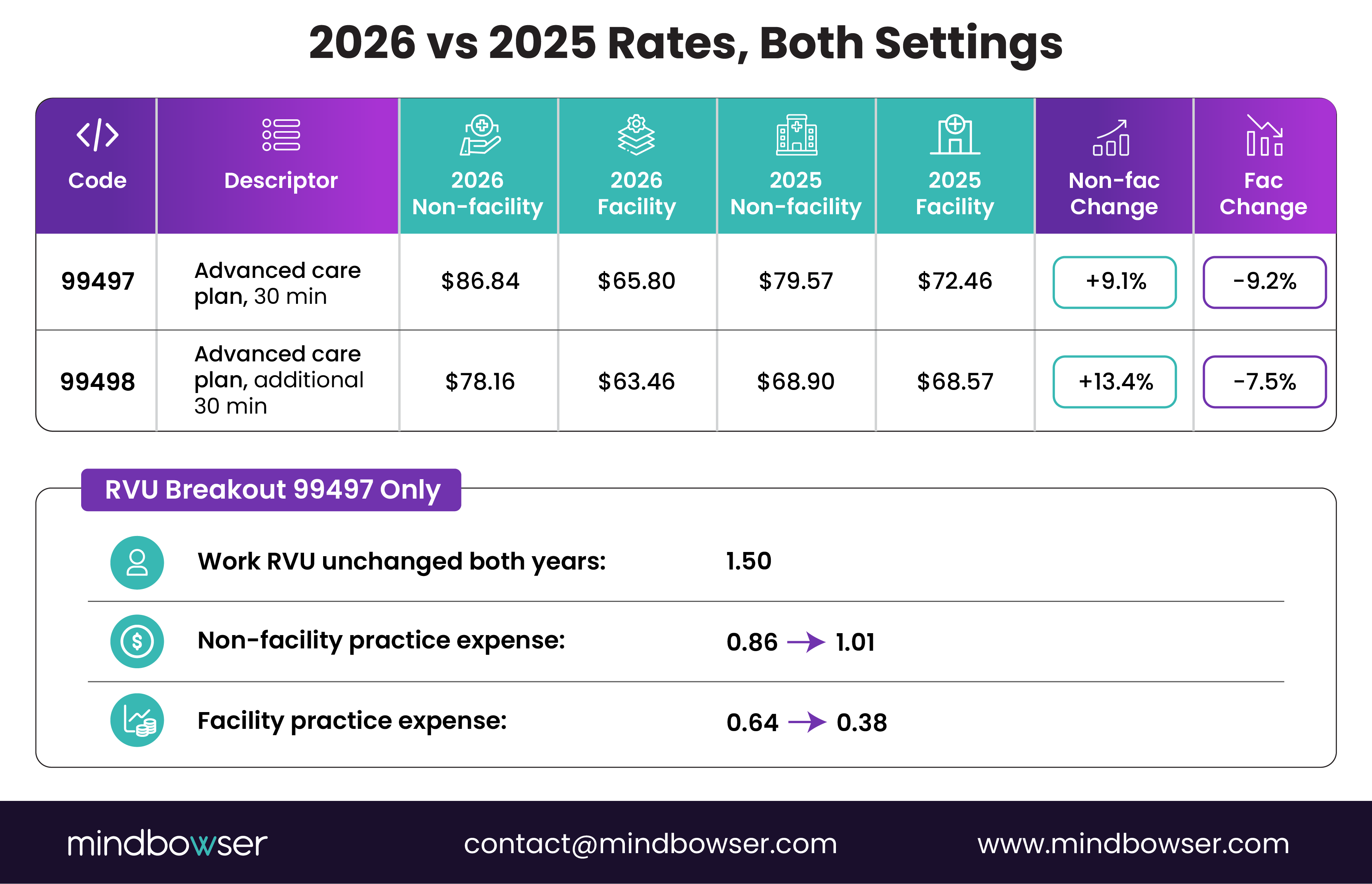
Here is the actual answer, computed from the CMS Physician Fee Schedule Relative Value Files. I used `PPRRVU2026_Jul_nonQPP.csv` and cross-checked every figure against the January release, `PPRRVU2026_Jan_nonQPP.csv`. The two agree to the RVU on both codes. Conversion factor $33.4009 for non-qualifying APM participants. These are national averages and they vary by locality.
The year-over-year movement is the part worth understanding, because it is not what most people assume. Office-based advance care planning pays 9.1% more in 2026. Hospital outpatient advance care planning pays 9.2% less.
The conversion factor rose 3.26%, which explains neither number. Work RVUs are unchanged at 1.50 and 1.40 in both years. The whole swing is practice expense: non-facility practice expense on 99497 moved from 0.86 to 1.01, while facility practice expense fell from 0.64 to 0.38. That is the CY2026 practice-expense reallocation toward office-based settings, and the same reallocation is visible across the other Medicare care management families, including transitional care management, advanced primary care management and behavioral health integration.
The practical consequence: if you are modeling advance care planning revenue across a system with both office and hospital outpatient sites, a single blended rate will be wrong in both directions. 99497 pays 32% more outside a facility than inside one.
The four conditions that make advance care planning free to the patient
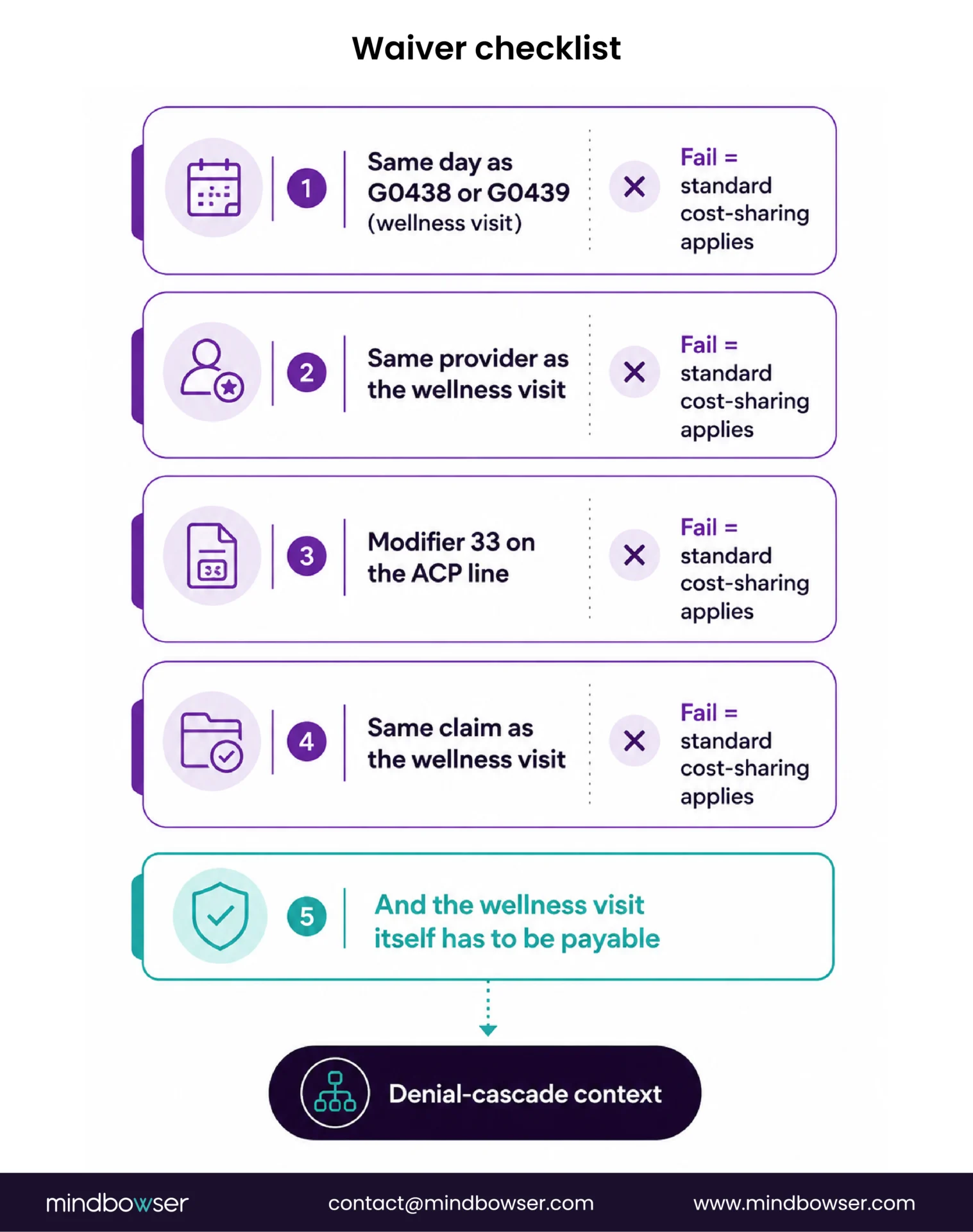
The shorthand version of this rule is that advance care planning during a wellness visit is free to the patient. The shorthand drops three of the four conditions.
CMS states it as a list. “We waive the ACP Part B deductible and coinsurance when the ACP is:”
- Provided on the same day as the covered annual wellness visit, HCPCS code G0438 (the initial wellness visit) or G0439 (every subsequent one)
- Provided by the same provider as the covered annual wellness visit
- Billed with modifier 33, the preventive services modifier
- Billed on the same claim as the annual wellness visit
All four, or the patient gets a bill.
Two precision points that matter more than they look.
CMS names G0438 and G0439. It does not name G0402, the Welcome to Medicare initial preventive physical examination, which ran 538,027 services in CY2024. I want to be careful about what that means. The booklet lists the two annual wellness visit codes and says nothing about the initial preventive examination in the context of the waiver. That is what the source says. It is not the same as CMS prohibiting the pairing, and I am not going to turn a document’s silence into a rule. If you are billing advance care planning alongside G0402 and treating the cost-sharing as waived, that is a question for your MAC, and it is worth asking before the volume builds up.
Modifier 33 is not decoration. It is the flag that tells the claims system this line is a preventive service. The most-read family practice reference on this topic tells readers the patient “has no out-of-pocket responsibility for ACP that takes place during his or her Medicare annual wellness visit.” Taking place during the visit is the first condition. Three more have to be true, and the modifier is the one a busy coder is most likely to drop. Our own annual wellness visit billing guide covers the wellness visit’s own component and frequency requirements, which are what condition one actually depends on.
Why 99497 claims get denied
This is one of the most-asked questions about the code, and the published guidance is largely silent on it. The answer has three parts.
Part one, the cascade. From MLN909289: “If we deny the AWV billed with ACP for exceeding the once-per-year limit, we’ll apply the ACP deductible and coinsurance.”
Read that carefully, because it describes a failure that does not look like an advance care planning failure. The advance care planning line is not denied. The wellness visit is denied for coming in too soon after the previous one, and the advance care planning line survives with the patient’s cost-sharing reattached. The claim pays. The patient gets a bill they were told they would not get. Nobody in the practice notices until the patient calls, and when they do, everyone looks at the advance care planning code, which was never the problem. Eligibility-check the wellness visit date and this whole class of complaint disappears.
Part two, there is no frequency limit. CMS: “There are no limits on the number of times you can report ACP for a certain patient or in a certain period.” Bill it repeatedly and the requirement is documentation of a change in health status or wishes, not a waiting period.
This is where a widely used code reference goes wrong. AAPC’s code page for 99497 tells readers the service is “billable once per year for Medicare.” It is not. What is once per year is the wellness visit that carries the cost-sharing waiver. Those are different rules about different things, and conflating them means a practice that has already done its one wellness visit stops billing advance care planning for the rest of the year, for patients whose condition is changing, on a service Medicare will pay for every time.
Part three, your payer may impose a limit even though Medicare does not. Providence Health Plan’s coding policy states: “Payment for 99497 is limited to three times within a 12-month period.” That policy covers commercial, Medicaid and Medicare Advantage lines.
So both of these are true at once: fee-for-service Medicare sets no cap, and a specific payer may. When a denial lands, the first question is which payer adjudicated it, not what the code allows. Practices running care programs across mixed payer panels hit this constantly, and it is the same class of problem as chronic care management billing, where the federal rule and the plan rule diverge and only one of them is in your billing manual.
Put the four waiver conditions in your claim path, not your checklist!
Modifier 33 or modifier 25: two questions people keep merging
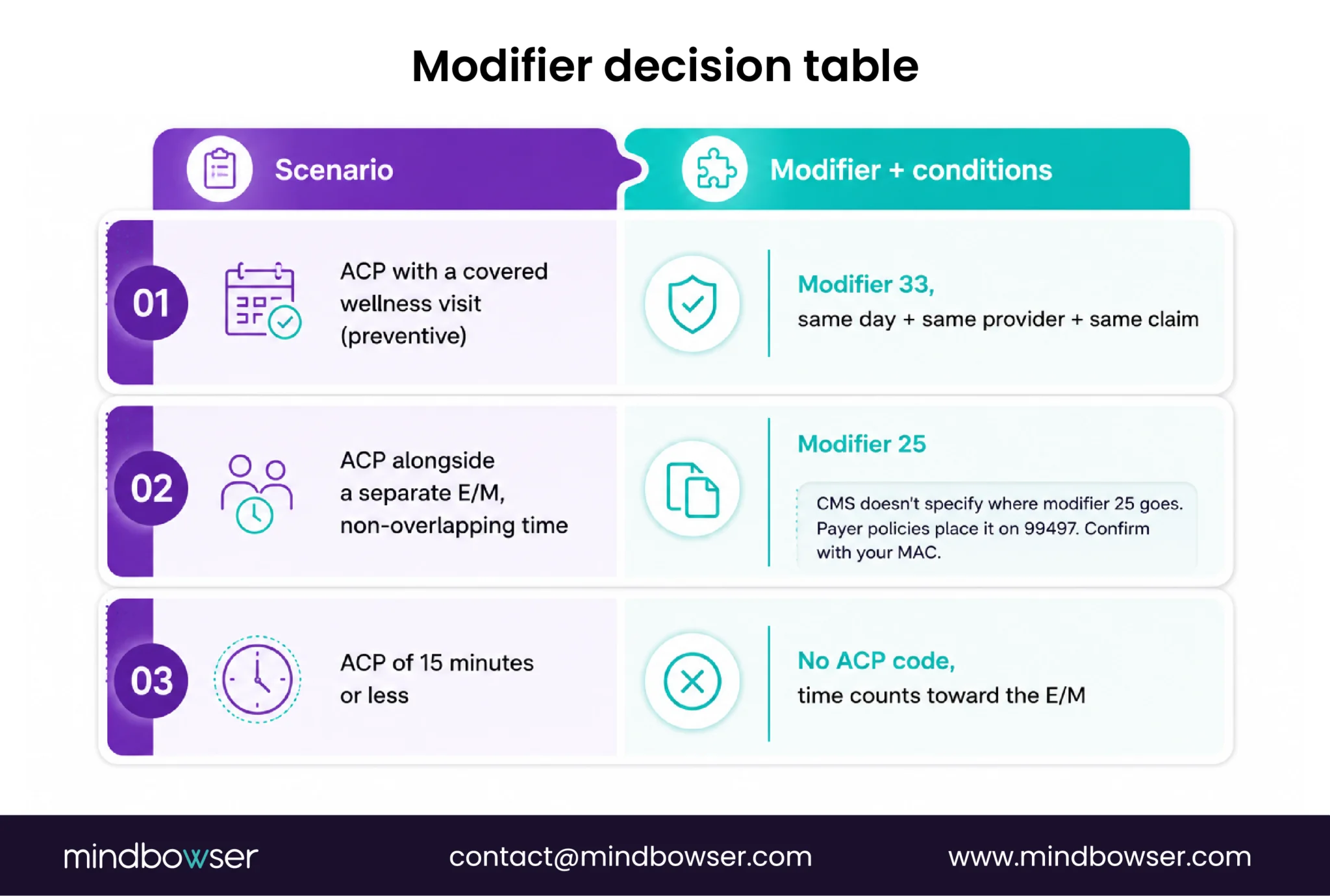
Two questions come up constantly and get treated as the same question: can you bill advance care planning with the wellness visit, and can you bill it with a regular office visit. Both are yes. They are different scenarios, they take different modifiers, and merging them is how the wrong one ends up on the claim.
Yes, you can bill an E/M and advance care planning on the same day. CMS supplies the worked example. A 68-year-old woman on multiple medications for heart failure and diabetes with a new diagnosis of mild dementia sees her physician, who adjusts her medications, and the conversation turns to long-term treatment preferences. CMS: “the physician may report the ACP codes in addition to the E/M visit code describing the active management of the heart failure, diabetes, and dementia if the ACP time doesn’t overlap with actively managing those E/M conditions.”
The non-overlap rule is the whole gate, and CMS states it three ways: discuss advance care planning issues during the time you are billing for advance care planning, do not discuss other active management during that time, and when you perform another time-based service concurrently, do not count that time twice. In practice this means one thing for your documentation: the advance care planning minutes have to be recorded as their own quantity, not inferred from total visit time. A template that captures only total encounter time cannot support both codes.
Three things here the published sources do not settle. I would rather name them than paper over them.
Where modifier 25 goes. I want to be straight about the state of the evidence rather than pick a side CMS has not picked. MLN909289 does not address modifier 25 at all. Providence’s coding policy says it “must be appended to CPT code 99497.” The Society of Gynecologic Oncology’s coding column and AAPC’s code page both also place it on 99497. Conventional CPT guidance places modifier 25 on the E/M service, since that is the code the modifier’s own descriptor describes. Three payer-facing sources point one way, the modifier’s definition points the other, and CMS has not resolved it in this booklet. Check your MAC’s guidance and your top payers’ policies, and build the rule you find into the claim scrubber rather than into individual coders’ memory.
The three-way claim. A wellness visit, a problem-oriented E/M, and advance care planning on the same day is a routine encounter, not an edge case. The sources cover the pairs and none of them covers the triple. What follows from the parts is that the advance care planning line carries modifier 33 for the preventive waiver, the problem E/M carries modifier 25 as the separately identifiable service subject to the placement question above, and all three time quantities are documented separately. That reading is mine, not CMS’s. Confirm it with your MAC before running volume through it.
What “same provider” means. The waiver requires the advance care planning to be provided by the same provider as the covered wellness visit. Whether that means the same individual NPI or the same group is the first question a biller asks, and MLN909289 does not define it. In a practice where a nurse practitioner performs the wellness visit and a physician has the goals-of-care conversation later the same day, the answer decides whether the patient owes anything. Put it in writing to your MAC.
Who can bill it, and the incident-to question
CMS’s scope statement is broad: “We allow hospitals, physicians, and NPPs whose scope of practice and Medicare benefit category include the services described by the CPT codes in Table 1 and who are authorized to independently bill Medicare for those services to bill for ACP.” The booklet defines non-physician practitioner as including “nurse practitioners, physician assistants, and clinical nurse specialists.”
Clinical nurse specialists are in that list. The 2016 CMS payment one-pager that still ranks on this topic names only physicians, nurse practitioners and physician assistants, and calls them “the only providers who can use these codes.” That omission has had ten years to propagate.
Then there is a genuine contradiction between two widely read sources, and a biller reading both would reasonably land on either answer.
The family practice reference states that “medical assistants and registered nurses are not considered QHPs for the purposes of billing for ACP.” The 2016 one-pager describes the opposite-sounding arrangement: a physician starts the conversation, hands to a nurse who works through surrogate selection with the patient, and the physician debriefs afterward, all under “incident to” rules with ongoing direct supervision.
Both are defensible, because they are about different mechanisms. The first is about who the billing professional is: a registered nurse cannot be the qualified health professional whose name goes on the claim. The second is about who may perform part of the work under the incident-to rules, with the billing professional supervising and involved. Neither source says the other is wrong. Neither says what the other is talking about either, which is why the confusion survives.
If your model involves nursing staff carrying part of the conversation, the questions to settle are the incident-to ones: was the initiating service performed by the billing professional, is supervision direct and documented, and does the note make the billing professional’s involvement visible. Those are answerable. Guessing from a coding blog is not.
Need a Quick Reference for Medicare Care Management Codes?
The diagnosis code question, and why it has a one-sentence answer
Coders ask which diagnosis code makes advance care planning payable more often than they ask almost anything else about these codes. CMS answers it in one sentence: “You don’t need to report a specific diagnosis to bill for ACP services.”
The full guidance is three sentences long. Report the condition you discuss with the patient using an ICD-10-CM code. When advance care planning is part of the annual wellness visit, that code reflects an administrative exam or an exam diagnosis, which is why the wellness visit’s own preventive diagnosis coding carries the encounter. And you do not need a specific diagnosis to bill.
So the premise behind the expensive query is mostly wrong. There is no secret code that makes the claim pay. The convention you will see most often, Z71.89 for other specified counseling, is a convention rather than a requirement, and it exists because coders need to put something in the field.
Where diagnosis coding does bite is at the MAC and payer level, where local policy can be more specific than the national rule. Medicare Administrative Contractors publish their own advance care planning coding guidance, and there is a local coverage determination on the subject, L38970, with a companion billing and coding article. If claims are being denied for diagnosis reasons, that is a local coverage question, not a CPT question.
The codes that attach around advance care planning on a wellness visit claim, including the cognitive assessment code that changes what else you can bill that day, are covered in our guide to the codes that attach to a wellness visit.
Where the conversation happens changes the rules
Two widely read references tell providers advance care planning has to happen in person. One states that advance care planning “cannot be provided via telephone or video.” The 2016 one-pager says “the conversation has to be in-person (you cannot use the code for telehealth).”
Both statements are wrong, and the primary source is a spreadsheet anyone can download.
99497 and 99498 both appear on the CY2026 Final List of Medicare Telehealth Services, with the action “Maintain.” MLN909289 independently lists advance care planning as billable “through telehealth guidelines effective at the time of service.”
Being on that list means the service may be furnished via telehealth under the telehealth conditions in force when you deliver it. It does not mean advance care planning can be done by phone under any circumstances a practice likes. The telehealth conditions still govern, and they change. What it does mean is that a practice declining to offer advance care planning by video because a reference page told them it was prohibited is leaving a payable service undelivered on the strength of a claim CMS’s own list contradicts.
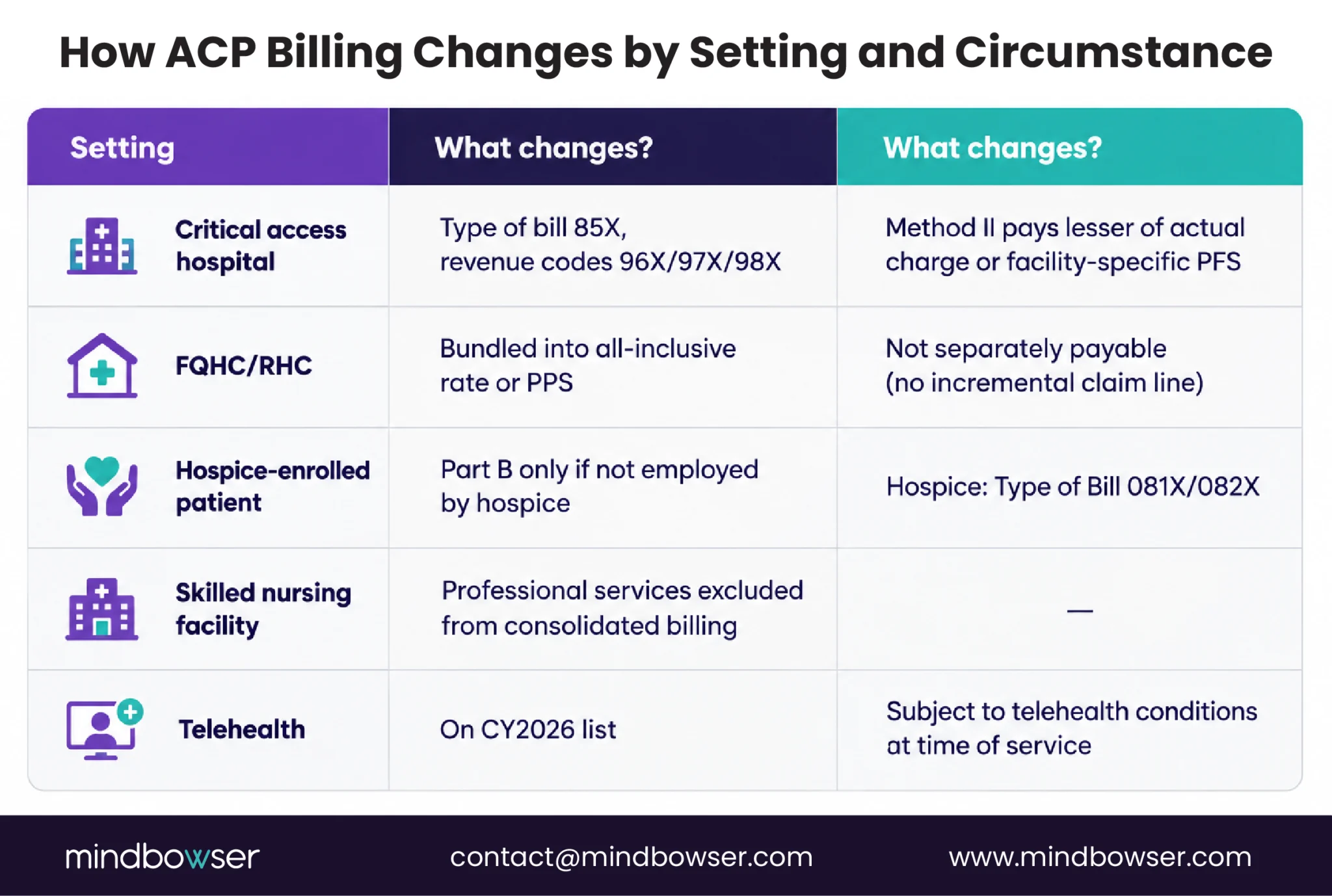
The setting rules that follow are the ones summaries skip. Advance care planning is billable “in any care setting,” including an office, a hospital, a nursing home and a patient’s home, with these specifics:
The federally qualified health center and rural health clinic row is the one that changes a business case. Advance care planning is inside the bundle there. It is part of what the all-inclusive rate already pays for, so there is no incremental claim line to capture. If you run a mixed network with both clinic types and office-based practices, the revenue model only applies to part of it.
What advance care planning is worth per 1,000 wellness visits
The arithmetic is not complicated, which is what makes the attach rate interesting.
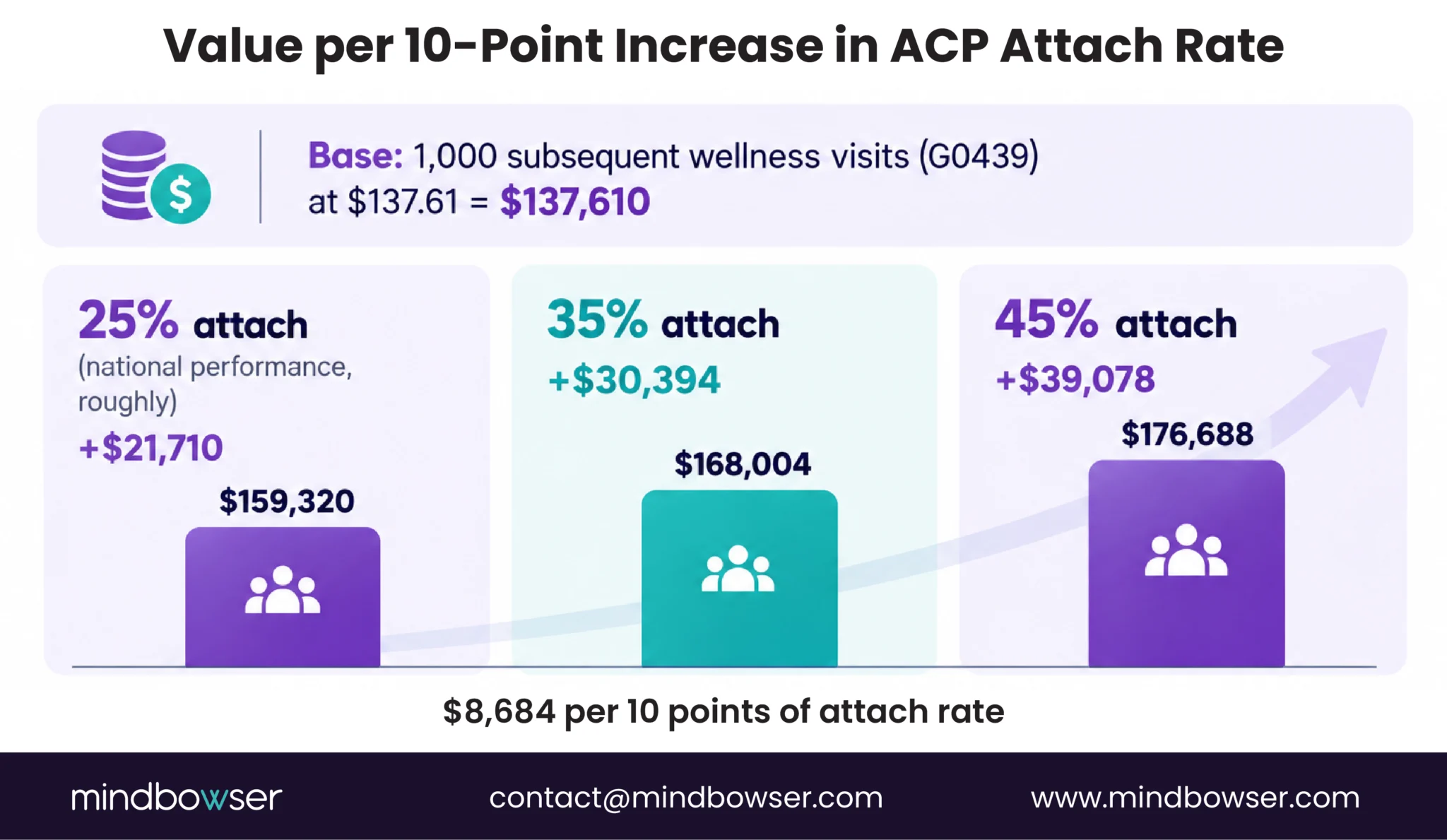
At 2026 non-facility national averages, a subsequent annual wellness visit (G0439, 4.12 total RVUs) pays $137.61. Advance care planning at 16 minutes or more adds $86.84. The encounter goes to $224.45.
Advance care planning adds 63% to a subsequent wellness visit, and under the four conditions above, it adds it at zero cost to the patient.
Size this as a rate. At the 2026 national average allowed amount, every 10 points of attach rate is worth $8,684 per 1,000 subsequent wellness visits. Moving from roughly a quarter of visits to 35% is $8,684 of additional allowed amount. Getting to 45% is about $17,400. I am deliberately not modeling 100%, because advance care planning is a clinical conversation that will not be appropriate at every visit, and a model that assumes otherwise is the kind of number that gets a business case thrown out of the room.
One caveat on the arithmetic before anyone builds a forecast on it. The 24.6% national figure is measured against both wellness visit codes combined, while this model prices every visit at the G0439 national average of $137.61. That is the right rate for most volume, since subsequent visits outnumber initial ones roughly 15 to 1 in the national data, but G0438 pays more at $174.35, so a panel with a lot of newly eligible patients has a bigger base than this model shows. Use your own code mix for a real forecast.
Why the attach rate stays where it is
In my experience looking at how provider organizations actually run these programs, it is rarely because clinicians do not want to have the conversation, and almost never because the codes are unknown. It fails at three specific places, and all three are upstream of the coder.
Nobody flags the candidate before the visit. The patient most likely to benefit from a goals-of-care conversation is identifiable from the chart days before they arrive. If that identification happens during the visit, it competes with everything else on a wellness visit agenda and usually loses.
The minutes are not captured as their own quantity. A note that records total encounter time cannot support a 16-minute threshold or the non-overlap rule. This is the single most common reason a conversation that happened is not a claim that pays.
The claim construction is a separate step no EHR does by default. Modifier 33, same provider, same claim as the wellness visit. Each is trivial. Together they are a rule that has to be enforced somewhere, and if it is enforced in a coder’s memory it will be enforced inconsistently.
What is already built, and what is not. Pre-visit identification and structured intake run in production in tools like HealthCheck AI, where our own deployment data shows roughly a third higher check-up completion and half the manual outreach volume, and the connectivity to read the wellness visit schedule out of the EHR and write documentation elements back runs through ConnectHealth. Those are the parts you configure rather than build.
The advance care planning specifics are not. Time capture measured against a 16-minute threshold, the modifier 33 plus same-claim construction, and the eligibility flag that says this patient is a candidate today have no pre-built component in our catalog. That part is a custom build, and I would rather say so than describe a demo that does not exist. Practices generally have three options here: rent a point platform and accept its logic, configure the pre-built pieces where they cover the workflow, or build the rules into the stack you already run. For advance care planning the honest answer is a mix, and the ratio depends on how much of your wellness visit workflow is already instrumented.
This is the same problem shape as every other Medicare care program. The rule is knowable and written down; the failure is that nothing in the workflow makes it fire. How advance care planning interacts with the other programs a patient may be enrolled in is covered in our guides to Medicare care program stacking rules and transitional care management. Where the constraint is that documentation and claim logic live in systems that do not talk to each other, it becomes an EHR integration question, and where the rule needs to live in the claim path rather than in someone’s checklist, a custom medical billing software build.
Before you spend anything on any of that, do two queries.
Query one. Pull your G0438 and G0439 volume for the last 12 months, pull your 99497 volume for the same period, and divide. Near 24.6% and you are average.
Query two, which is the one that matters. Narrow to just the advance care planning lines that sat on the same claim as a G0438 or G0439, since those are the only ones the waiver could ever have applied to, and count how many carried modifier 33. Anything short of all of them is a patient who was billed for a conversation that should have cost them nothing. Most organizations have never run this query, and it takes about ten minutes.
If the second number surprises you, start a conversation with our team and we will walk through what it takes to move it.