













 BLOGS
BLOGS  NEWSROOM
  CASE STUDIES
  WEBINARS
  PODCASTS
  ASSET HUB
  EVENT CALENDAR
























TL;DR
- G0136 stopped being the social determinants of health code on January 1, 2026. It is now the physical activity and nutrition assessment. As of August 2026 both AAFP pages on the code still describe the retired version, and so does one of CMS’s own MLN articles.
- You may bill 99483 in the same visit as the AWV, with modifier 25. CMS says so directly. The widely repeated claim that it requires a separate visit is wrong.
- 99483 knocks three of these codes off your own claim for that date: 96160 and 96161, advance care planning, and office or outpatient evaluation and management. CMS’s full same-day exclusion list runs to seven groups and is reproduced below.
- 2026 national averages, non-facility, varying by locality: G0439 $137.61 · G0136 $20.04 · G0444 $18.70 · 99497 $86.84 · 99483 $292.93 · 96160 $3.01.
- A subsequent AWV billed with the three add-on lines it most often carries comes to $263.19. Billed on its own it comes to $137.61.
I build claim logic for provider workflows, so the question reaches me in a particular form. Nobody asks me what CPT 99483 means. They ask what else they can put on the annual wellness visit claim, and whether the thing they put on it last month is why the whole encounter came back denied.
That question has no good answer online. Every page that ranks for these codes covers a single code. AAFP has separate pages per code. AAPC has separate pages per code. CMS has separate pages per code. The medical societies and the Medicare Administrative Contractors publish per-code fact sheets. Google knows the real question, because on three of the four codes here it surfaces a version of “can you bill this with G0439” in People Also Ask.
So this page is about the encounter, not the codes. What can sit on one annual wellness visit claim, what quietly removes something else, and which line needs a modifier.
G0136 is the physical activity and nutrition code now
Start here, because it is the change most likely to be costing you money right now.
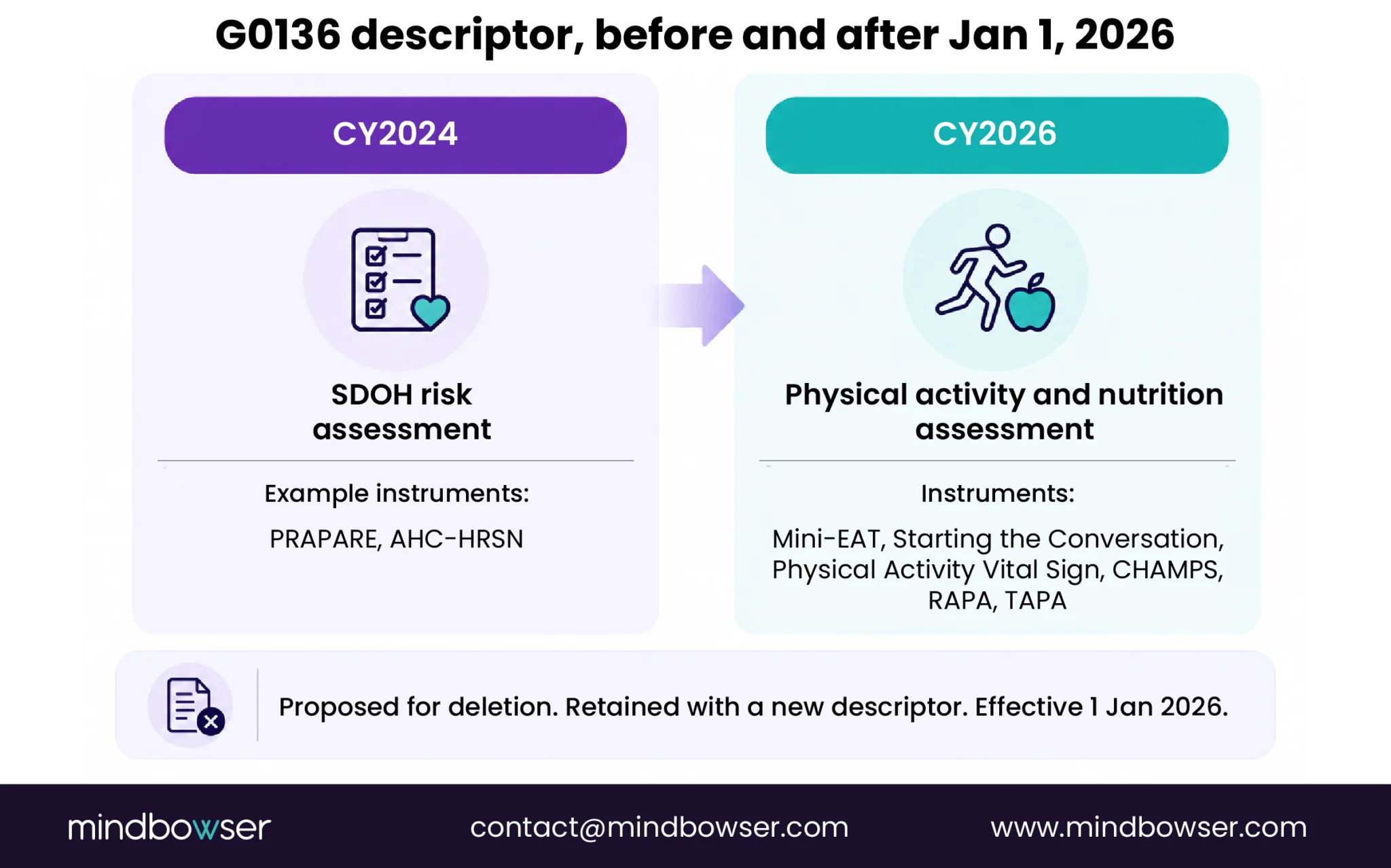
CMS created G0136 in the CY2024 fee schedule as the social determinants of health risk assessment. In the CY2026 proposed rule it moved to delete the code entirely. After comments, it kept the code and rewrote the descriptor instead. CMS’s own MLN summary of the final rule puts it plainly:
We’re finalizing a new code descriptor for HCPCS G0136 focusing on the essential patient behaviors of physical activity and nutrition with an aim to reduce chronic disease and improve health.
The current descriptor, from the CMS annual wellness visit page
The instruments changed with it. CMS now names Mini-EAT and Starting the Conversation for nutrition, and the Physical Activity Vital Sign, the CHAMPS questionnaire, RAPA and TAPA for physical activity. A PRAPARE or AHC-HRSN screen, which is what most practices built their G0136 workflow around in 2024, is not an assessment of physical activity and nutrition.
This change has propagated unevenly, which is the practical problem. Some references carry it: a University of Texas Medical Branch faculty practice bulletin from January 13, 2026, and CodingIntel. Widely used ones do not. As of August 2026 both AAFP pages on G0136 still describe the SDOH assessment, and so does CMS’s own MLN Matters MM13486, last revised in October 2024 and still published.
If your internal coding reference was written before 2026, assume it is on the old descriptor until you have checked it.
What can actually sit on one AWV encounter
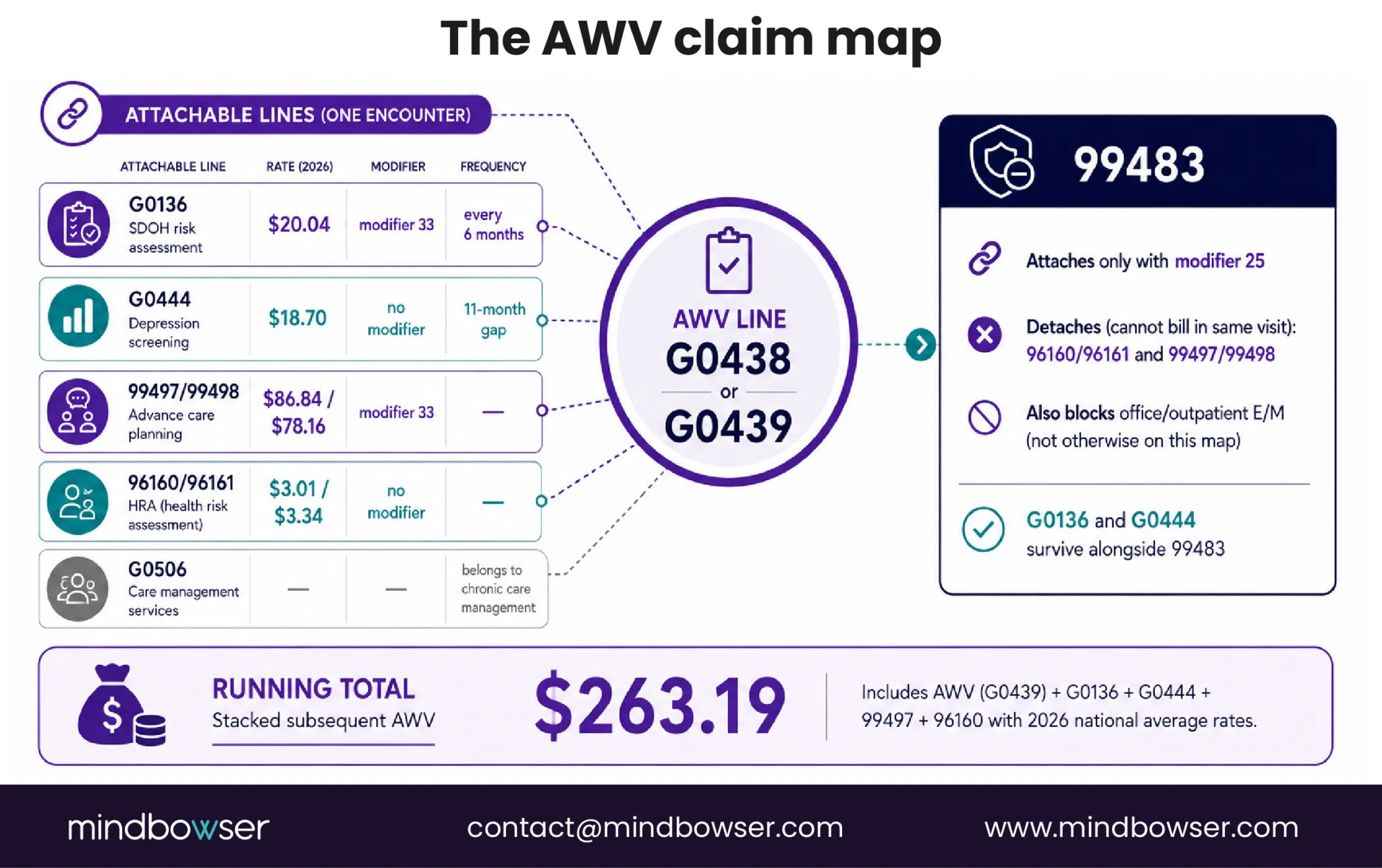
The AWV codes themselves pay the same in both settings. G0438 and G0439 carry identical facility and non-facility totals, as do 96160 and 96161. For the AWV codes that is unusual, because they carry substantial physician work and most such codes are paid less in a facility. Across the paid codes on the table the two diverge, and by wildly different amounts: non-facility exceeds facility by 23% on 99498, by 73% on 99483, and by 150% on G0136. So the setting caveat that matters on every other line of the claim does not bite on the AWV line itself.
Administration of a standardized, evidence-based assessment of physical activity and nutrition, 5-15 minutes, not more often than every 6 months
96160 pays $3.01, and the caregiver version pays more than the patient version. Billers ask constantly whether Medicare pays for 96160 at all. It does. The code is status A on the 2026 fee schedule, carrying a ZZZ global indicator, which means it is always reported alongside another service rather than on its own. It is worth roughly the price of a coffee. Practices that built a whole HRA capture workflow expecting revenue from 96160 built it for the wrong reason. The reason to capture the HRA well is that it drives the AWV, and the AWV pays $137.61.
G0468 carries status X on the fee schedule, meaning it appears in the file as a statutory exclusion with no relative values and no PFS payment. Federally qualified health centers are paid for the AWV under the FQHC prospective payment system instead, so none of the dollar figures above apply to them. That is a different page and it belongs with the AWV hub.
Do the arithmetic on a subsequent AWV carrying the three add-ons it most often earns. At the national average, non-facility, G0439 at $137.61, plus G0136 at $20.04, plus G0444 at $18.70, plus advance care planning at $86.84, comes to $263.19. The same encounter billed as G0439 alone is $137.61. The gap of $125.58 per encounter comes from real work: three services the clinician very likely performed and did not put on the claim. Multiplied across a panel, this is care-gap arithmetic applied to the claim.
Talk to us about claim composition if the gap between what your clinicians do and what your claims carry is the problem you are actually trying to solve.
G0136: physical activity and nutrition
Five to fifteen minutes, standardized and evidence-based, not more often than every six months.
Bill it with modifier 33 on the same AWV claim. CMS sets two conditions for waiving the Part B coinsurance and deductible: the assessment is provided on the same day by the same AWV provider, and it is billed with modifier 33 on the same AWV claim. Both, not either. The modifier is how the claim declares the service preventive, so the practical risk of omitting it is cost sharing landing on a patient who was told the visit was free.
There is a second coverage route with a different financial outcome, and it is easy to misread. CMS covers G0136 once every six months when you furnish it with an evaluation and management or behavioral health service on the same claim with the same date of service. In that case the patient’s deductible and coinsurance apply. The cost-sharing waiver is once a year and it is attached to the AWV, not to the code. So the same code, delivered twice in a year, is free to the patient once and billable to them once.
Documentation is the descriptor. A standardized, evidence-based instrument, administered, with the result in the record. An unstructured conversation about diet is not this code.
Are You Capturing the Right AWV Add-On Codes?
G0444: depression screening, and the rule that is narrower than it sounds
There is an awkward fact underneath this code. Reviewing depression risk factors is already a required element of the annual wellness visit. So is detecting cognitive impairment. Two of the codes on this page pay for work you have to do anyway, which is a strange thing for a billing page to admit and it is the first thing you should understand about them. G0444 pays for administering a screening instrument, with staff-assisted depression care supports in place to act on the result. Noticing during the visit is already inside the AWV payment.
The co-billing rule is where published guidance goes wrong. Search for whether you can bill G0444 with an AWV and you will be told, confidently, that you cannot bill it on the same day as the initial AWV. I could not find that rule in any primary source. It is not in the Medicare Claims Processing Manual Chapter 18, which is where G0444’s coverage rules live, and there is no G0438 versus G0439 distinction anywhere in section 190.
What the manual does say is more useful. Section 190.2 sets the frequency: no more than once in a 12-month period, and 11 full months must elapse following the month of the last screening. Section 190.3, effective January 1, 2025, restricts the place of service to codes 02, 10, 11, 19, 22, 49 and 71. Read that list closely, because two entries for the home sit on opposite sides of the line. Telehealth delivered in the patient’s home, place of service 10, is payable. An in-person screen in the home under place of service 12 is not, and neither is one in a skilled nursing facility. Those are denied on place of service alone, regardless of everything else on the claim.
The bundling question is answered in Chapter 12 of the 2026 NCCI Policy Manual, and it is a duplication test rather than a date ban:
If a patient presents with symptoms suggestive of depression, the provider/supplier shall not report G0444 in addition to the E&M, psychiatric diagnostic, or psychotherapy service code. The time and work effort devoted to the HCPCS code screening, intervention, or counseling service must be distinct and separate from the time and work of the E&M, psychiatric diagnostic, or psychotherapy service. Both services may occur at the same patient encounter.
So in an office, a screen administered as a screen, distinct from the visit work, goes on the claim. Rural health clinics and FQHCs are the exception, and only in one circumstance: Chapter 18 instructs contractors to deny G0444 for an RHC or FQHC when it is reported with another encounter or visit on the same line-item date of service, using CARC 97, the benefit is included in the payment for another service. On a date with no other encounter it is reportable. The flat denial is real, and it binds two settings on one condition rather than everybody always.
99483: the code that cancels the others
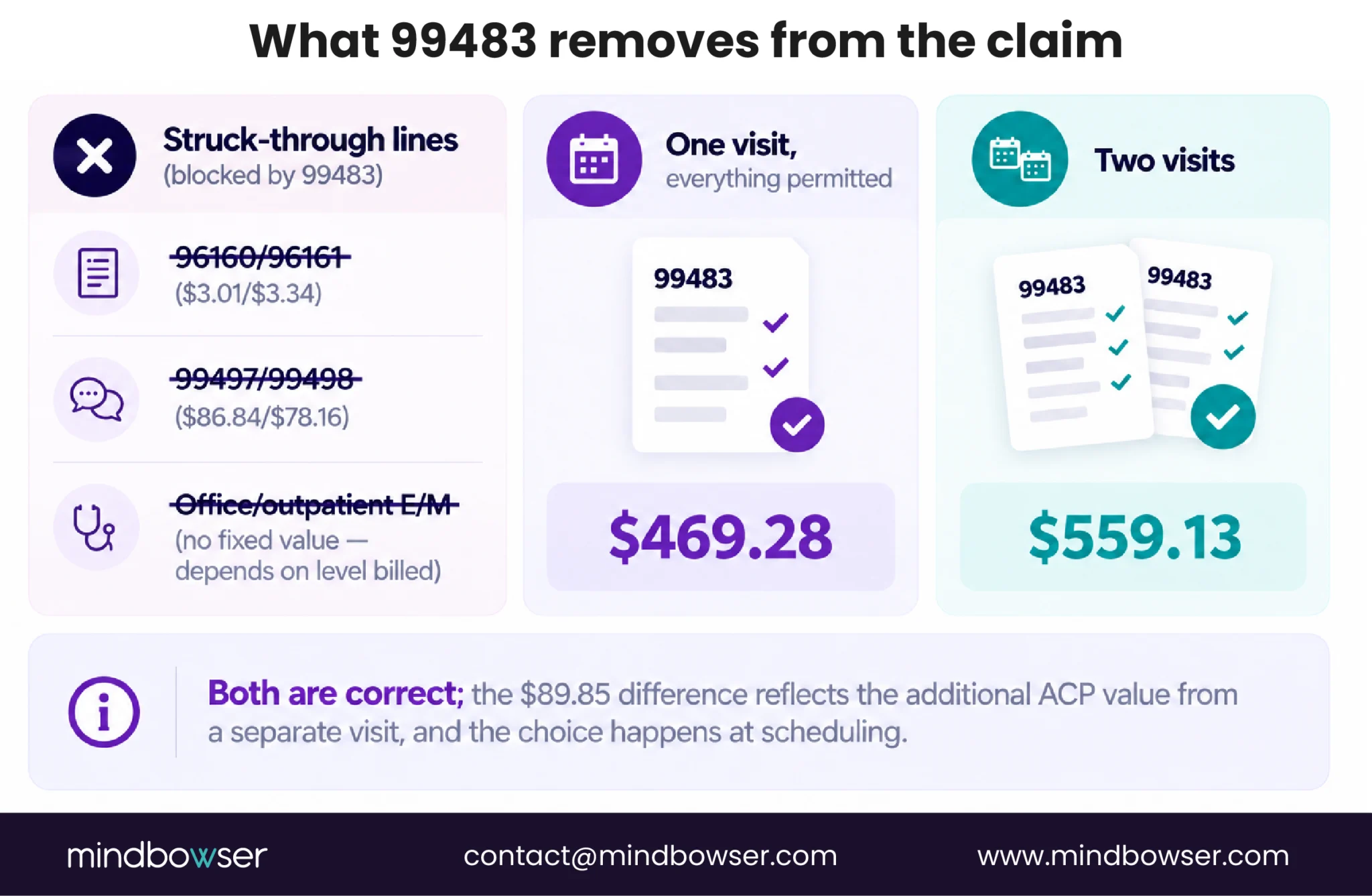
This is the largest number on the page and the one that changes how you build the rest of the claim.
First, the correction. A great deal of published billing guidance says 99483 cannot be performed on the same date as the annual wellness visit and requires a separate appointment. The CMS cognitive assessment and care plan services page, updated May 20, 2026, says the opposite in two sentences:
You may bill 99483 separately from the AWV. If you choose to perform the AWV along with the cognitive assessment and care plan service in the same visit, add modifier 25 to the claim.
Second, the part almost nobody publishes. CMS lists the services you cannot report on the same day as 99483, and three of them are codes discussed on this page. Read the scope carefully: this constrains what the reporting practitioner puts on their own claim for that date, which is also how the correct-coding edits enforce it. It is not a rule that a different practitioner in a different practice cannot see the patient that day.
- 96160 and 96161, health risk assessment
- 99497 and 99498, advance care planning
- 99202 to 99215, office and outpatient evaluation and management
- 99341 to 99350, home visits
- 90785, 90791 and 90792, psychiatric services
- 96127, brief emotional and behavioral assessment
- 96146, automated psychological testing
Where it does appear it is a bare set of code numbers with no explanation of what it costs you. Read it against the claim map and the consequence is concrete. Note first what is not on that list: G0136 and G0444 survive alongside 99483, so a combined visit still carries them.
One visit, everything permitted: G0439 $137.61, plus 99483 $292.93, plus G0136 $20.04, plus G0444 $18.70, is $469.28. Advance care planning and the HRA codes are foreclosed.
Two visits: the stacked wellness visit at $263.19, and the cognitive assessment on a later date at $292.93, is $556.12.
At the national average, the second is worth $86.84 more, which is exactly the advance care planning the combined visit gives up. Both are legitimate. They are different encounters, and the choice gets made at scheduling, before the patient arrives, by whoever books the appointment. Booking the combined visit without knowing that is how a practice gives up the difference without deciding to.
The other requirements are strict and are where the service actually fails. An independent historian must be present: a parent, spouse, guardian or another individual who can supply history the patient cannot reliably give. No independent historian, no 99483. CMS describes a typical 60 minutes face to face, covering ten elements including functional assessment of activities of daily living, standardized dementia staging with an instrument such as the FAST or the Clinical Dementia Rating, medication reconciliation for high-risk drugs, a safety evaluation covering the home and driving, and identification of caregiver support.
Above 60 minutes, add G2212 at $34.07. CMS states this directly on the same page, which is worth flagging because G2212 is otherwise the prolonged-service add-on for 99205 and 99215, and both of those sit on the exclusion list above. The add-on is permitted with 99483; the office visit codes it normally attaches to are not. Clinicians who can report evaluation and management services can furnish it: physicians, nurse practitioners, clinical nurse specialists and physician assistants. It is payable in the office, a private residence, a care facility, a rest home and via telehealth.
Where the health risk assessment sits
Short section, because the depth belongs elsewhere and because the honest answer is that 96160 is not really an AWV code.
96160 covers administration of a patient-focused health risk assessment instrument, with scoring and documentation. 96161 covers the caregiver-focused version. Neither is Medicare-specific and neither was written for the wellness visit. The specialty societies publishing guidance on it make that clear: the American College of Allergy, Asthma and Immunology on when allergists may use it, and the American Academy of Child and Adolescent Psychiatry on screening codes in child psychiatry. It is a general screening administration code used across specialties, and the wellness visit is one context among many.
The AWV’s own health risk assessment requirement is not 96160. CMS requires an HRA as a component of the visit, collecting demographic data, self-assessment of health status, psychosocial and behavioral risks, and activities of daily living. That requirement is satisfied inside the AWV payment. Billing 96160 alongside is possible and adds $3.01. It also collides with 99483 on the same day, which at $292.93 is worth nearly a hundred times as much.
The instrument capture problem is worth solving on its own merits, for the AWV it feeds and not for the $3.01.
Related Read: The Medicare AWV Health Risk Assessment: Required Every Visit, Coded on 2%
Modifier 25, modifier 33, and which line carries which
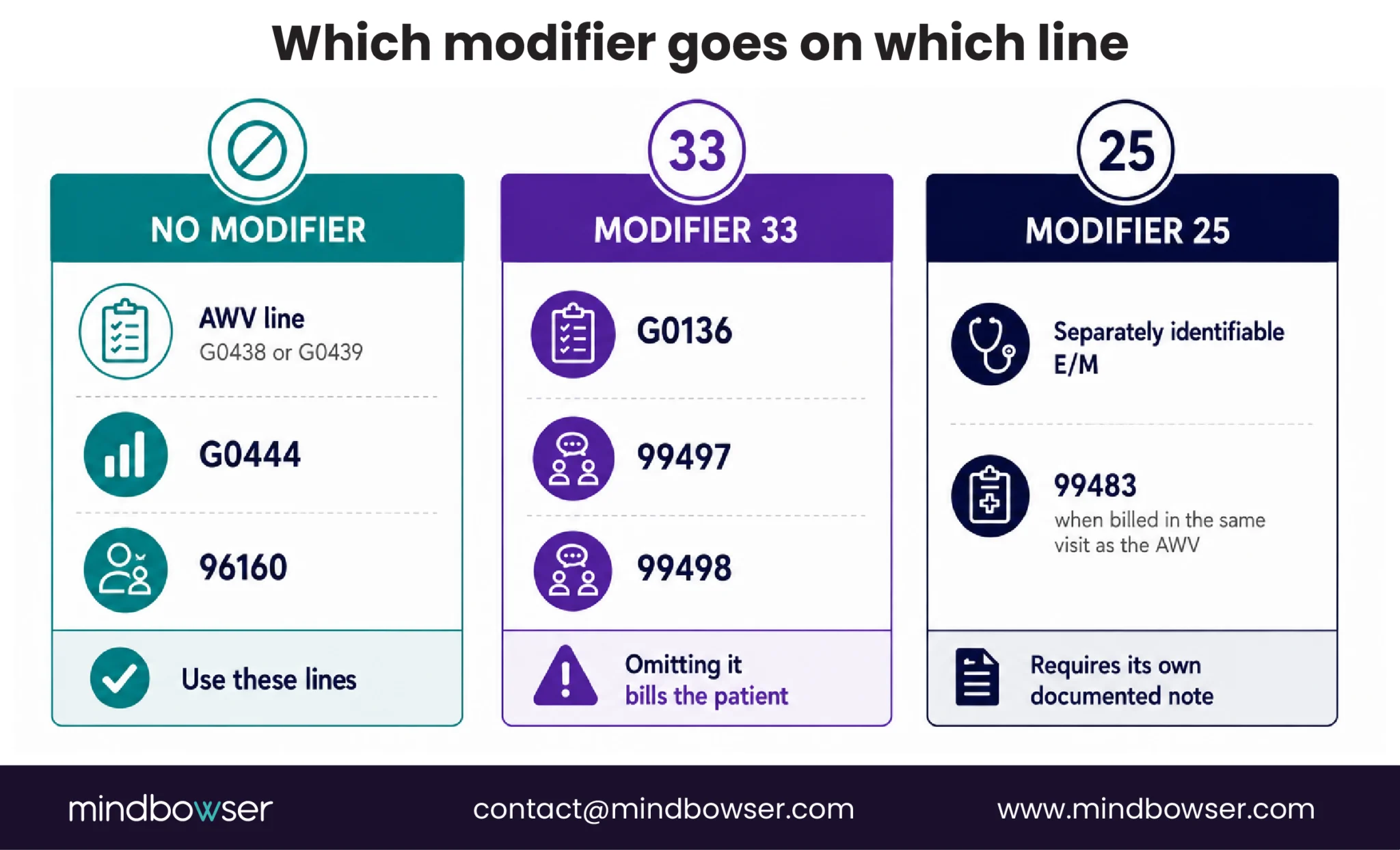
Two modifiers, two entirely different jobs, and they are the most common thing to get wrong on this claim.
Modifier 33 is about money changing hands. It marks a preventive service so the patient’s coinsurance and deductible are waived. On this claim it goes on advance care planning and on G0136. Leave it off and the waiver does not apply, and a patient who was told their wellness visit was free receives a bill. The waiver carries four separate conditions and the modifier is only one of them, which is a common way the waiver quietly fails; the advance care planning billing guide works through all four.
Modifier 25 is about work. It marks a significant, separately identifiable service performed on the same day. It goes on an office or outpatient E/M code, 99202 to 99205 or 99211 to 99215, when a medical problem is addressed at the wellness visit and documented as separately identifiable with its own note. One exception matters and it is easy to miss: those same E/M codes sit on 99483’s same-day exclusion list, so if you are reporting 99483 for that date you cannot also report a problem E/M on your claim, modifier 25 or not. It also goes on the claim when 99483 and the AWV are performed in the same visit.
On which line, though, CMS does not say. Its instruction is only to “add modifier 25 to the claim.” The AWV codes are not evaluation and management codes and 99483 is the service carrying the E/M-equivalent work, so the prevailing convention appends the modifier to the 99483 line. That is a convention rather than a published rule, so confirm it with your own contractor before you change a scrubber. It is listed with the other open questions at the end.
The order that keeps this straight: the AWV line carries no modifier. Preventive add-ons carry 33. Problem-oriented work carries 25.
One diagnosis question, because it comes up constantly. For the AWV itself, for advance care planning as an AWV element, and for G0136, CMS is explicit that no specific diagnosis code is required. You may choose any diagnosis code consistent with the exam. The anxiety is real and mostly misdirected.
Talk to us about the coding layer if these modifier rules are being applied by memory rather than by the system.
Four clocks, and the denials they produce
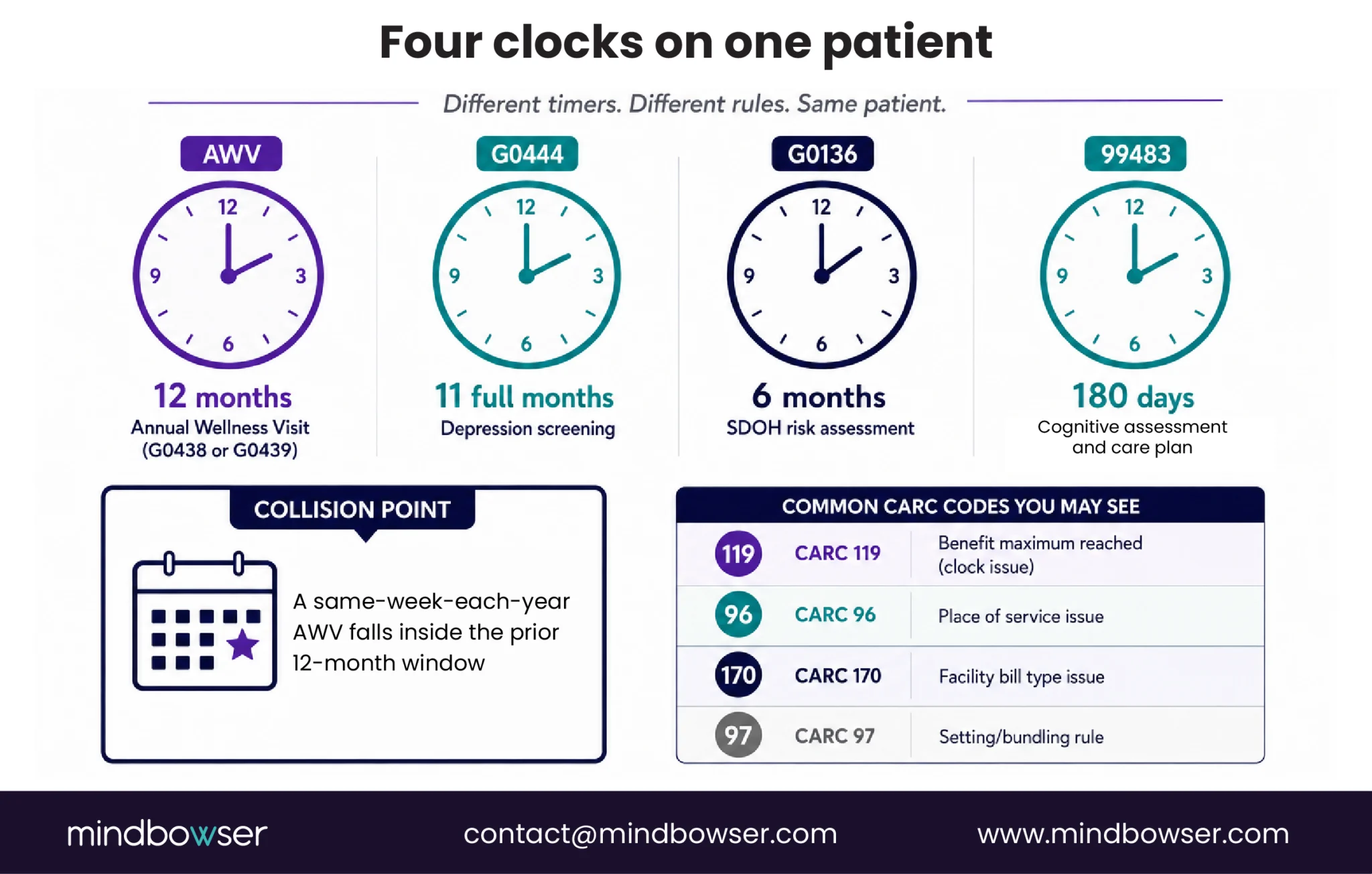
Every code here runs on its own calendar, and the calendars do not line up.
- The AWV runs on 12 months. Chapter 18 section 140 words it as an eligible beneficiary who “has not received either an IPPE or an AWV providing PPPS within the past 12 months.” G0438 once in a lifetime, G0439 once per 12 months, and CMS instructs providers not to bill G0438 or G0439 within 12 months of a G0402 initial preventive physical exam for the same patient.
- G0444 runs on 11 full months, which is a different rule and not a rounding of the same one. Section 190.2 states that 11 full months must elapse following the month of the last screening, and the Common Working File counts them that way. Several other Medicare preventive benefits use this 11-month formulation; the AWV does not.
- G0136 runs on 6 months, with the cost-sharing waiver running on 12.
- 99483 is typically once per 180 days.
A practice that schedules the wellness visit at the same time each year, which is the sensible thing to do operationally, will hit the AWV’s 12-month edge repeatedly. Chapter 18 spells out what comes back: CARC 119, benefit maximum for this time period or occurrence has been reached, with RARC N362 and Medicare Summary Notice 20.5. Wrong place of service on G0444 returns CARC 96, non-covered charge. The RHC and FQHC same-date bundling returns CARC 97. Chapter 18 also restricts which facility bill types may carry G0444 at all, to 13X, 71X, 77X and 85X, and a claim outside those returns CARC 170, payment is denied when performed or billed by this type of provider.
Those four reason codes are the ones you will see most on this claim, and they are diagnostic. CARC 119 means a clock, CARC 96 means a place of service, CARC 170 means a facility bill type, CARC 97 means a setting rule. A denial queue that groups by CARC tells you which of the four you have a systemic problem with, which is considerably more useful than a denial rate.
Building this into a workflow, honestly
The rules above are stable, checkable and mostly public. The reason practices still lose the money is that the decision happens at the wrong moment. By the time a coder sees the encounter, the independent historian was not in the room, the depression screen was a conversation rather than an instrument, and the scheduling choice between stacking the AWV and reserving 99483 for a later date was made by default.
So the useful place to put logic is before the visit, not after it. Concretely, that means four checks against data you already hold: the last AWV, IPPE, G0444, G0136 and 99483 dates from claims history to resolve the four clocks; the place of service against G0444’s permitted list; whether an independent historian is expected, which is a scheduling field; and whether the instruments captured actually match the current descriptors, which after January 1 means a physical activity and nutrition tool rather than an SDOH screen.
Two of those are standard integration work. Reading prior service dates and place of service out of an EHR is a well-trodden path through FHIR `Encounter`, `Procedure` and `Coverage` resources, and it is the same plumbing that feeds any care program eligibility check. ConnectHealth covers that connectivity layer as a product.
The other two are not. There is no packaged component in our catalog for AWV claim composition or preventive-code eligibility routing, and I would rather say that than imply one exists. The modifier logic, the 99483 tradeoff and the instrument-to-descriptor matching are a custom build every time, because they depend on how a given practice schedules, who administers instruments, and which MAC adjudicates. Anyone who tells you this configures out of the box has not read the place of service list.
The rest of the claim has somewhere to go. G0506 sits on this claim but belongs to chronic care management, which runs on its own code set and its own eligibility rules, and a positive depression screen has a destination of its own in behavioral health integration. Stacking across the Medicare care programs is its own set of rules. One last warning while you are here: 99484 turns up in a lot of published AWV code lists and does not belong on this claim at all. It is a behavioral health integration code.
Request an assessment if you want the eligibility layer mapped against your own claims history before anyone writes code.
Building Technology That Supports Long-Term Healthcare Goals
Successful healthcare technology decisions require balancing innovation, operational needs, scalability, and long-term adaptability. The right approach depends on understanding business goals, workflow requirements, integration challenges, and future growth needs.
By evaluating these factors early, healthcare organizations can choose technology strategies that improve efficiency, support better workflows, and create a stronger foundation for sustainable digital transformation.