





 BLOGS
BLOGS  NEWSROOM
  CASE STUDIES
  WEBINARS
  PODCASTS
  ASSET HUB
  EVENT CALENDAR





















TL;DR
- Oracle Health ended DSTU2 support in December 2025: every Cerner Millennium FHIR API now requires R4.
- 14+ resources changed names between DSTU2 and R4 (MedicationOrder to MedicationRequest, DiagnosticOrder to ServiceRequest, and more), and a line-by-line mapping audit is step one, not step three.
- SMART on FHIR plus OAuth 2.0 is now mandatory in R4. Apps that got by on looser DSTU2 auth need a real rebuild, not a config change.
- CMS-0057-F sets a January 2027 compliance deadline for provider-to-payer data exchange, so this migration isn’t optional for anything that touches provider data.
In December 2025, Oracle Health ended DSTU2 support across its Millennium FHIR APIs. If your app was still calling Cerner’s DSTU2 endpoints, you’re in a race now, whether you planned for it or not.
I’ve sat on the other side of this exact call. An integration engineer opens their CI/CD pipeline on a Monday morning, sees a wall of 401s on endpoints that worked fine for two years, and spends the next hour figuring out whether it’s their code or Cerner’s. It’s not their code. It’s the sunset date they didn’t have on a calendar.
This isn’t a “what is FHIR” primer. If you’re reading this, you already know what FHIR is and you already know DSTU2 is dead. What you need is the mechanics: what actually changed, what breaks first, and the order to fix it in.
Why Cerner Deprecated DSTU2 (and Why January 2027 Is the Real Deadline)
Oracle Health’s DSTU2 deprecation didn’t happen in isolation. It landed at the same time as two federal rules that make R4 the only viable target, not just Cerner’s preferred one.
- Oracle Health ended DSTU2 support on its Millennium FHIR APIs in December 2025, confirmed on the Oracle Health developer portal.
- ONC’s HTI-1 final rule (2024, 89 FR 1192) mandates FHIR R4 and USCDI v3 for certified EHR technology.
- CMS-0057-F (2024, 89 FR 8758) sets a January 2027 compliance deadline for provider access APIs, and it requires FHIR R4.
- TEFCA is now operational with 11 designated QHINs connecting thousands of organizations, all exchanging on FHIR R4.
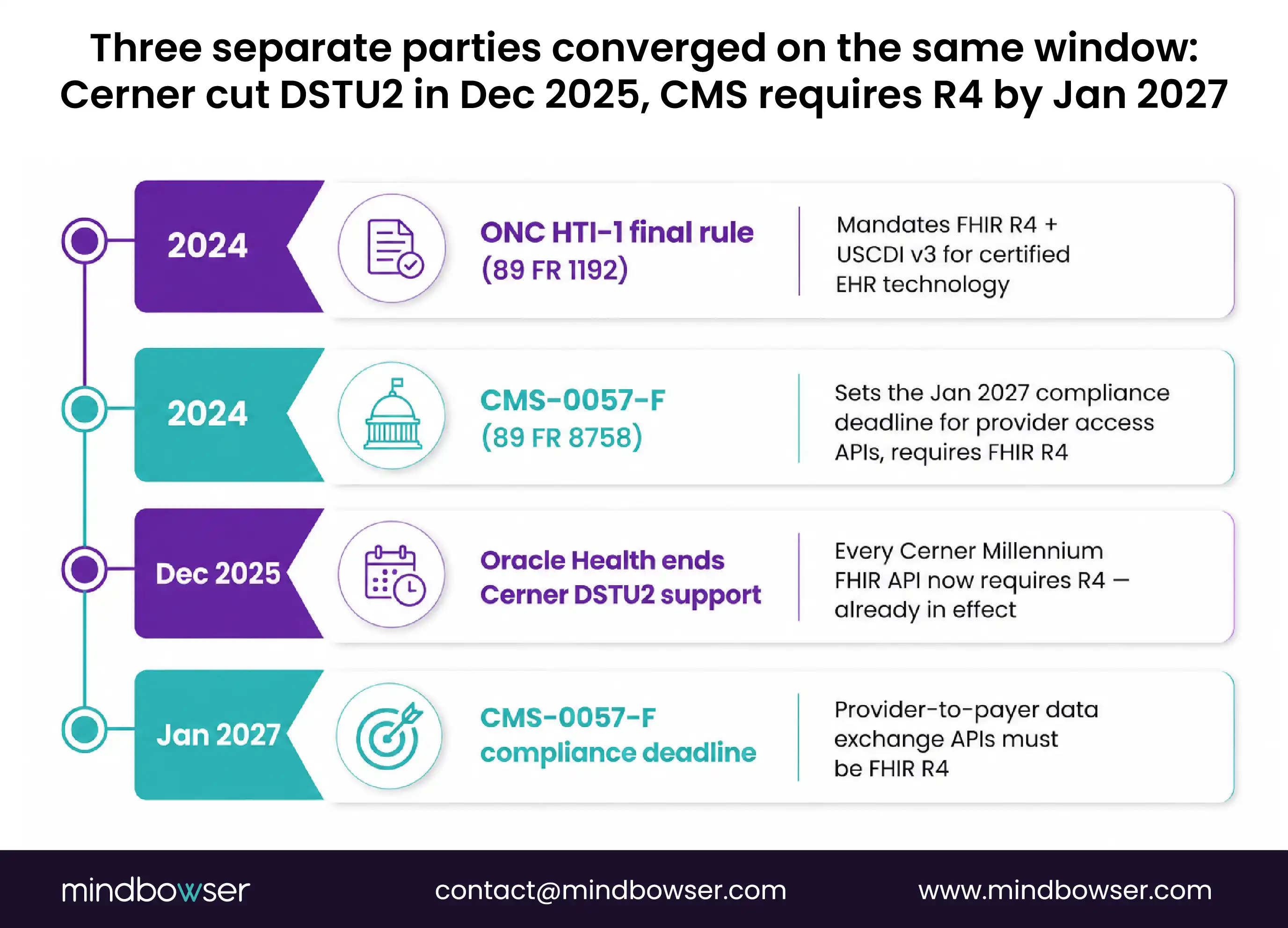
Here’s the part most migration guides miss: this isn’t “you should probably upgrade at some point.” The vendor turned off the old API, the certifying body requires the new one, and the payer-facing deadline is on the calendar. Three separate parties, one date range, one target spec. And that alignment is why this migration window closes faster than most engineering teams expect.
It’s also worth being precise about which deadline applies to you, because many vendors conflate the two dates. Oracle Health’s deprecation is already in effect: if you’re calling a DSTU2 endpoint today, it’s failing, full stop, regardless of what any regulatory calendar says.
But CMS-0057-F’s January 2027 date is a separate, downstream requirement that applies specifically to provider access APIs exchanging data with payers. If your app touches provider-to-payer exchange at all, treat January 2027 as the outer bound for having R4 fully validated in production, not as your starting deadline. The Oracle Health cutover already happened.
Before the resource-level changes, it helps to place DSTU2 and R4 on the same timeline as the rest of the FHIR version history: R4 isn’t the newest spec anymore, but it’s the one Cerner and CMS both require today.
What Actually Changed: DSTU2 vs FHIR R4 Resource Mapping
The hardest part of this migration isn’t the architecture. It’s the naming. DSTU2 and R4 are different enough that a find-and-replace across your codebase will break things in ways that don’t show up until a specific edge case hits production.
Here’s the mapping table I’d start from, pulled from the HL7 FHIR R4 specification and cross-checked against Oracle Health’s own developer documentation:
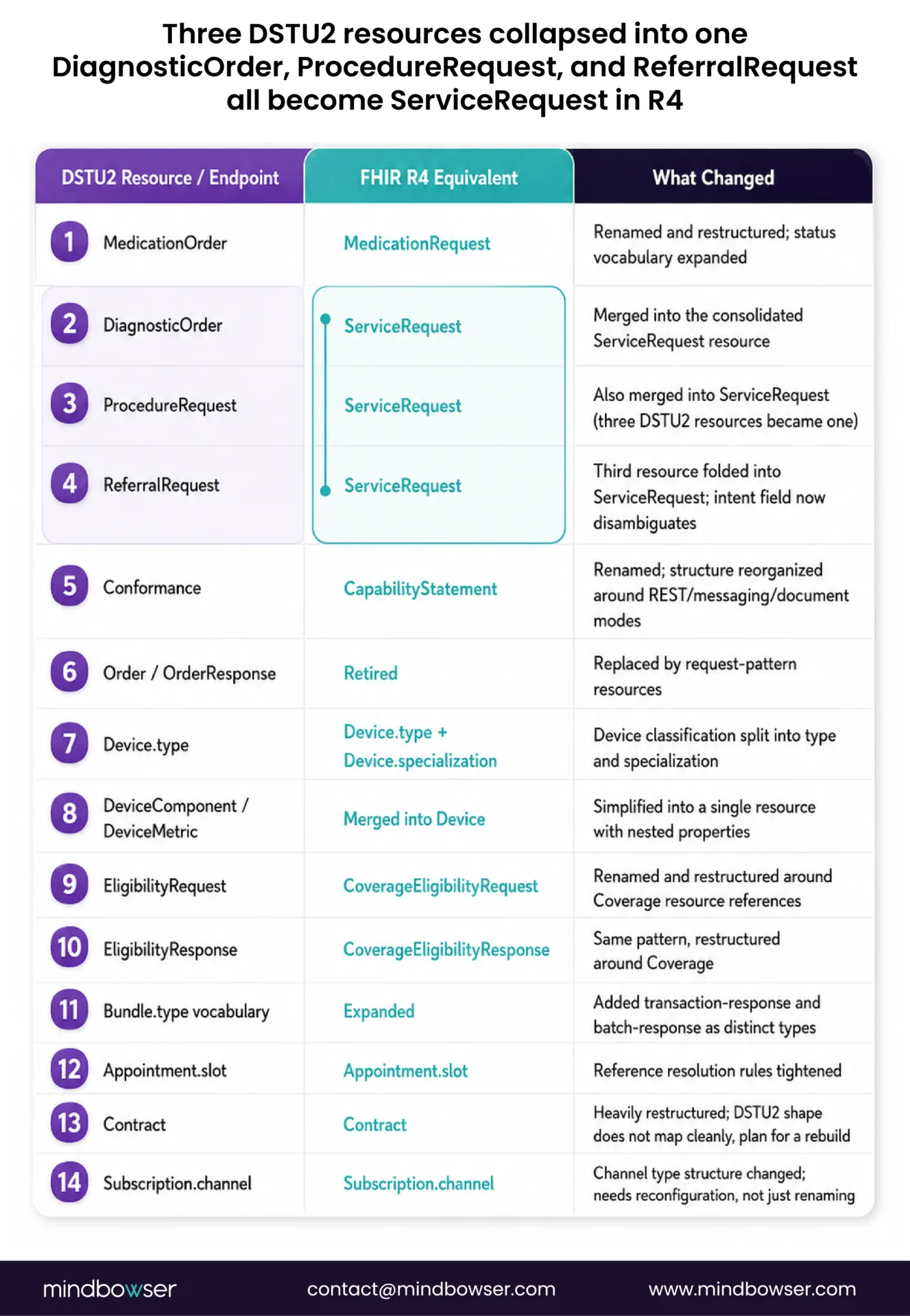
That’s 14 rows, and it’s still not exhaustive. Beyond the resource renames, more than 40 search parameter names changed between the two versions, and DSTU2 extensions don’t map one-to-one to R4 extension URLs. But if your team built custom extensions against DSTU2, budget time to re-derive them against the R4 extension registry rather than assuming a direct port.
For the segment-level detail behind any of these changes, I’d point you to the HL7 v2 to FHIR mapping guide. It covers the underlying message-to-resource logic this table builds on.
The Authentication Overhaul: SMART on FHIR Is Now Non-Optional
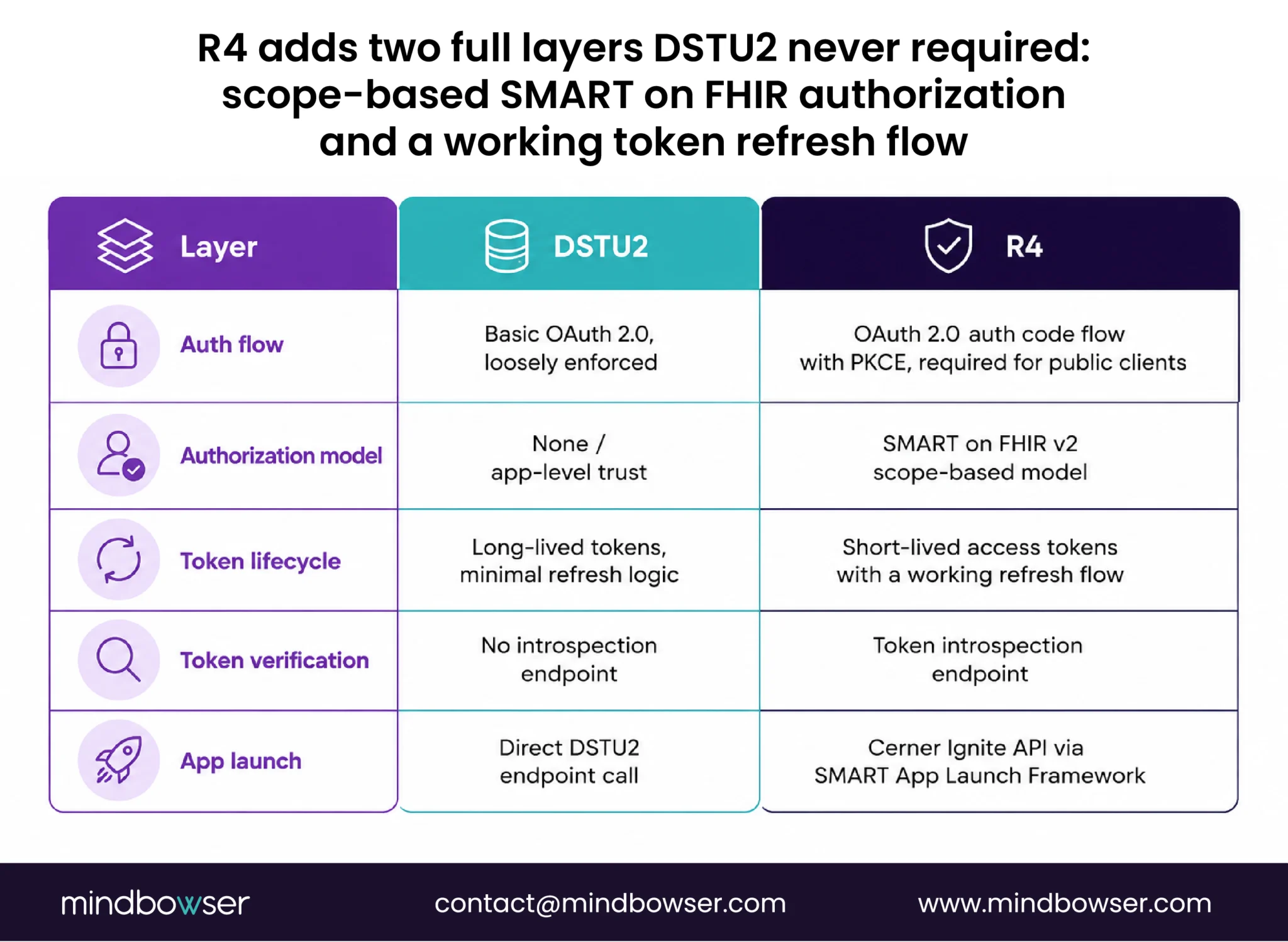
DSTU2 allowed looser authentication flows. Some Cerner apps I’ve seen ran on basic OAuth 2.0 without the full SMART on FHIR scope framework, and that worked fine for years because Cerner didn’t enforce it strictly. And R4 closes that door.
- SMART on FHIR v2 (adopted alongside FHIR R4 / HL7 STU2) introduces a formal scope-based authorization model.
- Required scopes for patient-level data now include patterns like patient/*.read, launch/patient, and openid.
- Cerner’s Ignite API requires the SMART App Launch Framework, per Oracle Health’s developer documentation.
- OAuth 2.0 authorization code flow with PKCE is now required for public clients under R4.
- A token introspection endpoint is part of standard R4 flows, and most DSTU2-era Cerner apps never implemented one.
The part that catches teams off guard isn’t the auth flow itself. It’s the Bundle semantics underneath it. DSTU2 transaction bundles and R4 transaction bundles handle errors differently, and if you’re running batch operations, that difference produces silent failures, not loud ones. And a batch job that used to fail fast on a bad record now partially succeeds under R4’s revised semantics, and you don’t find out until someone notices missing data downstream. Audit every batch and transaction bundle in your integration for this before you cut over, not after.
There’s a second layer to the auth rebuild worth planning for separately: token lifecycle. DSTU2-era Cerner apps commonly used long-lived tokens with minimal refresh logic, because nothing in the spec forced better behavior.
R4’s SMART on FHIR framework expects short-lived access tokens with a working refresh flow, and if your app’s session-handling code assumed a token that stays valid for hours, you’ll see intermittent 401s in production that look like flaky infrastructure but are actually an expired token your refresh logic never caught. Build and test the refresh path explicitly; don’t assume it works because the initial auth handshake does.
If you need hands-on support standing up SMART on FHIR against Cerner’s R4 requirements, that’s exactly the kind of implementation work my FHIR expert services team handles.
Need Help Rebuilding SMART on FHIR Authentication?
The Five-Phase Migration Plan (What I’d Run First)
I’d run this in five phases. And the teams that try to compress it into one sprint always end up running three sprints instead, just unplanned ones.
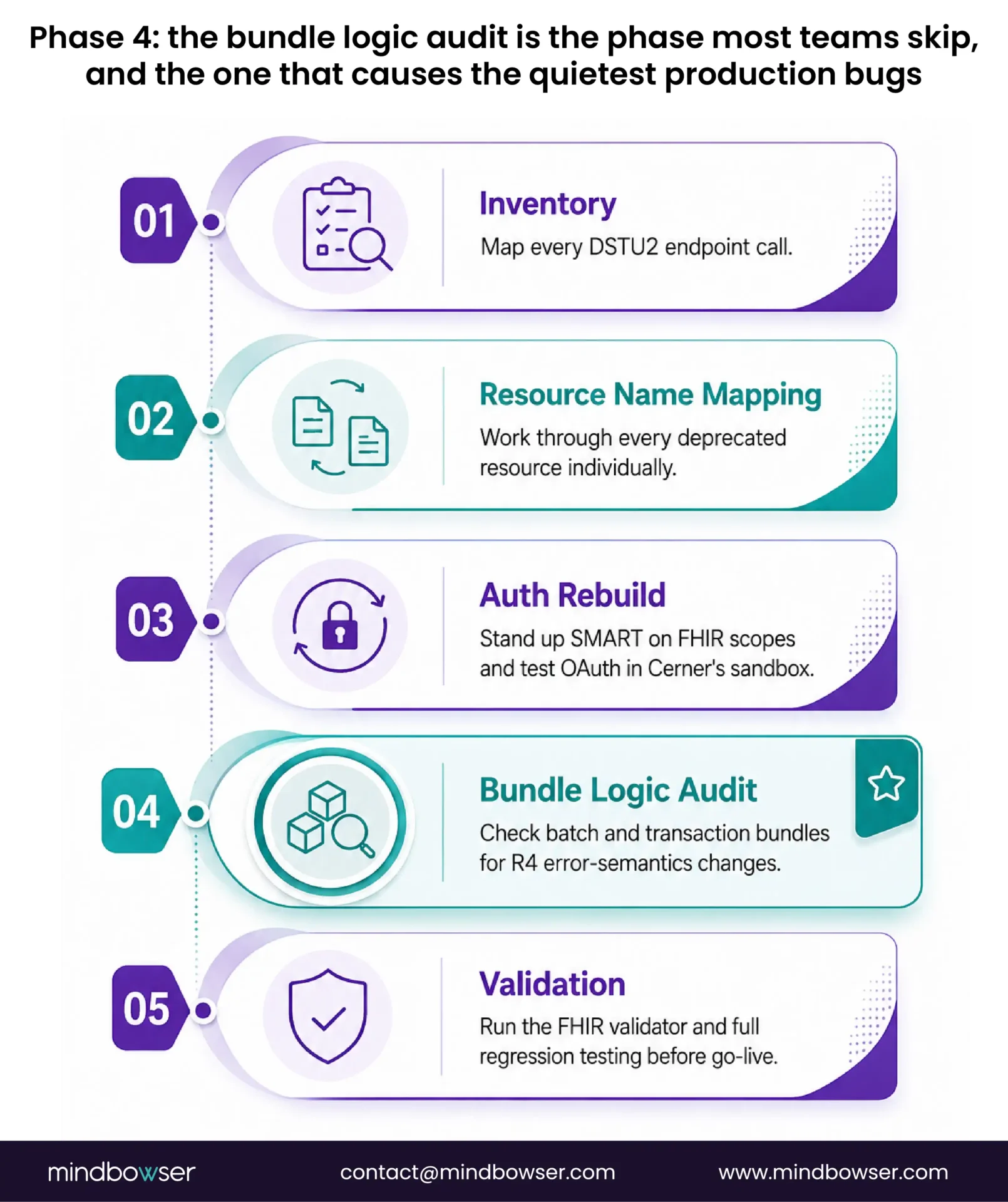
- Inventory: Map every DSTU2 endpoint call in your codebase. A grep across the repo plus a Postman collection audit gets you a real list, not a guessed one.
- Resource name mapping: Work through the table above and flag every deprecated resource name as its own task. Don’t batch this into one giant PR: it hides regressions.
- Auth rebuild: Stand up SMART on FHIR scopes and test the full OAuth flow in Cerner’s sandbox before touching production credentials.
- Bundle logic audit: Check every batch and transaction bundle for the R4 semantics change described above. This is the phase most teams skip and the one that causes the quietest production bugs.
- Validation: Run the FHIR validator against every renamed resource, then run a full regression suite against a Cerner R4 test environment before go-live.
I’ve watched this sequence work on real builds. One clinical workflow platform I worked with stood up bidirectional FHIR R4 write-backs and reached SMART on FHIR Vendor Services certification by following roughly this order: inventory and mapping first, auth and validation last, rather than trying to rebuild everything at once.
A research-IT platform on the other end of the spectrum runs a five-year bulk FHIR data pipeline for outcomes analysis today, built on the same phased discipline: get the mapping right before you touch scale.
For the Cerner-specific endpoint reference you’ll need during Phase 1 and Phase 2, the Cerner FHIR capabilities page has the current API surface.
The Three Things That Break Most (From Migration Projects I’ve Run)
The naming table and the auth rebuild are the planned work. These are the things that surprise teams who thought they were done.
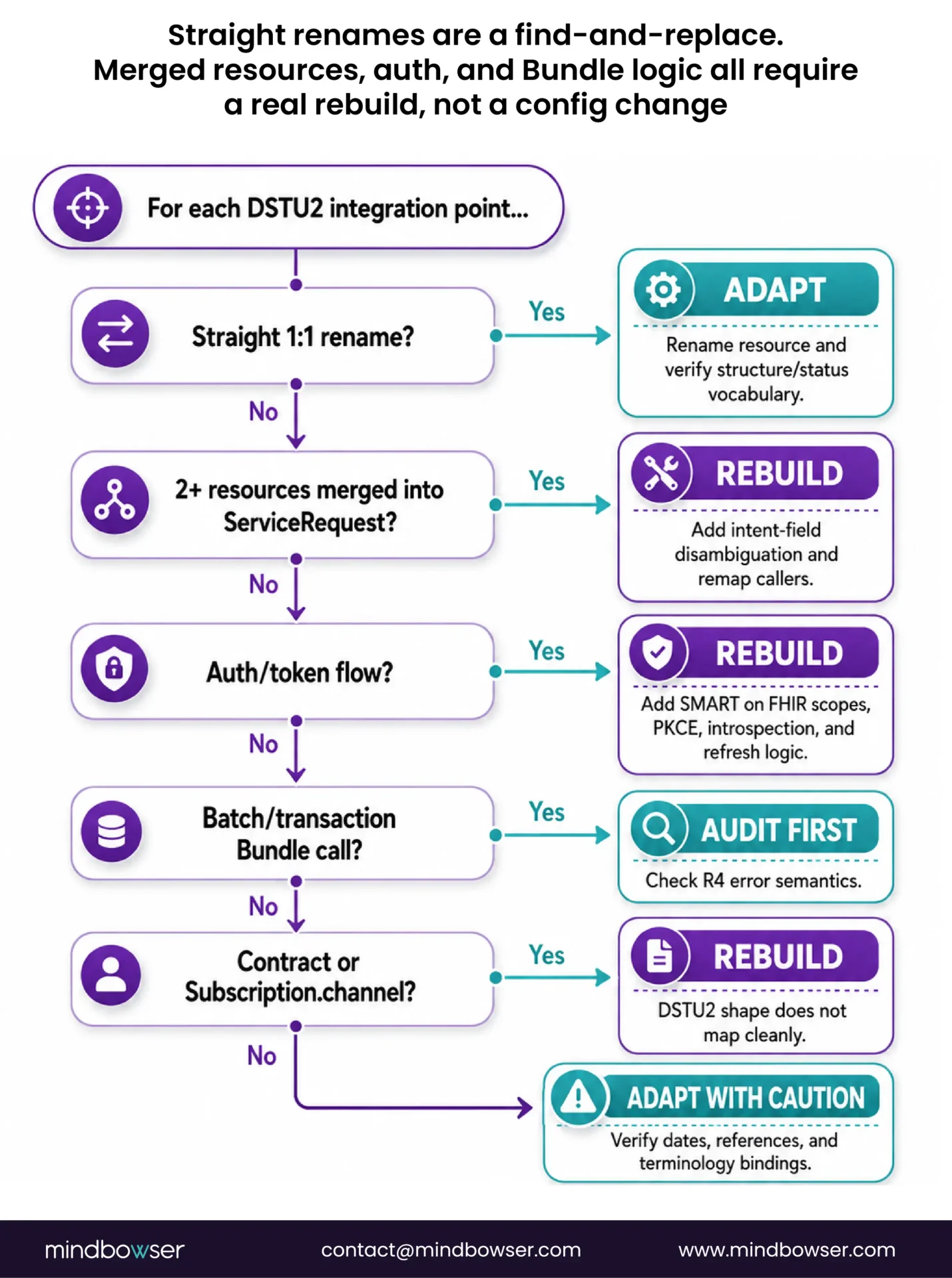
- Date and time formats: DSTU2 tolerated partial dates. R4 enforces ISO 8601 strictly. Validation errors from this don’t show up in your unit tests; they show up in production when a real patient record has an incomplete date field that used to pass silently.
- Reference resolution: DSTU2 allowed relative references with more slack than R4 does. R4 requires references to be absolute or clearly resolvable, and cross-resource lookups that worked fine under DSTU2’s looser rules start failing under R4’s tighter ones.
- ValueSet and CodeSystem binding strength: DSTU2 had “required” and “preferred” binding strength, but enforcement was inconsistent. R4 tightened enforcement across the board, so codes that passed DSTU2 validation can fail R4 validators outright, even when the underlying clinical code hasn’t changed.
None of these three show up in a spec diff. They show up in production, usually a few weeks after go-live, when a real-world record hits an edge case your test data didn’t cover.
Take reference resolution specifically, because it’s the one I see teams underestimate most. A DSTU2 app that stored a loosely-formed relative reference (something like a bare resource ID without a clear base URL) worked fine for years because DSTU2’s resolution rules were forgiving about it. Port that same reference into an R4 client and the resolver either throws an error or, worse, resolves to the wrong resource silently.
But that second case is the dangerous one: no error, no log entry, just a cross-resource lookup quietly pointing at the wrong record. Test this specifically; don’t assume your existing test suite catches it, because if your test data was built under DSTU2 assumptions, it was built to pass exactly the check that’s now missing.
For readers hitting document-specific migration issues, the Cerner clinical document handling guide goes deeper into that specific angle.
Testing Your FHIR R4 Migration Before Go-Live
Don’t go to production on Cerner’s R4 endpoints without running these checks first:
- FHIR Validator (the official HL7 tool at validator.fhir.org) validates every resource against R4 profiles.
- Cerner Ignite sandbox lets you test all endpoints before a production cutover.
- Crucible FHIR test suite handles conformance testing against the spec.
- A Postman collection built against Cerner’s R4 endpoints gives you a fast smoke test for your resource mapping.
- Regression coverage for every renamed resource type: if you touched it in the mapping table, it needs its own smoke-test case, not a shared one.
Testing against your mappings is where the HL7 v2 to FHIR mapping guide is worth a second look, this time checking your actual output against the spec rather than planning from it.
Do You Need ConnectHealth? (Honest Assessment)
If you’re migrating a single app from DSTU2 to R4, you don’t need an accelerator. You need the mapping table above and the time to work through it properly.
Where it’s different is scale. If you’re managing multiple Cerner integrations across a platform, a provider network, a digital health platform, a payer-provider exchange, ConnectHealth handles the FHIR R4 connectivity layer across Cerner, Epic, Meditech, Athena, and eCW from one normalized layer, and PHISecure handles HIPAA-grade token scoping for the OAuth flows underneath it. That’s the difference between rebuilding SMART on FHIR once and rebuilding it ten times because you’re connecting to ten different Cerner instances.
I’ll say the honest version of this plainly: a single-app migration doesn’t need either of those. A multi-EHR platform migration is where the accelerator ROI is real, because you’re not paying the auth-rebuild cost per connection.
Here’s the concrete version of that math. Every Cerner instance you connect to needs its own SMART on FHIR scope setup, its own OAuth token handling, its own bundle-semantics audit. Do that once for one app, and it’s a few weeks of focused work. Do it ten times because you’re a platform connecting to ten different provider organizations running Cerner, and you’re either building the same auth layer ten times or building it once and reusing it. That reuse is what ConnectHealth’s normalized connectivity layer actually does. It isn’t a shortcut around the migration work described above; it’s a way to not repeat that work per connection.
To be direct about the current gap: I don’t yet have a published Cerner-specific case study to point you to here, my strongest FHIR R4 proof so far comes from Epic-side builds, so treat the mechanics above as the standards-level guidance and treat the accelerator claim as directional until I can show you Cerner-specific numbers.
For the broader integration platform behind this, see the EHR integration platform overview, and for Cerner specifically, the Cerner EHR integration page covers the full connectivity picture beyond just DSTU2-to-R4.
What Comes After FHIR R4 (R5, USCDI v3, and What to Watch)
R4 is the compliance floor for January 2027, but it isn’t the end of the line. FHIR R5 was published in January 2023, and while it isn’t mandated yet, teams building for a 2028-and-beyond horizon should know it exists. USCDI v3, part of the ONC HTI-1 mandate, expands the required data classes beyond what USCDI v1 covered, touching lab results, imaging, and social determinants of health.
And TEFCA’s 11 operational QHINs, connecting thousands of organizations, already run their exchange on FHIR R4, which is a reasonable signal for where the interoperability backbone is heading next.
DSTU2 (Draft Standard for Trial Use 2) was an early FHIR specification that Cerner’s Millennium platform used for years. Oracle Health ended DSTU2 support in December 2025 to standardize on FHIR R4, which is also the version mandated by ONC’s HTI-1 rule and CMS-0057-F.
14 or more resources changed names or were consolidated, including MedicationOrder to MedicationRequest, and DiagnosticOrder, ProcedureRequest, and ReferralRequest, all merged into the single ServiceRequest resource. The full mapping table is above.
Not entirely, but expect meaningful rework in three areas: resource naming throughout your codebase, your authentication layer (SMART on FHIR is now required), and your bundle/transaction handling logic, which has different error semantics in R4.
Oracle Health already ended DSTU2 support in December 2025, so functionally the deadline has passed for anyone still calling those endpoints. The broader regulatory deadline, CMS-0057-F’s provider access API requirement, lands in January 2027.