BLOGS
 NEWSROOM
 CASE STUDIES
 WEBINARS
 PODCASTS
 ASSET HUB
 EVENT CALENDAR


























As healthcare accelerates its digital shift, interoperability stands out as one of the most persistent roadblocks. Teams building remote care management tools or other digital health products often face integration issues when working with existing Electronic Health Record (EHR) systems.
Developing a SMART on FHIR app offers a standardized approach to embed your solution directly within major EHR platforms like Epic. It ensures secure data access, improved user workflows, and a better provider experience without disrupting existing systems.
In this post, we look at the challenges and key considerations in developing a SMART on FHIR app for listing on EHR marketplaces. The focus lies on optimizing referral workflows, enabling bidirectional data exchange, and ensuring your app meets clinical needs while complying with regulatory requirements.
➡️ The Challenge: Embedding Remote Care Management into EHRs
Many healthcare organizations use remote care management platforms to monitor patient vitals, medication adherence, and clinical progress between visits. Without EHR integration, these platforms create workflow gaps and administrative burdens. A Smart on FHIR app addresses these challenges by enabling real-time, secure data exchange within the EHR environment.
1️⃣ Manual Data Entry – Providers must manually enter referral data and extract patient insights, leading to time-consuming administrative tasks.
2️⃣ Lack of Real-Time Synchronization – Critical patient data, such as recent vitals, medication adherence, and care summaries, does not sync with the EHR in real time.
3️⃣ Limited Referral Tracking – Once a referral is made, tracking patient progress within the remote care system is disconnected from the provider’s primary workflow.
4️⃣ Incomplete Billing Integration – Capturing billable services from remote patient monitoring into the EHR’s billing system is complex and often requires manual intervention.
Related Read: Decoding SMART on FHIR for Healthcare Interoperability
➡️ The Solution: SMART on FHIR for Simple, Reliable Integration
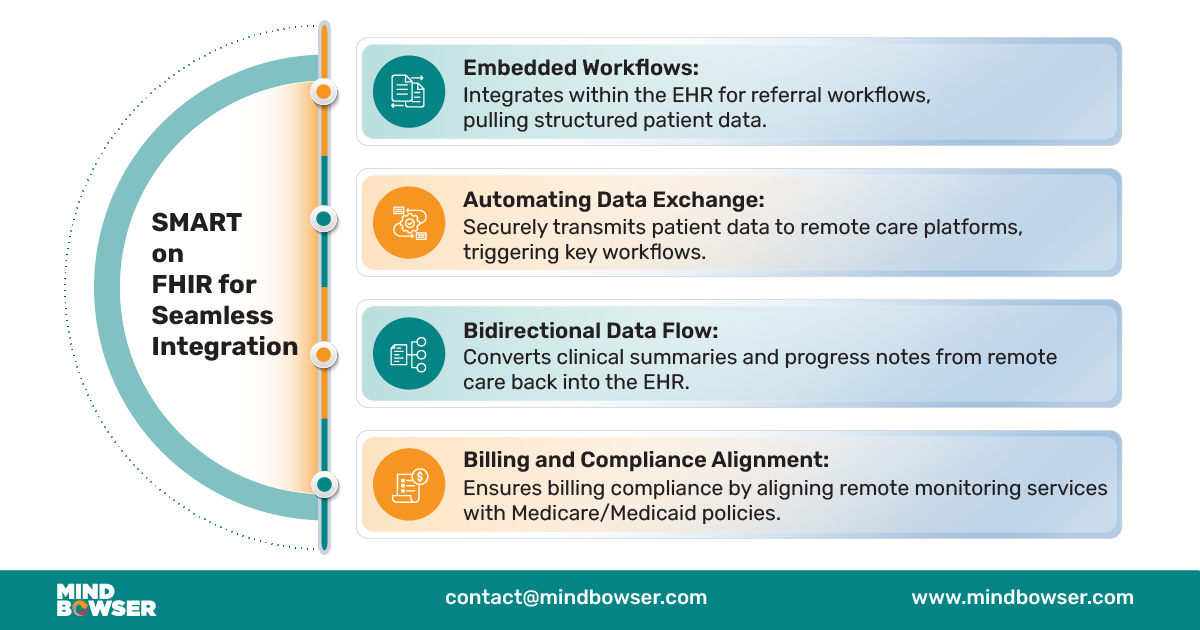
A SMART on FHIR app serves as the bridge between remote care management platforms and EHRs, offering a standardized, scalable approach to data exchange. The core solution includes:
Step 1: Enabling SMART on FHIR Embedded Workflows
🔹 The app is embedded within the EHR and provides a referral workflow where providers can preview patient information before submitting a referral.
🔹 It retrieves structured patient data, including demographics, diagnosis, medications, allergies, insurance details, and recent encounters.
Step 2: Automating Data Exchange Between Systems
🔹 Once a referral is submitted, relevant patient data is securely transmitted to the remote care platform.
🔹 The system ingests data from the last three months to identify trends and trigger workflows (e.g., scheduling wellness visits, flagging non-adherence, and updating care plans).
Step 3: Bidirectional Data Flow for Real-Time Updates
🔹 Remote care platforms generate clinical summaries, adherence reports, and patient progress notes.
🔹 These reports are automatically converted into structured clinical documents (e.g., progress notes) and written back to the EHR under the patient’s record.
Step 4: Billing and Compliance Alignment
🔹The system supports billing workflows by analyzing past claims data and ensuring remote monitoring services align with Medicare/Medicaid reimbursement policies.
🔹 Encounter history and structured claim data help trigger appropriate workflows within the EHR.
➡️ The Outcome: Enhanced Care Coordination and Provider Efficiency
Implementing a Smart on FHIR app leads to measurable improvements in how healthcare teams manage data, patients, and operations. Here’s what you can expect:
✅ Streamlined Provider Workflows
Reduce manual data entry, improve referral tracking, and enable real-time synchronization with EHR records—directly from within the provider’s workflow.
✅ Real-Time Patient Monitoring
Get continuous updates on vitals, medication adherence, and care summaries—without switching between systems. The Smart on FHIR app embeds directly into the EHR interface.
✅ Improved Billing and Reimbursement
Automate documentation of billable services and simplify compliance with payer rules—reducing revenue leakage and admin time.
✅ Scalable EHR Integration
The modular setup supports future expansion beyond Epic, making the Smart on FHIR app a long-term solution across multiple health IT systems.
Conclusion
The integration of SMART on FHIR applications marks a significant step forward in making healthcare data more accessible, structured, and actionable. By embedding remote care management solutions directly into EHR workflows, healthcare organizations can eliminate inefficiencies, improve patient outcomes, and ensure financial viability.
If you’re looking to develop a SMART on FHIR app for EHR integration, investing in the right strategy and development approach can make all the difference. Reach out to explore how a tailored solution can help achieve operational efficiency and enhance care coordination.