













 BLOGS
BLOGS  NEWSROOM
  CASE STUDIES
  WEBINARS
  PODCASTS
  ASSET HUB
  EVENT CALENDAR






















TL;DR
EHR software costs anywhere from $200/provider/month (off-the-shelf SaaS) to $160 million (enterprise Epic implementation). The range is absurdly wide because most articles treat “EHR cost” as one question when it’s really four different questions depending on your build model. we built a country-scale clinical platform for under $150K and helped a healthcare company cut infrastructure costs 30-40% through cloud migration. This guide breaks down all 4 cost models, shows real project numbers, and explains why the 3-5 year total cost of ownership matters more than the upfront price.
Healthcare EBITDA fell from 11.2% in 2019 to 8.9% in 2024. Every dollar of IT spend is getting scrutinized harder than it was three years ago. Becker’s ran a piece in early 2026 about how health systems are moving from “acquire new tools” to “prove the ROI on what we already bought.”
Into that environment, a CTO walks in and says: “We need to build a custom EHR. What’s the budget?”
The answer you’ll find on most websites: “$50,000 to $500,000+.” Which tells you nothing. That’s like saying a car costs “$20,000 to $2 million.” Technically true. Practically useless.
Here’s what actually determines the number.
I. What Do the 4 EHR Cost Models Actually Look Like?
There isn’t one “EHR cost.” There are four fundamentally different cost models, and the one you choose determines everything.
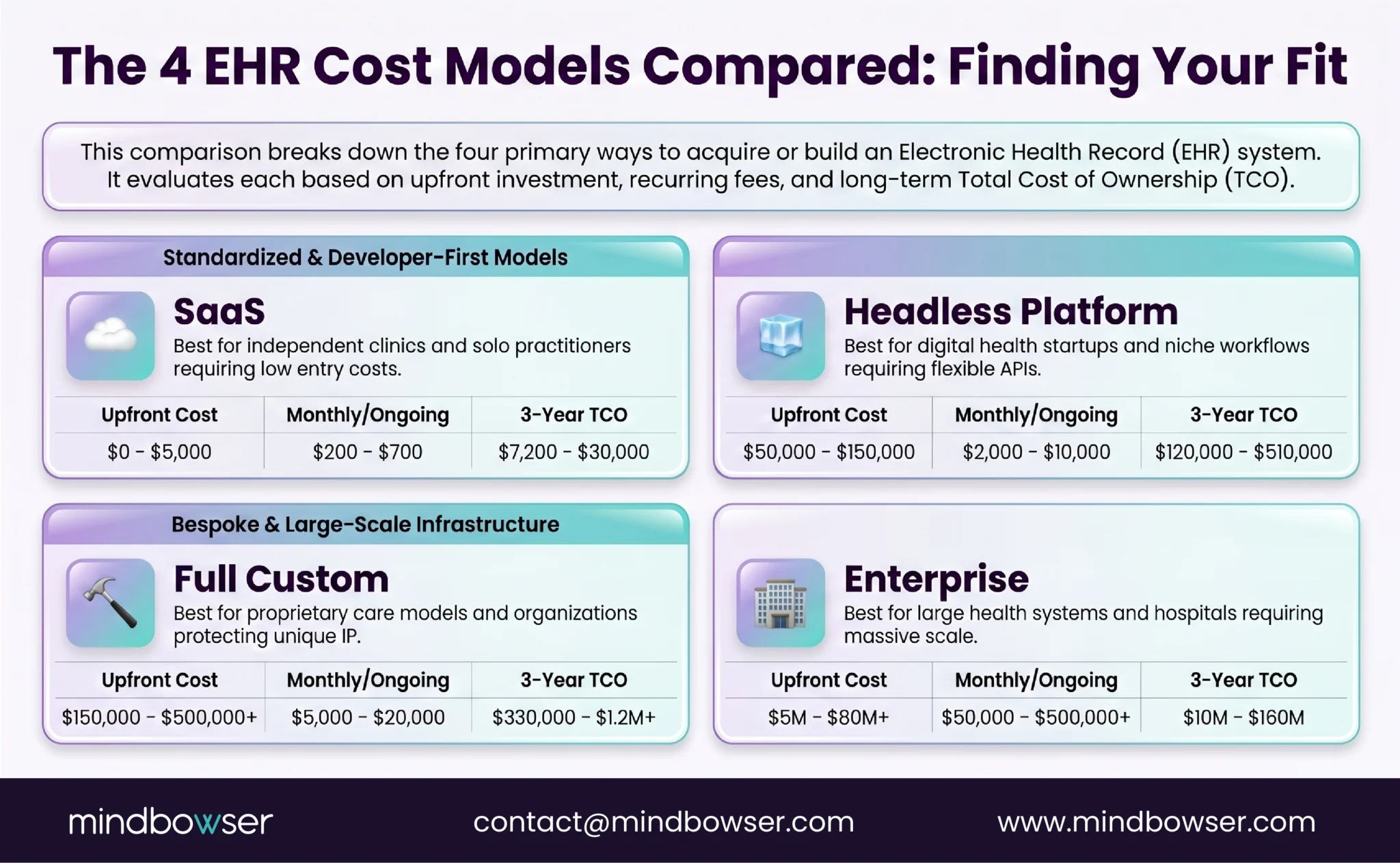
The range in that table is the problem. Everyone quotes it and nobody explains it. The difference between $50K and $500K isn’t complexity alone – it’s which row of this table you’re in. A platform-based build on Medplum is a $50K-$150K project. A from-scratch build with ONC certification is $300K-$500K+. An Epic implementation at a 40-hospital system is $160M (Becker’s 2025).
For context: SaaS pricing data shows cloud-based EHR ranges of $118-$729/provider/month. Five-year TCO per provider averages $30,000-$75,000 for cloud solutions.
II. What Did Our Custom Builds Actually Cost?
This is the section no competitor can write. We’re publishing real project economics because the “ranges” game doesn’t help anyone make a decision.
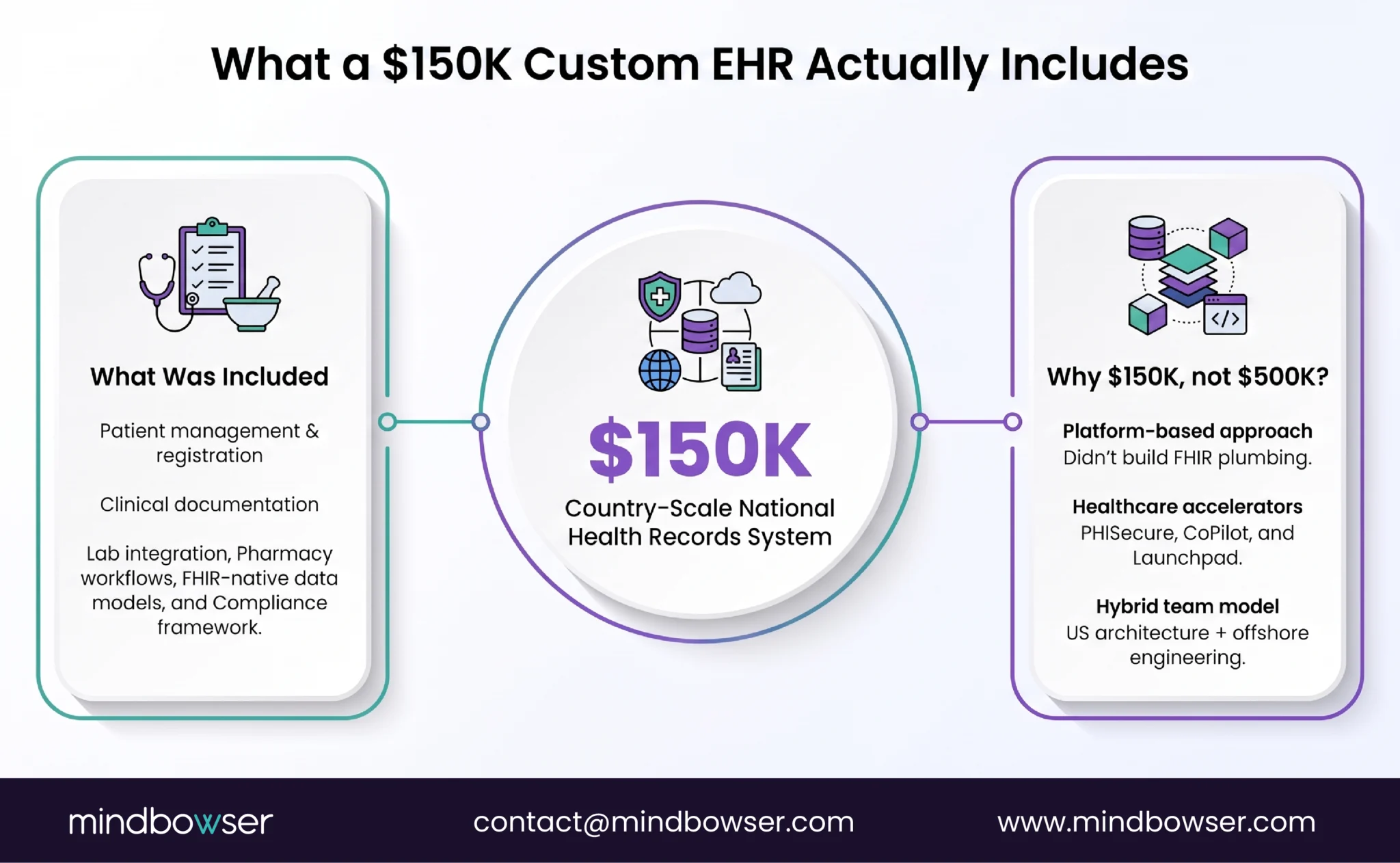
A. Project 1: Country-Scale National Health Records System — Under $150K
A government health ministry needed a clinical platform for its entire public healthcare infrastructure. Not a module. Not an MVP. A production EHR covering:
- Patient management and registration
- Clinical documentation
- Lab integration
- Pharmacy workflows
- ONC-aligned FHIR-native data models
- Compliance framework
Total engagement: $150K.
Why $150K and not $500K? Three reasons:
1. Platform-based approach – built on FHIR infrastructure that already handled data storage, auth, audit logging, and API compliance. We built the clinical layer, not the plumbing.
2. Healthcare accelerators – our PHISecure (HIPAA data handling), FHIR integration layer (EHR adapters + client), and Launchpad (MVP framework) reduced custom development by an estimated 30-40%.
3. Hybrid team model – onshore architecture + offshore engineering. Same quality, lower hourly cost.
B. Project 2: Cloud Migration for Healthcare Platform – 30-40% Cost Reduction
A multi-specialty healthcare platform needed to migrate from Azure to AWS. Not a rebuild – same application, new infrastructure.
- 30TB of data across 180 production databases
- Database latency improved from 120ms to under 80ms (33% faster)
- Infrastructure cost dropped 30-40% through AWS Reserved Instances, EC2 Spot, and S3 Intelligent-Tiering
- The migration paid for itself within 12 months
C. Project 3: Platform-Based Builds (Medplum/Healthie) – $50K-$150K Starting Range
For digital health startups building specialty clinical platforms, we typically recommend building on a headless EHR platform. The platform handles:
- Data storage and FHIR compliance
- ONC certification infrastructure
- Auth, audit logging, bulk export
- API layer
You build:
- Specialty-specific UI and workflows
- Clinical logic and decision support
- Custom integrations
- Patient-facing experience
The cost math: Platform fee ($0-$2K/month for Medplum’s usage-based model) + $50K-$150K custom development. Compare that to building everything from scratch at $300K-$500K+. For the full scope of what we do on Medplum, see our Medplum integration services.
III. What Drives the Cost of Custom EHR Development?
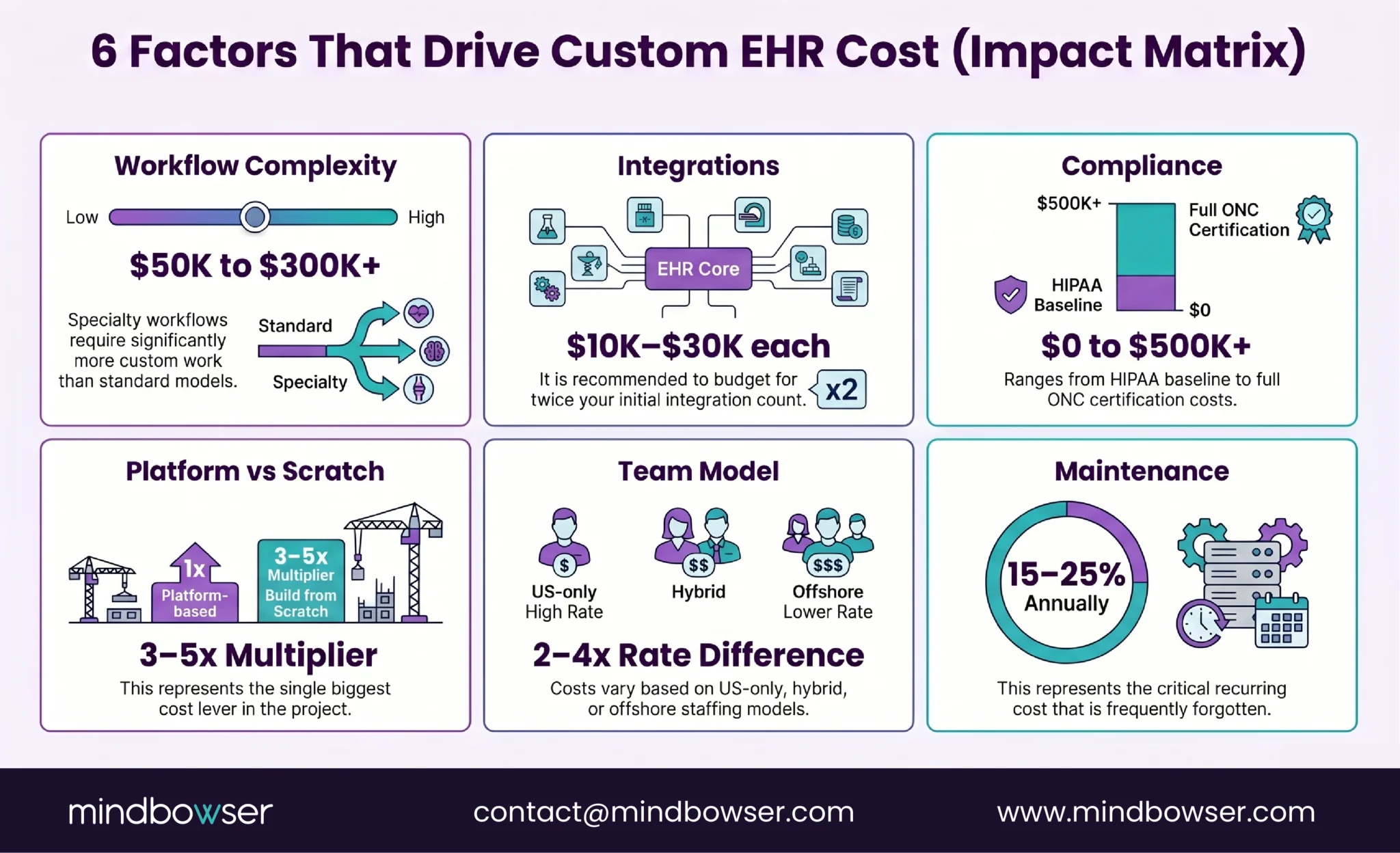
Six factors. The first one has the most impact. The last one is the one everyone forgets.
A. Complexity of clinical workflows
- Standard primary care workflows = lower cost
- Specialty workflows (OB/GYN, behavioral health, home health) = higher cost because no template exists
- The more your clinical workflow deviates from what Epic and Athena already do, the more custom work is required
B. Number of integrations
- Labs (LabCorp, Quest, hospital labs)
- Pharmacies (Surescripts e-prescribing)
- Billing/RCM systems
- Medical devices and wearables
- Each integration: $10K-$30K
C. Compliance requirements
- HIPAA baseline: included in any healthcare build
- ONC certification: adds $200K-$500K+ and 12-18 months if self-certifying
- SOC 2 Type II: adds $50K-$150K for audit + remediation
- USCDI v3 compliance: mandatory since January 2026, affects data model architecture
D. Platform vs from-scratch decision
- This is the single biggest cost lever. Building on Medplum or Healthie vs building from scratch can be a 3-5x cost difference for the first year
- Platform handles: FHIR infrastructure, auth, audit, bulk export, certification
- You handle: clinical workflow layer, UI, integrations, custom logic
E. Team model
- US-only team: $150-$250/hour
- Hybrid (US architecture + offshore engineering): $75-$150/hour blended
- Offshore-only: $40-$80/hour (but needs strong product management)
- This national EHR used a hybrid model. Same architecture quality, lower execution cost.
F. Ongoing maintenance and support
- 15-25% of initial build cost annually – this is the one everyone forgets to budget
- Includes: bug fixes, security patches, compliance updates, infrastructure, support
- For a $200K build, that’s $30K-$50K/year in perpetuity
- If you can’t budget for maintenance, you can’t afford custom
Build a Custom EHR with Us
IV. What Does EHR Implementation Cost Look Like Phase by Phase?
Whether you’re building custom or implementing off-the-shelf, the cost is distributed across the same phases. The percentages shift based on the model.
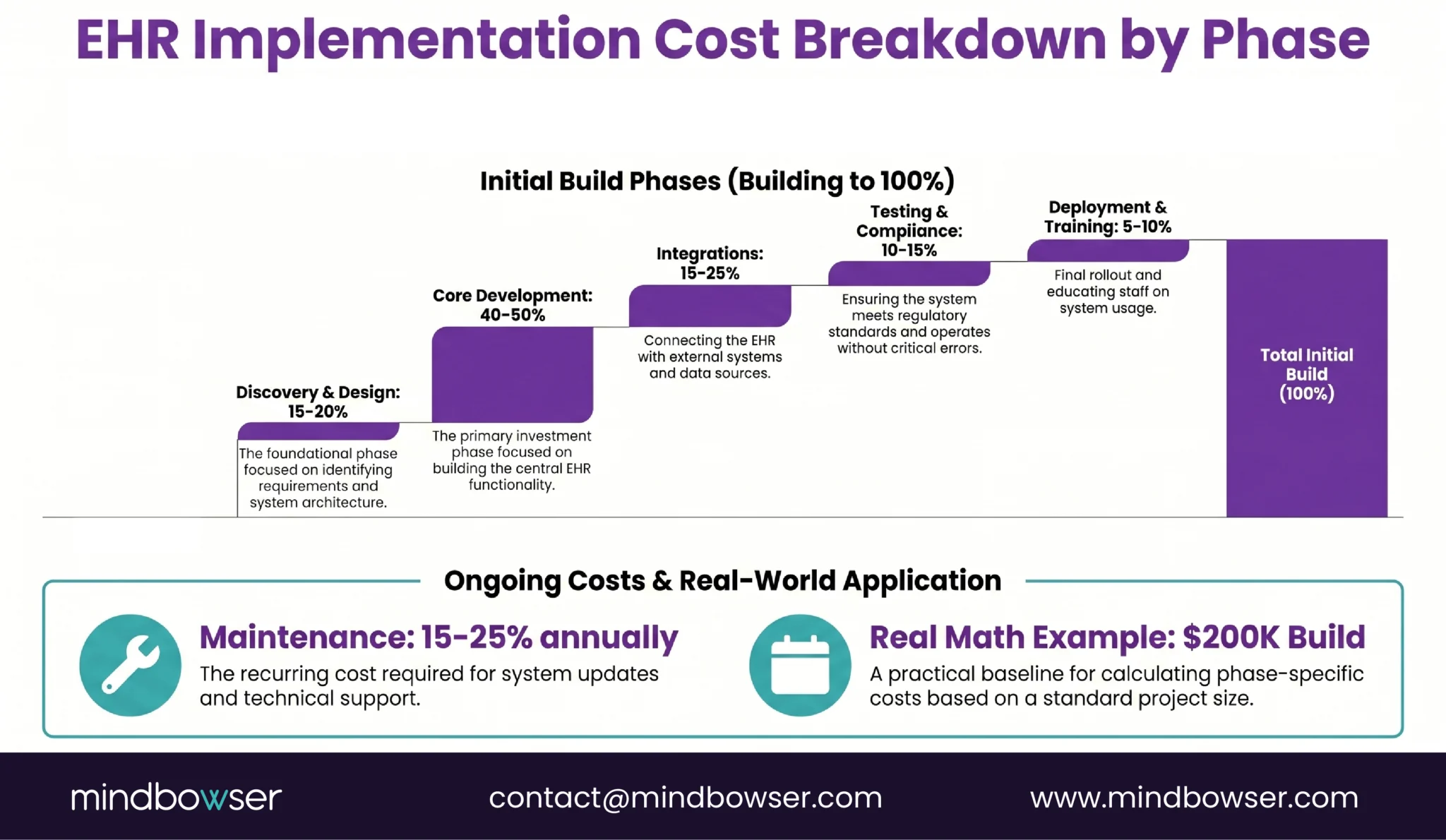
Plus ongoing: 15-25% of initial cost annually for maintenance, updates, and support.
Real math: For a $200K custom build:
- Discovery: $30K-$40K
- Development: $80K-$100K
- Integrations: $30K-$50K
- Testing: $20K-$30K
- Deployment: $10K-$20K
Year 1 total: $200K. Year 2+ maintenance: $30K-$50K/year.
If you’re also migrating data from a legacy system, add the migration cost separately – that’s $20K-$50K for data migration alone.
V. What Are the Hidden Costs of Off-the-Shelf EHR?
Off-the-shelf EHR pricing looks simple: $200-$700 per provider per month. What it doesn’t show is everything below the waterline.
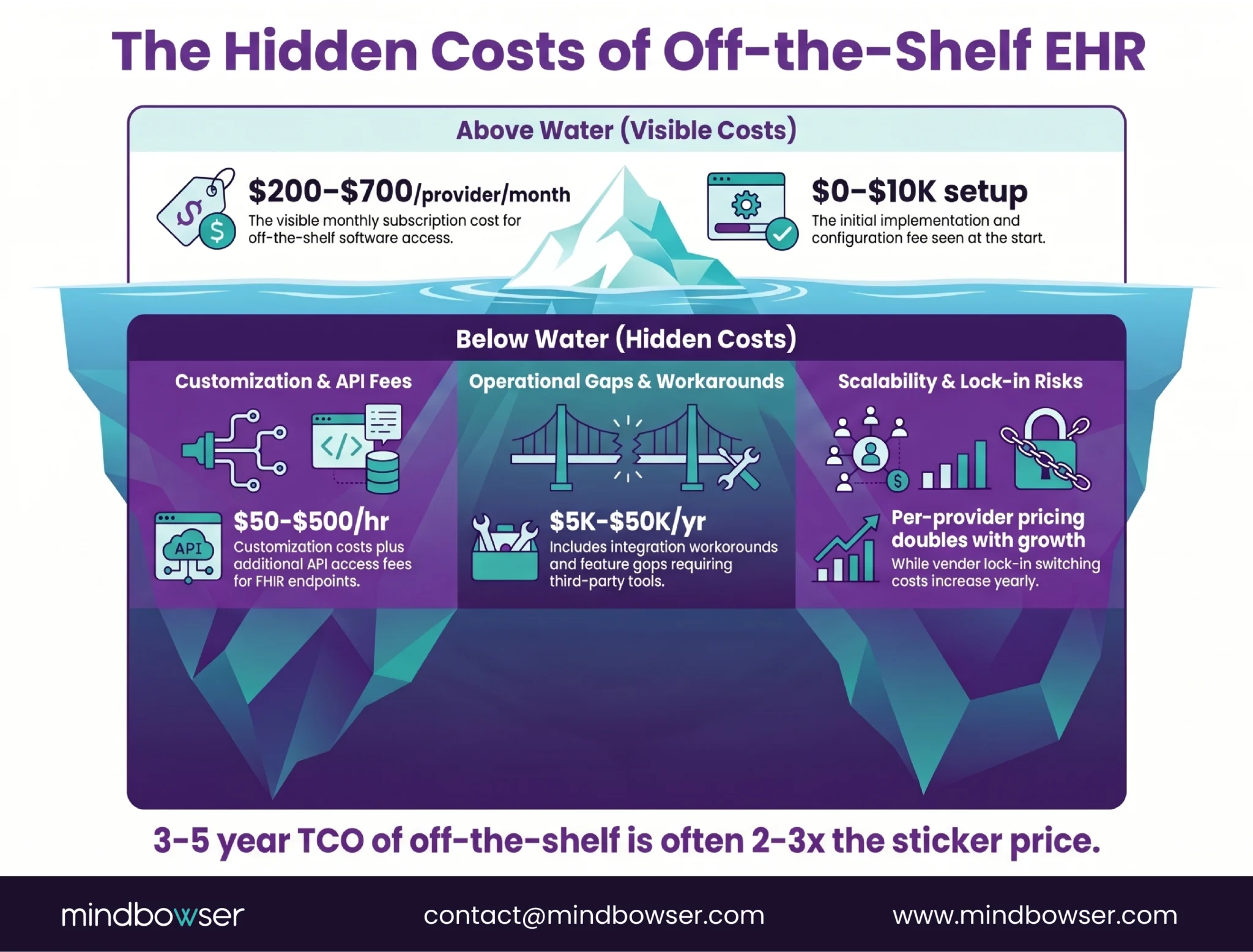
What you see:
- Monthly subscription: $200-$700/provider
- Setup fee: $0-$10K
- First-year total: looks manageable
What you don’t see:
- Customization fees: $50-$500/hour for vendor professional services. Need a custom workflow? That’s a professional services engagement on top of your license.
- Integration workarounds: Vendor doesn’t support your lab’s interface? You’re building custom middleware or doing manual data entry.
- Vendor lock-in: Switching costs increase every year. After 3 years, your data, workflows, and integrations are so entangled that migrating costs more than the original implementation.
- Per-provider pricing that scales non-linearly: 10 providers at $300/mo = $36K/year. 50 providers at $300/mo = $180K/year. 100 providers = $360K/year. In year 3, you’re paying more annually than a custom build would have cost upfront.
- Feature gaps: Need a feature the vendor doesn’t support? Buy a third-party tool ($5K-$50K/year) and integrate it yourself.
- API access fees: Some vendors charge extra for FHIR endpoint access. Yes, really.
Our build vs buy analysis found that over 3-5 years, many organizations discover the all-in cost of off-the-shelf is 2-3x the sticker price. Custom EHR eliminates: per-seat licensing, API fees, add-on modules, proprietary integration fees, and customization charges. The upfront investment is higher. The 5-year TCO is often lower.
| EHR Model | Year 1 Cost | Annual Ongoing | 5-Year TCO |
|---|---|---|---|
| SaaS off-the-shelf (20 providers @ $300/mo) | ~$72K | ~$72K/yr | ~$360K |
| Custom platform build (Medplum-based) | $50K–$150K | $10K–$30K/yr | $90K–$270K |
| Custom from-scratch build | $200K–$500K | $30K–$75K/yr | $320K–$800K |
| Epic (mid-size health system) | $10M–$160M | $1M–$5M/yr | $14M–$180M+ |
This doesn’t mean custom is always the right call. For a 5-provider primary care practice with standard workflows, off-the-shelf SaaS at $300/provider/month is the right answer. Custom makes sense when:
- Your specialty workflow breaks the vendor’s template
- You need full data ownership and portability
- Per-provider pricing will exceed custom build cost within 2-3 years
- You’re building a platform product (not just using one internally)
VI. How Does Epic EHR Cost Compare to Custom?
This is the comparison buyers actually want. Here’s the honest picture.
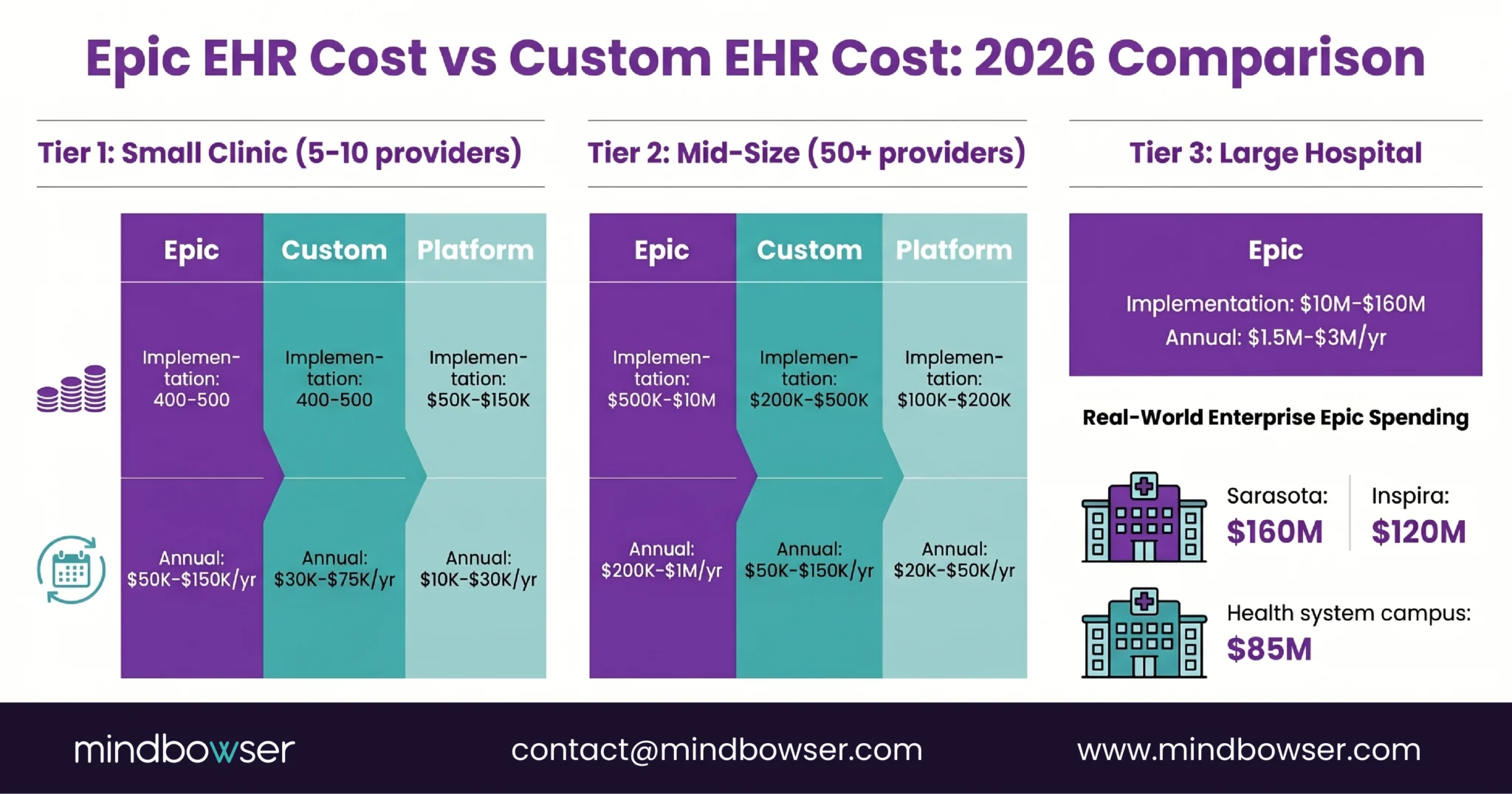
The $160M question: Sarasota Memorial Healthcare System is investing $160M in its Epic implementation. Inspira Health budgeted $120M. A 500-physician system reported spending $85M in the first year alone. Meanwhile, UPMC has 1,800 people working on its Cerner-to-Epic migration.
When Epic EHR makes sense:
- Large health system (40+ hospitals) needing enterprise standardization
- M&A consolidation requires a single platform
- Interoperability with the existing Epic network matters
- Budget exists ($10M+ minimum)
When custom makes sense:
- Specialty workflow that Epic templates don’t cover
- Startup building a clinical platform product
- Budget under $500K with need for full ownership
- Speed to market matters (custom can ship in 3-6 months vs Epic’s 12-24)
The third option nobody mentions: Build your clinical layer on a headless EHR platform like Medplum. You get FHIR infrastructure, ONC certification, and API compliance from the platform. You build the workflows, UI, and clinical logic. Cost: $50K-$150K. Time: 2-6 months. It’s the option between “$300/provider/month forever” and “$500K upfront.”
VII. How Should You Budget for Custom EHR Development?
If you’ve read this far, you’re probably trying to put together a number for your board, your investors, or your own planning.
Start with these questions:
- What’s the minimum viable clinical platform? Not every feature on day one. What do you need for the first 50 patients?
- Platform or from-scratch? This single decision is a 3-5x cost multiplier.
- What integrations are non-negotiable? Each one is $10K-$30K. List them and multiply.
- Do you need ONC certification? If yes (and your provider customers need it), add $200K-$500K and 12-18 months. Or build on a certified platform and skip this entirely.
- What’s your team model? US-only vs hybrid vs offshore changes the hourly rate by 2-4x.
Budget by buyer segment:
- Digital health startup (Series A-C): $150K-$2M initial build + $50K-$200K/year maintenance. Start with a platform-based MVP, validate with early customers, then invest in custom features.
- Specialty practice group: $200K-$5M depending on scope. Start with the workflow that breaks your current EHR, build that module custom, keep the rest commercial.
- Government/national health programs: Scope varies enormously. Our national EHR engagement is on the low end of this range. Multi-country deployments can exceed $5M.
Bottom Line: EHR Cost Depends on the Build Model You Choose
EHR cost isn’t one number. It’s a function of which cost model you choose, how complex your clinical workflows are, and whether you’re buying compliance infrastructure or building it.
Three things worth remembering:
- The $50K-$500K range is real, but the driver is platform choice. Building on Medplum at $50K-$150K and building from scratch at $300K-$500K are both “custom EHR development.” They’re not the same project. Name the model you’re in before you budget.
- 3-5 year TCO matters more than upfront cost. Off-the-shelf at $300/provider/month looks cheap in year 1. In year 3, per-provider licensing, customization fees, and integration workarounds compound. Custom’s higher upfront investment often wins on the total cost of ownership.
- Every dollar needs ROI justification now. McKinsey (2026) shows healthcare margins shrinking. Becker’s reports health systems scrutinizing every tech investment. If you’re pitching a custom build to your board, lead with the TCO comparison, not the feature list.
Ready to scope a custom EHR build with real numbers? Tell us about your clinical workflow and we’ll estimate the cost based on which model fits – not a generic range.
Custom EHR development costs $50K-$500K+ depending on the approach. A platform-based build on Medplum or Healthie (where the platform handles FHIR infrastructure and you build the clinical layer) runs $50K-$150K. A full custom build from scratch with ONC certification runs $300K-$500K+. We built a country-scale national health records system using a platform-based approach with healthcare accelerators that reduced custom development by 30-40%.
For large health systems (40+ hospitals), Epic’s enterprise licensing often makes sense despite the $10M-$160M implementation cost. For specialty practices, startups, and mid-size organizations, custom is typically cheaper on a 3-5 year total cost of ownership basis. Custom eliminates per-seat licensing, API access fees, customization charges, and vendor lock-in costs that compound annually in off-the-shelf systems. The breakeven point for custom vs SaaS is usually 2-3 years for organizations with 20+ providers.
For a small practice (5-10 providers), costs range by model: – Off-the-shelf SaaS: $0-$10K setup + $200-$700/provider/month = $12K-$84K/year – Custom platform build: $50K-$150K upfront + $10K-$30K/year maintenance – Epic: $100K-$300K + $50K-$150K/year ongoing The right choice depends on whether your clinical workflows fit a commercial template. If they do, SaaS is the most cost-effective. If they don’t, a platform-based custom build is usually cheaper than forcing a commercial EHR to do something it wasn’t designed for.
TCO for custom EHR includes: initial build ($50K-$500K), annual maintenance (15-25% of build cost per year), infrastructure ($1K-$5K/month for cloud hosting), and periodic updates (compliance changes like USCDI v3, security patches). For a $200K build, the 5-year TCO is approximately $350K-$450K ($200K build + $30K-$50K/year x 4 years maintenance + infrastructure). Compare to off-the-shelf SaaS at $300/provider/month for 20 providers: $360K over 5 years – and that’s before customization, integration, and API fees push it higher.
Depends on the savings source. Infrastructure cost savings (like our client’s 30-40% reduction after cloud migration) show ROI within 12 months. Workflow efficiency gains (reduced documentation time, fewer clicks) typically show measurable results in 6-9 months post-deployment. Revenue cycle improvements (better coding accuracy, fewer denials) take 9-18 months to fully materialize. Platform-based builds see faster ROI because they go live in 2-6 months vs 12-18 months for from-scratch builds.
Yes, for an MVP. Medplum’s ONC-certified platform handles FHIR infrastructure, auth, audit logging, and bulk data export. You build the clinical workflow layer on top. For a focused specialty workflow (e.g., a fertility clinic platform, a home health EMR), a $50K-$100K engagement can deliver a production-ready MVP. The constraint is scope, not the platform. If you need 15 integrations, complex billing logic, and multi-site deployment, you’ll exceed $100K. If you need a single specialty workflow with 2-3 integrations, it’s achievable. See our Medplum integration services for specifics.