












 BLOGS
BLOGS  NEWSROOM
  CASE STUDIES
  WEBINARS
  PODCASTS
  ASSET HUB
  EVENT CALENDAR















TL;DR
Not all EHR systems are built the same, and if you’ve ever struggled with rigid, outdated platforms, you know the frustration. Headless EHRs are changing the game; offering customization, seamless integrations, and developer-friendly flexibility that traditional systems just can’t match. Instead of being locked into a one-size-fits-all approach, headless EHRs let you build a solution that fits your needs.
In this side-by-side comparison of Medplum, Healthie, and OpenEMR, we break down customization options, interoperability, scalability, security, and cost so that you can pick the best fit for your healthcare organization. If you’re looking for an EHR that works the way you need it to; this guide is for you.
Let’s learn more about headless EHRs first:
What are Headless EHRs?
A headless EHR is an electronic health record system where the user interface (front end) is separated from the data management system (back end). Unlike traditional EHRs, with predefined workflows and rigid UI, a headless EHR lets healthcare providers create a completely customized interface while keeping the important patient data structured and accessible. This approach is gaining popularity because it offers greater flexibility, better interoperability, and smoother integration with AI-driven healthcare applications, wearables, and third-party tools.
Why should healthcare providers choose a headless EHR?
Customization: Build workflows that fit your exact needs rather than adjusting to outdated interfaces.
Scalability: Adapts to evolving technology, directly integrating with telehealth, AI analytics, and patient portals.
Interoperability: Ensures secure, real-time data sharing across healthcare applications, enhancing connectivity and patient care efficiency.
Overview of Medplum, Healthie, OpenEMR and OysterEHR
Choosing the right headless EHR can feel overwhelming, especially with many options promising flexibility, scalability, and FHIR-based integrations. Whether you’re a healthcare startup, wellness platform, or full-scale medical practice, understanding how these EHRs function can help you make an informed decision.
Here’s a breakdown of Medplum, Healthie, and OpenEMR, explaining what makes each unique.
Medplum: The Developer-Friendly, FHIR-Based Headless EHR
If you’re a developer or startup looking for maximum customization and interoperability, Medplum is built for you. As an open-source, FHIR-compliant headless EHR, it provides a flexible backend that allows you to build the frontend, integrate with existing tools, and scale effortlessly. Medplum is ideal for teams that need complete control over their data structure while ensuring compliance with FHIR standards for FHIR-based healthcare integrations. It’s perfect for those who want an API-first, cloud-based solution without being locked into a rigid EHR system.
USCDI v3 Alignment:
Medplum’s FHIR-native architecture positions it well for USCDI v3 data classes and elements, as USCDI is increasingly mapped to FHIR resources. However, since it is an open-source platform, full USCDI v3 compliance depends on implementation and configuration, not out-of-the-box certification.
Healthie: The Engagement-Focused EHR for Wellness & Virtual Care
Healthie takes a different approach, focusing on patient engagement, virtual care, and wellness platforms. Designed for nutritionists, therapists, and health coaches, it combines EHR functionality with scheduling, billing, and telehealth tools. Healthie offers an open API allowing developers to integrate engagement features like automated messaging, progress tracking, and virtual consultations into their workflows. If you’re building a wellness-focused digital health solution and want an intuitive, patient-friendly experience, Healthie is a strong contender.
USCDI v3 Alignment:
Healthie is not FHIR-native, which limits direct alignment with USCDI v3 data exchange standards. While it supports APIs and HIPAA compliance, USCDI v3 interoperability would require custom integrations or middleware, making it less ideal for organizations prioritizing standardized data exchange.
OpenEMR: The Comprehensive, All-in-One Open-Source EHR
For those looking for a full-fledged EHR and practice management system, OpenEMR is one of the most widely used open-source solutions. It offers medical records management, appointment scheduling, billing, and compliance tools, making it a better fit for clinics, hospitals, and healthcare organizations that need a ready-to-use platform with broad functionality. While OpenEMR is powerful and customizable, it may require technical expertise to implement and maintain, especially for teams looking for a fully tailored experience.
USCDI v3 Alignment:
OpenEMR supports interoperability standards and has ongoing FHIR integration capabilities, but USCDI v3 compliance is not inherent and depends heavily on configuration, modules, and versioning. Organizations must actively manage updates to align with evolving USCDI requirements.
Related Read: Remote Patient Monitoring Billing Guidelines For Healthcare Providers – CPT Codes, Reimbursement & Compliance
Oystehr: The Developer-First, FHIR-Native EHR for Modern Health Tech
Oystehr is built for developers and digital health teams that need cutting-edge FHIR compliance without sacrificing speed or control. As one of the few platforms supporting both FHIR R4B and R5, Oystehr is purpose-built for organizations that want to stay ahead of interoperability standards. It’s ONC-certified out of the box and follows a pay-as-you-go pricing model; making it ideal for startups and scaling companies that want enterprise-grade compliance without committing to fixed subscription costs. If you’re building a modern healthcare application from the ground up and need a future-proof, developer-friendly foundation, Oystehr is worth serious consideration.
USCDI v3 Alignment:
Oystehr’s support for FHIR R4B and R5 aligns closely with USCDI v3 requirements, especially as newer USCDI versions increasingly map to updated FHIR resources. Combined with ONC certification, Oystehr is one of the stronger options for organizations that need future-ready USCDI alignment with minimal additional configuration.
Canvas Medical: The Workflow-Customizable EHR Built Around Python Plugins and FHIR
Canvas Medical is a strong fit for healthcare organizations that want more than API access; they want to shape clinical workflows inside the EHR itself. Its developer stack combines a Python-based SDK, server-side plugins, and a FHIR R4 API, giving teams multiple ways to extend the platform depending on whether they need deep in-workflow customization or standards-based interoperability. Canvas is especially compelling for organizations that want to embed clinical logic, automate documentation steps, connect external services, and tailor provider workflows without rebuilding the entire EHR experience from scratch. For teams evaluating headless or semi-headless flexibility, Canvas sits in an interesting middle ground: more opinionated than a bare backend, but far more customizable than closed EHR platforms
USCDI v3 Alignment:
Canvas Medical supports FHIR R4 APIs, which provides a solid foundation for USCDI v3 data exchange. However, since it is not positioned as a turnkey certified EHR, USCDI v3 compliance depends on how developers implement data models, plugins, and integrations using the platform.
Medplum vs. Healthie vs. OpenEMR: Which Headless EHR Fits Your Needs?
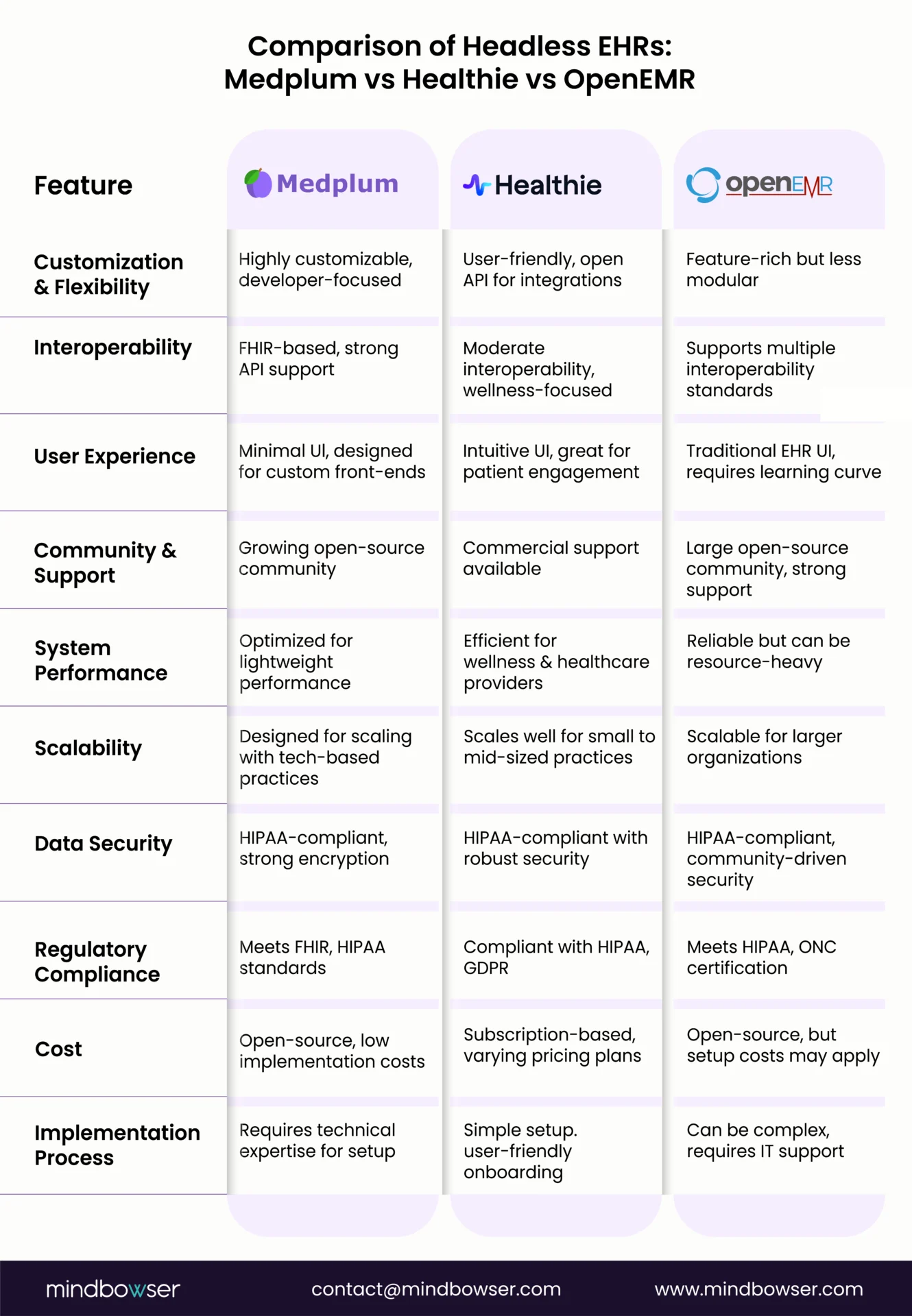
Different headless EHRs operate in several ways. Some offer complete customization, while others focus on pre-built features with fewer customization options. The key is finding the right balance between customization, interoperability, user experience, and support.
Let’s break down how Medplum, Healthie, and OpenEMR stack up across essential EHR features so you can make the right call.
Customization and Flexibility
Medplum
Medplum is built for developers and tech-driven healthcare teams that want full control over their EHR experience. With its FHIR-compliant API, teams can custom-build dashboards, patient portals, and workflows to match their needs. This is the go-to for organizations that don’t want to be stuck with rigid templates and pre-set workflows.
Healthie
Healthie provides some customization, but within its ecosystem. It has built-in telehealth, billing, and scheduling tools, which is good for teams that want an all-in-one EHR without heavy development work. The downside? If you need deep customization or integrations outside Healthie’s framework, you’ll hit limits quickly.
OpenEMR
OpenEMR offers extensive customization, but you’ll need technical expertise to make it work. Unlike Medplum, which is API-driven, OpenEMR requires manual modifications, self-hosting, and ongoing maintenance. If you have a development team and need open-source flexibility, this is a strong option; but be ready to handle the setup and upkeep yourself.
Oystehr
Oystehr is designed API-first, giving developers granular control over data models, workflows, and UI; with no rigid templates in the way. Its FHIR R4B/R5 foundation means customization isn’t just about the interface; you can model clinical data the way your application actually needs it. Whether you’re building a specialty care app, a remote monitoring platform, or a complex patient portal, Oystehr lets your team define the experience from the ground up without fighting the platform.
Canvas Medical
Canvas Medical stands out for teams that want to customize the EHR using Python plugins rather than relying only on external APIs. Through the Canvas SDK, developers can write server-side plugins that respond to EHR events, request additional data, call external services, and return effects that modify workflows or update data within Canvas. That makes it well-suited for organizations that want to embed custom business rules, charting logic, task automation, or decision support directly into the clinical workflow. It also offers structured options for custom data models and a FHIR client inside the SDK, giving developers more flexibility than a UI-only or form-based customization layer. The trade-off is that teams with real engineering capacity best leverage Canvas customization; it is not a low-code environment.
Want expert guidance on Medplum, Healthie, or OpenEMR?
Scalability: Can the EHR Grow with Your Organization?
Medplum
Medplum is built to scale. Whether you’re a small telehealth startup or a growing hospital network, its FHIR-compliant API architecture ensures modular expansion. You can build a Custom EHR, add new features, integrate additional tools, and expand patient records without worrying about system overload. Since it’s cloud-based, you don’t need to manage hardware or manually scale servers; Medplum adapts as your organization grows.
Healthie
Healthie EHR scales well for small to midsized practices, but it’s not designed for large enterprise-level expansion. If you’re running a small clinic or wellness practice, it works out of the box, but if your organization is expanding into multiple locations or needs deeper integrations, you’ll eventually hit a scalability wall. Since Healthie controls its infrastructure, you don’t have full control over how it scales.
OpenEMR
OpenEMR is as scalable as you make it. Since it’s self-hosted, you can expand storage, upgrade servers, and optimize databases to accommodate more patients and larger workflows. But scalability depends entirely on your technical team. If you have the right IT resources, OpenEMR can handle massive growth, but without proper maintenance, performance may degrade as your system expands.
Oystehr
Oystehr is built to scale alongside modern health tech companies. Its cloud-native, pay-as-you-go architecture means you’re not over-provisioning infrastructure on day one or hitting artificial ceilings as you grow. Because it’s API-driven and stateless by design, scaling to new geographies, patient volumes, or clinical use cases is a matter of configuration rather than re-architecture. It’s particularly well-suited for startups that expect rapid growth and can’t afford to re-platform later.
Canvas Medical
Canvas Medical is a strong option for organizations that expect workflow complexity to grow over time. Its architecture lets teams extend the platform through plugins and FHIR-based integrations instead of forcing every new use case into the same fixed workflow. That means as your organization adds service lines, care programs, automation layers, or third-party tools, your team can keep evolving the EHR logic without ripping out the platform. The SDK’s plugin model is especially useful for scaling operational sophistication; things like custom chart apps, event-driven logic, and workflow-specific automation; while the FHIR API supports interoperability with adjacent systems. For fast-growing digital health companies and care delivery models that need ongoing product iteration, Canvas offers more room to evolve than traditional closed EHRs.
Security and Compliance: Medplum vs. Healthie vs. OpenEMR
Security isn’t optional in healthcare; it’s mission-critical. Whether you’re handling patient medical records, billing information, or clinical workflows, data protection and regulatory compliance should be non-negotiable. A breach doesn’t just mean fines and penalties; it erodes trust and risks the patient’s safety.
Let’s break down how Medplum, Healthie, and OpenEMR compare when it comes to data security and compliance with industry regulations.
Data Security Measures: How Well is Patient Data Protected?
Medplum
Medplum takes security seriously, with enterprise-grade encryption, role-based access controls, and cloud-native security infrastructure. Since it’s built with FHIR-native architecture, it ensures secure data transmission, authentication, and storage right out of the box. Medplum also supports audit logs so healthcare organizations can track every action taken within the system, making it ideal for high-risk environments that need strict security policies.
Healthie
Healthie implements standard security measures like encrypted data storage and two-factor authentication, making it a solid option for small to midsized practices. However, since it’s a closed system, users don’t have full control over security configurations. While it meets basic security requirements, organizations needing advanced security controls or third-party risk assessments might find limitations.
OpenEMR
OpenEMR’s security depends entirely on how it’s set up. Since it’s self-hosted, organizations can implement their encryption, firewalls, and access controls. While it offers some built-in security features, it can be vulnerable to cyber threats if improperly configured. Without an IT team managing regular security patches and updates, OpenEMR could pose serious risks in data protection.
Oystehr
Oystehr approaches security through its API-first, cloud-native architecture, where compliance and data protection are built directly into the platform rather than left to custom configuration. It includes HIPAA, ONC, and SOC 2-aligned infrastructure, along with identity management, access controls, and secure data handling as part of its core offering.
Because Oystehr is FHIR-native (R4/R5), it supports modern healthcare security patterns such as OAuth-based authentication, role-based access control, and audit-ready data exchange; critical for protecting PHI in distributed systems.
Its event-driven architecture (via serverless “Zambdas”) also enables controlled data flows between internal workflows and external systems, reducing the need for insecure middleware or manual data handling. The result is a platform where security, interoperability, and extensibility are tightly coupled, making it a strong choice for organizations building complex, integration-heavy healthcare applications.
Canvas Medical
Canvas Medical supports secure integration patterns through its OAuth-based API access model and controlled SDK environment. Its FHIR API uses OAuth 2.0-style authentication patterns, and the SDK allows developers to build plugins that run within the Canvas environment rather than relying entirely on brittle external automation layers. That architecture can reduce workflow fragmentation while giving teams tighter control over how custom logic interacts with patient data. For organizations building custom extensions, this is important: security is not just about encryption at rest and in transit, but also about reducing the number of disconnected tools touching PHI. As with any extensible platform, governance still matters; custom plugins should be reviewed with the same rigor as any production healthcare software.
Related Read: Securing Healthcare: The Critical Role of Data Security
Regulatory Compliance: Does It Meet HIPAA, GDPR, & Other Standards?
Medplum
Medplum is fully HIPAA, GDPR, and FHIR-compliant, ensuring patient data is handled according to strict global standards. Because it’s built on modern security protocols, it supports automated compliance reporting, audit logs, and access monitoring, making it an excellent choice for healthcare organizations that require airtight compliance from day one.
Healthie
Healthie is HIPAA-compliant and provides secure data storage, but it doesn’t natively support FHIR. While it’s suitable for small and midsized practices needing a quick, compliant solution, larger organizations looking for deeper interoperability with strict compliance controls may find it limiting.
OpenEMR
OpenEMR can be HIPAA-compliant, but compliance depends on the user’s setup. Unlike Medplum and Healthie, which handle compliance as part of their infrastructure, OpenEMR requires manual security configurations, access control setup, and compliance monitoring. Without active IT management, OpenEMR cannot ensure full adherence to healthcare regulations.
Oystehr
Oystehr ships with ONC certification and full HIPAA compliance built into the platform; not bolted on. Data encryption, role-based access controls, and audit logging come standard, removing the burden of manual compliance configuration that plagues self-hosted alternatives. Its support for FHIR R4B and R5 also ensures alignment with the latest federal interoperability mandates, making it a strong choice for organizations that need to demonstrate regulatory readiness to partners, payers, or investors.
Canvas Medical
Canvas Medical’s interoperability layer is built on FHIR R4, which makes it a stronger fit for organizations that care about standards-based data exchange and future integration flexibility. Its developer tooling is also designed for healthcare-specific customization rather than generic app development, which matters when teams need to operationalize documentation rules, care workflows, and integration logic in regulated environments. While organizations should still validate their own legal, contractual, and implementation requirements, Canvas gives healthcare teams a more modern foundation for building compliant workflow extensions than platforms that rely on ad hoc customization or non-standard data layers.
Related Read: Navigating the Regulatory Landscape: A Guide to Healthcare Compliance Regulations
Cost & Implementation: Medplum vs. Healthie vs. OpenEMR
Choosing an EHR isn’t just about features; it’s also about cost and ease of implementation. Some platforms have subscription fees and built-in support, while others require self-hosting and ongoing maintenance costs. On top of that, how easy (or difficult) the setup process is can make or break an organization’s ability to switch or scale efficiently. Let’s break down Medplum, Healthie, and OpenEMR to see which fits your budget and implementation needs.
Cost Analysis: What’s the Total Expense?
Medplum
Medplum follows a modern, API-first pricing model, which means you only pay for the resources you use. Since it’s cloud-based, there are no heavy infrastructure costs, and you don’t need a full IT team to manage it. It’s a great choice for startups and enterprises looking for predictable, scalable pricing without licensing fees or hidden maintenance costs.
Healthie
Healthie operates on a subscription-based pricing model, which means you pay a monthly or annual fee based on your organization’s size and needs. While it includes built-in telehealth, scheduling, and billing, the cost can increase significantly as you scale. It’s ideal for small to midsized practices that want a pre-packaged solution without worrying about backend infrastructure costs.
OpenEMR
OpenEMR is free and open-source, which sounds great until you factor in the cost of implementation, hosting, and ongoing support. Since it’s self-hosted, you need server space, IT staff, and maintenance resources to keep it running efficiently. The price depends on whether you have in-house technical expertise or need to hire developers to configure, secure, and optimize the system.
Oystehr
Oystehr uses a pay-as-you-go model, meaning you only pay for what you actually use; there are no large upfront licensing fees or subscription tiers that charge for features you haven’t unlocked yet. For early-stage teams, this dramatically lowers the barrier to entry. Implementation is developer-led and API-driven, so teams with engineering resources can move quickly. Unlike OpenEMR, there’s no self-hosting overhead; unlike Healthie, you’re not constrained by a closed ecosystem.
Canvas Medical
Canvas Medical is likely to be a better fit for organizations that value long-term workflow leverage over lowest-entry pricing. The platform’s real economic advantage is not just licensing; it’s the ability to use Python plugins, SDK tooling, and the FHIR API to reduce workflow workarounds, manual overhead, and dependency on disconnected middleware. For healthcare teams with technical resources, that can improve total cost of ownership over time because the platform can be adapted as needs change. But unlike plug-and-play systems, Canvas may require more upfront product and engineering investment to unlock its full value. In other words, it may cost more to implement thoughtfully, but it can create more operational upside for organizations that need a configurable clinical platform rather than a static EHR.
Implementation Process: How Hard Is It to Set Up?
Medplum
Medplum is built for fast, API-driven implementation. Because it’s cloud-based, there’s no need to set up physical servers or worry about backend infrastructure. The FHIR-compliant API allows developers to integrate it seamlessly with existing tools, making it one of the quickest and most efficient EHRs to deploy. For teams with basic technical knowledge, implementation is smooth and scalable.
Healthie
Healthie is plug-and-play, meaning setup is as easy as signing up and onboarding your team. There’s no need for deep technical knowledge, and you can start using the platform within days. The downside? If you need custom features or integrations outside Healthie’s ecosystem, you might run into limitations that require workarounds or support intervention.
OpenEMR
OpenEMR requires the most effort to implement. Since it’s self-hosted, organizations must set up their infrastructure, configure security protocols, and manage updates manually. If you have an IT team, it’s manageable; but for clinics or practices without technical expertise, setup can be complex, time-consuming, and prone to errors.
Oystehr
Oystehr is built for developer-led, API-first implementation, making it significantly faster to deploy for teams with engineering resources. Since it’s cloud-native and doesn’t require self-hosting, there’s no infrastructure setup; teams can start integrating immediately using its FHIR APIs and modular services.
What sets Oystehr apart is its use of serverless functions (Zambdas), which allow developers to build and deploy backend logic without managing servers. This makes it easier to create custom workflows, automate processes, and integrate third-party systems without complex infrastructure overhead.
However, like Medplum, Oystehr is not a plug-and-play solution. Implementation requires familiarity with APIs, FHIR standards, and modern development practices. For product-focused health tech teams, this enables rapid iteration and customization, but for organizations without technical resources, the setup can be more demanding than turnkey EHR platforms.
Canvas Medical
Canvas Medical implementation is best suited for teams that want to build with the platform, not just turn it on. Its developer environment includes the Canvas SDK, plugin guides, examples, a CLI, and FHIR API tooling, which gives engineering teams a clear path for extending the platform. Developers can build server-side plugins, create custom chart applications, define data models, and interact with Canvas resources through a FHIR client. That makes implementation more flexible than a closed SaaS EHR, but also more technical. Organizations without internal engineering support may find setup and customization more demanding than turnkey systems, while product-minded health tech teams will likely see that flexibility as a major advantage.
Pros and Cons: Medplum vs. Healthie vs. OpenEMR
No headless EHR is perfect; each comes with strengths and trade-offs depending on your organization needs. Some offer full customization, while others provide plug-and-play simplicity but with limited flexibility. Below is a detailed breakdown of the pros and cons of Medplum, Healthie, and OpenEMR, so you can make the right decision.
Medplum: Full Control, but Still Growing
Pros:
Highly customizable – Built for developers and healthcare teams who want total UI, workflows, and data structure.
FHIR-native – Seamless interoperability and data exchange with third-party applications.
Transparent and open-source – No vendor lock-in, giving teams the freedom to modify, scale, and optimize.
Cloud-native and scalable – Handles large workloads without slowing down, making it great for fast-growing healthcare providers.
Cons:
Still maturing – Compared to legacy EHRs, Medplum is relatively new, meaning some features are still evolving.
Requires development expertise – This isn’t a plug-and-play solution;you’ll need technical skills to customize and set it up properly.
Healthie: Easy to Use, but Limited for Large-Scale Needs
Pros:
All-in-one solution – Comes with built-in telehealth, billing, and patient engagement tools, making it quick to deploy.
Robust API – Allows for some integrations, giving healthcare teams a way to connect with third-party applications.
Mobile-friendly – Strong mobile support for both patients and providers, improving accessibility.
Cons:
Not FHIR-native – While it offers API access, it’s not designed for deep interoperability with enterprise healthcare systems.
Limited customization – Great for small clinics, but lacks flexibility for large-scale enterprise integrations.
You’re locked into Healthie’s ecosystem – If you need features outside their platform, your options are limited.
OpenEMR: Feature- Rich, but Needs Technical Know-How
Pros:
Comprehensive feature set – Includes everything from patient records to billing and compliance, making it one of the most complete open-source EHRs.
Large community support – Backed by a strong open-source developer community, ensuring constant improvements and troubleshooting support.
Highly flexible – Since it’s self-hosted, it offers full control over how it’s configured and expanded.
Cons:
Outdated UI – Compared to modern EHRs, OpenEMR’s interface feels clunky and requires updates to make workflows intuitive.
Steep learning curve – Customization is possible but requires IT resources to implement and maintain effectively.
Not cloud-native – Since it’s self-hosted, scalability depends on how well the infrastructure is set up.
Oystehr: Developer-First and Future-Proof, but Newer to Market
Pros:
FHIR R4B/R5 support – One of the only platforms offering R5 readiness, keeping your stack ahead of evolving interoperability mandates.
ONC-certified out of the box – Compliance is built in, not a configuration task.
Pay-as-you-go pricing – No fixed subscription bloat; cost scales directly with usage.
Developer-first design – Clean APIs, modern tooling, and no legacy UI baggage to work around.
Cons:
Smaller ecosystem; As a newer entrant, third-party integrations and community resources are still growing compared to OpenEMR or Medplum.
Requires engineering resources; like Medplum, this is not a plug-and-play solution; you need a development team to get the most out of it.
Canvas Medical: Deep Workflow Extensibility with a Strong Developer Stack
Pros:
Python plugin architecture – Lets developers customize workflows natively inside the EHR, not just around it.
FHIR R4 API – Supports standards-based interoperability for external integrations and data exchange.
SDK-driven customization – Gives teams tools for plugin development, custom apps, data modeling, and event-based workflow logic.
Built for healthcare workflow extension – Useful for charting automation, decision support, task orchestration, and clinical operations customization.
Cons:
Requires engineering resources – Best suited for teams with developers who can work in Python and healthcare integration environments.
Not a lightweight plug-and-play option – Organizations looking for instant deployment with minimal configuration may find it more involved.
More opinionated than a pure backend – Flexible, but not as infrastructure-agnostic as some developer-first headless platforms.
When to Use Which Headless EHR: A Decision Framework
Choosing the right headless EHR isn’t just about features; it’s about aligning the platform with your product strategy, technical capabilities, and long-term growth plans.
Use this framework to quickly determine which EHR fits your use case.
Medplum – For Full Custom Product Development
Use Medplum if:
You’re building a custom healthcare platform from the ground up
You need complete control over UI, workflows, and data models
Your team is comfortable with FHIR + API-first architecture
You want to avoid vendor lock-in with open-source flexibility
Best fit: Digital health startups, internal innovation teams, custom care platforms
Oystehr – For Scalable, Modern Health Tech Platforms
Use Oystehr if:
You need FHIR R4B/R5 support with future-ready interoperability
You want ONC + HIPAA compliance out of the box
Your architecture favors serverless (Zambdas) and API-driven workflows
You’re planning for rapid scale or multi-tenant environments
Best fit: Series B+ healthtech companies, scaling virtual care platforms
Canvas Medical – For Workflow-Level Customization
Use Canvas Medical if:
Your differentiation lies in clinical workflows and provider experience
You want to customize logic inside the EHR using Python plugins
You need FHIR APIs + embedded workflow automation
You’re optimizing charting, care pathways, or operational efficiency
Best fit: Care delivery organizations, value-based care models, workflow-heavy platforms
Healthie – For Fast, Plug-and-Play Deployment
Use Healthie if:
You want a ready-to-use EHR with minimal engineering effort
Your focus is on telehealth, patient engagement, and scheduling
You don’t need deep customization or complex integrations
Speed to market is your top priority
Best fit: Wellness platforms, small clinics, early-stage startups
OpenEMR – For Cost-Controlled, Self-Hosted Systems
Use OpenEMR if:
You need a free, open-source EHR
You have an internal IT team for hosting and maintenance
You’re comfortable managing security, updates, and infrastructure
Your use case is more traditional practice management
Best fit: Cost-sensitive clinics, hospitals with strong IT capabilities
How Mindbowser Can Help You Choose the Right Headless EHR for Your Organization?
Selecting a headless EHR isn’t just about picking a platform; it’s about finding a solution that fits your workflows, scalability needs, and long-term goals. Medplum, Healthie, and OpenEMR each bring different strengths to the table. Medplum stands out for its modern API-first design, built-in scalability, and seamless interoperability, making it the best fit for tech-driven healthcare organizations, telehealth startups, and enterprises looking for flexibility. Healthie offers an easy-to-use platform with built-in features but limits deep customization and large-scale expansion. OpenEMR provides open-source freedom but requires technical expertise to configure and scale effectively.
The right choice comes down to how much control you want over customization, how easily you need to integrate with other systems, and whether you have the technical resources to manage infrastructure.
At Mindbowser, we don’t just evaluate EHR platforms; we build on them.
We’ve worked hands-on with Medplum and Healthie, implementing custom workflows, integrating third-party systems, and solving real-world challenges around interoperability, compliance, and scalability. This gives us a practical understanding of where these platforms deliver value and where teams need to plan for trade-offs.
The right EHR isn’t the one with the most features; it’s the one that adapts to your workflows, not the other way around.
Whether you’re choosing Medplum for flexibility or Healthie for speed, success ultimately depends on how well the platform aligns with your product vision, integration needs, and long-term scalability goals.
If you’re looking for a scalable, cloud-based, fully customizable headless EHR that doesn’t force you into rigid workflows, Medplum delivers the best balance of performance, flexibility, and future-proofing.
Streamline your Medplum integration with Mindbowser – efficient, secure, and tailored for your healthcare workflows. Get Started!
A headless EHR separates the frontend (user interface) from the backend (data and logic layer), allowing healthcare organizations to build custom workflows, interfaces, and integrations. Traditional EHRs come with rigid interfaces and predefined workflows, limiting flexibility. Headless EHRs are better suited for organizations building digital health platforms, AI-driven workflows, or scalable care models.
For scaling digital health platforms:
- Oystehr is ideal for rapid scaling with FHIR R4B/R5, ONC certification, and serverless architecture
- Medplum is best for teams that want full control and open-source flexibility
- Canvas Medical is a strong fit when scaling requires workflow-level customization using Python plugins
The best choice depends on your engineering maturity and long-term product roadmap.
Most headless EHR platforms support HIPAA compliance, but USCDI v3 alignment varies:
- Oystehr offers strong alignment with FHIR R4B/R5 and ONC certification
- Medplum and Canvas Medical support USCDI through FHIR but require proper implementation
- Healthie and OpenEMR may need additional integrations or configuration for full USCDI v3 alignment
Compliance ultimately depends on both the platform and how it is implemented and governed.
- Healthie is the easiest with a plug-and-play setup
- Medplum and Oystehr offer fast API-driven implementation but require developers
- Canvas Medical requires engineering effort for SDK and plugin-based customization
- OpenEMR is the most complex due to self-hosting and manual setup
If speed is critical, choose Healthie. If flexibility matters, API-first platforms are better.
Start by evaluating:
- Do you need customization or a ready-to-use system?
- Do you have an engineering team?
- Will you need FHIR-based interoperability and USCDI compliance?
- Are you planning to scale or integrate with multiple systems?
A simple decision guide:
- Custom platform → Medplum or Oystehr
- Workflow-heavy care delivery → Canvas Medical
- Fast deployment → Healthie
- Budget-controlled setup → OpenEMR
Yes with open-source options like Medplum and OpenEMR, you own the build completely. Managed platforms (Healthie, Canvas, Oystehr) run the backend as a service, so you own the application layer and data but operate within their platform terms. In all cases, the clinical product you build on top is your IP.