













 BLOGS
BLOGS  NEWSROOM
  CASE STUDIES
  WEBINARS
  PODCASTS
  ASSET HUB
  EVENT CALENDAR

















TL;DR
- CPOE is a clinician entering orders directly into a computer instead of writing them. The P is read as physician, provider, or practitioner depending on who wrote the sentence, and all three mean the same system.
- Hospitals are scored on it. The Leapfrog CPOE Evaluation Tool tests whether your system catches at least 60% of the frequent serious medication errors known to cause harm. In 2025, 90% of surveyed hospitals met the standard, against 66% in 2018.
- CPOE without decision support is just typing. The order-entry screen is a data-capture form until something inspects the order before it commits.
- Two of the three CDS Hooks that Epic supports in practice fire at order entry:
order-selectandorder-sign.That is the technical answer to where decision support actually lives.
What CPOE Stands For, And Why The Middle Word Keeps Changing
CPOE means a clinician types the order themselves, and the moment they do is the only moment decision support can still change it.
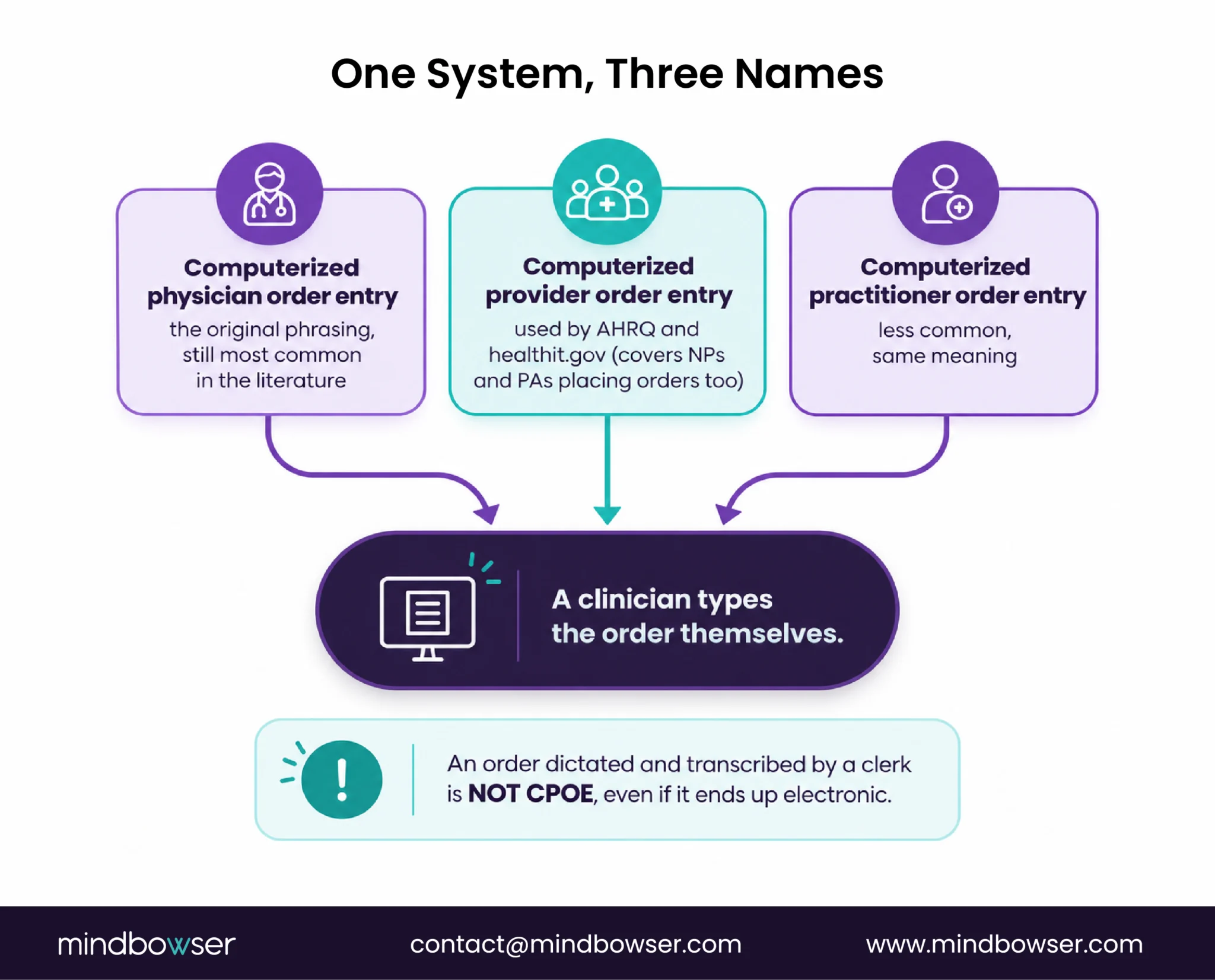
The acronym expands three ways in active use:
- Computerized physician order entry, the original phrasing, still the most common in the literature
- Computerized provider order entry, used by AHRQ and healthit.gov, because nurse practitioners and physician assistants place orders too
- Computerized practitioner order entry, less common, same meaning
Nothing turns on the choice. Federal certification criteria say provider. Leapfrog says prescriber. Vendors say whichever their buyer says. If you are reading a requirements document and the middle word shifts between paragraphs, it is a drafting artifact, not a scope change.
What does matter is the word entry. CPOE is defined by who does the typing. An order that a physician dictates and a unit clerk transcribes into the system is not CPOE, even though the order ends up electronic. The safety case for CPOE rests entirely on removing the transcription step and the handwriting that preceded it.
What A CPOE System Actually Does
A CPOE system captures the order, checks it, and routes it to whoever fills it. Six order classes cover almost everything in an acute setting:
| Order class | Goes to | Typical checks at entry |
|---|---|---|
| Medication | Pharmacy | Allergy, interaction, dose range, duplicate therapy |
| Laboratory | Lab | Duplicate order, specimen requirements, standing-order rules |
| Radiology / imaging | Imaging | Appropriateness criteria, contrast and renal cautions, prior-study duplication |
| Procedure | Procedural area | Prerequisites, consent, pre-procedure requirements |
| Referral / consultation | Receiving service | Specialty routing, insurance and network rules |
| Nursing and diet | Unit | Protocol conflicts, NPO status |
Two of those columns are the entire subject. The routing column is logistics, and every system does it. The checks column is where systems differ, and it is the column Leapfrog tests.
Most CPOE also carries order sets, which are grouped orders for a recurring situation such as an admission or a post-operative day one. Order sets are the reason CPOE is tolerable at the bedside. Placing forty admission orders individually is not something anyone does twice.
Where CPOE Sits: CPOE, EHR, and CDSS
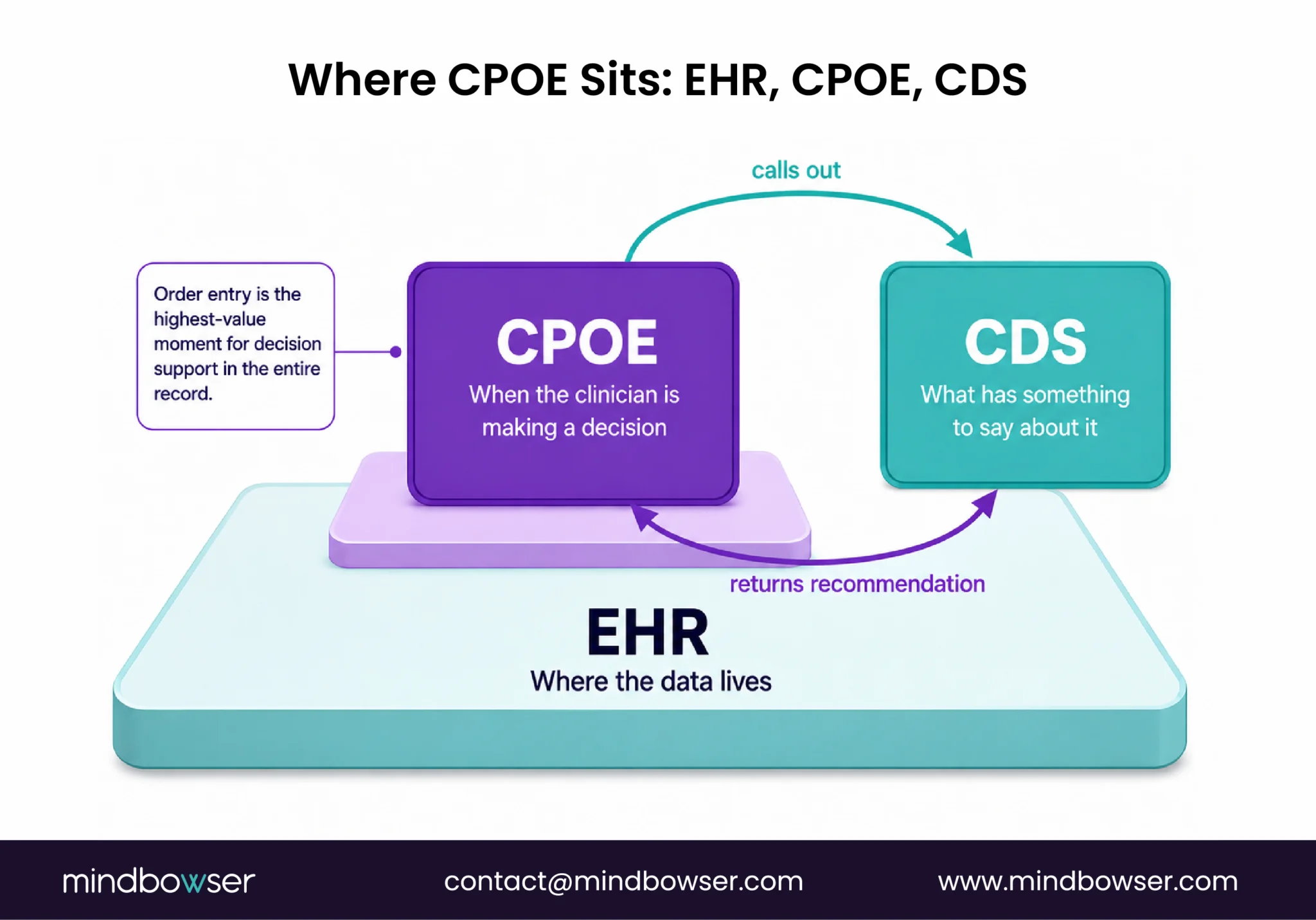
These three get used interchangeably, and they are not the same layer.
- The EHR is the record. It holds the chart, the results, and the documentation.
- CPOE is one workflow inside the EHR. It is the screen where orders originate.
- A clinical decision support system is the logic that inspects clinical data and returns a recommendation. It can fire at order entry, at chart open, at result release, or on a schedule.
The useful way to hold it: the EHR is where the data lives, CPOE is when the clinician is making a decision, and CDS is what has something to say about it. Order entry is the highest-value moment for decision support in the entire record, because it is the last point at which changing the plan costs nothing. A recommendation delivered after the order is signed requires someone to undo something.
That is why CPOE and CDS are discussed together so often, and it is also why the pairing gets asserted more than it gets explained.
You Are Graded On It: The Leapfrog CPOE Evaluation Tool
Most CPOE explainers stop at the definition. For a hospital, CPOE is not a definition. It is a scored measure that shows up in a public safety grade.
The Leapfrog Group runs a two-part standard. The first part is adoption: what share of inpatient medication orders go through CPOE. The second part is the one that catches people, a live test of whether the system actually alerts.
Hospitals run a set of simulated orders written against real patient records in a test environment. The orders are constructed to trip known categories of serious error. The system must alert on at least 60% of them. Leapfrog groups the tested categories into order-checking classes covering therapeutic duplication, dosing limits, allergies and drug interactions, contraindications tied to diagnosis or condition, and monitoring requirements.
Two things follow from this that rarely get said out loud:
- Adoption and effectiveness are scored separately: A hospital can run 100% of orders through CPOE and still fail, because routing every order through a form that checks nothing is a compliance number, not a safety outcome.
- The test is on your configuration, not your vendor’s product: Two hospitals on the same EHR score differently, because the alert rules, the order sets, and the suppression settings are local. Buying a certified system does not buy the score.
The trend line is worth knowing before you benchmark yourself. In 2018, 66% of surveyed hospitals met the standard. By 2025 that was 90%. Leapfrog’s Spring 2026 Hospital Safety Grade named CPOE among 17 measures showing national improvement.
That matters for how you read older material. AHRQ’s PSNet primer, reviewed in March 2025 and still one of the most cited pages on the subject, presents adoption figures from the end of 2015: 84% of federal acute care hospitals adopted CPOE, and only 40% had integrated decision support. Those numbers are a decade old. The adoption half has moved a long way. Treat the 40% as a historical marker of the gap rather than a current statistic, and check any vendor page that quotes it without a date.
Reduce Ordering Errors With Smarter CPOE
CPOE Without Decision Support Is Just Typing
Every page on this subject says CPOE integrates with clinical decision support. Almost none of them say how. Here is the mechanism.
Modern decision support at order entry runs on CDS Hooks, an HL7 specification that is web hooks underneath, standardized so the same service works across EHRs. The EHR calls out at a defined moment, your service responds, and the response renders as a card in the clinician’s workflow.
The moment is the hook. In practice Epic supports three: patient-view,which fires when the chart opens, and order-select and order-sign,which both fire during order entry. Two of the three live in CPOE. Other vendors support subsets of the specification, and Cerner leans on launching a SMART on FHIR app from a card link rather than returning rich in-card suggestions.
The exchange has four steps: trigger, validate, process, respond. The EHR sends context describing which hook fired and prefetch data you declared in advance. Your service validates the token it receives, evaluates the order, and returns cards.
A card has a defined anatomy, and the details decide whether clinicians tolerate it:
- The info section is mandatory, and it carries a title and a source, so the clinician can see where the recommendation came from.
- Suggestions are action items: A suggestion creates or updates a FHIR resource and appears as a button, which means the clinician can accept a correction without leaving the order.
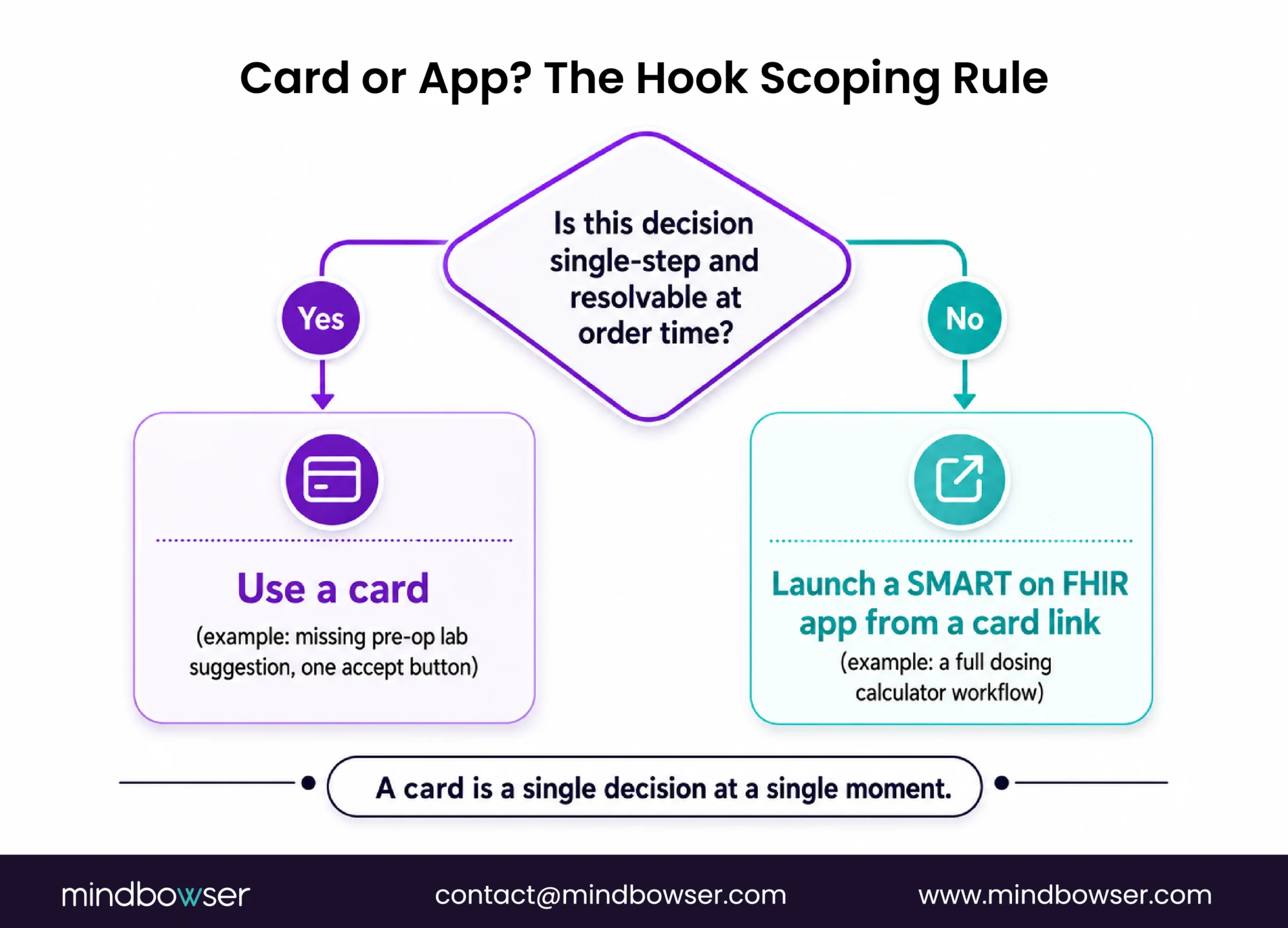
- The link section can launch an embedded SMART on FHIR app or an external URL, for anything too complex to resolve inside a card.
- Returning an empty array is valid and normal: Not every trigger deserves a card, and a service that always responds is a service clinicians will learn to dismiss.
There is one detail worth designing around. Override reasons are supported but discouraged, because capturing one makes the card persist. If your card is going to be overridden often, the answer is a better rule, not a better override form.
An advantage that gets missed: calling the FHIR API directly needs a launch, an authentication step, or a backend connection, which adds a step to the clinician’s workflow. The hook needs none of that. The EHR initiates, so the decision support arrives without anyone asking for it.
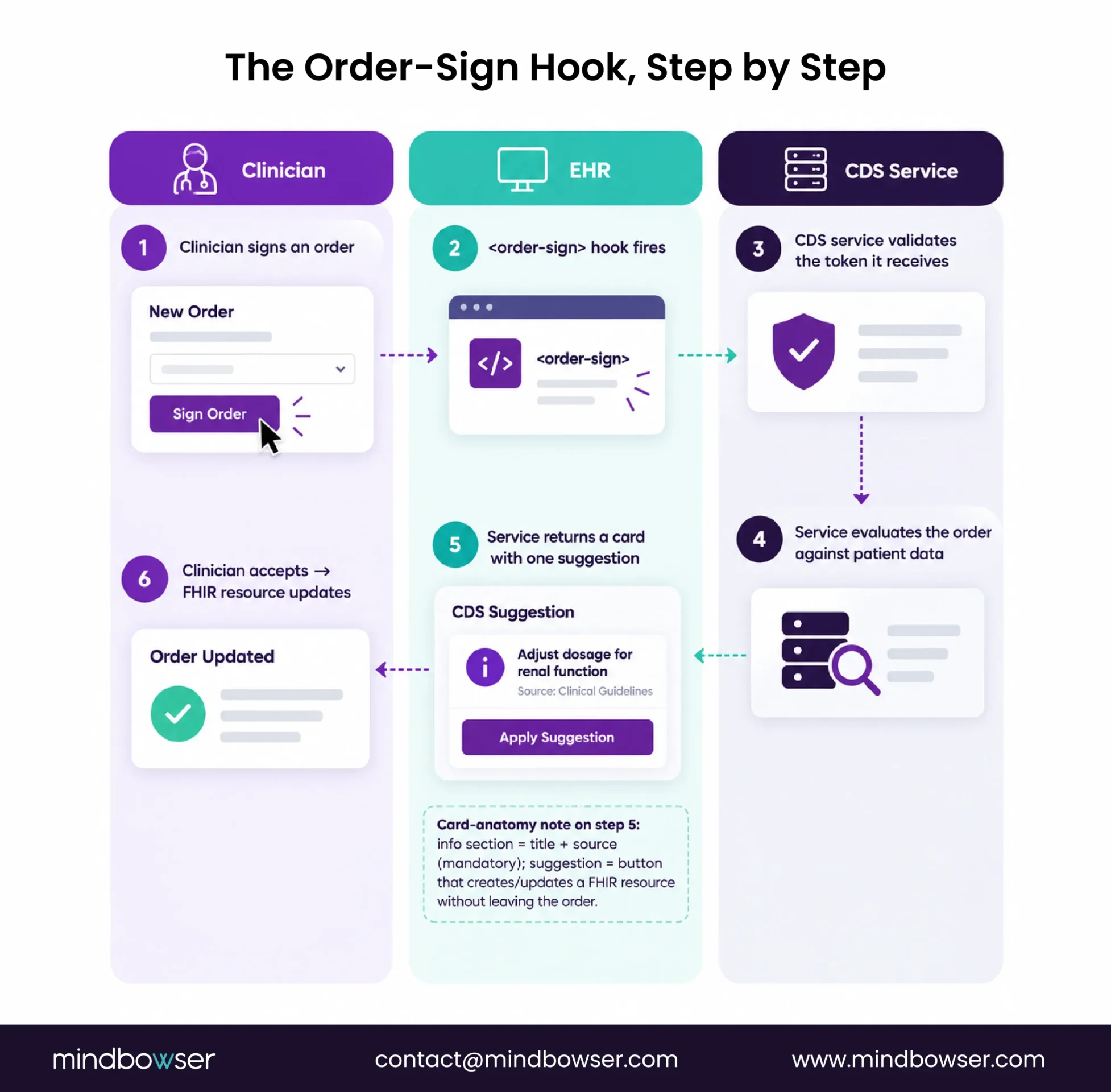
For the request and response shapes, our CDS Hooks implementation guide walks through real payloads.
What it looks like shipped
A perioperative care company founded by a practicing anesthesiologist came to us with a problem that is entirely a CPOE problem. Surgeries were being delayed because pre-operative labs were missing at the point the case was scheduled, and the miss was only discovered later.
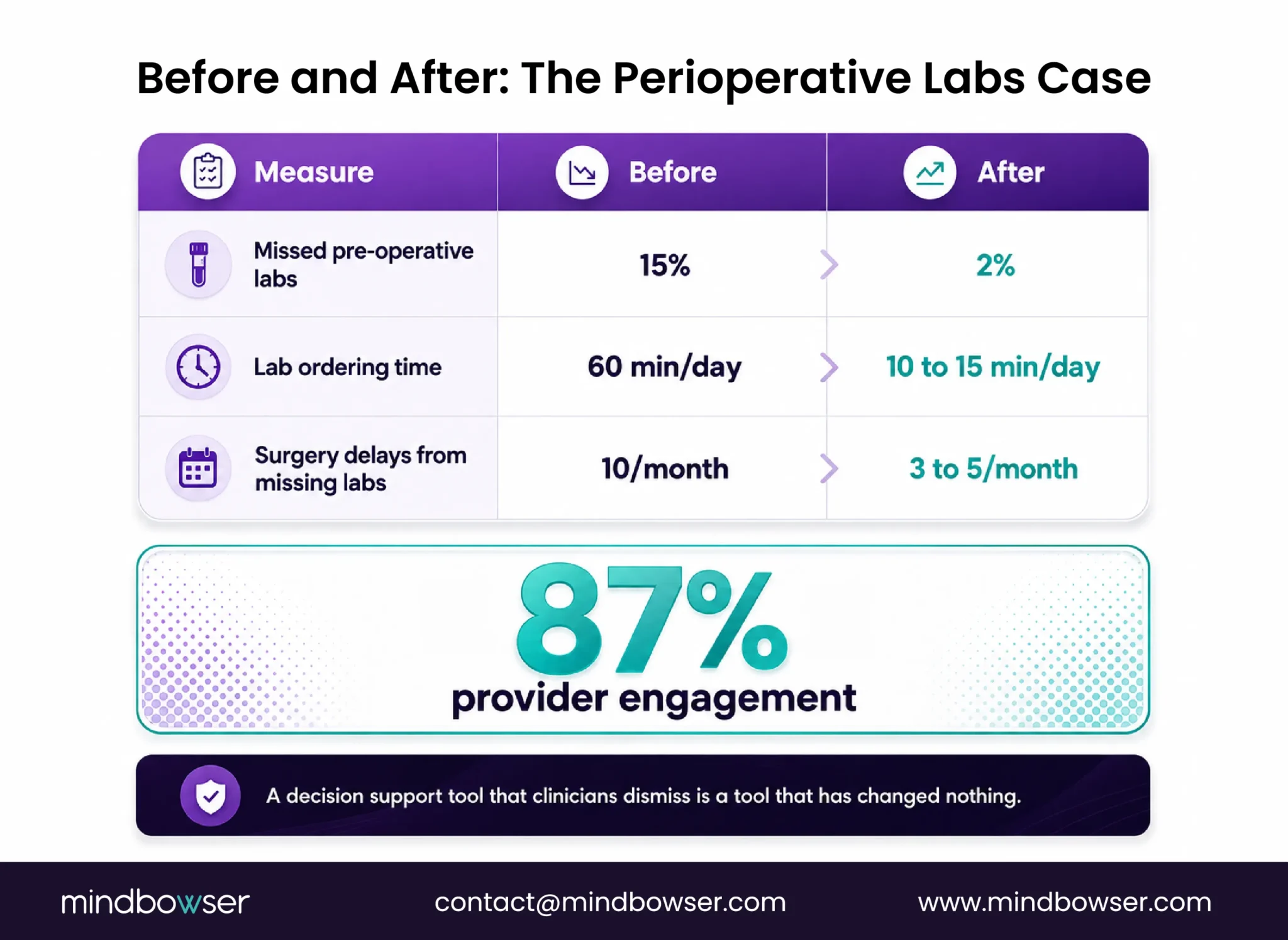
We built a CDS service against Epic’s order-sign hook. When a surgical order is signed, the hook fires, the service checks the patient’s record against the pre-operative requirements for that procedure, and any missing labs come back as a card with the orders as suggestions. The clinician accepts them in place.
The results after deployment:
| Measure | Before | After |
|---|---|---|
| Missed pre-operative labs | 15% | 2% |
| Lab ordering time | 60 min/day | 10 to 15 min/day |
| Surgery delays from missing labs | 10/month | 3 to 5/month |
| Provider engagement with the tool | Not tracked before | 87% |
The engagement number is the one we watch. A decision support tool that clinicians dismiss is a tool that has changed nothing, and 87% is the difference between a card that reads as help and a card that reads as an interruption. More examples of this pattern are in our real-world CDS examples.
What breaks, and the trade-offs nobody puts in the brochure
CPOE reduces some errors and introduces others. The honest version:
The evidence for the upside is solid. A 2013 meta-analysis found a 48% reduction in the likelihood of a prescribing error against paper, which the authors translated to more than 17 million medication errors prevented in a year. A separate five-year analysis attributed roughly 15 million fewer medication errors and 14,500 fewer adverse drug events to CPOE adoption.
The new failure modes are real too. Selection errors replace handwriting errors. Picking the adjacent patient from a list, or the adjacent drug from a dropdown, produces a clean, legible, wrong order. Becker’s has reported on studies finding preventable wrong-patient orders occurring more often than most organizations assume.
Three things reliably go wrong after go-live:
- Order-set sprawl: Order sets get created faster than they get retired. Duplicates accumulate, they drift out of line with current protocol, and clinicians start choosing by habit rather than by content. This is a governance problem with a maintenance owner, not a software problem.
- Override behavior: When alerts fire on low-value checks, clinicians learn to clear them without reading. The override rate is the number to watch, and a rising one is a design signal. We cover the mechanics in alert fatigue in clinical decision support, and the medication-specific side in medication-safety decision support.
- Latency: A card that arrives after the clinician has moved on is worse than no card, because it trains people to expect nothing. Cache aggressively, keep one action item per card, and use the feedback endpoint to avoid re-firing on a suggestion that was already acted on.
There is also an integration cost that vendors do not advertise. Not every EHR exposes the discovery endpoint that lets a service publish which hooks it responds to. Where it is missing, hook endpoints and prefetch conditions are configured by hand for each environment.
And a scoping rule: do not over-use hooks. A card is a single decision at a single moment. Anything multi-step belongs in an embedded SMART on FHIR app launched from a card link.
Buying or building a CPOE system
Almost nobody buys standalone CPOE. It ships as a module of an EHR, and if your organization runs Epic, Oracle Health, MEDITECH, or athenahealth, you already own one. The real question is whether its decision support layer earns its Leapfrog score and whether it covers the workflows your clinicians actually complain about. If you need certification detail, ONC publishes the CPOE test methods for medication, laboratory, and diagnostic imaging separately.
Where custom work is warranted is the layer above: the decision support that fires into an order-entry workflow your EHR does not cover natively. That is what our clinical decision support system development work covers for healthcare teams, as CDS services against the hooks the EHR already exposes, rather than as a replacement for order entry itself. If you are evaluating options, our clinical decision support software buyer’s guide sets out the criteria. Teams building order entry as part of a wider EHR project should start with CPOE as an EHR module.
Computerized physician order entry. It is also written as computerized provider order entry and computerized practitioner order entry. All three describe the same system, and the variation reflects who is authorized to place orders rather than any difference in function.
It is the process of a clinician entering medication, laboratory, radiology, procedure, and referral orders directly into a computer system, which then checks the order and routes it to the department that fills it. It replaces handwritten or verbal orders and the transcription step that came with them.
Yes, and it causes confusion in search. In American football, CPOE is completion percentage over expected, a quarterback passing statistic. In Los Angeles County government, CPOE refers to the County Policy of Equity, a workplace conduct policy. Neither has any connection to order entry.
No. E-prescribing is the outpatient case, transmitting a prescription to a retail pharmacy. CPOE is broader and mostly inpatient, covering labs, imaging, procedures, and referrals as well as medications.
The evidence says yes for prescribing errors specifically. A 2013 meta-analysis found a 48% reduction in the likelihood of a prescribing error against paper ordering. It also introduces new error types, notably wrong-patient and wrong-item selection errors, which is why alert configuration and order-set governance matter as much as adoption.
A two-part measure. Hospitals report the share of inpatient medication orders placed through CPOE, and separately run a test in which the system must alert on at least 60% of simulated orders representing frequent serious medication errors. In 2025, 90% of surveyed hospitals met the standard.