




 BLOGS
BLOGS  NEWSROOM
  CASE STUDIES
  WEBINARS
  PODCASTS
  ASSET HUB
  EVENT CALENDAR



















A build-vs-license framework for three commonly misjudged EHR modules build only what’s core to your clinical differentiation, license/partner for the rest.
- CPOE the hard part isn’t the order form, it’s the workflow (interaction/allergy/formulary checks). Alert fatigue is real (90-96% override rates per a 2020 JMIR review). Build only if your edge is clinical decision logic or specialty order sets; otherwise start from a certified foundation.
- Clinical Data Repository (CDR) not an EHR, not a data warehouse. The real lift is data normalization (HL7 v2, FHIR, proprietary formats → one patient record), not storage. “Store everything as FHIR” doesn’t solve normalization by itself. Build from scratch = 4-8 months of specialized engineering (FHIR store, terminology services, HL7-to-FHIR translation); platforms like Medplum cut that time.
- Scheduling multi-provider/multi-location scheduling is a state machine, not a calendar grid. Needs clean rollback on cascading conflicts, a shared constraint engine for patient self-scheduling, and ties into billing (appointment type → CPT code → documentation).
- Decision order settle your CDR/data layer first; that makes the CPOE and scheduling build-vs-license calls easier.
A CTO on our last EHR build asked which of these three modules to license and which to build. The honest answer took longer than the demo.
That’s usually how this conversation starts. You’ve got a clinical platform on the roadmap, funding closed, and a punch list that says “CPOE,” “clinical data repository,” and “scheduling” like they’re three checkboxes of roughly equal weight. They aren’t. One of them is a workflow problem disguised as a data problem. One is a data-architecture problem disguised as a feature. And one is a state-machine problem that everyone assumes is a calendar.
I’m Arun Badole, VP of Engineering at Mindbowser. I lead builds on HL7 (the messaging standard hospitals have used for decades to move clinical data between systems) and FHIR (the modern, API-friendly successor most new health-tech platforms build on), and this piece is the answer I wish I’d had written down the last three times a technical co-founder asked me this exact question.
If you’re a CTO or VP Engineering at a Series A-C digital health company staring at build-vs-license-vs-partner for these three components, this is for you.
Two things up front. First, if you want the workflow-education view of how CPOE, scheduling, and the other core EHR functions fit together operationally, we’ve covered that separately: this piece doesn’t repeat it. What follows is the build-decision layer: what each module actually costs in engineering effort, where the architecture traps are, and when licensing beats building. Second, none of these three terms individually has enough search volume to carry its own page.
That’s exactly why nobody in the SERP has written the build-decision version. Every top-ranking result is either a vendor’s own product page or an academic paper. None of them are written for someone deciding whether to build.
The Build-vs-License Decision, One Framework for All Three
Before the module-by-module breakdown, here’s the lens I use on every one of these calls.
Build it if: the module is where your clinical differentiation actually lives. If your product’s whole reason for existing is a scheduling logic no off-the-shelf system supports (multi-modality visits, dynamic caregiver matching, a state machine nobody else has modeled), build it. If it’s CPOE and your differentiation is a novel order set or CDS logic tuned to a specific specialty, build it.
License or partner if: the module is table stakes, not differentiation. A generic clinical data repository normalizing standard HL7/FHIR feeds is table stakes for almost every digital health company. Nobody buys your product because your CDR exists; they buy it despite having to trust it exists. That’s a strong signal to build on a foundation (Medplum, for instance) rather than from raw FHIR resources.
Partner for the plumbing, keep the workflow. This is the pattern I see work most often: license or partner for the underlying data layer (FHIR store, terminology services, HL7 v2 ingestion), and build the workflow logic on top of it yourself. You get ONC-certifiable infrastructure without six months of segment-mapping work, and you keep the parts of the product that are actually yours.
I’ll come back to this framework at the end of each module section, because the right call is different for CPOE, CDR, and scheduling, and it should be.
CPOE: The Module Where the Order Workflow Is the Hard Part, Not the Order Entry
CPOE, Computerized Physician Order Entry, is the system that lets a clinician place a medication, lab, imaging, or referral order digitally instead of on paper or by phone. If you’re picturing a form with a submit button, that’s the 10% that’s easy. The other 90% is what happens between “clinician clicks order” and “order reaches the right downstream system correctly.”
The order workflow, not the form. A medication order alone triggers a chain: dose-range check, drug-drug interaction check, allergy check, formulary check, and (if the patient has renal impairment on file) a dosing adjustment prompt. Each of those checks is a separate service call in a well-architected system, not a single monolithic validation function.
Build them as one tangled function and you can’t test them independently, and you definitely can’t turn one off when it’s misfiring without redeploying the whole order pipeline.
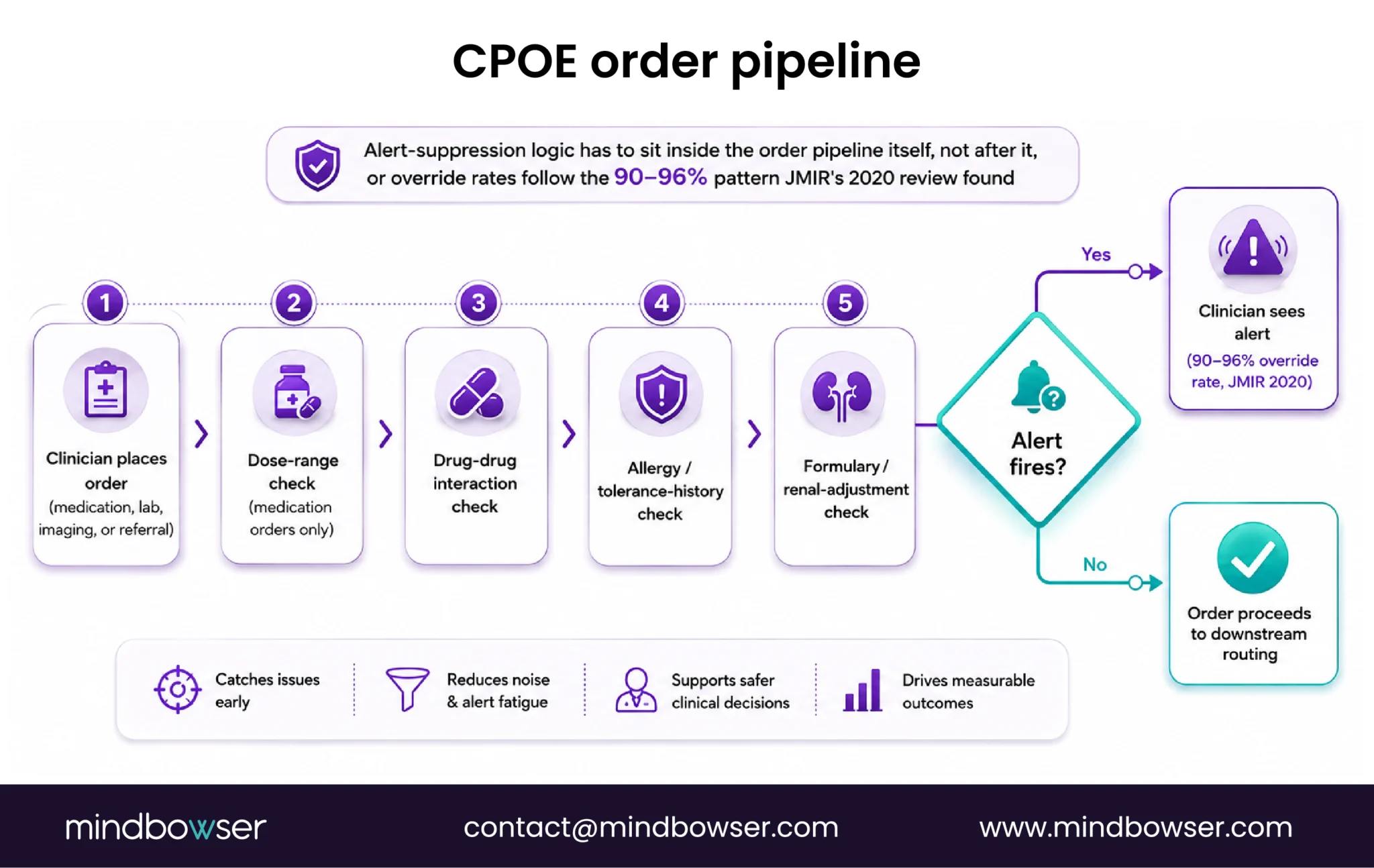
This is where CDS lives, and this is where alert fatigue starts. Clinical Decision Support integrates directly at the CPOE layer: dosing checks, interaction alerts, protocol-compliance prompts. A 2020 systematic review in JMIR Medical Informatics found override rates for CPOE drug-safety alerts commonly fall in the 90%-96% range across the studies it reviewed. Read that again. Ninety to ninety-six percent of the alerts your CDS engine fires get overridden, not acted on. So what.
The implication isn’t “alerts don’t work.” It’s that alert specificity is an architecture decision, not a tuning knob you fix after launch. If your alert engine can’t distinguish “this patient has a documented tolerance to this drug-allergy pair” from “this patient has never seen this drug,” you inherit the exact override-fatigue problem the JMIR review documented. We built the alert-suppression logic into the order pipeline itself on a Medplum-based EHR build for a Seed-stage precision-medicine platform, not as a downstream filter.
That single architectural choice, checking tolerance history before firing the alert, was the difference between clinicians reading the third alert of the day and clinicians auto-clicking through all of them.
Order types aren’t interchangeable in the data model. Medication orders, lab orders, imaging orders, and referrals share a superficial shape (who ordered what, for whom, when) but diverge hard on downstream requirements. A lab order needs a specimen-collection workflow and a result-routing path back to the ordering clinician. An imaging order needs a modality-specific protocol code and, if you’re integrating with a PACS, a DICOM-compatible identifier scheme.
Model all four order types as one generic “Order” resource with a type flag, and you’ll spend the next six months bolting exceptions onto a data model that was never built for the variance. Model them as distinct FHIR Service Request profiles from day one and the downstream integrations are dramatically less painful.
The build-vs-license call for CPOE: if your product’s differentiation is genuinely in the clinical decision logic (a specialty-specific order set, a novel alert-suppression model, a workflow no generalist EHR supports), build it. If you’re building CPOE because “every EHR needs it,” you’re right, and that’s exactly the case for starting from a certified order-entry foundation and spending your engineering hours on the 10% that’s actually yours.
Mapping CPOE, CDR, Scheduling? Get Free Expert Guidance Now
Clinical Data Repository: The Distinction Almost Everyone Gets Wrong
Here’s the confusion I run into more than any other on these calls: founders use “clinical data repository” and “EHR” interchangeably, and then wonder why their data architecture keeps breaking.
A CDR is not an EHR, and it’s not a data warehouse either. A clinical data repository is a system that consolidates data from multiple clinical sources (an EMR, a lab system, a device feed) into a normalized, patient-centric store built for near-real-time access during active care. An EHR is the full application layer: the CDR sits underneath it, but the EHR also includes the CPOE module, the documentation module, the scheduling module, and the user interface that clinicians actually touch.
Build a CDR and call it an EHR, and you’ll have a very well-organized database with no way for anyone to actually use it clinically.
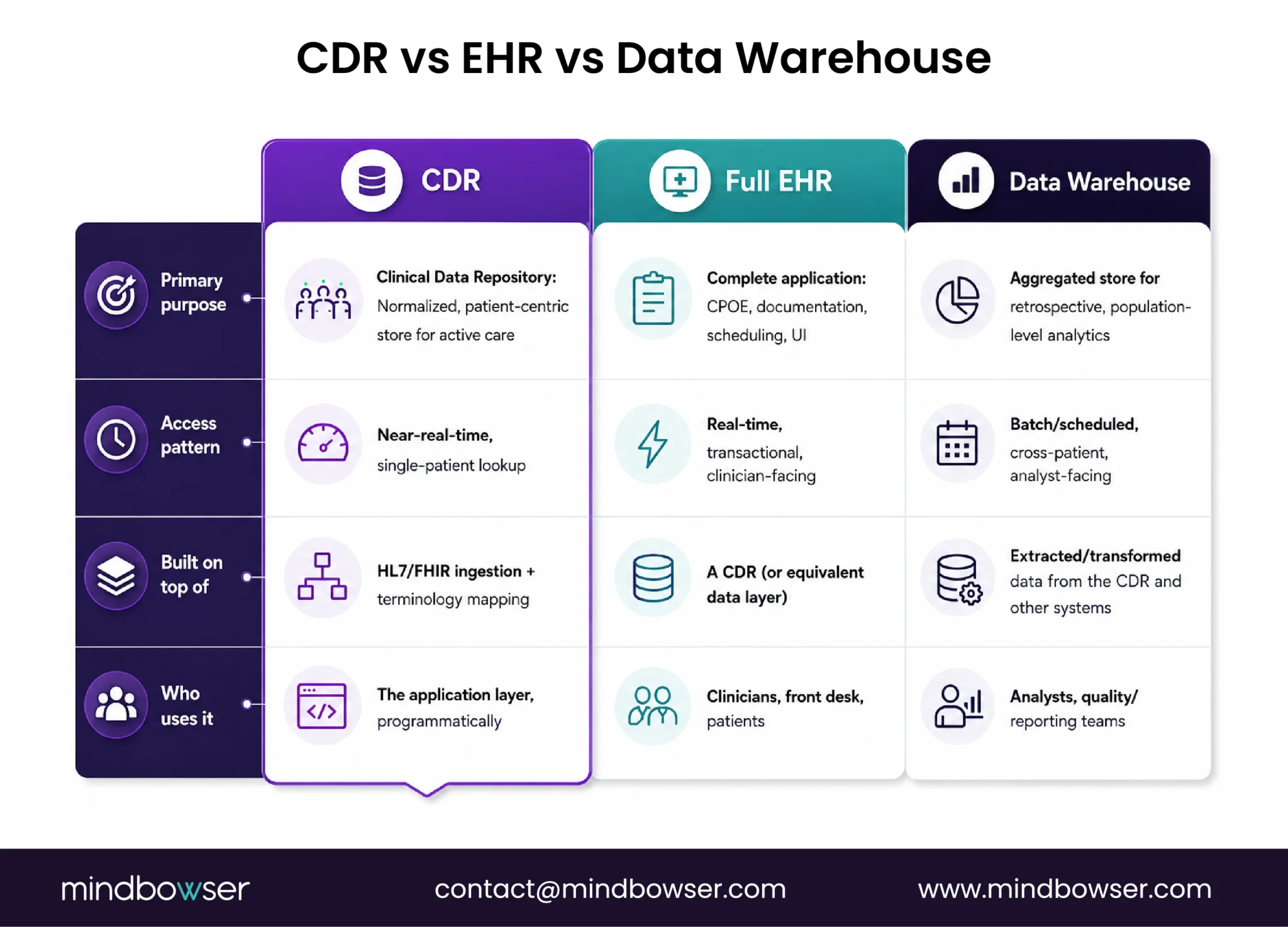
The comparison that actually clarifies this: a CDR is built for one patient’s current clinical picture, retrieved fast, during a visit. A data warehouse is built for population-level, retrospective analysis across every patient, aggregated slowly, after the fact. Health Catalyst’s comparison of the two frames it well: the CDR’s job is real-time clinical insight for individual patient care; the warehouse’s job is strategic, retrospective analytics across the whole organization.
You need both, eventually. You do not need to build them as the same system, and most teams that try end up with neither working well.
Data normalization is the actual engineering lift, not storage. Say you’re pulling in an HL7 v2 ADT feed from a partner hospital, a FHIR feed from your own front-end, and a device manufacturer’s proprietary CSV export for wearables data. Three different formats, three different vocabularies, one patient record that has to reconcile all of it without duplicating the patient or losing the timestamp precision that made the device data useful in the first place.
This is where ONC’s United States Core Data for Interoperability (USCDI) standard earns its keep: USCDI defines the data classes and elements (medications, problems, lab results, and more) that a certified system has to support, along with the vocabulary standards behind them (RxNorm for medications, SNOMED CT for conditions, LOINC for labs). Building your CDR’s normalization layer against USCDI from the start means you’re not retrofitting an ONC certification pathway onto a data model that was never designed for it.
Actually, let me refine that. It’s not just “build against USCDI.” It’s building the normalization layer as its own service, separate from both the ingestion pipeline and the application layer, so that when USCDI v5 adds a data class next year (it’s an annually updated standard), you’re extending one component instead of touching every integration point in the system.
Where teams underestimate the CDR: the assumption that “we’ll just store everything as FHIR resources” solves normalization. It doesn’t. FHIR gives you a shape for the data. It doesn’t give you the mapping logic that decides a lab value from a 2019 HL7 v2 feed and a lab value from a 2026 FHIR feed represent the same LOINC-coded observation. That mapping layer, not the FHIR store itself, is where the CDR build actually lives.
The build-vs-license call for CDR: this is the module where “build the workflow, license the foundation” applies hardest. Standing up a FHIR-native data layer from scratch, with terminology services, USCDI mapping, and HL7 v2-to-FHIR translation, is 4-8 months of specialized engineering most teams don’t need to own. Building on Medplum or a comparable FHIR-native platform and spending your engineering budget on the clinical logic layered on top gets you to a defensible product faster, with less risk on the certification pathway.
Scheduling: Where a Calendar UI Hides a State Machine
Scheduling is the module that gets scoped like a feature and behaves like a distributed system.
Multi-provider, multi-location scheduling is a state machine, not a calendar grid. A single-provider, single-location appointment book is genuinely simple: one resource, one calendar, book or don’t. The moment you add a second provider, a second location, and shared resources (an exam room, an imaging device, a piece of equipment that only one patient can use at a time), you have a constraint-satisfaction problem.
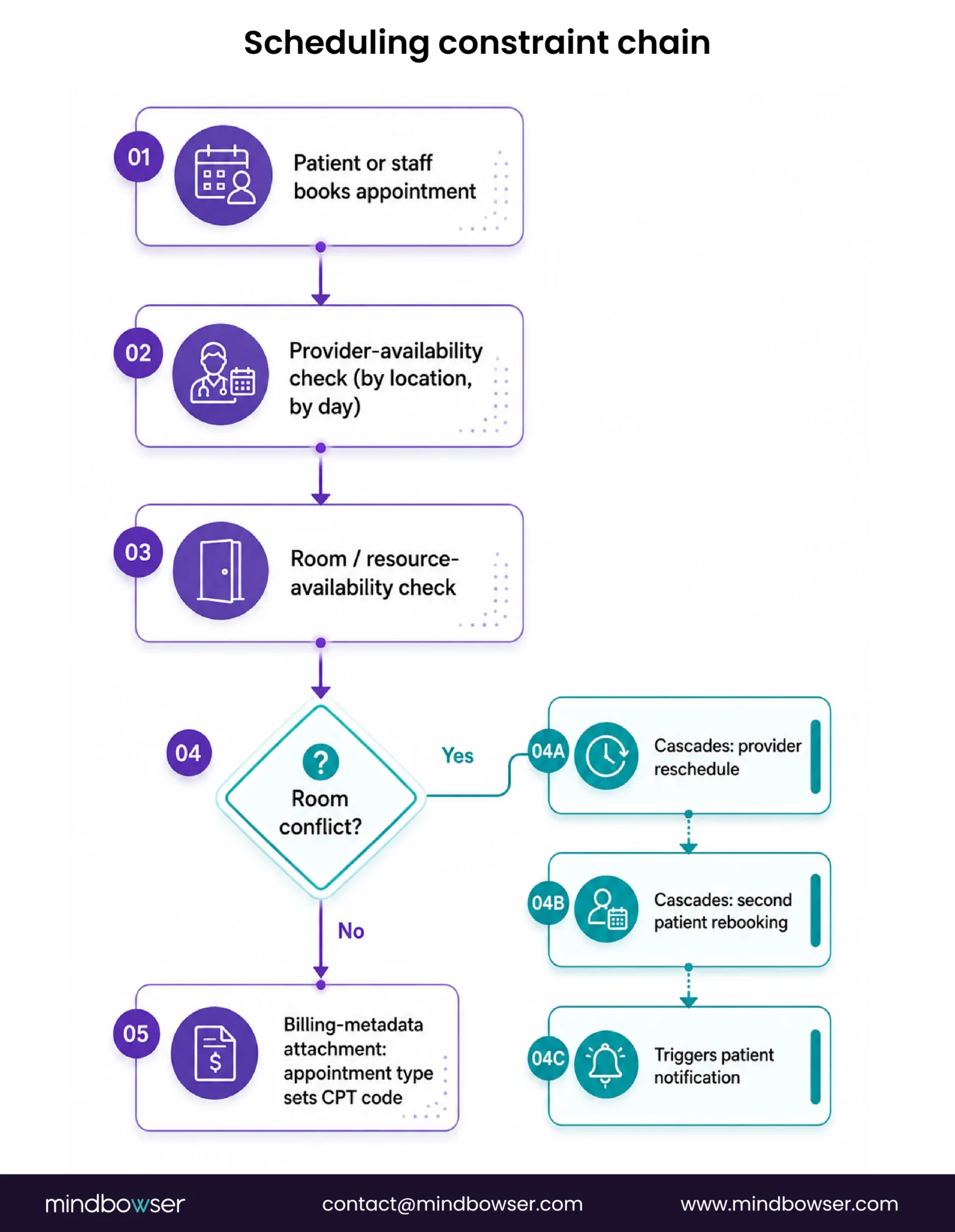
Provider A is available at Location 2 only on Tuesdays. Room 3 is booked for a procedure that runs long 20% of the time. A referral has to land on a provider who’s in-network for the patient’s specific plan. Each of those is a constraint your scheduling engine has to check before it can confirm a slot, and they interact: a room conflict can cascade into a provider conflict that cascades into a patient having to be rebooked.
We learned this the hard way on a multi-location build where the initial scheduling model treated “provider available” and “room available” as independent checks run in sequence. They’re not independent. A double-booked room forces a provider reschedule, which can knock a second patient off their slot, which triggers a rebooking notification, which needs to reach the patient through whatever channel they actually check.
Model the whole chain as a state machine, with each booking as a state transition that can fail and roll back cleanly, and the cascading-conflict problem stops being a production incident and starts being a handled edge case.
Patient self-scheduling is an integration problem before it’s a UX problem. Letting a patient book their own appointment sounds like a calendar widget on your website. It’s actually an authorization and real-time-availability problem: the patient-facing scheduler has to query the same constraint engine the internal staff scheduler uses, in real time, without exposing internal scheduling logic (why a slot is blocked, which provider is out) to an unauthenticated or lightly-authenticated user.
Build the patient-facing scheduler against a separate, simplified data model that gets out of sync with the internal one, and you’ll get double-bookings the front desk didn’t create and can’t easily explain.
The billing-integration dependency almost nobody scopes upfront. Scheduling doesn’t operate in isolation from the revenue side. An appointment type often determines the CPT code that gets billed, which determines the required documentation, which determines whether the visit is even eligible for reimbursement under the patient’s plan. If your scheduling module doesn’t carry that metadata forward to the billing workflow, you’ve built a calendar that creates downstream reconciliation work every single time.
The build-vs-license call for scheduling: if multi-provider, multi-location, multi-modality scheduling logic is genuinely core to your clinical model, build it. This is usually the module where the workflow itself is the product, so licensing a generic scheduling engine means licensing away your differentiation. If your scheduling needs are closer to standard appointment management, a mature scheduling module inside your chosen EHR foundation will save months you’d otherwise spend rebuilding a constraint engine that’s been solved a hundred times already.
For a deeper look at where teams misjudge this kind of build-vs-partner call across an EHR project, our implementation-mistakes piece covers the scheduling rollout failures we see most often.
Deciding Across All Three at Once
You rarely get to make these three calls independently, because the modules share data. CPOE needs the CDR’s medication and allergy history to run its checks. Scheduling needs the CDR’s provider and patient records to build the appointment model. If you build one module on a foundation and hand-roll another, you’ll spend real engineering time just keeping the two data models in sync.
That’s the actual argument for deciding your CDR foundation first, before you scope CPOE or scheduling. Once you know what your data layer looks like (Medplum-based FHIR store, a custom HL7 v2 ingestion pipeline, whatever you land on), the build-vs-license call for CPOE and scheduling gets easier, because you’re evaluating “can we build this workflow on top of what we already have” instead of three separate vendor evaluations that don’t talk to each other.
If you’re weighing whether to build that foundation yourselves or bring in a partner who’s done the FHIR/USCDI mapping work before, our guide to evaluating an EHR development partner walks through the questions worth asking before you sign anything. And if Medplum specifically is on your shortlist for the data layer, here’s how we approach custom EHR builds on top of it.
What I still can’t fully resolve, and I’d genuinely like to hear from anyone who’s cracked it: how to keep a CDR’s normalization layer from becoming a bottleneck once you’re ingesting more than 4-5 distinct source formats at scale. We’ve solved it well up to that range. Past it, every approach I’ve tried trades one kind of complexity for another.
Where This Leaves You
CPOE, CDR, and scheduling look like three items on a build checklist. They’re three different kinds of engineering problems: a workflow-and-alert-fatigue problem, a data-normalization problem, and a state-machine problem. The teams that get this right don’t ask “should we build or buy” once. They ask it three separate times, get three different answers, and build their data foundation first so the answers to the other two get easier instead of harder.
If you’re at that decision point right now, Request an Assessment and bring the punch list. We’ll tell you honestly which parts are worth building and which aren’t.
If clinicians in your product place any medication, lab, imaging, or referral orders, yes. There’s no path to ONC certification or safe clinical operation without an order-entry workflow that includes basic decision support (drug interaction and allergy checks at minimum).
A CDR is the normalized, patient-centric data store underneath the application. An EHR is the full application: CPOE, documentation, scheduling, and the user interface, all built on top of a CDR (or equivalent data layer). You can have a CDR without a full EHR. You can’t have an EHR without something functioning as a CDR.
No. A CDR serves real-time, individual-patient clinical care. A data warehouse serves retrospective, population-level analytics. Most digital health platforms eventually need both, built as separate systems with different access patterns and different latency requirements.
Most of it. Single-provider, single-location scheduling is close to a solved problem. The moment you add a second location, shared resources, or multi-modality visits (in-person and telehealth on the same calendar), you’re building a constraint-satisfaction engine, not a calendar.
Building from scratch means owning FHIR store implementation, terminology services, and HL7-to-FHIR translation yourself: 4-8 months of specialized engineering on our last three builds. Building on an existing FHIR-native foundation lets you spend that time on the clinical workflow logic that’s actually specific to your product.