












 BLOGS
BLOGS  NEWSROOM
  CASE STUDIES
  WEBINARS
  PODCASTS
  ASSET HUB
  EVENT CALENDAR
























TL;DR
- The best occupational therapy EHR depends on practice size and complexity. TherapyNotes leads for solo and small-group OT practices. ClinicSource handles multi-discipline and multi-location setups.
- Athenahealth wins on revenue cycle for complex payer mixes. AOTA’s 2024 workforce survey found therapists lose 4.2 hours/week to documentation and billing tasks a right system can automate; that’s the baseline problem every platform on this list addresses differently.
- For 50+ clinicians, franchise models, or specialty integration, a custom-built OT EMR typically outperforms any off-the-shelf option within 24 months.
Why Do Generic EHRs Fall Short for Occupational Therapy?
OT has distinct clinical, billing, and scheduling requirements that general-purpose EHRs weren’t designed to handle.
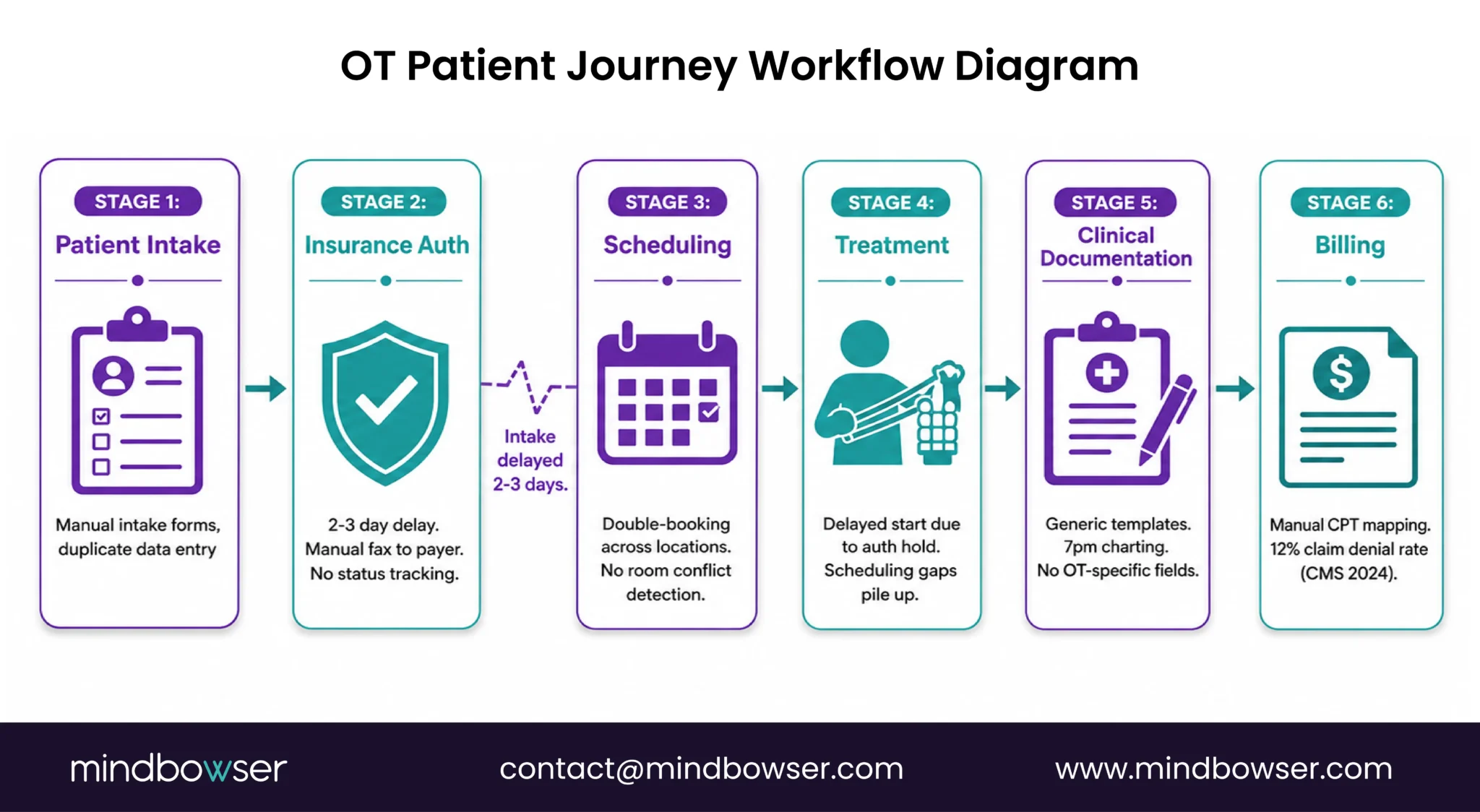
The OIG’s 2022 Medicare Advantage audit found that millions of prior authorization denials are issued annually with therapy services among the most frequently affected, often due to incorrect code mapping or missing clinical documentation.
The core gaps:
1. AOTA and CMS CPT code mapping: OT uses the 97000-series CPT codes, including evaluation codes 97165-97167 (low/moderate/high complexity) and re-evaluation code 97168, requiring precise time-unit billing. Systems that auto-map physician billing codes often misfire on therapy units. The OIG’s 2022 Medicare Advantage audit found millions of prior authorization denials issued annually, with therapy services among the most frequently affected, often due to incorrect code mapping or missing clinical documentation.
2. Insurance pre-authorization workflows: OT services frequently require prior auth from payers, especially Medicare Advantage and Medicaid. A manual auth workflow adds 2-3 days to intake, delays treatment, and creates scheduling gaps that are hard to fill.
3. Multi-location and multi-discipline scheduling: OT practices often co-locate with PT and speech therapy. Generic scheduling tools don’t handle shared resource conflicts (treatment rooms, adaptive equipment, specialized staff) across locations.
4. OT-specific documentation templates: SOAP notes, functional goals, ADL assessments, and sensory integration evaluations follow OT-specific structure. Generic templates force clinicians to adapt, slowing documentation and introducing compliance risk.
What Should You Look for in an Occupational Therapy EHR?
Use this five-category framework before evaluating any platform. If a vendor can’t demonstrate capability in two or more of these categories, you’ve found your implementation risk before you sign a contract.
1. AOTA-aligned billing and code management
Native 97000-series CPT support, auto-calculated therapy units, and pre-submission mismatch flagging. Look for built-in denial management and payer-specific rule sets. The goal: zero manual CPT edits between clinical documentation and claim submission.
2. Insurance pre-auth and eligibility verification
Real-time eligibility checking (not batch) plus automated prior auth workflows for the 10-15 payers covering 80% of your patient volume. Auth requests queued, approval status tracked, scheduling triggered only after clearance. Practices that automate this step consistently report intake timelines compressing from 2-3 days down to same-day.
3. Multi-location scheduling with resource management
Room assignments, shared equipment, and therapist availability across physical locations, with conflict detection and waitlist management. Essential for 3+ locations or multi-discipline setups (OT + PT + speech).
4. OT clinical documentation templates
Pre-built templates for initial evaluations, ADL assessments, SMART goals (including COPM), progress notes, and discharge summaries. Voice-to-text support with structured fields that feed directly to billing, so note completion drives claim generation rather than a separate billing entry step.
5. Interoperability with referring providers
Bidirectional data exchange with physician EHRs (Epic, Cerner, Athena) for referral intake, shared care plans, and outcome reporting. FHIR R4 compliance is the current baseline for any system implemented in 2026.
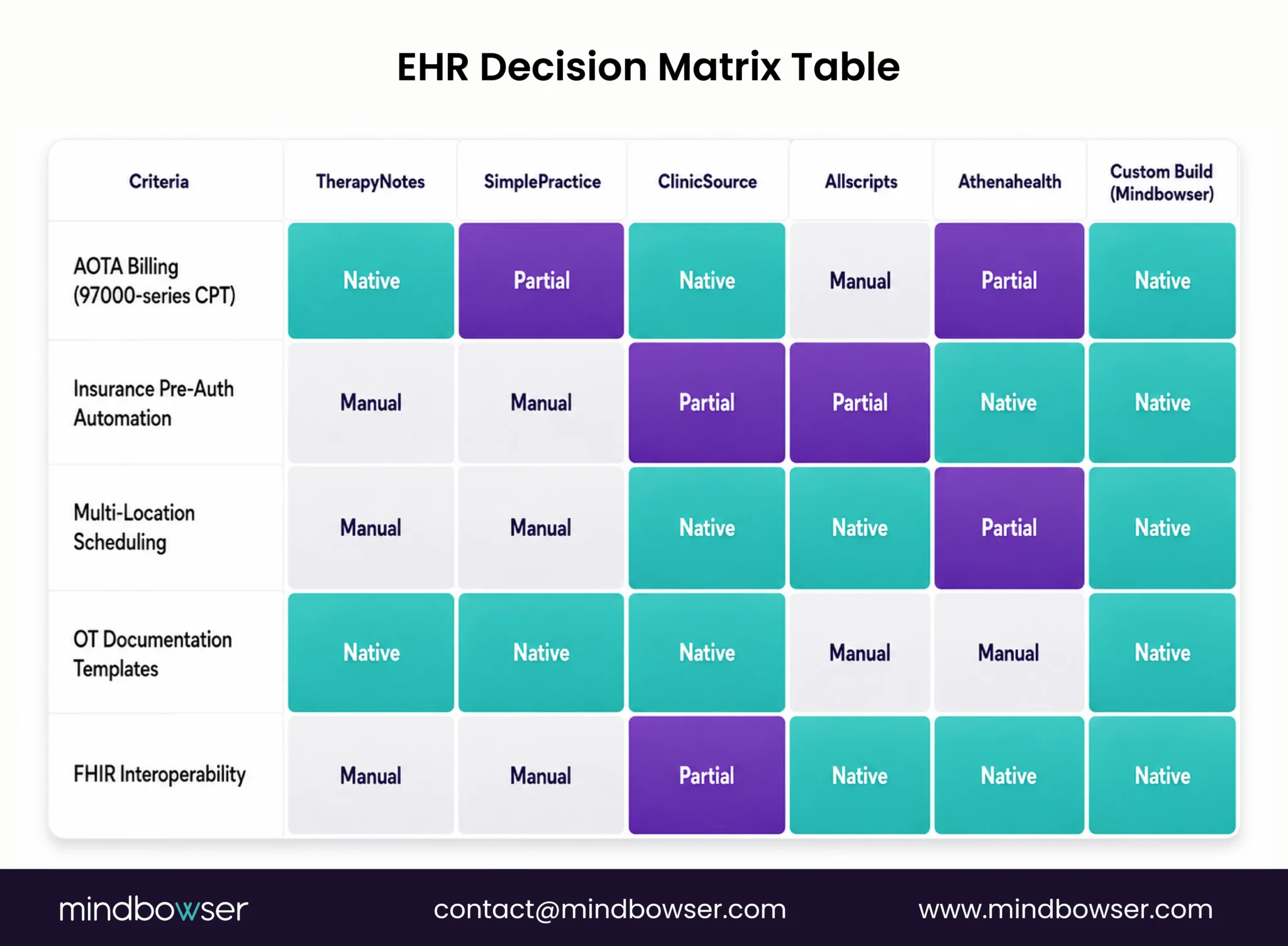
For a broader medical specialty EHR selection guide covering how to apply this framework across therapy, surgical, and diagnostic specialties, that reference is worth reading before you run demos.
Talk to Our Team About Your OT EHR Requirements
Which Occupational Therapy EHR Solutions Are Worth Comparing in 2026?
TherapyNotes
Best for: Solo to mid-size OT practices (1-10 clinicians)
Purpose-built for behavioral health and therapy disciplines, TherapyNotes is the most OT-native solution on this list. It handles 97000-series billing natively, ships with pre-built OT documentation templates, and runs a clean scheduling interface that most therapy front-desk staff can learn in a day.
Clinicians report 30-40% faster note completion compared to generic systems, largely because documentation fields map directly to therapy CPT code categories rather than physician billing logic. Or rather, that’s the range we see across practices coming from Epic or Allscripts. A well-configured Epic OT template narrows the gap, but the default Epic build is physician-first and most OT clinics aren’t customizing it.
- Strengths: documentation speed, therapy-specific billing rules, patient portal with OT intake forms, affordable per-clinician pricing
- Weakness: limited multi-location support; insurance verification is manual; doesn’t scale past roughly 15 clinicians without workflow friction
- Cost: ~$49-99/month per clinician
- Best fit: independent OT practices, small group practices, single-location clinics
SimplePractice
Best for: Private practice OT clinicians, solo or small group with telehealth needs
Competes directly with TherapyNotes on ease-of-use and documentation speed. The standout capability is telehealth integration: OT delivered over video with session notes, billing, and scheduling handled inside the same platform.
The mobile app makes it practical for community-based OT (home visits, school-based programs, in-facility treatment). It’s less suited to high-volume clinics with complex payer mixes.
- Strengths: telehealth built in, OT-friendly note templates, strong mobile app, easy onboarding
- Weakness: billing automation is light: manual prior auth, limited EDI integration, weak multi-location scheduling; not designed for high-volume practices
- Cost: ~$29-99/month per clinician
- Best fit: solo practitioners, telehealth-integrated OT, school-based or community-based programs
ClinicSource
Best for: Mid-size OT and multi-discipline therapy practices (10-50 clinicians)
Specifically designed for OT, PT, and speech therapy, ClinicSource is one of the most complete off-the-shelf options for multi-discipline clinics. Scheduling handles resource conflict detection across rooms and equipment. Outcome tracking ties directly to AOTA goal frameworks.
Medicare compliance is built in: claim scrubbing, functional limitation reporting, and KX modifier rules are pre-configured rather than requiring manual setup.
- Strengths: multi-discipline scheduling with resource management, therapy-specific billing, outcome tracking aligned with AOTA frameworks, Medicare compliance built in
- Weaknesses: dated UI makes staff onboarding slower; inflexible reporting for custom KPIs; no native FHIR integration (requires middleware for referring provider interop)
- Cost: ~$100-150/month per clinician (enterprise rates negotiable at 20+ clinicians)
- Best fit: multi-discipline therapy practices, Medicare-heavy payer mix, practices with functional outcome reporting requirements
Allscripts (Veradigm)
Best for: Large health systems with OT departments
If your OT practice sits inside a hospital system or large multi-specialty group, Allscripts provides enterprise-grade interoperability. The tradeoff is therapy-specific functionality out of the box.
The platform connects cleanly with Epic, Cerner, and Meditech environments. Payer contract management and compliance tooling are enterprise-grade. But OT-specific configuration requires vendor-assisted setup, therapy billing rules need manual configuration, and implementation timelines run 6-12 months. It’s not a plug-and-play situation.
- Strengths: deep Epic/Cerner integration, payer contract management, multi-site deployment, strong compliance audit trails
- Weakness: OT templates require paid customization; therapy billing logic needs manual configuration; implementation is slow and expensive for pure OT practices
- Cost: enterprise pricing ($300-600K+ for large deployments)
- Best fit: hospital-employed OT departments, health systems consolidating therapy across facilities
Athenahealth
Best for: OT practices prioritizing revenue cycle automation and payer integration
Athena’s managed billing is the strongest revenue cycle offering on this list. For practices with complex payer mixes (Medicare Advantage, Medicaid, multiple commercial plans), the automated denial management and root-cause flagging reduces claims rework significantly.
The documentation side is the tradeoff: OT-specific templates are generic and they’ll require paid implementation services to configure. Scheduling is functional but not therapy-optimized. The ROI case for Athena is strongest when billing complexity is the practice’s core pain, not scheduling or documentation.
- Strengths: automated eligibility verification, ML-driven denial management with root-cause analysis, network-based benchmarking for therapy billing, strong payer relationships
- Weakness: documentation templates are generic for OT; OT-specific customization requires paid implementation services; scheduling is functional but not therapy-native
- Cost: 4-8% of collections (managed billing) or SaaS licensing for smaller practices
- Best fit: multi-payer practices where revenue cycle is the dominant pain point
Custom OT EMR (Mindbowser)
Best for: Multi-location enterprises, franchise therapy models, hybrid OT/PT/speech practices with scale
When off-the-shelf covers 70-80% of your workflow requirements, the remaining 20-30% becomes a daily operational tax: auth delays, scheduling conflicts, documentation workarounds, and reporting gaps that persist through every vendor update cycle.
A custom-built OT EMR closes that gap permanently. Mindbowser builds on pre-existing accelerators for healthcare scheduling, insurance auth automation, APTA code integration, and FHIR R4 interoperability, compressing timelines from the typical 18+ months to 8-12 months.
For practices with 50+ clinicians or 10+ locations, the 3-year total cost of ownership for custom often comes in below enterprise SaaS licensing, with higher workflow coverage and no per-seat cost at scale.
Learn more about custom EHR development for therapy practices.
When Should You Build a Custom Occupational Therapy EHR?
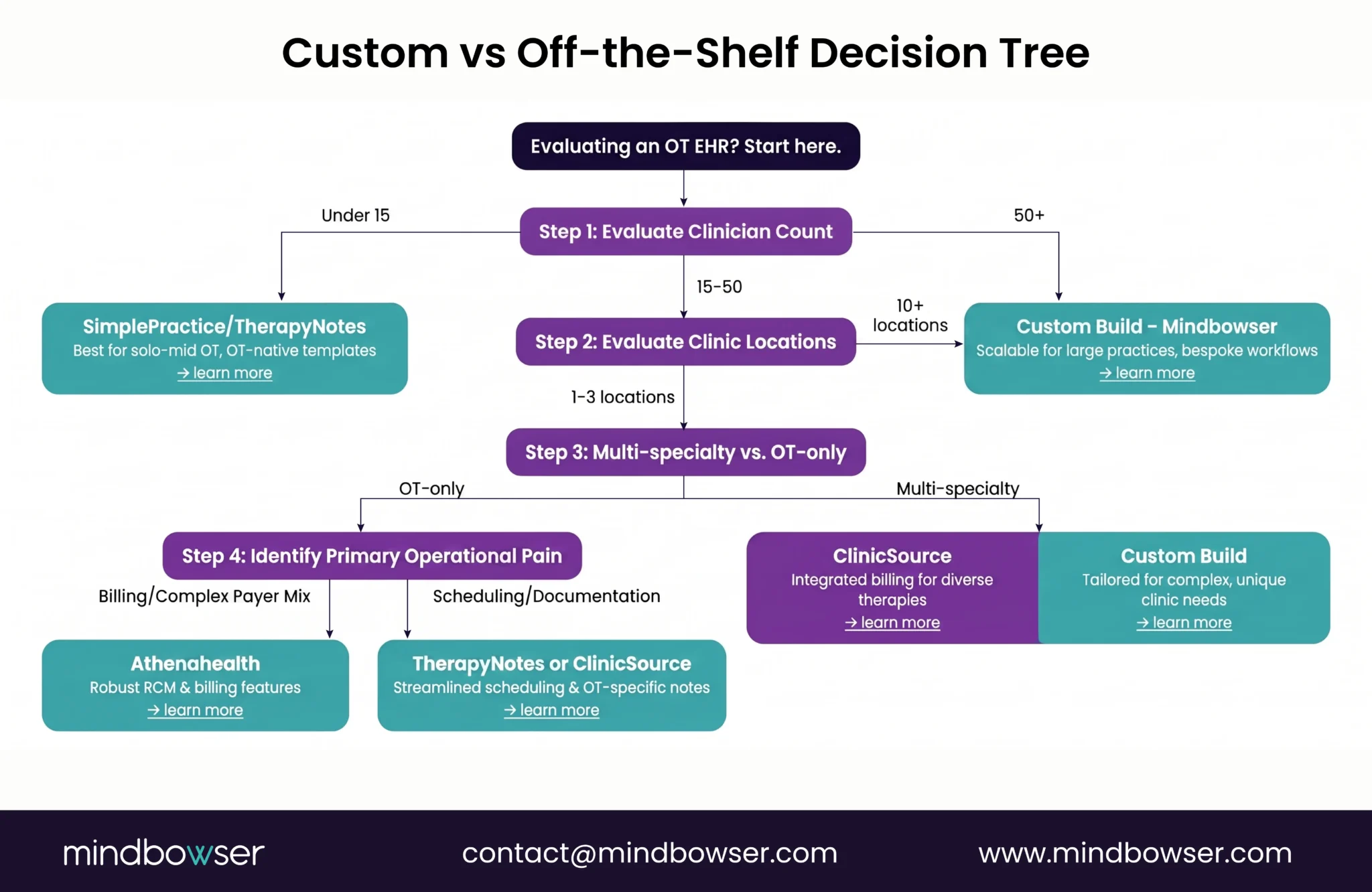
1. Multi-specialty integration. Your practice co-operates with PT, speech, ABA, and rehabilitation therapy. No off-the-shelf system handles all four disciplines in a single scheduling and documentation environment without significant middleware overhead.
2. Franchise or multi-location scaling (10+ sites). Enterprise SaaS licensing compounds per-clinician at scale. At 50+ clinicians, custom is typically cost-neutral within 24 months and cost-positive in year 3. No per-seat pricing, no API access fees, no forced integrations at cost.
3. Unique reimbursement models. DPC, subscription, or capitated OT contracts require billing logic that most systems default away from, since they’re designed for fee-for-service. Custom billing architecture handles any model you negotiate.
4. Deep referring provider integration. If a significant share of referral volume comes from a physician network running Epic or Cerner, custom FHIR R4 integration ingests referrals directly, triggers intake workflows, and returns outcomes without manual data re-entry at either end.
5. Value-based contract outcome reporting. Payer contracts tied to ADL improvement scores, functional outcomes, or readmission prevention require structured outcome data. Generic systems produce exports; custom systems produce reports in the format your payer contract requires.
Our scheduling and insurance auth automation modules are pre-built into custom OT EMR projects, not configured from scratch. For practices comparing off-the-shelf against custom, the small practices vs custom EHR comparison covers the full decision framework.
What Does an OT EMR Implementation Checklist Cover?
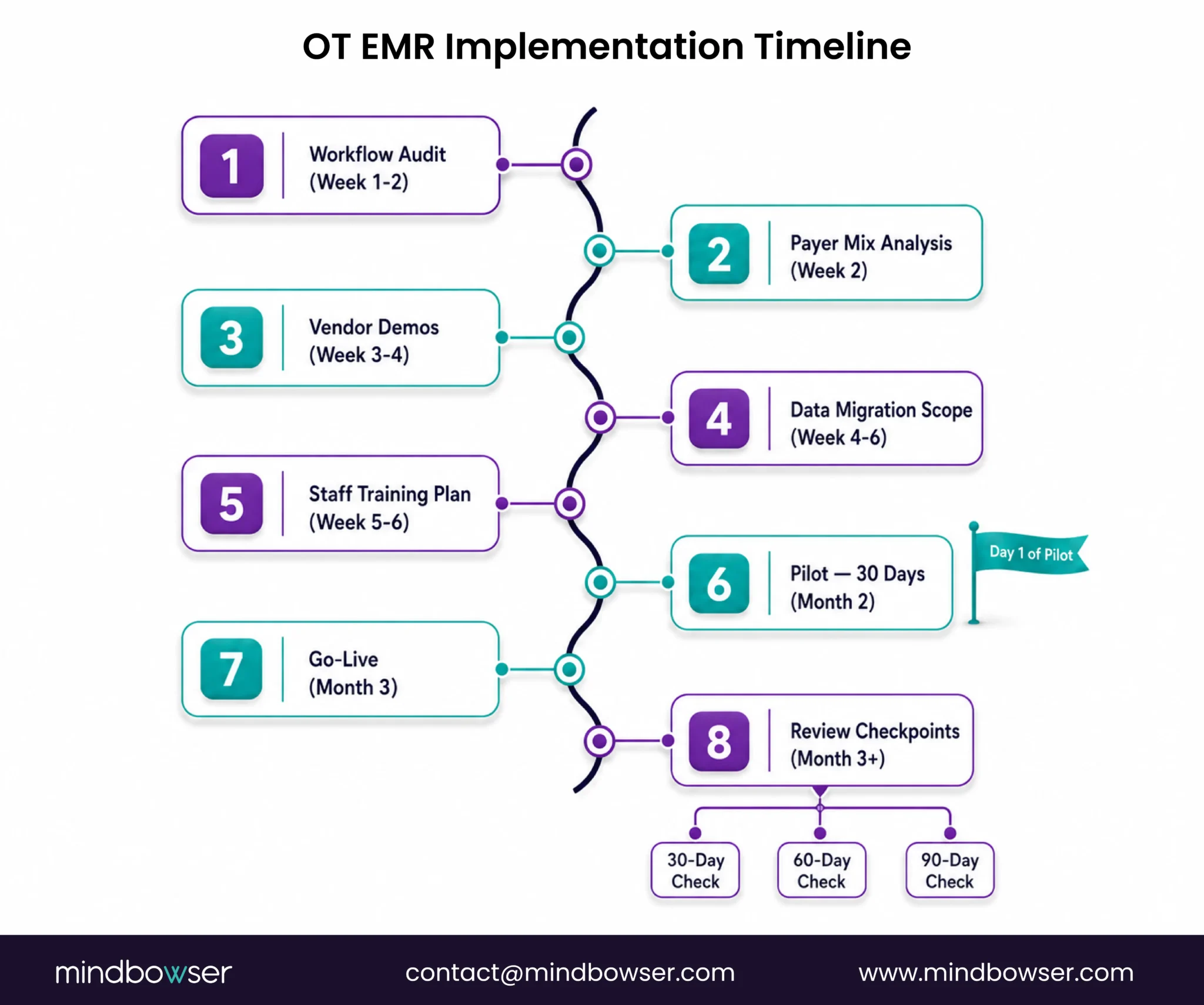
Whether you’re moving from paper, migrating from a generic system, or deploying your first OT-specific EMR, the same eight steps apply.
1. Workflow audit before selection.
Map your current intake-to-billing flow. Document every step, every handoff, every data touchpoint. Don’t evaluate vendors until you know exactly where the friction is. Otherwise, you’ll buy a platform that solves the symptom, not the cause.
2. Payer mix analysis.
List your top 10 payers by claim volume. Confirm shortlisted EMRs have native EDI integrations or managed billing relationships with each. A gap at payer #3 is a billing problem you inherit on day one.
3. Demo with real OT scenarios.
Don’t let vendors demo their own scripts. Run them through: (a) insurance pre-auth for a Medicare Advantage patient, (b) scheduling a complex multi-location day with room conflicts, (c) completing an ADL assessment note and auto-mapping it to billing codes.
4. Data migration scoping.
Understand what patient data needs to move, what the current data quality looks like, and what migration support the vendor covers end-to-end. Budget 20-40% more time than vendor estimates: therapy records often carry structured data that doesn’t map cleanly across systems.
5. Staff training planning.
The most common go-live failure is undertrained staff reverting to workarounds within 30 days. Plan for role-specific training: clinician documentation, front-desk scheduling, billing CPT mapping. Budget 12-16 hours per staff member minimum, and more for staff who haven’t used a digital system before.
6. Pilot before full deployment.
Run one clinic location or one care team for 30 days before full rollout. You’ll catch workflow gaps in a controlled environment where adjustments don’t disrupt patient care across the whole practice.
7. Go-live support.
Confirm dedicated vendor support is available during the first two weeks post go-live. That’s when the highest volume of critical issues surface: documentation errors, billing submission failures, scheduling edge cases.
8. 30/60/90-day review checkpoints.
Track: claims denial rate, documentation time per note, scheduling conflict frequency, patient throughput. Baseline these in the first week and compare at each checkpoint. These are your ROI proof points and your early warning system if adoption is slipping.
Conclusion
The best occupational therapy EHR is the one that matches your actual workflows, not the one with the most features in a brochure. For solo practices and small groups, TherapyNotes or SimplePractice handle the core requirements. For mid-size multi-discipline clinics, ClinicSource fills the gap. For complex, multi-location or enterprise OT operations, Athena’s revenue cycle management or a custom-built system delivers what off-the-shelf cannot.
Use the five-category decision framework before any vendor demo. If two or more categories show a clear gap against your workflow requirements, you’ve found your implementation risk, and you know what to prioritize in vendor conversations.
The AOTA 2024 workforce survey finding that 4.2 hours per week are lost to documentation and billing tasks isn’t a software problem on its own. It’s a system-fit problem. The right EHR eliminates that overhead. The wrong one just moves it to a different part of your day.