





 BLOGS
BLOGS  NEWSROOM
  CASE STUDIES
  WEBINARS
  PODCASTS
  ASSET HUB
  EVENT CALENDAR
























TL;DR
- CMS-0057-F requires impacted payers to build four FHIR APIs by 1 January 2027. Providers are not required to build any of them.
- The impacted payers are Medicare Advantage organizations, state Medicaid and CHIP fee-for-service programs, Medicaid and CHIP managed care plans, and qualified health plan issuers on the federally facilitated exchanges.
- Providers carry one obligation, and it is much smaller: a new Electronic Prior Authorization measure under Promoting Interoperability, reported as a yes/no attestation, starting with the CY2027 performance period.
- The four APIs are Patient Access, Provider Access, Payer-to-Payer, and Prior Authorization. Most coverage of this rule says “FHIR APIs” without naming them, which is where scoping goes wrong.
- Prior authorization decisions move to 72 hours for expedited requests and 7 calendar days for standard ones.
What CMS-0057-F Actually Is
CMS-0057-F is the CMS Interoperability and Prior Authorization Final Rule. The 0057 is a CMS rule number, not a code, a form, or a measure, which is worth saying because the number gets searched far more often than the rule’s name.
Its purpose is to move prior authorization off fax machines and phone calls and onto standards-based APIs, and to make plan data available to patients, to providers, and to other plans. The rule does that by regulating health plans, not by regulating the practices and hospitals that send them requests.
That distinction is the single most useful thing to get right about this rule, and it is the thing most often garbled. If you are reading a requirements document that says your practice must build a prior authorization API by January 2027, the document is wrong.
Who Must Comply, And With What
Two groups have obligations under this rule. They are very different in size.
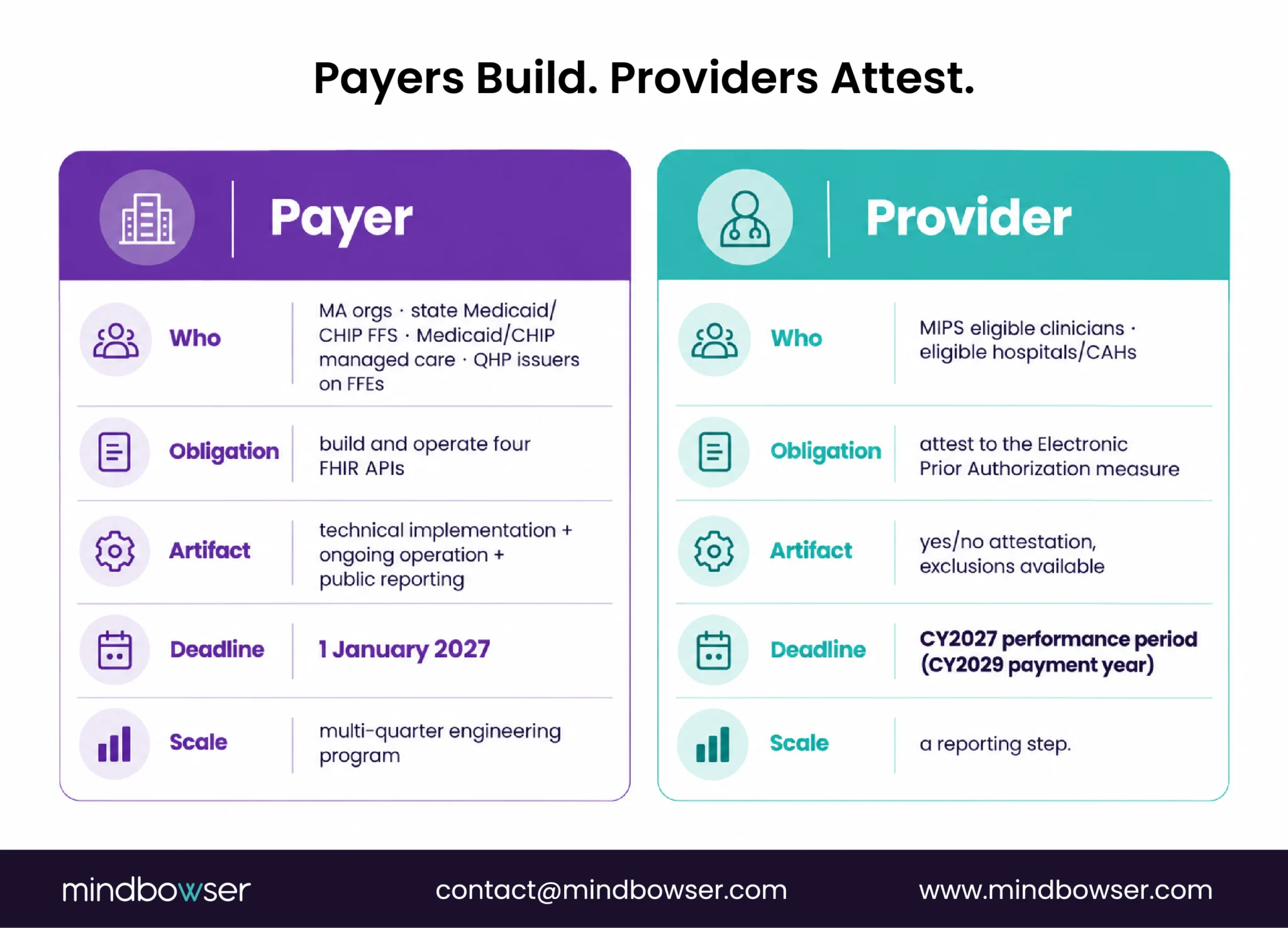
Notably, the measure that lands on providers was finalized as an attestation rather than the numerator-and-denominator measure originally proposed. A clinician or hospital reports yes or no, or claims an applicable exclusion. It is not a volume threshold, and it does not require a build.
For anyone who is neither, and there are many, the rule still matters commercially. If you sell software to impacted payers, your roadmap now has a fixed date in it.
The Four APIs, Named
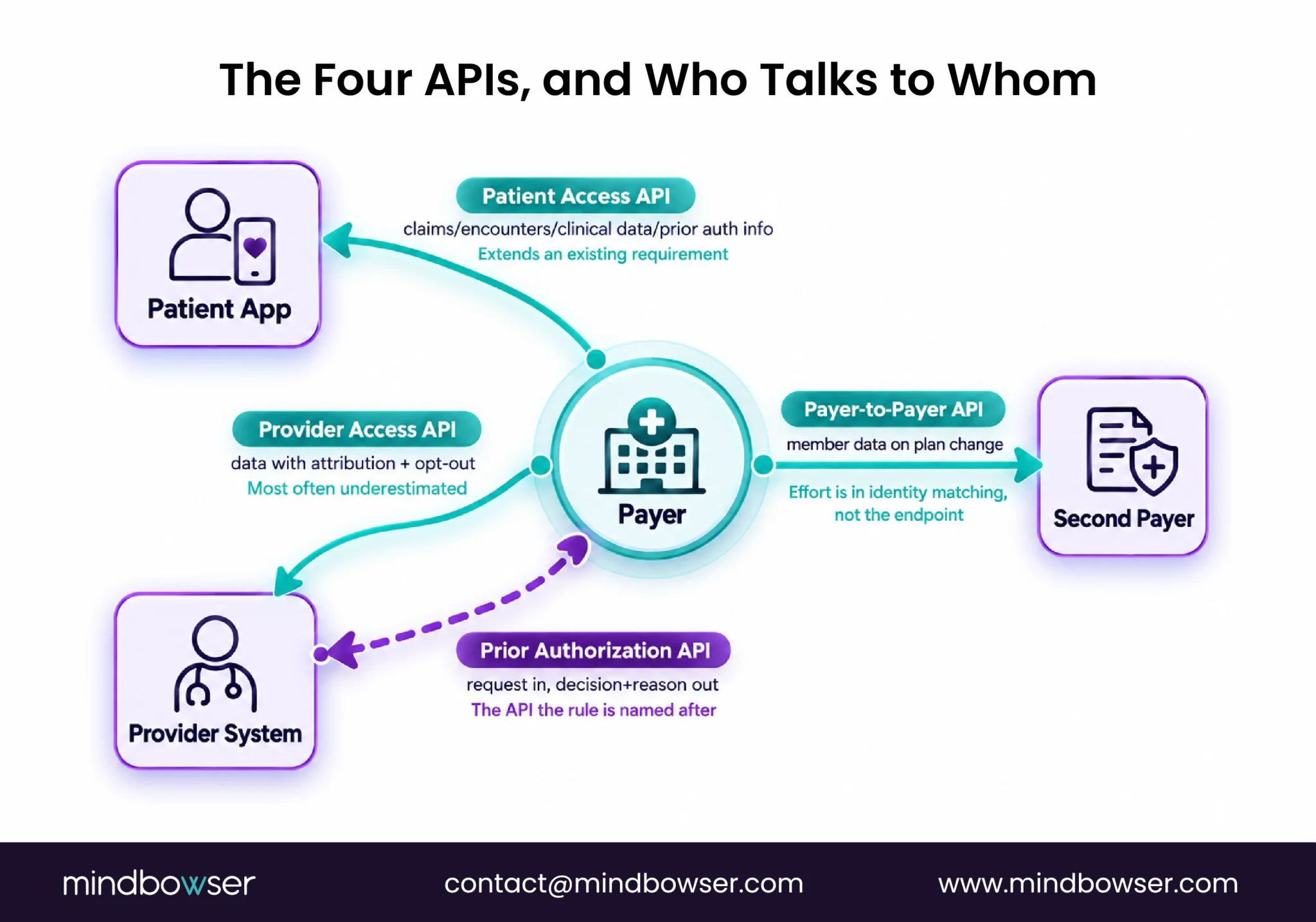
Most coverage of this rule refers to “FHIR APIs” collectively. That is not enough to scope anything, because the four differ substantially in effort and in who consumes them.
- Patient Access API: Lets a patient’s chosen application retrieve their claims, encounters, clinical data and, under this rule, their prior authorization information. The rule extends an existing requirement rather than creating one from nothing.
- Provider Access API: Lets a provider retrieve a patient’s data from the payer, with attribution and opt-out handling. This is the one most often underestimated, because it needs patient attribution logic and an opt-out mechanism that did not previously exist.
- Payer-to-Payer API: Moves a member’s data when they change plans. Effort concentrates in identity matching and in the operational process around member consent, not in the endpoint itself.
- Prior Authorization API: Supports submitting a request, checking status, and returning a decision with the reason when denied. This is the one the rule is named after and the one with the most workflow attached.
Each API is defined against a FHIR implementation guide, and the guides are not all equally settled. A useful question for any vendor conversation is which guide and which version a given endpoint is built against, and whether that guide is required by the rule or merely recommended. Treating a recommended implementation guide as mandatory is the most common way this scope inflates.
The Provider Obligation, In Full
This section exists because the best-ranked coverage of CMS-0057-F does not mention it at all.
Providers do not build APIs under this rule. They report a measure. Specifically, CMS added an Electronic Prior Authorization measure to the Promoting Interoperability performance category of MIPS, and the equivalent for eligible hospitals and CAHs under the Medicare Promoting Interoperability Program.
What that means in practice:
- It is an attestation: Yes, no, or an exclusion. Not a percentage, not a count.
- It starts with the CY2027 performance period for MIPS eligible clinicians, affecting the CY2029 payment year. Hospitals and CAHs report for the CY2027 EHR reporting period.
- Exclusions are available, which matters for clinicians whose specialties rarely submit prior authorization requests.
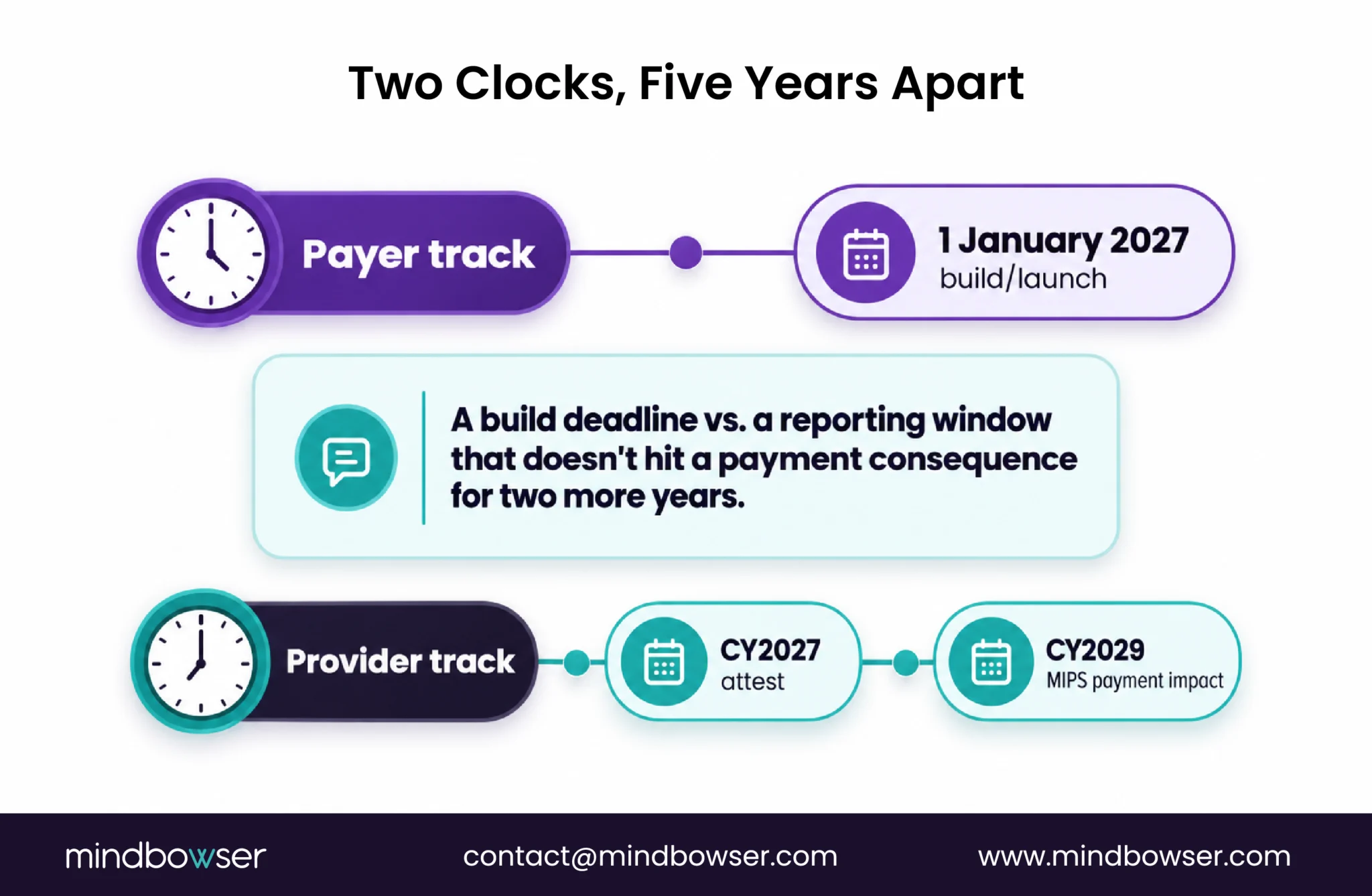
The practical consequence for a provider organization is that the work is in being able to answer yes rather than in building anything. That usually means confirming your EHR supports electronic prior authorization against payers that now expose it, and that clinicians actually use it rather than reverting to the portal.
Make CMS-0057-F Compliance Easier to Execute
What Changes In Prior Authorization Itself
Regardless of which side you sit on, the operational changes are the part clinicians will notice.
- Decision timelines compress: Impacted payers must issue decisions within 72 hours for expedited requests and 7 calendar days for standard requests: For organizations used to longer and less predictable turnarounds, this changes staffing and follow-up assumptions more than it changes technology.
- Denials must carry a reason: When a request is denied, the payer must provide a specific reason. This is a small sentence in the rule with a large effect on appeals workflow, because a specific reason is actionable in a way that a generic denial is not.
- Certain metrics become public: Payers must publicly report prior authorization data annually, which creates a comparison surface that did not previously exist.
We cover the broader question of how decision support fits into clinical workflow separately in clinical decision support systems; this page stays on the rule.
The Prior Authorization API, For The People Building It
This is the section for engineering and product teams at payers and at the vendors serving them.
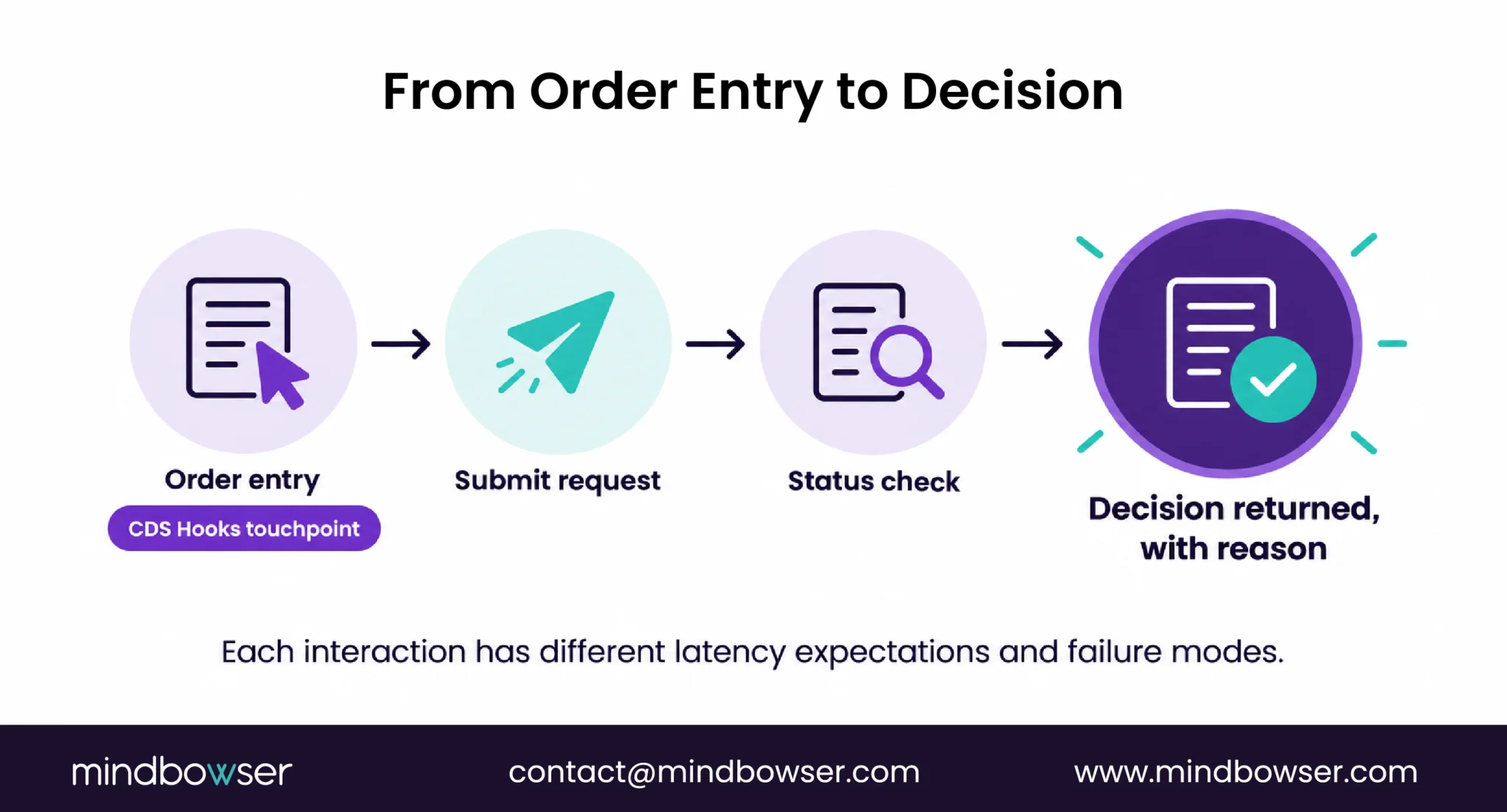
The Prior Authorization API is not a single endpoint. It has to support three distinct interactions: submitting a request, checking status, and returning a decision with its reason. Each has different latency expectations and different failure modes, and the third is the one that carries the compliance obligation about denial reasons.
Three things reliably cause trouble:
- Attribution and opt-out: The Provider Access API needs to know which providers are attributed to which members, and members can opt out. That logic frequently does not exist in a payer’s current stack and is not a FHIR problem at all.
- Which implementation guide, and which version: The rule references guides at different levels of obligation. Deciding early which are required and which are optional prevents a scope conversation from reopening late.
- Documentation requirements: Requests routinely carry attachments and supporting documentation, and modelling that cleanly is more work than modelling the request itself.
The natural adjacency for anyone already working in this area is CDS Hooks, which solves the related problem of putting a payer’s answer in front of a clinician at the moment they are ordering, rather than in a separate portal. If a prior authorization requirement can surface at order entry, the request starts from a better place. Our CDS Hooks guide covers the mechanism and the technical implementation detail covers the request and response contract.
To be clear about what we have and have not done: we build FHIR integrations and decision support against EHR workflows, and that is directly adjacent work. We have not delivered a CMS-0057-F prior authorization API program, and nothing here should be read as a claim that we have.
The Adjacent Rule Worth Knowing About
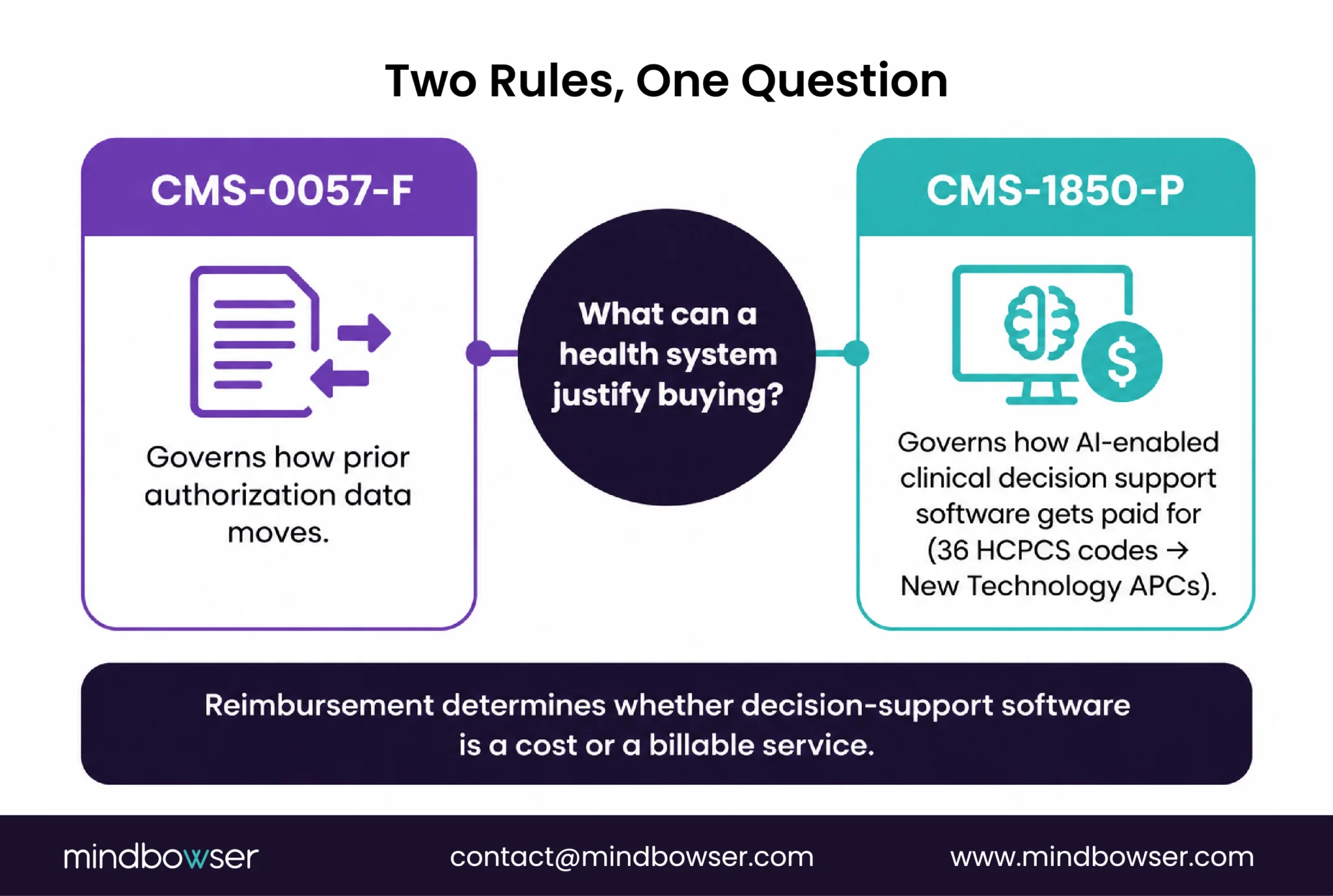
Separately from CMS-0057-F, CMS proposed CMS-1850-P, which would create the first Medicare payment pathway for software that provides AI-enabled decision support, moving 36 HCPCS codes into New Technology Ambulatory Payment Classifications.
It is worth knowing about for a reason that has nothing to do with deadlines. Reimbursement is the question every conversation about clinical AI eventually reaches and most content avoids. A defined payment pathway changes how a hospital evaluates buying decision-support software, because it changes whether the software is a cost or a billable service.
We are not tracking a comment period here and we are not filing comments. The reason to pay attention is the direction of travel, not a date.
What To Do Next, Depending On Who You Are
If you are an impacted payer, the useful sequencing question is not which API to build first. It is which capability you are missing across all four: patient attribution, opt-out handling, identity matching for payer-to-payer, and documentation modelling for prior authorization. Those are the four that are not standard FHIR plumbing, and they determine the timeline more than the endpoints do.
If you sell to impacted payers, your buyers now have a fixed date and a defined scope, which is a rare and short-lived condition. Ask which implementation guides a prospect considers mandatory, because the answer reveals how far along their scoping actually is.
If you are a provider organization, do not scope an API build. Confirm that your EHR supports electronic prior authorization, confirm your clinicians use it rather than the payer portal, and confirm you can attest for the CY2027 performance period. Then spend the saved effort on the turnaround-time change, which affects your staffing far more than the attestation does.
If you are evaluating decision support more broadly, our clinical decision support software buyer’s guide sets out the criteria, worked examples show what these implementations look like in production, and what a clinical decision support system is covers the fundamentals. For the wider regulatory picture, see FDA guidance on clinical decision support.
CMS-0057-F is the CMS Interoperability and Prior Authorization Final Rule. The 0057 is a CMS rule number rather than a billing code or a quality measure. It requires certain health plans to build four FHIR APIs and to change how prior authorization decisions are made and communicated, with the main compliance date falling on 1 January 2027.
Impacted payers: Medicare Advantage organizations, state Medicaid and CHIP fee-for-service programs, Medicaid and CHIP managed care plans, and qualified health plan issuers on the federally facilitated exchanges. Healthcare providers are not required to build the APIs. Providers instead report a new Electronic Prior Authorization attestation measure under Promoting Interoperability, beginning with the CY2027 performance period.
No. That obligation falls on impacted payers. The provider requirement under this rule is an attestation measure reported through MIPS Promoting Interoperability, or the equivalent program for eligible hospitals and critical access hospitals, and exclusions are available. Providers benefit from the APIs their payers build rather than building their own.
Patient Access, Provider Access, Payer-to-Payer, and Prior Authorization. The Patient Access API extends an existing requirement. The Provider Access API adds patient attribution and opt-out handling. The Payer-to-Payer API moves member data when someone changes plans. The Prior Authorization API supports submitting requests, checking status, and returning decisions with a specific reason when denied.
Impacted payers must issue decisions within 72 hours for expedited requests and 7 calendar days for standard requests, and must give a specific reason for any denial. For most provider organizations this operational change has a larger day-to-day effect than the technical requirements of the rule.