BLOGS
BLOGS  NEWSROOM
  CASE STUDIES
  WEBINARS
  PODCASTS
  ASSET HUB
  EVENT CALENDAR
























TL;DR
- Generic EHRs fail podiatry across five dimensions: diabetic foot exam templates, wound staging, DME billing, prior authorization, and LCD compliance documentation.
- Kareo/Tebra and EzChartWriter are the two options purposefully built for podiatric workflows; every other platform requires substantial customization.
- Custom-built solutions make financial sense for multi-location wound care centers, physician-entrepreneurs launching DFU management platforms, and orthotic-heavy practices requiring complex supplier system integration.
A common scenario in podiatry practices: claim denials for routine foot care in Medicare patients with diabetic neuropathy. The clinical documentation exists, but it appears in free-text rather than structured fields, and the systemic condition was not recorded in the format required by LCD L33822 audit standards. The result is 45 minutes rebuilding a note from scratch.
This is not a billing problem. It is not a clinical competency problem. It is a product compatibility problem, excellent clinical work happening inside an EHR designed for documentation volume rather than podiatric precision.
Why Generic EHRs Keep Failing Podiatry Practices
Five specific gaps drive most complaints from podiatry practices:
1. CMS G0245/G0246/G0247 Diabetic Foot Exam (LOPS) Set
G0245 is the initial physician evaluation of a diabetic patient with loss of protective sensation (LOPS). Medicare requires documentation of nine specific elements for this initial visit. G0246 is the follow-up evaluation. G0247 covers routine foot care and is only payable when billed same-day with G0245 or G0246. Generic EHR platforms lack native templates for this coding scenario.
2. CMS LCD L33822 Routine Foot Care
Coverage applies only when systemic conditions are documented at the encounter level. Generic systems provide no compliance prompts or alerts.
3. Wagner Wound Classification
This six-grade diabetic foot ulcer staging system (Wagner FW Jr, 1981) represents standard care, but appears natively supported by no mainstream EHR platform.
4. APMA Practice Survey 2023 Findings
The majority of surveyed podiatrists identified EHR workflow friction as their leading operational challenge. DME/orthotics billing and wound care templates were identified as the two largest functionality gaps.
5. DME/Orthotics HCPCS L-Codes
Custom orthotic prescriptions require specific documentation fields. Standard SOAP templates do not accommodate this. Most practices maintain parallel Word documents as workarounds.
If you are evaluating whether a generic EHR or a specialty-specific platform fits your practice, the gap across these five areas is where the decision usually becomes clear.
What a Podiatry EMR Actually Needs: 5 Non-Negotiables
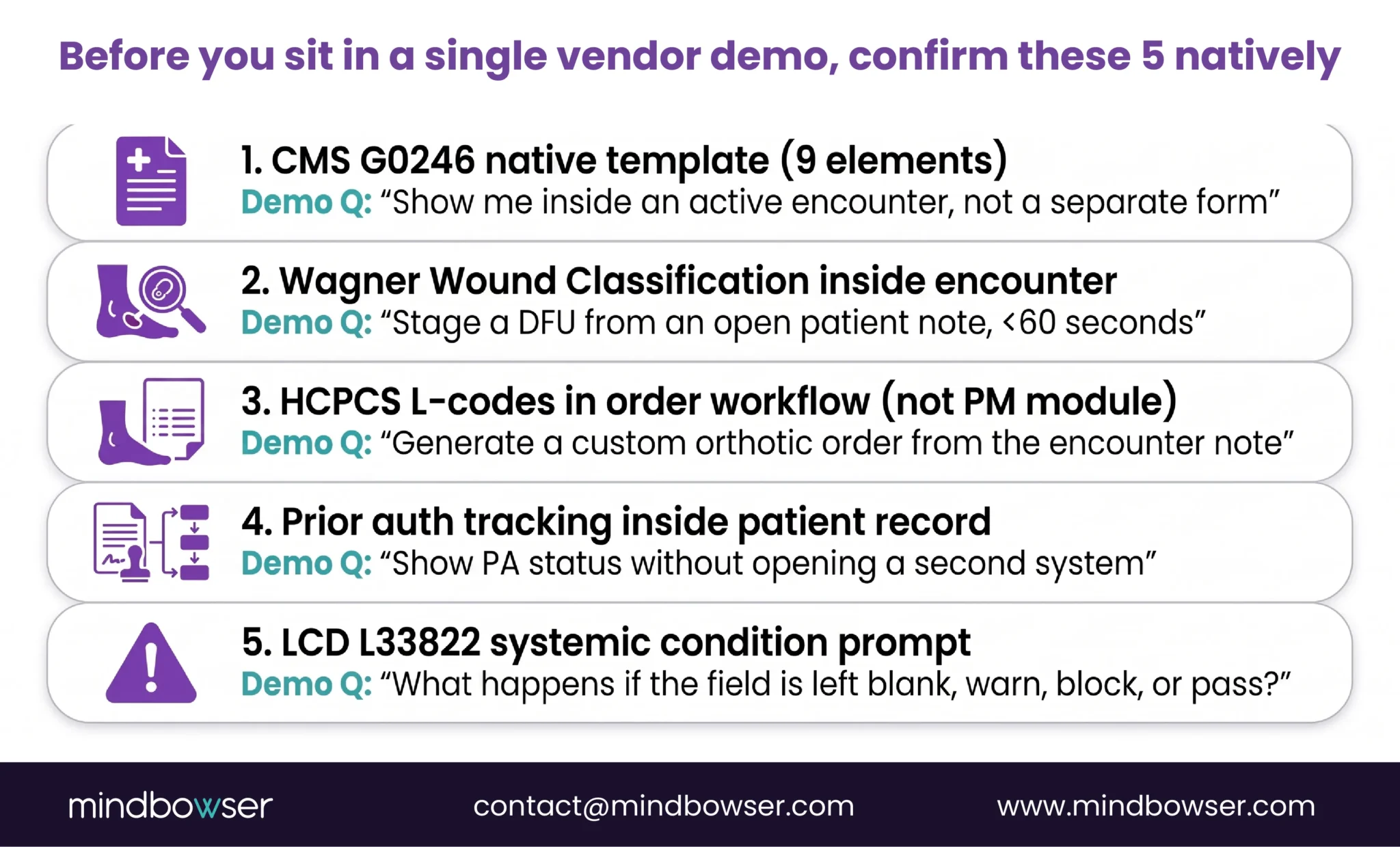
Any specialty EHR evaluation for podiatry should start here. If a vendor requires a workaround for three or more of these five, it is a generic EHR with podiatry marketing language applied to it.
1. Diabetic Foot Exam Documentation
Native G0245/G0246/G0247 templates with the nine-element set on the G0245 initial visit and the G0247 same-day pairing rule enforced, auto-prompted at every at-risk patient encounter.
2. Wound Care Staging
Wagner Classification plus NPUAP pressure ulcer staging within the encounter record, with automated baseline versus follow-up comparison.
3. DME/Orthotics Billing
HCPCS L-codes integrated into the order workflow, custom orthotic measurement fields, and auto-generated clinical necessity narratives.
4. Prior Authorization Tracking
Real-time PA status visible within the patient record for wound care supplies, diabetic shoes, and custom orthotics.
5. LCD Compliance Prompts
CMS LCD L33822 requires documenting the systemic condition at every routine foot care encounter. The EHR must prompt for this, not leave it to clinician memory.
Best EMR Software for Podiatry Practices in 2026
Here is how the leading platforms stack up across the five non-negotiables. Work with a vendor evaluation framework before signing anything.
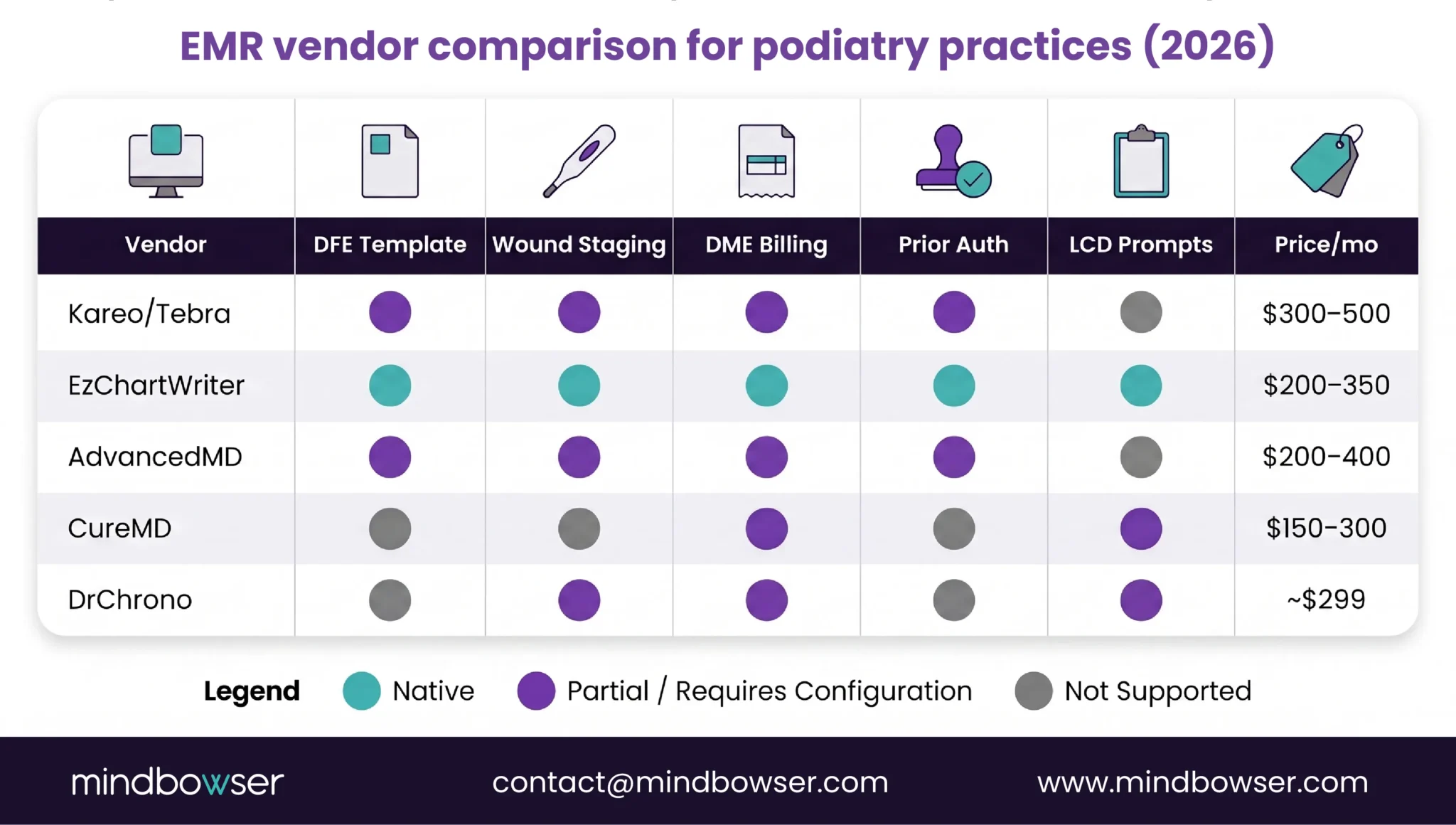
Kareo/Tebra
- KLAS rating: 80.2/100 (2024)
- Strong revenue cycle management capabilities
- G0245/G0246/G0247 template set requires custom configuration, not native
- Wagner Classification is not included out-of-the-box
- Many practices maintain a separate wound care documentation layer
- Cost: $300-500 per provider monthly
EzChartWriter
- Podiatry-specific platform
- Native G0245/G0246/G0247, Wagner Classification, and DME/orthotics documentation
- Strongest clinical documentation depth of any option reviewed
- Limitation: older user interface, smaller vendor
- Cost: $200-350 monthly
AdvancedMD
- Configurable mid-market solution
- Podiatric specialization requires a customized engagement
- No native LCD L33822 compliance prompts
- Cost: $200-400 monthly
CureMD
- Strong revenue cycle capabilities
- Template library needs configuration for podiatric workflows
- No native LCD compliance prompts
- Cost: $150-300 monthly
DrChrono
- Mobile-first design, suitable for solo practices
- Poor fit for wound care or high-volume diabetic shoe billing
- No native DFE template or wound staging
- Cost: approximately $299 per provider monthly
Vendor Summary (Feature Coverage)
- Kareo/Tebra: DFE template (partial), wound staging (partial), DME billing (partial), prior auth (partial), LCD prompts (no)
- EzChartWriter: DFE template (yes), wound staging (yes), DME billing (yes), prior auth (partial), LCD prompts (yes)
- AdvancedMD: DFE template (partial), wound staging (partial), DME billing (partial), prior auth (partial), LCD prompts (no)
- CureMD: DFE template (partial), wound staging (partial), DME billing (partial), prior auth (partial), LCD prompts (no)
- DrChrono: DFE template (no), wound staging (no), DME billing (partial), prior auth (no), LCD prompts (no)
Kareo/Tebra vs EzChartWriter
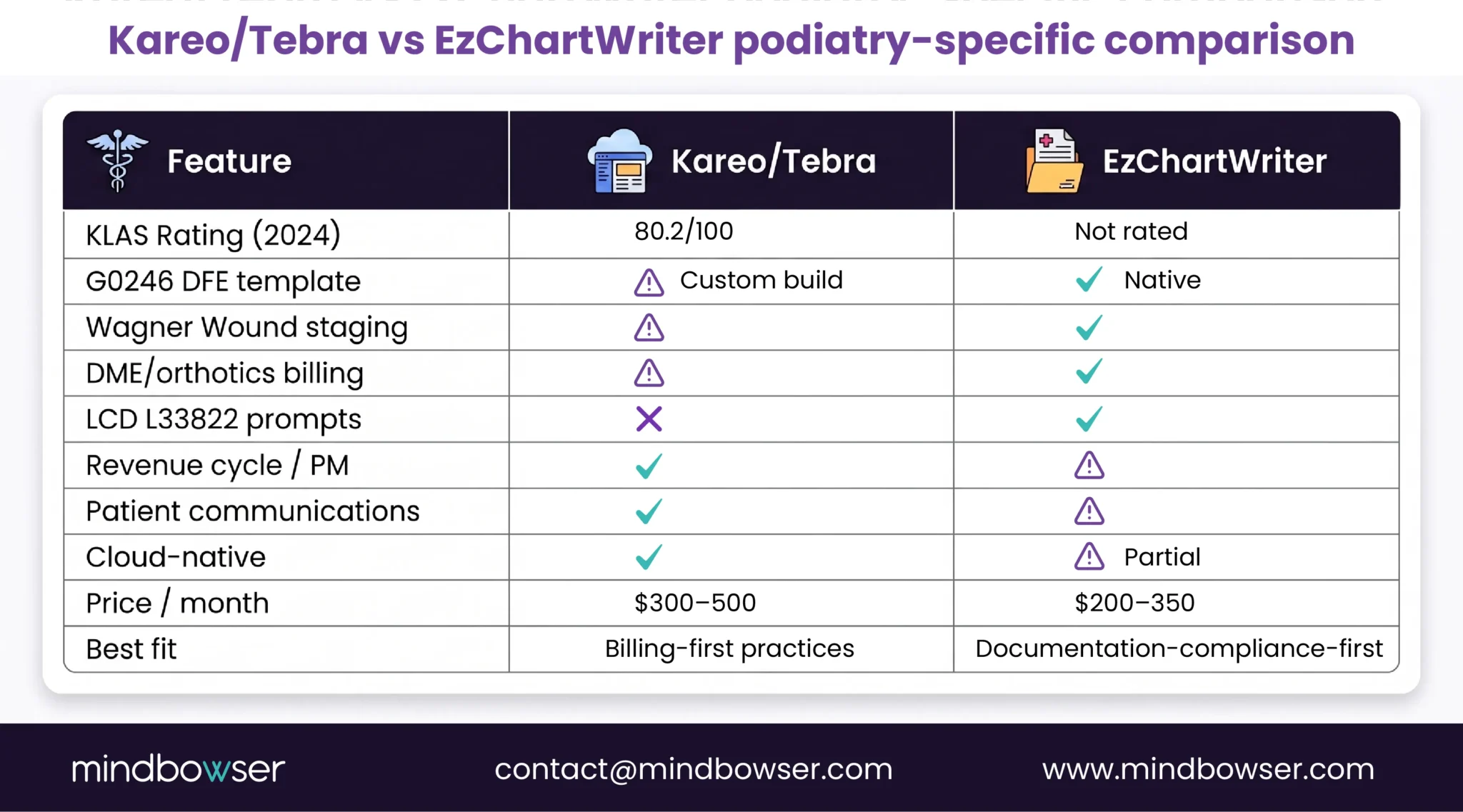
When practices narrow to two options, this is usually the final decision. Both are discussed at length across EHR vendor comparisons, but the choice comes down to your primary operational bottleneck.
Kareo/Tebra: Revenue Cycle Focus
This platform prioritizes revenue cycle efficiency. If claim denial rates represent your primary operational bottleneck, Kareo ranks as the strongest option on this list. However, the G0245/G0246/G0247 template set requires custom configuration rather than arriving natively, and Wagner Classification is not included out-of-the-box. Many practices maintain a separate documentation layer specifically for wound care.
EzChartWriter: Clinical First
G0245/G0246/G0247 documentation is native. Wagner Classification integrates into the encounter workflow. LCD L33822 compliance prompts appear automatically. The trade-off is working with a smaller vendor and an older interface design. If you are familiar with ophthalmology EMR comparisons, the Kareo vs EzChartWriter decision follows the same pattern, RCM-first versus documentation-first.
Decision Framework
- Choose Kareo/Tebra when revenue cycle efficiency is your primary operational constraint
- Choose EzChartWriter when clinical documentation compliance and Medicare audit risk reduction are your primary concern
Is a Custom Podiatry EHR the Right Move for Your Practice?
When a Custom-Built Podiatry EMR Makes More Sense
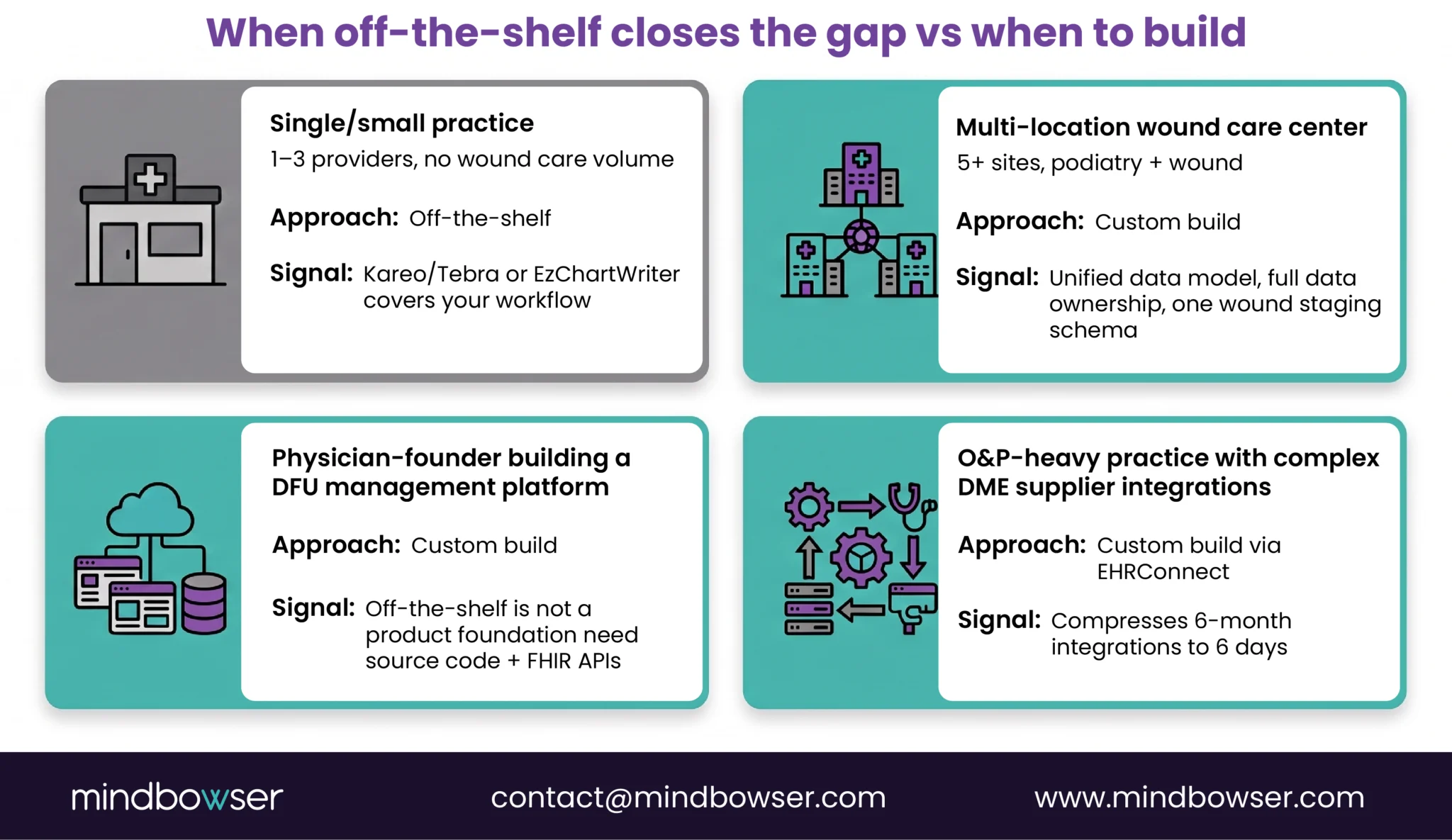
Off-the-shelf platforms work well for most podiatry practices. Three scenarios justify building a custom solution instead.
1. Multi-Location Wound Care Centers (5+ Sites)
What you need that no off-the-shelf platform delivers:
- Unified patient record across all locations
- Full data ownership and API access
- Single wound staging schema across all facilities
- Integrated diabetic patient registry
2. Physician-Founders Building DFU Management Platforms
If you are building a product, not just running a practice, off-the-shelf platforms cannot serve as your foundation. You need full source code ownership and clean FHIR APIs for remote wound imaging, telehealth monitoring, and population health dashboards.
3. O&P-Heavy Practices with Complex Supplier Integrations
O&P-Heavy Practices with Complex Supplier Integrations: ConnectHealth connects podiatry EHR systems to DME supplier data, diabetic shoe suppliers, and orthotics manufacturers.
Accelerators for Custom Development
Two Mindbowser-built tools reduce time and cost for custom podiatry EHR projects:
- AI Medical Summary: Reduces documentation time by approximately 50% and improves accuracy by around 45%. Relevant context: AI in EHR workflows.
- Launchpad: standardized project setup and team onboarding for physician-founders building DFU management platforms.
Custom Build Cost Range
$150,000 to $500,000 or more depending on project scope.
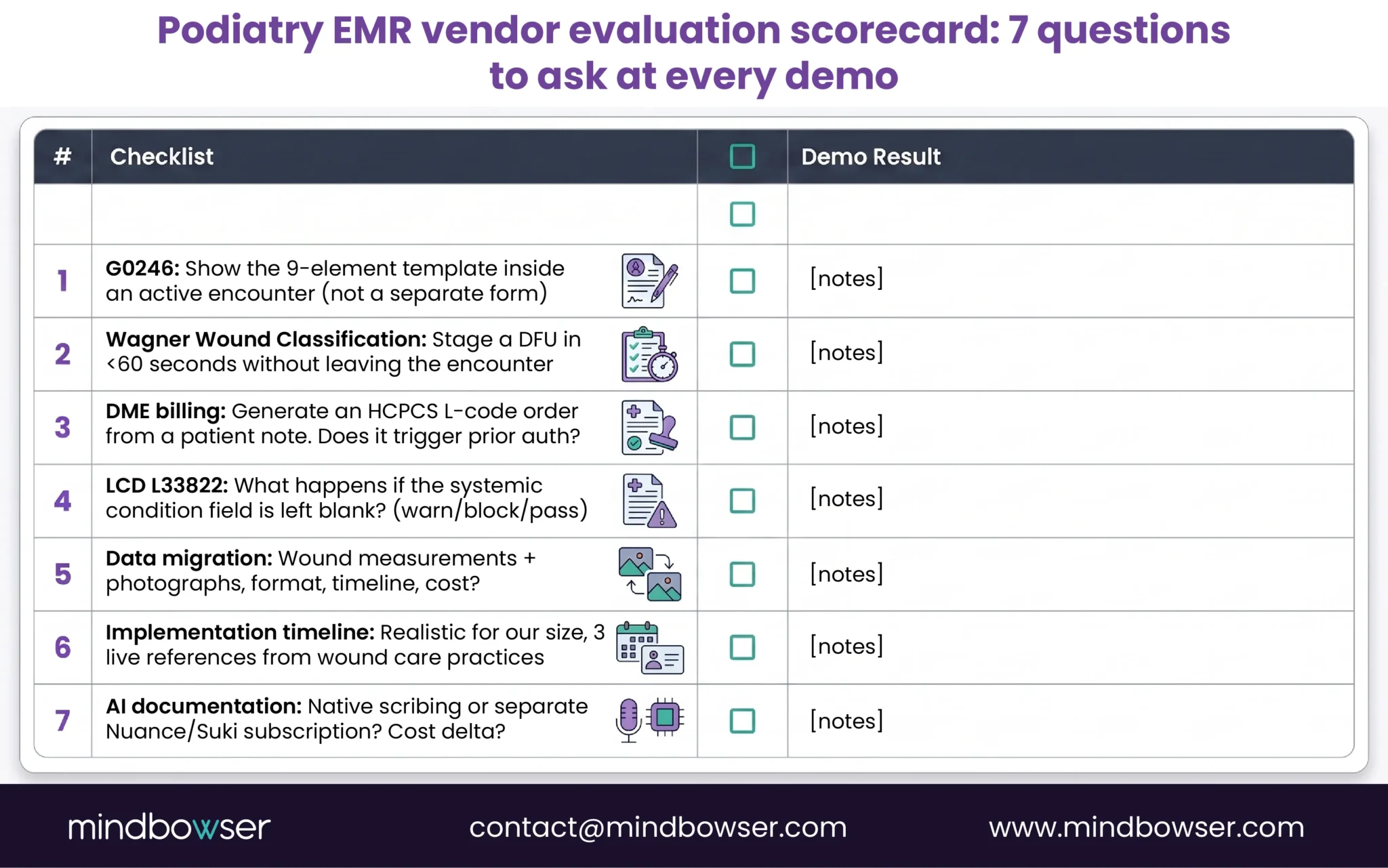
How to Evaluate Podiatry EMR Vendors: 7-Question Checklist
Run every vendor through these seven questions in a live demo. Watch common EHR implementation mistakes to understand what goes wrong when this step is skipped.
1. G0245/G0246/G0247 Documentation
“Show me how you capture the nine elements on the G0245 initial visit and how the system enforces the G0247 same-day pairing rule inside the encounter workflow, not a separate form.”
2. Wagner Wound Classification
“Stage a DFU using Wagner from inside an active encounter. Does the score auto-populate?”
Should complete in under 60 seconds. Anything slower signals a workaround, not native support.
3. DME/Orthotics Billing
“Generate a custom orthotic order with HCPCS L-code from inside a patient note. Can it trigger the prior auth workflow automatically?”
4. LCD L33822 Compliance
“How does the system prompt for systemic condition documentation? What happens if the field is left blank, warn, block, or let it through?”
5. Data Migration
“Can you extract structured wound care data, including photographs? What format, timeline, cost?”
Note: KLAS 2024 data shows average implementation of 5.2 months versus vendor claims of three months.
6. Implementation Timeline
“Realistic timeline for a podiatric practice our size, not the stated one. Three live references, please.”
7. AI Documentation
“Is ambient scribing available natively or does it require a separate Nuance/Suki subscription? What is the cost delta?”
Five Questions Before Signing Any Podiatry EMR Contract
1. Uptime SLA
“What is your uptime SLA for billing-heavy workflows?”
Push for 99.95% or better. Prior authorization processing and DME claims carry time-sensitive requirements.
2. API Data Access
“Can we have full API access to our wound care data, including photographs, without routing through your support team?”
The CMS Interoperability Rule grants legal rights to your data. “Accessible” and “practically accessible” are not the same.
3. Implementation References
“What is the realistic implementation timeline for three live references?”
Request actual calls with practices managing wound care at comparable volumes, not PDF case studies.
4. Data Portability Upon Exit
“What happens to our wound image library if we switch vendors in three years?”
Ask about export format, timeline at contract conclusion, and associated costs. If this is not resolved in contract, your data migration options shrink significantly when it matters most.
5. Podiatry-Specific References
“Do you have podiatry-specific references we can speak to directly, not a case study, an actual call?”
The Right Podiatry EMR Doesn’t Feel Like a Workaround
The pattern I see across every EHR complaint from podiatric practices is the same: the system doesn’t understand the clinical workflow, so the team builds workarounds. A second screen for wound staging. A Word document for DME notes. A sticky note for LCD compliance reminders. A spreadsheet for diabetic shoe tracking.
Those workarounds don’t show up in the vendor contract. But they show up in claim denial rates, in staff overtime reconciling documentation gaps, in wound staging data that never makes it into the population health layer, and occasionally in readmission events for diabetic patients whose foot ulcer progression wasn’t tracked across visits the way it should have been.
The evaluation process is the protection. Seven questions at the demo, five contract questions before you sign: that process reveals the workarounds before they become yours to live with.
If Kareo/Tebra or EzChartWriter fits your practice size and workflow, either one is a genuine step up from a generic EHR with podiatry templates bolted on. For multi-site wound care groups, physician-founders building DFU platforms, or practices dealing with supplier integrations that off-the-shelf can’t handle: that’s a different conversation.