













 BLOGS
BLOGS  NEWSROOM
  CASE STUDIES
  WEBINARS
  PODCASTS
  ASSET HUB
  EVENT CALENDAR
























TL;DR
RTM has ten codes in three families, and four of them are new for 2026: 98984, 98985, 98986 and 98979. The single most useful fact is that the new 2 to 15 day device supply codes pay exactly what the 16 to 30 day codes pay, so a patient transmitting 6 days is now worth the same as one transmitting 20. Only one device supply code may be billed per patient per 30 days, and only one practitioner may bill remote monitoring for a patient in that window.
RTM and RPM can never be billed for the same patient in the same month, but either can run alongside chronic care management, transitional care management, behavioral health integration, principal care management and chronic pain management. Physical, occupational and speech therapists can bill RTM under a therapy plan of care, which makes a plan-of-care modifier mandatory; the rule names GP for physical therapy and GO for occupational therapy. And RTM is billable inside a global surgical period when the monitored condition is unrelated to the procedure.
I was pricing a remote monitoring workflow earlier this year, the ordinary kind of job where you take a code set, attach real Medicare rates to it, and hand a provider group a forecast they can plan against. I pulled the published 2026 rate table off a vendor page, then did what I always do before a number goes into a model, and opened the Physician Fee Schedule relative value files to check it.
Two of the six rates did not match, both of them device supply codes. The musculoskeletal device supply code was published at $40.08 where the fee schedule pays $51.44, and its 2 to 15 day sibling carried the same error, on a page calling its figures finalized.
That is the reason this guide exists. Remote therapeutic monitoring got four new CPT codes for 2026 and a set of rules that are easy to get wrong, and much of what circulates about it is incomplete or out of date. Every rule and rate below is checked against the CMS document that governs it, and that document is named each time so you can check it yourself.
How Much RTM Is Actually Being Billed
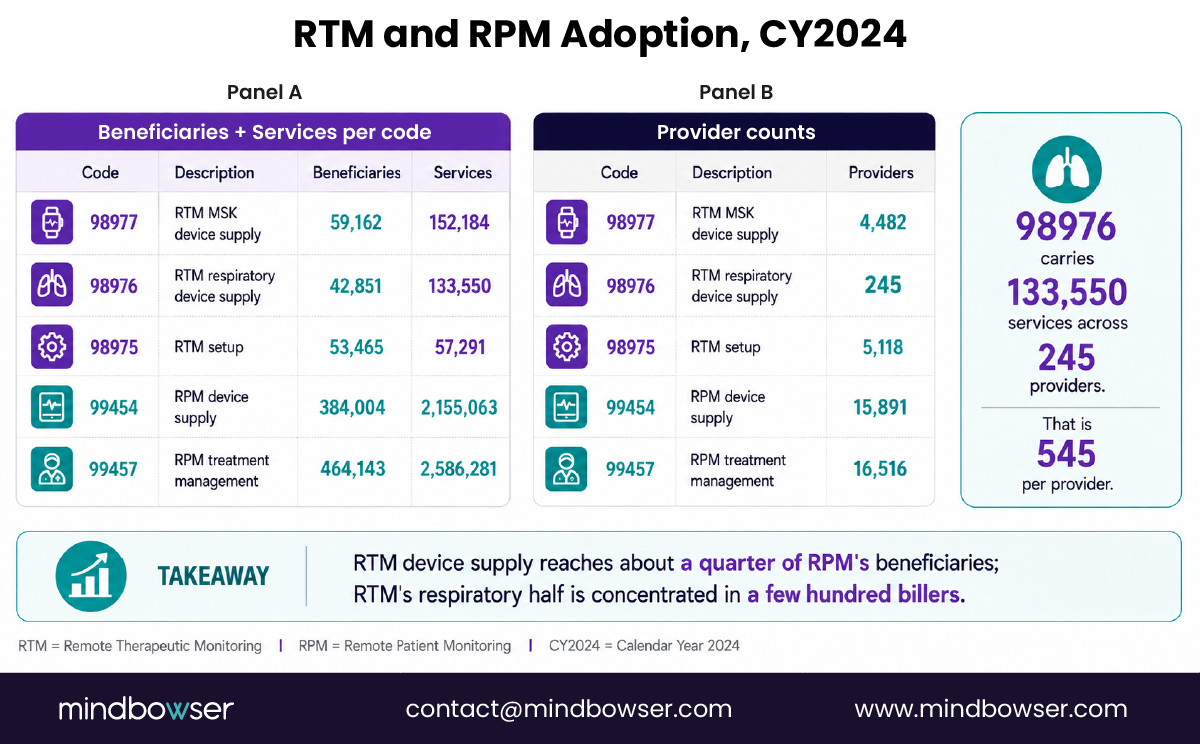
RTM is small. Comparing device supply against device supply, in calendar year 2024 the two RTM device codes together covered 102,013 Medicare beneficiaries in the office setting, 59,162 on musculoskeletal 98977 and 42,851 on respiratory 98976. RPM’s single device supply code, 99454, covered 384,004. RTM runs at roughly a quarter of RPM’s beneficiary reach, and on service volume the gap is wider, 285,734 against 2,155,063. RPM’s own code set and 2026 rates are covered in our remote patient monitoring billing guide. These figures come from the CMS Medicare Physician and Other Practitioners by Geography and Service dataset, national level, office place of service.
The more useful number is hiding one row down. Code 98976, the respiratory device supply code, was billed 133,550 times in 2024 across just 245 rendering providers. That is 545 services per provider. Its musculoskeletal twin, 98977, carried a similar service volume across 4,482 providers.
Those two rows describe two different markets wearing the same code family. Respiratory RTM is concentrated in a few high-volume billers, which is what a device-supplier-led market looks like. Musculoskeletal RTM is spread across thousands of ordinary practices, and that is where the practice-level opportunity sits for most readers of this page.
One more signal, and it cuts against a story I expected to find. Setup code 98975 was billed 57,291 times against 285,734 device supply billings, about five device months per enrollment. That is a program running as designed. Where the numbers diverge is provider count: 5,118 practices billed setup, only 4,482 billed the musculoskeletal device supply that usually follows.
What Counts as RTM, and Where RPM Stops
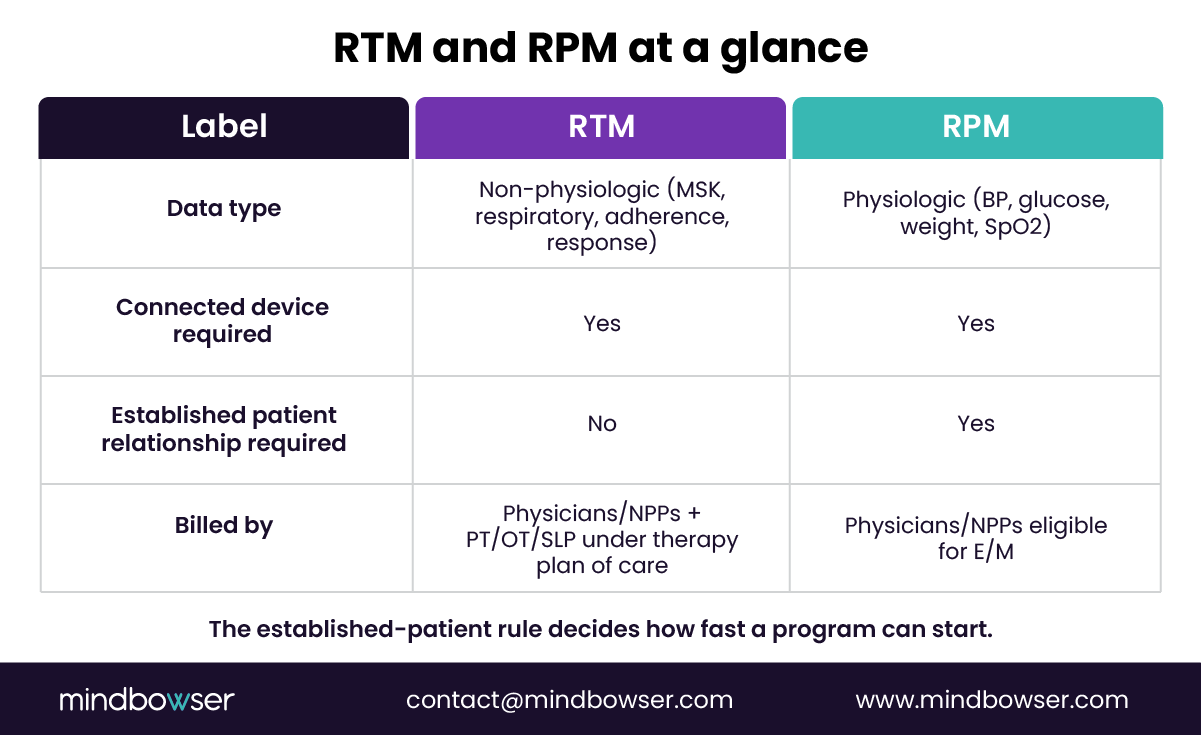
Remote therapeutic monitoring covers non-physiologic data. CMS describes it in MLN901705, the Telehealth and Remote Monitoring booklet as capturing data “which can be self-reported, related to a therapeutic treatment,” including musculoskeletal and respiratory system status, treatment adherence, and treatment response. Remote physiologic monitoring covers measured vitals: oxygen saturation, blood pressure, blood sugar, weight.
There is a widespread misreading of that self-reported clause. Patient-reported does not mean hardware-free. The same booklet finishes the sentence: “A connected medical device transmits the patient’s information.” The device must meet the FDA definition, which puts RTM in wearable and connected device app development territory rather than pure software. An app collecting pain scores with no device layer is not a billable RTM program, and I have watched that assumption survive several product conversations before anyone checks it. Getting that data into the chart where it can be documented and billed is an EHR integration problem before it is a monitoring one.
One distinction in that booklet is a genuine advantage for RTM and rarely gets picked up: “Remote physiologic monitoring, but not RTM, requires an established patient relationship.” RPM needs an existing relationship with the patient. RTM does not. For a practice taking post-surgical referrals it has never treated before, that difference decides whether a program can start in week one or week five.
Which program suits which practice, and what to build first, is covered in our RTM versus RPM guide; the RPM code set and rates are in the remote patient monitoring billing guide.
The Complete 2026 RTM Code Set
Ten codes, in three families. Partial versions circulate, including widely shared ones naming only two of the four codes added for 2026, so here is the whole set, with descriptors from the published fee schedule file.
Setup. 98975 covers initial setup and patient education on use of the equipment, billed once at enrollment.
Device supply. Six codes, split by what is monitored and how many days of data were transmitted in the 30-day period. For 16 to 30 days: 98976 respiratory, 98977 musculoskeletal, 98978 cognitive behavioral therapy. New for 2026, covering 2 to 15 days: 98984 respiratory, 98985 musculoskeletal, 98986 cognitive behavioral therapy.
Treatment management. 98980 covers the first 20 minutes in a calendar month and 98981 each additional 20 minutes. New for 2026, 98979 covers the first 10 minutes.
That is four new codes for 2026: 98984, 98985, 98986 and 98979. The cognitive behavioral therapy code, 98986, is the one most often left off. The CY2026 Physician Fee Schedule final rule describes the change at 90 FR 49394 as the CPT Editorial Panel having “added three remote therapeutic monitoring (RTM) device supply codes to report respiratory, musculoskeletal and cognitive behavioral therapy for 2 to 15 days and 16 to 30 days within a 30-day period,” alongside one new treatment management code. Three device codes plus one time code. If a table you are working from names only two new codes, check which two, because the cognitive behavioral therapy device code and the 10-minute treatment management code are the ones usually dropped.
Check Your RTM Billing Setup Against the New 2026 CMS Rules!
Two Things to Settle Before You Forecast
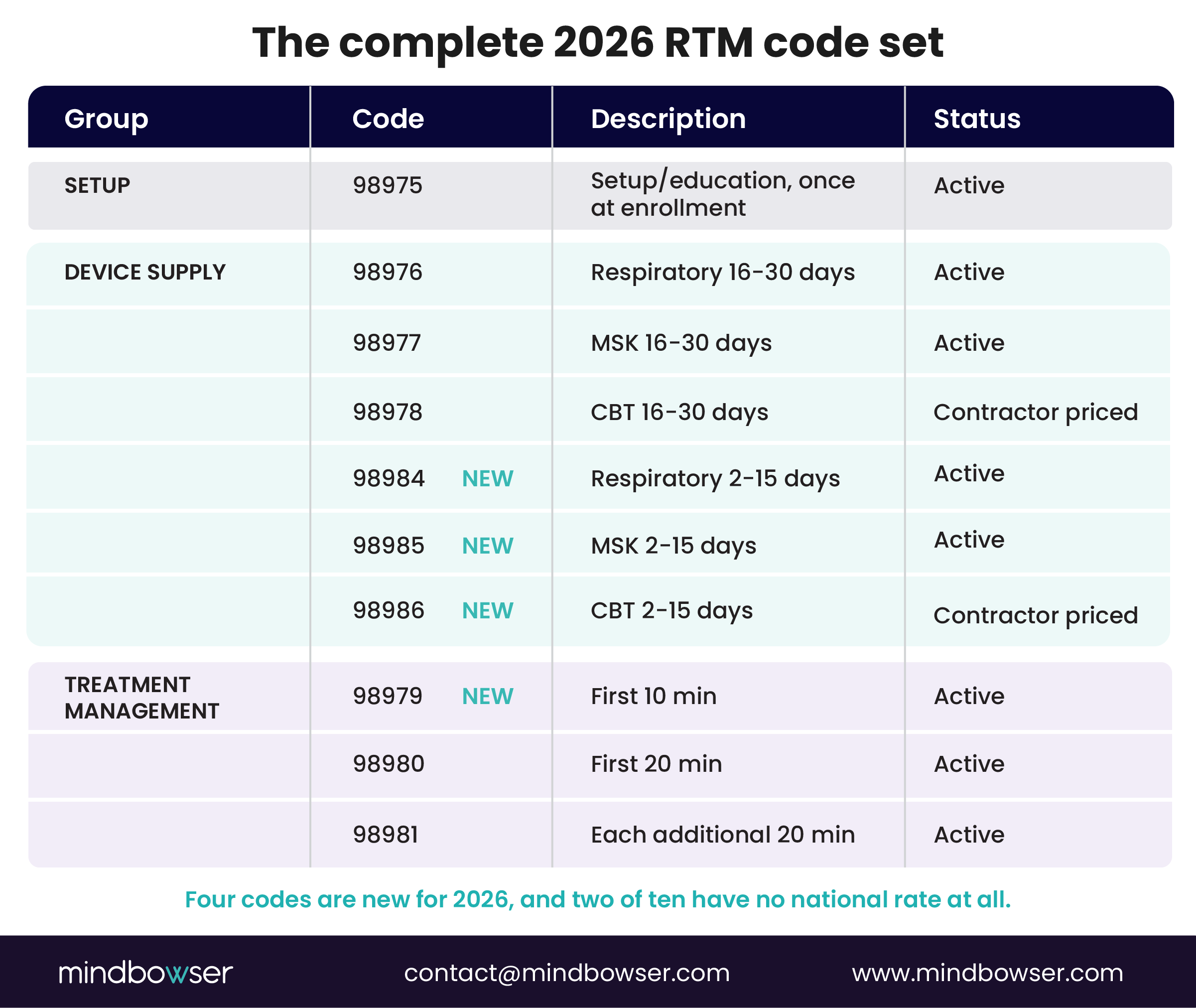
98978 and 98986 have no national rate. Both cognitive behavioral therapy device supply codes are contractor priced, which means your Medicare Administrative Contractor sets the amount, and no published national average applies. CMS finalized that position at 90 FR 49403 over objections from commenters who asked for active pricing, on the grounds that “the technologies for this service are still evolving and there is significant pricing variability.” If you are building a digital therapeutic with a custom digital therapeutics program behind it, your revenue model needs a MAC-specific number, not a national one.
Most of the family sits on the New Technology list. CMS placed the RTM codes it lists at 90 FR 49395, which covers 98975, 98976, 98977, 98979, 98980, 98981, 98984 and 98985, on that list for review once three years of utilization data under the new code structure are available, which the rule puts at April 2030. Valuation is stable for now and explicitly under review later, which is a reasonable input to a build-timing decision.
Choosing the Window: 2 to 15 Days, or 16 to 30
The version of this rule in circulation is often more permissive than what CMS wrote, which is the costly direction to be wrong in.
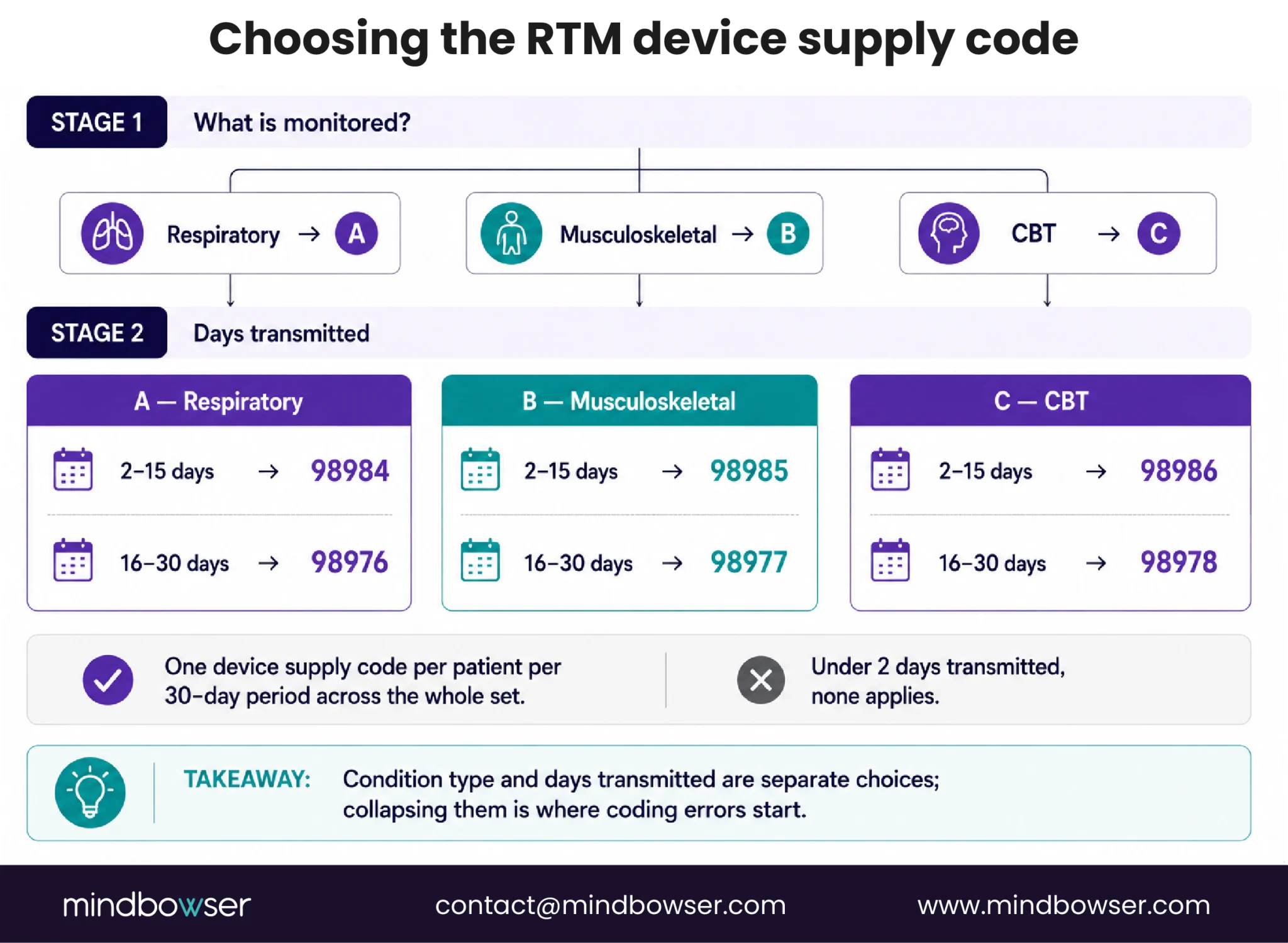
The final rule is unambiguous. At 90 FR 49397: “The 2 to 15 day codes (99445, 98984, 98985, and 98986) and 16 to 30 day codes (99454, 98976, 98977, 98978) are not additive and are not a base and add-on code structure. Billing practitioners would only bill for one of those codes for the appropriate number of days of data transmission per 30 days.”
One device supply code per patient per 30 days. Not one per condition type, not one from each window. The set is treated as a single choice.
What trips practices up is that two independent decisions get collapsed into one. Condition type decides which of the three families applies: respiratory, musculoskeletal, or cognitive behavioral therapy. Days transmitted decides the window within it. A musculoskeletal patient at 9 days is 98985; the same patient at 20 days is 98977. There is never a month where both are billable.
Before 2026 this was a cliff. The 16-day threshold was all or nothing, so a patient transmitting 12 days generated no device supply payment at all. For a three-week post-surgical protocol, that made RTM a poor fit for the population it was designed around. The 2 to 15 day codes removed the cliff, and what they pay for it is covered in the rate section.
The Time Codes and the Communication They Require
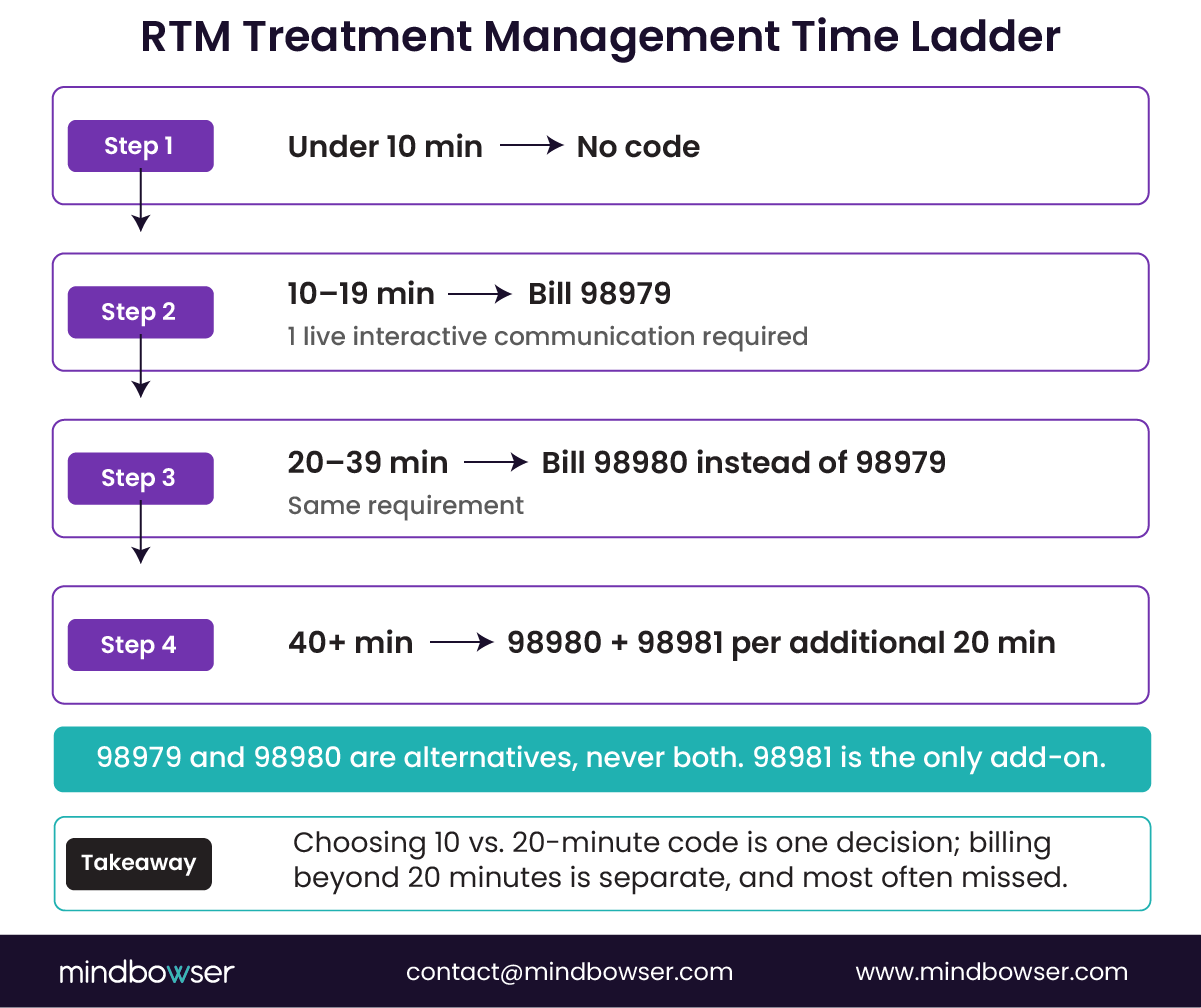
Treatment management works the same way, and CMS says so directly at 90 FR 49397: “the treatment management services describing the first 10 minutes (99470 and 98979) and first 20 minutes (99457 and 98980) of service are also not additive. Billing practitioners would choose the most appropriate code for the time spent that calendar month.” You pick one, not both.
What gets left on the table is what comes next, three sentences later in the same passage: “In instances where more than 20 minutes of treatment management is needed after either 99457 or 98980 is billed, 99458 or 98981 can be used.” So 98981 bills each additional 20-minute increment beyond 98980. A practice operating on the belief that one management code applies regardless of time spent is under-billing its own documented work.
Every treatment management code carries a communication requirement. The rule adopts the CPT language directly: codes 98979, 98980, 98981, 99470, 99457 and 99458 “require a live, interactive communication with the patient/caregiver. The interactive communication contributes to the total time, but it does not need to represent the entire cumulative reported time of the treatment management service.” One live interaction per calendar month, and it counts toward the total rather than sitting outside it.
The 2026 clarification worth knowing is about what qualifies. Commenters asked CMS whether audio-only telephone calls, secure messaging, asynchronous chat, automated bi-directional messaging and AI prompts count toward that interactive communication time. CMS declined to narrow it: “We are not specifying further exclusions for the types of communications that can be had with the patient/caregiver, so long as they meet the CPT specifications.” For anyone designing the engagement layer of a monitoring product, that is a wide door, and it was not obviously open before.
Who Can Bill RTM
Physical therapists, occupational therapists and speech-language pathologists can bill RTM. That much is well covered. The operational half, how the claim actually has to be constructed, is the half that gets it paid.
The mechanism is the “sometimes therapy” designation, and it covers the whole RTM family rather than only the new codes. CMS confirmed at 90 FR 49397 that the new codes 98979, 98984 and 98985 carry the designation “since they are based on RTM codes we designated as sometimes therapy in the CY 2022 PFS final rule.” The original codes were designated first; the 2026 rule extends the same treatment to their new siblings. A therapist can bill across the set, not just the three codes named in the 2026 discussion.
CMS defines what the designation means precisely: these services “can be billed outside a therapy plan of care (POC) by a physician and certain NPPs, when appropriate; and always require a POC therapy modifier when furnished by a physical therapist (PT) or occupational therapist (OT), or by a therapy assistant under the PT’s or OT’s supervision, or speech-language pathologist.”
Read that second clause carefully. When a therapist furnishes RTM, a plan-of-care modifier is not optional; a claim without one is incomplete.
One document appears to say the opposite, and it is worth knowing why. MLN901705, the CMS booklet on remote monitoring, states plainly: “Only physicians and non-physician practitioners eligible to provide evaluation and management services can bill remote monitoring services.” Taken literally, that sentence tells a physical therapy practice it cannot bill RTM at all.
It is a simplification, and the Physician Fee Schedule rule governs. The rule is more specific and more recent, addresses RTM directly rather than remote monitoring generally, and describes in detail how a therapist bills these codes, which would be incoherent if therapists could not. The booklet’s sentence is accurate for remote physiologic monitoring and over-broad as applied to RTM. If a payer or an internal compliance review raises it, the citation that resolves it is 90 FR 49397 and the “sometimes therapy” designation carried forward from the CY2022 final rule at 86 FR 65116.
I flag the conflict rather than quietly picking a side, because a practice that finds that sentence alone will reasonably conclude the program is closed to it.
Request an Assessment: Check Which Medicare Care Programs Can Be Billed Alongside RTM- Get the Multi-Program Stacking Matrix
The Modifier Layer Underneath
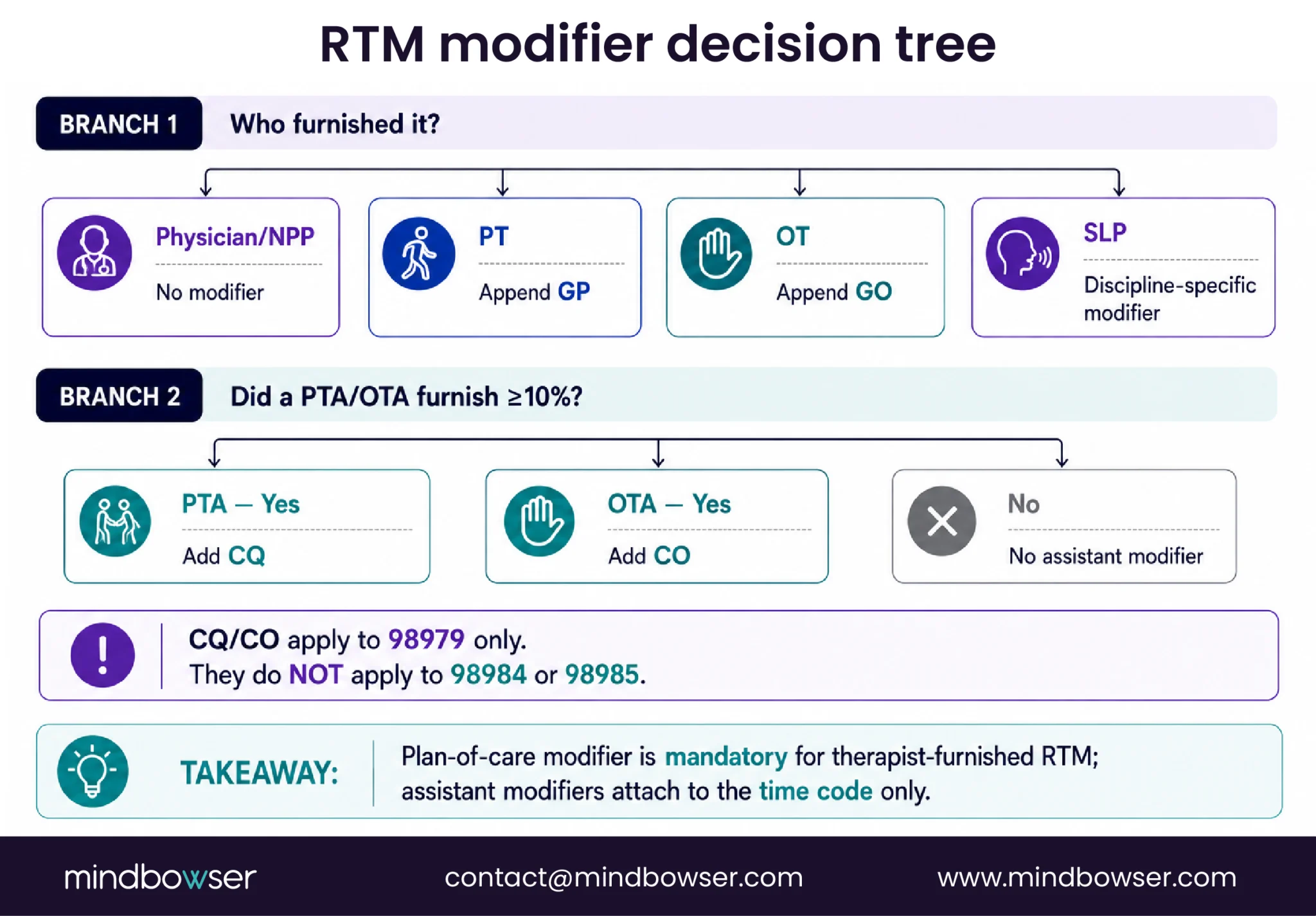
The plan-of-care modifier is the first layer. The CY2026 rule names two of them in the context of RTM: GP for physical therapy and GO for occupational therapy. Speech-language pathology services are furnished under their own plan of care and carry the corresponding modifier for that discipline; the RTM discussion in this rule does not address it, so it is governed by the general outpatient therapy modifier rules rather than by anything RTM-specific.
There is a second modifier layer underneath. When a physical therapist assistant or occupational therapy assistant does part of the work, CQ or CO respectively is required on top of the plan-of-care modifier, once the de minimis 10% threshold is met. And there is a distinction here that I have found nowhere except in the rule itself, at 90 FR 49398: the CQ and CO modifiers “apply to the new RTM code 98979. However, the CQ/CO are not applicable to the RTM device codes 98984 and 98985 as they are based on the existing codes 98976 and 98977.” So the assistant modifiers attach to the treatment management code, and not to the two device supply codes named. CMS gives its reasoning, that 98984 and 98985 inherit the treatment of 98976 and 98977, which is the same basis on which those older device codes were handled in CY2022. The rule does not extend the statement to the cognitive behavioral therapy device codes, so treat those separately. This reads narrower than the “sometimes therapy” point above for a reason: there CMS said the new codes inherit the designation from the originals, which invites generalizing. Here it named two codes and gave a basis for those two only. This is the kind of rule that produces a denial nobody can explain three months later.
Running RTM Alongside a Practice’s Other Programs
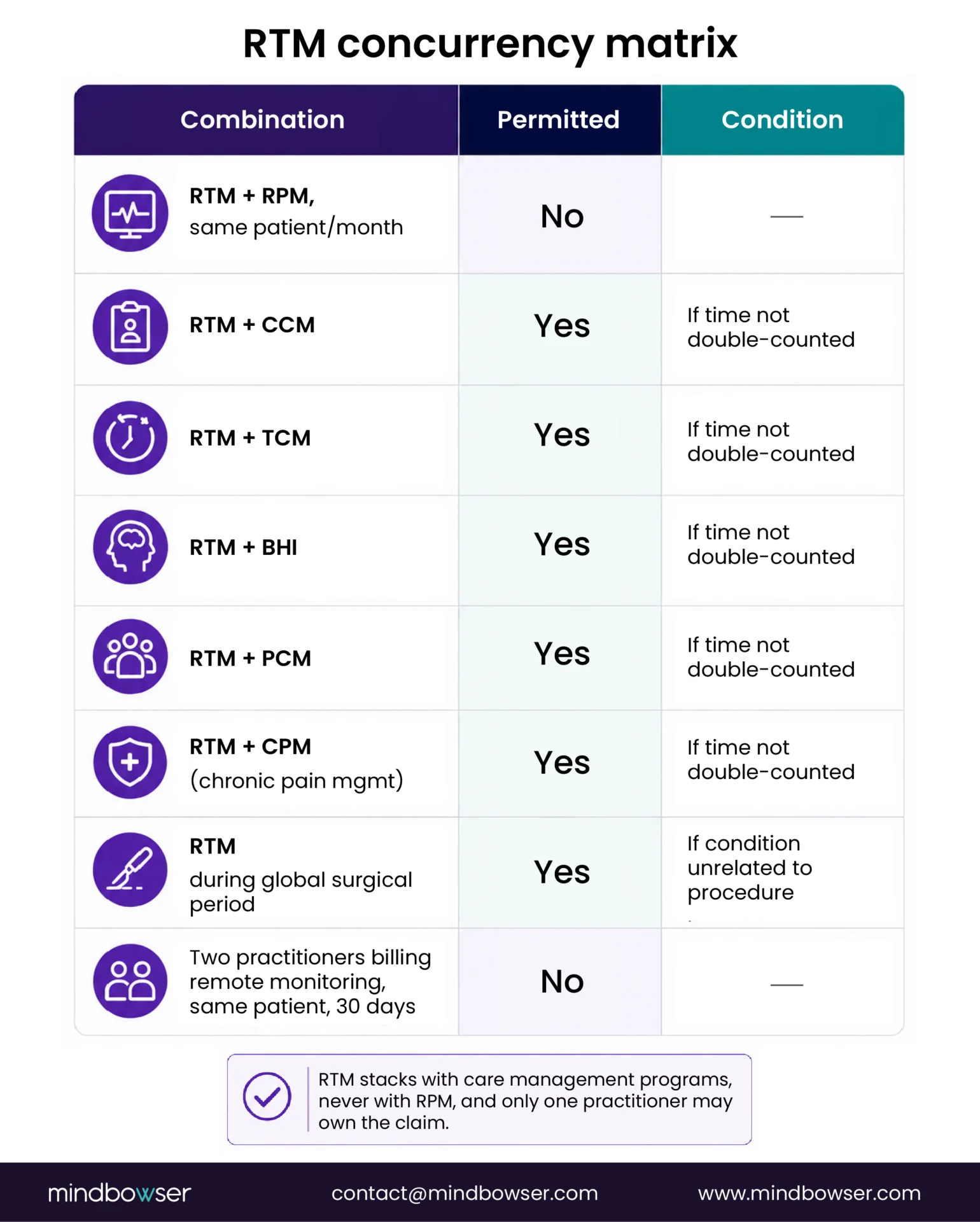
Most practices billing RTM are billing something else too, and the concurrency rules decide whether those claims survive.
RTM and RPM cannot be billed together. MLN901705 states it in one flat sentence: “You can’t bill remote physiologic monitoring and RTM together.” This is settled rather than pending: commenters on the CY2026 rule asked CMS to allow concurrent RPM and RTM billing, and CMS finalized without that change. For a given patient in a given month, it is one or the other.
Either one may run alongside the care management programs. From the same booklet: “You may bill remote physiologic monitoring and RTM, but not both, concurrently with the following care management services for the same patient if you don’t count time and effort twice: Chronic care management, transitional care management, behavioral health integration, principal care management, and chronic pain management.” The time-counting condition is the operative part, and it is a documentation design problem before it is a billing one. In practice it means monitoring time and care management time have to be captured in separate, timestamped places in the record, which for most groups is an Epic integration question rather than a policy one.
The full cross-program matrix is in our Medicare care program stacking rules guide. For the per-patient revenue math rather than the rules, see the RPM and CCM stacking revenue analysis.
Two further constraints change how a program has to be designed.
Only one practitioner may bill remote monitoring per patient per 30 days. That is MLN901705 again, and it is stricter than the program-level rule people usually plan around. In a group where a surgeon, a physical therapist and a primary care physician all touch the same post-surgical patient, the program has to decide in advance who owns the monitoring claim. Discovering it at month end means someone’s documented work is unbillable.
Remote monitoring is billable during a global surgical period. From the booklet: “For patients who receive a procedure or surgery and related services that we cover under a global surgery payment, practitioners may bill for remote monitoring services if the services address an underlying condition that isn’t linked to the global procedure.” Given that post-surgical rehabilitation is the single largest RTM use case, this may be the most operationally useful rule in this guide. The qualifier matters: the monitored condition has to be genuinely separate from the procedure under the global package.
What RTM Actually Pays in 2026
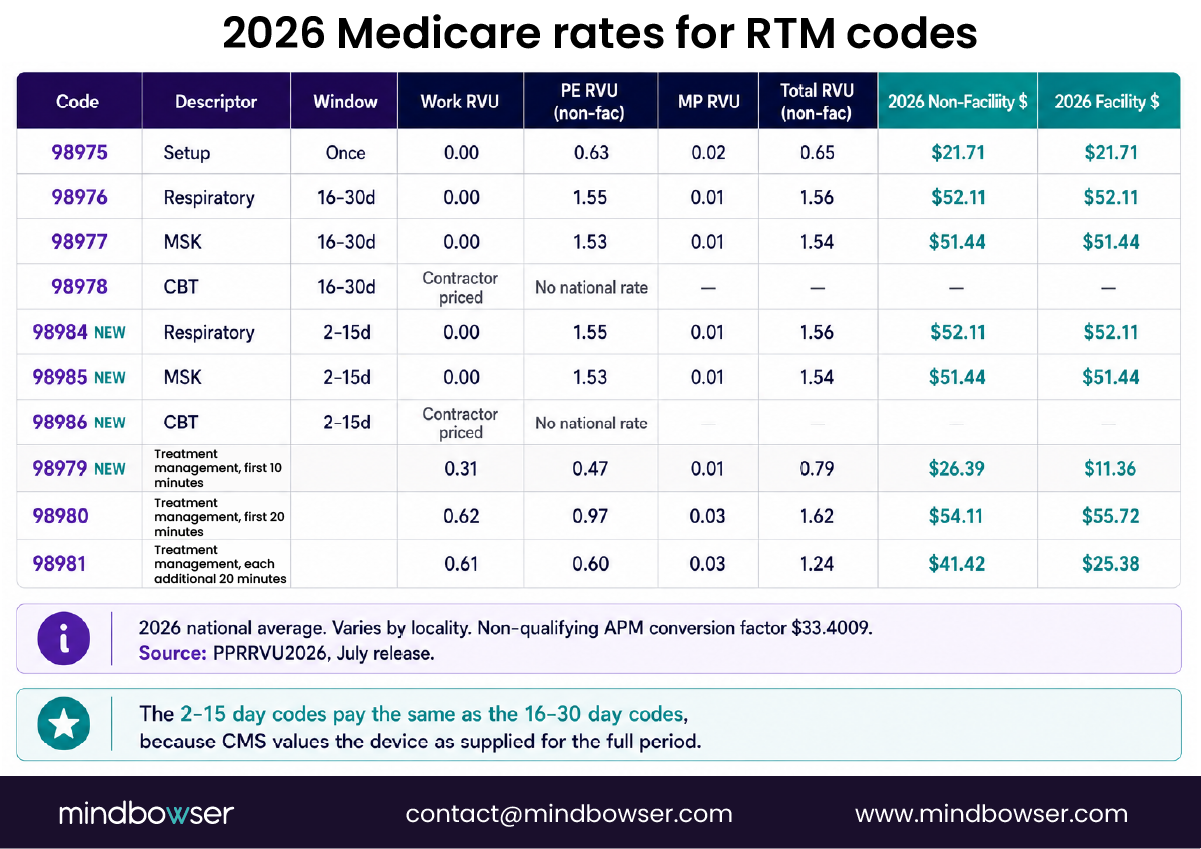
This is the table that sent me to the fee schedule file in the first place.
Every figure below comes from PPRRVU2026, the published Physician Fee Schedule relative value file, July release. Rates are total RVUs times the conversion factor. For 2026 there are two conversion factors: the CY2026 final rule fact sheet states that “the final CY 2026 qualifying APM conversion factor of $33.57 represents a projected increase of $1.22 (+3.77%)” and “the final CY 2026 nonqualifying APM conversion factor of $33.40 represents a projected increase of $1.05 (+3.26%).” The figures below use the non-qualifying factor of $33.4009. These are 2026 national averages and they vary by locality, and the non-facility and facility columns are different amounts for the time codes.
The finding worth carrying away: the short-window codes pay exactly what the long-window codes pay.
98984 pays $52.11. So does 98976. 98985 pays $51.44. So does 98977. A patient who transmitted 6 days of data yields the same device supply payment as one who transmitted 20.
That is deliberate, and CMS explains why at 90 FR 49403: the agency finalized the same valuation across the pair “since the device is supplied to the beneficiary for the full 30-day period, regardless of the number of days that data is transmitted, and more accurately represents the reality of practice expense for these services.”
The practical consequence is worth sitting with. The 2 to 15 day codes pay full freight for a patient who engages less. They removed an all-or-nothing threshold without reducing what gets paid. For a practice running three-week post-surgical protocols, or serving a population whose engagement is realistically intermittent, the arithmetic on whether RTM is worth building changed in January, by more than the conversion factor increase suggests.
One note on method, because it is why I trust these over the numbers I started with. The July 2026 release and the January 2026 release agree on every code. Rate tables are circulating that do not match either, including one labelling its figures finalized. Before any of this goes into a forecast, pull PPRRVU2026 and reproduce it. The components are in the table so you can.
What This Means If You Are Building an RTM Program
Everything above is a specification for software, whether or not anyone writes it down that way.
Everything above is a specification for software, whether or not anyone writes it down that way. Practices building these workflows need remote therapeutic monitoring software that can support device data capture, treatment management workflows, billing logic, documentation, and integration with the clinical systems already in use.
Four of these rules have to be enforced by a system, because a person checking them at month-end will miss some.
The device supply logic has to hold one code per patient per 30 days across the whole set, and select it from two independent inputs, condition type and actual days transmitted. The treatment management logic has to choose between 98979 and 98980 on measured time and then correctly add 98981 beyond 20 minutes. The modifier logic has to attach GP or GO by furnishing provider, add CQ or CO at the assistant threshold, and know that those assistant modifiers apply to 98979 but not to 98984 or 98985.
And the claim logic has to block an RPM claim in any month where an RTM claim exists for the same patient, and enforce one practitioner per 30 days across the whole group. Each of those is a rule engine sitting on top of ConnectHealth‘s data layer, enforcing at the point the claim is assembled.
There is a fifth job that no rule mandates, and it follows from the code structure rather than from the claims data. Setup is billed once; device supply is billed every 30 days. A patient who is enrolled but never starts transmitting produces one 98975 and nothing after, and in a manual workflow nobody notices until month end, by which point the window to fix it easily has passed. Flagging an incomplete setup inside the first week is the difference between recovering that patient and writing off the month. The same enrollment-tracking problem shows up in chronic care management billing and gets solved the same way.
How Mindbowser Builds RTM Programs
Mindbowser builds these programs on ConnectHealth, and a buyer has three real options: rent a point platform and accept its rules, configure a pre-built ConnectHealth use case, or commission a full custom build. For RTM the line falls in a specific place, and it is worth naming precisely. The EHR connectivity, the device data ingestion, the scheduling layer and the HIPAA compliance controls and audit trail are components we deploy repeatedly and can stand up quickly. The code selection and modifier logic described above is a custom build. Our library of pre-built workflow components covers plenty of clinical and data movement; it does not cover RTM’s window selection or the CQ and CO exception, so that layer gets specified from the rules above, built, and tested against real claims as healthcare software development work. Saying so up front is more useful than a demo that turns out not to cover it.
The adjacent pattern is proven, which is worth knowing when you are assessing delivery risk. MedAdhere AI runs continuous monitoring with automated escalation for medication adherence. Measured across our own production deployments, it has driven a 26% adherence improvement and a 12% reduction in emergency visits tied to missed care. Those are our numbers from our own installations, not an industry benchmark. RTM tracks a different data type, exercise completion and symptom reporting rather than medication doses, so it is an adjacent proof rather than a reusable component. The monitoring-and-escalation architecture underneath transfers. The clinical logic on top does not.
One part of an RTM program stays with the clinical team. The exercise library, the prescribed movements and instructional content, is a clinical and licensing choice a practice makes for itself. Software’s job is the workflow around that content.
Where This Leaves a Practice Deciding Whether to Build
RTM in 2026 is a small program with a settled rulebook and a documentation problem. The rules are published and checkable, and much of what circulates about them is incomplete or out of date. Most of the code lists I checked while writing this were missing at least one of the four codes added this year. One widely shared rate table is 22% low on both musculoskeletal device supply rows, which is the code practices bill most and its new sibling.
None of that is exotic. It is what happens to a code family that changed recently in a year when attention was elsewhere. The practical response is the same one that produced this guide: pull the fee schedule file, read the rule section, and check the number before it goes into a model.
If you are weighing whether RTM justifies a build, start from the arithmetic that changed in January. A patient transmitting 6 days now pays what one transmitting 20 pays, which reaches exactly the short-episode, intermittent-engagement populations RTM previously served badly.
One scope note before you act on any of this. Everything above is Medicare fee-for-service. Medicare Advantage plans and commercial payers set their own coverage and documentation rules for remote monitoring, and several publish RTM medical policies that differ from the fee-for-service position, including on which codes they recognize at all. For a physical therapy or orthopedic practice where Medicare is under half the book, the fee-for-service rules are the floor to design against and the payer-by-payer check is a separate exercise, and one worth building into the annual wellness visit and care management programs running alongside it.
If you want a second pair of eyes on your own code map, your window-selection logic, or the modifier rules your claims are carrying today, that is the kind of review we do before any build conversation starts.
Request an Assessment