













 BLOGS
BLOGS  NEWSROOM
  CASE STUDIES
  WEBINARS
  PODCASTS
  ASSET HUB
  EVENT CALENDAR

























TL;DR
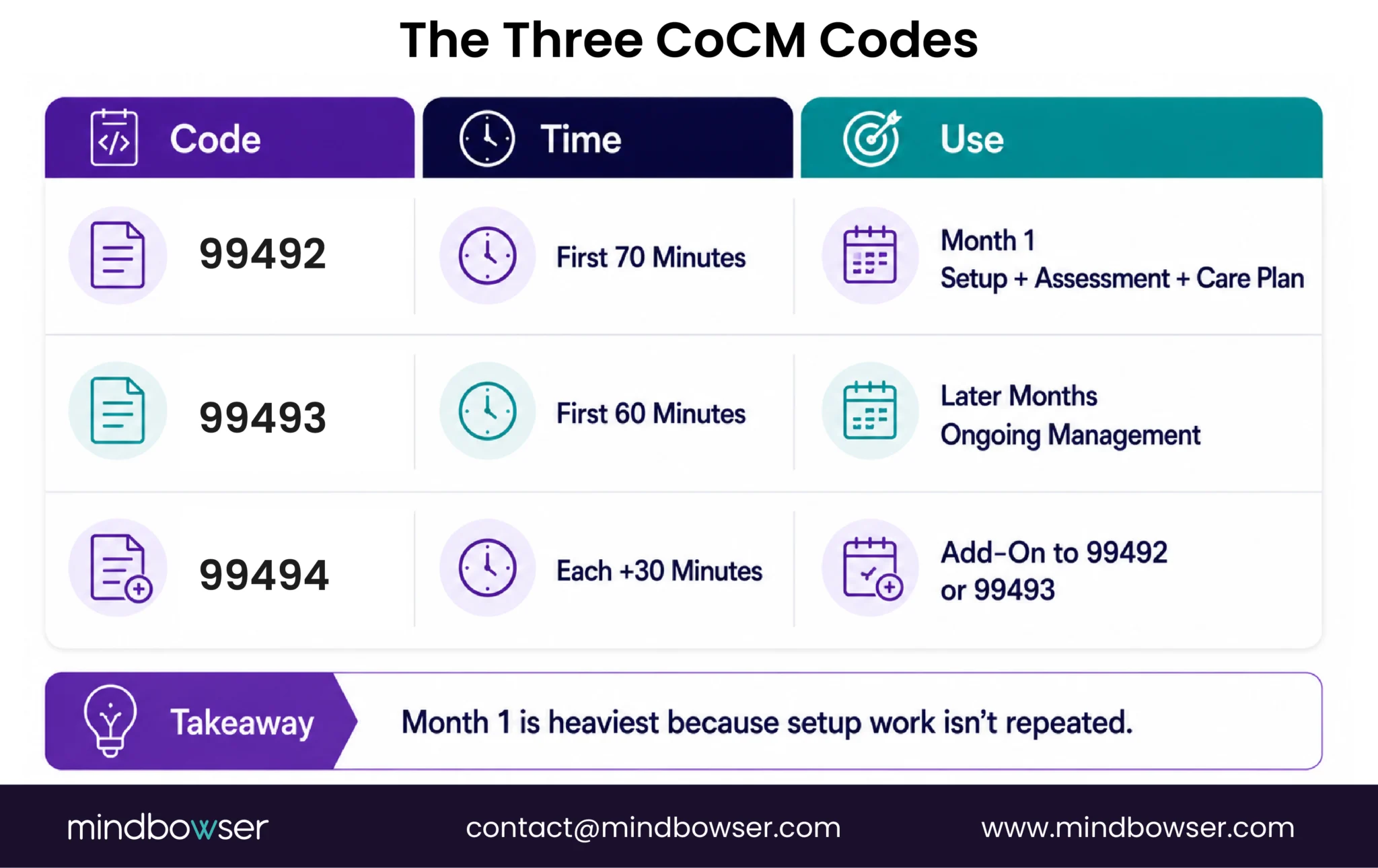
The BHI/CoCM CPT codes billing guide walks through billing for Behavioral Health Integration (BHI) and Collaborative Care Model (CoCM) under Medicare, covering four CPT codes: 99484 (general BHI, 20+ min/month, single clinical staff role), 99492 (CoCM initial month, 70 min, includes setup/assessment), 99493 (CoCM subsequent months, 60 min), and 99494 (CoCM add-on, each additional 30 min).
The core distinction is team structure and time: general BHI needs just one clinical staff role at 20+ minutes monthly, while CoCM requires a three-person team (care manager, psychiatric consultant, billing practitioner) and 60-70 minutes monthly, with the psychiatric consultant reviewing cases without necessarily seeing the patient. The two are mutually exclusive for the same patient in the same month, so practices need to track which model applies as care needs shift.
Both BHI and CoCM stack with CCM, and the 2026 APCM add-on codes simplify behavioral health billing for APCM patients. The main takeaway: the CPT codes and time thresholds are easy enough to implement, but the real challenge and what determines program success is unified registry infrastructure that tracks screening scores (PHQ-9/GAD-7), care manager notes, and consultant reviews in one shared system with defensible documentation, especially for audits.
Every billing guide I read while researching this page explains the codes and the time thresholds correctly, then stops. None of them address the part I have seen actually determine whether a behavioral health integration program runs cleanly or falls apart within a quarter: whether the practice has one system that tracks a patient’s screening scores, the care manager’s notes, and the psychiatric consultant’s reviews together, or three separate records that nobody reconciles.
Epic-Approved Vendor – HIPAA and SOC 2 controls built into every build · 50+ healthcare solutions shipped
General BHI vs. CoCM: Two Different Reimbursement Models
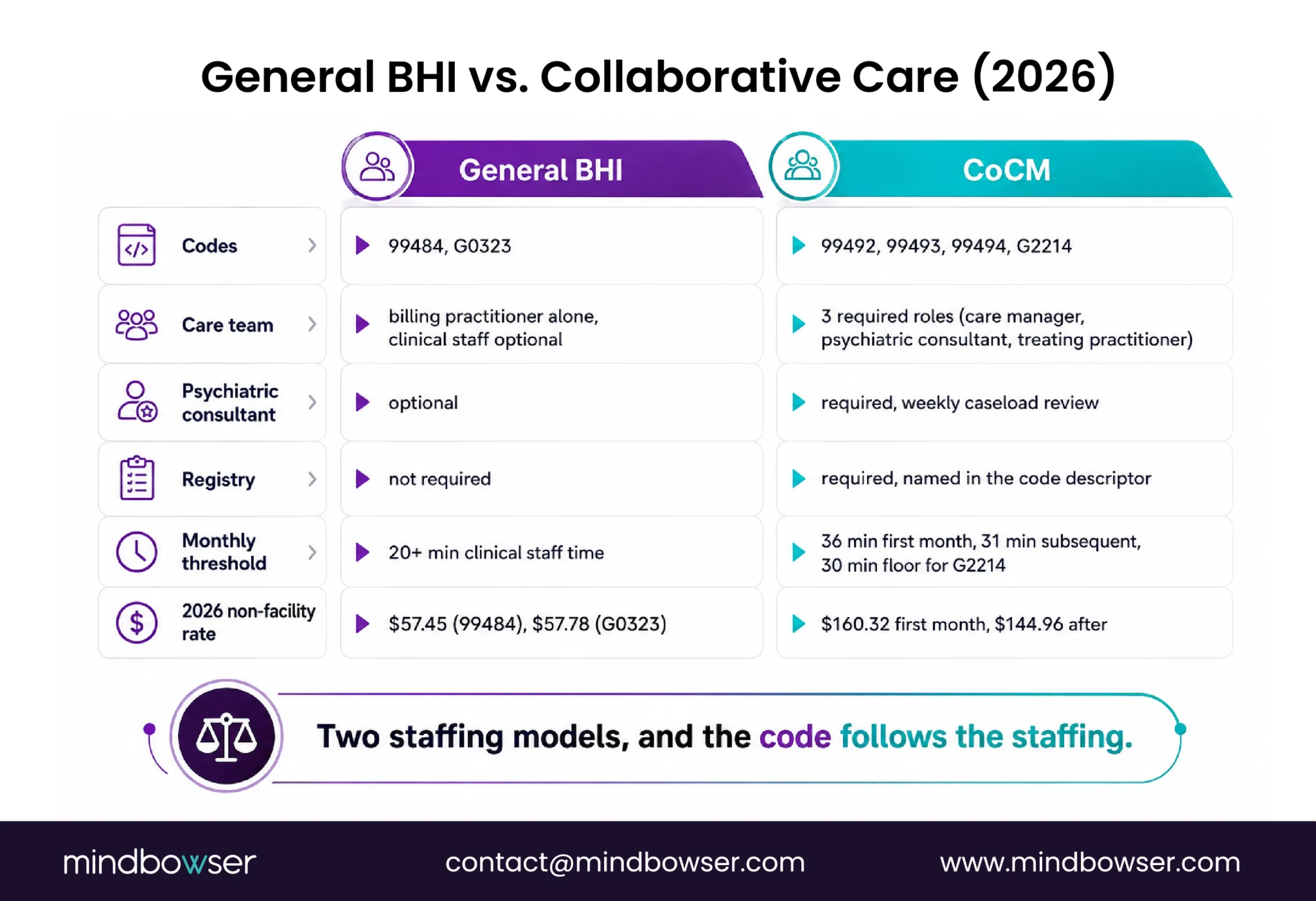
Behavioral Health Integration covers two distinct pathways, not one program with two billing options. General BHI (CPT 99484) is the simpler model: 20 or more minutes of clinical staff time per month spent on behavioral health assessment, care planning, and coordination, with a lower staffing bar and broader applicability. The Collaborative Care Model (CoCM, CPT 99492-99494) is structurally different, requiring a defined three-person care team: a behavioral health care manager, a consulting psychiatric provider who reviews the caseload on a scheduled basis without necessarily seeing the patient directly, and the billing practitioner.
CPT 99484: The Lower Bar, Broader Applicability Code
General BHI requires 20 or more minutes of clinical staff time monthly, delivered under general supervision, covering behavioral health assessment, a care plan tied to the behavioral health condition, and ongoing coordination with the primary care team. It doesn’t require a psychiatric consultant on the case, which is the main reason it fits a broader range of practices than CoCM does. A primary care practice that already has clinical staff capacity but no access to a consulting psychiatrist can typically stand up general BHI faster than CoCM.
CPT 99492, 99493, 99494: The Collaborative Care Codes
Why BHI and CoCM Can’t Both Be Billed in the Same Month
A practice cannot bill general BHI and CoCM for the same patient in the same month. This makes sense once the staffing models are clear: a patient’s behavioral health coordination is either running through the simpler single-role structure or the three-person collaborative team, not both simultaneously. A patient can transition between the two models across months, moving into CoCM when psychiatric consultation becomes available, or stepping down to general BHI once a case stabilizes, but the switch has to be clean month to month.
The practical failure mode here isn’t usually a practice deliberately double-billing. It’s a patient whose case genuinely evolves, say, a psychiatric consultant becomes available mid-quarter after the practice started the patient on general BHI, and the transition month gets billed under the old model out of habit rather than the new one the care team actually delivered. Tracking which model applies to a given patient in a given month, and flagging the switch clearly when it happens, is a small logic problem with the same audit-exposure consequence as any other mutual-exclusivity miss on this cluster’s stacking matrix.
For the full mutual-exclusivity matrix across all Medicare care management programs, see Mindbowser’s program stacking rules guide.
Simplify Behavioral Health Integration billing.
The Registry Problem: Where BHI/CoCM Documentation Actually Breaks Down
This is the gap the codes-and-rates guides don’t name. CoCM in particular requires a specific documentation trail: PHQ-9 or GAD-7 screening scores tracked over time, the care manager’s session notes, and the psychiatric consultant’s periodic caseload review, all tied to the same patient record and available to the billing practitioner. When these live in three separate places, a spreadsheet the care manager keeps, notes in a behavioral health platform, and the consultant’s own review log, reconstructing a defensible billing record at audit time becomes a real problem, not a hypothetical one.
The practices where this runs cleanly are the ones where all three roles work from one shared registry, not three disconnected systems that happen to be talking about the same patient.
What a BHI/CoCM Registry Actually Needs to Track
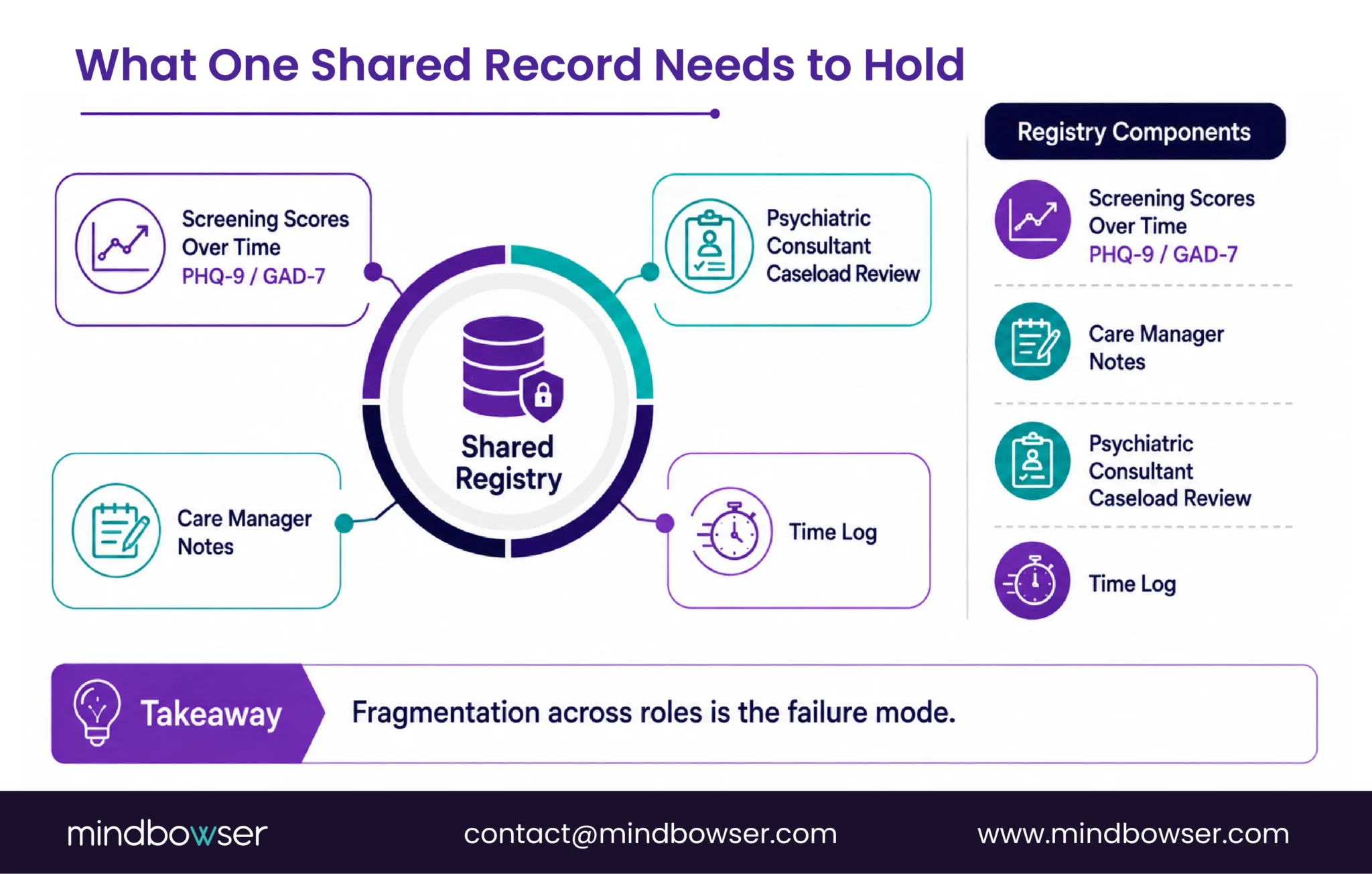
This page covers the billing side: the codes, the thresholds, the exclusion rule. The clinical workflow side, screening-tool selection, consent management, and the behavioral-health-specific technology stack, is covered in more depth in Mindbowser’s mental health cluster content, which this piece defers to rather than duplicate.
The 2026 APCM Behavioral Health Add-On Codes
CMS introduced new BHI add-on codes for Advanced Primary Care Management in 2026, changing how a practice layers behavioral health coordination onto an APCM-enrolled patient. Before this update, adding BHI or CoCM to an APCM patient meant running BHI’s separate billing structure alongside APCM’s tiered rate, tracking two distinct billing logics for one patient. The add-on codes fold behavioral health coordination directly into APCM’s billing structure for a qualifying patient, removing the second billing logic entirely.
Building the Registry That Makes BHI and CoCM Billing Defensible
The codes and thresholds in this guide are the easy part to implement correctly. The registry that ties screening scores, care manager notes, and psychiatric consultant reviews into one defensible record is where most BHI and CoCM programs actually succeed or struggle. Mindbowser builds that registry into the EHR a practice already runs, so the billing trail exists because the clinical documentation was captured in one place from the start, not reconstructed at audit time.
General BHI (99484) uses a single clinical-staff role at a 20-minute monthly threshold. CoCM (99492-99494) requires a three-person team, a behavioral health care manager, a consulting psychiatric provider, and the billing practitioner, at a 60-70 minute threshold.
No, they’re mutually exclusive. A patient can move between the two models across different months.
No. The consultant reviews the caseload with the care manager on a scheduled basis and doesn’t need to see the patient face to face for CoCM billing to apply.
99492 covers the first month, which includes setup work, registry enrollment, initial assessment, and care plan development that subsequent months don’t repeat.
Yes, both stack with CCM, and 2026’s APCM add-on codes simplify billing behavioral health coordination for APCM-enrolled patients specifically.