













 BLOGS
BLOGS  NEWSROOM
  CASE STUDIES
  WEBINARS
  PODCASTS
  ASSET HUB
  EVENT CALENDAR






















TL;DR
- Medication reconciliation is the process of comparing every medication a patient is actually taking against every medication being ordered, at each transition of care, and resolving the differences. It is not a medication review and it is not the same as keeping a tidy list.
- Five steps: build the current list, build the intended list, compare them, make clinical decisions about each discrepancy, communicate the reconciled list onward. Published versions that stop at four collapse the communication step — the one that most often fails.
- Most errors happen at step one. Published data finds errors in the medication history in up to 67% of cases. If the list of what the patient is actually taking is incomplete, every step after it inherits the error.
- No regulation mandates a specific product. Joint Commission NPSG.03.06.01 requires the process to happen and be documented. That is a workflow requirement, not a purchasing one.
- Software helps at one point: surfacing the discrepancy to the right person at the moment the order is being written. That is a `MedicationStatement` vs `MedicationRequest` data problem before it is an interface problem, and most teams conflate the two resources.
What Medication Reconciliation Actually Is
The Joint Commission defines it as comparing the medications a patient is taking with newly ordered medications, and resolving any discrepancies. That definition is deceptively simple, and the word doing the work is reconciling.
Reconciliation is one of the clearest examples of what clinical decision support is for, and it is not a review. A full medication review (CMR) is a separate pharmacy service with its own billing and its own purpose, which is optimizing therapy. Reconciliation asks a narrower question: do these two lists agree, and if they do not, which one is right?
For worked examples of decision support running in production, including this pattern, see our collection of clinical decision support system examples.
It happens at every transition where medications change hands. Admission. Transfer between units or levels of care. Discharge. Each of those is a moment where one system’s understanding of the patient’s medications gets handed to another system that may never have seen it.
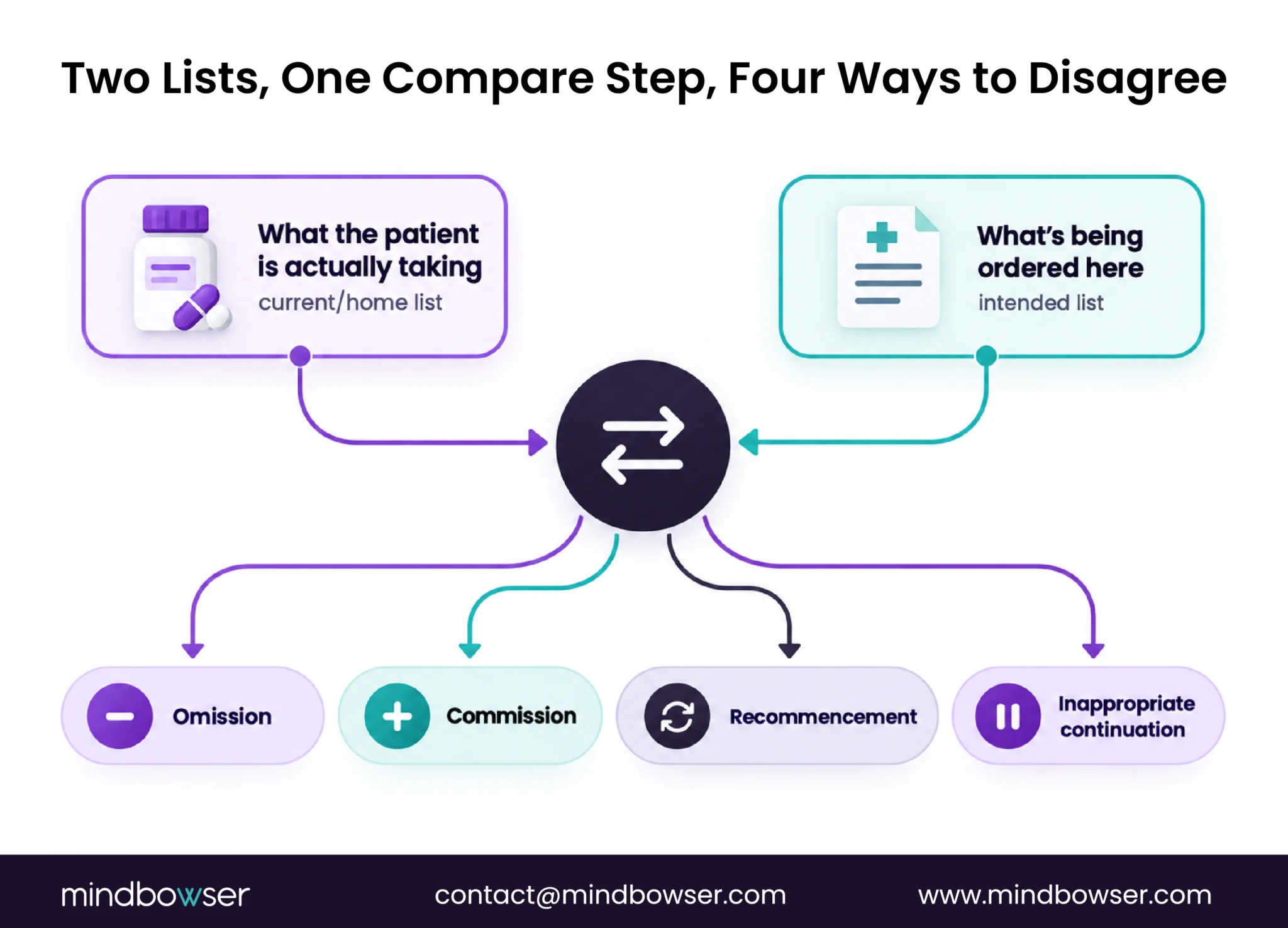
The Five Steps
The canonical process has five steps, and the order matters:
- Build the current list: Everything the patient is actually taking, including over-the-counter medicines, supplements, and anything prescribed elsewhere.
- Build the intended list: Everything about to be prescribed in this setting.
- Compare them.
- Make clinical decisions about each discrepancy: Continue, stop, adjust, or clarify.
- Communicate the reconciled list to the next clinician and to the patient.
It is worth being precise about this, because it is commonly published as four steps, with the communication step folded into the decision step or dropped entirely. A page currently ranking on the first page of Google for this term lists four. The fifth step is the one that fails most often in practice, and collapsing it into step four is how it gets designed out of a workflow.

Where It Breaks
The failure is almost always upstream of the software.
Published error rates for the medication history itself are high. The most-cited systematic review on this, Tam and colleagues in CMAJ (2005), found errors in prescription medication histories in up to 67% of cases. Between 10% and 61% of patients had at least one omission error, and 13% to 22% had at least one commission error. Across the six studies that assessed clinical importance, covering 588 patients, 11% to 59% of those errors were judged clinically important.
Those ranges are wide, and the review is explicit about why: the underlying studies used enough different methods that meta-analysis was not possible, and it concludes that a precise description of the problem remains elusive. Treat the numbers as evidence that the failure is common and consequential, not as a benchmark to measure your own organization against.
Budnitz and colleagues quantified the downstream harm in their 2011 study of emergency hospitalizations for adverse drug events in older adults (New England Journal of Medicine).
The most common single error is omission: a medicine the patient takes that never makes it onto the list.
Discrepancies fall into a small number of types, and knowing which type you are looking at changes what you do about it:
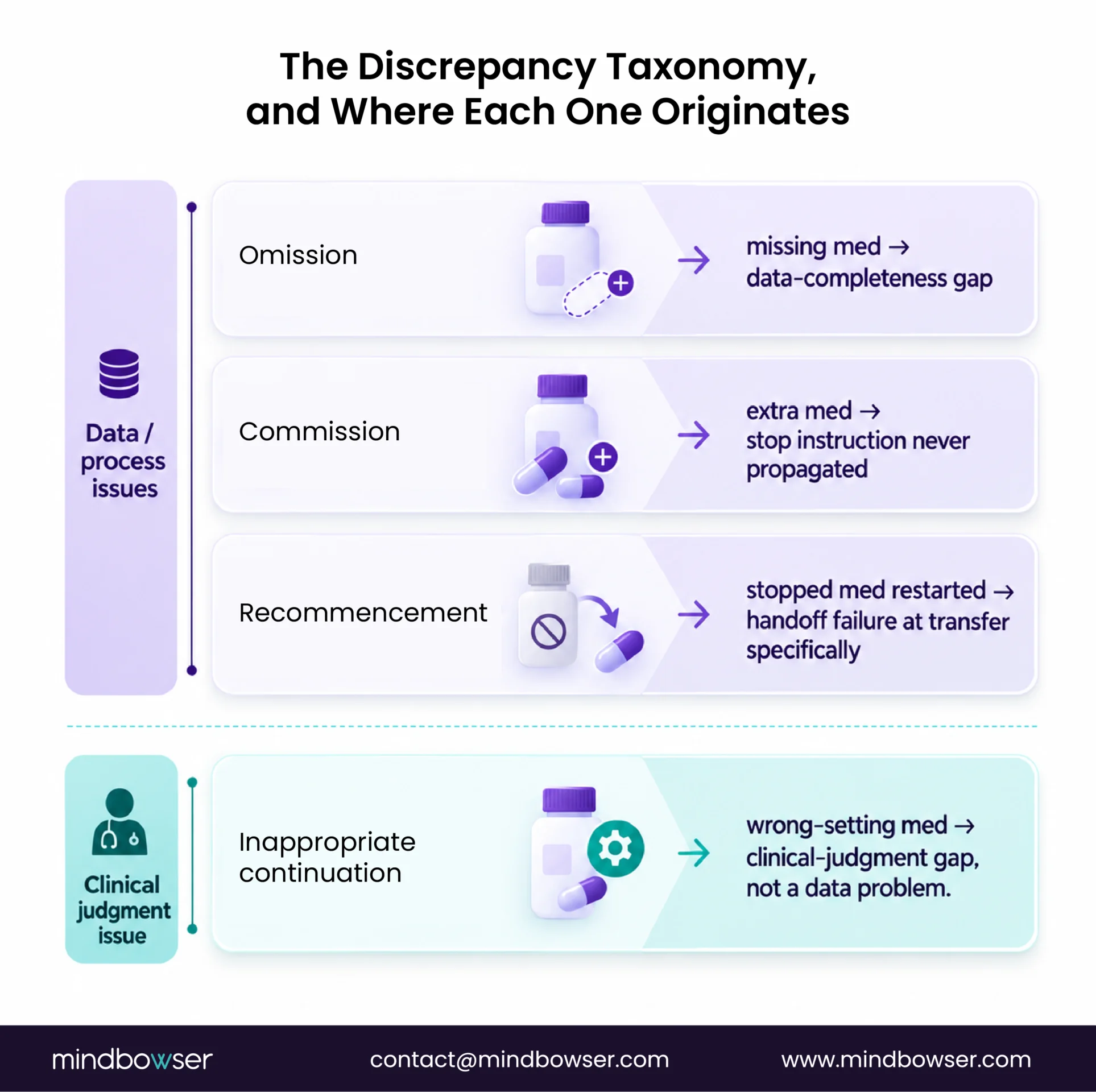
- Omission: A medicine the patient takes is missing from the record.
- Commission: A medicine appears on the record that the patient is not taking.
- Recommencement: A medicine that was deliberately stopped gets restarted on transfer, usually because the stop reason never traveled with the list.
- Inappropriate continuation: A medicine appropriate in one setting is continued into a setting where it is not.
Each type has a different root cause, which is why counting discrepancies without classifying them tells you very little. Omissions are a data-completeness problem. Commissions usually mean a stop instruction never propagated. Recommencements are a handoff problem specifically, and they cluster at transfer rather than admission. Inappropriate continuations are a clinical-judgment problem that no amount of better data will solve on its own.
The reason step one fails is structural. The patient’s real medication list lives in several places at once: the practice that prescribes most of it, the specialist who added something, the pharmacy that dispensed it, the supplement bought without a prescription, and the patient’s own memory. No single system holds it. Reconciliation asks a clinician to assemble ground truth from sources that were never designed to agree.
What Regulators Actually Require
Medication reconciliation is a required process, not a required product.
The Joint Commission carries it as National Patient Safety Goal NPSG.03.06.01: maintain and communicate accurate patient medication information. Its elements of performance are concrete. Find out what medicines the patient is taking. Compare those against the medicines being ordered. Record and pass along the correct information. Give the patient written information about the medicines they should be taking. The comparison is expected to address duplications, omissions and interactions, and to cover name, dose, frequency, route and purpose.
The goal applies across hospitals, ambulatory care, critical access hospitals and nursing care centers, so the care setting does not exempt you from it.
What that means for a build decision is worth stating plainly, because it is a common source of confusion in procurement: no regulation requires you to buy medication reconciliation software. The requirement is that the process happens reliably and is documented. Software is a way of making that reliable, not a way of satisfying a rule that names it.
If you are being told a product is required for compliance, ask which regulation names it. There generally is not one.
What auditors do look for is evidence that the process ran. That means a documented list at each transition, a record of who verified it, and a trail showing discrepancies were resolved rather than noted. A system that surfaces discrepancies beautifully and records nothing about their resolution will fail a review that a paper process passes.
Two adjacent requirements get confused with reconciliation and are worth separating. Medication list accuracy in the record is a documentation standard. Reconciliation is a comparison activity. You can satisfy the first with a tidy list that was never compared against anything, which is precisely the failure mode reconciliation exists to catch. If your quality team reports high list-completeness and your pharmacists still find discrepancies at every admission, those two facts are not in conflict. They are measuring different things.
For a fuller treatment of how regulatory posture shapes what you can build, our guide to FDA clinical decision support regulations covers where decision support crosses into regulated territory and where it does not.
Stop Medication Errors Before They Happen
What It Looks Like in Software
This is the part almost nobody writes about, and it is where most implementations go wrong.
Reconciliation is a data-contract problem before it is an interface problem. In FHIR terms, the two lists in step one and step two are two different resources, and teams conflate them constantly:
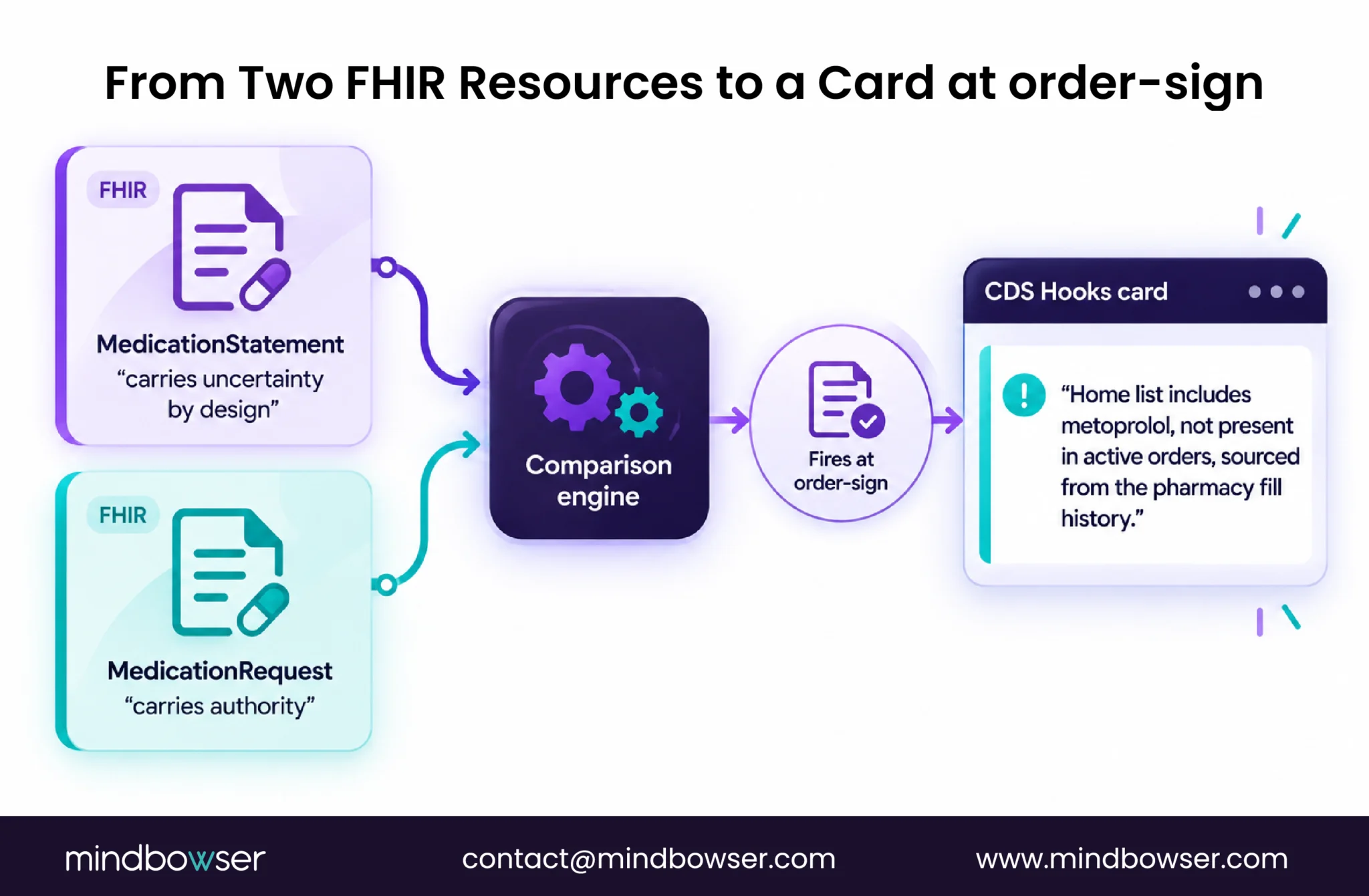
MedicationStatementis what the patient reports taking. It is a statement about reality, and it can come from the patient, a caregiver, another provider, or a pharmacy fill history. It carries uncertainty by design.MedicationRequestis an order. It is an instruction inside this system, and it carries authority.
Reconciliation is the comparison between a set of MedicationStatement resources and a set of MedicationRequest resources. Building it against MedicationRequest alone, which is the common shortcut because that data is already local and clean, means you are reconciling the chart against itself. That will pass every test you write and catch none of the errors that actually occur, because the medicine the patient takes and never told you about was never a MedicationRequest in your system.
The timing question is separate from the data question. There are two useful moments:
patient-view, when the chart is opened. Good for surfacing an unreconciled list as a task, because nobody is mid-decision and the prompt is not interrupting anything.order-sign, when medications are being signed. Good for surfacing a specific conflict against a specific order, because the clinician is already holding the decision the alert is about.
Using order-sign for a general “this list has not been reconciled” nudge is a reliable way to train people to dismiss it. The moment has to match the specificity of the message.
When the comparison finds something, it returns as a CDS Hooks card: a summary line, the discrepancy, and where the conflicting information came from. Naming the source matters more than the finding. “Home list includes metoprolol, not present in active orders, sourced from the pharmacy fill history” is actionable. “Possible discrepancy detected” is not.
The last piece is the one teams skip, and it is the one that decides whether the system is still useful in a year. Capture why a clinician dismissed a card, in structured codes rather than free text. This is the same discipline that separates a tuned alert set from alert fatigue. Without it, a genuinely useless rule and a good rule firing on the wrong patients produce identical data, and neither can be tuned. The practical approach to that tuning is covered in our guide to reducing CDS alert fatigue. Published override rates for medication alerts run high enough that this is not a theoretical concern: one multi-site study of 16,011 alerts found an override rate of 95.7%, with only 0.5% of high-severity overrides judged clinically appropriate (Cho et al., JAMIA, 2019).
In a perioperative readiness deployment we built on this pattern, missed pre-operative items fell from 15% to 2%, and provider engagement with the prompts held at 87%. The engagement number is the one that matters. It held because the prompt arrived at the moment the order was being written, asked for one decision, and could be acted on without leaving the workflow.
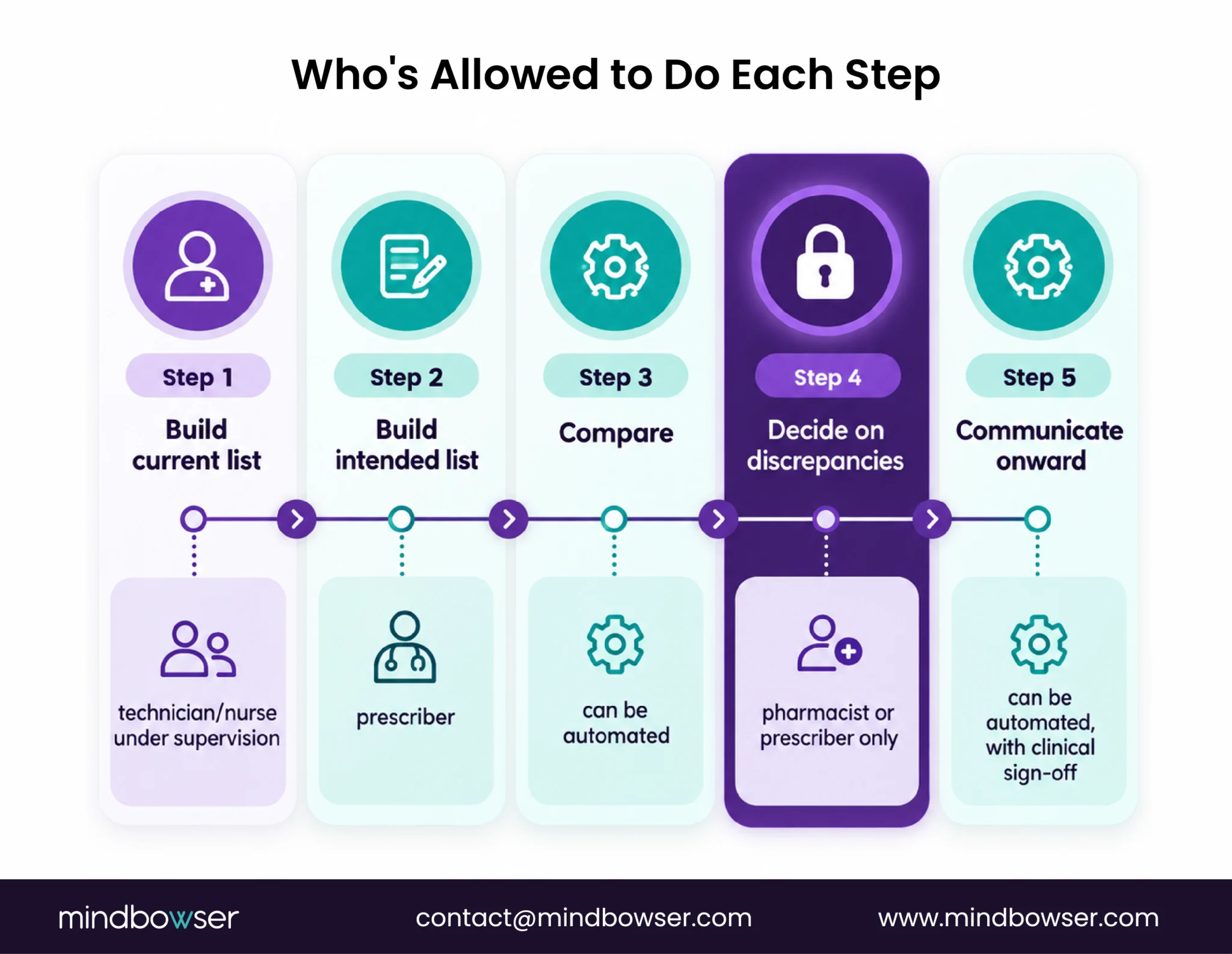
Who Is Allowed to Do Each Step
Scope of practice decides your workflow design, and it is the constraint most software teams discover late.
The rules are set at state level and they are specific about delegation. Oregon’s Board of Pharmacy, for example, permits pharmacy technicians to gather and document a medication history only under the supervision, direction, and control of a licensed pharmacist. The pharmacist must verify the list, and that verification may not be delegated to non-pharmacist staff. Technicians are explicitly not permitted to make clinical decisions of any kind during history gathering. Those are Oregon’s rules; the specifics vary by state, so check your own board before designing a workflow around them.
Read that against the five steps and the design follows:
| Step | Who can do it |
|---|---|
| 1. Build the current list | Technician or nurse may gather, under supervision |
| 2. Build the intended list | Prescriber |
| 3. Compare | Can be automated |
| 4. Decide on discrepancies | Clinical decision. Pharmacist or prescriber only |
| 5. Communicate onward | Can be automated, with clinical sign-off |
Nursing involvement varies more than the pharmacy rules do. Nurses are frequently the people who collect the admission history and who deliver the reconciled list to the patient at discharge, but the reconciliation decision itself sits with a pharmacist or prescriber in most settings.
The practical consequence for a build: steps 1, 3, and 5 can carry substantial automation. Step 4 cannot, and routing a step-4 decision to someone not permitted to make it produces an alert that is guaranteed to be dismissed, and possibly a compliance problem.
What to Look for in Medication Reconciliation Software
If you are evaluating or building, four questions separate systems that work from systems that demonstrate well:
- Which data sources can it actually reach? Not which it lists. If it cannot see external prescriptions and pharmacy fill history, it is reconciling the chart against itself.
- Where does the discrepancy surface? Inside the ordering workflow, or on a separate screen someone has to remember to open. The second one does not get used.
- Does it capture structured override reasons? If not, it cannot be tuned, and it will decay.
- Is it native to the EHR or bolted alongside it? Bolt-on systems require manual entry, and manual entry is the thing reconciliation exists to eliminate.
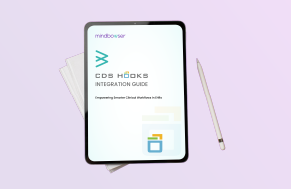
Most organizations already have some reconciliation capability inside their EHR. The real question is usually coverage and accuracy rather than acquisition, which makes this a workflow and integration problem more often than a purchasing one. We build clinical decision support that fires inside the EHR at the moment of the decision, and medication safety decision support is the specific pattern this page describes. If you want the payload-level detail, the CDS Hooks integration guide covers the request and response shapes.
Reconciliation also sits inside broader care coordination work. For teams running chronic care management programs, reconciliation is one of the recurring service components in the monthly requirement, which changes who performs it and how it is documented.
The process of comparing every medication a patient is actually taking against every medication being ordered for them at a transition of care, and resolving the differences. It happens at admission, transfer, and discharge.
Build the list of what the patient is currently taking. Build the list of what is intended to be prescribed. Compare the two. Make clinical decisions about each discrepancy. Communicate the reconciled list to the next clinician and to the patient. It is sometimes published as four steps, with communication folded into the decision step, which is the step that most often fails in practice.
It is usually pharmacist-led. Technicians and nurses commonly gather the medication history under supervision, but the clinical decision about each discrepancy sits with a pharmacist or prescriber. State rules are specific about what may not be delegated, so check your own state before designing the workflow.
The Joint Commission carries medication information accuracy as a National Patient Safety Goal, requiring comparison and communication of medication information at transitions of care. The requirement is that the process happens and is documented. No regulation mandates a specific product.
Nurses frequently collect the admission medication history and deliver the reconciled list to the patient at discharge. The reconciliation decision itself generally sits with a pharmacist or prescriber, though this varies by setting and state.
Outside the United States it is often written as medicines reconciliation. Some organizations refer to medication history reconciliation, which describes step one rather than the whole process.
Drug interaction checking asks whether the medicines being ordered are safe together. Reconciliation asks whether the list is complete and correct in the first place. Interaction checking on an incomplete list is checking the wrong list, which is why reconciliation comes first.