





 BLOGS
BLOGS  NEWSROOM
  CASE STUDIES
  WEBINARS
  PODCASTS
  ASSET HUB
  EVENT CALENDAR























TL;DR
Medicare requires a health risk assessment at every annual wellness visit, and has since 1 January 2012. The rules that govern it sit in 42 CFR 410.15, which was last amended on 5 November 2025. It has to cover 6 topic areas, take no more than 20 minutes, and it can be filled in by the patient before they arrive. In 2024, Medicare paid $429,494 for the code that covers administering it, across 214,292 services. There were 10,981,752 annual wellness visits that year. The assessment is not where the money is. It is what makes the visit payable.
I train clinical teams on documentation and quality processes, and the health risk assessment is where I see the same mistake most often. A practice treats it as a form to be collected: print it, hand it over, scan it, move on. Then the visit runs long, the assessment adds nothing to the note, and somebody asks whether it is worth billing for at all. The answer to that last question is genuinely no. The answer to whether it is worth doing well is genuinely yes, and those two answers are not in tension once you see what the assessment is actually for.
There Are Two Medicare Health Risk Assessments, And Most Of What You Will Find Is About The Other One.

Search for guidance on the Medicare health risk assessment and the majority of what comes back is about Medicare Advantage, not about the wellness visit you are trying to document.
Those are different instruments doing different jobs. The Medicare Advantage assessment belongs to the plan. Health Net’s Medicare provider manual describes the mechanics plainly: the plan “performs aggressive outreach to newly enrolled members to complete the health risk assessment (HRA) within 90 days after the effective date of enrollment and annually, depending on specific program requirements.” It is triggered by enrollment, owned by the plan, and used to identify members for care management.
The assessment at the annual wellness visit belongs to you. It is a required component of the visit itself under 42 CFR 410.15, it runs on the visit’s clock rather than the plan’s, and it feeds the personalized prevention plan you are paid to produce. A patient in a Medicare Advantage plan may well encounter both in the same year, from two different organizations, asking overlapping questions for unrelated reasons.
If the guidance you found talks about enrollment windows, risk scores or member outreach, you are reading about the plan’s instrument. Everything below is about yours.
What The Regulation Actually Requires The Assessment To Contain
This is where most published guidance stops short. The four items usually presented as “HRA requirements” come from Section 4103(b) of the Affordable Care Act, and they describe how the assessment may be delivered, not what it has to ask. The content requirements live in the regulation.
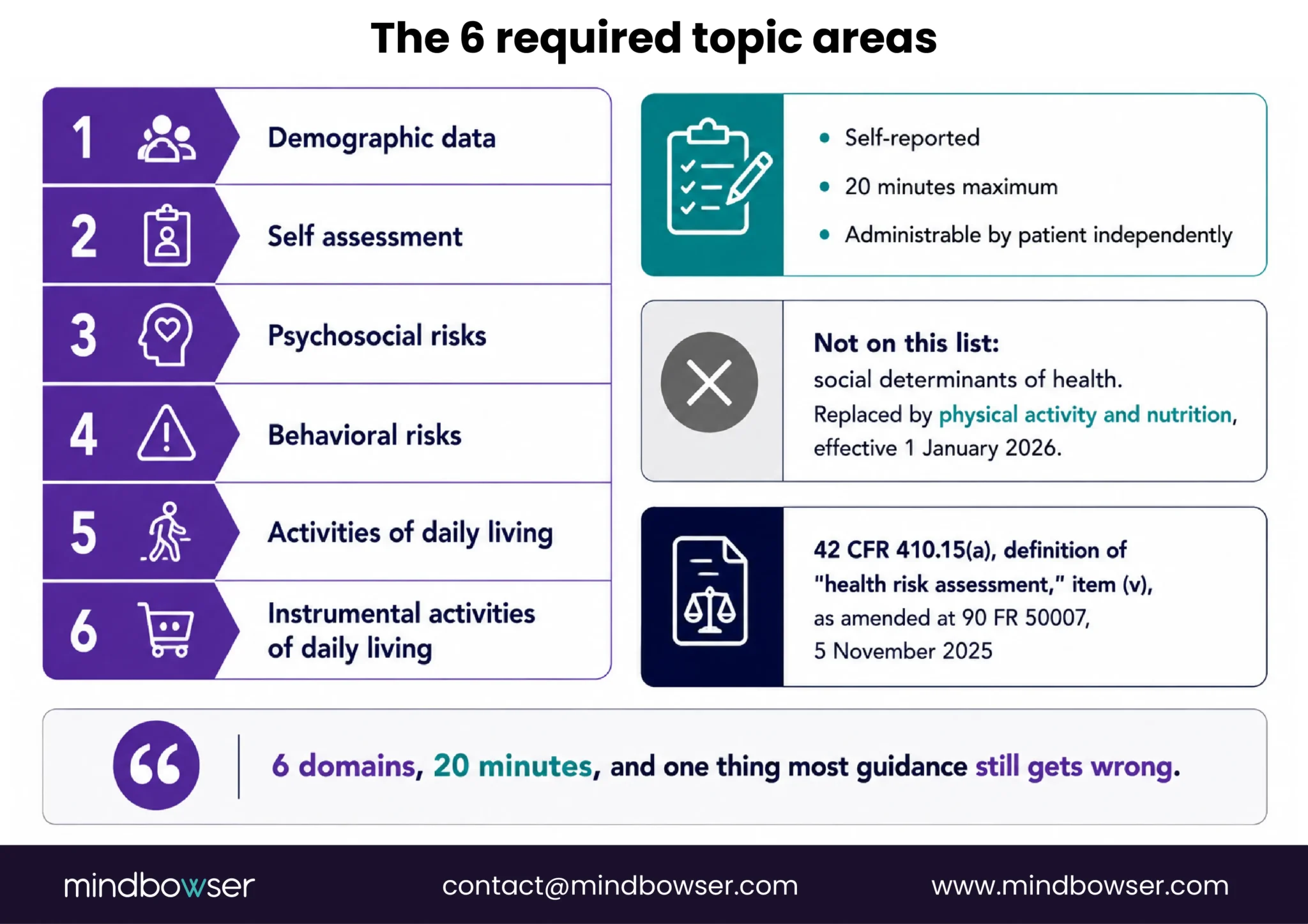
Under 42 CFR 410.15(a), a health risk assessment is an evaluation tool that collects self-reported information, “can be administered independently by the beneficiary or administered by a health professional prior to or as part of the AWV encounter,” is “appropriately tailored to and takes into account the communication needs of underserved populations, persons with limited English proficiency, and persons with health literacy needs,” and “takes no more than 20 minutes to complete.”
That 20-minute cap is a regulatory criterion. An instrument that reliably takes half an hour falls outside the definition, whatever its clinical merits.
The regulation then names 6 topic areas the assessment must address at a minimum, each with a list of named examples underneath it that is explicitly not a closed set:
- Demographic data, including age, gender, race and ethnicity.
- Self assessment of health status, frailty and physical functioning.
- Psychosocial risks, including depression and life satisfaction, stress, anger, loneliness and social isolation, pain, and fatigue.
- Behavioral risks, including tobacco use, physical activity, nutrition and oral health, alcohol consumption, sexual health, motor vehicle safety, and home safety.
- Activities of daily living, including dressing, feeding, toileting, grooming, ambulation and balance, and bathing.
- Instrumental activities of daily living, including shopping, food preparation, using the telephone, housekeeping, laundry, transportation, managing medications, and handling finances.
Two things are worth correcting here, because both circulate widely.
Social determinants of health are not on that list, and the wellness visit’s optional social-risk element was replaced rather than retired. Two changes landed together, effective 1 January 2026, both summarised in CMS’s own MLN summary of the CY2026 final rule. CMS proposed deleting HCPCS code G0136, which paid for administering a standardized social-risk assessment, took comment, and instead kept the code with a new descriptor covering physical activity and nutrition. Separately, the CY2026 final rule amended the regulation itself, so the discretionary element in 42 CFR 410.15(a) now reads “furnish a Physical Activity and Nutrition Risk Assessment that is standardized and evidence-based.”
The social determinants version is gone from the regulation. ChartSpan, currently the only practice-facing result on the first page of this search, still lists social determinants of health as an element of the Medicare wellness-visit assessment. That was right for several years. It is not right now. You can still administer and bill a standardized social-risk screen, because 96160 is defined per standardized instrument rather than by which instrument you use. What you cannot do is bill G0136 for it, since that code now names physical activity and nutrition. And a social-risk screen is no longer an element of this visit either way.
The sixth-grade reading level is guidance, not regulation. The requirement in 410.15 is the communication-needs language quoted above. The reading level comes from the interim guidance CDC prepared for CMS, which says the assessment “should be written at a 5th or 6th grade literacy level and in plain language.” That is good practice and I would build to it. It is not the standard you will be measured against, and attributing it to the Affordable Care Act, as ChartSpan does, muddles which parts are binding.
If you are here for the codes that attach to this claim rather than the instrument itself, that is covered in our guide to the codes billed alongside the AWV.

The regulation defines “health professional” for wellness-visit purposes in three tiers, and the third tier carries a condition that rarely makes it into published guidance.
The first is a physician, a doctor of medicine or osteopathy. The second is a physician assistant, nurse practitioner or clinical nurse specialist. The third is “a medical professional (including a health educator, a registered dietitian, or nutrition professional, or other licensed practitioner) or a team of such medical professionals, working under the direct supervision of a physician.”
That closing clause is the part that shapes a staffing model. A health educator or a registered dietitian can furnish the wellness visit, which is what makes the visit economically sensible for a lot of practices. They can only do it under direct supervision, as defined at 42 CFR 410.32(b)(3)(ii), which means a physician has to be present in the office suite and immediately available. A practice that builds a wellness-visit program around non-physician staff and then schedules those visits on days the supervising physician is offsite has built something that does not bill.
Administering the assessment is a separate question from furnishing the visit. The regulation is explicit that the patient can complete it independently. Nothing stops a medical assistant from handing over a tablet or calling to walk a patient through it. The supervision condition attaches to the professional furnishing the visit, not to whoever collects the form.
If your wellness-visit program runs on non-physician staff and you are not certain the supervision condition holds on every scheduled day, that is worth checking before an audit does it for you. Start a Conversation and we will walk the schedule with you.
Map Your AWV Assessment Onto All Six CMS Regulatory Domains.

Section 4103(b) permits the assessment to be furnished through an interactive telephonic or web-based program, during the encounter with a health professional, through community-based prevention programs, or through any other means that improves accessibility while protecting privacy. Four routes, and they cost very different amounts of clinical time.
Collecting it in the room is the most common and the most expensive. It consumes appointment minutes that the rest of the visit needs, and it puts a 20-minute instrument in front of a patient who came to talk to a clinician.
Collecting it before the visit is the route that scales, whether by portal, phone or post, and the guidance CDC prepared for CMS goes further than permitting it. The community-based route the statute also allows is real but rare, and it puts completion outside the practice’s control. It recommends prepopulation: the assessment is “a more efficient use of resources, if information related to patient demographics, biometric values, medical history, and clinical preventive services use is prepopulated in the HRA record.” In other words, do not ask a patient to retype what the chart already holds.
Ask them the things only they know, which is what the instrument is for. The same document describes the assessment as covering “patient behaviors that only the patient knows,” and every question you can answer from the chart is a question that should not be on the form.
That is the design brief for a portal-based or phone-based capture step, and it is endorsed by CMS’s own commissioned guidance rather than being something a vendor made up.
What The Assessment Is Worth, And What The Code Is Worth
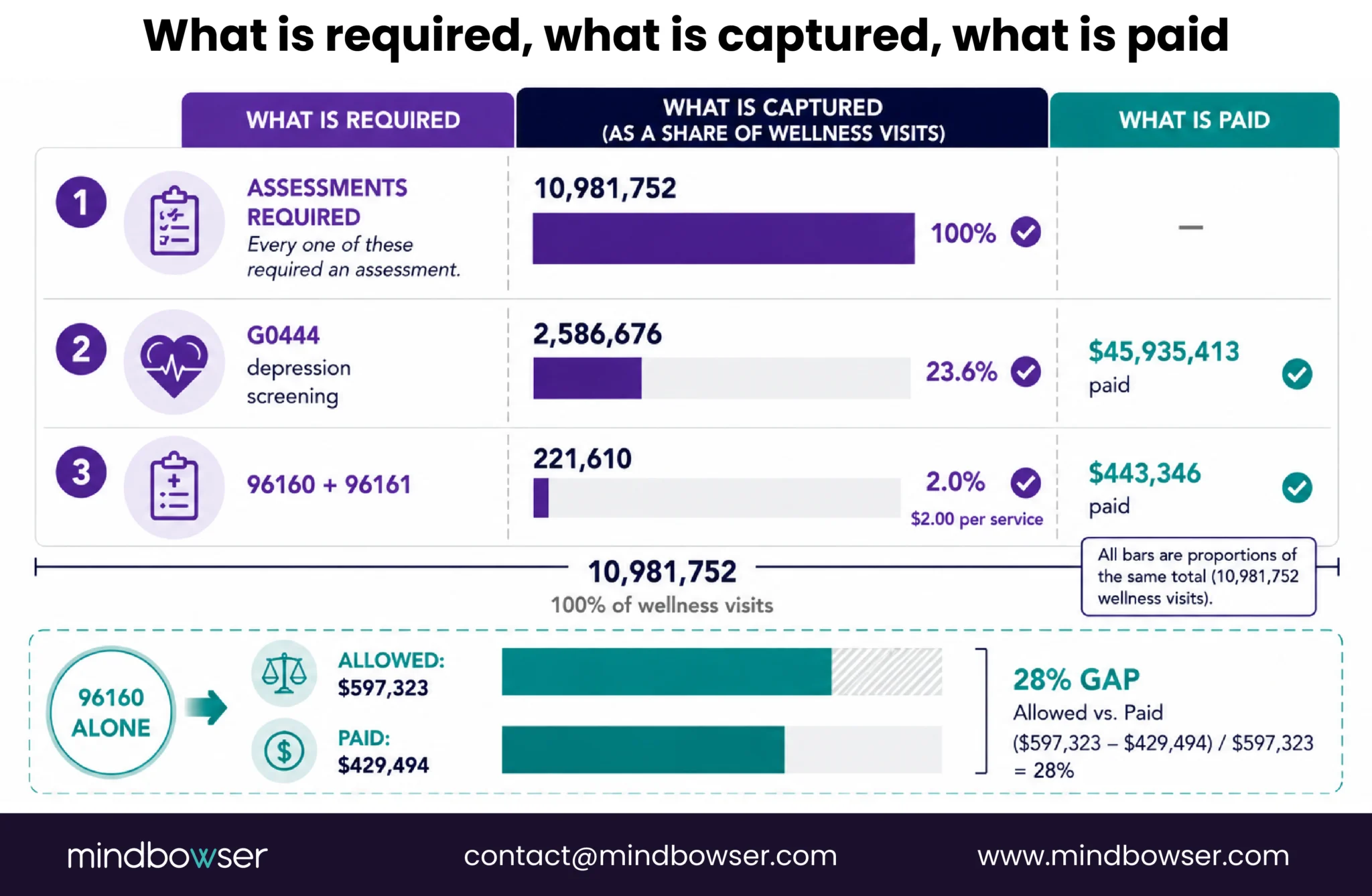
These are not the same number, and the gap between them is the most useful thing on this page.
Two CPT codes cover administering a standardized health risk assessment: 96160 for the patient-focused version and 96161 for the caregiver-focused one. In 2026 they pay $3.01 and $3.34 respectively, national averages that vary by locality. Unusually, they pay the same in a facility and a non-facility setting. Those are current fee-schedule amounts, while the utilization figures below are from calendar year 2024, so the two are not the same measure. In 2024 the allowed amount on 96160 worked out at $2.79 per service. Both carry a ZZZ global indicator, meaning they are always reported alongside another service. The full claim map for the wellness visit, including which codes cancel which, is in our guide to the codes billed alongside the AWV.
Now the actual usage. In calendar year 2024, using CMS’s Medicare Physician and Other Practitioners by Geography and Service file:
- 10,981,752 annual wellness visits were billed, across G0438 and G0439.
- 96160 ran 214,292 services and 96161 ran 7,318. Together, 221,610 services, or 2.0% of those visits.
- 96160 paid $429,494 in total, which is $2.00 per service. 96161 paid $13,852, or $1.89 per service.
There is a fair objection to that 2.0%, and it is worth taking seriously rather than stepping around. 96160 pays for administering an instrument. As the next section sets out, a subsequent wellness visit only requires review and update of an assessment already on file, and 93.8% of those 10.98 million visits were subsequent visits. If a practice reviews an existing assessment rather than administering a new one, not billing an administration code is correct coding, not lost revenue.
So measure it against the visits where administration genuinely happens. There were 676,884 initial wellness visits in 2024. Against that denominator the two codes appear on 32.7% of visits, and that is an upper bound, since some of those 221,610 services will have been reported on subsequent visits where a fresh instrument was administered. Both numbers are true and they mean different things. The 2.0% is not evidence that 98% of practices are leaving money on the table. It is evidence that this code is rare enough that almost nobody has built a workflow around it, which is a different and more useful observation.
An assessment is required at every one of those 10.98 million visits. The code that covers administering it appears on one visit in fifty.
For scale, look at another line on the same claim. G0444, the annual depression screening, ran 2,586,676 services in the same year, and Medicare paid $45,935,413. That is 23.6% of wellness visits, and 107 times what 96160 paid, on the same form in the same year. Whatever is stopping practices from capturing the health risk assessment code is not a general inability to capture add-ons.
The same pattern shows up wherever a required clinical step has a low-value administration code attached, including remote monitoring billing. There is a further reason not to reach for 96160 reflexively. In that CY2024 file, the wellness visit codes report allowed and paid amounts that are identical to the dollar, because the visit carries no patient cost-sharing.
G0402 and G0444 behave the same way. 96160 does not: Medicare allowed $597,323 and paid $429,494, a gap of 28%. CMS documents a cost-sharing waiver route for advance care planning and for the physical activity and nutrition assessment when they are furnished on the same day by the same provider and billed on the same claim with modifier 33. No equivalent route for 96160 appears in the AWV coverage guidance, though that is a search coming back empty rather than a published prohibition. So attaching it to a visit you have told the patient is free may put a balance on their statement, in exchange for a line that nets the practice $2.00. Confirm the current position with your contractor before you decide either way.
None of that is a coding restriction. Nothing stops you reporting 96160 on the wellness visit claim, with one exception: CMS excludes it from any date on which you report 99483, the standalone cognitive assessment and care planning service. That is a distinct service from the cognitive-impairment detection the wellness visit already requires, and performing the latter does not block 96160.
The visit itself pays $174.35 for an initial wellness visit and $137.61 for a subsequent one in 2026, again national averages that vary by locality, and again identical in both settings. That is what the assessment makes payable. A practice that built a capture workflow expecting revenue from 96160 built it for the wrong reason. But a practice that skipped the workflow because 96160 pays $2.00 answered the wrong question, because the workflow was never a revenue play. Those 10.98 million visits were paid whether or not anyone billed an administration code. What a capture step buys is the appointment minutes a 20-minute instrument would otherwise consume, and a documented assessment that holds up when somebody asks to see it.
If the gap between what your teams collect and what reaches the claim is the problem you are actually trying to solve, Start a Conversation and we will look at where it breaks.
The Constraint That Decides Which Questions Belong On The Form
There is a design rule in the CDC guidance that rarely gets quoted, and it is the most useful sentence in the document. Every question on the assessment has to be actionable, and the guidance defines actionable strictly: “for a question about smoking behavior to be included, a smoking cessation program must be shown to be efficacious in reducing that behavior and available, if the patient chooses to attend.”
Available. Not merely evidence-based in general, but something this patient could actually be referred to.
Applied honestly, that rules out a lot. A question about food insecurity on a form belonging to a practice with no referral pathway is a question that generates a data point and a duty and no intervention. The same goes for questions about transport, housing, or loneliness where nothing sits behind the answer. The instrument exists to drive a decision. Under the regulation it feeds a written screening schedule and a list of risk factors with treatment options attached, so a question with nothing behind it fails at the point where the visit is supposed to produce a plan. The same logic governs the visit’s other discretionary element, advance care planning, which is furnished only at the beneficiary’s discretion and carries its own documentation rules.
The same guidance recommends that the assessment and its delivery system be reviewed no less than every 2 years, to keep pace with prevention evidence. Between that and the 20-minute cap, you have a real design budget: 20 minutes, every question tied to something you can actually offer, revisited every other year.
The first visit and every visit after are different jobs
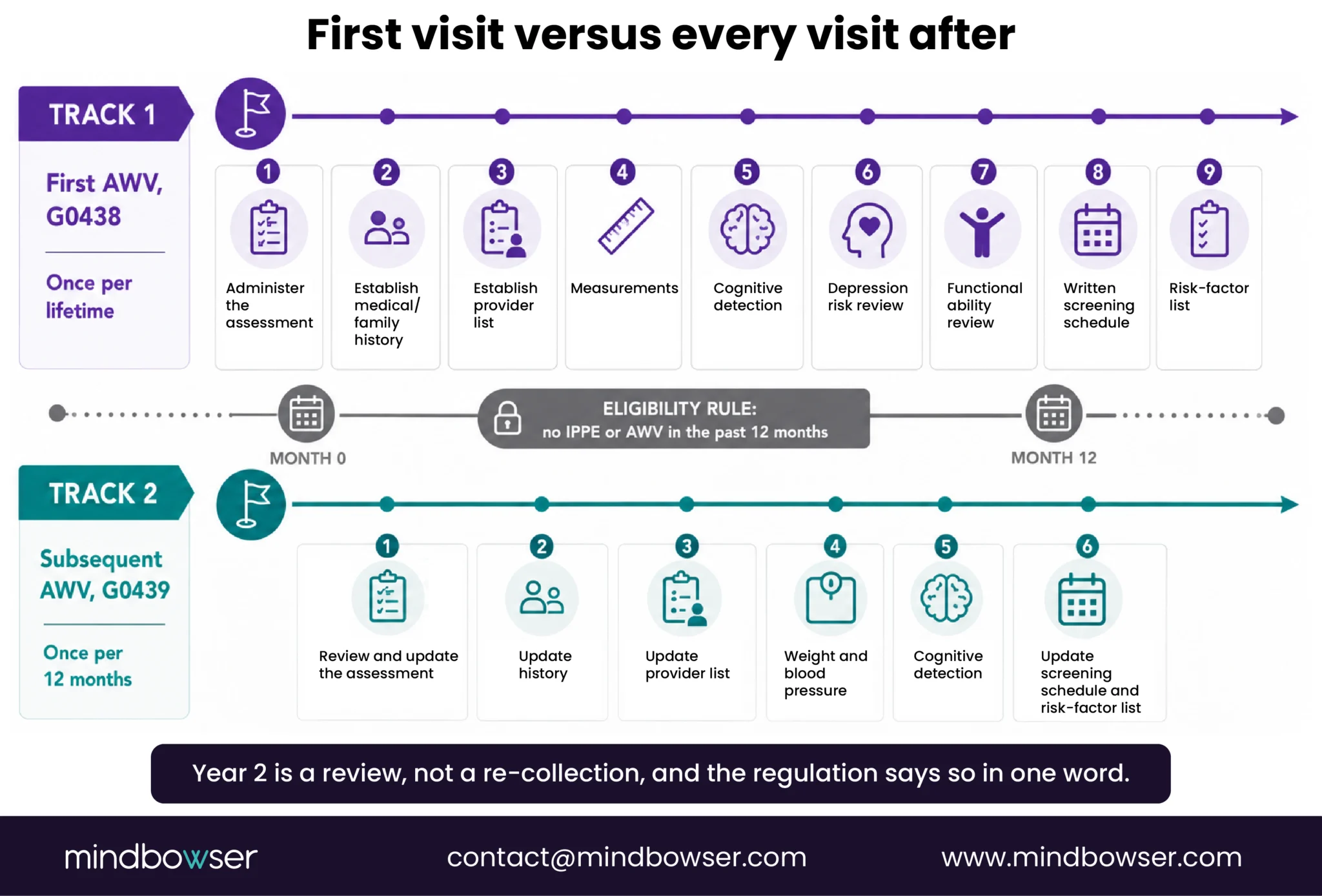
Practices routinely re-collect the whole instrument annually. The regulation does not ask for that.
A first annual wellness visit requires “review (and administration if needed) of a health risk assessment.” A subsequent one requires “review (and administration, if needed) of an updated health risk assessment.” The operative word in the second is updated. Once a patient has a completed assessment on file, the yearly job is to review and update it, not to start again. Cindy Hughes wrote exactly this in Family Practice Management in 2012, the year the requirement took effect, and it has largely dropped out of circulation since.
The eligibility clock sits alongside it and is a separate rule. A beneficiary qualifies when they are no longer within 12 months of the effective date of their first Part B coverage period and have not had an initial preventive physical examination or a wellness visit in the past 12 months. G0438, the initial visit, is billable once in a patient’s lifetime. G0439 is billable once every 12 months after that.
Put those together and the recall list writes itself: patients whose last wellness visit was 12 months ago, with their existing assessment pulled forward and pre-filled for review rather than reissued blank.
Most EHRs will not build that list for you without help. If you want one that runs off your own panel rather than a spreadsheet somebody maintains by hand, Start a Conversation.
When the patient will not complete it
Some patients decline, usually after being handed a form at the end of a run of other forms.
The visit is still furnishable. The assessment is a required component, so a refusal is a fact to be documented rather than a box to be left blank, and the practical instruction has not changed since 2012: record the reasons the patient gave for not completing it, and get as much from the visit as you can. Several of the questions the assessment asks are separately required elements of the visit anyway, including the depression risk review and the functional ability and safety review, so a refused form does not empty out the encounter.
I would flag one honest gap here. CMS does not publish a refusal protocol for this, so what I have described is documentation practice rather than a rule you can point a payer to. If your contractor has issued guidance on it, theirs governs.
Building the capture step so it produces the claim
Set the codes aside and the problem is an operational one with four parts: get the instrument to the patient before the visit, get it back, land it in the chart as structured data rather than a scanned image, and carry it into the note the clinician writes.
Parts one and two are the ones with the most existing machinery behind them. Pre-visit outreach and intake by voice or chat runs in production today through tools like HealthCheck AI, whose published deployment figures are 32% higher check-up completion and a 50% reduction in manual outreach time. Getting structured responses back into the record has its own pattern: automated call-bot questionnaires log FHIR responses, the interoperability standard for exchanging health data, directly into the EHR, and logic-driven digital forms validate answers in real time before submission. Those capabilities reach a practice as pre-built ConnectHealth use cases rather than as separate products to integrate.
Parts three and four are where I would be straight with you: for the wellness visit specifically, they are a custom build. Mapping answers onto the 6 regulatory domains so the note demonstrates compliance, running the 12-month eligibility clock against your patient panel, and prepopulating from the existing chart are all specific to how your data sits and how your teams work. There is no packaged version of that. It is custom healthcare software development, and it should be scoped and budgeted as such.
Some of it stays human on purpose. Confirming consent, having the conversation the assessment is supposed to start, and judging what a patient’s answers actually mean are not automation targets, and the honest version of this is that the technology’s job is to get a complete, structured assessment in front of a clinician with the appointment minutes still intact.
One boundary worth naming: turning assessment answers into program enrollment, deciding which patients the responses qualify for chronic care management or behavioral health integration, is a different job with different rules and its own consent and staffing model. It starts where this one ends.
The teams that get this right stopped treating the assessment as paperwork attached to the visit and started treating it as the input the visit is built on, which is what the regulation assumed all along. The form matters, and so does everything that happens before a patient ever sees it. If that is the shift you are trying to make, Start a Conversation and we will start with what your current capture step actually produces.
Known gaps
- The cost-sharing point on 96160 is the most speculative claim here. The allowed-versus-paid gap is measured, but it combines deductible, coinsurance and secondary-payer coordination, and no published waiver route for 96160 was located either way. Confirm with your contractor before changing billing behavior.
- CMS does not publish a refusal protocol for a patient who declines the assessment. The guidance above is documentation practice, not a rule.
- The comparison with G0444 above is a scale contrast, not a structural one. Whether the depression screening code duplicates the visit’s own required depression risk review is not settled by the sources cited here.
- The Medicare Advantage assessment is described from one payer provider manual and one plan member page. It is characterized here, not quantified.
- Two sources that appear on this search returned access errors and nothing is asserted from them.
Yes. It has been a required component of the Medicare annual wellness visit since 1 January 2012, for both the initial and subsequent visits.
At a minimum, 6 topic areas: demographic data, self assessment of health status and physical functioning, psychosocial risks, behavioral risks, activities of daily living, and instrumental activities of daily living.
The patient can complete it independently, or a health professional can administer it before or during the visit. Furnishing the visit itself is restricted to a physician, a physician assistant, nurse practitioner or clinical nurse specialist, or a medical professional such as a health educator or registered dietitian working under the direct supervision of a physician.
No more than 20 minutes. That is a regulatory criterion, not a recommendation.
No. The Medicare Advantage assessment belongs to the health plan, is usually triggered within 90 days of enrollment, and is used to identify members for care management. The wellness visit assessment belongs to the practice and is a required component of the visit.
There are codes for administering a standardized assessment, 96160 for the patient-focused version and 96161 for the caregiver-focused one, paying about $3.01 and $3.34 in 2026. They are billed on 2.0% of wellness visits and are not where the value of the visit sits.
No. A subsequent wellness visit requires review and administration if needed of an updated assessment. Once one is on file, the annual task is to review and update it.
Not as a distinct element. Effective 1 January 2026 the optional element is a standardized physical activity and nutrition risk assessment. Social risk screening can still be administered, but it is no longer an element of this visit.