BLOGS
BLOGS  NEWSROOM
  CASE STUDIES
  WEBINARS
  PODCASTS
  ASSET HUB
  EVENT CALENDAR






















TL;DR
The top cardiology EMRs compared on what actually matters: EP workflows, device data integration, prior authorization handling, and ACC registry compliance. Includes the financial inflection point where a custom build makes more sense than another vendor license.
The cardiology documentation burden is real. An average cardiologist documents 3,200+ characters per patient encounter, between cath lab reports, echo findings, device interrogations, and prior authorization letters. Most general-purpose EMRs weren’t designed with any of that in mind. They ship with templates built for internal medicine, then force cardiology into the same workflow. The result: extra clicks, missed data fields, and two hours a night of note cleanup that should have been automated.
I’ve seen this from both sides. As a clinician and health outcomes researcher, I’ve lived the frustration of pressing against an EMR designed for someone else’s specialty. As someone who advises on healthcare technology builds, I’ve watched practices waste $200K on an “Epic cardiology module” upgrade that still requires workarounds.
This guide compares the EMRs actually used by cardiology practices today, shows what each one does and doesn’t do for specialty workflows, and includes a hard question: at what point does building a custom cardiology EMR cost less than licensing a vendor platform that doesn’t fit?
I. Why Cardiology Needs a Different EMR Than Your Hospital Uses
Here’s the scene: it’s 3 p.m. in the cath lab. A cardiologist finishes an EP ablation and walks back to the workstation to document. She opens her generic EMR and finds the template for “procedure note.” There’s a place for procedure name, start time, end time, indication, and maybe a checkbox for complications. But the workflow she actually needs to document doesn’t fit that box.
She needs to record: which catheters were used, at what temperatures, for how long. She needs to note anomalies in the electrogram. She needs to flag which arrhythmia sites were ablated, which ones were avoided (and why), and what the post-ablation electrograms showed. She needs to integrate data from the EP recording system, ECG traces, intracardiac electrogram maps, fluoroscopy time. And she needs to do this fast, because there’s another patient waiting.
A generic EMR makes this into a 30-minute note. A cardiology-specific EMR makes it into 7 minutes.
The documentation burden in cardiology is among the highest across medicine. Cardiologists average 16 minutes per patient note, compared to 10 minutes for internal medicine and 12 minutes for family medicine. In a high-volume cardiology practice, that gap costs 10-15 hours a week per provider.

What Cardiology Workflows Generic EMRs Miss
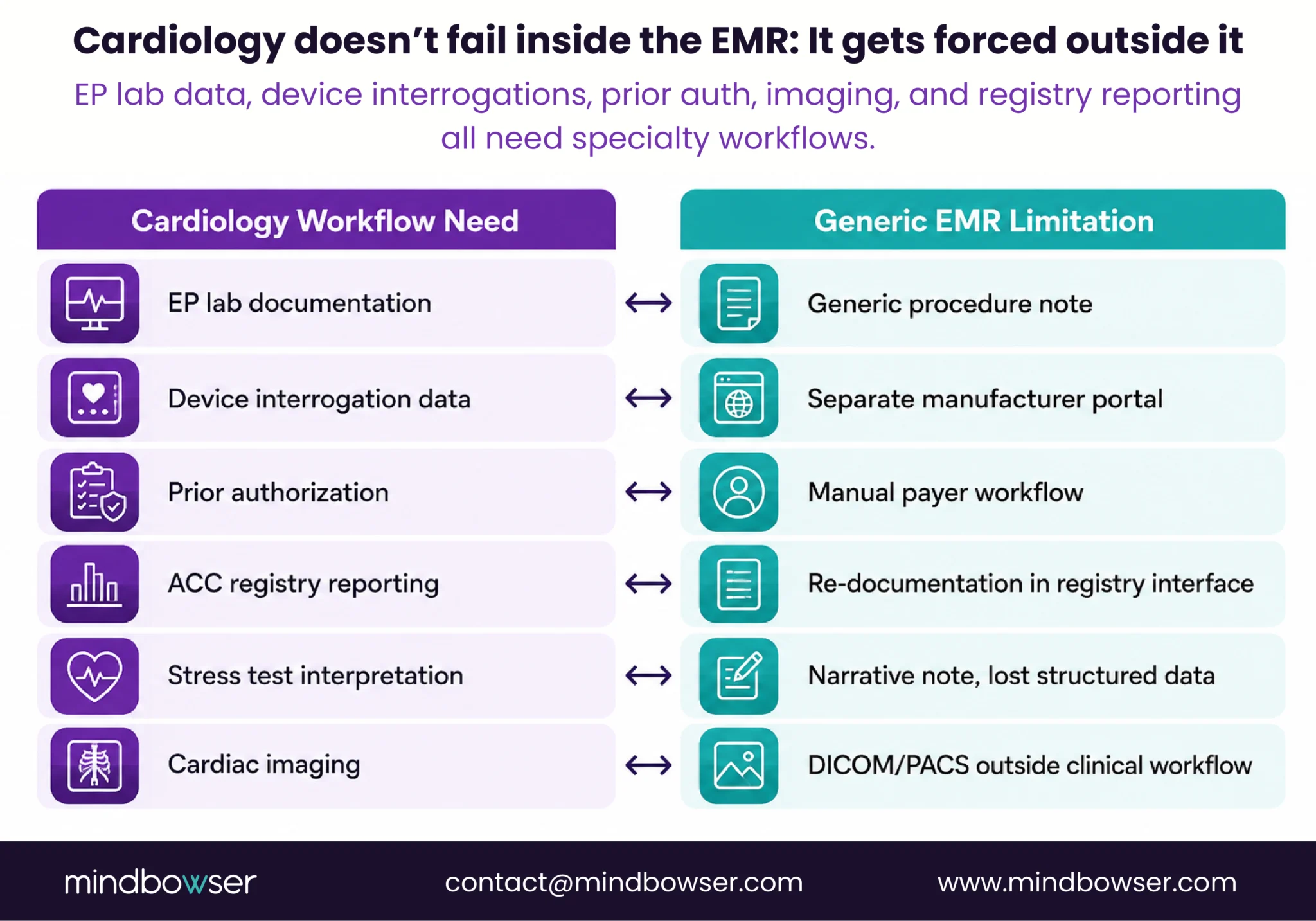
EP Lab Documentation: Generic EMRs have no native integration with EP recording systems. The cardiologist documents manually, or the data lives in a separate system with no clinical connection. No vendor templates account for electrogram mapping, ablation site tracking, or arrhythmia classification.
Cardiac Device Data: Pacemakers, ICDs, and loop recorders generate proprietary data formats. Generic EMRs can’t ingest device interrogation data natively. It lives in a separate device manufacturer portal, and the clinical summary has to be copied and pasted.
Prior Authorization Workflows: Cardiology has one of the highest prior auth burden rates across medicine. Generic EMRs have billing and clinical modules that don’t communicate. Back-and-forth adds 2-3 days to the process.
ACC Registry Integration: Generic EMRs don’t pull required NCDR data elements automatically. Cardiologists re-document in a separate registry interface.
Stress Test Interpretations: Most generic EMRs have no structured place to capture stress test raw data. Cardiologists end up typing narrative, losing the structured data.
The Numbers
There are approximately 22,000 cardiologists in the US (ACC/AAMC data). Roughly 60% work within health systems on generic EMRs and tolerate the workflow friction. The remaining 40%, primarily independent and group practices, use specialty-focused systems that cost 20-40% more than generic alternatives.
Documentation time per patient is the leading complaint: 43% of cardiologists report their EMR adds 2+ hours to an 8-hour day. Prior authorization turnaround time averages 2-3 days; 37% of practices cite this as their biggest billing bottleneck.
II. What Makes a Cardiology EMR Different? (6 Features That Actually Matter)
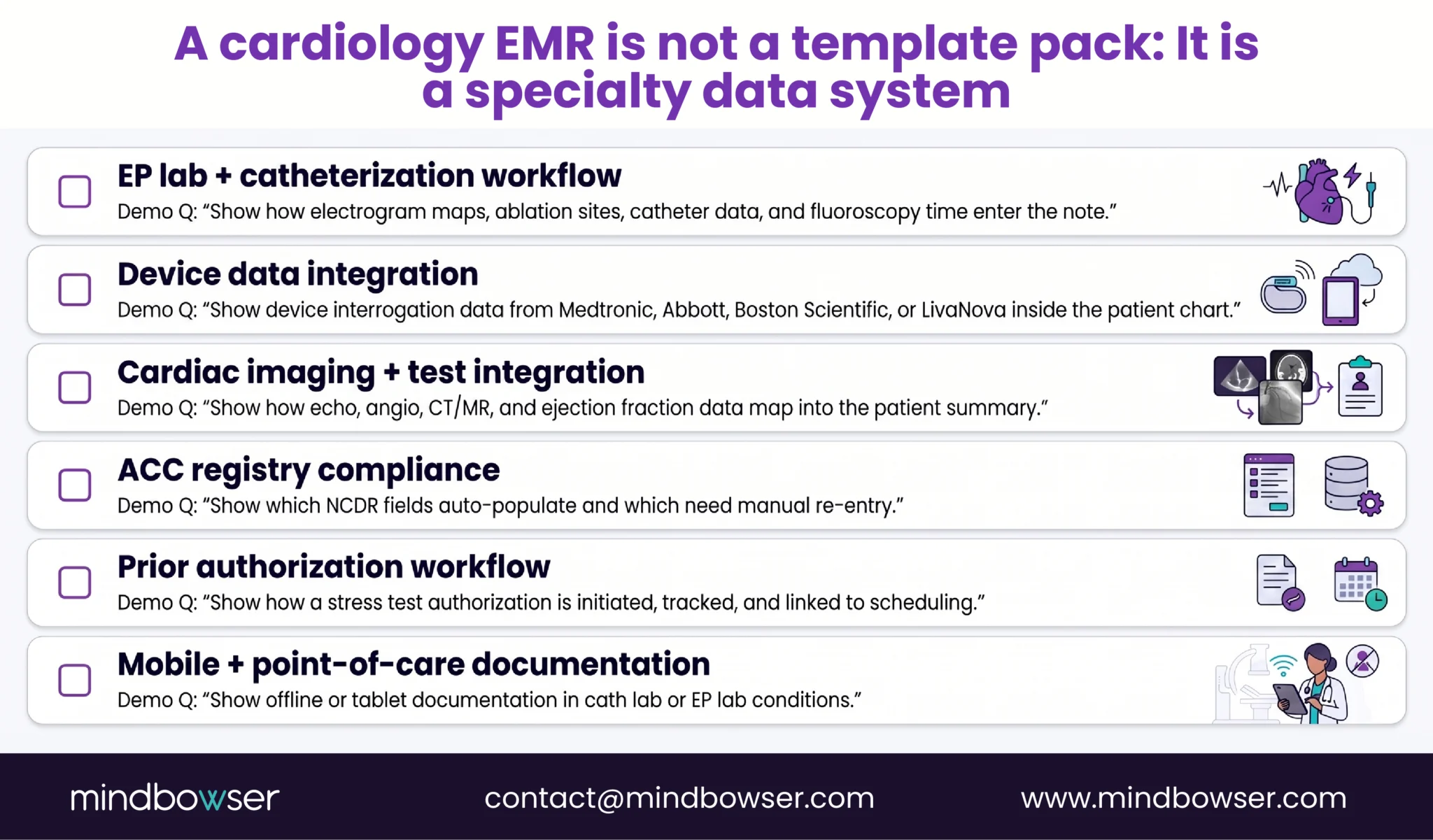
1. EP Lab and Catheterization Workflow
A cardiology EMR should have structured templates for EP studies, catheterization procedures, and ablation documentation:
- Pre-populated fields for catheters used, catheter positions, temperatures, durations
- Structured electrogram interpretation (drop-downs for arrhythmia types, sites of origin)
- Integration with EP recording systems (GE, Philips, St. Jude, Abbott)
- Automatic flagging of high-risk arrhythmias
- Native ability to embed electrogram images and maps into the clinical note
A generic EMR will have a “procedure note” template with 5 fields. A cardiology EMR will have 40+ fields, most auto-populated from lab equipment.
2. Device Data Integration
A cardiology EMR should:
- Accept device interrogation files from major manufacturers (St. Jude, Boston Scientific, Abbott, Medtronic, LivaNova)
- Auto-parse device data into structured FHIR elements
- Flag critical alerts (low battery, lead failure, episode threshold breaches)
- Sync device data with the patient’s clinical record automatically
Without this, the cardiologist logs into the device portal separately, downloads a PDF, and manually transcribes critical findings. You’ve lost the data structure and automation opportunity.
3. Cardiac Imaging and Test Integration
A cardiology EMR should:
- Accept DICOM images (echo, angio, CT/MR) natively
- Parse structured reports (ejection fraction, wall motion, stenosis severity)
- Auto-populate relevant measurements into the patient summary
- Link imaging findings directly to clinical decision points
4. ACC Registry Compliance and Reporting
A cardiology EMR should:
- Auto-map clinical data to ACC registry requirements
- Flag missing required elements before submission
- Generate compliant XML/HL7 exports to the registry
- Track practice performance metrics for quality improvement
5. Prior Authorization Workflow Integration
A cardiology EMR should:
- Have a built-in prior auth request builder
- Pre-populate clinical data from the note
- Connect directly to major payer APIs (UnitedHealth, Aetna, BCBS, Humana)
- Track auth requests and auto-remind when authorization expires
- Integrate with scheduling so you can’t book a procedure without authorization
6. Mobile and Point-of-Care Documentation
A cardiology EMR should have:
- Native mobile apps (not web-only)
- Offline capability for cath lab
- Voice documentation with specialty-specific speech recognition
- Tablet-friendly interface in EP labs
III. Top 7 Cardiology EMR Systems (Honest Review)
Epic with Cardiology Module
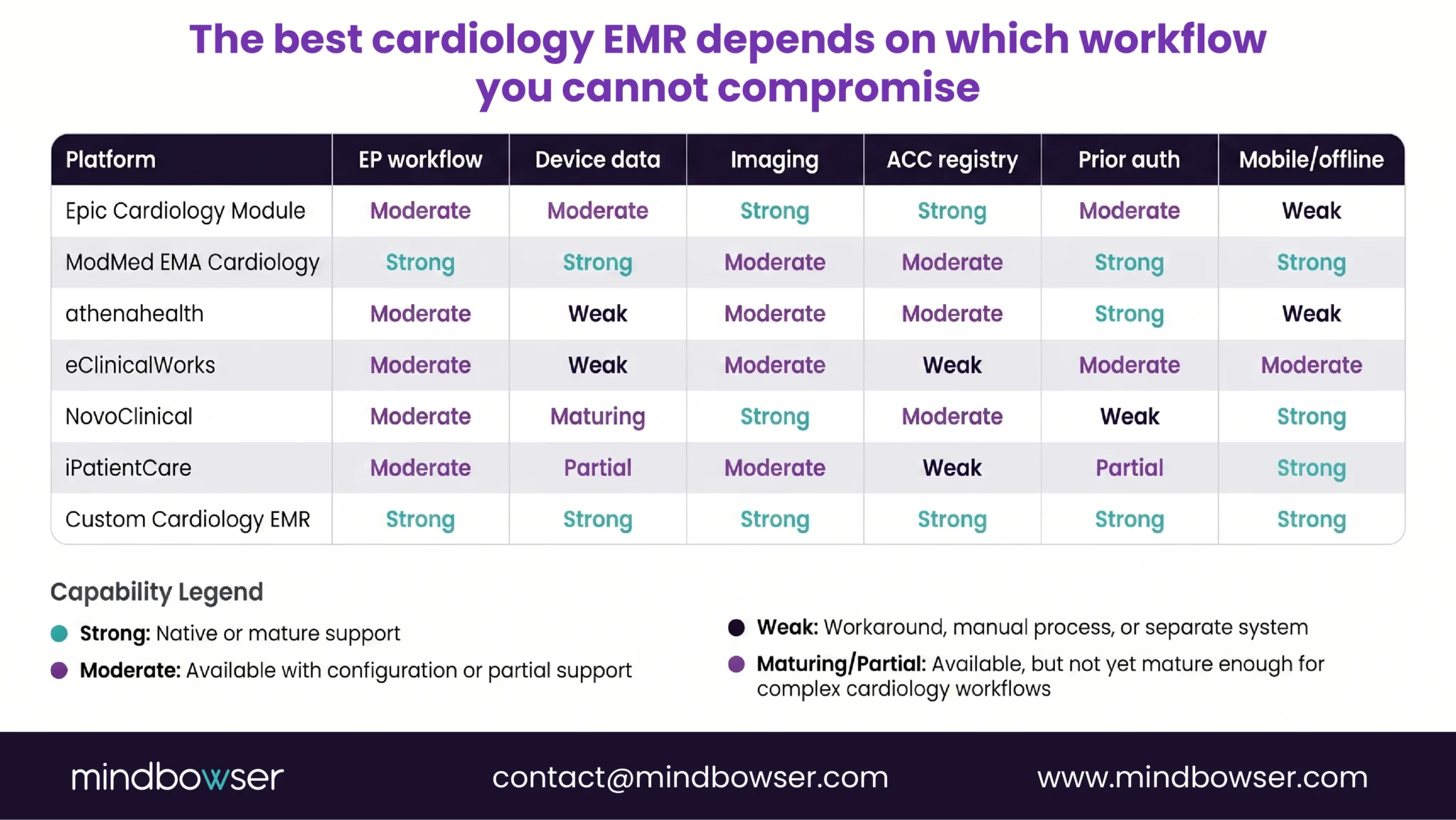
What it does well: Massive install base in health systems. Strong integration with hospital systems. Epic’s cardiology module has improved significantly in 2024-2025. Device data integration via Epic’s cardiovascular devices adapter. Good institutional support and training.
What it misses: Epic’s cardiology module is an add-on to a generic EMR, not purpose-built. Prior auth integration requires separate configuration. Device data integration only works with Epic-approved devices. Expensive: $200K+ for a 10-cardiologist group, plus $40K-60K annual support.
Best for: Large health systems already on Epic with IT staff to configure it.
Cost: $15K-30K per cardiologist per year, $150K-300K implementation.
Modernizing Medicine (EMA Cardiology)
What it does well: Purpose-built for cardiology. Excellent EP lab workflow, templates designed by cardiologists. Native device data integration (Medtronic, St. Jude, Boston Scientific, Abbott). Strong prior auth workflow. Mobile app that works offline.
What it misses: Smaller install base. Limited integration with hospital systems. User interface feels older. Reporting tools less sophisticated than enterprise EMRs.
Best for: Standalone or group practices that prioritize specialty workflow over enterprise integration.
Cost: $10K-20K per cardiologist per year, $80K-150K implementation.
athenahealth
What it does well: Cloud-based, no IT burden. Strong prior auth workflow. Good billing integration. Growing cardiology-specific templates.
What it misses: Device data integration limited. EP lab workflow less specialized. No offline capability. Mobile app not optimized for cath lab environments.
Best for: Practices that want a modern cloud platform and don’t need deep EP lab specialty.
Cost: $8K-18K per cardiologist per year.
eClinicalWorks
What it does well: Affordable. On-premise or cloud option. Growing cardiology templates. Decent API for third-party integrations.
What it misses: Device data integration is weak. Prior auth workflow is clunky. User experience lags behind peers. Customer support has mixed reviews.
Best for: Budget-conscious practices willing to accept workflow compromises.
Cost: $5K-12K per cardiologist per year.
NovoClinical
What it does well: Specialty-first design. Excellent DICOM imaging integration. Mobile-first interface. Strong cardiovascular outcomes tracking.
What it misses: Smaller national footprint. Limited integration with hospital systems. Fewer payer integrations. Still building out device data support.
Best for: Independent or group practices that want specialty-first design without health system integration needs.
Cost: $12K-22K per cardiologist per year.
iPatientCare
What it does well: Cloud-based. Strong cardiology templates. Affordable. Good mobile interface. Decent API ecosystem.
What it misses: Smaller market share. Device data integration is partial. Prior auth workflow requires manual steps.
Best for: Small practices looking for an affordable specialty-capable system.
Cost: $7K-15K per cardiologist per year.
Build Route (Custom Cardiology EMR)
What it does well: 100% customizable to your exact workflow. Can integrate any device vendor. Ownership of the data and codebase.
What it misses: 18-24 months to build and launch. Higher upfront cost ($300K-$1M+). Requires ongoing development and support.
Best for: Large cardiology groups (15+ cardiologists) or health systems where no off-the-shelf system fits. Also health systems planning to sell the platform to other cardiology groups.
Cost: $300K-$1M to build, plus $80K-150K annual support.
Start Building a Custom Cardiology EMR With Us Now!
IV. What Do Cardiologists Actually Complain About in Their EMR?
“Epic charges $27 for each AI-generated note. For a 25-bed hospital or small group, that’s ridiculous. If you’re a huge academic medical center, yeah, you can afford it.”, Physician-founder, rural hospital segment
“In the cath lab, I’m clicking through 7 screens to document a procedure that took 20 minutes. By the time I’m done documenting, I haven’t moved on to the next patient for 30 minutes.”, Interventional cardiologist
“Device data lives in a separate portal. I have to log in three times a day to check pacemaker status.”, Device clinic nurse
“Prior auth for a stress test takes 3 days. It’s not integration. It’s parallel processes that don’t talk to each other.”, Practice manager
“The imaging integration works for our echo machine but not our stress test equipment. We’re still hand-entering ejection fractions.”, Cardiology practice IT director
V. The Prior Auth Problem: Why Most Cardiology EMRs Fail at Billing
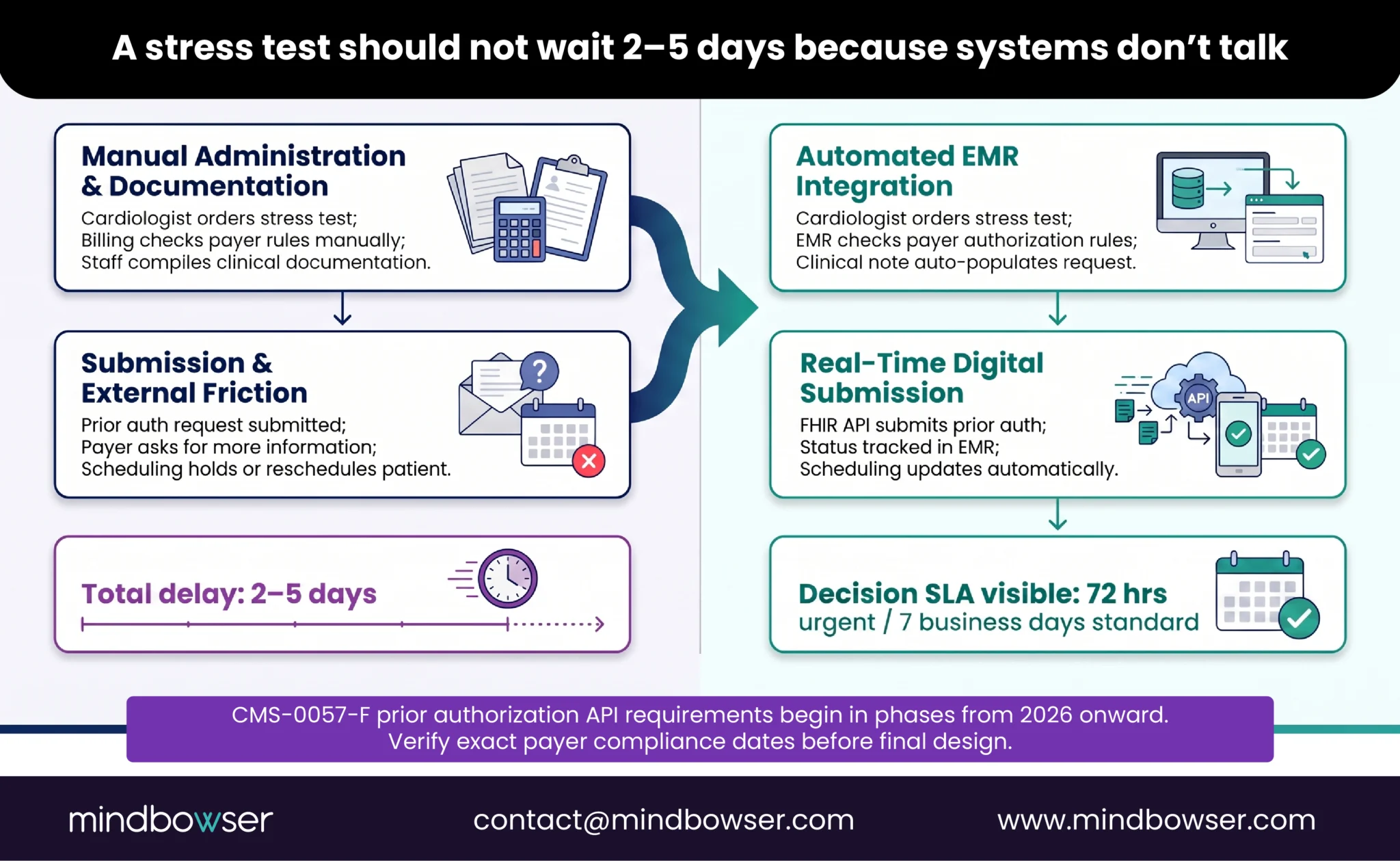
A cardiologist orders a stress test. In an ideal world, she orders it from the EMR, the system checks payer authorization rules, and the procedure is scheduled with auth pre-approved.
In reality, billing receives the order, looks up the payer’s current prior auth requirements, compiles the clinical documentation, writes a prior auth request letter, and submits it. The payer responds in 1-3 days. Often, they request more information. Total time: 2-5 days. In the meantime, the patient’s appointment is held or rescheduled.
CMS Interoperability and Prior Authorization Final Rule (CMS-0057-F)
The CMS rule was finalized in January 2024, with most payer compliance requirements taking effect January 1, 2026. It requires:
- Payers must provide prior auth decisions within 72 hours for urgent requests and 7 business days for standard requests
- Prior auth requests must be submitted electronically through standardized FHIR-based APIs
- Payers must expose FHIR APIs so EMRs can check covered services and initiate requests programmatically
A cardiology EMR should integrate with payer APIs to: check authorization requirements before scheduling, auto-populate clinical necessity from the note, submit requests in real-time, track authorization status, and alert staff when authorization is expiring.
VI. Cardiology Data Integration: Device Data, ACC Registry, and FHIR Compliance
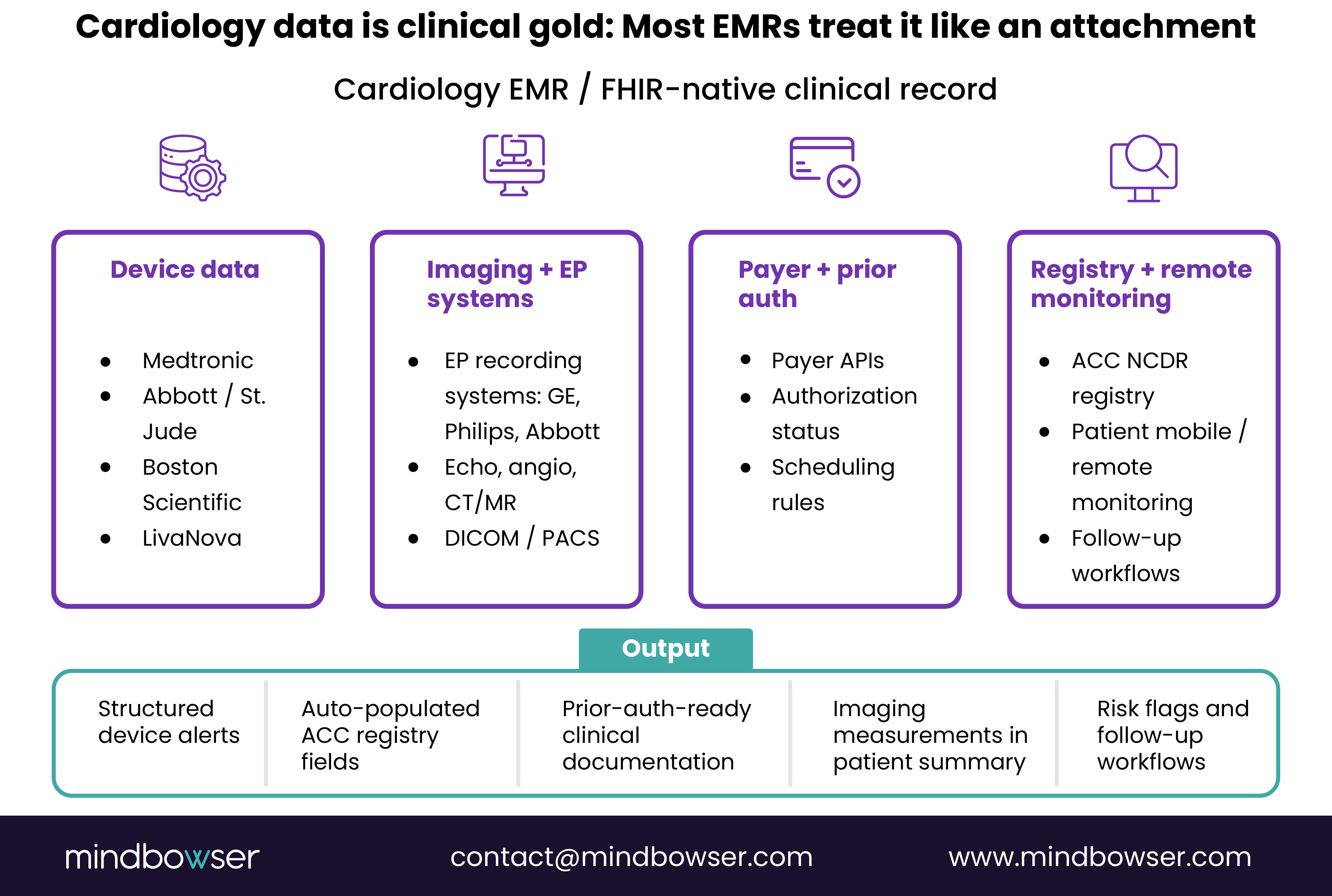
Cardiac devices log every heartbeat, every episode of arrhythmia, battery voltage trends, lead impedance, and pacing data. That data is clinical gold. But most devices output proprietary formats. Abbott, Medtronic, St. Jude, and Boston Scientific each have their own data structure.
A modern cardiology EMR needs to:
- Accept device interrogation files from major vendors
- Parse those files into FHIR standard
- Flag critical alerts automatically
- Display device status in the main EMR (not a separate portal)
ACC Registry Requirements
If your practice reports to the ACC NCDR, you’re required to submit specific data elements:
- For cath procedures: vessel disease severity, intervention type, complications
- For EP studies: arrhythmia type, ablation success, complications
- For ICD implants: indication, device type, implant location, complications
An EMR that can’t auto-map clinical data to registry requirements means re-documenting. The same ejection fraction gets entered three times: once in the clinical note, once in the imaging interface, once in the registry export.
VII. When to Build a Custom Cardiology EMR Instead of Buying One
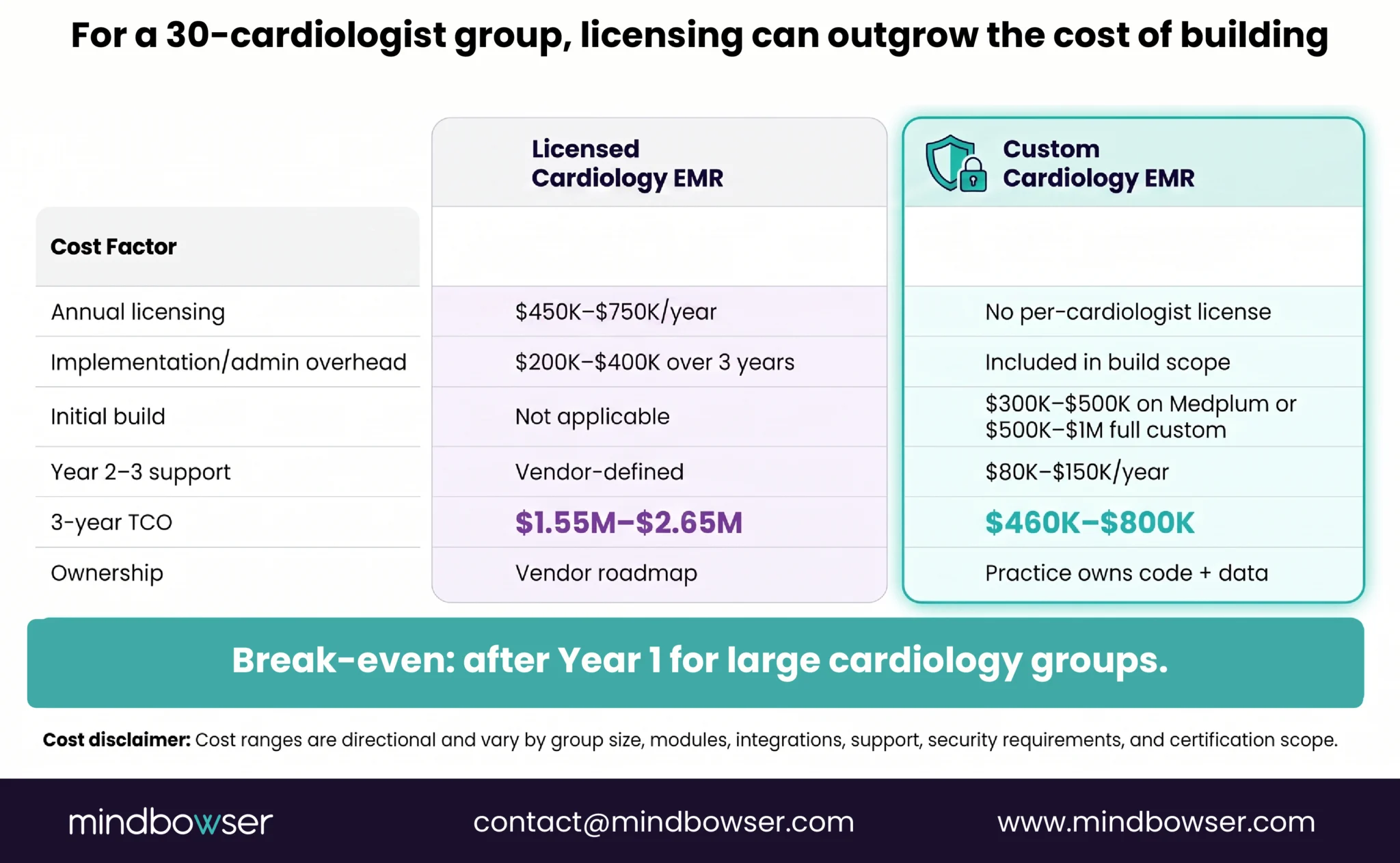
The Financial Math
Licensing Model (3-year horizon):
- Epic cardiology module: $25K/cardiologist/year = $750K/year for a 30-person group, $2.25M over 3 years
- Modernizing Medicine: $15K/cardiologist/year = $450K/year, $1.35M over 3 years
- Implementation, training, admin overhead: add $200K-400K over 3 years
- Total cost of ownership: $1.55M-$2.65M for a 30-cardiologist group over 3 years
Build Model (3-year horizon):
- Initial build (18-24 months): $300K-500K on Medplum or $500K-$1M for full custom
- Year 2-3 support and ongoing development: $80K-150K/year
- Total cost of ownership: $460K-$800K for a 30-cardiologist group over 3 years
- Break-even: After year 1, the build is cheaper than licensing
When Does This Make Sense?
Build makes sense if:
- Your practice is large (15+ cardiologists) so the per-person cost is low
- Your workflow is so specialized that no vendor fits
- You plan to sell the platform to other practices
- You’ve been paying the vendor lock-in tax for years
Buy makes sense if:
- Your practice is small (5-10 cardiologists) and can’t afford development overhead
- Your workflow is standard (mostly cath procedures, routine office visits)
- You need vendor support and don’t have in-house engineering
- You want to go live in 3-6 months, not 18 months
A Real Build Comparison: Custom EHR for a US-Based Wellness Provider
A US-based wellness provider needed a custom EHR to unify fragmented patient records, support physician-defined treatment workflows, and coordinate care across an aging patient population. No off-the-shelf EMR could support their combination of customizable clinical protocols, telemedicine, and billing workflows in a single system.
Mindbowser built a dual-portal EHR, patient portal and doctor portal, with customizable treatment workflow templates, e-prescription, telemedicine, and role-based access control. The practice cut post-discharge readmissions, improved care coordination, and gave patients self-service access to records, medications, and progress notes. They owned the platform outright, no per-user annual license, no vendor-imposed workflow constraints.
The cardiology analog: a large independent practice or regional health system builds a custom cardiology EMR on a FHIR-native foundation (Medplum or custom core), owns the workflow, and licenses it to other cardiology groups, turning the build cost into a recurring revenue stream while reducing their per-user cost to near zero over a 3-5 year horizon.
VIII. How Mindbowser Builds Custom Cardiology EHR Software
Phase 1: Discovery (2-4 weeks)
We map your current workflow. Not what you think your workflow is, what it actually is. We observe providers documenting in your current EMR. We interview billing staff about prior auth. We catalog every system you’re currently using.
Out of this: a requirements document that names exactly what the custom build needs to do, what data flows need to be automated, and what can’t be automated.
Phase 2: Architecture (4-6 weeks)
We design the data model:
- FHIR-native core
- Custom cardiology schema (EP lab procedures, device interrogations, cardiac imaging, ACC registry mapping)
- Prior auth workflow engine (custom rules engine that knows payer requirements)
- Device integration layer (parser for Medtronic, Abbott, St. Jude, Boston Scientific files)
Phase 3: MVP Build (12-18 months)
Core workflows: office visit documentation, cath lab procedure documentation, device clinic workflow, prior auth workflow, ACC registry export, mobile app for offline documentation.
Phase 4: Advanced Features (Months 12-18)
- AI Medical Summary: Ambient documentation in real-time during office visits
- Cardiac Imaging AI: Auto-parsing of echo reports into structured data
- Device Alert AI: Flags critical device findings automatically
- Readmission Risk Prediction: Flags high-risk heart failure patients for proactive follow-up
Phase 5: ONC Certification (Months 18-24)
If you want to sell or license the platform nationally: USCDI v3 compliance, FHIR API compliance, SOC 2 Type II security audit, documentation and attestation.
Your Next Step
The cardiology EMR decision is rarely about comparing software. It’s about whether your workflow fits inside a vendor’s box or whether you need to build your own.
If you’re at the size and complexity threshold where a build makes sense, the time to start is now. An 18-month build means going live in mid-2027 or early 2028.
Request an Assessment we’ll map your cardiology workflow against your current EMR and the market alternatives. 15 minutes, no commitment, and you’ll know whether you’re optimizing within your current system or exploring a build.
Large health systems lean heavily on Epic (~40% of practices). Independent practices split between Modernizing Medicine (~20%), eClinicalWorks (~15%), athenahealth (~15%), and others (~10%). These are rough estimates, not cited figures.
Yes, as an add-on but it’s cardiology templates on top of Epic’s generic core. If you’re already on Epic, adding the module is faster than switching. If you’re building new, there are better cardiology-first options.
$8K-25K per cardiologist per year for a license, plus $150K-400K implementation for a group practice. Total 3-year cost of ownership is $1.5M-2.5M for a 30-person group. Custom builds: $300K-$1M upfront + $80K-150K/year.
Modernizing Medicine or athenahealth for practices under 15 cardiologists. If budget is the constraint: eClinicalWorks or iPatientCare.
Yes. 18-24 months and $300K-$1M. Build on Medplum (faster, pre-built FHIR foundation) or from scratch. The payoff: full workflow control, lower TCO over 3+ years, potential to license to other practices.