BLOGS
BLOGS  NEWSROOM
  CASE STUDIES
  WEBINARS
  PODCASTS
  ASSET HUB
  EVENT CALENDAR


























TL;DR
The top pain management EHR platforms compared on what actually breaks in clinical workflows: PDMP integration, controlled substance prescribing, procedure documentation, urine drug screening, and CDC opioid guideline compliance. Includes the financial inflection point where a custom build costs less than licensing.
It’s 8 a.m. Monday at a 12-provider pain management practice. A provider checks a urine drug screen result in System 1, verifies PDMP compliance in System 2, writes a prior authorization letter in System 3, and documents the visit in System 4. Four systems. Zero integration. That is not exceptional. That is standard operating procedure for a pain management practice running a generic EHR.
I’ve watched this inefficiency repeat across fifteen different pain management EHR architecture engagements over the past four years. The problem is always the same: generic EHRs were designed for primary care. Pain management practices run on a different set of workflows. The mismatch costs time, introduces compliance exposure, and forces practices to maintain parallel systems they never wanted to build in the first place.
This guide walks through what actually matters in the best EHR for pain management, scores six platforms honestly on those criteria, and shows you the math on when building a custom platform makes financial sense.
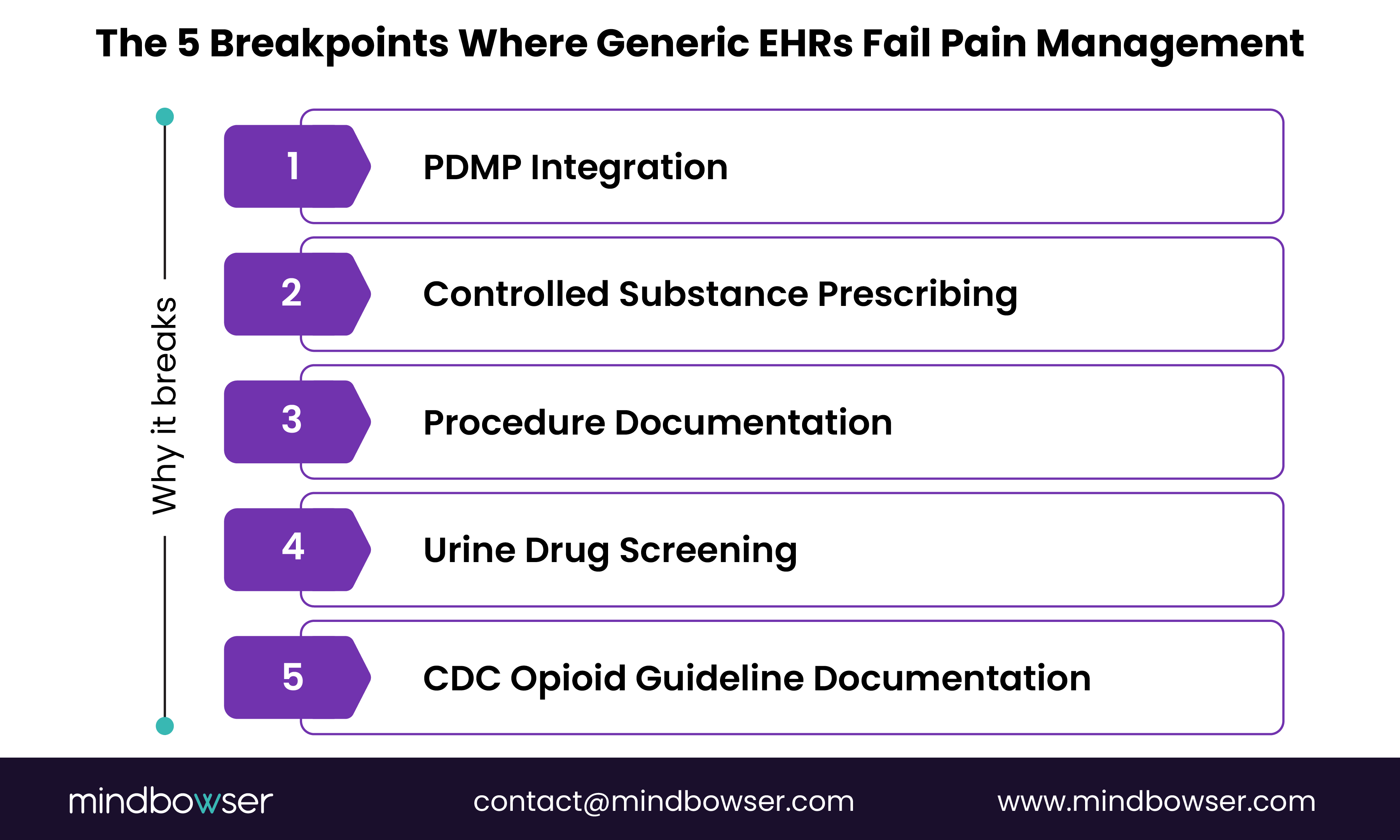
Why Pain Management Workflows Break Generic EHRs at Five Specific Points
The PDMP Integration Problem
Prescription Drug Monitoring Programs are now mandatory in 38 states. Before you prescribe a Schedule II or Schedule III controlled substance, you must check the PDMP. No exceptions.
A pain management practice with 20 providers seeing 25 patients per day runs 500 PDMP checks per day. Manual check: open a separate state portal tab, verify provider credentials, run the query, document that you checked it. Two to three minutes per check. That is 1,000 to 1,500 minutes of manual PDMP checking daily, every single day. An integrated PDMP workflow brings that to under 15 seconds per check, with automatic logging to the patient record.
No generic EHR ships with PDMP integration. Most practices open a separate browser tab and manually document that they checked PDMP. But the problem is not that PDMP checking is hard. The problem is that it is not wired into the prescribing workflow.
The Controlled Substance Prescribing Problem
DEA Schedule II prescriptions have specific federal rules: no refills permitted, 90-day supply maximum in most states (a state-level rule, not universal federal DEA law), and EPCS (Electronic Prescribing of Controlled Substances) requirements in 30+ states. Most states now require or allow EPCS; some older state rules required triplicate paper but that is essentially gone. Generic EHRs do not validate these rules proactively.
A provider writes a Schedule II prescription. The EHR sends it like any other prescription. There is no validation that the prescription complies with federal or state rules.
Result: prescriptions get rejected at the pharmacy. Calls come back to the clinic. The prescription gets re-written the right way. Cycle time: 24 to 48 hours per rejected prescription (the time until the patient receives their prescription), with approximately 1 hour of administrative rework per rejection. A pain practice with 50+ opioid-treated patients can hit 5 to 10 rejected prescriptions per week from DEA rule violations the EHR should have caught proactively.
The Procedure Documentation Problem
Pain management procedures (nerve blocks, epidurals, spinal cord stimulator trials, trigger point injections, fluoroscopy-guided procedures) have complex documentation requirements. You need to record catheter placement, needle gauge, injectate volume and type, landmarks used, anesthesia approach, fluoroscopy time, and post-procedure status.
Generic EHRs have a “procedure note” template with four fields. Pain management procedures have 20+ required data points. Practices solve this by printing a paper template and taping it to the wall next to the clinic workstation. Providers fill it out by hand. Someone types it into the EHR afterward.
The structured data is lost. There is no post-procedure alert if a complication flag was missed. There is no analytics on procedure outcomes across the practice. And the entire procedural dataset becomes unstructured prose that nobody can analyze.
The Urine Drug Screening Problem
Urine drug screening is recommended at 80 to 90 percent of opioid-prescribing pain management visits per CDC 2022 guidelines. The lab results come back as a PDF. In a generic EHR, that PDF gets filed somewhere in the chart. It is not connected to the patient’s controlled substance record. If the UDS shows a controlled substance the patient is not supposed to be taking (discordance), the provider has to notice it manually.
A discordance can indicate prescription drug diversion, doctor shopping at another practice, or a medication interaction. Missing it has real clinical consequences. But the problem is not that generic EHRs can’t file lab results. The problem is that UDS results are not linked to the controlled substance medication list where they belong.
The CDC Opioid Guideline Documentation Problem
In 2022, the CDC released a revised Clinical Practice Guideline for Prescribing Opioids. It has 12 recommendations. Four of them require specific, structured documentation in the clinical record:
1. Document the patient’s functional goals before initiating opioids
2. Document that non-opioid treatments were tried or considered before opioids
3. For patients taking more than 50 MME per day, document the clinical rationale for that dose
4. Document the patient’s risk screening results (using tools like the Opioid Risk Tool or DIRE score)

Generic EHRs do not include any of these as structured fields. And practices have no good workaround. Practices solve this by creating a Word document template that providers fill out and paste into the chart as text. The data is unstructured. It cannot be audited. It cannot be reported. It cannot be analyzed for quality improvement.
What Does a Pain Management EHR Actually Need to Do? (5 Capabilities That Actually Matter)
If you are evaluating specialty EHR options for a pain practice, these are the five filters that separate purpose-built platforms from general-purpose tools. I evaluate pain management EHRs using five filters. If a platform nails three of these, it is worth a trial. And if it nails all five, it is rare enough to build your practice around.
1. Integrated PDMP Check Within the Prescribing Workflow
Not a separate browser tab. Integrated. The system should:
- Trigger a PDMP query automatically when a controlled substance prescription is initiated
- Return results in real time within the prescribing interface
- Log the PDMP check result to the patient’s chart automatically
- Require provider attestation (checkbox: “I have reviewed PDMP and found no unsafe patterns”)
- Block prescription completion if PDMP check is not performed
2. CDC Opioid Guideline Compliance Fields
The system should have structured fields for:
- Patient functional goals (free text, structured data type)
- Non-opioid trial documentation (checkboxes for which treatments were tried)
- MME calculation (automatic from medication list, with manual override if needed)
- Risk screening score (ORT, DIRE, or custom risk tool, stored as structured data)
- Informed consent documentation (dated, signed digitally, stored as discrete field)
These should be required fields before an opioid prescription can be completed.
3. Procedure Documentation Templates
Not a generic “procedure note.” Specialty templates for:
- Nerve blocks (epidural, interscalene, femoral, etc.)
- Epidural injections
- Spinal cord stimulator trials
- Trigger point injections
- Fluoroscopy-guided procedures
Each template should have 20+ structured fields (needle gauge, injectate volume, landmarks, anesthesia approach, fluoroscopy time, complications, post-procedure status). Results should feed into an outcomes registry.
4. Urine Drug Screening Workflow
The system should:
- Have a dedicated UDS order module (not just a generic lab order)
- Link UDS results directly to the patient’s controlled substance medication list
- Flag discordances automatically (substance in UDS that is not on the med list, or missing expected substance)
- Route discordances to the provider inbox with a clinical alert
- Generate a compliance report for audits
5. Prior Authorization Workflow for Both Medications and Procedures
The system should:
- Auto-submit prior auth requests for opioids and pain procedures to major payers (United, Aetna, Humana, Cigna)
- Support both FHIR-based APIs and legacy payer portals
- Track authorization status and alert when authorization is about to expire
- Prevent scheduling of procedures without prior auth in place
- Generate a payer compliance report
Top 6 Pain Management EHR Systems (Honest Scorecard)
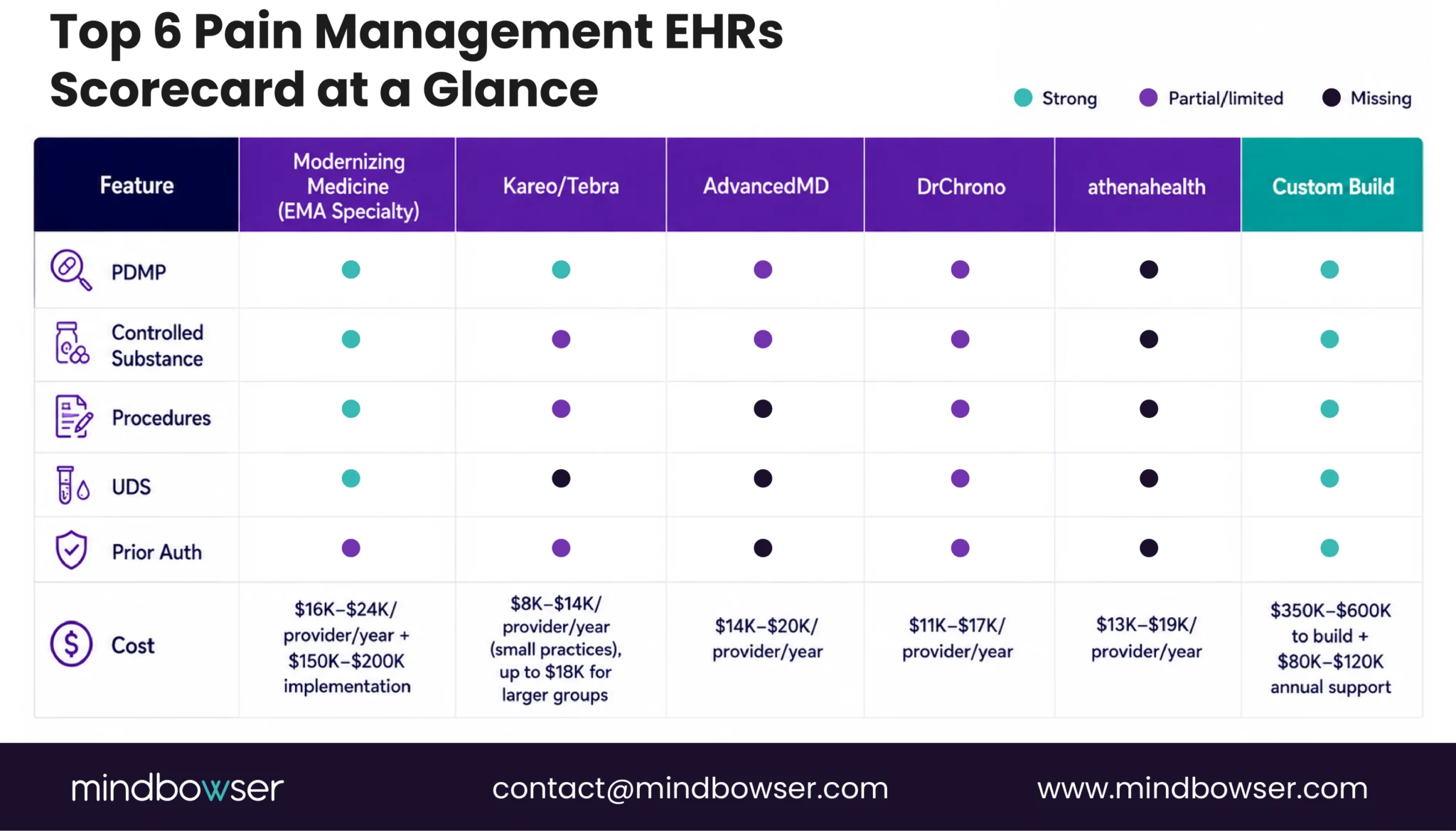
Before diving in: this series also covers cardiology EHR systems and the ASC EHR comparison (same five-capability framework, different specialty contexts). I have seen six platforms deployed or evaluated at pain management practices over the past four years. Here is how they score on the five capabilities above.
Modernizing Medicine (EMA Specialty)
What it does well: Purpose-built for specialty practices, including pain management. The best procedure documentation templates in the market. PDMP integration in most states. Strong workflow automation. Good vendor support.
What it misses: UDS workflow is basic (no automatic discordance flagging). CDC guideline fields not fully structured. Anesthesia integration limited.
Best for: Practices that prioritize procedure documentation and are willing to accept limitations on UDS and guideline compliance tracking.
Cost: $16K–$24K per provider per year, $150K–$200K implementation.
Kareo/Tebra
What it does well: Large market share in independent pain practices (specifically acquired Kareo practice management, integrating with Tebra). Strong PDMP integration across most states. Prior authorization workflow good. Cloud-native platform. Growing pain management feature set.
What it misses: Procedure documentation is generic (not pain-specific). UDS module not integrated. CDC guideline fields missing. Smaller install base for specialty pain workflows.
Best for: Independent solo and small-group practices prioritizing ease of use over specialty depth.
Cost: $8K–$14K per provider per year (small practices), up to $18K for larger groups.
AdvancedMD
What it does well: Strong PDMP integration. Solid controlled substance prescribing workflow. Good prior auth workflow. Reasonable cloud-native platform.
What it misses: Procedure documentation is generic. No native UDS module. CDC guideline fields missing. Limited pain management specialization.
Best for: Practices that want a solid general platform and do not need pain-specific templates.
Cost: $14K–$20K per provider per year.
DrChrono
What it does well: Cloud-native, modern interface. Decent pain management templates. PDMP integration (varies by state). Good mobile app.
What it misses: Procedure documentation limited. PDMP integration incomplete in all states. UDS module not integrated. Smaller install base.
Best for: Small pain practices that want a modern cloud platform.
Cost: $11K–$17K per provider per year.
athenahealth
What it does well: Strong prior authorization workflow (hospital and outpatient). Good patient engagement tools. Cloud-native. Large install base.
What it misses: PDMP integration limited. No native pain management templates. Procedure documentation is generic. UDS workflow not integrated.
Best for: Large practices already on athenahealth who can tolerate generic templates.
Cost: $13K–$19K per provider per year.
Build Route (Custom Pain Management EHR)
What it does well: 100 percent customizable to your workflow. Can integrate any PDMP state portal. Can integrate any lab (automatic UDS result parsing). Can build the exact procedure documentation you need. You own the code. Can be licensed to other practices after launch.
What it misses: 16–20 months to build. Higher upfront cost. Requires ongoing development team.
Best for: Large pain practices (10+ providers) with a specialized procedure mix, or pain practice networks planning to scale nationally. Also: health systems building a pain-specific platform to license to other pain practices.
Cost: $350K–$600K to build, $80K–$120K annual support. See the full custom EHR development overview for what the engagement looks like end to end.
What Pain Management Providers Say About Their EHR
(The following observations come from five pain management EHR architecture engagements conducted from 2022 to 2026. All provider and practice details are anonymized.)
“PDMP is a separate browser tab. I check it before I prescribe. I document manually that I checked it. Every single patient. If I forget to document it, there is no flag. It is just on me to remember.”
- Pain management physician, 8-provider group practice
“We have a 15-field procedure note template for epidurals that we use clinically. Our EHR has a 4-field procedure note. Someone printed the template and taped it to the wall. We fill it out on paper, then someone types it into the EHR.”
- Pain management specialist, regional practice, Southwest US
“Prior authorization for a nerve block takes a week. We cannot schedule the procedure until it is approved. There is no automation in the process. Our billing department faxes a letter to the payer. We wait to hear back.”
- Practice manager, 6-provider pain clinic
“The CDC 2022 opioid guideline changed our documentation requirements significantly. Our EHR does not have fields for functional goals, non-opioid trial history, or risk screening. We built a Word document template to capture what the EHR cannot.”
- Pain physician, independent practice
“UDS results come back from the lab as a PDF. They get filed somewhere in the chart. They are not connected to the patient’s controlled substance record. If there is a discordance, we notice it manually. Sometimes we do not notice it at all.”
- Nurse practitioner, chronic pain clinic
The PDMP, DEA, and CDC Documentation Problem: Where Pain EHRs Lose You Money and Create Compliance Risk
Three overlapping federal mandates hit every pain management practice. Most EHRs handle them manually, which costs time and creates regulatory exposure.
The PDMP Mandate Across 38 States
As of 2024, 38 states mandate PDMP check before prescribing Schedule II or Schedule III controlled substances. And the FHIR prior auth APIs that power integrated PDMP workflows are now available from most major EHR vendors. The bottleneck is not the standard, it is whether your EHR vendor has implemented it. The Prescription Drug Monitoring Program Transparency and Accountability Commission (PDMP TTAC) publishes the current mandate map.

A 20-provider pain practice seeing 25 patients per day touches 500 patients per day. If 60 percent need controlled substances, that is 300 PDMP checks per day. Manual check at 2–3 minutes per check = 600–900 minutes of manual PDMP work daily. Over a year (250 work days), that is 150,000–225,000 minutes, or 2,500–3,750 hours of pure PDMP-checking work annually. At a blended labor rate of $50 per hour, that is $125K–$187K per year in labor cost for a single workflow task.
An integrated PDMP check (under 15 seconds per patient) reduces that to under 125 hours per year, or $6,250 annually. Net savings: $118K–$180K per year for a 20-provider practice.
The DEA Schedule II Prescribing Rules
DEA Schedule II prescriptions have four strict rules:
- No refills permitted – 90-day supply maximum in most states (a state-level rule, not universal federal DEA law)
- EPCS (Electronic Prescribing of Controlled Substances) requirements in most states; some older rules required triplicate paper but this is now essentially obsolete
- Prescriber must verify DEA registration number on every prescription
Generic EHRs do not validate these rules. A provider writes a Schedule II prescription. The EHR sends it like any other prescription. The pharmacy rejects it. The clinic gets a call back. The prescription has to be re-written. Cycle time: 24–48 hours per rejected prescription. Administrative rework time: approximately 1 hour per rejection.
A pain practice with 50+ opioid-treated patients can hit 5–10 rejected prescriptions per week from DEA rule violations. Annual rejections: 250–500. Annual rework: 250–500 hours at $25 per hour (billing staff) = $6,250–$12,500 per year. The larger cost is the operational disruption and delayed patient care, not just the labor.
The CDC 2022 Guideline Documentation Mandate
The CDC guideline is not a legal mandate, but CMS now expects practices to document compliance. The four required documentation fields are:
1. Functional goals before opioid initiation (free text, at least 3–5 words)
2. Non-opioid trial documentation (specific non-opioid tried, dosage, why it did not work)
3. MME calculation + clinical rationale if >50 MME per day
4. Risk screening score (ORT, DIRE, or other validated tool)
Generic EHRs have none of these as structured fields. Practices paste in Word templates as unstructured text. When a CMS auditor requests proof of compliance, the practice has to manually extract text from 500–1,000 patient records and re-compile it into a report. If the compliance requirement ever becomes a reimbursement condition, the practice has no audit trail and no automated compliance report.
42 CFR Part 2: Substance Use Disorder Records
If your pain practice runs a MAT (medication-assisted treatment) or buprenorphine program, substance use disorder records are protected under 42 CFR Part 2. These records require special consent before disclosure, and the consent logic cannot be the standard HIPAA authorization. Generic EHRs do not have 42 CFR Part 2 logic baked in. Practices have to manage this manually or use a separate system. A custom pain management EHR should include this compliance layer automatically.
Wondering Whether a Custom Pain Management EHR Is Worth It?
When Does Building a Custom Pain Management EHR Beat Buying One?
The 3-Year Cost Math
Before committing to either route, the EHR build playbook covers the technical scoping questions worth answering first. But the cost math is a good starting filter.
Licensing Model (Modernizing Medicine / Kareo / AdvancedMD / DrChrono):
- Per-provider cost: $12K–$24K per year (varies by platform and practice size)
- For a 10-provider practice: $120K–$240K per year
- 3-year cost: $360K–$720K
- Implementation: $150K–$200K
- Total 3-year: $510K–$920K
Custom Build (FHIR-native foundation like Medplum):
- Initial build (16–18 months): $350K–$600K
- Year 2–3 support + enhancements: $80K–$120K per year
- Total 3-year: $510K–$840K
Break-even: End of Year 2. The build ships at months 16–18. By month 24, the custom build is financially equivalent. From month 24 onward, you are ahead.

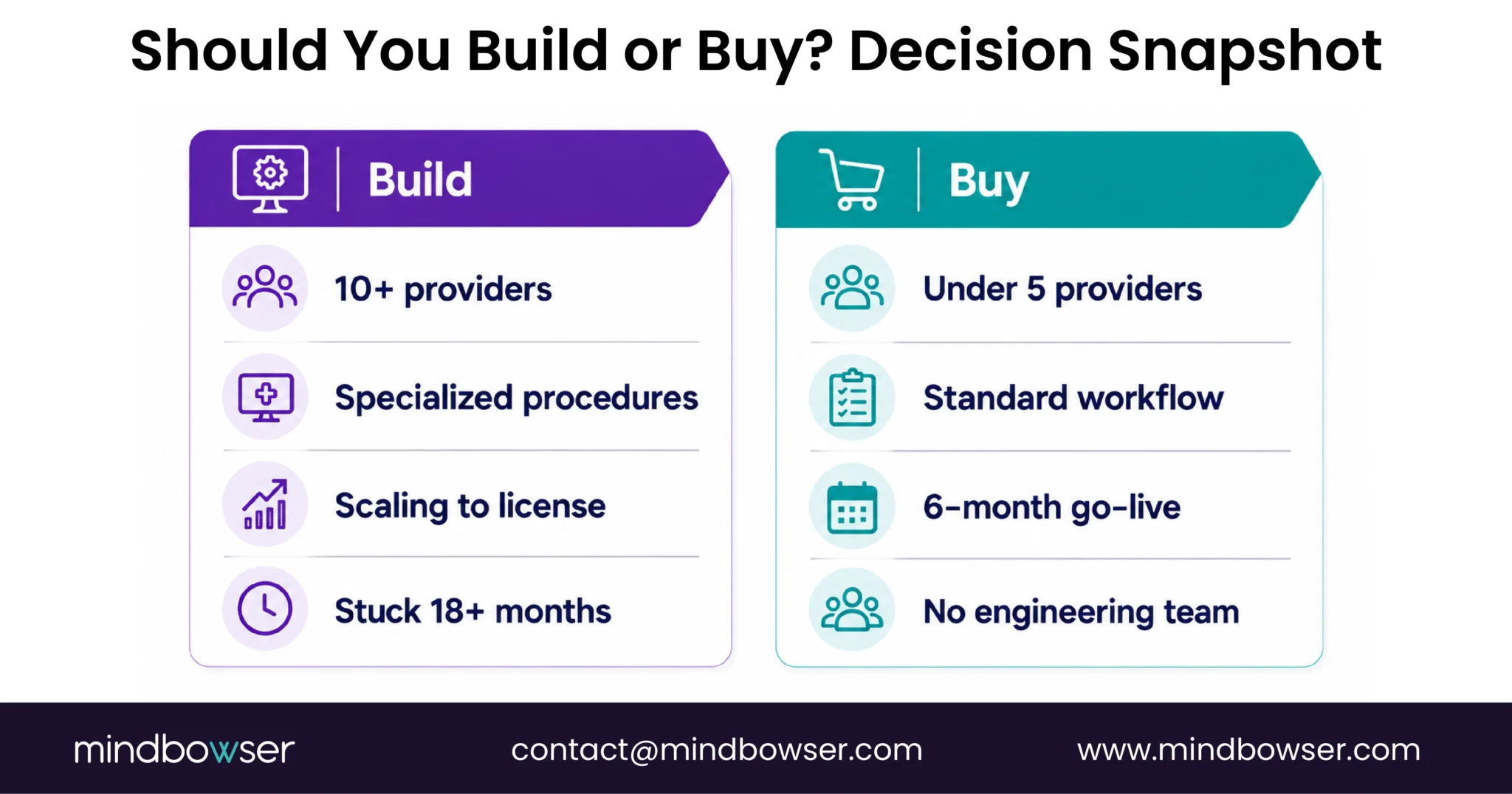
When Does Build Make Sense?Real Custom Build: US-Based Wellness Provider EHR
Build if:
1. You have 10+ providers
2. Your procedure mix is specialized (blocks, stimulators, complex pain medicine)
3. You plan to scale (open more locations or license to other practices)
4. You have been hitting the same ceiling with vendor products for 18+ months
Buy if:
1. You have fewer than 5 providers
2. Your workflow is standard (opioid management, basic documentation)
3. You need to go live in 6 months
4. You do not have internal engineering resources to manage ongoing development
Real Custom Build: US-Based Wellness Provider EHR
A mid-market US-based wellness provider needed a custom EHR to unify fragmented patient records, support physician-defined treatment workflows, and coordinate care across multiple conditions. No off-the-shelf product supported their combination of customizable clinical protocols, telemedicine, and integrated billing in a single system.
We built a dual-portal EHR on a FHIR-native EHR foundation. The result: customizable treatment workflow templates, e-prescription, telemedicine integration, role-based access control, and integrated billing. The practice owned the platform outright. No per-provider annual license. No vendor-imposed workflow constraints.
Post-launch outcomes: reduced unnecessary readmissions, improved care coordination metrics, gave patients self-service access to records and medications. They owned the codebase. No recurring licensing tax.
How We Build Custom Pain Management EHR Software
When a pain practice decides to build, the timeline looks like this.
Phase 1: Workflow Mapping (2–4 weeks)
We observe actual providers and staff working. Not interviews. Actual observation. We map:
- How PDMP checks are currently performed (separate portal, manual documentation) – Controlled substance prescribing process (rejection rates, manual workarounds)How We Build Custom Pain Management EHR Software
- Procedure documentation workflow (paper templates, manual entry into EHR)
- UDS ordering and result management (where results live, how discordances are caught)
- Prior authorization process (payers, timelines, how procedures are blocked/approved)
- 42 CFR Part 2 scope (if the practice runs a MAT or buprenorphine program, substance use disorder records need special consent logic)
Out of this: a detailed process map and a requirements document that names exactly what the system needs to do.
Phase 2: Architecture (4–6 weeks)
We design the data model:
- FHIR-native core: all clinical data in standard FHIR resources.
- Custom pain schema: PDMP query layer, controlled substance prescribing engine with DEA rule validation, procedure templates, UDS record with automatic discordance detection, MME calculator, risk screening tool integration, CDC guideline compliance fields.
- Integration layer: PDMP state portal connectors, pharmacy e-prescribing with DEA validation, lab system connectors (automatic UDS result parsing), payer prior auth APIs.
Phase 3: MVP Build (12–16 months)
Core features launch: – Controlled substance prescribing with DEA rule validation – Integrated PDMP check with attestation logging – Pain procedure documentation (nerve blocks, epidurals, spinal cord stimulator, trigger point) – UDS ordering and result integration with automatic discordance flagging – Prior authorization workflow for medications and procedures – Patient pre-visit intake (pain assessment, functional goals, risk screening)
Phase 4: AI and Advanced Features (Months 12–18, overlaps MVP)
- AI Medical Summary: ambient documentation during the visit. A microphone captures the provider’s verbal notes. AI transcribes and structures into the clinical note automatically. Reduces post-visit documentation time by 50 percent. Already built and running in production.
- Patient Questionnaire Form: pre-visit digital intake (pain scale, functional goals, medication list, non-opioid trial history). FHIR-compliant, auto-populates the clinical record. Reduces front-desk intake time by 40 percent. Already built.
- Surgical Risk Prediction: ML model flags high-risk pain patients for proactive post-procedure monitoring
Phase 5: Interoperability (Months 16–20)
Most pain patients also receive care at hospitals, primary care clinics, or pharmacies. Data needs to move.
- ConnectHealth: integrates with major EHRs (Epic, Cerner, Athena, eCW) where patients are also treated, pulling in relevant records (prior surgeries, current medications, allergy alerts) and pushing back procedure results and medication reconciliation, dropping integration time from 6+ months to days. It also connects to payer FHIR APIs for real-time eligibility checks, prior authorization submission, and authorization tracking, which matters here since pain procedures typically need prior auth from payers. A programmatic API eliminates the 5–7 day manual wait. Already built and running in production.
- PHISecure: HIPAA-compliant PHI de-identification layer for pain practices running MAT or SUD programs. 42 CFR Part 2 records require special consent before disclosure. PHISecure handles the consent logic and de-identification. Already built.
- PatientCompanion AI: patient-facing conversational assistant. Patients can ask about medication history, upcoming appointments, prescription refill status. Reduces administrative follow-up calls by 30 percent. Already built.
Phase 6: ONC Certification (Months 22–24, optional)
If you plan to license the platform to other pain practices nationally: – USCDI v3 compliance – FHIR API certification – SOC 2 Type II security audit – Full documentation and attestation
Your Next Step
The pain management EHR decision comes down to whether your workflow fits inside a vendor box or whether you need to build your own. If you are evaluating build partners, our guide on evaluating EHR development partners covers the evaluation criteria worth running before you commit.
Request an Assessment: we will map your pain management workflow against your current EHR and the market options. 20 minutes, no commitment. You will know whether you are getting more out of your current system or starting a custom EHR development engagement.
Start a Conversation: if you are at the size and procedure complexity where a custom build makes sense, let us scope it. One call, no sales pitch.