BLOGS
BLOGS  NEWSROOM
  CASE STUDIES
  WEBINARS
  PODCASTS
  ASSET HUB
  EVENT CALENDAR





















![How to Build an EHR System: A Founder’s Playbook [2026]](https://www.mindbowser.com/wp-content/uploads/2025/05/How-to-Build-an-EHR-System-for-Modern-Healthcare-A-Founders-Playbook.webp)


TL;DR
- This guide covers how to build a custom EHR system from scratch, not how to implement Epic or Cerner.
- If you’re a digital health founder, CTO, or health IT leader evaluating a custom build, this playbook walks through architecture decisions, tech stack choices, compliance requirements, cost ranges, and a realistic timeline based on projects we’ve shipped.
We built a predictive childbirth platform integrated with Epic via SMART on FHIR
EHR Software Development: Choosing Your Approach
Once the feature list is clear, the next step is deciding what tech to build on. Picking the right stack early lays the foundation for performance, scalability, and compliance. Here’s a quick breakdown of what you should be considering:
Frontend and Backend Technologies
React.js is a strong choice for the front end; it is fast, responsive, and backed by a massive community. It plays well with component libraries like Material UI, ensuring your EHR feels modern and user-friendly across all devices.
Node.js with NestJS or Python (Django/FastAPI) are popular on the backend. These scalable frameworks allow rapid development and integrate smoothly with third-party APIs like FHIR, ePrescriptions, and claims systems. If you need stricter typing and structure, Java or .NET are solid bets, especially in enterprise setups.
Remember that healthcare systems often interact with multiple data standards and third-party services, so your backend needs to be flexible and modular from day one.
Cloud Hosting vs. On-Premise
Most modern EHR systems opt for cloud-first architecture. Platforms like AWS, Google Cloud, or Azure allow for fast deployments, automated backups, and managed security tools; all critical when dealing with sensitive patient data. They also support HIPAA-ready infrastructure and scalable storage out of the box.
Some hospitals and clinics (especially in rural or government settings) may require on-premise deployments for regulatory reasons. If that’s your use case, ensure your stack supports containerization (Docker, Kubernetes) so you can deploy across environments without rewriting core logic.
Hybrid approaches are also gaining traction; sensitive PHI is stored on-premise, while non-sensitive features like scheduling or billing are cloud-hosted.
Database and Security Layers
EHR software deals with PHI, so your data layer can’t be an afterthought. Go with PostgreSQL or MongoDB for structured or semi-structured medical records, and use encryption-at-rest and in-transit as the default.
Implement role-based access control (RBAC) to ensure only authorized users can view or edit specific types of records. Use OAuth2 or SAML for secure authentication flows. And if you’re dealing with wearable data or telemedicine features, plan for real-time event streaming using Kafka or AWS Kinesis. Add security features early; HIPAA compliance is not just a checkbox at the end.
Related Read – Choosing Between Ready-Made and Custom EHR Solutions
Step-by-Step Guide to EHR Implementation
Building an EHR system is not just about writing code. It’s about getting the foundation right, aligning with regulations, and ensuring providers and staff can use it. Whether you’re a founder or tech partner, here’s a straightforward breakdown of how to build an EHR system the right way.
Requirement Gathering
Start by talking to real users: doctors, nurses, front-desk staff, and billing teams. Understand their day-to-day flow and where current tools fall short; document every must-have feature, from patient intake to billing and reporting. Don’t forget compliance needs like HIPAA and ONC certification if you plan for the U.S. market.
Pro tip: Focus on workflows, not just features. The goal is to reduce admin time and improve care delivery.
UI/UX Prototyping
Once you’ve mapped out the features, move to visual design. Build wireframes and clickable prototypes that reflect how users will move through the system. The EHR interface must be intuitive; even for less tech-savvy users. Prioritize clarity, minimal clicks, and mobile responsiveness. This is where you validate and adjust assumptions before writing a single line of code.
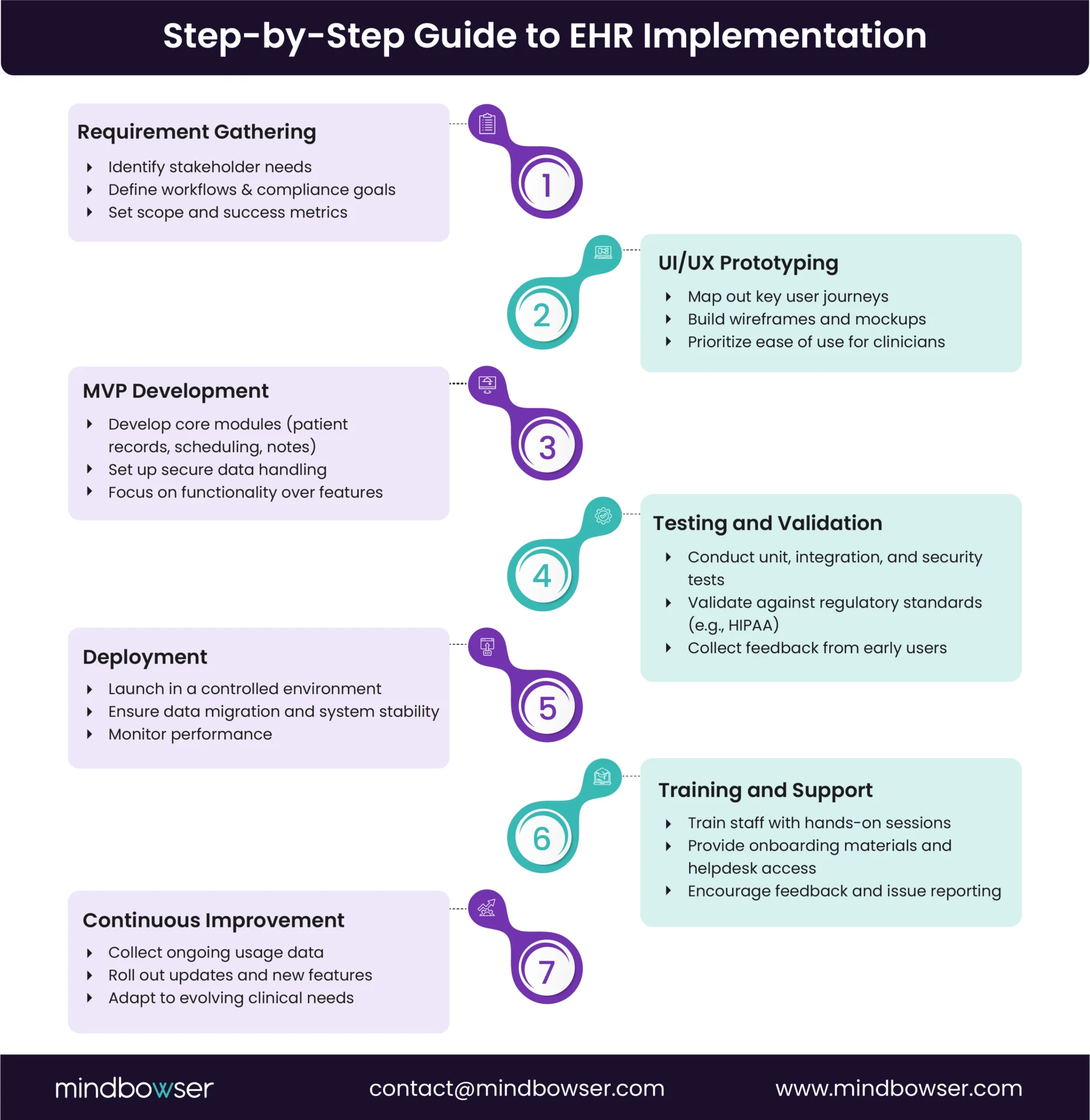
MVP Development
You don’t need every feature from Day 1. Focus on creating an MVP with core modules like:
- Patient registration
- Clinical documentation
- Appointment scheduling
- Secure messaging
- Basic reporting
Keep the backend flexible, preferably with modular architecture, so that new features can be added without major rewrites. If you’re figuring out how to create EHR software with scalability in mind, this is the step where your choices matter most. For a real-world reference point, see how we built a patient and doctor portal system that consolidated fragmented legacy workflows into one modular EHR platform.
Testing and Validation
Test the system across devices, roles, and workflows. Include functional testing (does it work?) and user acceptance testing (do users like it?). Validate security measures like user roles, audit logs, and encryption. Healthcare data is sensitive; you can’t cut corners here.
Conduct pilot runs in real clinics and capture feedback before full rollout.
Deployment
Deploy the system in a controlled environment first. This allows for real-time monitoring and issue fixing. Whether you go with cloud-based or on-premise hosting, ensure your deployment setup meets data residency laws and has redundancy.
Roll it out in phases if needed, starting with one department or clinic before expanding.
Training and Support
A well-built EHR system still fails without proper onboarding. Set up hands-on training sessions, create help docs, and assign support contacts. The support doesn’t stop after launch, expect questions and confusion in the first few months.
Support should feel like an extension of the product, not an afterthought.
Continuous Improvement
The best EHR platforms evolve. Set up a feedback loop to collect user insights and keep optimizing based on what’s working and what’s not. Add new features, improve load time, and tighten security patches. Use analytics to guide what comes next.
Founders who win in the EHR space treat software like a living product, not a one-time build.
Ready to scope your custom EHR build?
Common Pitfalls and How to Avoid Them
Building an EHR system is more than just writing code. Many well-funded teams stumble because they overlook the basics that don’t show up on fancy dashboards. Here are the most common traps founders walk into, and how to sidestep them.
Data Migration Mistakes
When switching from an old system (or even spreadsheets), it’s tempting to cut corners on data mapping. That’s a quick way to end up with mismatched fields, lost records, or incomplete patient histories. Whether you’re working with HL7, FHIR, or CSV dumps, start early with an explicit data schema and validation plan. Run small migration tests before going all in. Your EHR is only as strong as the data it holds.
Underestimating Compliance
Privacy isn’t optional, especially when Protected Health Information (PHI) is involved. Founders often underestimate how deep HIPAA, GDPR, and local data laws can go. It’s not just about encryption or access control; every feature must be compliance-aware by design, from notes to messaging. Don’t wait until after development to “make it HIPAA compliant.”
Build with compliance in mind from day one. This now extends beyond HIPAA. All custom EHR builds must align with USCDI v3 (mandatory since January 1, 2026) to ensure standardized data exchange across certified health IT systems. Ignoring this early can create interoperability gaps and costly rework later
User Adoption Issues
You can build the most technically perfect system, but it’ll fail if doctors, nurses, and admins find it clunky. Overcomplicating workflows or ignoring real-life clinical routines leads to low adoption. Involve end-users early. Watch how they currently operate, then design screens and flows that fit that behavior, not the other way around.
Choosing the Wrong Development Partner
This one’s tricky. Not every dev shop with healthcare experience knows how to build an EHR system that balances usability, compliance, and scalability. Some outsource core components; others use outdated tech stacks. Before signing a contract, ask about their experience with FHIR, integrations with labs or pharmacies, and HIPAA readiness. Speak to past clients. A lousy partner will cost you time, compliance risk, and product-market fit.
If you want to see how modern teams are building FHIR-first, AI-enabled clinical platforms in practice, watch this webinar.
Cost and Timeline for EHR Development
Understanding the investment needed to build an EHR system helps founders set the right expectations from day one. Whether you’re a startup founder bootstrapping your MVP or an enterprise leader mapping digital transformation, cost and time will largely depend on your scope, team, and go-to-market speed.
Key Factors That Affect EHR Development Cost
Several variables influence the final cost of building an EHR system:
- Feature Set: Core modules like patient records, appointment scheduling, and e-prescriptions cost less than advanced features like AI-driven diagnostics or real-time health data integration.
- Compliance Requirements: Ensuring HIPAA, GDPR, or ONC-ATCB compliance involves rigorous testing and legal oversight, adding time and cost.
- Third-Party Integrations: Connecting with labs, pharmacies, insurance systems, or wearable devices typically requires custom APIs or HL7/FHIR support.
- Technology Stack: A microservices-based architecture or cloud-native stack might cost more initially but save in the long run via scalability.
- Headless EHR Architecture: A headless EHR approach separates the backend (data, workflows, APIs) from the frontend (clinician or patient interfaces). This allows faster UI innovation, easier integrations (FHIR-first APIs), and multi-channel experiences (web, mobile, devices). While it may increase initial development effort, it significantly improves long-term scalability and customization, especially for organizations building differentiated care models.
- Development Team Location: Offshore or nearshore development teams can significantly reduce your hourly rate compared to U.S.-based teams.
EHR Budget: Startups vs. Enterprises
The cost of developing an EHR system can range widely depending on the size of the business and intended scope:
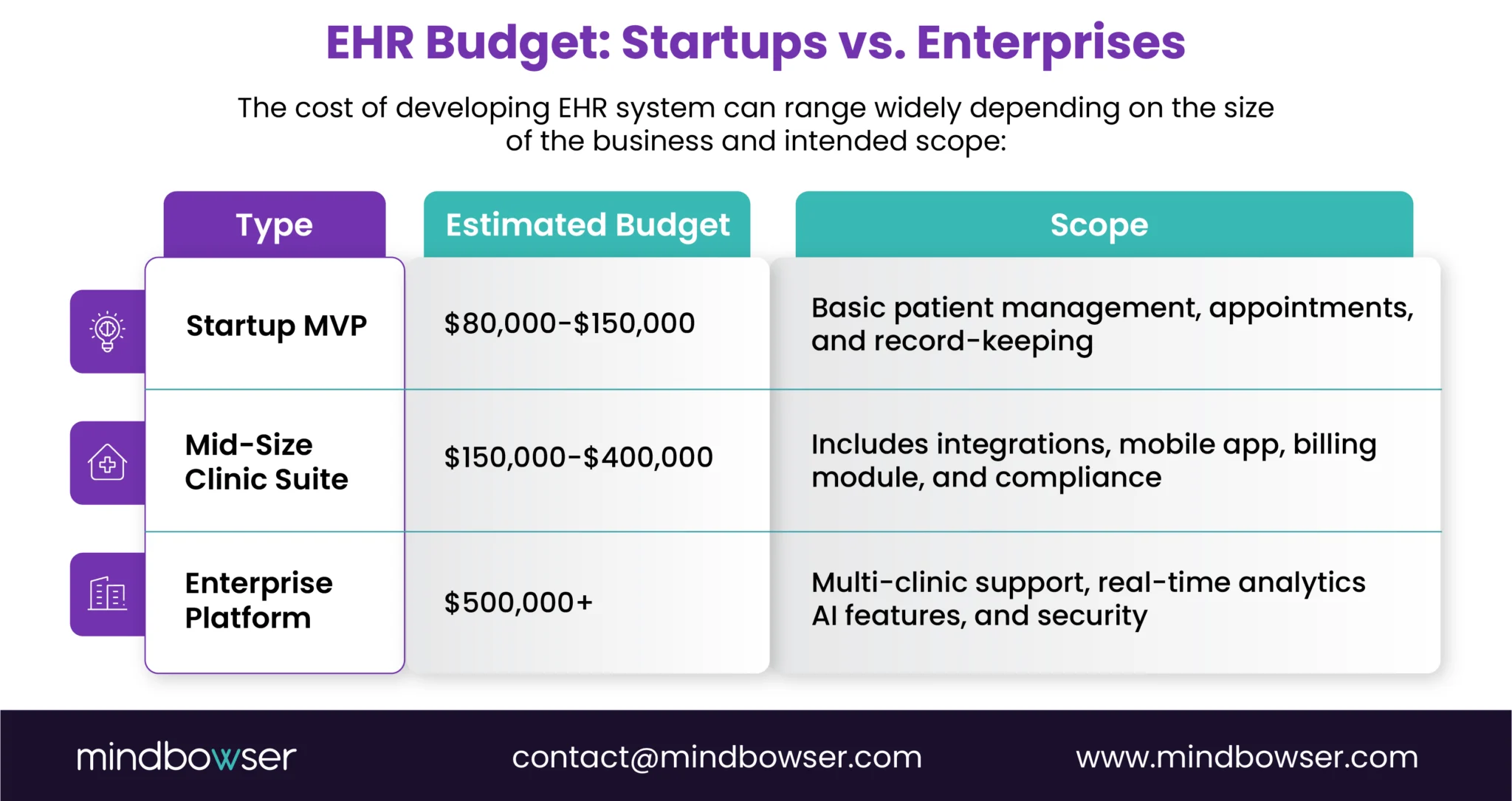
Enterprise-level builds also involve multiple compliance layers and rigorous audits, contributing to higher overall cost.
Typical Timeline and Team Composition
The timeline for a startup looking to build an MVP usually ranges between 4 to 6 months. A full-fledged, feature-rich enterprise EHR system can take 9 to 15 months depending on integrations and complexity.
Here’s what a lean, cross-functional EHR development team might look like:
- 1 Product Manager
- 1–2 UX/UI Designers
- 3–5 Developers (Frontend, Backend, Mobile)
- 1 QA Engineer
- 1 DevOps Engineer (for scalable deployments and CI/CD)
- 1 Compliance Consultant (part-time, as needed)
A HIPAA-trained team and dedicated compliance oversight from day one help avoid costly reworks later.
Build vs. Outsource: What’s More Cost-Effective for EHR?
Founders often ask whether to build an internal team or outsource the development. Here’s a quick breakdown:
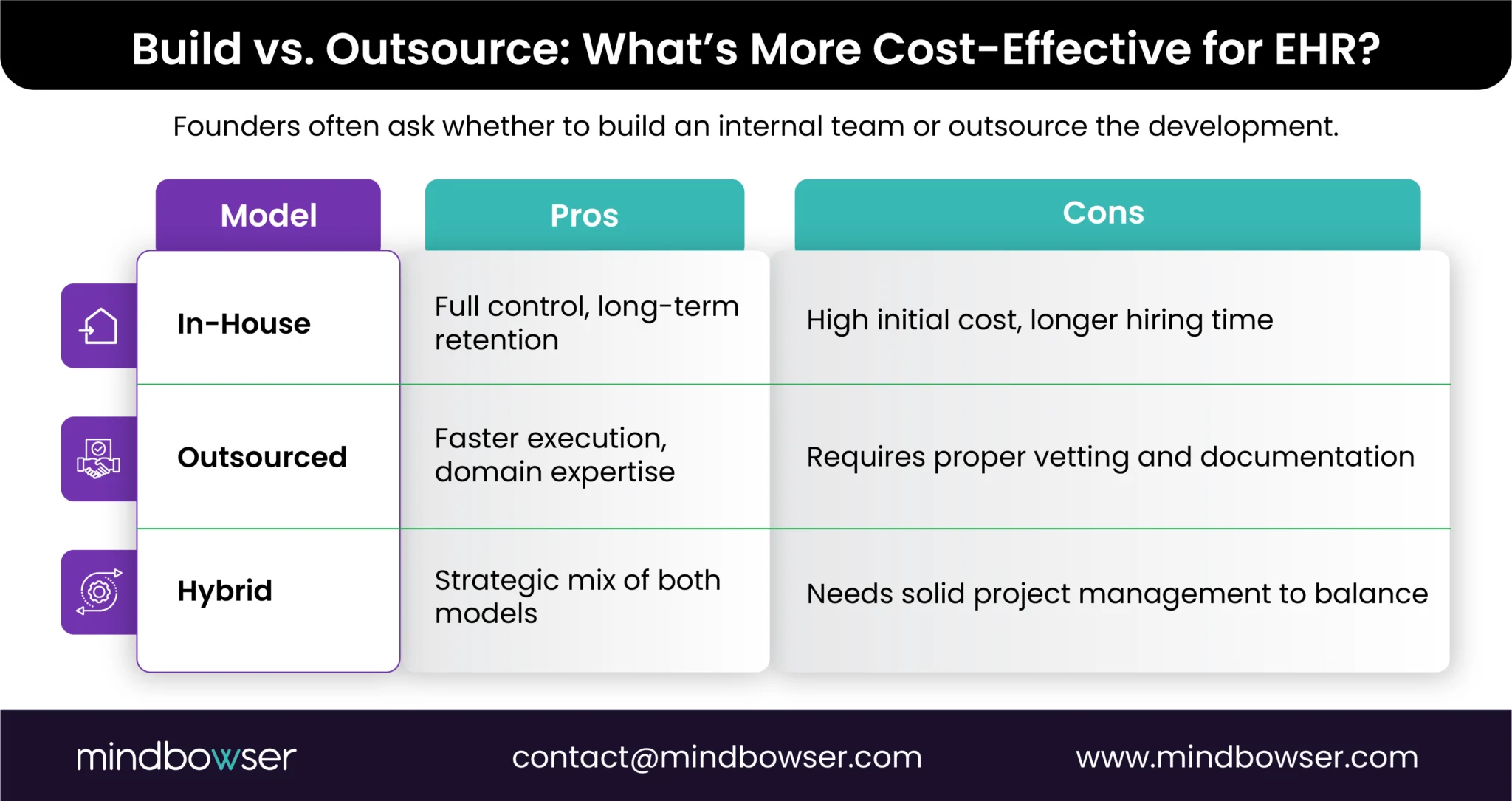
For early-stage startups, outsourcing the first few phases to a team experienced in how to build an EHR system can fast-track launch. Building in-house with some external consultation often makes more sense for enterprises for long-term scale and control.
Related Read: Choosing Between Ready-Made and Custom EHR Solutions
How Mindbowser Can Help with EHR System Development
If you’re figuring out how to build an EHR system or exploring how to create EHR software that’s secure, scalable, and gets adopted, you’re in the right place.
At Mindbowser, we bring over 15 years of hands-on experience building healthcare platforms that work in the real world. Whether you’re a founder starting fresh or a healthcare enterprise looking to modernize, our teams are built to support every stage of your product journey. See our custom EHR development services.
- Healthtech veterans: 15+ years delivering impactful solutions across the healthcare ecosystem
- Compliance-ready teams: Engineers trained in HIPAA, HL7, and FHIR from day one
- FHIR, HL7, HIPAA & Telehealth Integration Experts: We know the protocols, and we understand how to implement them right
- Startups to enterprise success: We’ve built and scaled EHR systems for VC-backed startups and established healthcare organizations alike
- End-to-end support: From product discovery to architecture, implementation, and post-launch growth, we stay with you throughout
We don’t just write code; we co-build products that can handle real workflows, meet compliance needs, and get buy-in from doctors, patients, and payers.
Conclusion
When thinking about how to build an EHR system, focus on three things: flexibility, compliance, and user experience.
Your platform should adapt to evolving care models, meet regulatory standards like HIPAA and ONC, and offer a smooth experience for both clinicians and patients. That’s how you stay relevant today and ready for what’s next.
If you’re exploring how to create EHR software, think beyond the MVP. Build with scalability in mind and choose tech that supports modular upgrades, integrations, and secure data exchange.
Most importantly, find a partner who understands the healthcare domain; not just the tech stack. That alignment can make all the difference between just launching and truly succeeding.