













 BLOGS
BLOGS  NEWSROOM
  CASE STUDIES
  WEBINARS
  PODCASTS
  ASSET HUB
  EVENT CALENDAR
























TL;DR
Behavioral health EHR adoption trails the rest of healthcare, and the reason isn’t that psychologists, social workers, and community mental health centers were slower to modernize. The HITECH Act’s 2009 meaningful-use incentive program, which paid for most of the rest of American healthcare’s EHR transition, explicitly excluded these provider types from eligibility. A partial fix arrived nearly a decade later as a narrow demonstration program, not full parity. This piece covers the actual mechanism behind the gap and where adoption stands now.
Watch: Why Behavioral Health EHR Adoption Still Lags: The HITECH Act Gap
The Provider Types HITECH Left Out
The HITECH Act’s meaningful-use incentive program, which ran through the early-to-mid 2010s, did more than any other single policy to give most of American healthcare an EHR. It paid physicians, dentists, and a handful of other Medicare and Medicaid “eligible professionals” real money to adopt certified EHR technology. What it didn’t do was include psychiatrists’ non-physician peers in behavioral health at all: psychologists, clinical social workers, and counselors were never on the eligible-professional list, on either the Medicare or Medicaid side.
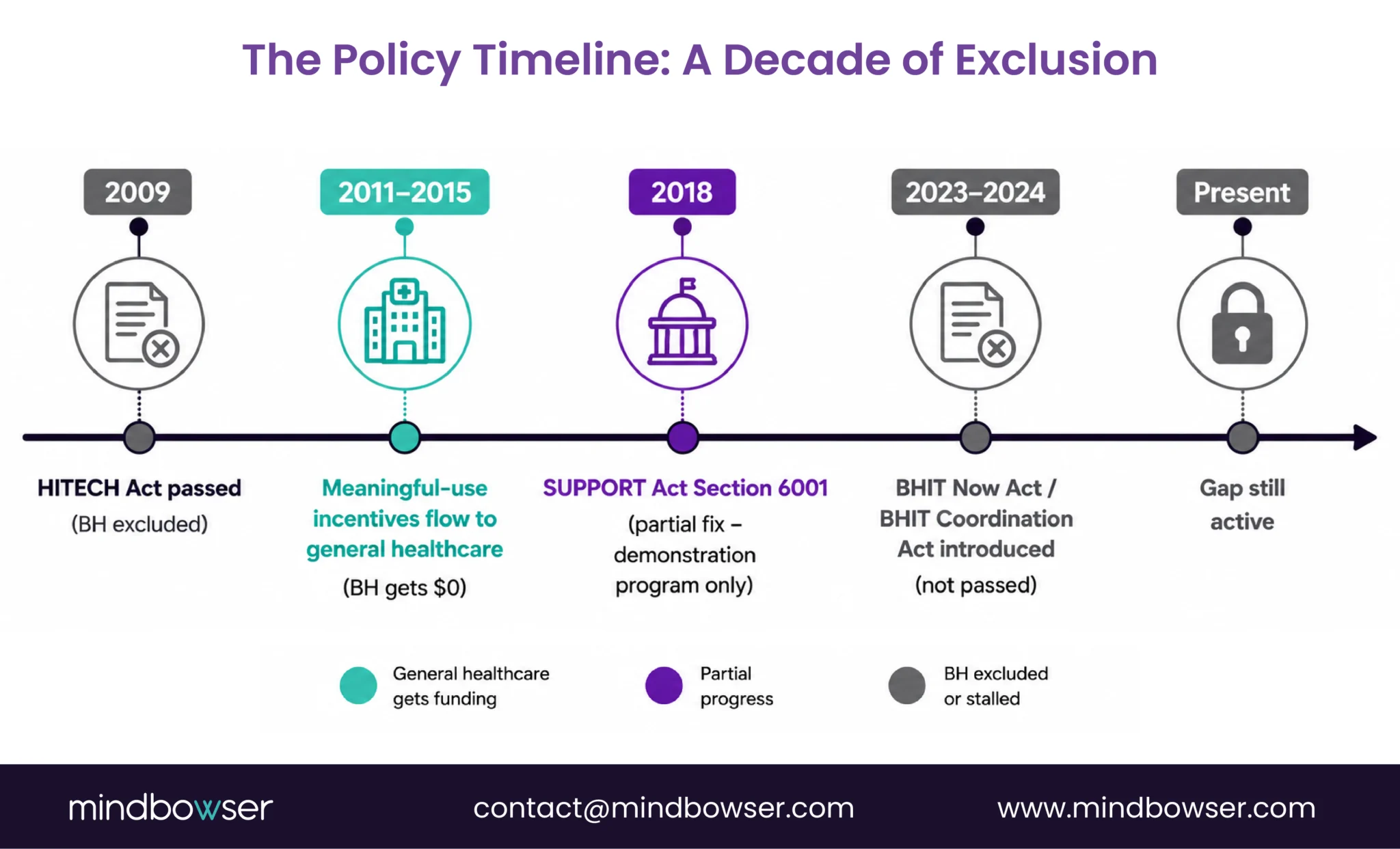
The hospital side had its own exclusion, and it happened almost accidentally through a definitional choice. HITECH’s “eligible hospital” definition borrowed the Social Security Act’s “subsection (d)” definition of an acute-care hospital, which specifically excludes psychiatric hospitals, along with long-term care, rehabilitation, children’s, and cancer hospitals. That means community mental health centers and psychiatric hospitals got no incentive payments either, not because Congress made a specific decision to exclude behavioral health facilities as a category, but because they didn’t fit a hospital definition written for a different purpose.
Why This Matters More Than a Historical Footnote
I want to be direct about why this isn’t just an interesting piece of legislative history. The rest of healthcare got billions of dollars in direct financial incentive to buy and implement EHR systems between roughly 2011 and 2015. The psychologists, clinical social workers, counselors, community mental health centers, and psychiatric hospitals covered above got none of it. If your intuition is that behavioral health has somehow lagged in modernizing because the field is culturally resistant to technology, that’s not the actual mechanism. A huge, direct financial incentive existed, and it simply wasn’t available to this provider category.
For context on where certification requirements sit today, our breakdown of CCBHC technology and EHR requirements covers the specific tech obligations these programs create. A partial fix arrived years later. Section 6001 of the SUPPORT for Patients and Communities Act, enacted October 2018, authorized a CMS Innovation Center demonstration program to test behavioral health EHR incentive payments. That’s real, but it’s a demonstration program, narrower in scope than the original meaningful-use incentive, not full legislative parity with what the rest of healthcare received. Subsequent bills aimed at fuller parity, including versions called the BHIT Now Act and BHIT Coordination Act introduced in 2023 and 2024, have not passed.
Need An EHR Designed For Behavioral Health?
Where Adoption Actually Stands Now
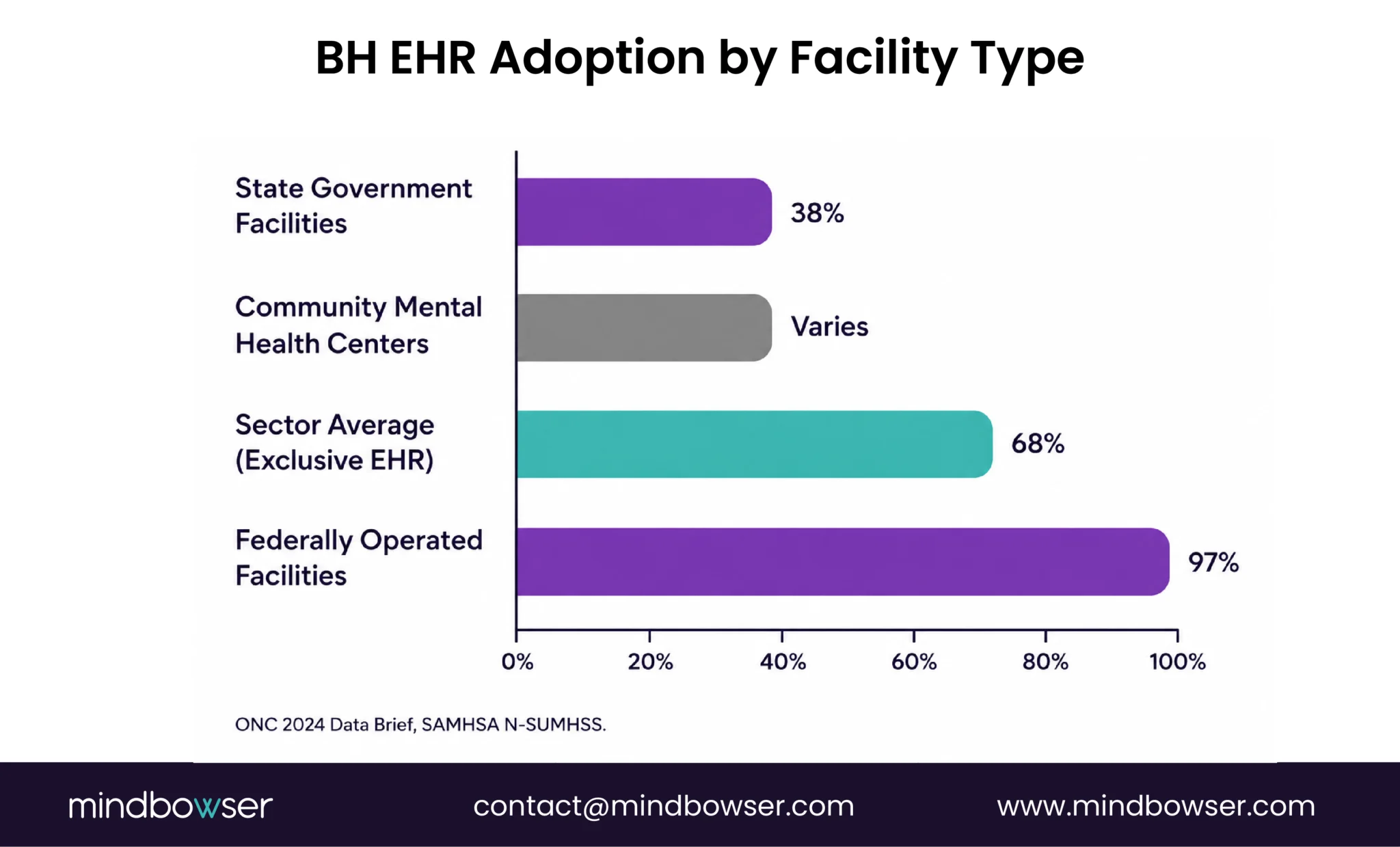
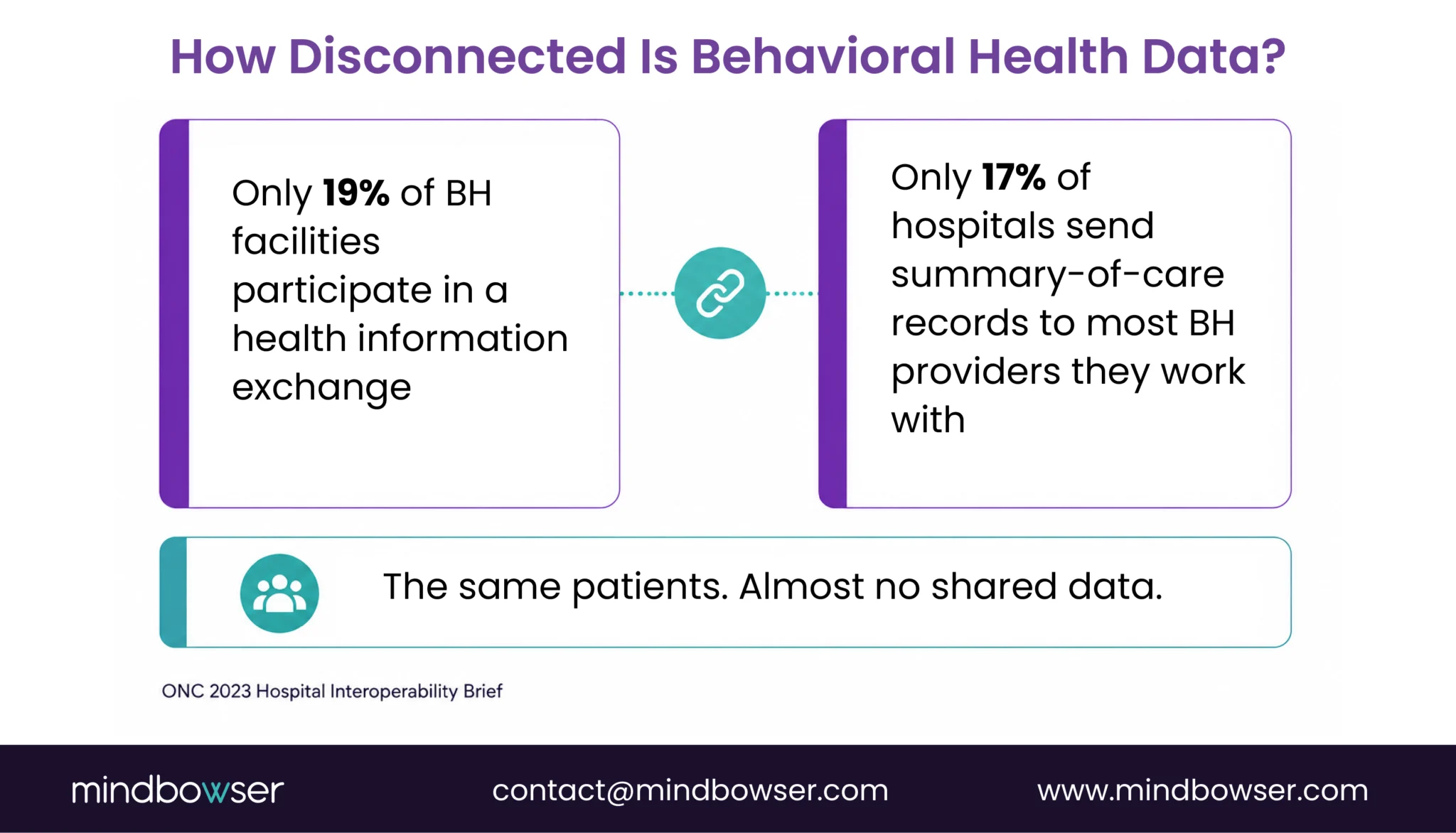
Current data confirms the gap is real and specific, not a vague generalization. Per ONC’s 2024 data brief drawing on SAMHSA’s N-SUMHSS survey, 68% of substance use and mental health facilities use an EHR exclusively, with another 25% running a hybrid EHR/paper system. Adoption varies sharply by facility type, from 38% at state government facilities up to 97% at federally operated ones. Only 19% of these facilities participate in a health information exchange at all. On the behavioral health interoperability side specifically, ONC’s 2023 hospital interoperability brief found that only 17% of hospitals send summary-of-care records to most or all of the behavioral health providers they work with, meaning even hospitals with a mature EHR often aren’t actually exchanging data with the behavioral health providers treating the same patients — a gap that compounds 42 CFR Part 2 compliance obligations for SUD records.
What This Means for Anyone Building or Buying BH Technology
If you’re evaluating why a behavioral health organization‘s technology feels a decade behind a typical primary care practice’s, this is the actual structural reason, not an assumption about the field’s appetite for modernization. It also means the adoption curve still has real room to run: facilities operating without a certified EHR today aren’t holdouts resisting change, in a lot of cases they’re providers who never had the same financial incentive everyone else did, and are now modernizing on their own timeline and budget rather than a subsidized one.
If you’re building or modernizing behavioral health technology and want to understand what this adoption gap actually means for your specific integration and interoperability requirements, request an assessment.
The HITECH Act’s 2009 meaningful-use incentive program, which funded most of American healthcare’s EHR adoption, excluded psychologists, clinical social workers, counselors, community mental health centers, and psychiatric hospitals from eligibility. The gap is a legislative/financial-incentive gap, not a technology-adoption-culture gap.
Partially. Section 6001 of the 2018 SUPPORT for Patients and Communities Act authorized a CMS Innovation Center demonstration program for behavioral health EHR incentives, narrower in scope than the original meaningful-use program. Later bills aimed at fuller parity have not passed as of this writing.
Per ONC’s 2024 data brief, 68% use an EHR exclusively and another 25% use a hybrid EHR/paper system, with adoption ranging from 38% at state government facilities to 97% at federal facilities.
Limited. Only 19% of behavioral health facilities participate in a health information exchange, and only 17% of hospitals send summary-of-care records to most or all of the behavioral health providers they work with, per ONC’s 2023 interoperability data. [Our guide to healthcare integration challenges](https://www.mindbowser.com/healthcare-integration-challenges-solutions/) covers the broader technical picture behind these numbers, why interoperability gaps like this persist across healthcare generally, not just behavioral health.