













 BLOGS
BLOGS  NEWSROOM
  CASE STUDIES
  WEBINARS
  PODCASTS
  ASSET HUB
  EVENT CALENDAR






















TL;DR
Behavioral Health Integration (BHI) and the Collaborative Care Model (CoCM) are clinical frameworks, but they fail or succeed on data architecture. A care manager coordinating a patient’s behavioral health, medical claims, referrals, and social risk factors needs one view, not five logins. We built exactly this kind of aggregation layer for Alera Health’s ONEcare Networks, a behavioral health system serving 3 million lives, pulling seven data sources into one dashboard. CMS is now paying for the clinical work this technology supports, through new CY2026 billing codes. The interoperability standards that would make this easier industry-wide are still not finished, targeted for the end of this year. Here’s what the technology actually has to do, and where it genuinely still needs custom work.
The Five-Login Problem
A care manager at a 3-million-life behavioral health network used to need five separate logins just to answer one question: is this patient safe right now? That’s not a collaborative care problem. That’s a data architecture problem wearing a clinical label.
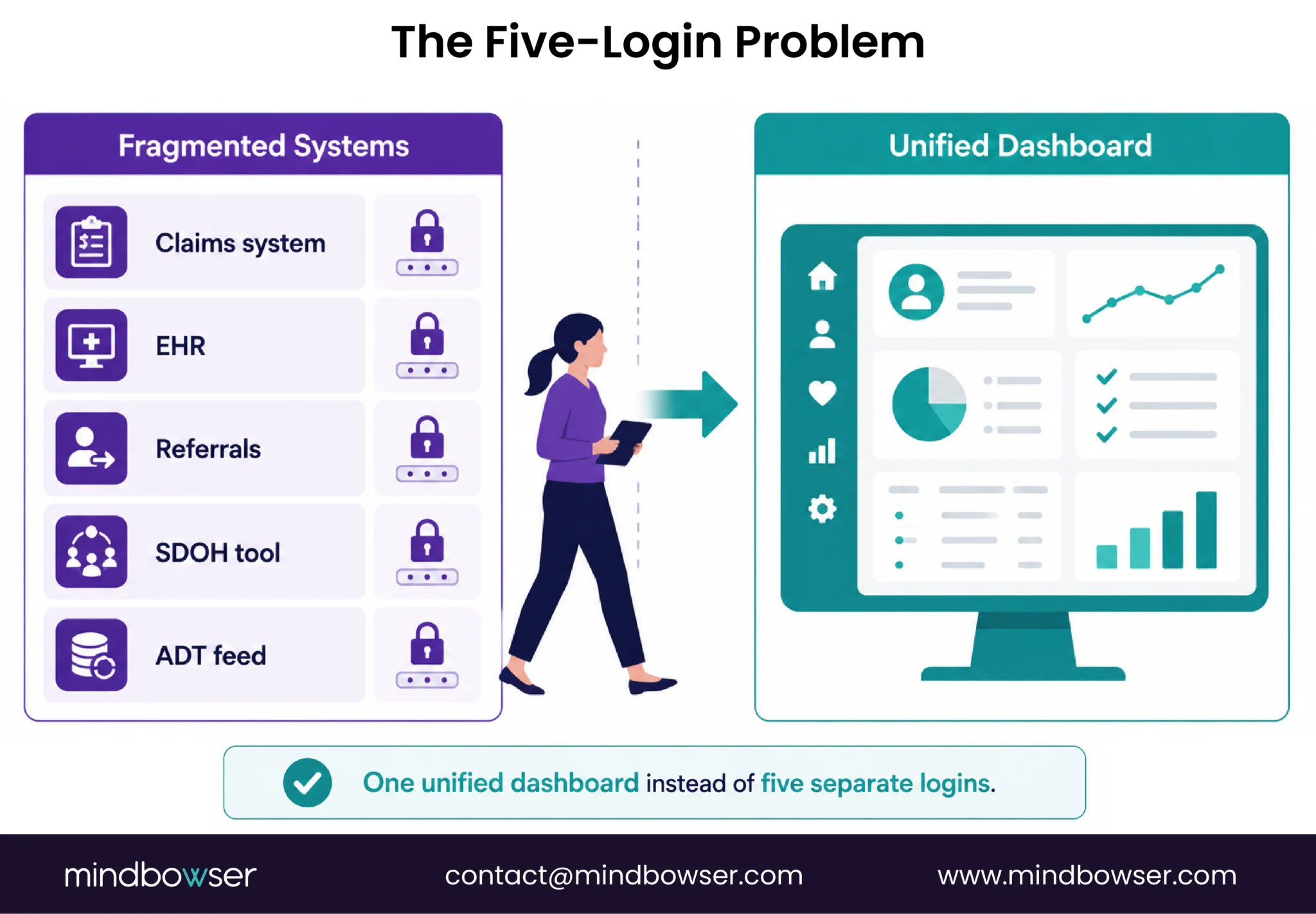
I’ve spent the last several years building integration layers for healthcare systems, and the pattern repeats almost identically every time: the clinical model is well understood, the technology to support it is not built, and everyone assumes the gap is smaller than it is. Collaborative care and behavioral health integration both look, on paper, like workflow problems. A primary care doctor screens a patient, a psychiatric consultant reviews the case, a care manager coordinates follow-up. Simple. Then you try to build the system underneath it and discover that claims data lives in one place, EHR records in another, referral status in a third, and social risk factors, housing, transportation, food security, somewhere else entirely. Piecing together one patient’s real situation means logging into four or five disconnected tools and hoping nothing got missed.
That’s the problem this piece is actually about. Not “what is collaborative care,” which you can get from a dozen academic sources. What the technology underneath it has to actually do, and what happens when you build it at real scale.
What Collaborative Care Actually Requires From a Technology Stack
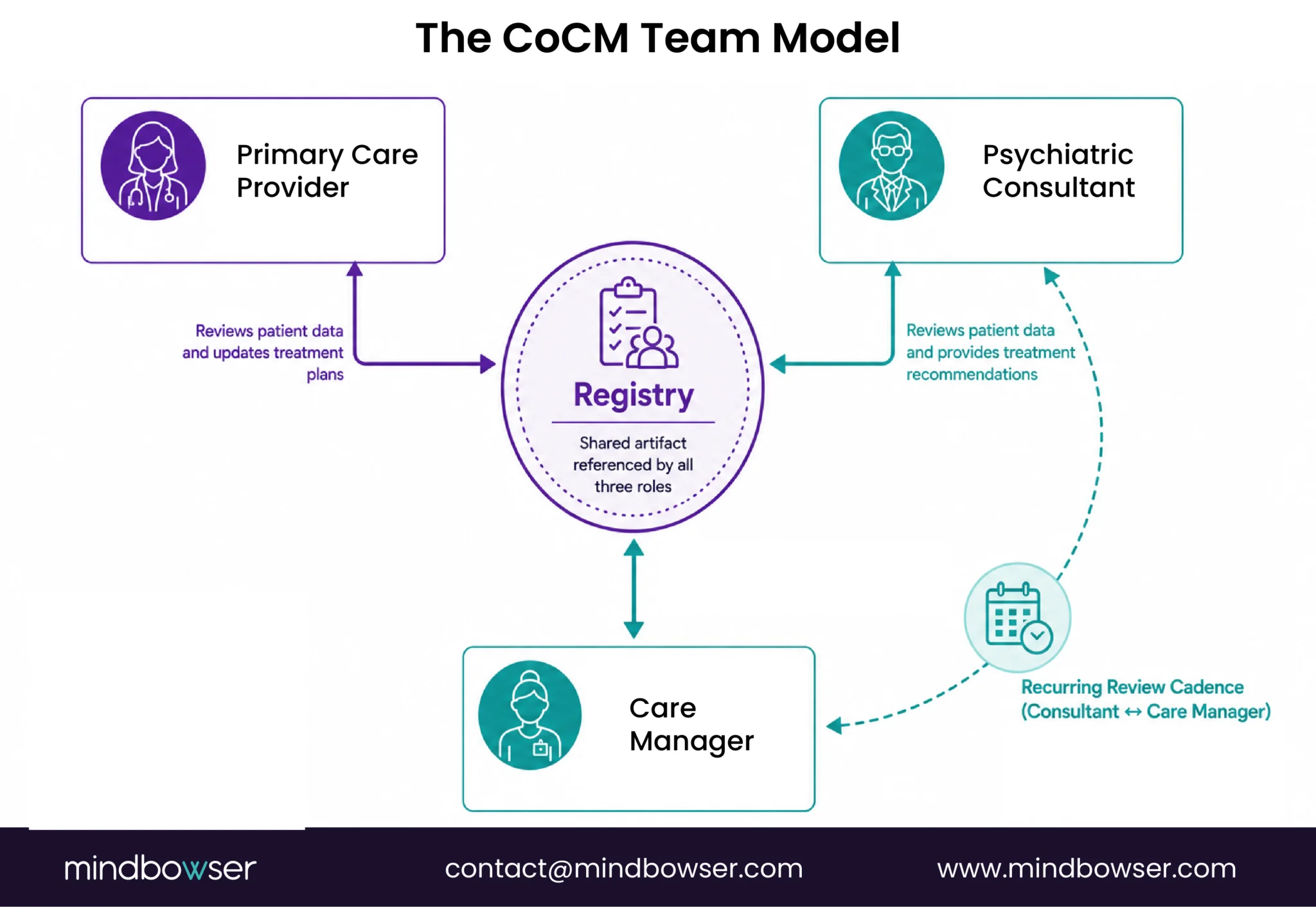
The Collaborative Care Model runs on a specific team structure: a primary care provider, a psychiatric consultant who reviews cases on a scheduled cadence without necessarily seeing the patient directly, and a care manager who tracks the caseload day to day. That structure only works if the technology underneath it does three things well.
First, registry-based caseload tracking. The care manager needs a running list of every patient in the program, their current status, and where they sit against a target, not a manual spreadsheet someone updates on Fridays. Second, validated instrument tracking as the actual measurement backbone. PHQ-9 for depression, GAD-7 for anxiety, scored consistently and trended over time, because the whole model depends on demonstrating improvement, not just documenting contact. This is exactly the territory our measurement-based care piece covers in more depth: CoCM doesn’t work without a real measurement-based care backbone underneath it, they’re the same infrastructure problem viewed from two angles. Third, a genuine handoff mechanism between the psychiatric consultant’s recommendations and the care manager’s day-to-day actions, so a case review doesn’t just generate a note that nobody acts on.
Behavioral health integration is the broader version of the same problem: instead of one structured team model, it’s the general work of connecting behavioral health into primary care, hospital, and social-service systems so a patient’s full picture is visible wherever they show up. Same underlying requirement, wider scope.
The Data Aggregation Problem Nobody Names Directly
Here’s what most conversations about BHI skip past: only about 19% of behavioral health facilities participate in a health information exchange, per ONC’s 2024 data brief on EHR adoption and exchange capabilities in behavioral health facilities. That’s not a rounding error. That’s one of the biggest reasons collaborative care technology is hard to build, and it’s rarely stated plainly.
Most healthcare technology conversations treat interoperability as a compliance checkbox, something you handle with an integration engine and move on. In behavioral health specifically, the data isn’t just siloed, it’s siloed across systems that were never designed to talk to each other in the first place: claims systems built for payment, EHRs built for clinical documentation and rarely built with BHI data-sharing in mind, referral tracking built as its own standalone workflow, and social determinants of health data that, until recently, most systems didn’t capture at all. A care team trying to coordinate across all four is doing manual integration work in their heads, every single day, for every patient.
The EHR piece deserves its own callout, because it’s the source most people assume is already solved. A behavioral health-specific EHR handles session notes, treatment plans, and billing well. It was not built to expose a patient’s status to a primary care provider’s system, a hospital’s ADT feed, or a payer’s claims data in real time. That’s a different integration surface entirely, and it’s usually the one a BHI build discovers is missing only after the clinical workflow is already designed around an assumption that it exists.
How We Solved This at 3 Million Lives
Alera Health runs ONEcare Networks, a system connecting primary care, behavioral health, hospitals, social services, and payers for over 3 million patients across the United States. Their care teams had exactly the problem above: a care manager working with a patient who had a behavioral health diagnosis, an active referral, a housing instability flag, and a recent ED visit had to pull that picture from claims data, EHR records, a referral system, and an SDOH assessment tool, each living separately.
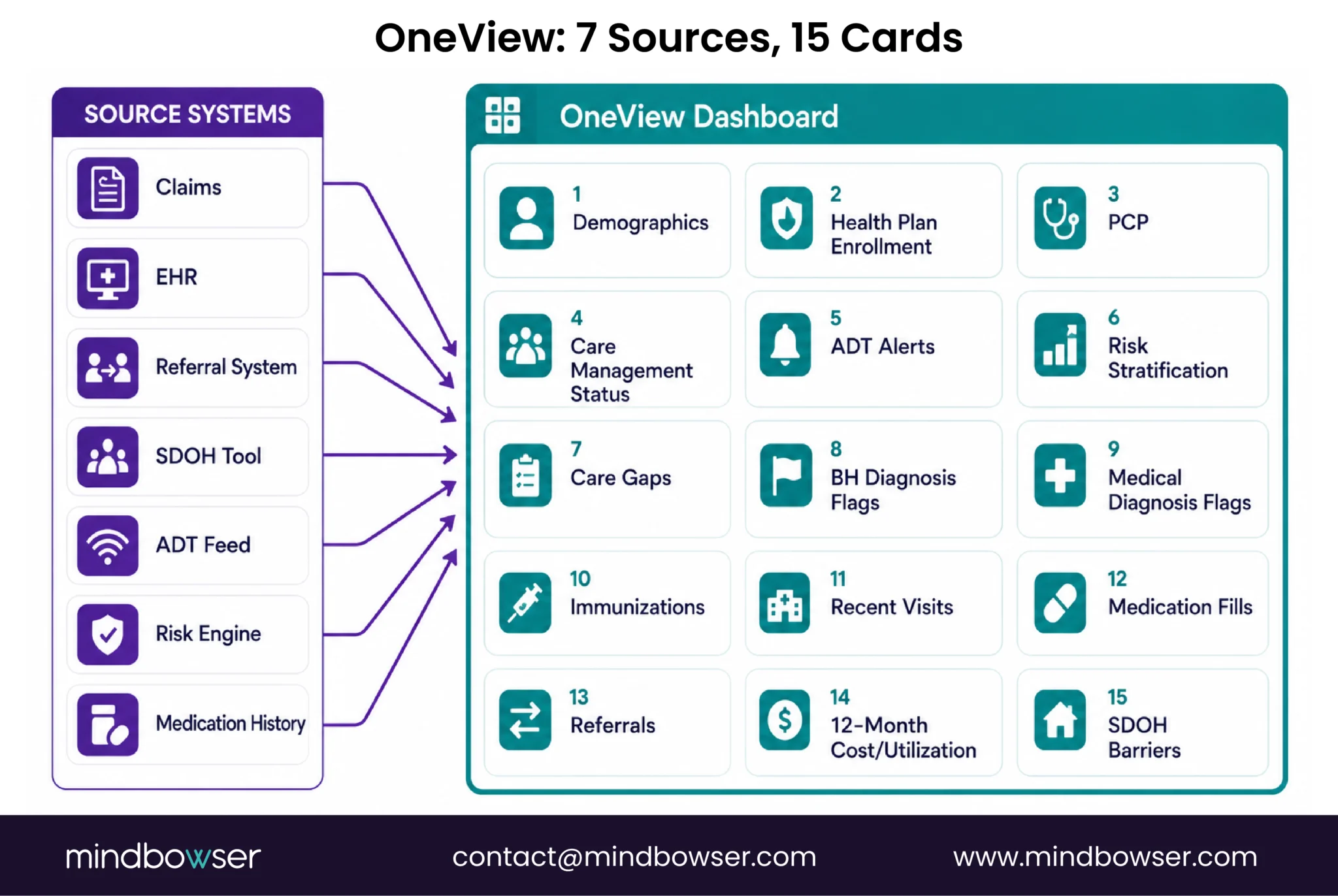
We built OneView, a longitudinal patient dashboard that pulls seven data sources into fifteen clinical and operational cards on a single screen: demographics, health plan enrollment, primary care provider, care management status, real-time ADT alerts, risk stratification, care gaps, behavioral health diagnosis flags, medical diagnosis flags, immunizations, recent visits, medication fill history, referrals, twelve-month cost and utilization, and SDOH barriers. A care manager searches by patient name and date of birth, or by Medicaid ID, and gets the complete picture in one screen instead of five.
The engagement ran a four-week discovery phase auditing Alera’s legacy .NET application and Azure data access patterns, then built and deployed OneView between October 2025 and January 2026. It went live on schedule, hit 99% uptime from day one, and had zero critical or major bugs in the first thirty days. SonarQube graded the codebase A.
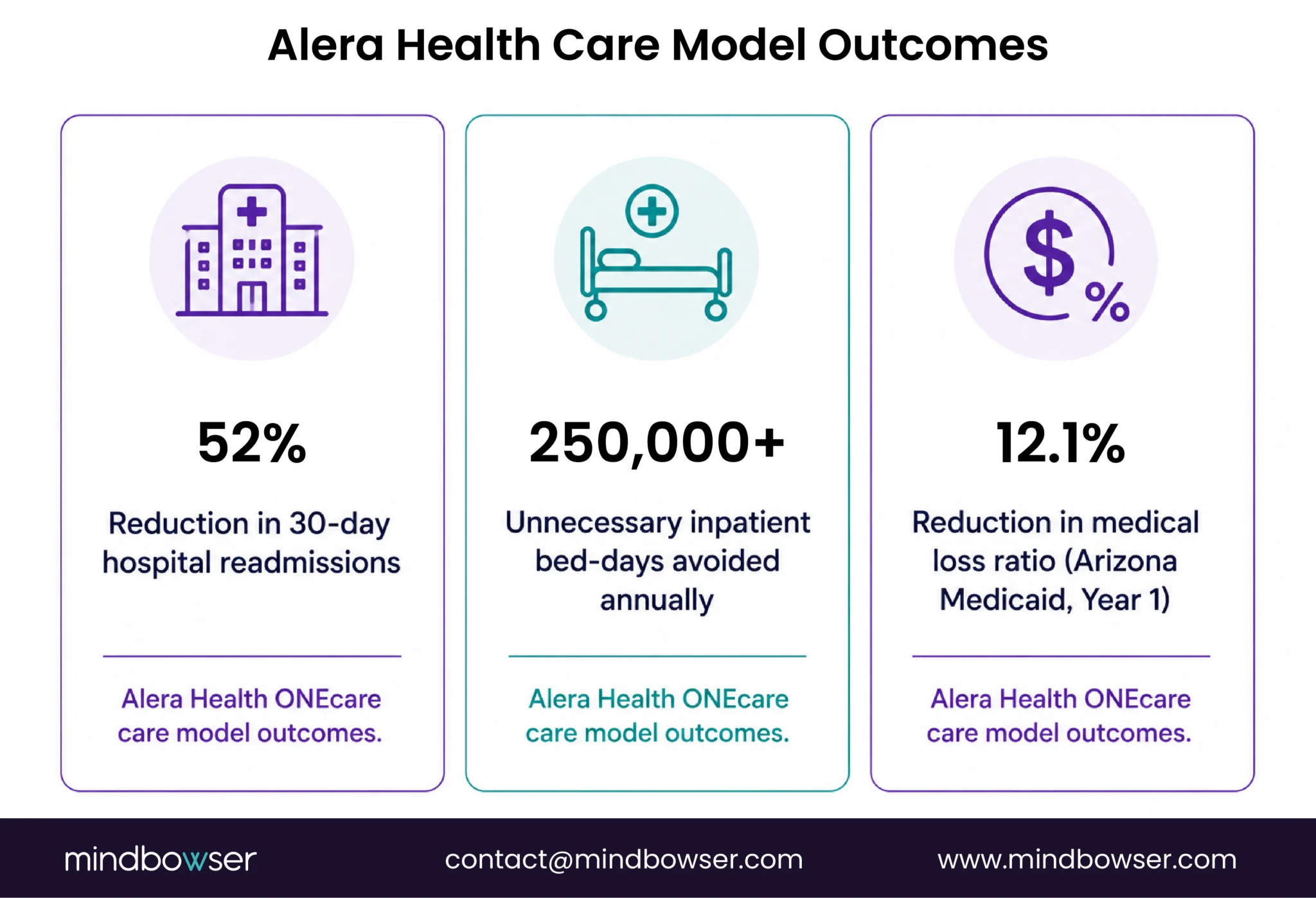
Alera’s own care model, the clinical program OneView now runs on top of, has produced a 52% reduction in 30-day hospital readmissions, over 250,000 unnecessary inpatient bed-days avoided annually, and a 12.1% reduction in medical loss ratio in one Arizona Medicaid network in its first year. I want to be precise about what that means: those are outcomes from Alera’s broader ONEcare care model, not a claim that OneView itself produced them. What OneView does is give the care teams running that model the unified view they need to keep making decisions like that at scale, instead of losing time to the five-login problem while the model’s own value depends on speed.
Why Read-Only Architecture Is a Feature, Not a Limitation
One design decision on OneView is worth explaining because it’s the kind of thing that looks like a limitation until you understand why it’s there. OneView reads from finalized Azure data tables. It never writes back to any source system.
That sounds like it should be a constraint. It’s actually what makes the aggregation trustworthy. If a unified dashboard could write back into claims, EHR, or referral systems, every integration point becomes a place where a sync conflict or an accidental overwrite can corrupt a system of record that other tools and other care teams depend on. Read-only removes that risk category entirely. Care teams get the complete picture; the underlying systems of record stay exactly as authoritative as they were before OneView existed. For a network spanning multiple independent behavioral health organizations, that distinction matters even more, because agency-level data separation is enforced at the API layer, not just the UI. A care manager at one agency cannot see patients managed by another agency, and that access control runs on the backend, so the data never reaches a browser it isn’t authorized for.

Registry Tracking and Risk Stratification for BH Populations
Come back to the CoCM registry requirement with this architecture in mind. A registry that shows risk scores and care gaps only earns its keep if the underlying data is current, which means the ADT feed (admission, discharge, transfer events) has to update in something close to real time, not batch-refresh overnight. OneView’s risk stratification card shows a trend line, not just a current score, because a care manager needs to know if a patient is heading in the wrong direction before a crisis forces the issue. The same is true of the care gaps card, which tracks screening metrics like depression scores and A1c against when they were last refreshed, so a stale data point doesn’t get mistaken for a current one.
This is the part of collaborative care technology that’s easy to describe and genuinely hard to build correctly: not just displaying data, but making sure the staleness of that data is visible to the person making a clinical judgment call based on it.
Registry tracking also feeds directly into quality reporting, which is where a lot of CoCM programs run into a second, separate build problem. Payers and CMS increasingly want to see outcomes tied to standardized quality measures, not just internal dashboards. Our HEDIS measures guide covers how those measure definitions actually work; the practical point here is that a registry built only for internal care-team use, without an eye toward how its data maps to the measures a payer contract requires, usually ends up needing a second integration pass later to bolt on quality reporting. Building the registry with that mapping in mind from the start is cheaper than retrofitting it.
Build Technology That Enables Integrated Behavioral Healthcare.
CMS Is Paying Attention: The New CY2026 BHI Codes
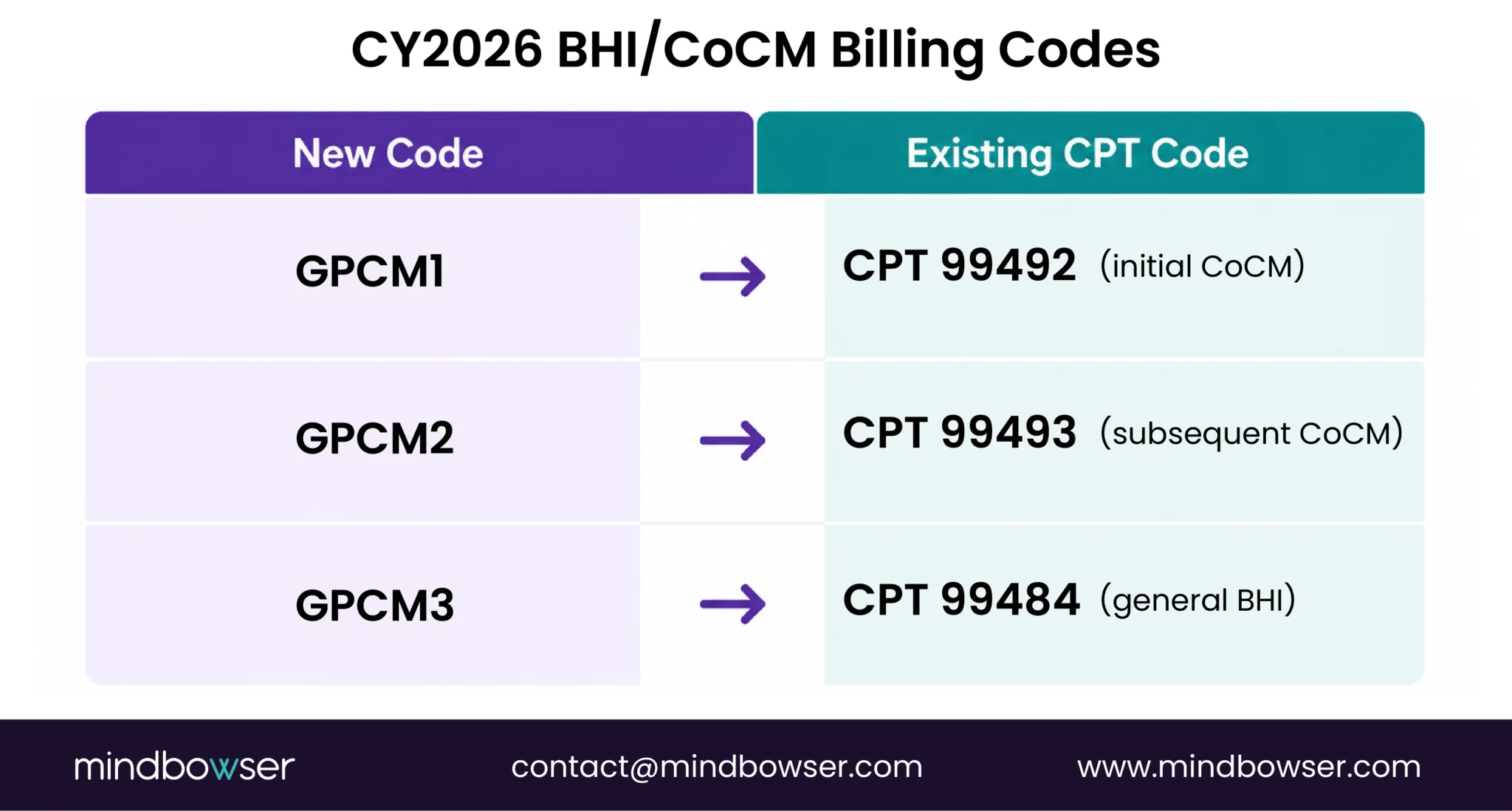
The regulatory momentum behind this is real and current. The CY2026 Medicare Physician Fee Schedule Final Rule, finalized October 31, 2025 and published in the Federal Register November 5, 2025, introduced three new billing codes, GPCM1, GPCM2, and GPCM3, as optional add-ons to Advanced Primary Care Management base codes. GPCM1 mirrors the existing CPT 99492 (initial CoCM), GPCM2 mirrors CPT 99493 (subsequent CoCM), and GPCM3 mirrors CPT 99484 (general BHI), effective January 1, 2026.
I’ll stay in my lane here rather than go deep on billing mechanics, since the reimbursement rules and documentation requirements for these codes are genuinely a different discipline from the clinical-workflow technology this piece covers. What matters for a platform decision is the direction: CMS is actively building more reimbursement pathways for collaborative care and BHI, not fewer, which changes the ROI math for a health system or practice deciding whether to invest in the technology now.
What’s Still Being Built: FHIR BH Profiles and the Interoperability Standard Gap
Here’s something I won’t oversell. ASTP and SAMHSA are running a $20 million initiative to develop a USCDI+ Behavioral Health dataset and FHIR BH Profiles, standardized ways for behavioral health data to move between systems. That work is targeted for completion by the end of 2026. It isn’t done yet.
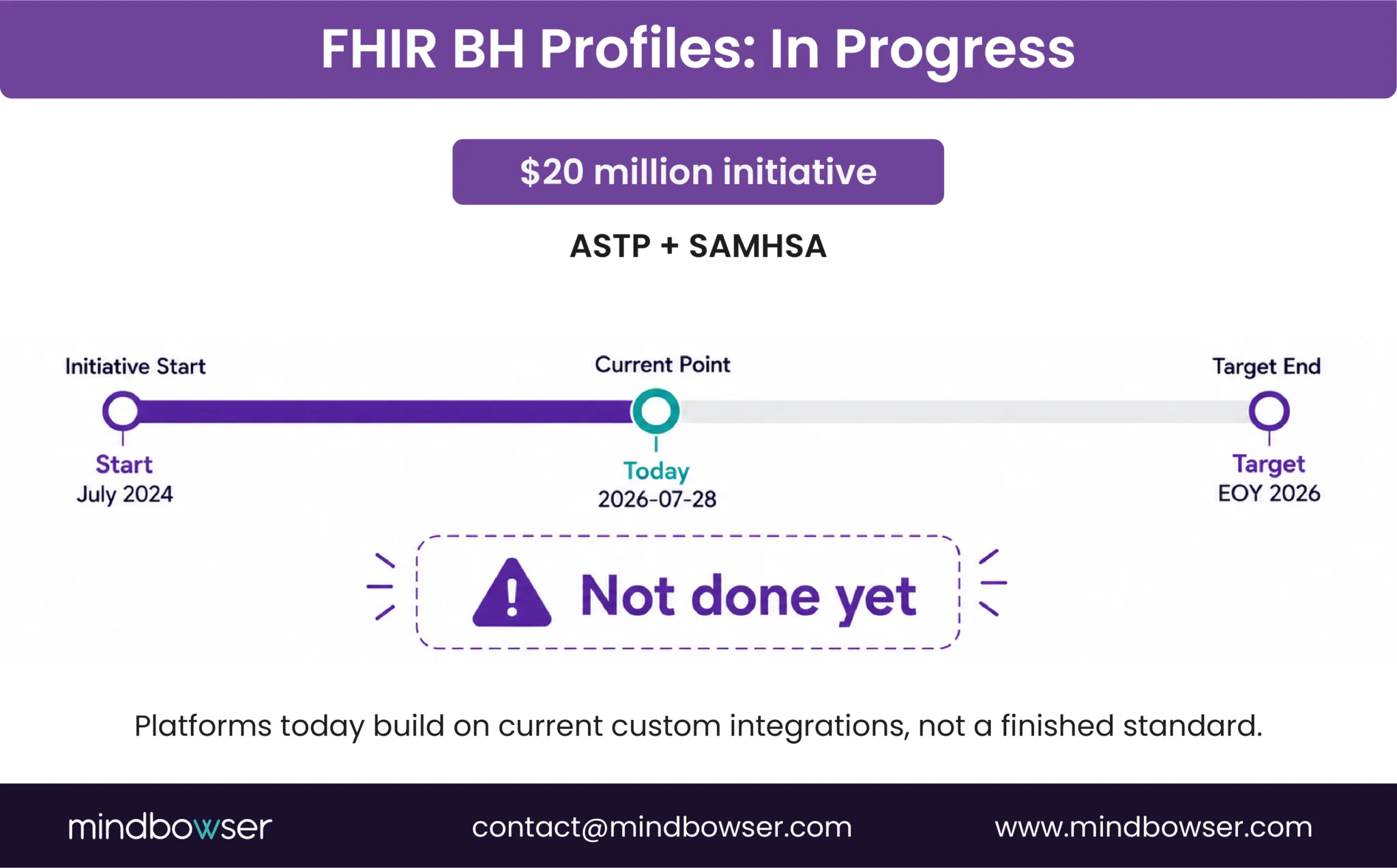
That means any platform built today for BHI or CoCM is building against the specific data sources and formats that actually exist right now, custom integration work, not a finished national standard it can plug into. That’s not a criticism of the effort, standards work like this takes the time it takes, but it’s worth being honest about instead of implying a plug-and-play interoperability layer exists when it doesn’t yet.
Consent Management for Integrated BH Data
Any integrated behavioral health platform touching SUD-related records has to account for 42 CFR Part 2 consent and redisclosure rules, which are meaningfully stricter than HIPAA alone in ways that catch teams off guard. I’m not going to re-explain the mechanics here since we’ve covered the specifics elsewhere, redisclosure notices, the consent-scope requirements, the exceptions that get misunderstood most often, but it’s worth flagging directly: a BHI/CoCM aggregation layer that pulls SUD-adjacent data has to enforce Part 2’s consent boundaries at the same architectural level OneView enforces agency-level access separation. It’s the same category of problem, just a different rule set.
Practically, this means a registry or dashboard can’t apply one access-control model uniformly across every patient record. A patient with a documented SUD diagnosis needs their record flagged so downstream redisclosure notices attach automatically when that data moves between systems, the same way OneView flags which agency a given patient belongs to before any care manager can view them. Bolt this on as an afterthought and you end up with a registry that’s technically HIPAA-compliant but silently non-compliant with Part 2 the first time a care team shares a consolidated view with a referral partner who didn’t have the right consent on file.
How Mindbowser Helps
For the care-team summary and documentation side of this, AI Medical Summary generates clinical summaries adjusted for the reviewing specialty directly from raw EHR records, cutting documentation time by roughly half and improving accuracy by about 45% in the deployments we’ve measured. In a collaborative care setting specifically, that means a psychiatric consultant reviewing a caseload gets a synthesized picture instead of raw chart data to parse manually, which is exactly the kind of handoff friction that breaks the CoCM model in practice.
What that accelerator doesn’t do: it doesn’t map your specific data sources into a unified registry, and it doesn’t build the agency-level or Part 2-aware access controls a multi-organization network needs. That’s the integration architecture work OneView represents, custom to the systems a given health system or network already has in place, because there’s no way to build that generically until the FHIR BH Profile standard actually lands.
This is where I’d push back on any vendor pitching a pre-built, plug-and-play BHI or CoCM platform as a drop-in fit for your organization. The registry logic, the risk-stratification thresholds, and the access-control boundaries all depend on which EHR you run, which referral partners you work with, which state’s Medicaid rules apply, and how many independent agencies need data separated from each other. A platform built for one health system’s data sources doesn’t map cleanly onto another’s without real integration work, and the honest version of that conversation starts with an assessment of your specific systems, not a demo of someone else’s.
If you’re a health system or a practice group trying to figure out what this build actually takes, that’s the conversation worth having before committing to a vendor platform that may not be built for the specific data sources you’re working with.
For the care-team summary and documentation side of this, AI Medical Summary generates clinical summaries adjusted for the reviewing specialty directly from raw EHR records, cutting documentation time by roughly half and improving accuracy by about 45% in the deployments we’ve measured. In a collaborative care setting specifically, that means a psychiatric consultant reviewing a caseload gets a synthesized picture instead of raw chart data to parse manually, which is exactly the kind of handoff friction that breaks the CoCM model in practice.
What that accelerator doesn’t do: it doesn’t map your specific data sources into a unified registry, and it doesn’t build the agency-level or Part 2-aware access controls a multi-organization network needs. That’s the integration architecture work OneView represents, custom to the systems a given health system or network already has in place, because there’s no way to build that generically until the FHIR BH Profile standard actually lands.
This is where I’d push back on any vendor pitching a pre-built, plug-and-play BHI or CoCM platform as a drop-in fit for your organization. The registry logic, the risk-stratification thresholds, and the access-control boundaries all depend on which EHR you run, which referral partners you work with, which state’s Medicaid rules apply, and how many independent agencies need data separated from each other. A platform built for one health system’s data sources doesn’t map cleanly onto another’s without real integration work, and the honest version of that conversation starts with an assessment of your specific systems, not a demo of someone else’s.
If you’re a health system or a practice group trying to figure out what this build actually takes, that’s the conversation worth having before committing to a vendor platform that may not be built for the specific data sources you’re working with.
Collaborative care and behavioral health integration read as clinical initiatives, but the ones that actually work are the ones where someone took the data architecture seriously first. If you’re evaluating what that build looks like for your own network, request an assessment and we’ll walk through what your specific data sources actually require.
CoCM is a structured behavioral health delivery model where a primary care provider, a psychiatric consultant, and a care manager work as a team, with the care manager tracking a registry of patients and the psychiatric consultant reviewing cases on a scheduled cadence, typically without seeing the patient directly.
BHI is the broader practice of connecting behavioral health services into primary care, hospital, and social-service systems so a patient’s full clinical and social picture is visible across every setting they interact with, rather than confined to a single specialty silo.
CoCM is a specific, structured team model with defined roles and billing codes. BHI is the wider umbrella of connecting behavioral health data and services across a care ecosystem, which can include CoCM as one implementation but also covers broader data-sharing and care-coordination work outside that specific team structure.
At minimum: claims data, EHR clinical records, referral status, and social determinants of health data such as housing, transportation, and food security. Real-time admission/discharge/transfer (ADT) alerts and validated screening instrument scores (PHQ-9, GAD-7) are what turn that aggregated data into something a care team can act on rather than just view.