













 BLOGS
BLOGS  NEWSROOM
  CASE STUDIES
  WEBINARS
  PODCASTS
  ASSET HUB
  EVENT CALENDAR























TL;DR
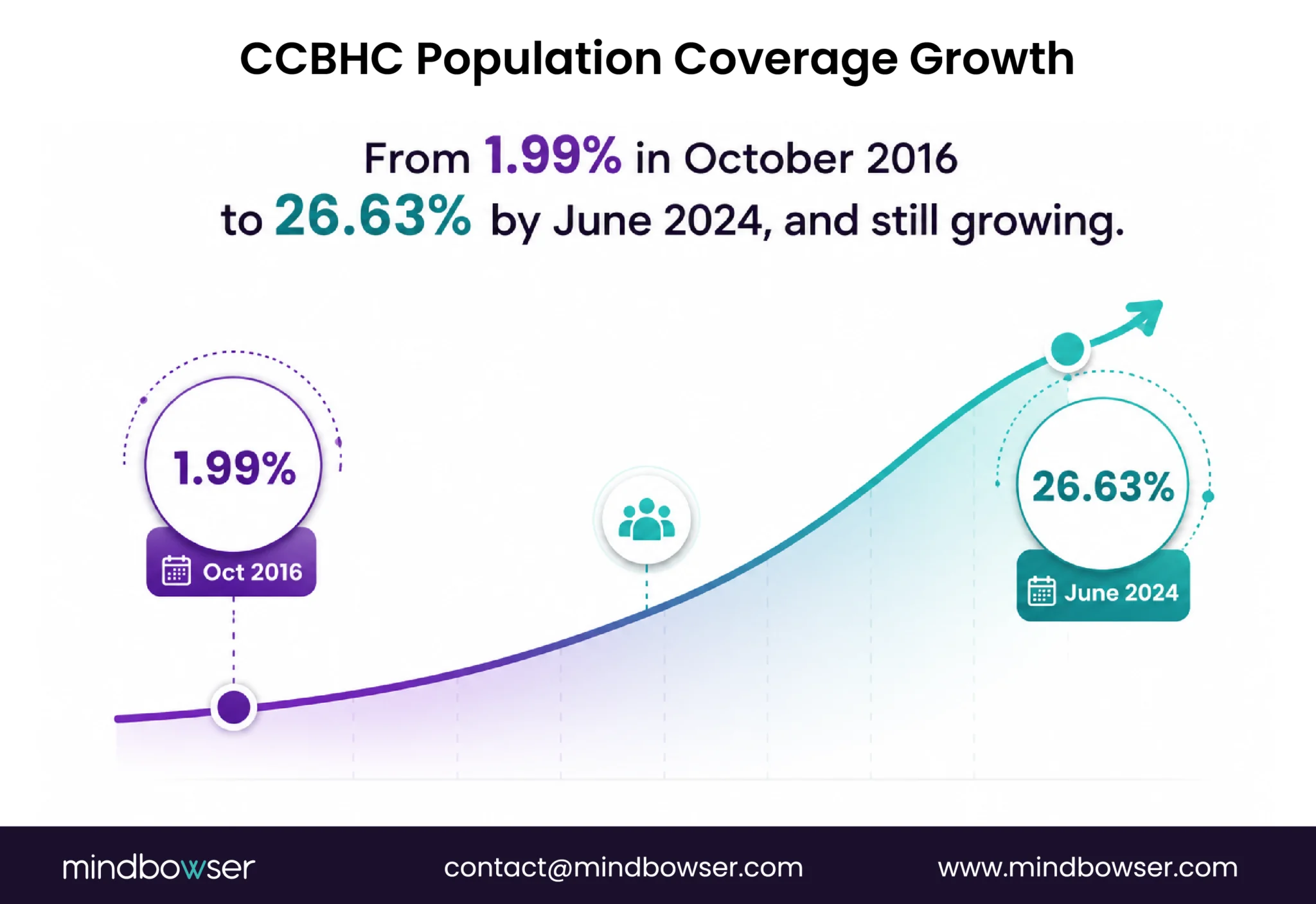
CCBHC coverage of the US population grew from 1.99% in October 2016 to 26.63% by June 2024, and it’s still expanding. That growth is running headlong into a technology problem: most CCBHCs are community mental health centers founded in the 1960s and 70s, running systems built for a much narrower service model than CCBHC certification now requires. This piece covers what CCBHC certification actually demands technically, where the funding is coming from, and why modernizing a legacy system is a different problem than building one from scratch.
The Expansion Is Real, and It’s Still Happening
I want to start with a number that gets cited constantly and usually without its actual context. CCBHC service-area population coverage grew from 1.99% in October 2016 to 26.63% by June 2024, according to a JAMA Health Forum analysis. That’s real, national growth, and it’s ongoing as more states join the Medicaid demonstration program. If you run a legacy community mental health center and haven’t felt pressure yet to modernize toward CCBHC requirements, that pressure is coming, because the reimbursement and funding structure is shifting in that direction.
Here’s the part that doesn’t get said enough: many of the organizations facing this transition aren’t young platforms bolting on a new capability. They’re nonprofits founded in the 1960s and 70s, when community mental health centers first emerged as a policy response to deinstitutionalization. Their technology, in a lot of cases, was built for that era’s much narrower scope, individual outpatient therapy, medication management, maybe case management. CCBHC certification asks for something structurally different.
What Makes a CCBHC Different From a Standard CMHC
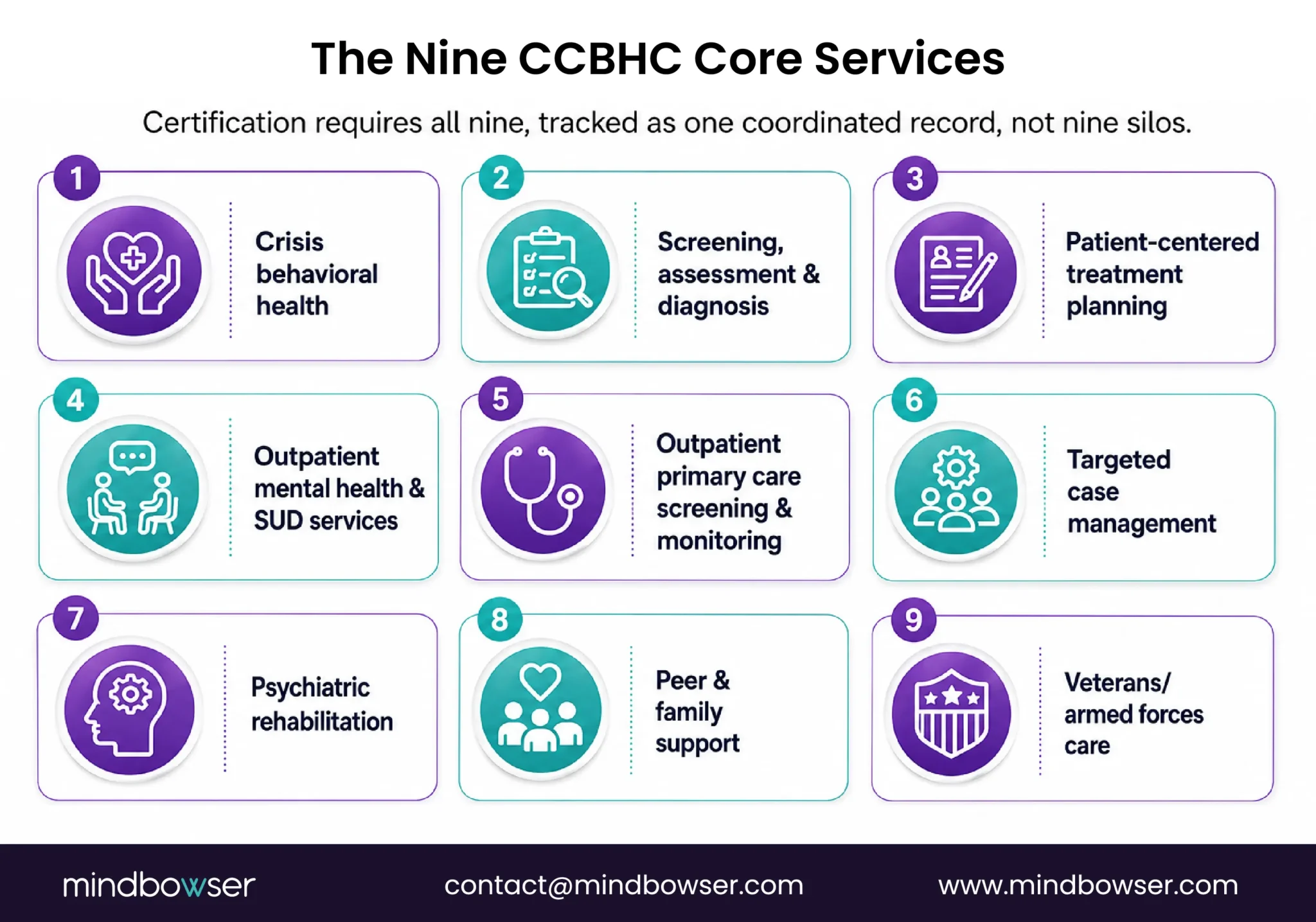
A Certified Community Behavioral Health Clinic isn’t just a community mental health center with a new name. Certification requires that nine specific core services be available to patients, whether delivered directly or through a formal partnership with a designated collaborating organization: crisis services; screening, assessment, and diagnosis; person-centered and family-centered treatment planning; outpatient mental health and substance use services; primary care screening and monitoring; targeted case management services; psychiatric rehabilitation services; peer supports and family/caregiver supports; and community care for uniformed service members and veterans. The model is often described as “no wrong door,” meaning a patient who walks in for any one of these services gets connected to whatever else they need, not routed elsewhere and lost in the handoff.
That’s a real technology requirement, not a service-brochure description. A mental health EHR built for individual outpatient therapy usually wasn’t designed to track a patient across crisis intervention, primary care screening, peer support, and case management as one coordinated record.
The Funding Behind the Expansion
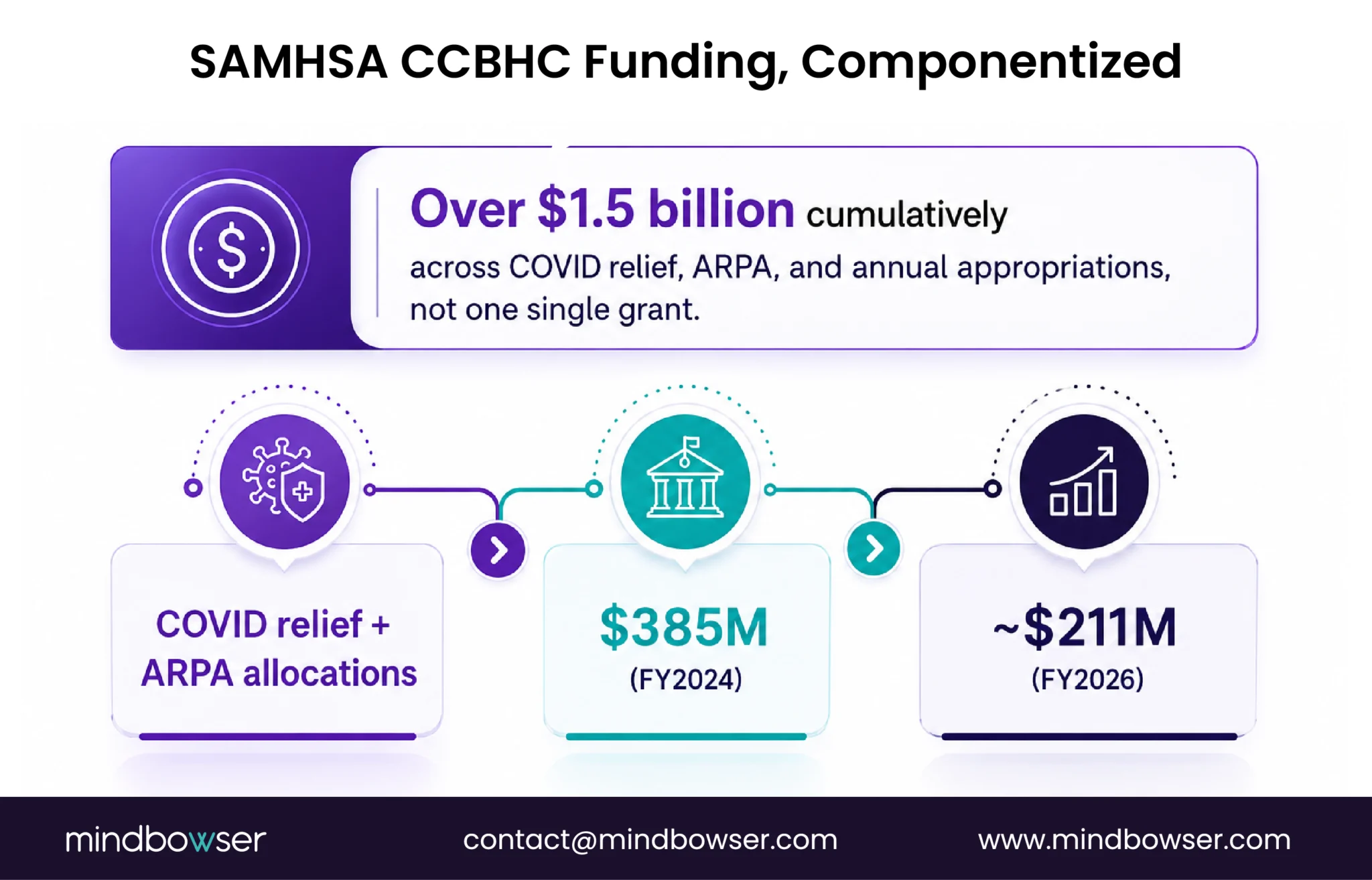
CCBHC funding comes from two main sources, and it’s worth being precise about the actual numbers rather than repeating a single unverified figure. SAMHSA has funded CCBHC expansion through a combination of COVID-era relief funding, American Rescue Plan Act allocations, and annual appropriations, cumulatively over $1.5 billion across these mechanisms, including a $385 million FY2024 appropriation and roughly $211 million more added for FY2026 (split between Planning grants and Improvement/Advancement grants). Separately, the CCBHC Medicaid demonstration program, which lets participating states get enhanced federal Medicaid matching for CCBHC services, has been extended and expanded multiple times since its 2017 launch, most recently with a long-term extension running through the early 2030s.
I’ll be direct about a number I chose not to use: an $8.5 billion Medicaid bundled-payment figure shows up in some secondary sources describing this expansion, and I couldn’t verify it against a primary CBO or CMS estimate. I’m leaving it out rather than repeating a number I can’t stand behind.
MAT and SUD Services Are a Certification Requirement, Not an Add-On
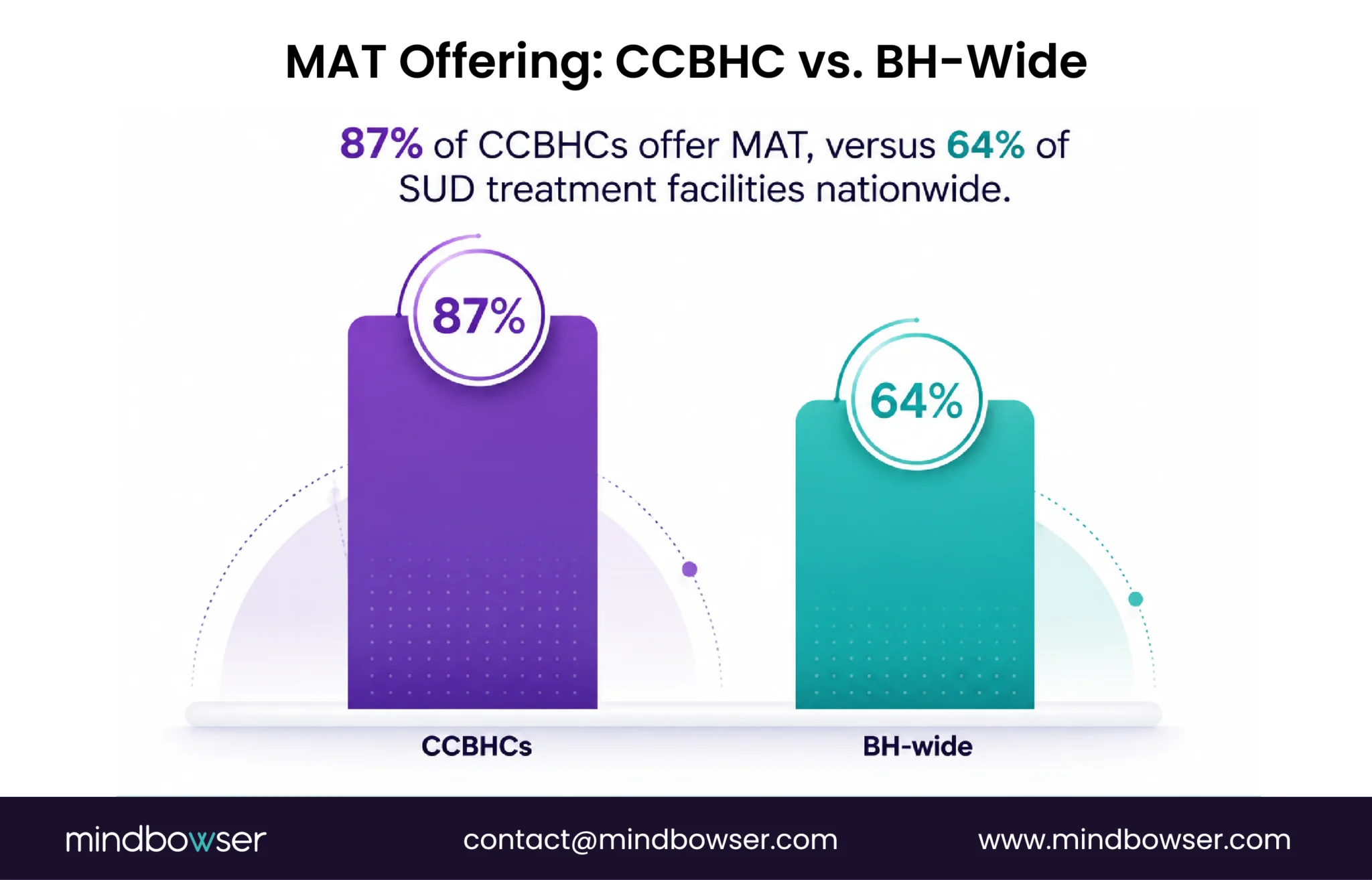
Substance use disorder services aren’t optional extras for a CCBHC, and that includes ensuring patients have access to medication-assisted treatment, whether a clinic delivers it directly or through a formal partner arrangement. Per the National Council for Mental Wellbeing’s 2024 CCBHC Impact Report, 87% of CCBHCs offer MAT directly, compared with 64% of substance use disorder treatment facilities nationwide. That gap matters technically: most CCBHC systems need to support MAT workflows directly, and because MAT touches controlled-substance prescribing and SUD-specific records, 42 CFR Part 2’s consent and redisclosure rules apply to that data, a compliance layer a standard outpatient-therapy EHR was never built to handle.
Planning Or Expanding A CCBHC Program?
Why Legacy CCBHC Systems Struggle With Modern Technology Requirements
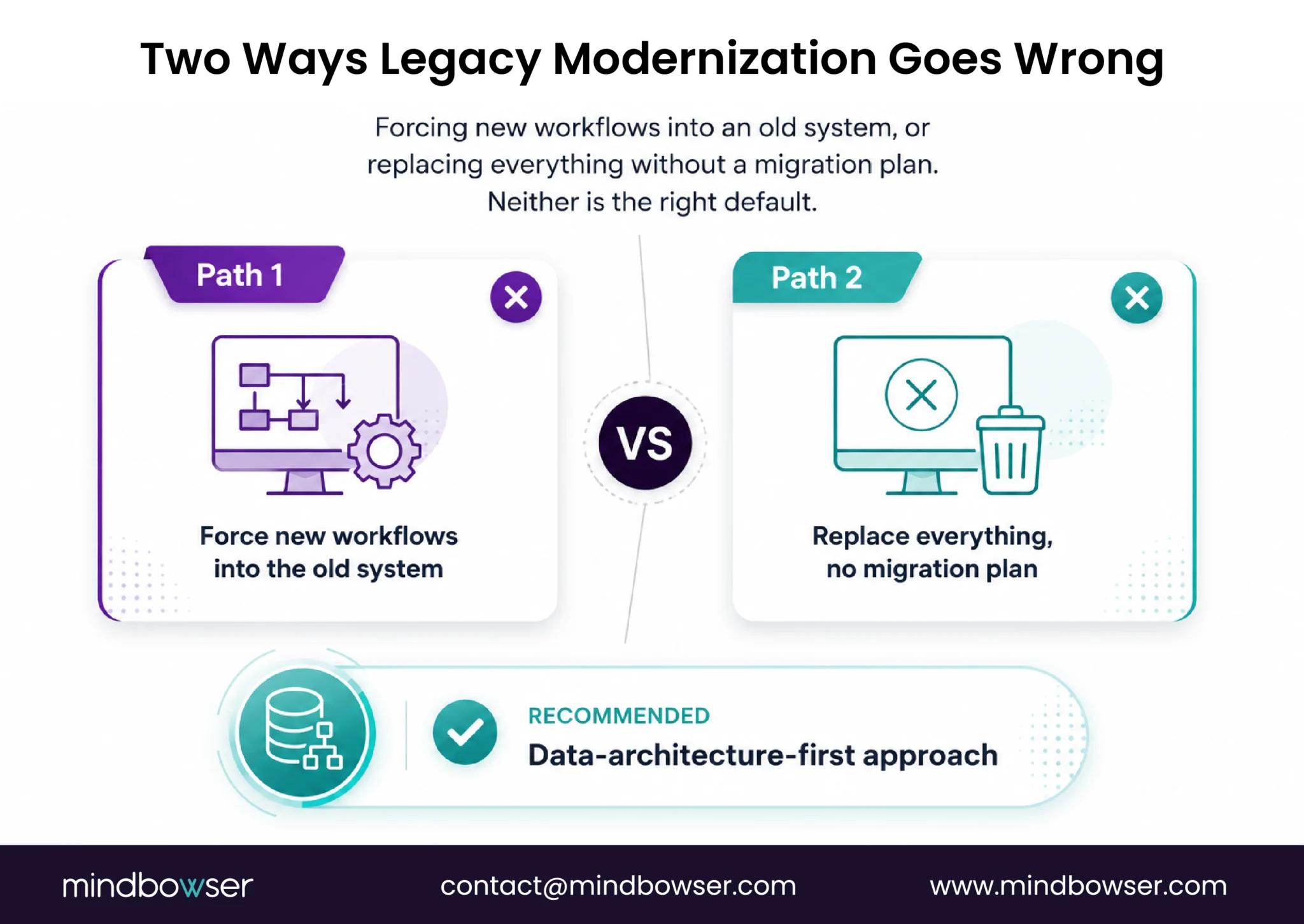
This is the crux of the modernization problem. A system built decades ago for a narrower service model wasn’t designed with today’s requirements in mind: FHIR-based interoperability that’s increasingly central to quality-measure reporting, coordinated data sharing across nine distinct service lines, or SUD-specific consent management layered on top of general behavioral health records. Retrofitting those requirements onto a legacy platform usually means one of two outcomes. Either the organization forces its new CCBHC workflows into a system that wasn’t built for them, creating the same kind of workaround-spreadsheet problem I’ve seen show up elsewhere in behavioral health technology, or it treats modernization as a full replacement project without a clear plan for migrating decades of patient history cleanly.
Neither is a good default. The organizations that handle this well treat it as a genuine data-architecture problem: what has to migrate, what has to integrate rather than migrate, and what workflow gaps the certification requirements expose that the current system was never asked to close.
What a CCBHC’s EHR Actually Has to Support
Concretely, a CCBHC-ready system needs to connect a patient’s care across all nine core services into one coordinated view, whether that’s a single unified record or tightly integrated systems working together, not nine separate silos. It needs to support quality-measure reporting, whether that reporting is built into the core system or handled through connected reporting infrastructure, since CCBHC certification and the Medicaid demonstration program both carry specific reporting requirements tied to continued funding. It needs to support the crisis-services and same-day-access components of SAMHSA’s “no wrong door” model without that becoming a separate, disconnected intake system. And for organizations with an integrated care model, one platform we helped build took to aggregating claims, EHR, referral, and social-determinants data into one longitudinal view is directly relevant here, not because it’s CCBHC-specific, but because the underlying data-aggregation problem, pulling a fragmented picture into one coordinated view, is the same technical challenge — one we also explore in our analysis of AI in mental health.
Is Your Technology Ready for CCBHC Certification?
Outcomes Reporting and the Hospitalization-Reduction Data
CCBHCs have real outcomes data behind them, and I want to cite it precisely rather than picking whichever number is most impressive. The National Council’s 2022 CCBHC Impact Report, a clinic self-report survey, found a 72% reduction in hospitalization among CCBHC patients. Their more recent 2024 report, using updated data, cites a 55% reduction. Both are real findings from the same reporting organization; the more recent figure is the one to cite now, and I’d treat the 72% figure as a 2022 data point specifically if you’re referencing it rather than a current statistic.
How Mindbowser Helps
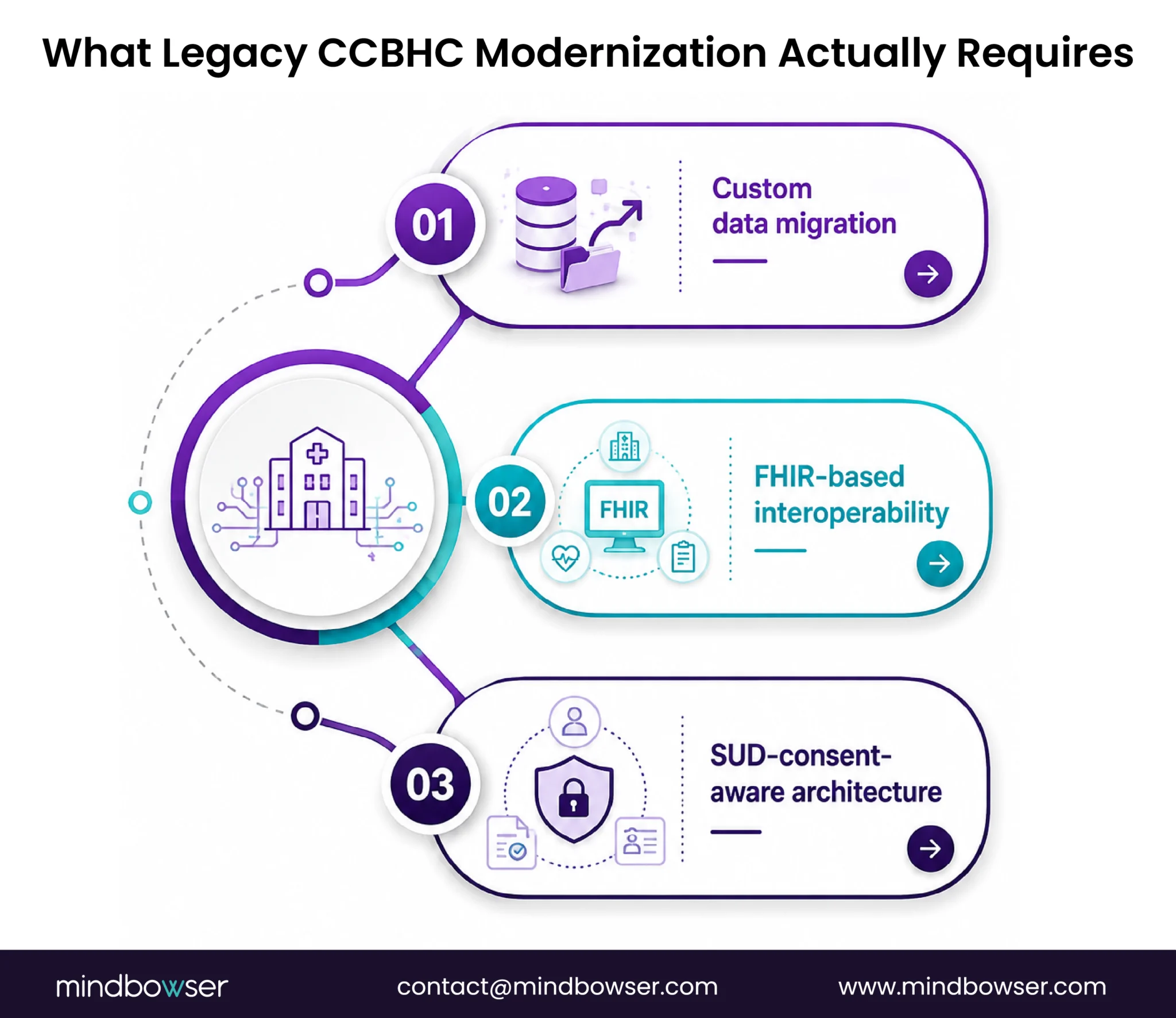
The technology-layer work a CCBHC modernization actually requires, legacy data migration, FHIR-based interoperability for quality reporting, and integrating SUD-specific consent management into a broader behavioral health record, is genuine custom-build work. There’s no packaged accelerator that migrates a specific legacy system’s twenty years of patient history, because that depends entirely on what that specific system is and how its data is structured. What we bring is direct experience with the underlying data-aggregation and access-control architecture this kind of modernization needs, the same category of problem we solved on one platform we helped build, which aggregates behavioral health data across more than 3 million lives.
What CCBHC Technology Decisions Look Like in Practice
What we bring is direct experience with the underlying data-aggregation and access-control architecture this kind of modernization needs, the same category of problem we solved on one platform we helped build, which aggregates behavioral health data across more than 3 million lives.