

 BLOGS
BLOGS  NEWSROOM
  CASE STUDIES
  WEBINARS
  PODCASTS
  ASSET HUB
  EVENT CALENDAR



















TL;DR
- Wearable integration connects devices like Apple Health, Fitbit, and Dexcom with healthcare systems
- It enables real-time patient monitoring and better clinical decisions
- Strong integration ensures secure data flow into EHRs and care platforms
- It is a key foundation for scalable remote patient monitoring solutions
Wearable integration in healthcare enables real-time patient monitoring, improves chronic disease management, and enhances remote care delivery. Seamlessly connecting wearable devices with EHR systems and clinical platforms allows healthcare providers to access continuous health data, leading to proactive interventions, reduced hospitalizations, and improved patient outcomes.
Wearable integration is the backbone of modern healthcare systems, enabling real-time data exchange between devices and clinical platforms.
This guide focuses on how wearable integrations work, including APIs, data flow, and real-world implementation in healthcare environments.
For a broader view of trends and future innovations, explore our guide on the future of wearable technology in healthcare.
The adoption of wearable health technology has grown, with devices like Apple HealthKit, Fitbit, Dexcom, and Garmin offering vital health insights. Integrating these wearables with FHIR-compliant healthcare systems ensures secure data exchange, allowing providers to track heart rate, glucose levels, activity trends, and more.
Let’s get to know more about wearable integration in healthcare:
What is Wearable Integration in Healthcare?
Wearable integration connects health-tracking devices with healthcare systems, enabling seamless data exchange between wearables, EHRs, and digital health platforms. These integrations allow real-time access to patient-generated health data, supporting remote monitoring, early intervention, and personalized care.
Wearables continuously generate vast amounts of health data, including heart rate, activity levels, and sleep patterns. Without proper integration, this data remains fragmented and underutilized. Standardizing and integrating wearable data ensures it becomes actionable, enhancing clinical decision-making and patient outcomes.
Successful wearable integration depends on three key factors: secure data-sharing connections, seamless compatibility with different healthcare systems, and strong security to protect patient information. Mindbowser makes this process simple, ensuring wearables work smoothly with healthcare platforms to improve patient care and real-time monitoring.
Related read: Choosing the Right Wearable App Development Company for Healthcare: A Complete 2025 Guide
What are the Challenges in Wearable Integration & Solutions?
Wearable devices are transforming healthcare by providing real-time health data, but integrating them with existing systems comes with challenges. Ensuring seamless wearable integration requires addressing data standardization, security, and usability concerns. Here’s a look at key obstacles and their solutions:
❌ Data Interoperability Issues
Wearable devices come with unique data formats and protocols. Standardizing this data for seamless communication with EHRs and healthcare platforms is a major challenge. Implementing FHIR-based wearable integration with interoperability solutions ensures smooth data exchange and consistency across systems.
Related Read: The Interoperability Challenge in Healthcare
❌ Privacy and Security Concerns
Handling sensitive patient data requires robust security measures. Wearables continuously transmit health metrics, making them vulnerable to breaches. Encrypting data, implementing multi-factor authentication, and ensuring HIPAA-compliant wearable integration help maintain privacy and secure patient information.
❌ Data Overload & Management
Massive amounts of health data can overwhelm healthcare systems, making it hard to extract meaningful insights. AI-driven analytics streamline wearable integration by filtering, analyzing, and transforming raw data into actionable insights that enhance patient care and decision-making.
❌ Integration Complexity
Integrating wearable data with healthcare systems is complex, requiring seamless connectivity with EHRs, patient portals, and clinical workflows. Development challenges include data standardization, security compliance, and interoperability issues. HealthConnect CoPilot simplifies this process with ready-to-use APIs, minimizing development efforts while ensuring secure and efficient data exchange.
Want to explore how to reduce integration friction with EHRs?
Read: Solving EHR Integration Challenges with Smart Software for Wearable Devices in Healthcare
❌ User Adoption & Accuracy Concerns
Patients may doubt the accuracy of wearable data or hesitate to rely on these devices for health monitoring. Educating users about the benefits and reliability of wearables, along with continuous validation of device accuracy, builds trust and encourages broader adoption of wearable integration in healthcare.
Addressing these challenges ensures a smoother integration process, improving patient outcomes and more efficient healthcare operations.
Struggling with Wearable Integration Challenges?
Let’s talk about how we can simplify your integration with ready-to-use APIs, FHIR compliance, and end-to-end security — without overhauling your existing system.
How Does Wearable Integration Enhance Patient Care?
Wearable devices have transformed how healthcare providers monitor patients beyond clinic walls. Integrating wearable data with healthcare systems ensures real-time insights, enabling proactive care and better health outcomes.
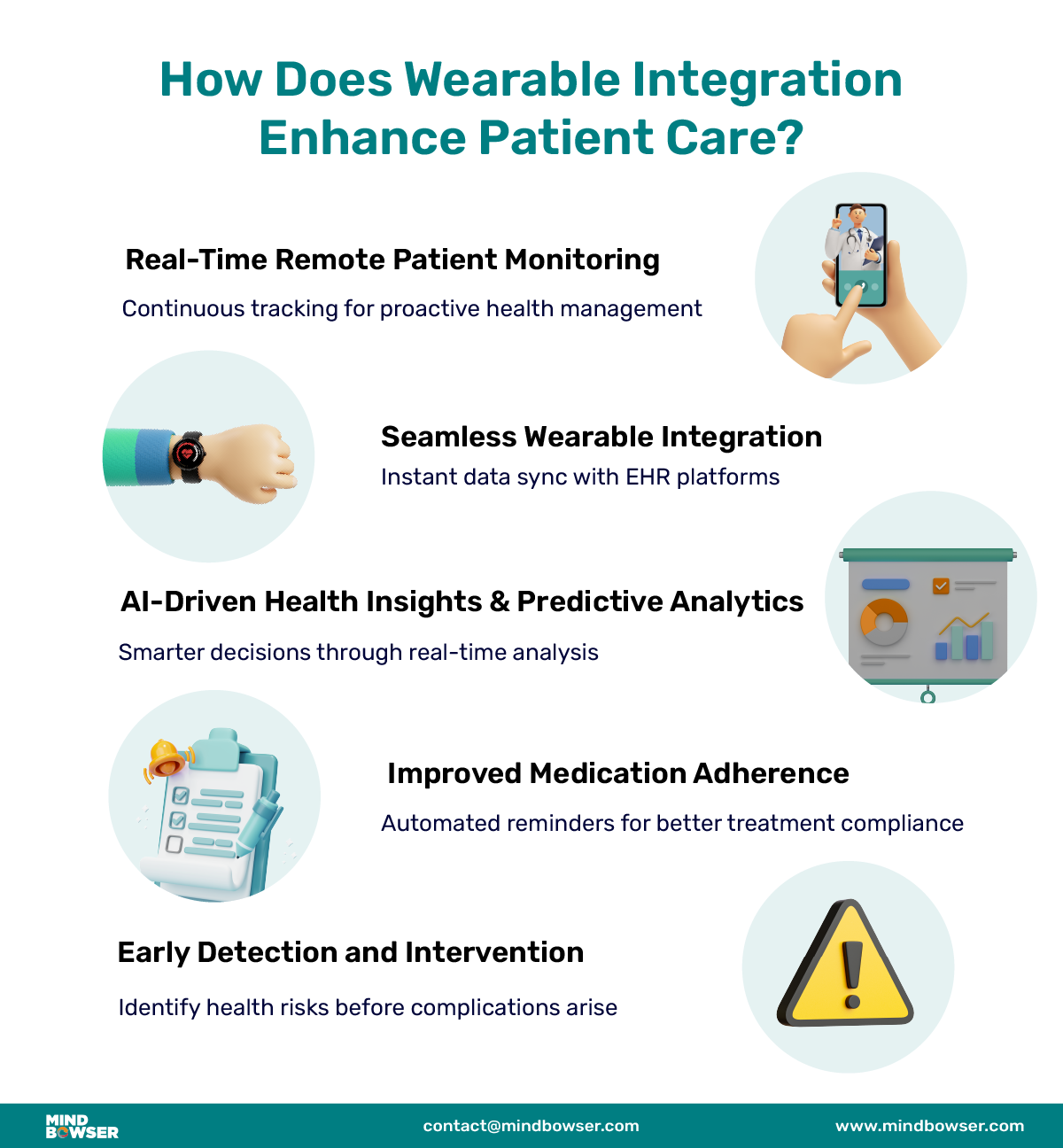
✅ Real-Time Remote Patient Monitoring
Wearables continuously track vitals such as heart rate, glucose levels, and oxygen saturation, enabling early detection and timely intervention.
Related Read: Patient Monitoring: A Guide for Healthcare Providers
✅ Seamless Wearable Integration with Healthcare Systems
Wearable APIs connect devices like Fitbit, Dexcom, and Apple Health with platforms like Epic and Cerner, ensuring real-time access to patient data.
✅ AI-Driven Health Insights & Predictive Analytics
Integrated systems use analytics to identify trends, detect risks early, and support better clinical decision-making.
Real-World Wearable Integration in Action
Built a proactive health app connecting Fitbit, Oura, Garmin, Apple HealthKit, and Google Fit to a unified patient dashboard using our WearConnect accelerator. Added OCR-based lab report parsing and an AI layer for predictive health insights. Result: 45% higher patient engagement, 90% AI prediction accuracy.
These platforms enable continuous health data flow, allowing care teams to monitor patient vitals in real time and take early action when risks are detected.
In these implementations, wearable data is securely integrated into clinical dashboards and care workflows, helping providers:
- Track patient health remotely
- Identify early warning signs
- Improve care coordination across teams
This approach is commonly used in building scalable remote patient monitoring solutions, where real-time data plays a critical role in improving outcomes and reducing hospital visits.
Real-World Wearable Integration in Action
We have built wearable-integrated healthcare platforms that connect devices like fitness trackers, glucose monitors, and smartwatches with centralized healthcare systems.
These platforms enable continuous health data flow, allowing care teams to monitor patient vitals in real time and take early action when risks are detected.
In these implementations, wearable data is securely integrated into clinical dashboards and workflows, helping providers:
- Track patient health remotely
- Identify early warning signs
- Improve care coordination
This approach is widely used in building scalable remote patient monitoring solutions.
Related read: Wearable Health Technology: Transforming Patient Care and Clinical Trials
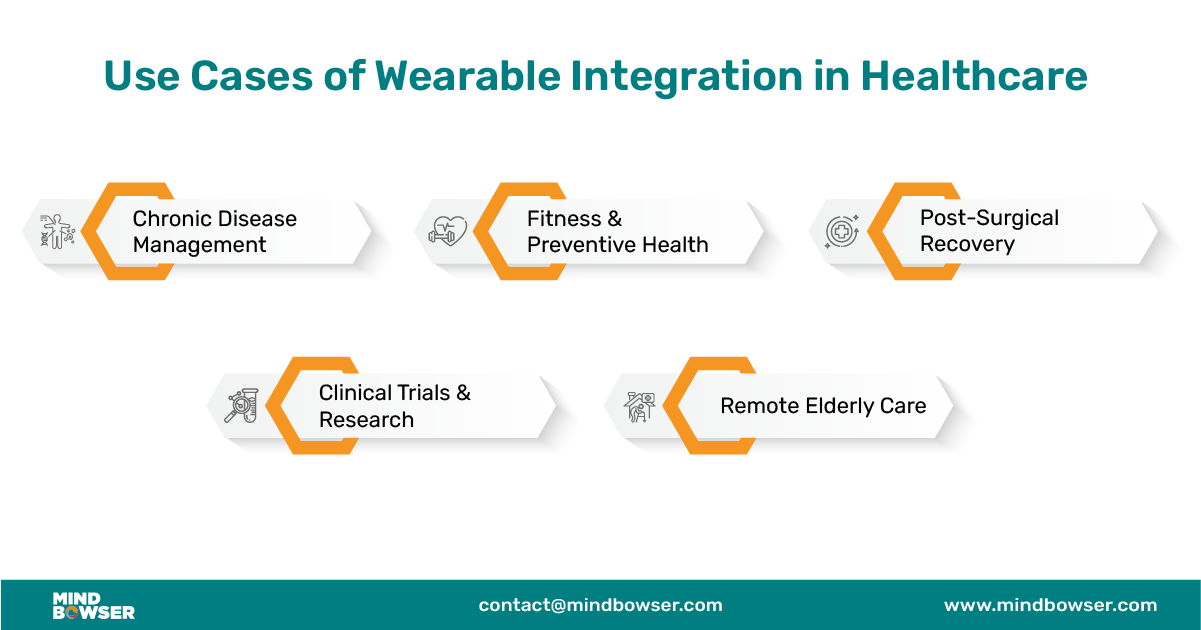
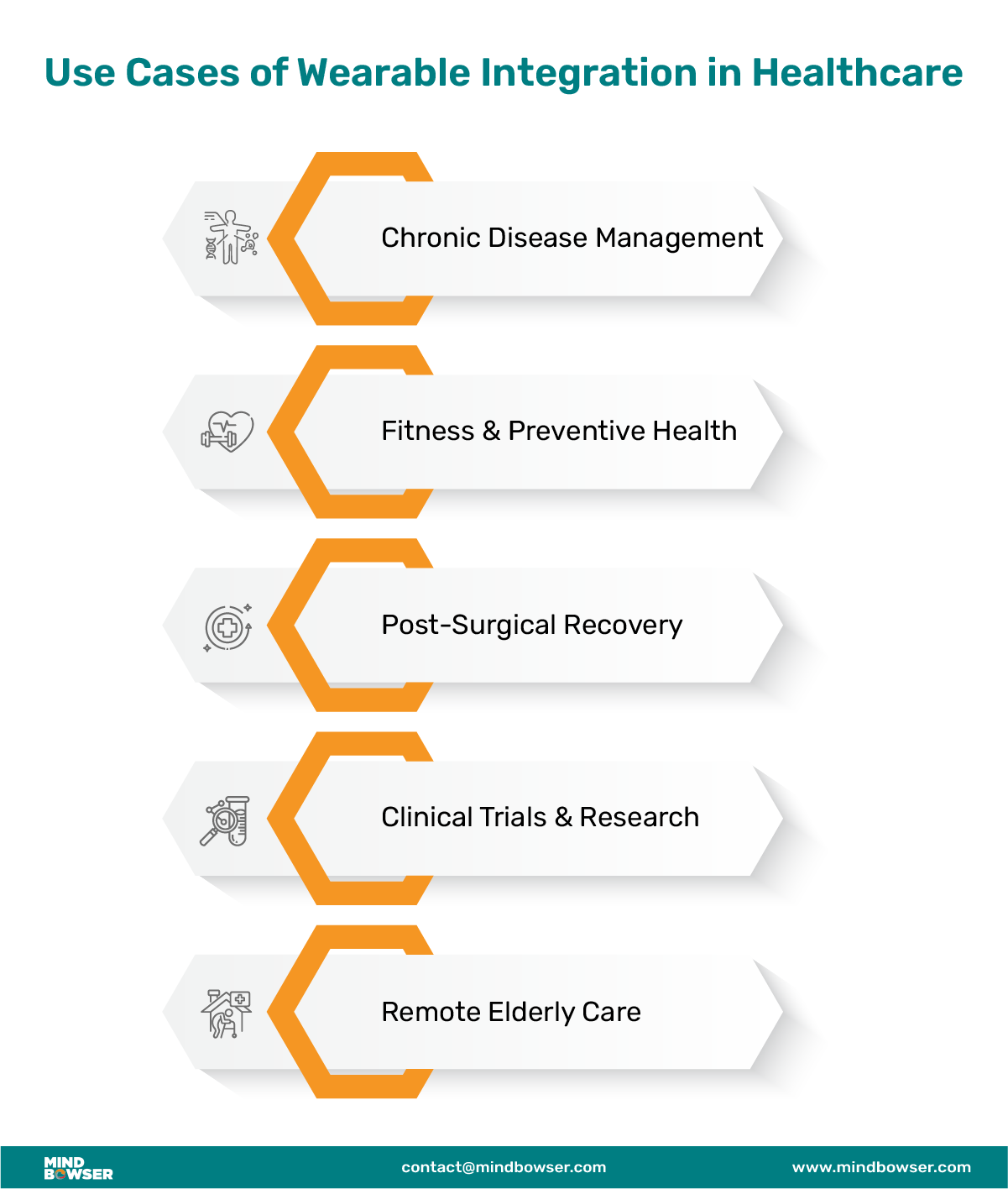
Key Use Cases of Wearable Integration
1️⃣ Chronic Disease Management
Continuous monitoring of conditions like diabetes and heart disease enables early intervention and better long-term care.
2️⃣ Post-Surgical Recovery
Wearables track recovery metrics such as heart rate and oxygen levels, helping providers detect complications early.
3️⃣ Remote Elderly Care
Wearables support elderly care through features like fall detection and continuous monitoring, enabling safer independent living.
4️⃣ Preventive Health
Wearables help track activity, sleep, and stress, supporting early intervention and wellness programs.
5️⃣ Clinical Research
Wearable data improves accuracy in clinical trials by enabling real-time patient monitoring.
3️⃣ Remote Elderly Care
Wearable devices enhance elderly care by enabling real-time health monitoring while allowing seniors to maintain independence. Features like fall detection, heart rate monitoring, and activity tracking provide caregivers with critical health insights, ensuring timely interventions. This continuous monitoring improves safety, supports proactive care, and enhances the well-being of elderly individuals.
Related Read: Revolutionizing Elderly Care Through Remote Patient Monitoring
4️⃣ Fitness & Preventive Health
Integrating wearables with healthcare apps allows users to monitor fitness, sleep, and stress levels. Providers can use this data for preventive care and wellness programs.
5️⃣ Clinical Trials & Research
Wearables collect real-time patient data for clinical studies, improving accuracy and patient engagement. API integration streamlines data sharing between researchers and healthcare organizations.
Want to Explore Use Cases Tailored to Your Healthcare Practice?
Discover how leading providers use wearables for chronic care, elderly support, and post-op recovery — and how you can too.
What are the Different Wearable Integrations in Healthcare?
Wearable integration in healthcare helps track vital health data, improving remote monitoring and patient care. These integrations are commonly used in building scalable remote patient monitoring solutions. By connecting popular wearables with healthcare platforms, providers can access real-time insights to enhance preventive care and chronic disease management.
Apple Health API Integration
Apple Health API connects iOS devices to share health data seamlessly, giving users and healthcare providers access to key metrics like heart rate, step count, sleep patterns, and blood oxygen levels. Integrating Apple Health with FHIR-based healthcare systems ensures smooth data exchange, enabling real-time monitoring and personalized care. This integration improves patient engagement and preventive healthcare by offering a unified view of health data.
These integrations are commonly used in building scalable remote patient monitoring solutions.
Fitbit API Integration
Fitbit API provides real-time health tracking, including steps, heart rate, exercise logs, and SpO2 levels. Healthcare providers can securely access this data to monitor patient fitness trends and improve wellness programs. While integration challenges like authentication and HIPAA compliance exist, Fitbit API integration helps in chronic disease management, remote monitoring, and proactive health recommendations.
Health Connect API Integration
Health Connect API (previously Google Fit) aggregates health data from multiple devices and apps, providing a centralized hub for patient health monitoring. Integrating Google Fit with healthcare platforms improves data standardization, ensuring consistency across Android devices. With support for FHIR and HL7, Google Fit API enables better patient tracking, seamless data sharing, and improved health outcomes.
Dexcom API Integration
Dexcom API plays a key role in diabetes management by providing real-time glucose monitoring. It enables remote patient monitoring and telemedicine by securely transmitting continuous glucose data, helping healthcare providers make informed treatment decisions. Dexcom API integration improves chronic disease management, alerts users about glucose fluctuations, and enhances patient engagement in diabetes care.
Strava API Integration
Strava API tracks fitness activities like cycling, running, and swimming, offering valuable data for preventive healthcare and athletic performance monitoring. Healthcare applications use Strava data to analyze fitness trends, set health goals, and improve patient engagement. By integrating the Strava API, healthcare providers can offer personalized fitness insights and enhance wellness programs.
How HealthConnect CoPilot Simplifies Wearable Integration?
HealthConnect CoPilot streamlines wearable API integration for healthcare applications, ensuring secure, standardized, and scalable data exchange. It connects multiple wearable APIs while maintaining compliance with healthcare regulations.
🔁 Seamless API Connectivity
HealthConnect CoPilot easily integrates with leading wearables like Apple Health, Fitbit, Google Fit, Dexcom, and Strava. Providing seamless API connectivity ensures healthcare applications can access real-time patient data, improving monitoring and decision-making without complex technical hurdles.
🤖 FHIR Standardization
Raw wearable data often comes in different formats, making it challenging for healthcare providers to use effectively. It converts this data into FHIR format, ensuring compatibility across different healthcare systems and enabling smooth data exchange.
🛡️ HIPAA-Ready Security Measures
Handling patient data requires strict security compliance. HealthConnect CoPilot is built with HIPAA-ready security measures, ensuring encrypted data exchange, secure storage, and restricted access to protect sensitive patient information while maintaining compliance with healthcare regulations.
Related Read: How to Become HIPAA Compliant?
📈 Scalability for Healthcare Providers
From small clinics to large hospital networks, HealthConnect CoPilot scales effortlessly to handle wearable data integration. It ensures that providers of all sizes can manage patient health data efficiently, supporting growth and expanding remote monitoring capabilities without additional infrastructure challenges.
How HealthConnect CoPilot Can Help You Shift from Google Fit to Google Health Connect?
Google’s transition from Google Fit to Health Connect signals a significant step in advancing healthcare interoperability. Creating a unified platform for health data integration simplifies how health information is shared and accessed across devices and apps. For healthcare providers and developers, it opens doors to build more connected solutions that prioritize patient care and data accessibility, paving the way for better collaboration and informed decision-making in the healthcare ecosystem.
Wearable devices are transforming healthcare by enabling real-time patient monitoring, chronic disease management, and early detection of health risks. Integrated with EHR systems and remote patient monitoring platforms, they provide continuous health data, improving clinical decision-making, patient engagement, and preventive care.
Wearable technology helps track vital signs, physical activity, and chronic conditions through devices like smartwatches, fitness trackers, and biosensors. These devices support personalized treatment plans, remote monitoring, and early intervention, reducing hospital readmissions and improving overall patient outcomes.
Wearable devices enhance remote patient monitoring by allowing providers to track heart rate, glucose levels, oxygen saturation, and more in real time. This technology enables proactive care, reduces emergency visits, and supports elderly care, ensuring patients receive timely interventions without frequent hospital visits.
A wearable health monitoring system is a network of smart medical devices that collect and transmit health data to healthcare providers and digital platforms. These systems use AI-powered analytics and cloud integration to offer insights on patient health trends, medication adherence, and early warning signs, improving proactive healthcare management.