












 BLOGS
BLOGS  NEWSROOM
  CASE STUDIES
  WEBINARS
  PODCASTS
  ASSET HUB
  EVENT CALENDAR



















TL;DR:
Interoperable healthcare data cuts the operational drag that eats into provider margins – fewer duplicate tests, less manual re-entry, cleaner records, and faster coordinated decisions. Below are 7 ways interoperability directly improves how providers work and what it costs them to do it.
Benefits of Interoperable Healthcare Data for Providers
Interoperable healthcare data greatly improves the efficiency and quality of patient care by enabling smooth data exchange across different healthcare systems. This integration allows for accurate and up-to-date patient information to be readily available, which supports better clinical decisions and more effective care plans.
Healthcare providers can streamline their workflows, reducing the time spent on manual data entry and paperwork. It increases efficiency, improves patient outcomes, and requires a more coordinated approach to care delivery. Interoperable data systems contribute to a more organized and responsive healthcare environment, significantly benefiting providers and patients.
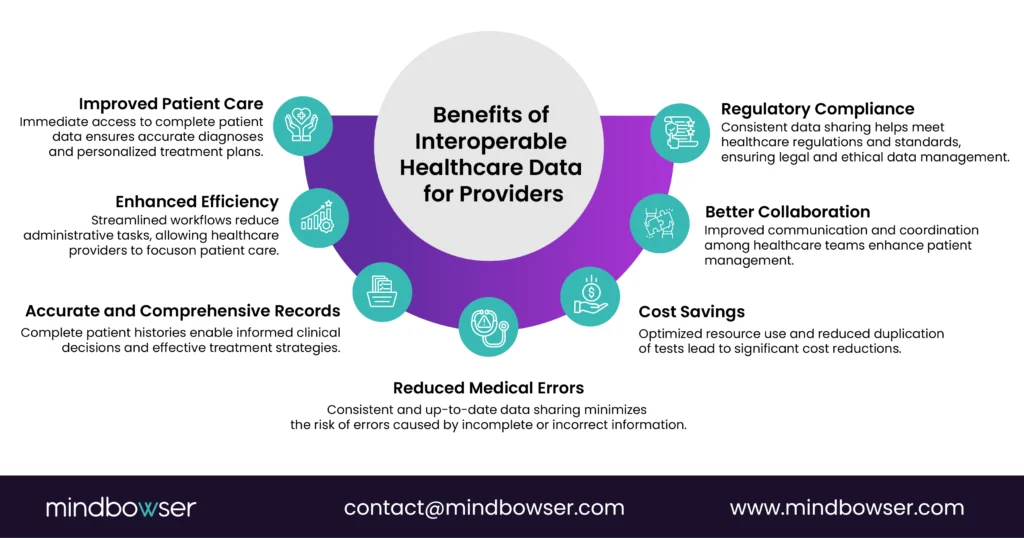
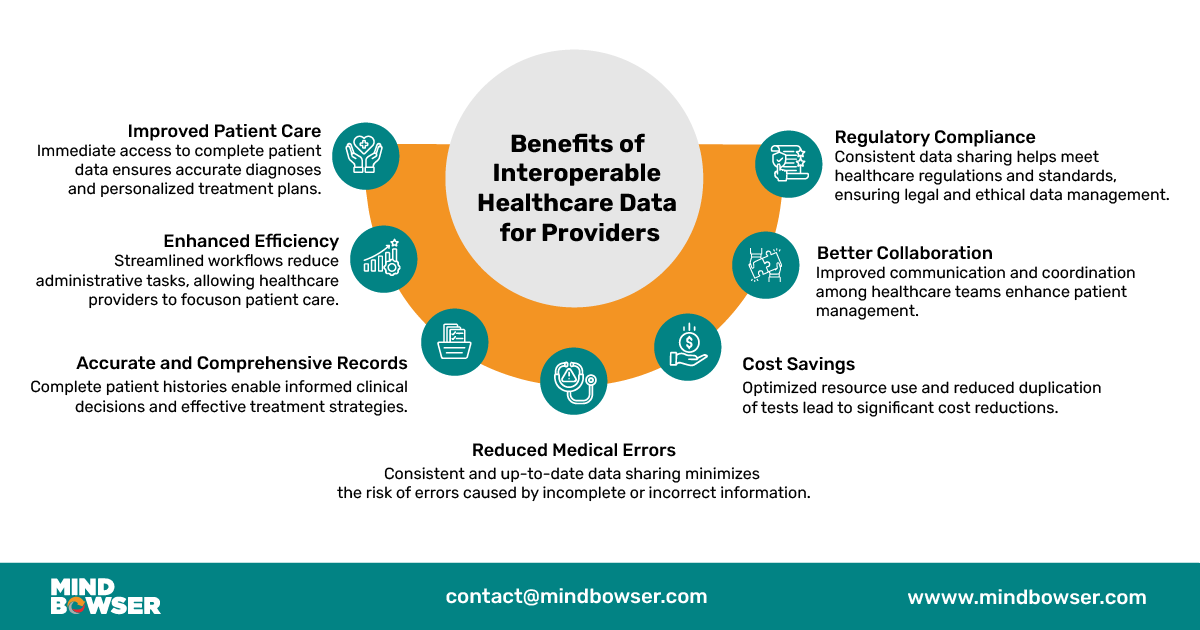
Improved Patient Care
Direct data exchange impacts patient outcomes by ensuring that healthcare providers have immediate access to a complete and accurate view of a patient’s health. This level of accessibility facilitates more precise diagnoses and timely interventions. With detailed and up-to-date information, healthcare professionals can develop personalized treatment plans that cater to each patient’s unique needs. As a result, the quality of care improves significantly, leading to better overall health outcomes and a more positive patient healthcare experience.
Enhanced Efficiency
Interoperable systems reduce the administrative burden on healthcare staff by simplifying workflows and decreasing the reliance on manual data entry and paperwork. With systems that communicate effectively with each other, healthcare providers can spend less time on administrative tasks and more time focusing on patient care. Its improvement in operational efficiency boosts the productivity of healthcare facilities and contributes to a more effective and smooth-running healthcare system.
Accurate and Comprehensive Records
Interoperability ensures that healthcare providers can access detailed and accurate patient records, which is critical for making informed clinical decisions. When patient histories are complete and easily accessible, doctors can track health trends over time and make well-informed decisions regarding treatments and interventions. Access to thorough records supports better diagnosis and care, contributing to improved patient health management and more effective treatment strategies.
Reduced Medical Errors
When healthcare systems are interoperable, it reduces the risk of medical errors by ensuring all relevant patient information is consistently available and up-to-date. Providers can access accurate details about a patient’s medications, allergies, and medical history, which helps avoid mistakes related to incomplete or incorrect information. Reducing errors enhances patient safety and contributes to more reliable and effective healthcare delivery.
Cost Savings
Adopting interoperable systems leads to significant cost savings by optimizing the use of resources and reducing the need for duplicated tests and procedures. When data is shared across systems, healthcare providers can avoid unnecessary repeat tests and simplify their care processes. This matters most for smaller and rural providers, who feel duplicate tests and manual re-entry on the thinnest margins.
Better Collaboration
Interoperable data systems facilitate better communication and coordination among healthcare teams. When all care providers access the same patient information, they can work together more effectively to provide coordinated care. The improved collaboration leads to more cohesive patient management, reducing the likelihood of miscommunication and ensuring that all aspects of a patient’s care are addressed.
Regulatory Compliance
Interoperable systems simplify the process of adhering to healthcare regulations and standards. With consistent and accurate data sharing, healthcare providers can more easily meet compliance requirements and avoid penalties. It ensures patient data is managed according to legal and ethical standards, supporting the protection of patient privacy and adherence to industry regulations.
How Mindbowser Helps Providers Get Interoperable
Most of these benefits stay theoretical until your systems actually exchange data — and that’s an engineering problem most provider teams don’t want to own. Mindbowser’s ConnectHealth platform handles it: pre-built FHIR and HL7 connectors to Epic, Cerner, Athenahealth and 20+ others, deployed in your own cloud, with HIPAA and SOC 2 safeguards built in. See healthcare interoperability solutions.
Interoperable healthcare data ensures providers have immediate access to complete patient information, leading to accurate diagnoses, timely interventions, and personalized treatment plans, ultimately enhancing patient outcomes and satisfaction.
Interoperable systems streamline workflows by reducing manual data entry and administrative tasks, allowing healthcare professionals to focus more on patient care, thus improving overall productivity and operational efficiency within healthcare facilities.
With consistent and accurate data sharing, providers can access up-to-date information about a patient’s medications, allergies, and medical history, significantly reducing the risk of errors due to incomplete or incorrect data.
Yes, interoperable systems optimize resource use by reducing unnecessary tests and procedures, streamlining care processes, and eliminating redundancies, leading to significant cost savings for healthcare organizations.