BLOGS
BLOGS  NEWSROOM
  CASE STUDIES
  WEBINARS
  PODCASTS
  ASSET HUB
  EVENT CALENDAR
























TL;DR
Choosing mental health software for a practice or platform isn’t a feature-comparison exercise, it’s a decision about which gaps you can tolerate and which ones will cost you a compliance finding or a lost contract later. This guide covers how to evaluate vendors, when off-the-shelf actually works versus when it doesn’t, what pricing models actually mean for your total cost, and the specific questions that separate a vendor demo from a real answer.
Many Vendor Comparisons Ask the Wrong First Question
Many guides to choosing mental health software start with a feature checklist: does it have scheduling, does it have billing, does it have telehealth. That’s the wrong starting point. The right first question is narrower and more specific to your organization: what does your patient population, your clinician mix, and your compliance exposure actually require, and which of those requirements does a given vendor’s platform genuinely support versus claim to support.
I’ve sat in enough vendor evaluation conversations to know the pattern. A sales demo shows every feature working cleanly on a clean dataset with a happy-path workflow. What it doesn’t show is what happens when your specific patient mix includes SUD records that trigger 42 CFR Part 2 consent rules the platform wasn’t built to handle, or when your clinician roster spans psychiatrists and psychologists who each need a different interstate licensure compact tracked correctly.
Build vs. Buy Isn’t a Binary Choice
The build-versus-buy framing gets presented as an either-or decision, and that’s rarely how it actually plays out. Most organizations end up somewhere in the middle: an off-the-shelf platform for the workflows it genuinely handles well, and custom integration work for the specific gaps that platform doesn’t cover. The question worth asking a vendor directly isn’t “can you do X,” it’s “what percentage of organizations like mine end up needing custom work beyond your core platform, and what does that actually cost.”
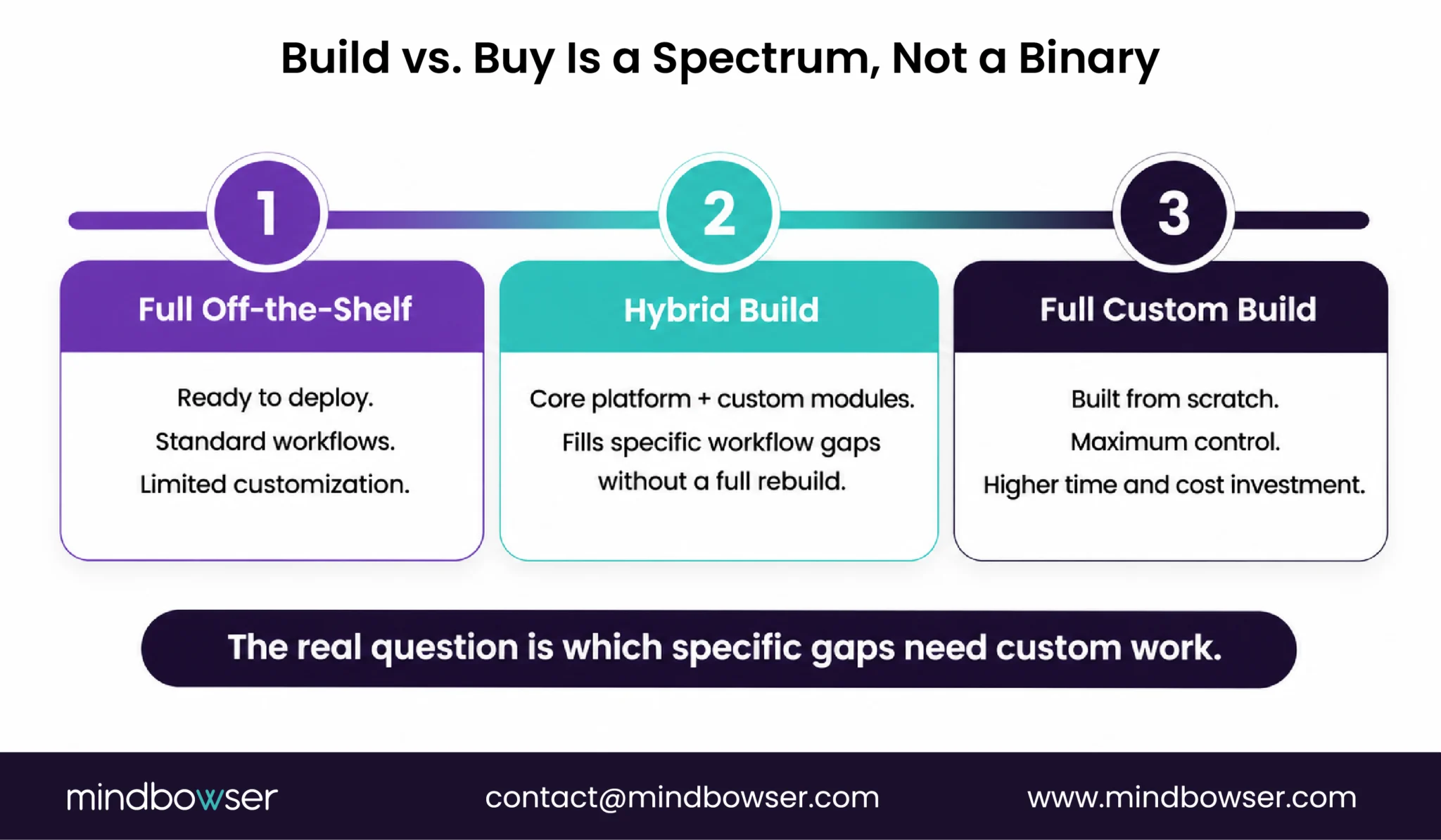
A vendor that answers that question honestly, with a real number and real examples, is telling you something useful. A vendor that insists their platform handles everything out of the box for every use case is telling you something too, just not what they think they’re telling you. Our guide on choosing between ready-made and custom EHR solutions covers this same decision in more general terms if your evaluation extends beyond behavioral-health-specific software.
What Pricing Models Actually Mean for Your Total Cost
Per-provider-per-month pricing looks simple until you scale past a handful of clinicians, at which point the math starts to diverge sharply from a flat implementation cost, and practices commonly underestimate this at the evaluation stage. Per-encounter pricing shifts the cost structure toward volume, which can work in your favor at low volume and against you as you grow. And several vendors quote a base platform price that excludes the specific compliance modules, EPCS support, multi-state licensure tracking, 42 CFR Part 2-aware access controls, that your organization may actually need, meaning the real comparable price is higher than the quoted one.
The practical move here: ask every vendor you’re comparing for a total cost projection at your actual expected scale, twelve and twenty-four months out, including every module you’d realistically need, not just the base platform price used to win the initial comparison.
Choosing the right mental health software shouldn't be guesswork.
The Questions That Actually Separate Vendors
A few questions consistently separate a vendor with a real answer from one reciting a sales script. Does your platform support EPCS for Schedule II controlled substances specifically, not just general e-prescribing. How does your system handle multi-state licensure tracking if my clinicians include both psychologists and psychiatrists, who need different interstate compacts. What happens to my data and my patients’ continuity of care if I need to migrate off your platform in three years. And can you show me, not describe, how your system enforces 42 CFR Part 2 consent boundaries if any of my patient population touches SUD records.
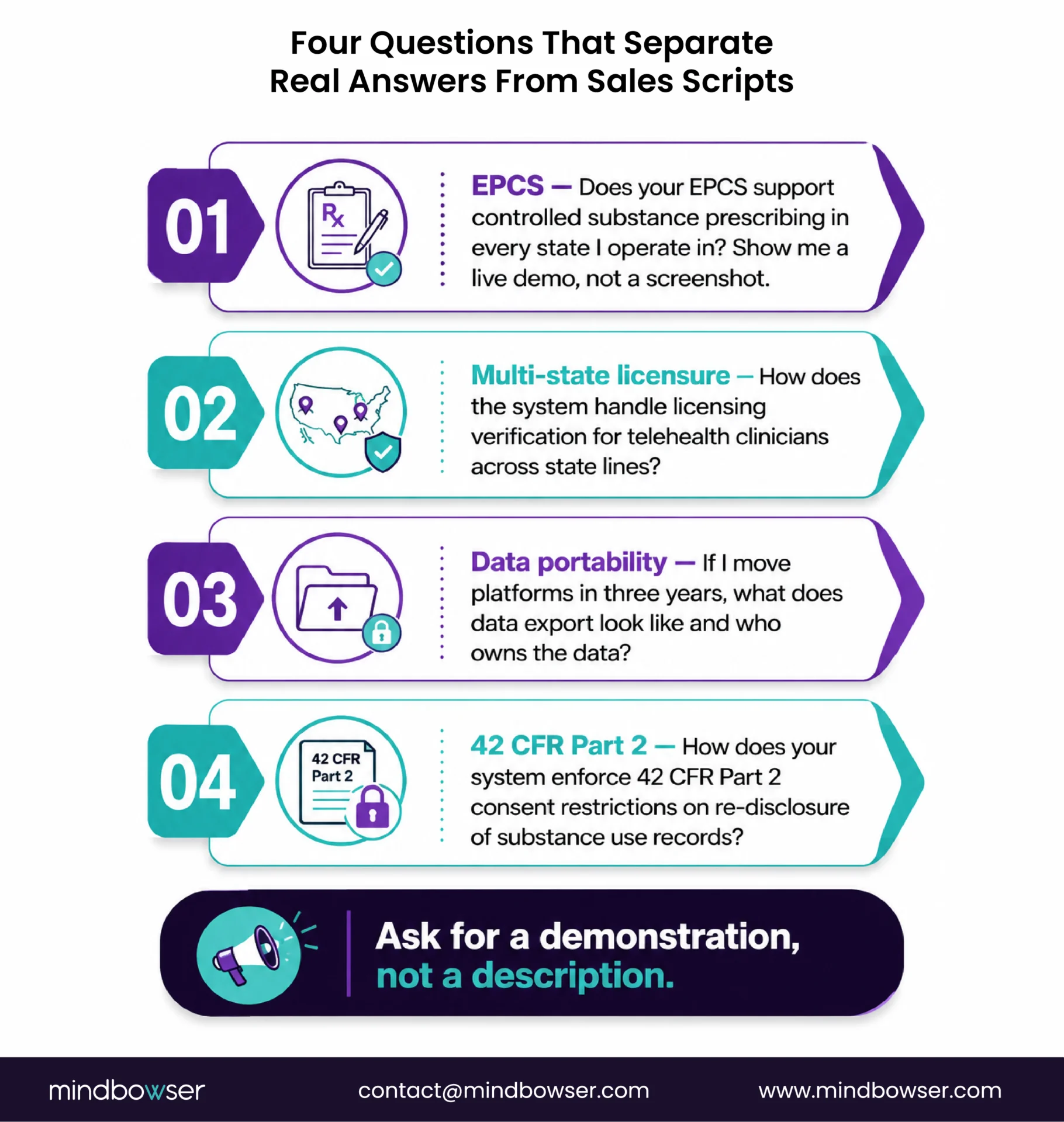
Vendors that can answer these specifically, with real mechanism detail, are worth taking seriously. Vendors that redirect to a generic HIPAA-compliance answer when asked about 42 CFR Part 2 specifically are telling you they haven’t built for behavioral health’s actual regulatory complexity, just general healthcare compliance.
Red Flags Worth Taking Seriously
A few patterns are worth treating as real warning signs rather than minor friction. A vendor that can’t name a specific behavioral health client reference, as opposed to a generic healthcare reference, when behavioral health has genuinely distinct workflow requirements. A demo that only ever shows the happy path and deflects when you ask about edge cases specific to your patient population. And pricing that requires a sales call to get even a rough range, which can signal the real number is higher than a vendor wants to lead with.
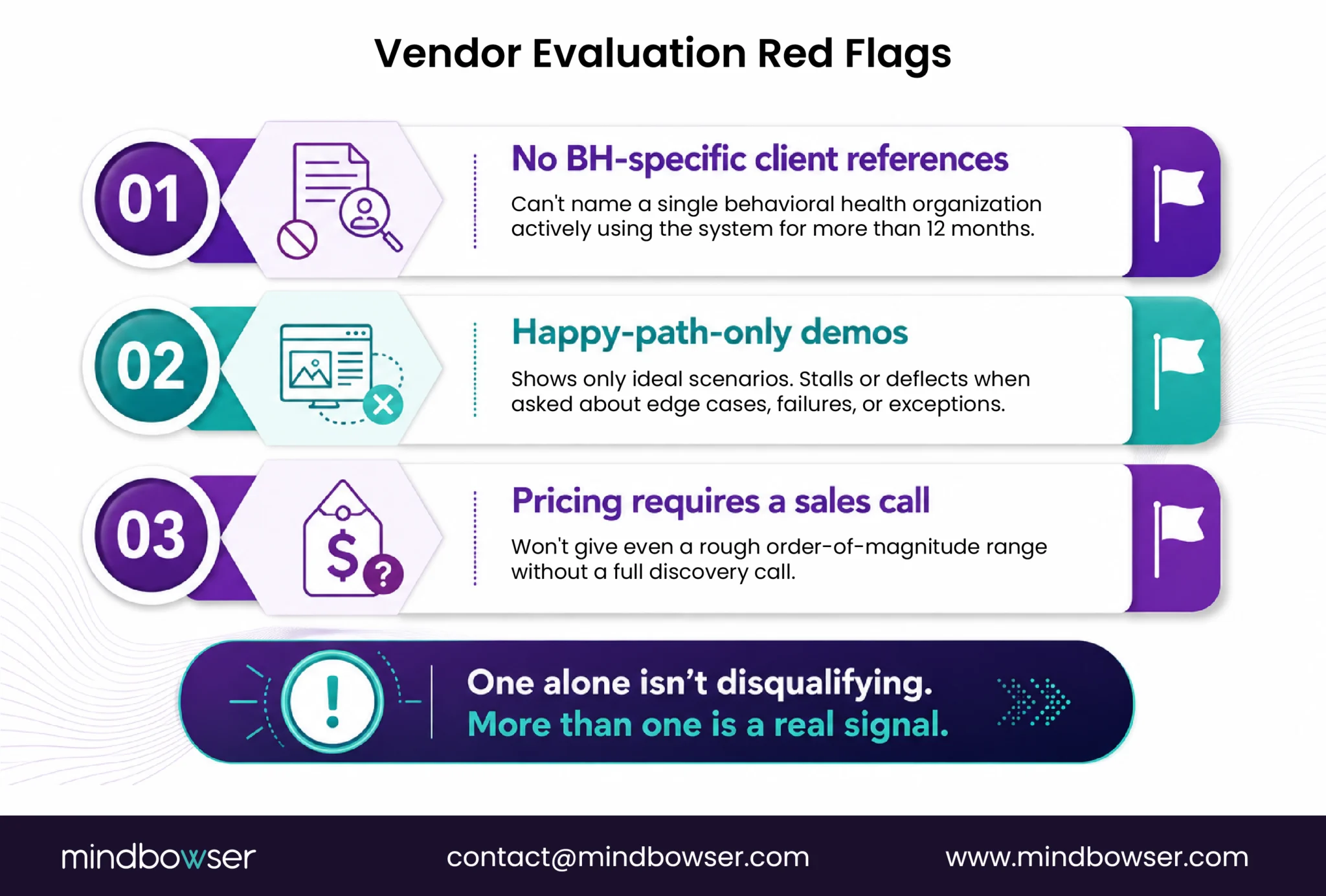
None of these are automatically disqualifying on their own. Together, more than one is a real signal to look elsewhere or dig much deeper before committing.
When Custom Development Makes More Sense Than a Platform
If your organization’s specific mix of compliance requirements, clinician types, and patient population doesn’t map cleanly onto any single off-the-shelf platform’s core design, a custom build or a heavily customized extension of an existing EHR foundation is often the more honest answer, even though it’s a harder sell than a quick platform signup. This is particularly true for organizations spanning multiple sub-specialties (general therapy plus psychiatric medication management plus SUD treatment) where a generic behavioral health platform’s one-size-fits-all workflow starts breaking down.
How Mindbowser Helps
We build both custom mental health platforms from the ground up and extensions on top of existing EHR foundations like Healthie and Medplum, depending on which actually fits a given organization’s requirements. That’s a genuinely different starting point than a vendor whose answer to every requirements conversation is their own platform: for some organizations, the honest answer is to extend what they already have.
If you’re evaluating whether an off-the-shelf platform, a customized EHR extension, or a custom build actually fits your organization’s requirements, request an assessment and we’ll walk through the specific gaps that matter for your situation.
It depends on how closely your specific compliance requirements, clinician mix, and patient population map onto an existing platform’s core design. Many organizations end up using an off-the-shelf platform for standard workflows and custom integration for specific gaps, rather than treating it as a strict either-or decision.
Ask every vendor for a total cost projection at your actual expected scale over 12 and 24 months, including every compliance module or feature you’d realistically need, not just the base platform price used in the initial sales comparison.
Ask specifically about EPCS support for controlled substances, multi-state licensure tracking across different clinician types, data portability if you need to migrate later, and how the platform enforces 42 CFR Part 2 consent boundaries if your patient population includes SUD records.
No specific behavioral health client references, demos that only show the happy path, and pricing that requires a sales call to get even a rough range are all worth taking seriously, especially in combination.