










 BLOGS
 NEWSROOM
 CASE STUDIES
 WEBINARS
 PODCASTS
 ASSET HUB
 EVENT CALENDAR





















TL;DR
Wearable sensors, heart rate variability, skin conductance, sleep tracking, generate real physiological signals related to stress and mood, but the clinical evidence for what these signals actually mean is more limited than most product pitches suggest. This piece covers what the data genuinely shows, where the FDA draws the line between a wellness claim and a medical-device claim (with a real, recent enforcement example), and where HIPAA does and doesn’t apply to a consumer wearable mental health app.
Committing to What This Piece Is Actually About
I want to be direct about scope before going further. This is about consumer-facing wearable and biometric data in mental wellness apps, he engagement-driven consumer product category, not clinical AI risk-screening tools used inside a care setting. Those are different builds with different safety requirements, and treating them as one topic is where a lot of content in this space gets vague. If you’re building a clinical AI screening tool, that’s a different conversation with a different bar. This piece is about what wearable data can genuinely support in a consumer wellness product.
What Wearables Actually Measure, and What That Data Can (and Can’t) Tell You
Heart rate variability is the most commonly cited signal, and it’s genuinely well-established as a marker of autonomic nervous system activity, reduced HRV correlates with anxiety and depression across a real body of research, including a 2025 Frontiers in Psychiatry study linking reduced HRV metrics to anxiety and depression specifically. What HRV is not is a precise, diagnostic signal. The research consensus is directional, not diagnostic, and methodological inconsistency across studies, different populations, different stress-induction methods, different measurement protocols, is a persistent, acknowledged limitation in the field itself.
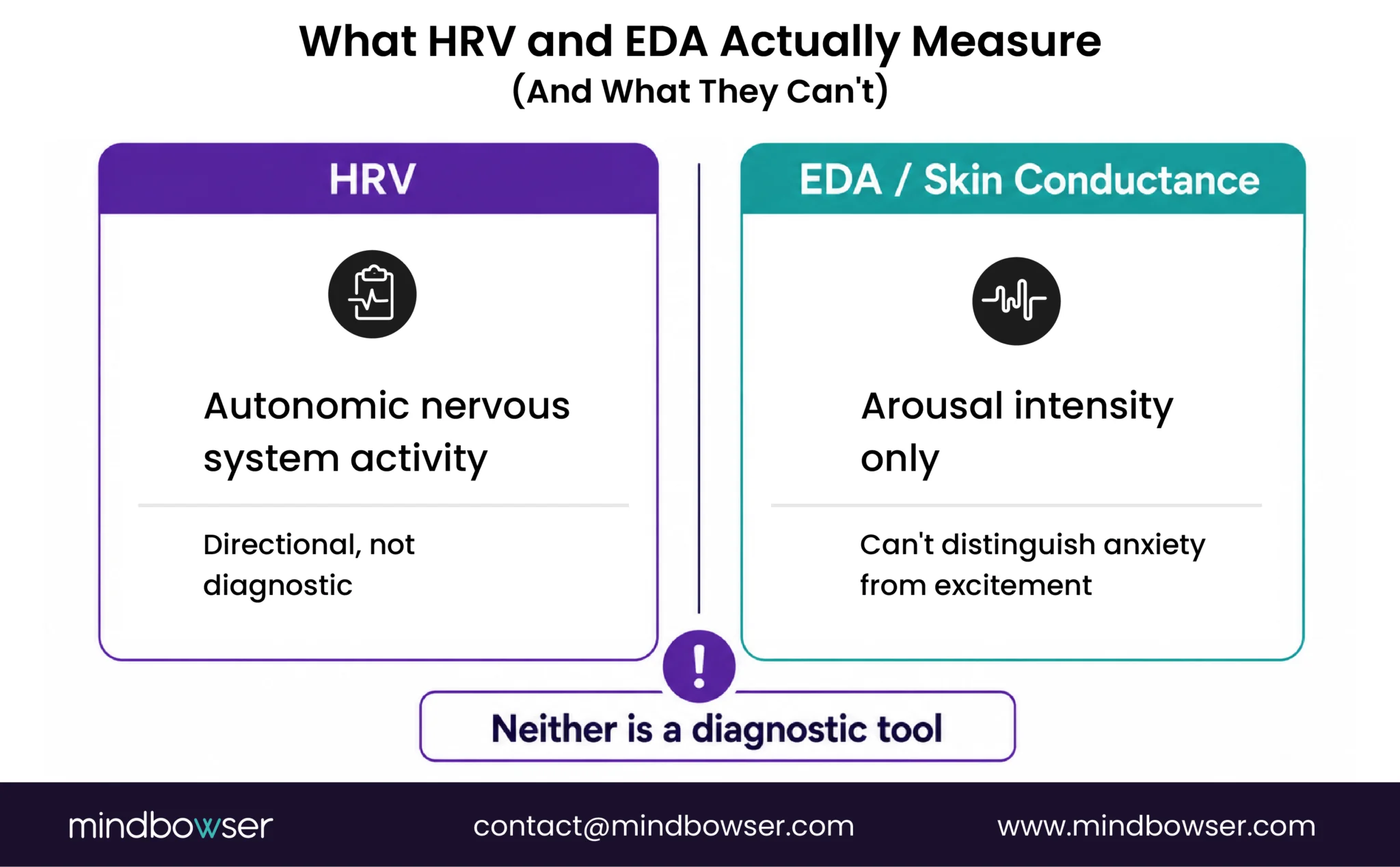
Electrodermal activity, skin conductance, is more contested in practical terms. It’s a legitimate, well-understood signal of sympathetic nervous system arousal, but a 2025 study in MDPI Sensors found that even the most effective amplitude-based EDA measures were validated in controlled lab conditions, not real-world use, where ambient temperature, movement, and hydration meaningfully degrade reliability. The more important limitation: EDA measures arousal intensity, not emotional valence. It genuinely cannot distinguish excitement from anxiety, both spike the same signal. A product that presents EDA-based “anxiety detection” without acknowledging this is overstating what the sensor can actually tell you.
The Engagement Problem This Data Is Supposed to Solve
Whatever the underlying signal, the actual product challenge is the same one every wellness app runs into: does anyone keep engaging with the insight long enough for it to matter. A mental wellness app we built to 250,000 active users isn’t a wearable-integration product specifically, so I won’t stretch it into a claim it doesn’t support, but the engagement architecture problem it solved, keeping someone opening an insight or exercise consistently rather than after week two, is the same underlying problem a wearable-data feature runs into. A biometric signal that generates a notification nobody reads isn’t a mental health feature, it’s an unread notification.
Clinical Validity and Where the Evidence Actually Stands
This is where a lot of product marketing gets ahead of the actual research. HRV’s link to stress and mood is real but directional, not a validated diagnostic marker. EDA’s link to arousal is real but can’t distinguish emotional states without additional context. Sleep-stage tracking has a more established evidence base for its own domain (sleep quality) but its downstream link to mood is inferential, not a direct measurement. Building a product on these signals means being honest, in the product itself and not just in a research appendix, about what the data supports: pattern awareness and general wellness insight, not clinical detection.
Turn wearable data into meaningful mental health insights.
Where the FDA Actually Draws the Line
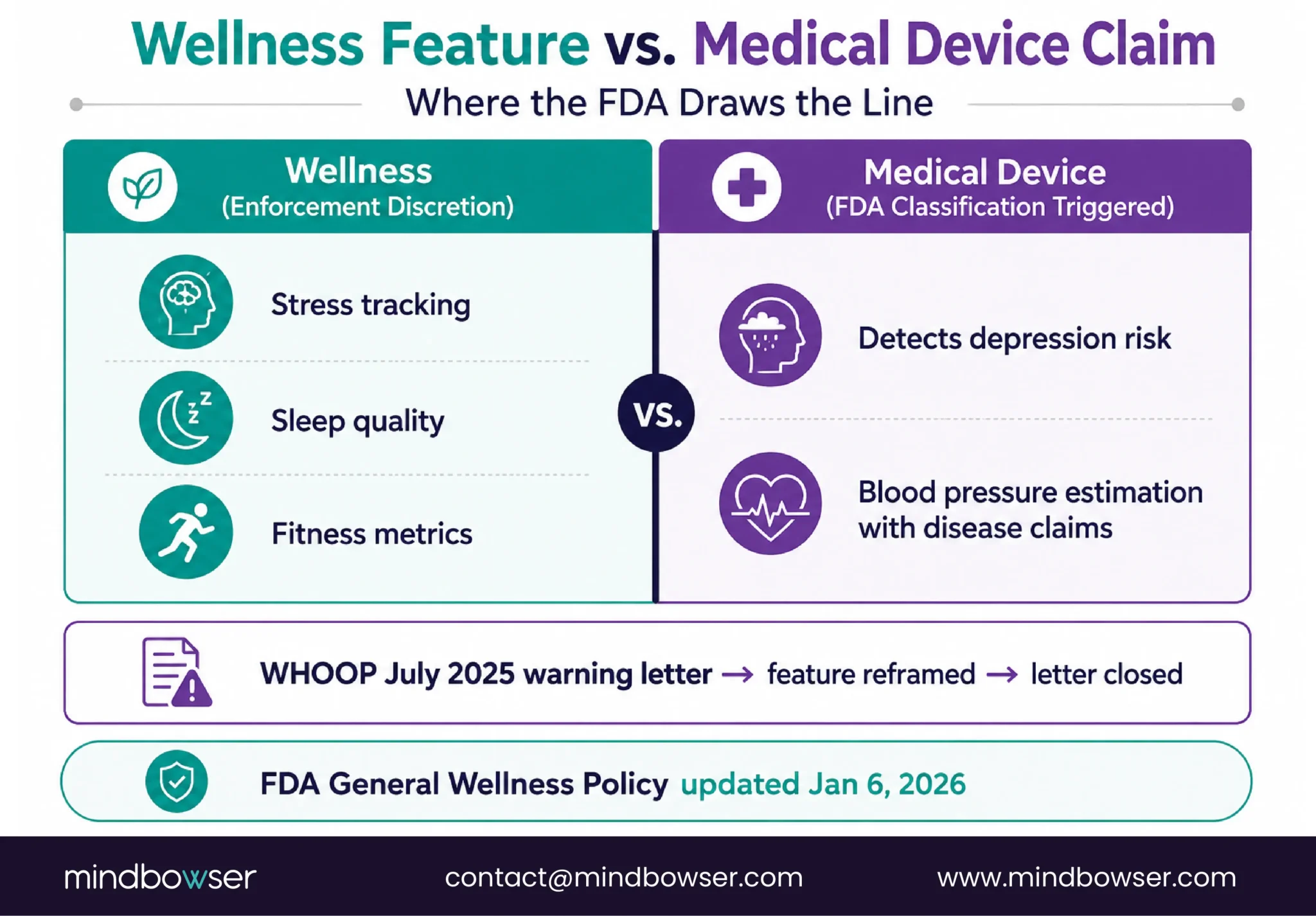
The FDA reissued its General Wellness Policy on January 6, 2026, and the enforcement-discretion line it draws matters directly for this category. A wearable feature framed around general states, fitness, sleep, stress, without naming a specific disease or condition, generally qualifies for the FDA’s low-risk wellness-device enforcement discretion. A feature that names a specific condition, “detects depression risk,” for instance, typically crosses into medical-device territory and needs clearance the wellness framing doesn’t provide. This isn’t theoretical. In July 2025, the FDA sent WHOOP a warning letter over an uncleared “Blood Pressure Insights” feature, real, recent enforcement showing the agency will act when a wellness product’s framing edges into a diagnostic claim. The FDA later closed out that warning letter after WHOOP revised the feature’s framing, and the January 2026 policy update now allows wellness products to estimate metrics like blood pressure when the intended use stays strictly wellness-focused, further evidence that the line moves with framing and intended use, not the sensor itself. If your product copy says a wearable “detects” a specific mental health condition, that word choice has real regulatory consequences, not just a marketing tone question.
Data Privacy and HIPAA Scope for Wearable Mental Health Data
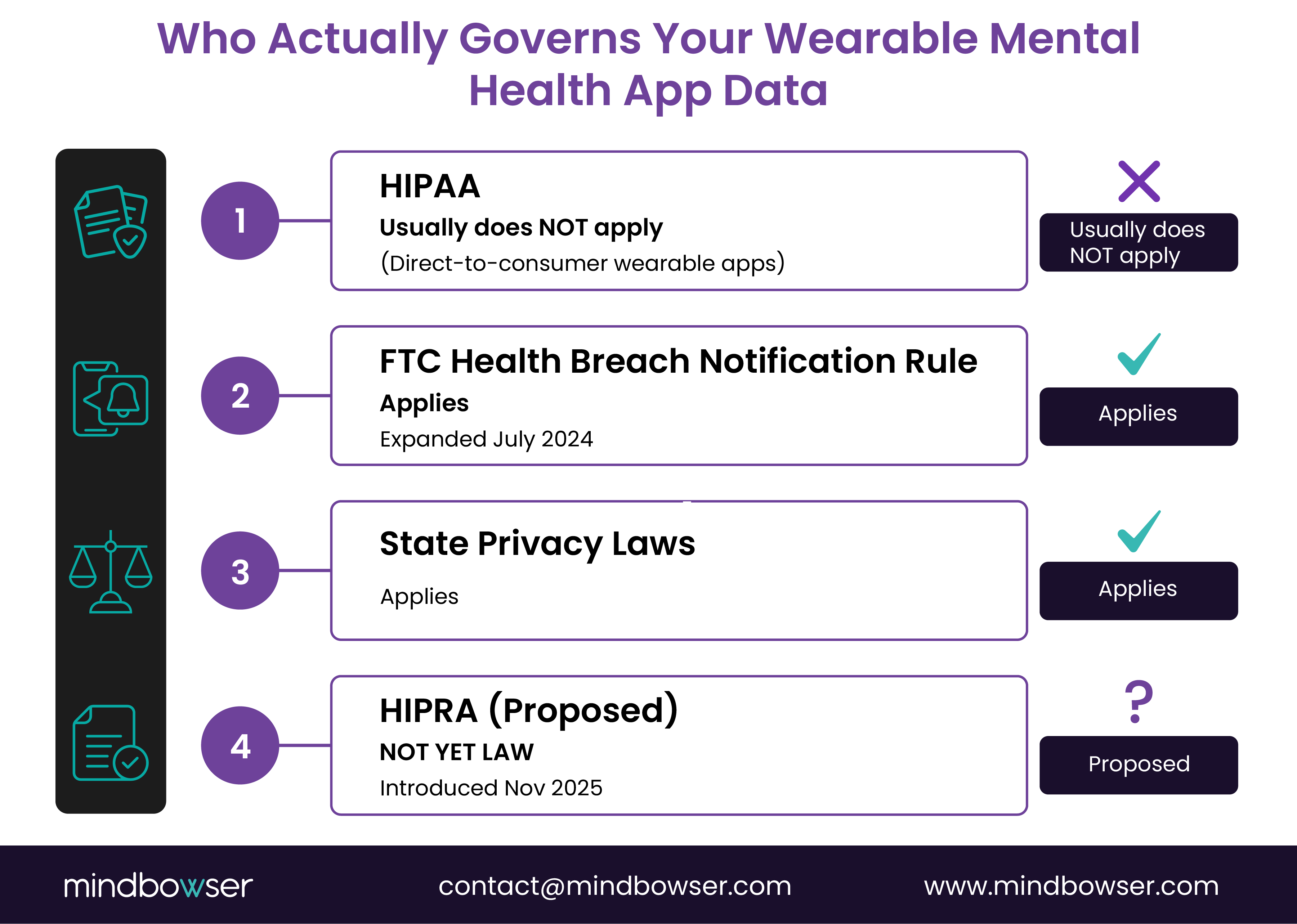
Here’s a distinction worth getting right rather than assuming the conservative answer by default. HIPAA generally does not apply to a direct-to-consumer wearable mental health app, HIPAA governs covered entities (providers, health plans) and their business associates, and most consumer wellness apps aren’t either. What actually governs this data instead is the FTC’s Health Breach Notification Rule, whose scope expanded as of July 2024, and applicable state privacy law. There’s a proposed federal bill, introduced in the Senate in November 2025, that would extend HIPAA-style rules to consumer health apps and wearables specifically, but it is not current law, and treating it as an existing requirement would be a real accuracy mistake. Our guide on HIPAA compliance in wearable health technology covers this scope question in more general terms across the broader wearable-health category, not just mental health specifically.
What’s Custom-Build Territory
Wearable SDK integration varies by device manufacturer and sensor type, and the specific clinical-framing decisions, what a product claims a signal means, at what confidence level, with what disclaimers, are genuinely product-specific rather than something a generic accelerator handles. That’s real, scoped work: mapping the specific sensors and SDKs a product needs against actual research-backed claims, and building the disclaimer and framing language that keeps a wellness feature inside FDA’s wellness-policy lane rather than accidentally making a diagnostic claim.
How Mindbowser Helps
We’ve built the engagement architecture problem at real scale a mental wellness app we built, scaled to 250K+ active users, and an NIH-funded postpartum mental health platform, HIPAA-compliant, reaching 1,000 users within 3 months of launch. Combining wearable data with honest clinical framing, not overclaiming what a biometric signal can diagnose, is the discipline that keeps a wellness product both credible and compliant.
If you’re building a wearable-integrated mental wellness product and want to get the clinical framing and regulatory positioning right from the start, request an assessment.