BLOGS
BLOGS  NEWSROOM
  CASE STUDIES
  WEBINARS
  PODCASTS
  ASSET HUB
  EVENT CALENDAR


























TL;DR
- Epic Bones is Epic’s orthopedic and sports medicine module, built on EpicCare Ambulatory.
- It supports joint-specific documentation, surgical planning, and return-to-play tracking.
- It integrates with Epic Radiant for imaging and EpicCare Ambulatory for outpatient charting.
- It is designed for orthopedic surgeons, sports medicine teams, and physical therapists in organizations already using Epic.
The Epic Bones Module is built specifically to support the needs of orthopedic and sports medicine practices. Sitting within the Epic EHR ecosystem, this module simplifies clinical workflows by providing focused tools for musculoskeletal care, from injury assessment to rehabilitation. It’s a solution aimed at reducing the documentation burden while improving the quality of patient interactions.
Unlike general-purpose EHR components, the Epic Bones Module brings specialty-specific templates, joint tracking features, and surgical planning tools into one interface. This focus allows orthopedic surgeons, sports medicine physicians, and support staff to work more efficiently, reducing clicks, streamlining referrals, and improving outcomes with better data access.
The module helps clinicians maintain continuity across the patient journey from pre-op evaluations to post-op recovery monitoring. Integration with other Epic tools ensures that imaging, notes, and rehabilitation plans are all connected. As organizations seek ways to improve throughput and care coordination, the Epic Bones Module has become a critical part of the orthopedic IT stack.
Understanding the Epic Bones Module
Orthopedic and sports medicine practices require precise tools to manage musculoskeletal cases effectively. The Epic Bones Module addresses this need by delivering structured workflows and clinical documentation tailored for such specialties.
What is the Epic Bones Module?
The Epic Bones Module is designed specifically for orthopedic and sports medicine settings. It offers tools that assist in evaluating and treating joint, bone, and soft tissue conditions. Built as a dedicated module within the Epic EHR system, it streamlines clinical tasks and supports high-volume, specialty-focused practices.
How to Get Featured on the Epic Showroom?
Learn how to showcase your app to thousands of Epic-integrated healthcare providers. From eligibility and API access to certification and launch, this guide walks you through every step to boost visibility, credibility, and adoption within the Epic ecosystem.
Key Features
Comprehensive Documentation
Enables detailed clinical documentation, including joint-specific notes, injection procedures, and image-annotated entries. It helps providers capture precise information during patient encounters.
Integration with Other Epic Modules
Works fluidly with EpicCare Ambulatory and Epic Radiant, allowing smooth transitions between diagnostics, outpatient care, and surgery scheduling. This integration ensures continuity and consistency in patient care.
Related read: Epic EHR Integration Strategies: Best Practices & Tips
Support for Orthopedic Surgery Teams
Assist surgical teams in managing patient lists, tracking progress, and preparing pre- and post-op workflows. It contributes to efficiency in surgical planning and follow-up care.
Sports Medicine Workflows
Includes athlete-specific record tracking, injury documentation templates, and return-to-play plans. It supports sports medicine clinicians in maintaining performance-focused care routines.
Benefits of Implementing the Epic Bones Module
Adding the Epic Bones Module to your orthopedic or sports medicine setup doesn’t just modernize your workflow—it makes it more precise, coordinated, and patient-focused. Here’s how it delivers real value:
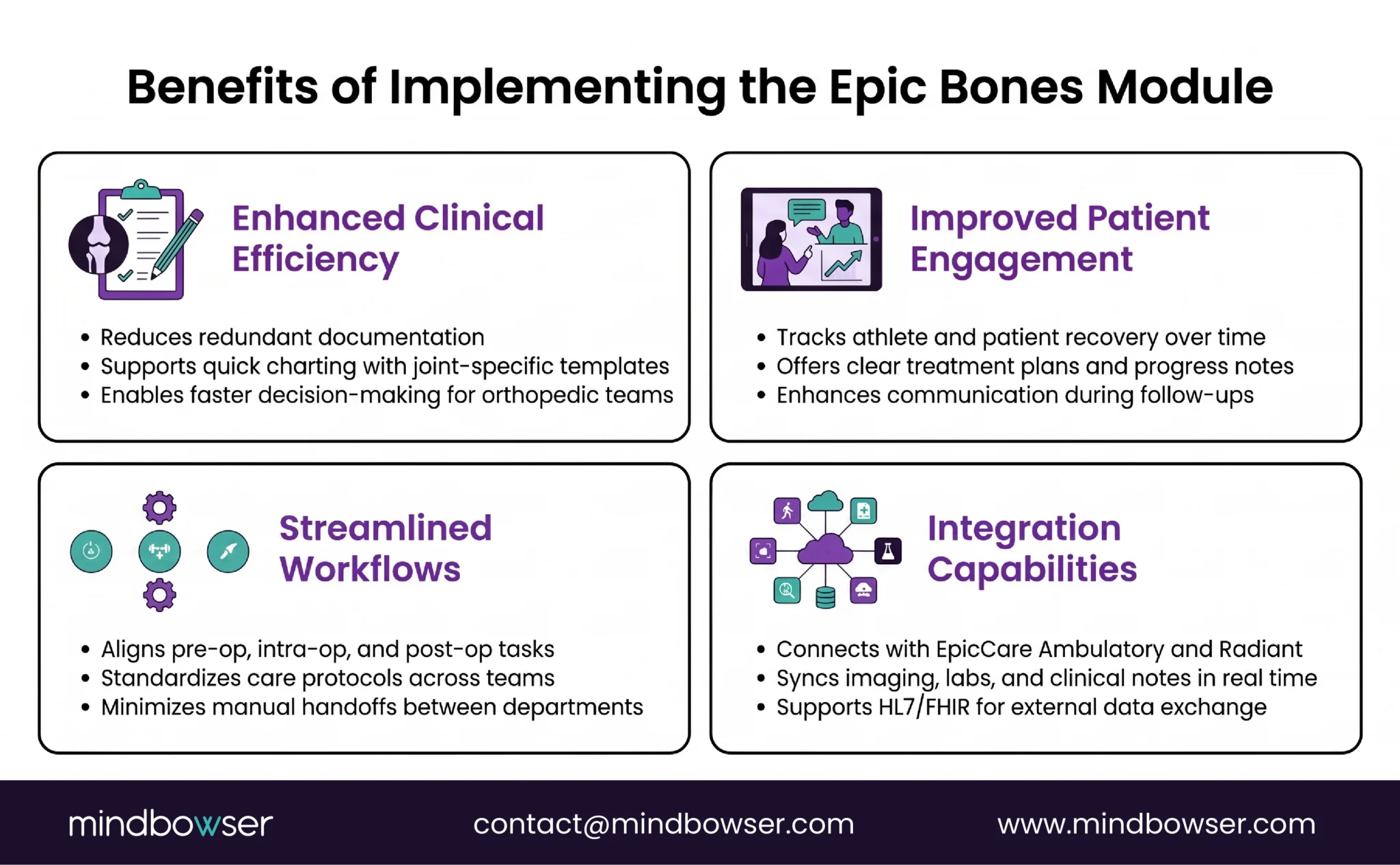
Enhanced Clinical Efficiency
Orthopedic and sports medicine teams often face challenges with scattered documentation and slow charting processes. The Epic Bones Module addresses this by offering structured templates, location-specific injury mapping, and support for procedure documentation like joint injections or casting. With fewer manual entries and more intuitive charting, clinicians can focus more on patient care and less on administrative tasks.
Improved Patient Engagement
For sports tracking, performance and injury history over time are critical. This module is for sports medicine professionals and provides tools to record functional assessments, treatment outcomes, and recovery metrics in one place. When patients see their data visualized clearly and progress tracked over time, they’re more likely to stay committed to their care plan and follow post-treatment protocols effectively.
Connected Workflows
This module links all relevant data points across the care continuum. It syncs effortlessly from initial consultation to post-op recovery with other Epic modules like EpicCare Ambulatory and Radiant, ensuring that imaging, notes, surgical planning, and referrals are connected. This helps avoid duplication, speeds up decision-making, and keeps everyone on the same page, including radiologists, surgeons, and physical therapists.
Integration Capabilities
The Epic Bones Module works best when connected to the broader Epic ecosystem. It integrates directly with modules like EpicCare Ambulatory and Epic Radiant, enabling clinical teams to access orthopedic records, radiology results, and patient histories without switching systems. This interconnected design reduces delays, ensures accuracy, and supports smooth care coordination from consultation to recovery.
For orthopedic surgery teams, imaging results can be reviewed alongside documentation, and treatment plans can be adjusted in real time based on radiology input. Athlete records remain centralized and updated for sports medicine workflows, making tracking therapies and progress across visits easier.
Related Read: How to Integrate a Health App with Epic EHR/EMR
Future Developments
Epic regularly updates the Bones Module, making the user interface more intuitive and improving how data moves between systems. Future enhancements are expected to streamline documentation, expand template options for musculoskeletal exams, and improve mobile usability for providers. Rather than major overhauls, these refinements are usually small but meaningful, based on clinician feedback, to ensure the system works the way orthopedic and sports medicine specialists need it to.
Start Building Your Custom EHR
How Mindbowser Can Help?
To surface Bones-module data — including joint findings, imaging, and surgical plans — in your own application or analytics layer, you integrate through Epic’s FHIR APIs, HL7 interfaces, and SMART on FHIR.
ConnectHealth, our healthcare integration platform, provides a pre-built Epic connector and Helix AI, deployed in your own AWS environment. This allows an integration that would normally require a multi-month build to be delivered in days.
Our team also supports custom Bones-module interfaces, wearable and imaging data synchronization, and HIPAA-grade architecture for orthopedic and sports medicine workflows.
Conclusion
The Epic Bones Module stands out as a purpose-built solution for orthopedic and sports medicine teams looking to simplify clinical workflows without compromising on care quality. Its ability to support joint-specific documentation, integrate with other Epic modules, and adapt to the fast-paced needs of surgical teams makes it a practical choice for providers.
Whether managing athlete recovery or preparing for complex orthopedic procedures, the module brings efficiency and clarity to each step. For organizations already using Epic, adding this module can significantly reduce documentation time while improving collaboration across departments. As healthcare continues to move toward specialization and value-based care, tools like the Epic Bones Module offer a clear operational advantage.
The Epic Bones Module is a specialized component within the Epic EHR system, designed to streamline orthopedic and sports medicine workflows.
By integrating advanced documentation tools and supporting connected workflows, it enhances clinical efficiency, allowing healthcare providers to deliver superior patient care.
Yes, it integrates with EpicCare Ambulatory and Epic Radiant, ensuring cohesive patient care by facilitating smooth transitions and data sharing across different stages of treatment.
It provides comprehensive tools for tracking athlete health and performance, enabling sports medicine professionals to deliver targeted, effective care, improving treatment outcomes and overall athlete health.
Epic continually improves the module through product enhancements that focus on user experience and data integration improvements, refining existing features to better support the needs of healthcare professionals.
Epic Bones reduces documentation time through pre-built orthopedic templates for joint assessments, surgical notes, and post-operative follow-ups. Clinicians avoid building these workflows from scratch, and its connection with EpicCare Ambulatory allows documentation to flow into the existing patient chart without duplicate entry.
Epic Bones integrates with EpicCare Ambulatory for outpatient charting, Epic Radiant for radiology imaging and PACS workflows, and Epic’s surgical scheduling capabilities. This allows orthopedic teams to access imaging orders, review results, and coordinate surgical planning within one connected environment.
Sports medicine teams benefit from structured return-to-play documentation, injury tracking across multiple encounters, and standardized functional assessments. The module also supports collaboration among team physicians, physical therapists, and athletic trainers working within the same patient record.
Rather than major overhauls, Epic Bones refinements are usually small but meaningful, driven by clinician feedback. Ongoing development may focus on tighter imaging-data synchronization, AI-assisted documentation, and improved interoperability with wearable devices and external imaging systems.