












 BLOGS
BLOGS  NEWSROOM
  CASE STUDIES
  WEBINARS
  PODCASTS
  ASSET HUB
  EVENT CALENDAR























TL;DR
EHR permissions and capabilities directly impact both compliance and care delivery; Epic and Cerner lead for large health systems with highly customizable, role-based access and advanced workflows, while Athenahealth offers a simpler, cloud-based model suited for smaller practices, and Meditech provides a structured, cost-effective option for community hospitals; ultimately, the right choice depends on how well the platform aligns with your organization’s workflow complexity, integration needs, and data governance requirements.
In healthcare, permissions and functionalities within EHR systems are critical as they directly impact how healthcare teams access, manage, and share patient information. Permissions control who can view or edit specific data, while functionalities define what users can do within the system, such as scheduling, data entry, or analytics. For healthcare providers, these elements ensure that sensitive patient information is secure and that workflows remain efficient. A well-defined permissions structure and functional flexibility are key to supporting care delivery and compliance with data protection regulations, which is vital in healthcare environments.
Understanding the distinct permissions and EHR capabilities in Epic EHR, Cerner EHR, AthenaHealth EHR, and Meditech EHR is important for healthcare providers, as each EHR platform offers unique strengths and limitations. Epic and Cerner systems currently have 50% of the market share. While Epic is known for its extensive interoperability and customizable workflows, Cerner often emphasizes user-friendliness and integration with other clinical tools. Athena is known for its cloud-based model and ease of use in outpatient settings, while Meditech is recognized for its structured, cost-effective solutions aimed at smaller hospitals.
Knowing these differences is essential for healthcare teams to select and optimize an EHR system that aligns with their operational needs, ensuring both effective patient care and streamlined internal processes.
Let’s learn how Epic EHR, Cerner EHR, Athena EHR, and Meditech EHR differ in their EHR permissions and capabilities, impacting healthcare operations and data access.
How Do Permissions and Functionalities Differ Across EHRs?
EHR capabilities vary widely among systems like Epic EHR, Cerner EHR, Athena EHR, and Meditech EHR, especially in permissions and data access controls. Permissions in EHR platforms are vital for security, data privacy, and compliance, defining who can access patient information. Systems like Epic and Cerner offer customizable permissions, allowing administrators to assign specific access levels based on user roles, ensuring only authorized personnel handle sensitive data. This flexibility aligns with clinical workflows, supporting both privacy and operational efficiency.
Functionality differences across EHR platforms impact day-to-day healthcare operations. Epic and Cerner, for example, provide full-featured workflow tools that enhance patient management, from appointment scheduling to visit documentation. Athena and Meditech meanwhile target different priorities, with Athena emphasizing billing and practice management features. Integration capabilities further distinguish these systems; Epic, for instance, is recognized for its strong compatibility with third-party applications, whereas other EHRs may offer more limited interoperability. Understanding these variations in functionality helps healthcare providers select an EHR that aligns best with their specific needs.
Related read: Cerner vs Epic: Choosing the Best Healthcare Solution for Your Business
Epic EHR: Permissions and Functionalities
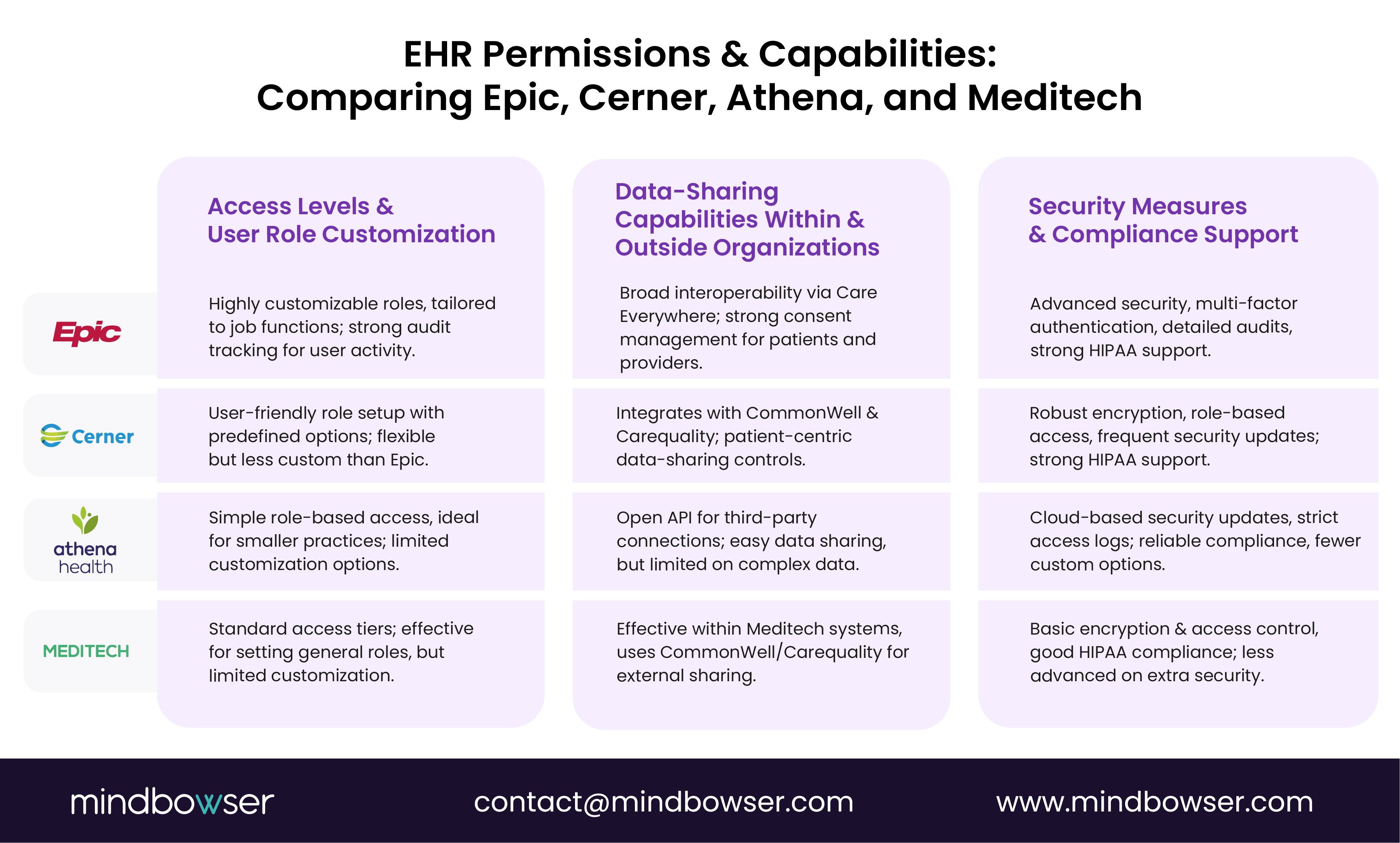
Epic EHR capabilities provide a structured approach to data access through role-based permissions, allowing healthcare teams to assign access based on job functions. This method boosts privacy by restricting sensitive data access and includes configurable limits for external sharing, aligning with regulations.
Epic offers a strong patient engagement suite, enabling patients to view health records, manage appointments, and communicate with providers securely. Its data visualization tools simplify information interpretation for clinicians, and strong interoperability supports smooth data exchange across healthcare settings. However, organizations must work through Epic’s complexity to ensure effective team adoption and usage.
Related read: Epic EHR Integration Strategies: Best Practices & Tips
Cerner EHR: Permissions and Functionalities
Cerner’s EHR system offers a flexible approach to permissions, allowing healthcare organizations to set customizable user roles with specific access levels. This level of access control supports secure data handling by enabling administrators to assign permissions based on job roles, ensuring users access the needed information. Cerner’s security includes audit trails to track user activities, support compliance, and spot unusual access patterns. In addition to these security layers, Cerner’s periodic security checks add an extra safeguard, helping healthcare organizations maintain a well-monitored digital environment.
Core functionalities within Cerner’s EHR focus on optimizing clinician workflows and supporting data-driven healthcare delivery. With population health management tools, Cerner helps clinicians identify and manage patient groups based on shared health needs, streamlining preventive care efforts. The platform encourages clinician collaboration through real-time data sharing and communication features.
Cerner’s mobile access enhances usability, keeping providers connected on-site or offsite. While its secure permission structure may add complexity, its adaptability and collaboration tools make it a solid choice for efficient, secure patient care.
Athenahealth EHR: Permissions and Functionalities
Athenahealth EHR designs its permissions framework to help small-to-midsized practices manage access effectively. Role-based assignments let users view or modify only the necessary information, protecting patient data. Its permissions model includes layers of access control, from clinical data to administrative functions, providing a clear way to monitor who accesses which records and actions. With a strong focus on data protection, Athenahealth EHR aligns with HIPAA requirements, making it a valuable choice for practices prioritizing patient confidentiality.
Athenahealth offers unique functionalities that cater to the needs of smaller practices. Its integrated telehealth capabilities support virtual consultations, which have become an essential service for many clinics. With built-in billing support, Athenahealth allows practices to handle payments directly through the EHR, which can help simplify workflows. These functionalities make Athenahealth a practical option for practices seeking an EHR with flexible access controls and features focused on efficient practice management.
Looking to a Build a Custom EHR with Custom Integrations?
Meditech EHR: Permissions and Functionalities
Meditech’s EHR system is designed with a structured permission setup that supports department-specific access, allowing healthcare providers to grant or restrict access to information based on roles and responsibilities. This department-focused approach to permissions helps maintain patient privacy by limiting access to those who need specific data. With Meditech, administrators can assign user restrictions, ensuring sensitive information remains secure across departments. The platform facilitates secure data sharing between authorized users, promoting collaboration while protecting patient data within compliance standards.
Key functionalities in Meditech’s EHR include complete patient records management, efficient clinical documentation, and options for system customization. These capabilities allow healthcare organizations to organize patient data, ensure detailed record-keeping, and adapt certain system elements to align with their workflow needs. However, managing permissions in a large organization can pose challenges, especially as roles and access requirements evolve. Balancing data access with security often requires a careful setup, and Meditech’s structured approach can require periodic updates to accommodate shifts in staffing and patient care demands.
Key Differences in Permissions: Epic vs. Cerner vs. Athenahealth vs. Meditech
When comparing EHR capabilities, enabling custom workflows, advanced interoperability. Each EHR system offers unique access controls, data-sharing options, and security protocols to manage sensitive healthcare information effectively. Here’s a breakdown of how Epic, Cerner, Athena, and Meditech differ in these key areas:
Choosing the Right EHR: Permissions and Functionalities in Perspective
When selecting an EHR, considering custom EHR capabilities like permissions and functionalities is essential for aligning with specific healthcare needs. Permissions affect how easily staff can access the required data while keeping sensitive information secure, which is critical for protecting patient privacy. Functionalities determine how effectively the EHR supports workflows, from appointment scheduling to medication tracking.
Evaluating each EHR capabilities strengths in permissions and functionalities can guide decision-makers in choosing the best fit for their practice size, specialty, and patient care goals. For example, large hospitals may benefit from Epic’s detailed permissions, while smaller clinics might find Athenahealth’s intuitive design better suited to their workflow needs.
Custom EHR Capabilities: When Standard Systems Aren’t Enough
While platforms like Epic, Cerner, Athenahealth, and Meditech offer solid out-of-the-box capabilities, many healthcare organizations reach a point where standard functionalities no longer align with evolving clinical, operational, or compliance needs. This is where custom EHR capabilities become critical, enabling custom workflows, advanced interoperability, and role-specific data access models that match real-world care delivery. Whether it’s integrating niche third-party systems, building specialty-specific modules, or implementing AI-driven decision support, custom enhancements allow organizations to move beyond system limitations and unlock measurable ROI. In practice, leading providers invest in custom layers or extensions to bridge gaps in care coordination, population health, and automation, ensuring their EHR becomes a strategic asset rather than a constraint.
Choosing the Right EHR Starts with Understanding Its Limits
Epic, Cerner, Athenahealth, and Meditech each come with distinct strengths in permissions, workflows, and interoperability. Epic and Cerner lead for large health systems that need deep customization and role-based access. Athenahealth is a practical fit for smaller practices prioritizing billing and cloud ease. Meditech offers a cost-effective, structured option for community hospitals.
But EHR capabilities are only as useful as their fit with your specific workflows, patient volume, and integration requirements. When a standard EHR can’t match your operational needs — or forces your team to work around its limitations — a custom EHR becomes the more practical path.
If you’re evaluating EHR options or running into gaps with your current system, see how Mindbowser builds custom EHR solutions designed around your workflows, not the other way around.
Each platform offers unique features. Epic excels in large healthcare systems with advanced interoperability. Cerner provides proven population health management tools. AthenaHealth focuses on cloud-based solutions for smaller practices, while Meditech is known for affordability and usability in community hospitals.
Permissions depend on the platform’s architecture. Epic and Cerner allow fine-grained user access control for larger organizations, while AthenaHealth and Meditech offer simplified access settings suited for smaller setups.
Epic EHR is widely regarded for its flexibility in customization for diverse workflows. Cerner EHR is also adaptable but may require more technical support. AthenaHealth EHR and Meditech EHR focus on straightforward implementations with fewer customization options.
Epic uses Care Everywhere for data exchange, Cerner relies on its CommonWell Health Alliance membership, AthenaHealth offers cloud-based connectivity, and Meditech supports data sharing through Expanse. Each takes a distinct approach to enabling interoperability across healthcare systems.