











 BLOGS
 NEWSROOM
 CASE STUDIES
 WEBINARS
 PODCASTS
 ASSET HUB
 EVENT CALENDAR























TL;DR
- Most urology practices run on general-purpose EMRs that weren’t built for cystoscopy procedure documentation, bladder cancer surveillance schedules, or BCG instillation protocol management: the three workflows that define high-volume urology.
- The 2026 best urology EMR shortlist with real traction is Modernizing Medicine (EMA), Nextech, DrChrono, AdvancedMD, and Kareo/Tebra, each with an honest failure point.
- For practices running active bladder cancer surveillance panels, BCG therapy, or urodynamics alongside standard urology, off-the-shelf systems hit a structural wall. That’s when custom development becomes the right conversation.
I have been reviewing urology practice data for years, first as a physician myself in cardiac care and clinical administration, then as an outcomes researcher at CHOP and Penn. I’ve seen the same pattern in every urology practice running a generic EMR: cystoscopy findings live in a free-text procedure note. PSA values are in a lookup table with no trend line. BCG instillation schedules are in a spreadsheet that someone’s administrative assistant built in 2019, and no one has touched.
That spreadsheet shouldn’t exist. But it does because the EMR doesn’t have a way to manage which phase of BCG therapy each patient is in (induction or maintenance), when the next instillation is due, which instillations were given, and whether the patient completed the protocol or interrupted it.
The system was built for appointment-based medicine. BCG intravesical therapy is a three-year, multi-phase, dose-event-by-dose-event protocol where every instillation is a clinical event that must be logged, tracked, and billed separately.
The problem isn’t that good urology EMRs don’t exist. It’s that most systems aren’t built for urology workflows at all. They’re built for primary care, for urgent care, for general practice. And when you try to force a generic appointment model onto a specialty that lives in cystoscopy procedure documentation, bladder cancer surveillance schedules, and multi-year immunotherapy protocols, something has to give. Usually, it’s a spreadsheet.
Why Generic EMRs Fail Urology Practices
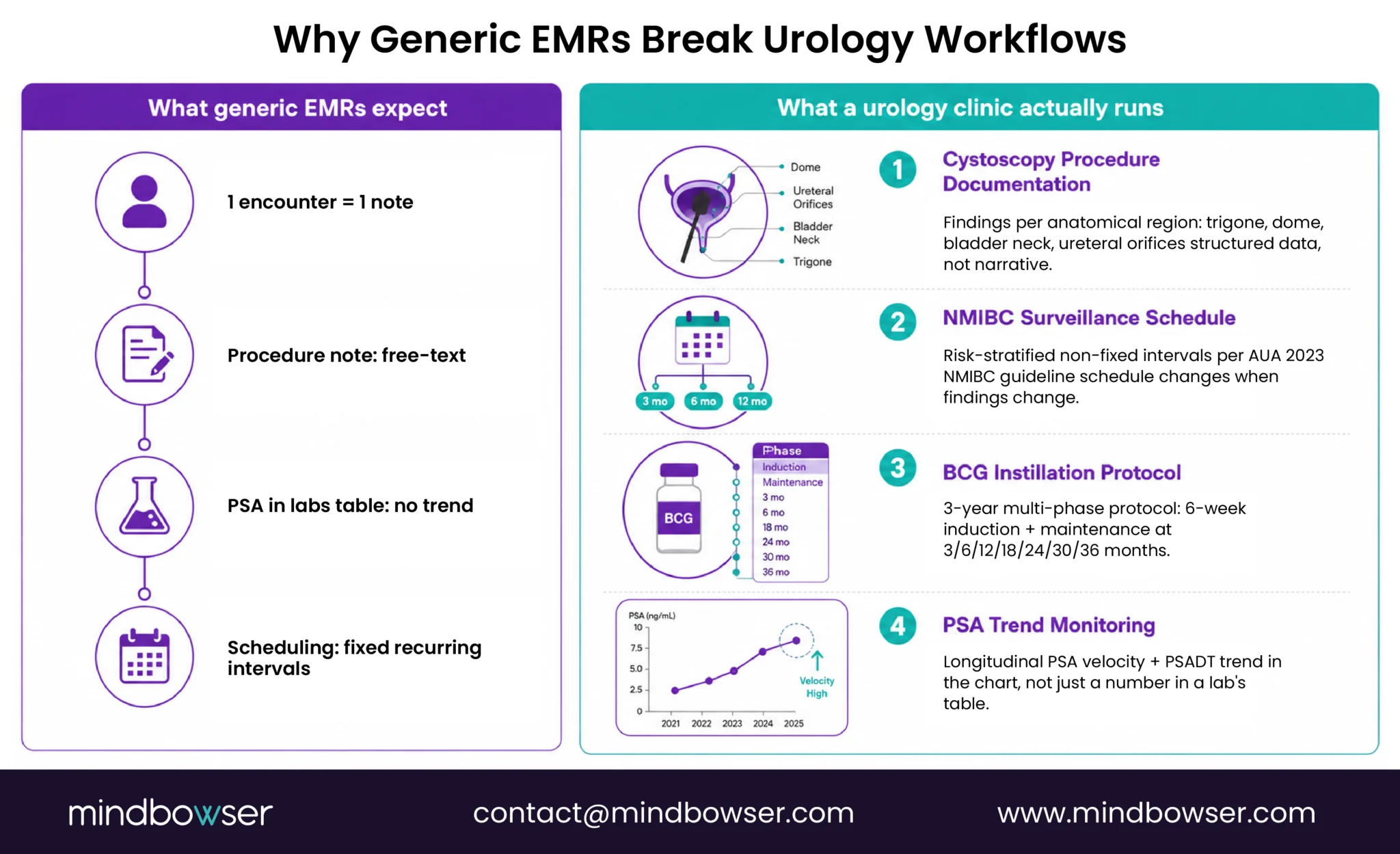
Here’s the core problem: a generic EMR sees a urology visit as one patient, one encounter, one set of vitals. Urology doesn’t work that way.
Walk into a urology clinic on a Tuesday morning. A patient sits down for cystoscopy. The urologist inserts a scope and visualizes the bladder. Cystoscopy is coded CPT 52000 if it’s diagnostic only. But the findings are anatomically specific: is there a lesion at the bladder neck, the trigone, the posterior wall, the dome, the left lateral wall, the right lateral wall, or at the ureteral orifices? That anatomical specificity changes clinical meaning.
A lesion at the trigone has different management implications than the same lesion at the dome. A generic EMR has a procedure note field. You type what you saw. The data is unstructured. You can’t query “all patients with trigone lesions in the past 12 months” without reading every note by hand.
Then the patient books a follow-up appointment three months later for surveillance cystoscopy. That’s a different visit in a generic EMR’s eyes. But clinically, it’s the continuation of a multi-year surveillance protocol. The American Urological Association 2023 Non-Muscle-Invasive Bladder Cancer (NMIBC) guideline specifies that low-risk NMIBC patients get cystoscopy at 3 months post-diagnosis, then at 12 months, then annually for 5 years.
High-risk NMIBC patients get cystoscopy every 3 months for the first 2 years, then every 6 months for the next 2 years, then annually for 5 years. A practice with 80 active NMIBC surveillance patients has 80 individual schedule tracks running simultaneously, each with a different interval based on risk stratification. Generic scheduling systems assume fixed recurring intervals (weekly, monthly). They don’t know about risk-stratified, non-fixed intervals that change based on findings.
Then throw in BCG intravesical therapy for high-grade NMIBC. Per the FDA prescribing information for Theracys and TICE BCG, the standard intravesical BCG regimen consists of a 6-week induction course (one instillation weekly for 6 weeks) followed by maintenance therapy at 3 months, 6 months, 12 months, 18 months, 24 months, 30 months, and 36 months after induction. Each maintenance course is three weekly instillations.
That’s a 3-year, multi-phase, dose-event-by-dose-event protocol. Your EMR needs to know which phase each patient is in, when the next instillation is due, which instillations were given, and whether the patient completed the course or interrupted it due to toxicity. Generic EMRs have a single “procedure completed” checkbox. They don’t understand induction vs maintenance phases, and they don’t flag when a patient needs a dose step-back after missing an interval.
Then add PSA trend monitoring for the prostate cancer screening side of urology. Prostate-specific antigen (PSA) values are clinically meaningless in isolation. PSA velocity (rate of rise over time), PSA doubling time (PSADT, how many months it takes for PSA to double), and PSA density (PSA relative to prostate volume) require longitudinal tracking across multiple visits.
A patient whose PSA rises from 2.4 to 3.8 to 5.1 over 18 months has a completely different clinical picture than a patient at 5.1 stable for 4 years. Generic EMRs put PSA in a labs table. No trend line. No velocity calculation. No alert when doubling time drops below 3 years (a threshold that warrants aggressive intervention per most urology guidelines).
Cystoscopy documentation is structurally broken in generic EMRs. The findings need to be anatomically mapped. The system should capture lesion location, size, appearance, biopsy status, and pathology result in the same structured record. Not a narrative note.
Bladder cancer surveillance scheduling is a multi-year clinical commitment that generic EMRs can’t model. AUA NMIBC intervals are risk-stratified and non-fixed. When a surveillance cystoscopy finding changes risk category, the schedule should recalculate. A patient who had a recurrence at the 12-month scope moves from low-risk to intermediate-risk intervals automatically. Most practices use a spreadsheet or a calendar to track this manually.
BCG intravesical therapy is a three-year immunotherapy protocol that generic EMRs weren’t built for. The system needs to distinguish the induction phase from the maintenance phase. It needs to log each instillation event (date given, dose, batch/lot number, nurse initials, patient tolerance), flag missed instillations, and show which maintenance course the patient is currently in. The FDA labeling specifies the exact instillation schedule. Miss one, and the protocol is compromised.
PSA trend monitoring requires longitudinal analytics in the chart, not just a labs table. Values need to be timestamped, visualized as a trend, and flagged for velocity when the rise rate exceeds clinical thresholds (typically greater than 0.75 ng/mL/year or PSADT less than 3 years). A generic EMR shows you a number. It doesn’t show you the trajectory.
CPT coding for cystoscopy procedures is conditional and complex. The same cystoscopy visit produces a different CPT code depending on what was done during the scope: CPT 52000 if diagnostic only, CPT 52204 if a biopsy was taken, CPT 52224 if fulguration was performed, CPT 52281 if dilation was done. If multiple procedures are performed during one cystoscopy, modifier rules apply.
A generic EMR requires your billing staff to determine the correct code by reading the procedure note. That’s manual, error-prone, and a direct source of claim rejections and underbilling.
That’s why a spreadsheet lives in every urology practice that doesn’t have a purpose-built system. It’s not a technology failure. It’s an architecture failure. The system was built for a different workflow.
What a Urology EMR Must Actually Do (The Evaluation Framework)
Six criteria separate systems built for urology from systems adapted to urology after the fact.
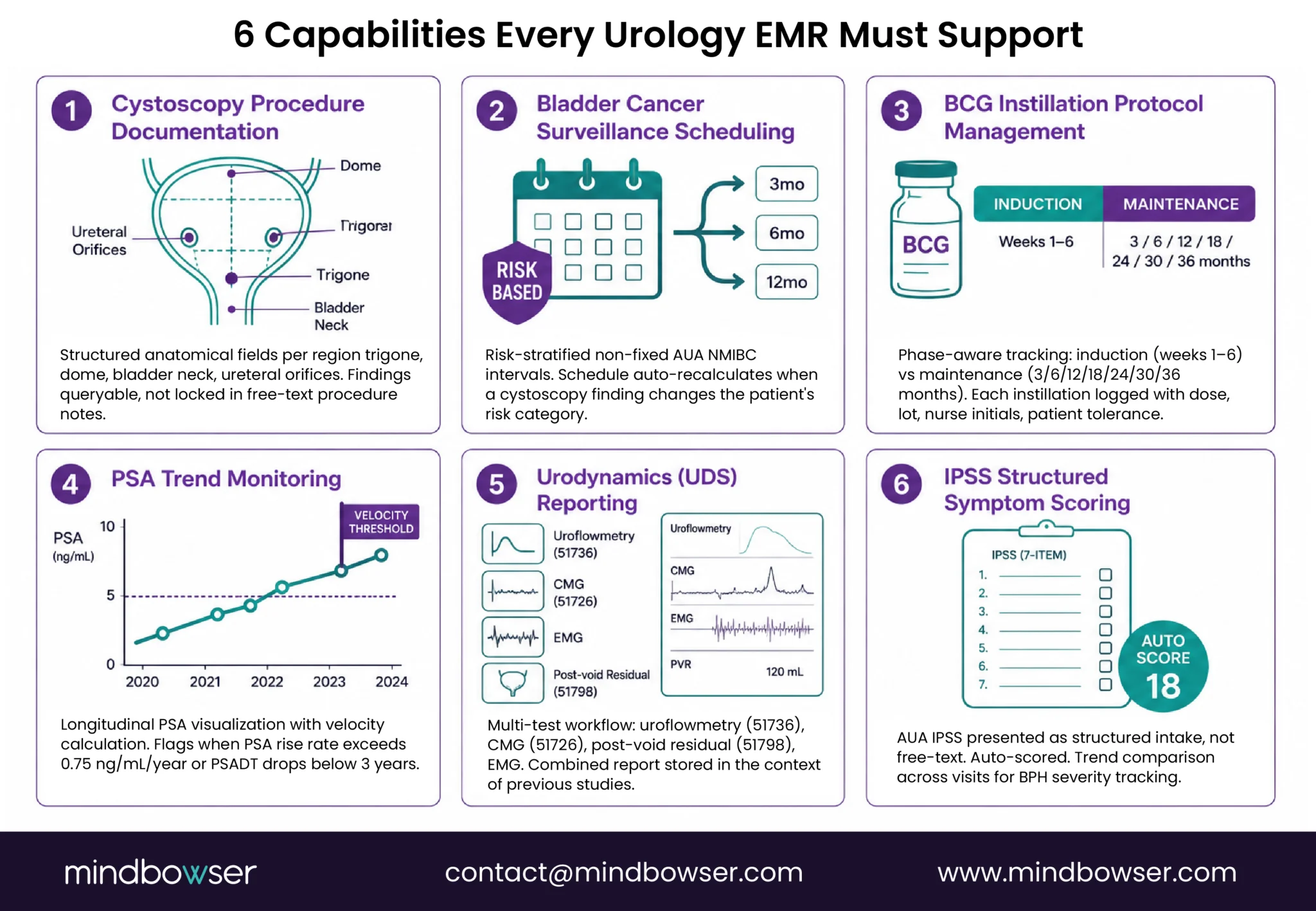
1. Cystoscopy procedure documentation: structured, not free-text. Anatomical regions as discrete fields (bladder neck, trigone, posterior wall, dome, left lateral wall, right lateral wall, ureteral orifices). Findings per region (normal, erythema, lesion, growth, scar). Biopsy location and size, if taken. Equipment used (flexible vs rigid scope, scope size). Cold cup vs hot biopsy technique. Results should be queryable: “all patients with lesions at trigone in the past 6 months.”
2. Bladder cancer surveillance scheduling: risk-stratified, non-fixed intervals. The system should know whether a patient is low, intermediate, or high-risk per AUA NMIBC stratification, and schedule accordingly. When a cystoscopy finding changes risk category, the schedule should update automatically. A patient who had a recurrence at the 12-month scope moves from low-risk to intermediate-risk intervals without manual recalculation.
3. BCG instillation protocol management: phase-aware tracking. The system should distinguish the induction phase (weeks 1 through 6) from the maintenance phase (3 months, 6 months, 12 months, and onward). It should log each instillation event (date given, dose, batch/lot, nurse initials, patient tolerance), flag missed instillations, and show which maintenance course the patient is currently in.
4. PSA trend monitoring and velocity calculation: longitudinal analytics in the chart. Values timestamped, visualized as trend, with PSA velocity flagged when rise rate exceeds clinical thresholds (typically greater than 0.75 ng/mL/year or PSADT less than 3 years).
5. Urodynamics (UDS) reporting: multi-test workflow with graphical output. UDS includes uroflowmetry (CPT 51736), post-void residual (CPT 51798), cystometrogram / CMG (CPT 51726), leak point pressure, and EMG. Each is a separate test generating data (flow curves, pressure readings, EMG tracings). The final UDS report synthesizes all. Generic EMRs have no concept of this multi-test, graphical-output workflow.
6. IPSS structured symptom scoring: standardized, longitudinal. The International Prostate Symptom Score (AUA IPSS) is a validated 7-item questionnaire for benign prostatic hyperplasia (BPH) severity tracking. The system should present IPSS as a structured intake (not a free-text field), score automatically, and allow trend comparison across visits.
These six dimensions separate systems that work from systems that create workarounds.
If you’re evaluating across multiple specialties, this guide to specialty EMR development walks through the full framework.
Not Sure Which EMR Fits Your Urology Practice? Request an Assessment.
The 5 Best Urology EMR Systems in 2026 (And Where Each One Breaks)
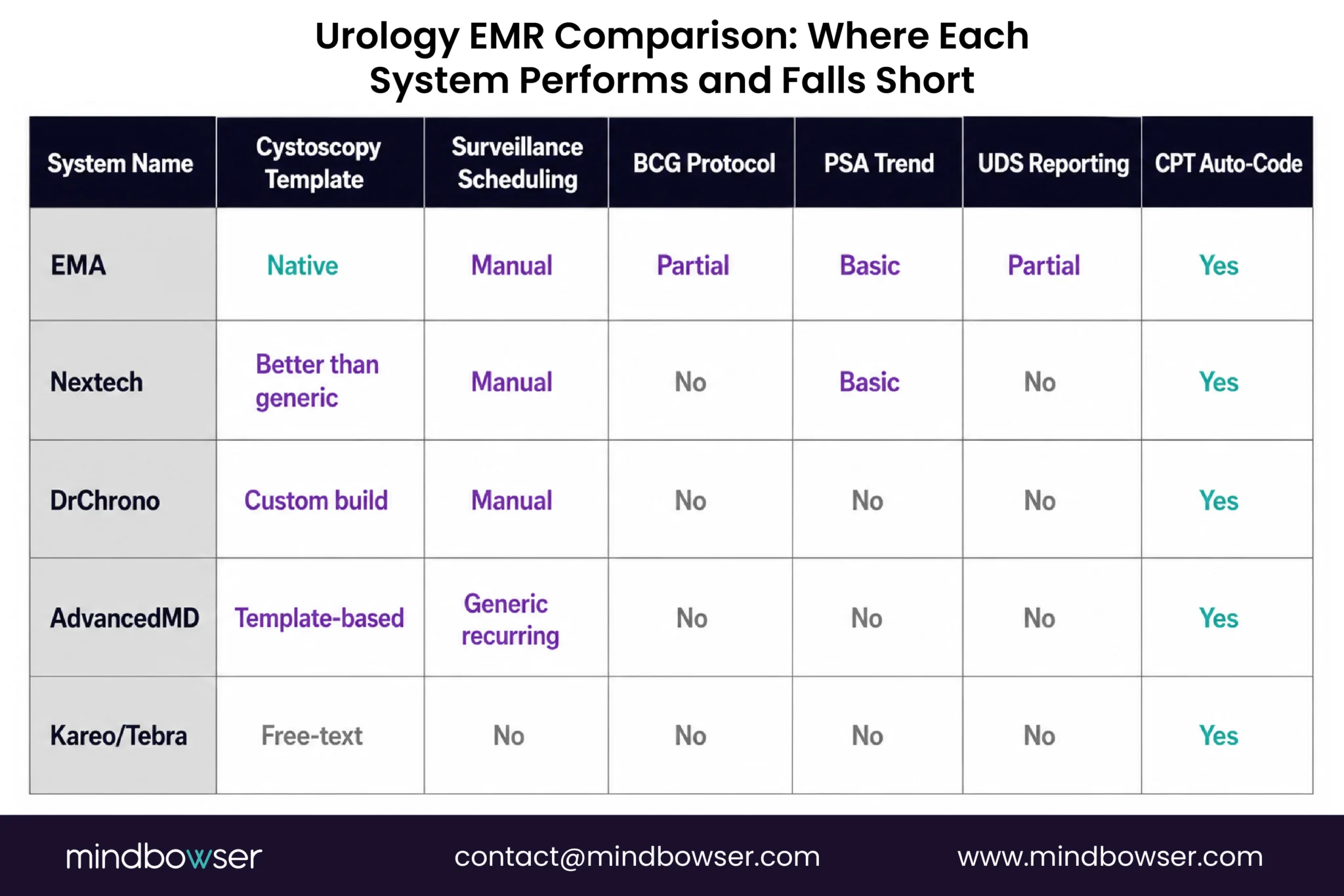
Modernizing Medicine (EMA): Most Purpose-Built for Urology
Modernizing Medicine’s EMA (Electronic Medical Assistant) is the only system on this list with a urology-specific vertical built from the ground up. Procedure templates cover cystoscopy, prostate biopsy (CPT 55700), extracorporeal shock wave lithotripsy (ESWL, CPT 50590), vasectomy, and urodynamics. The cystoscopy template has anatomical region fields, not free-text only.
Structured PSA tracking exists as a lab trend module. Billing for urology procedures is mapped. The interface is clean. They’ve built enough specialty-specific content that you’re not starting from a blank canvas.
Where it breaks: Price point is significant. EMA is enterprise-grade pricing for a specialty EMR. Practices with 2 through 3 urologists report sticker shock at implementation and annual costs. Implementation is complex and requires experienced staff. Post-go-live support quality is inconsistent. And while the cystoscopy template has anatomical regions, BCG protocol management is semi-manual.
You’re logging instillations, but the system isn’t aware of induction vs maintenance phases natively. The surveillance schedule is your responsibility to track.
Best for: Multi-physician practices with IT support and budget for specialty EMR pricing.
Learn more: See how CharmHealth’s EHR API is structured for independent practices considering EMA alongside other platforms.
Nextech: Strong Specialty Foundation, Growing Urology Presence
Nextech started in medical aesthetics and has expanded into urology as part of their specialty clinic push. Procedure documentation is better than a generic EMR. Revenue cycle management is built in. Scheduling handles higher-complexity procedure booking. The interface is modern.
Where it breaks: Urology wasn’t the founding vertical (aesthetics was). The clinical depth for cystoscopy-specific workflows shows it. PSA trend monitoring is basic. BCG protocol management doesn’t exist as a native feature. For urology practices that are primarily surgical (high scope volume, bladder cancer surveillance), Nextech is a step up from generic but still not where you need it to be.
Best for: Urology practices blending surgical procedures with cosmetic urology (penile aesthetics, hormone therapy), where the Nextech aesthetics heritage is actually useful.
DrChrono: Flexible, But You’re Building It Yourself
DrChrono’s form builder is flexible enough to produce a cystoscopy template with anatomical region checkboxes if you’re willing to invest implementation time. iPad-first is a plus for in-procedure charting. The API is open for integration with external tools.
Where it breaks: Nothing urology-specific is out of the box. Every urology practice I’ve seen run DrChrono invested 4 through 6 weeks of configuration time to build workable templates. When staff turnover happens, that institutional knowledge walks out the door. Bladder cancer surveillance scheduling isn’t native. You’re using DrChrono’s generic recurring appointment system and manually adjusting intervals.
BCG instillation tracking is a custom form. PSA trend visualization doesn’t exist (that’s still a spreadsheet). The configuration depth available in DrChrono is both its advantage and its liability. When you build it yourself, you maintain it yourself.
Best for: Practices with a dedicated IT resource or a vendor who can build and maintain urology-specific templates long-term.
AdvancedMD: Full Practice Management, Urology as an Add-On
AdvancedMD has a complete practice management suite (scheduling, billing, RCM, patient portal, telehealth). If you want one platform for everything, AdvancedMD is a legitimate option. Urology-specific templates exist in their library.
Where it breaks: Urology is a template module, not a built workflow. The cystoscopy template is a custom form, not a structured anatomical documentation tool. Surveillance scheduling is a generic recurring appointment. BCG tracking is a procedure note. PSA trend is a labs table.
The system doesn’t understand that these workflows are connected. A cystoscopy finding at month 3 should recalculate the month 6 surveillance schedule, but it doesn’t. That clinical intelligence has to live in your staff’s heads, not in the EMR.
Best for: Small independent practices that want unified scheduling, billing, and documentation under one roof, and can accept that urology-specific workflow logic lives outside the system.
Kareo / Tebra: Lowest Friction Entry, Minimal Urology Depth
Kareo (now Tebra post-merger) is well-suited for small independent practices that prioritize billing simplicity and ease of use. Affordable. Fast onboarding. Clean interface. Telehealth native. Good patient engagement features.
Where it breaks: Urology depth is minimal. Cystoscopy documentation is a procedure note field or a basic custom form. No anatomical region structure. No surveillance scheduling. No BCG protocol tracking. No PSA trend visualization. Kareo was built for primary care and behavioral health billing rhythms.
Urology is a procedure-heavy specialty with complex CPT rules and workflow logic. Tebra doesn’t have the infrastructure to support it. Every high-volume urology practice I’m aware of that tried Tebra ended up managing core clinical workflows outside the EMR.
Best for: Solo urologists doing mostly office-based evaluation and management (E&M) with simple procedural work, and minimal ongoing surveillance panels.
Two Scenarios Where Off-the-Shelf Urology EMRs Stop Working
Most 2 through 3 urologist independent practices can manage with EMA or Nextech. Two scenarios change that calculus.
Scenario 1: You have an active bladder cancer surveillance panel.
High-risk NMIBC patients require cystoscopy every 3 months for the first 2 years post-diagnosis. If a 4-physician group practice has 60 active high-risk NMIBC patients, that’s a surveillance schedule generating roughly 240 cystoscopy appointments in year 1 alone. Each appointment has a specific clinical context: which risk category the patient is in, which surveillance interval, what the previous finding was, whether BCG was given, and whether it completed full induction.
No off-the-shelf urology EMR handles this as a connected workflow. You’re scheduling in the EMR, tracking risk category in a separate document, logging BCG instillations in a third place, and hoping your staff pulls all three sources before each surveillance visit. I’ve seen this model in outcomes research data. Fragmented tracking creates protocol deviation risk. A missed interval or a missed BCG course changes clinical outcomes.
Scenario 2: You’re running urodynamics alongside a BCG program.
A urology group practice running full urodynamics (UDS) alongside a BCG intravesical therapy program has two high-documentation-complexity workflows in the same building. UDS generates multi-test reports with graphical output (uroflowmetry curves, CMG pressure traces) that need to be interpreted in the context of previous studies and stored for insurance authorization.
BCG requires a real-time instillation log with batch numbers and lot tracking (BCG is a live bacterial preparation with specific handling requirements per FDA labeling), and treatment phase documentation.
Generic EMRs were built for neither. Most practices we’ve looked at are managing UDS reports as scanned PDFs attached to a note, and BCG tracking in a binder at the nursing station. That’s liability exposure and lost data. Practices running both SCIT (standard cutaneous immunotherapy, i.e., subcutaneous injection) and BCG face workflow fragmentation that no off-the-shelf system solves natively.
How we analyzed a similar architecture problem across specialties: see the multi-phase protocol management gaps in IV therapy EMRs.
When Custom Development Makes Sense for Urology Practices
The honest threshold for urology is different from most specialties. It’s not driven by patient volume. It’s driven by protocol complexity.
A small 2-physician urology practice running 30 active NMIBC surveillance patients and a BCG program has higher EMR complexity than a 10-physician primary care group with 3,000 patients. Volume doesn’t decide when to build. Protocol depth does.
A custom urology EMR module with a clear scope (cystoscopy structured documentation, NMIBC surveillance scheduling, BCG instillation protocol management, PSA trend analytics, UDS report integration) is a bounded clinical workflow set. Not a full EHR rebuild. That’s a different cost conversation.
Mindbowser has built and deployed full custom EHR systems for health systems, and a specialty workflow module for a focused urology scope is a smaller build than that. With pre-built accelerators (Patient Questionnaire Form for IPSS integrated pre-cystoscopy intake, PHISecure for HIPAA compliance by default, Patient Referral Manager for urologist-to-PCP communication loops), the timeline compresses. 8 through 14 weeks from contract to live on a focused scope.
What custom brings that EMA and Nextech can’t:
Native NMIBC surveillance scheduling: The system knows the patient’s risk category per AUA NMIBC stratification, the guideline-specified intervals, and the current surveillance position. When a finding changes risk stratification, the schedule recalculates automatically. No manual adjustment. No spreadsheet.
BCG protocol management with phase awareness: The system distinguishes induction from maintenance. It logs each instillation (date, dose, batch/lot, nurse initials, patient tolerance) and tracks which maintenance course is current. It flags when a patient completes induction and needs maintenance scheduled at the 3-month mark. It prevents accidental double-dosing or missed phases.
PSA trend analytics in the chart. Longitudinal visualization: PSA velocity and PSA doubling time calculation. Alert when doubling time drops below a clinically significant threshold (typically less than 3 years). No separate spreadsheet. No manual graphing. The data is in context with the patient’s current clinical status.
Anatomically structured cystoscopy documentation: Findings logged per anatomical region as structured data. Queryable: “all trigone lesions from the past 18 months.” Biopsy location and pathology linked in the same record, not a separate report.
Urodynamics multi-test integration: UDS results (uroflowmetry, CMG, EMG, leak point pressure) synthesized in one report viewable next to PSA trends and cystoscopy history in the same chart.
How to Evaluate a Urology EMR Before You Sign
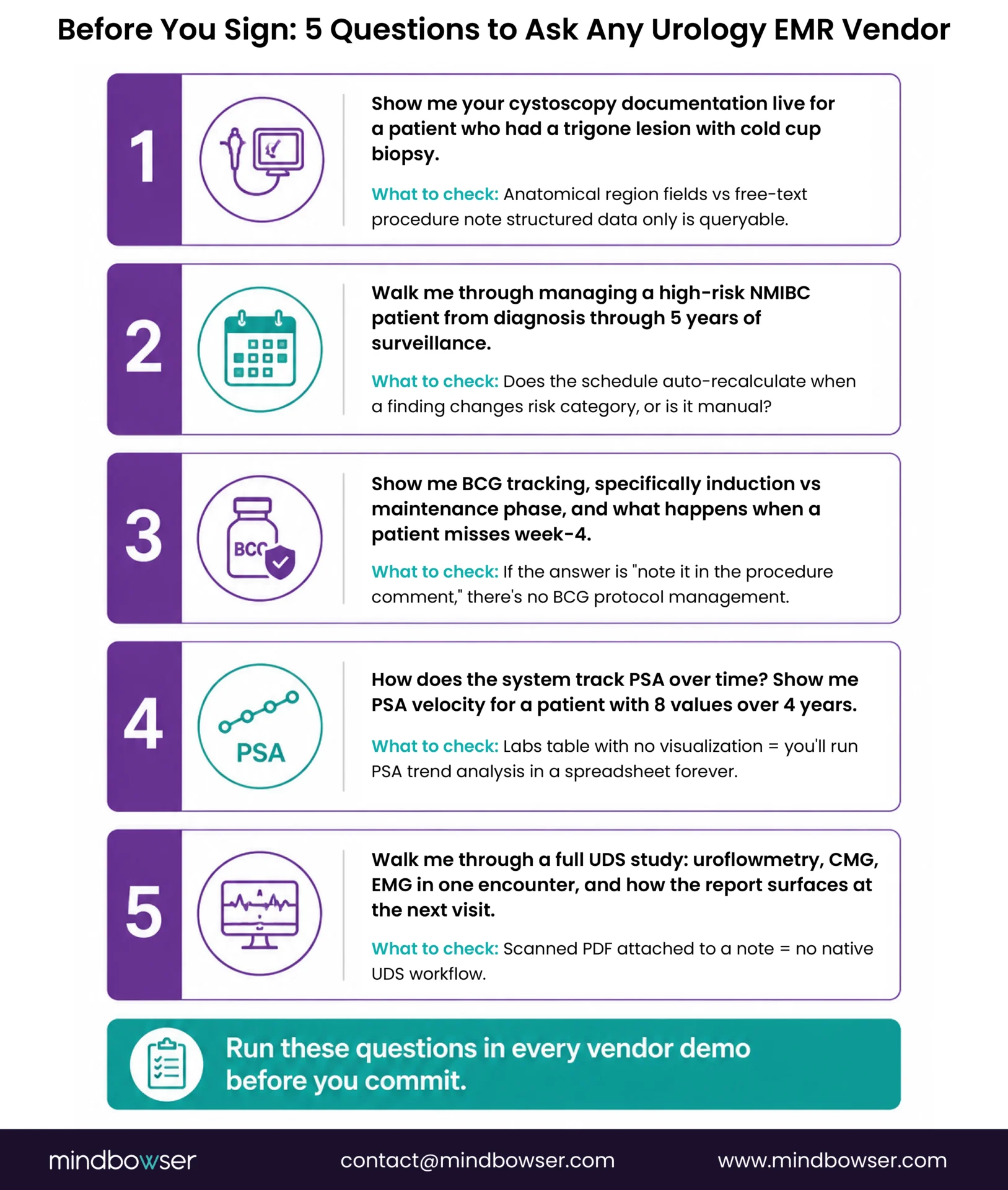
Five questions that will tell you everything you need to know before committing to any urology EMR.
1. “Show me your cystoscopy documentation (live, for a patient who had a trigone lesion with cold cup biopsy).” If they show you a text box, you’re looking at a generic procedure note. Ask: “Are the findings structured by anatomical region or is this free-text?” Structured fields are queryable. Free-text is a document storage system.
2. “Walk me through how the system manages a high-risk NMIBC patient from diagnosis through 5 years of surveillance.” The answer should include how risk category is recorded, how the schedule adjusts automatically, and what happens when a surveillance cystoscopy finds a recurrence. If the answer involves “we’d create recurring appointments,” you’re looking at a generic scheduler that doesn’t understand AUA surveillance intervals.
3. “Show me BCG intravesical therapy tracking: specifically, how you distinguish induction phase from maintenance phase, and what the system shows when a patient misses their week-4 instillation.” If the answer is “you’d note that in the procedure comment,” there’s no BCG protocol management in the system.
4. “How does the system track PSA over time? Can you show me PSA velocity for a patient with 8 values over 4 years?” If the answer is a labs table with no visualization, you’ll be doing PSA trend analysis in a spreadsheet for the lifetime of that system.
5. “How do you handle a full UDS study (uroflowmetry, CMG, and EMG) in one patient encounter, and how does the combined report get stored and surfaced for the next visit?” If UDS documentation is a scanned PDF attached to a note, there’s no native UDS workflow.
Evaluating specialty EMRs across multiple departments? See how we applied the same six-dimension framework to IV therapy and allergy practices.
Which Urology EMR Is Right for Your Practice?
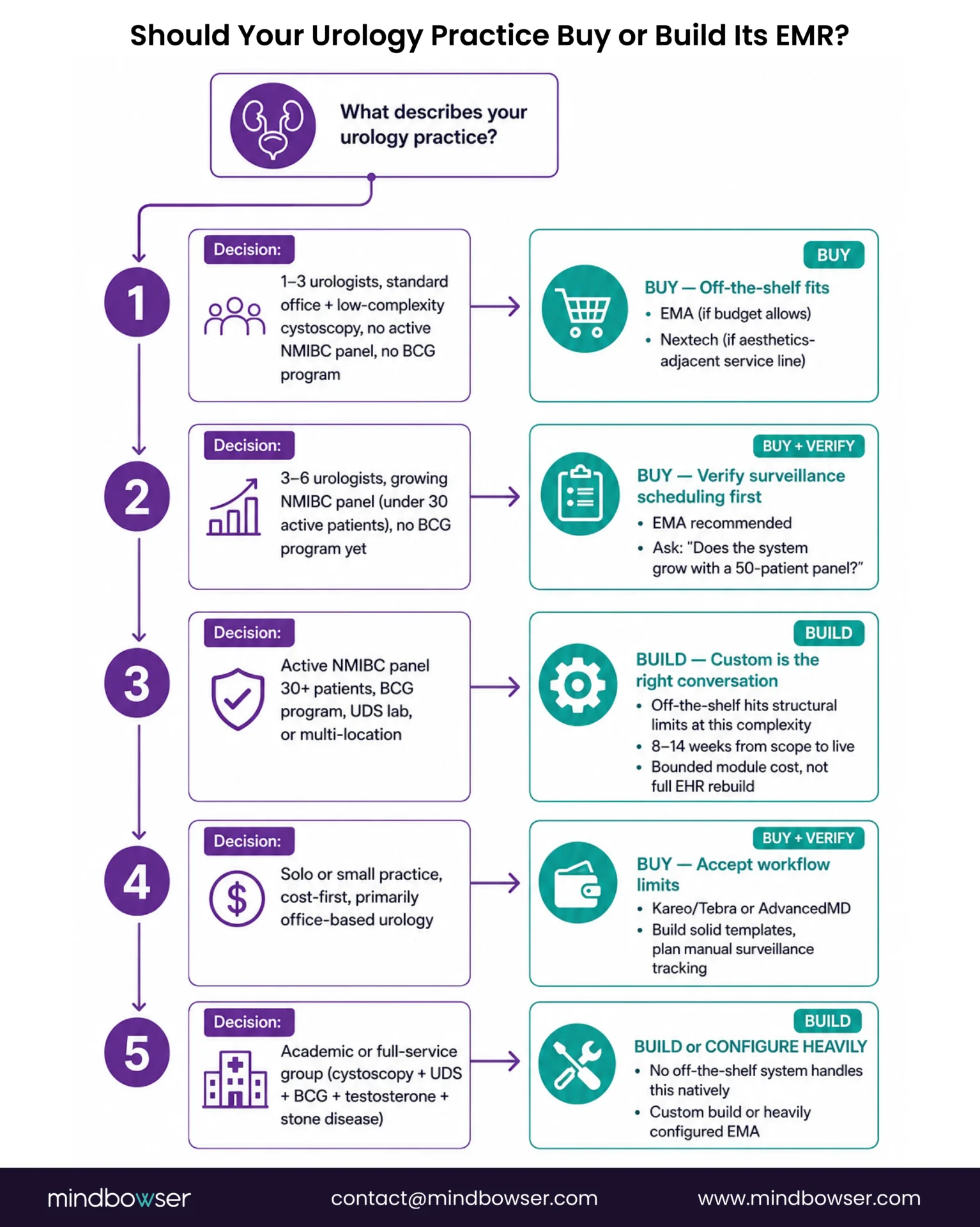
The answer depends on your surveillance panel size, your procedure mix, and your 18-month growth plan. Not which system demoed most smoothly.
1 through 3 urologists, standard office visits with low-complexity cystoscopy, no active NMIBC surveillance panel, no BCG program: EMA (Modernizing Medicine) if budget allows. Nextech if you’re also running an aesthetics-adjacent urology service. Buy.
3 through 6 urologists, growing surveillance panel (fewer than 30 active NMIBC patients), no BCG program yet: EMA. Buy, but ask the surveillance scheduling question before signing. Will this system grow with your panel when it hits 50 patients, or will you be managing intervals in a spreadsheet?
Active NMIBC surveillance panel 30 or more patients, BCG program, UDS lab, or multi-location: Off-the-shelf hits structural limits. Custom development is the conversation to start before you’ve outgrown EMA and are mid-panel.
Solo or small practice, cost-first, primarily office-based urology: Kareo/Tebra (buy) or AdvancedMD for broader practice management. Accept that cystoscopy-specific workflow logic lives outside the EMR. Build solid templates. Plan for manual surveillance tracking.
Academic or group practice with full service line (cystoscopy plus UDS plus BCG plus testosterone management plus stone disease): No off-the-shelf system handles the full service line natively. Custom build or a very heavily configured EMA are the two realistic paths.
We help urology practices evaluate, build, or integrate on any stack: EMA, Nextech, DrChrono, AdvancedMD, or custom.
Conclusion
Stop working around your EMR. The system you pick now should actually fit your urology workflow, not force you to invent spreadsheets for cystoscopy findings, surveillance intervals, and BCG schedules.
If you’re running 1 through 6 urologists, evaluate the five systems above using the six criteria in this guide. If you’re running 6 or more urologists, or planning active surveillance expansion or BCG therapy, the conversation with a custom development team should start now.
There’s no clear market leader for urology EMR software. EMA has the most traction among practices that can afford enterprise pricing. Nextech is growing in specialty clinics. DrChrono is popular in independent practices that want flexibility. No single urology EMR dominates the way Epic dominates hospital systems.
You can start with a general EMR, but you’ll hit walls fast. Cystoscopy documentation, NMIBC surveillance scheduling, and BCG protocol management are clinical workflows that general EMRs weren’t built for. You’ll end up managing them outside the EMR: spreadsheets, custom forms, manual workarounds. A purpose-built urology EMR removes that friction.
The best urology EMR systems have a surveillance module that knows the AUA NMIBC guideline-specified intervals and the patient’s current risk category (low, intermediate, or high-risk). When a cystoscopy finding changes risk category, the system recalculates the schedule. Manual systems require you to look up the guideline, determine the interval, and create the appointment yourself. The difference is automation and protocol compliance.
Yes, if you have the budget and IT resources. EMA is purpose-built for urology workflows. Cystoscopy templates are structured. Procedure coding is mapped. PSA tracking exists. The downside is price and implementation complexity. Post-go-live support can be inconsistent. And BCG protocol management is semi-manual, not fully native.
Diagnostic cystoscopy is CPT 52000. Cystoscopy with biopsy is CPT 52204. With fulguration is CPT 52224. With dilation is CPT 52281. Prostate biopsy is CPT 55700. Transurethral resection of prostate (TURP) is CPT 52601. Urodynamics codes include CPT 51736 (uroflowmetry), CPT 51726 (cystometrogram), and CPT 51798 (post-void residual). Your EMR should auto-populate these based on the documented service, not requiring manual billing staff entry.
If a licensed urologist is involved in diagnostics (cystoscopy findings, prostate biopsies, pathology interpretation), patient data is Protected Health Information. HIPAA Security Rule applies: encryption at rest and in transit, access controls, audit logging, workforce security, incident response, and business associate agreements with all vendors. Additionally, ONC’s USCDI v3 requires that procedure findings include structured data (not free-text) for interoperability and compliance. Your EMR must be HIPAA-certified and capable of USCDI v3 structured documentation.