











 BLOGS
 NEWSROOM
 CASE STUDIES
 WEBINARS
 PODCASTS
 ASSET HUB
 EVENT CALENDAR
























TL;DR
- Most allergy practices run on general-purpose EMRs that weren’t built for skin test grids, immunotherapy vial tracking, or dose-escalation schedules: the three workflows that define this specialty.
- The 2026 best allergy immunology EMR shortlist with real traction is Modernizing Medicine (EMA), Meditab, DrChrono, AdvancedMD, and Kareo/Tebra, each with an honest failure point.
- For practices running 4+ providers, SLIT home protocols, or biologic infusion alongside standard immunotherapy, off-the-shelf systems hit a structural wall. That’s when custom development becomes the right conversation.
Why Generic EMRs Fail Allergy & Immunology Practices
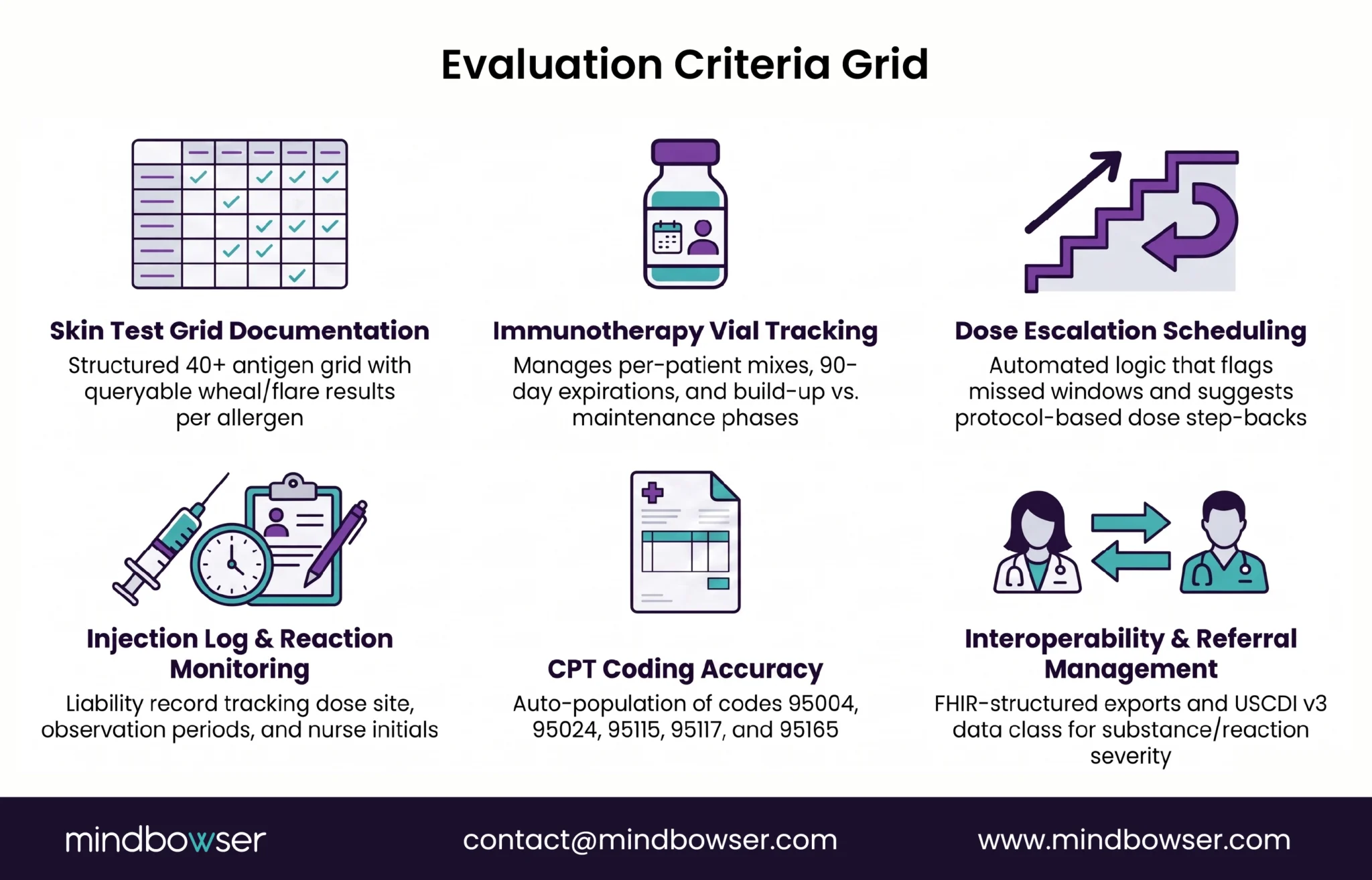
Here’s the core problem: a generic EMR sees an allergy visit as one patient, one encounter, one set of vitals. Allergy doesn’t work that way.
Walk into an allergy clinic on a Tuesday morning. A patient sits down for skin testing. The allergist or nurse administrator runs 40-50 percutaneous prick tests across the patient’s back or arm. Each test is read at 15 minutes. Each antigen is a discrete clinical data point: the specific allergen, the wheal diameter, the flare diameter, the reaction interpretation. That’s 40-50 individual clinical events captured in one 20-minute session. A generic EMR has a free-text “allergies” field. It doesn’t have a structured grid.
Then the patient books an immunotherapy injection appointment two weeks later. That’s a different visit in a generic EMR’s eyes. But clinically, it’s the continuation of the same protocol. The nurse pulls the patient’s vial (compounded specifically for this patient with their unique antigen mix). The dose is measured by volume per the escalation schedule. The injection is administered. A reaction is monitored for 20 minutes.
All of that must be logged individually because CPT 95115 (single injection) and CPT 95117 (two or more injections) are billed per discrete injection event. A generic EMR sees this as a routine injection appointment. It doesn’t see the vial expiration date (90 days standard), doesn’t understand build-up vs maintenance phase dosing, and doesn’t flag when a patient misses a dose window and needs a dose step-back.
Then throw in the emerging modality: biologics. Dupixent (dupilumab), Xolair (omalizumab), Fasenra (benralizumab) for allergy or eosinophil-driven asthma. These require separate administration records, prior auth documentation, and monitoring workflows that are orthogonal to skin testing and immunotherapy. A practice running both standard allergy and biologic infusion needs two separate documentation workflows. Generic EMRs were built for one or the other. Not both.
1. Skin test documentation is broken. The American College of Allergy, Asthma & Immunology (ACAAI) and American Academy of Allergy, Asthma & Immunology (AAAAI) Joint Task Force Practice Parameters specify that allergen immunotherapy documentation includes the allergen administered, the dose in micrograms, the route (subcutaneous or sublingual), and the patient’s reaction.
Percutaneous skin tests (CPT 95004) and intradermal tests (CPT 95024) require the same specificity: allergen by allergen, result by result. Generic EMRs have checkboxes for “patient has peanut allergy.” They don’t have a structured grid for 50 individual skin test results.
2. Immunotherapy vial management is a spreadsheet forever. IV therapy clinics (which we wrote about separately) have inventory hell. Allergy clinics have compounded-vial hell. Each patient’s immunotherapy vial is a unique mix of antigens (tree pollens, grass, dust mites, pet dander, molds) selected and mixed specifically for that patient. The vial has a 90-day shelf life from the compounding date.
Build-up phase patients get weekly injections with escalating doses over 3-6 months. Maintenance phase patients get injections every 2-6 weeks at a fixed dose. A practice managing 50-100 active immunotherapy patients has 50-100 individual vial expiration clocks running. A practice with 15 patients in build-up and 35 in maintenance needs to know, at a glance, which phase each patient is in and what the next dose should be. Spreadsheets do this. EMRs don’t.
3. Billing gets complicated fast. CPT 95165 is professional services for allergen immunotherapy per dose. CPT 95115 is single immunotherapy injection. CPT 95117 is two or more injections. A patient who gets two injections in a single visit is coded differently than a patient who gets one. A patient who needs a dose step-back after missing an appointment is coded as a lower dose (if your billing system knows about the step-back). Generic EMRs don’t. Your billing staff does it manually. That’s revenue leakage and compliance risk.
4. HIPAA and USCDI v3 compliance requires structure. When a licensed provider administers immunotherapy, patient data is Protected Health Information. HIPAA Security Rule applies. But there’s a newer layer: ONC’s USCDI v3 (United States Core Data for Interoperability, version 3) mandates that allergy documentation includes the allergen substance, the reaction type, and the severity (structured as data, not free-text). A practice using an EMR that only has a free-text allergy field is not USCDI v3 compliant and is at risk if an audit catches it.
That’s why a spreadsheet lives in every allergy practice that doesn’t have a purpose-built system. It’s not a technology failure. It’s an architecture failure. The system was built for a different workflow.
What Allergy & Immunology EMRs Must Actually Do (The Evaluation Framework)
Six criteria separate systems built for allergy from systems adapted to allergy.
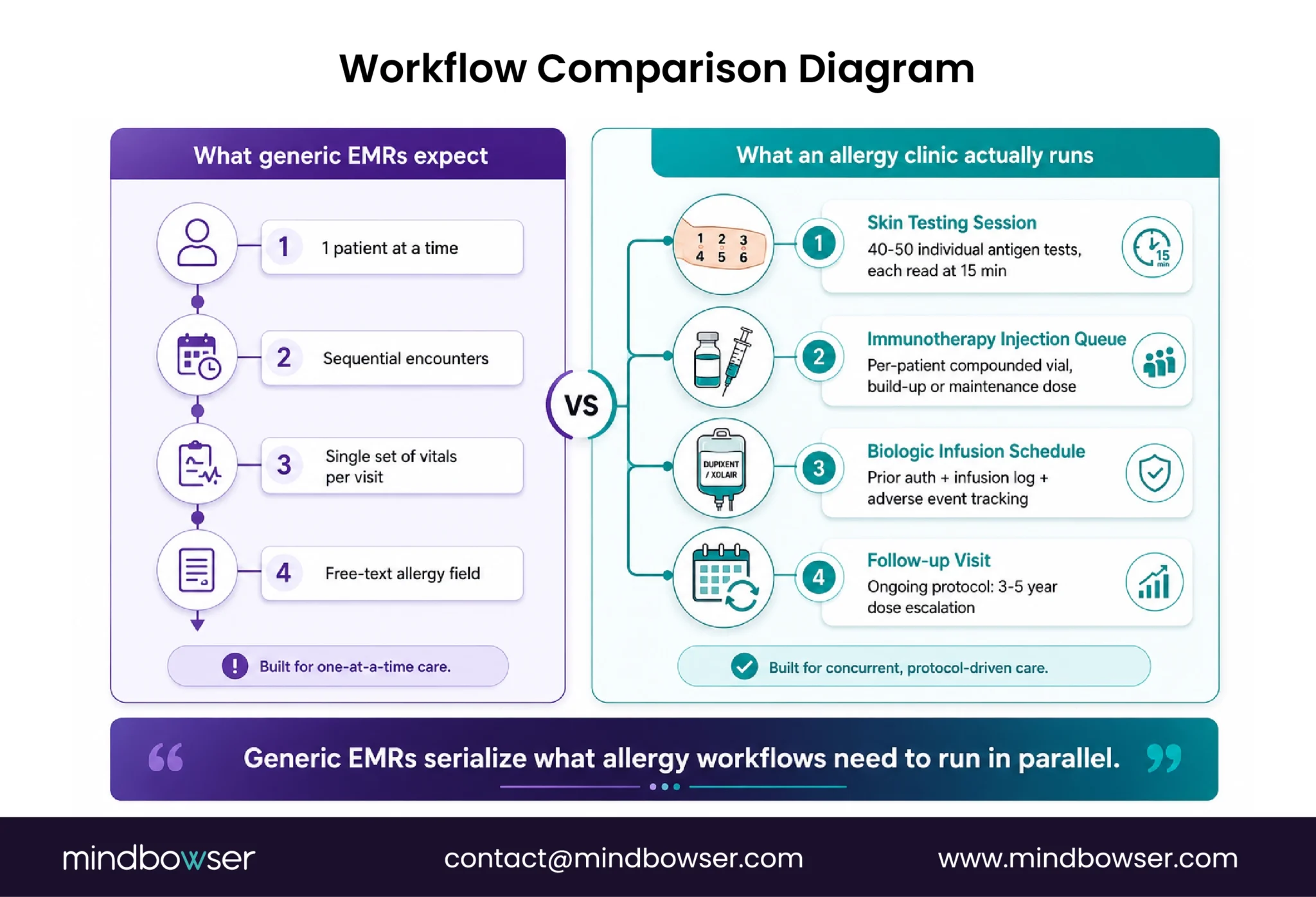
1. Skin test grid documentation. Structured, 40+ antigen grid. Percutaneous and intradermal results captured per allergen, not free-text. Results read at 15 minutes (wheal and flare measurements per allergen, per patient). The system should let you configure which antigen panel your practice uses (standard 60-antigen, extended panel, subset for pediatrics). Results should be queryable and comparable year-over-year.
2. Immunotherapy vial tracking. Per-patient antigen mix. Vial expiration dates (90-day standard). Dose per injection. Build-up vs maintenance phase designation. Lot number for compounded vials. The system should flag vials approaching expiration and prevent accidental use of expired stock.
3. Dose escalation scheduling. Multi-visit dose-escalation schedules with automatic dose progression logic. The system should know that standard SCIT (subcutaneous immunotherapy) build-up involves weekly injections with increasing dose volumes over 3-6 months. The system should flag when a patient misses a window and automatically suggest a dose step-back (protocol-defined dose reduction to account for the lapsed interval). The maintenance phase should be a separate state with different injection intervals (bi-weekly to monthly).
4. Injection log and reaction monitoring. Every SCIT or SLIT administration logged with dose given, injection site, 20-minute observation period, any local or systemic reaction, nurse initials. This is the liability record. The system should capture this in a single place per injection event.
5. CPT coding accuracy. CPT 95004 (percutaneous), 95024 (intradermal), 95115 (single injection), 95117 (two or more injections), 95165 (professional services, per dose) must auto-populate from the documented service type. Manual coding by billing staff equals claim rejections and revenue leakage.
6. Interoperability and referral management. Allergists receive referrals from PCPs. Bidirectional communication (a summary note back to PCP) and shared allergy data (structured per USCDI v3) matter for care coordination. The EMR should export allergy findings in FHIR-structured format.
These six dimensions separate systems that work from systems that create workarounds.
If you’re evaluating across multiple specialties, this guide to specialty EMR development walks through the full framework.
The 5 Best Allergy & Immunology EMR Systems in 2026 (And Where Each One Breaks)
Modernizing Medicine (EMA): Most Purpose-Built for Allergy
Modernizing Medicine’s EMA (Electronic Medical Assistant) is the only allergy immunology EMR system in this list built from the ground up with allergy in mind. Skin test grids are native: you configure allergen panels, document wheal and flare per antigen, and read results in the system. The immunotherapy module exists. Vial tracking is closer to real than any other off-the-shelf option. CPT codes for allergy testing and injection administration are mapped into the workflow.
Where it breaks: Price point is one issue. EMA is enterprise-grade pricing for a specialty EMR. Smaller 2-3 provider practices report sticker shock. Implementation is complex and requires experienced staff. I’ve sat through two EMA implementations in the past three years. Onboarding is solid, but steady-state support has gaps. Post-go-live, you’re often on your own for workflow tweaks.
And vial tracking, while better than generic systems, still doesn’t handle multi-antigen compounding logic or dose step-back protocols natively. You’re extending it yourself or accepting some manual steps.
Best for: Practices with budget for specialty EMR pricing and dedicated IT/IT vendor support.
Meditab: Strong Allergy Module, Mid-Market Fit
Meditab’s allergy module has skin test documentation, immunotherapy scheduling, and billing support. Mid-market pricing. Configurable to your workflows. Strong in practices running allergy alongside other specialties (ENT/allergy combined, pediatric allergy). The interface is functional.
Where it breaks: The interface shows its age. Meditab has been around since 1998. The UX is functional but not modern. The patient portal is weak (no real engagement features). Telehealth integration requires a third-party add-on. For a practice with younger patients expecting a consumer-grade experience, Meditab creates friction at the front desk. And like EMA, vial tracking is semi-manual: you get a log, not automatic expiration flagging or dose step-back automation.
Best for: Practices 4-8 providers blending allergy with ENT or pediatrics, willing to accept a dated UI.
Related read: Telehealth EHR Integration Development: How to Build Connected and Compliant Virtual Care Workflows
DrChrono: Flexible, Requires Configuration Investment
DrChrono’s form builder is flexible enough to build a skin test grid if you’re willing to invest implementation time. iPad-first is a plus for in-room skin test documentation. The API is open for integration with external tools.
Where it breaks: Nothing allergy-specific is out of the box. You’re building it yourself. Every allergy practice I’ve seen run DrChrono has a custom template that someone spent 3-4 weeks configuring. When staff turnover happens, that institutional knowledge walks out the door. Immunotherapy vial tracking isn’t available natively (that’s still a spreadsheet). And dose escalation logic? You’re creating workarounds with custom fields and manual reminders.
Best for: Practices with IT resources or a willing IT vendor who can build and maintain custom templates.
AdvancedMD: Full Practice Management, Allergy as Add-On
AdvancedMD has a full practice management suite (scheduling, billing, RCM, patient portal, telehealth). If you want one platform for everything, AdvancedMD is a real option. Allergy-specific templates exist in their library. You can run skin test documentation and injection logging without leaving the system.
Where it breaks: Allergy is a module, not a native workflow. The skin test grid is a custom form, not a structured clinical tool. Immunotherapy tracking is template-based, not logic-based. You don’t get dose escalation automation (you get a form that your medical assistant fills in). That distinction matters when a patient misses a dose and needs a step-back. The EMR won’t flag it. Your staff has to catch it manually. And vial expiration tracking? Manual spreadsheet.
Best for: Small independent practices that want one system for scheduling, billing, and basic allergy documentation, accepting that allergy-specific logic is missing.
Kareo / Tebra: Best for Small Independent Practices, Not Specialty-Depth
Kareo (now Tebra post-merger) is well-suited for small independent practices that prioritize billing simplicity and ease of use. Affordable. Fast onboarding. Clean interface. Telehealth native. Good patient engagement features.
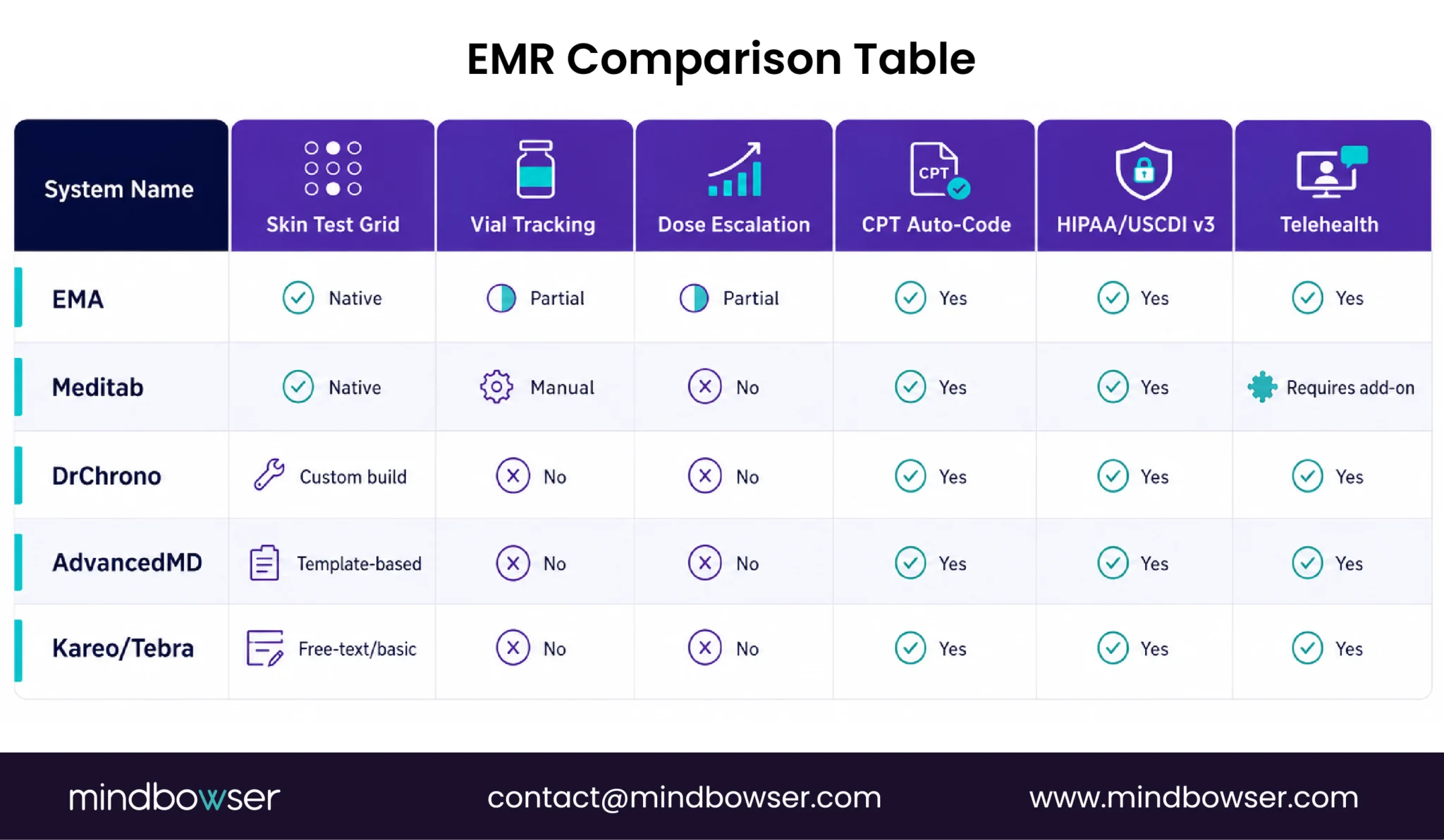
Where it breaks: Allergy depth is minimal. Skin test documentation is free-text or a basic custom form. No immunotherapy module. No vial tracking. No dose escalation logic. Kareo was built for primary care and behavioral health billing, not allergy. For a pure allergy practice, Tebra requires the most workarounds of any system on this list. You’ll be managing most allergy-specific workflows outside the EMR.
Best for: Hybrid practices (allergy plus primary care) that accept that allergy workflows live mostly outside the EMR.
Ready to Upgrade Your Allergy & Immunology EMR?
Two Scenarios Where Off-the-Shelf Allergy EMRs Stop Working
Most 2-4 provider allergy practices can get by with EMA or Meditab as their allergy EMR. Two scenarios change that calculation.
Scenario 1: You’re adding SLIT home protocols.
SLIT (sublingual immunotherapy) is growing. Instead of coming in weekly for shots, patients take antigen drops at home daily. It’s patient-friendly, expanding into allergy practices rapidly. But the clinic’s responsibility doesn’t end at the door. You’re managing dose escalation, reaction monitoring, and vial expiration for patients who aren’t in your building.
Generic allergy EMRs were not built for remote immunotherapy protocol management. EMA handles SCIT better than SLIT. When home protocols scale to 50+ active SLIT patients, the tracking overhead compounds (reminder systems, missed dose logging, escalation intervals, reaction reporting from home). Most EMRs on this list were built for clinic-based injection administration. SLIT home protocols require a different data model.
Scenario 2: You’re managing biologics alongside SCIT.
Practices prescribing Dupixent (dupilumab), Xolair (omalizumab), or Fasenra (benralizumab) for moderate-to-severe allergic asthma or atopic dermatitis are growing. These biologics are administered in-clinic or at home, require prior auth, and have specific monitoring requirements per the FDA prescribing information. Practices running both standard SCIT and biologics need biologic administration tracking (prior auth documentation, infusion logs, adverse event tracking, payer-specific requirements).
Most allergy EMRs were built for SCIT. Biologics require an overlay that none of the five systems above handles natively. You end up with two separate systems (allergy EMR + infusion tracking), two separate data sets, and two billing workflows. I worked with a practice running both SCIT and Xolair. They were managing EMA for allergy, a separate infusion log, and a billing platform that couldn’t talk to either. The reconciliation at end-of-month took two MAs a full day. That’s a real cost.
When Custom Development Makes Sense for Allergy Practices
The honest threshold: not based on practice size alone, but on workflow complexity. A custom allergy EMR module isn’t a $500K project.
If you have a clear scope (skin test grid, immunotherapy vial tracking with dose escalation logic, CPT auto-code, SLIT remote monitoring, biologic administration records), you’re defining a bounded set of clinical workflows for a best allergy immunology EMR. Not a full-stack EHR rebuild. That scope is realistic for a focused development engagement.
Mindbowser built and deployed a full EHR for a national health system. A specialty workflow module is a smaller scope than that. If you want to understand the full cost range before the conversation, the EHR software cost guide breaks it down. With pre-built accelerators (Patient Questionnaire Form for pre-visit allergy intake and symptom history, PHISecure for HIPAA compliance by default), the timeline compresses. 8-14 weeks from contract to live on a focused scope.
What custom brings that EMA and Meditab can’t:
- Native dose step-back logic. The system flags when a missed injection window requires dose reduction. It presents the correct next dose per your protocol. No manual calculation. No staff confusion.
- Multi-antigen vial compounding record. Vial contents, mixing date, lot numbers, expiration, per-patient custody chain. Automatic expiration flagging. Lot traceability for adverse event tracking.
- SLIT remote protocol management. Home dose log accessible via patient portal. Reaction reporting from home. Escalation pause when a patient reports a reaction. The system manages intervals and flags missed doses.
- Biologic + SCIT unified record. One patient chart. Both workflows visible in context. No dual documentation, no reconciliation at billing time.
- Dose escalation automation. The system knows your protocol. It suggests the next dose, tracks intervals, flags step-backs, and suggests maintenance transition timing.
How to Evaluate an Allergy EMR Before You Sign
Five questions every allergy practice should ask before committing to any EMR.
1. “Show me your skin test grid documentation, live, in the system, 40 antigens.” If they show you a form, ask if results are structured data or free-text. Free-text isn’t auditable and doesn’t satisfy USCDI v3 allergy data class requirements. Structured data means you can query “all patients sensitized to tree pollens” or “compare this patient’s 2024 panel to 2023.” Free-text means you’re reading notes.
2. “Walk me through immunotherapy vial management: vial creation, dose escalation, expiration tracking, and what happens when a patient misses a dose window.” If the answer involves a spreadsheet at any step, the system doesn’t have it. If the answer is “you can create a vial and log injections, but expiration flagging requires a manual check,” that’s a red flag.
3. “Show me how CPT codes 95115 and 95117 auto-populate when you document an SCIT injection.” If the answer is “your billing team enters those manually,” you’re adding billing overhead permanently. If the answer is “it depends on how you configure the injection record,” ask them to show you the specific configuration steps. If it requires conditional logic you need to set up, that’s customization friction.
4. “How does your system handle SLIT home protocols?” If they’ve never heard the question before, your growing SLIT panel will be managed outside the EMR. If they say “SLIT is just a flag on the immunotherapy record,” ask them how the patient logs home doses and reactions. If they don’t have an answer, SLIT is not in their DNA.
5. “Can your system handle biologic administration records alongside allergy workflows in the same patient chart?” If it’s a different module, a different system, or “we’re working on it,” plan for workflow fragmentation. You’ll be managing allergy in one system and biologic infusion in another.
Evaluating specialty EMRs across multiple departments?
See how we applied the same six-dimension framework to IV therapy and orthopedics.
Which Allergy & Immunology EMR Is Right for Your Practice
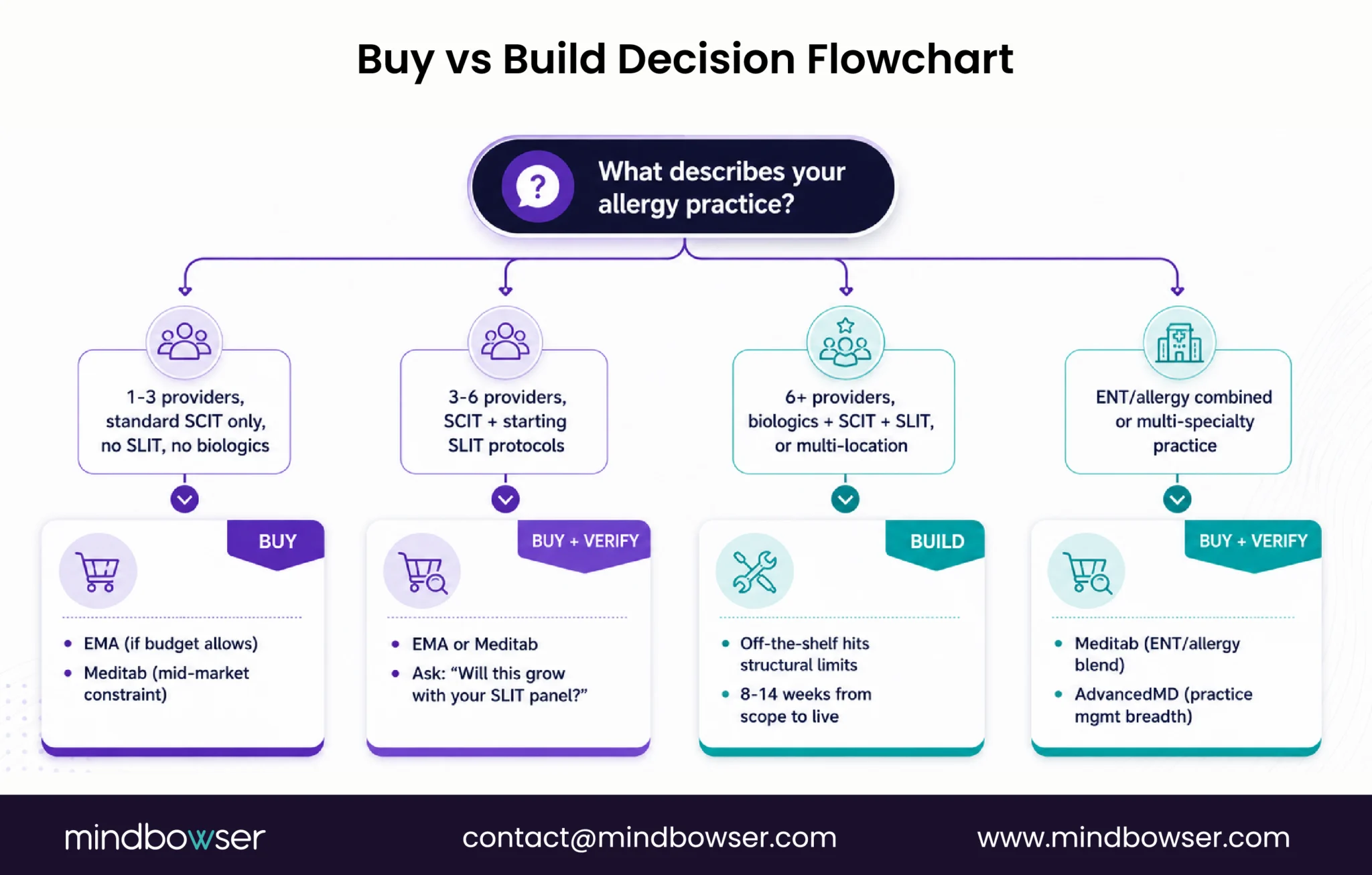
The answer to which allergy and immunology EMR fits your practice depends on protocol complexity and your 18-month growth plan. Not which system demos best.
1-3 providers, standard SCIT only, no SLIT, no biologics:
EMA (Modernizing Medicine) if budget allows. Meditab if mid-market pricing is the constraint. Buy.
3-6 providers, SCIT + starting SLIT:
EMA or Meditab. Buy, but ask the SLIT management question before signing. Will this system grow with your SLIT panel or will you be managing it outside the EMR in 12 months?
6+ providers, biologics + SCIT + SLIT, or multi-location:
Off-the-shelf hits structural limits. Custom development is the conversation to start now, not after you’ve outgrown two systems.
ENT/allergy combined practice:
Meditab (multi-specialty track). AdvancedMD if practice management breadth matters more than allergy depth.
Independent small practice, cost-first:
Kareo/Tebra. Buy. Accept that allergy depth is limited. Build a solid template library and plan for manual vial tracking.
Conclusion
Stop working around your EMR. The system you pick now should actually fit your allergy workflow, not force you to invent spreadsheets.
If you’re running 1-6 providers, evaluate the five systems above using the six criteria in this post. If you’re running 6+ providers or planning SLIT + biologic expansion, the conversation with a custom development team should start now.
There’s no clear market leader for allergy and immunology EMR software. EMA has strong traction among practices that can support enterprise-level pricing, while Meditab is common among mid-market practices. DrChrono is also used by independent practices looking for greater flexibility. No single allergy EMR dominates the specialty in the way Epic dominates large hospital systems.
A general EMR can work initially, but allergy-specific workflows often expose its limitations. Skin test documentation, immunotherapy vial tracking, dose escalation, and reaction monitoring are workflows that many general EMRs were not designed to handle. Practices may end up relying on spreadsheets, custom forms, and manual processes. A purpose-built allergy and immunology EMR can reduce these workarounds.
Advanced allergy EMRs can maintain a vial record containing the compounding date, expiration date, antigen contents, lot number, and patient-specific information. When an injection is administered, the system can record the dose, patient reaction, and administration details while flagging vials approaching expiration. Less specialized systems may require staff to maintain these records and injection logs manually.
EMA can be a strong option for allergy practices that have the budget and resources for implementation. It provides native skin test documentation and immunotherapy workflow capabilities. Practices should also evaluate implementation requirements, pricing, customization needs, and post-go-live support before making a decision.
Common allergy-related CPT codes include 95004 for percutaneous skin testing, 95024 for intradermal testing, 95165 for professional services related to allergen immunotherapy, 95115 for a single immunotherapy injection, and 95117 for two or more injections. An allergy EMR should ideally connect documented services with the appropriate billing workflow to reduce manual entry.
Allergy patient information handled by covered healthcare providers can qualify as Protected Health Information under HIPAA. Appropriate safeguards can include encryption, access controls, audit logging, workforce security measures, incident-response procedures, and Business Associate Agreements where applicable. Allergy data should also be captured in structured formats when required for interoperability and applicable certification requirements.