











 BLOGS
 NEWSROOM
 CASE STUDIES
 WEBINARS
 PODCASTS
 ASSET HUB
 EVENT CALENDAR






















TL;DR
- General EMRs often fall short for ENT workflows, especially around audiograms, allergy immunotherapy, scope imaging, procedure templates, and hearing aid workflows.
- The best ENT EMR depends on practice type: ENT-Cloud and Praxis fit smaller ENT practices, Nextech and ModuleMD suit ENT-plus-allergy groups, while NextGen fits larger organizations.
- Custom ENT EHRs make sense when workflows are highly specialized, especially for multi-subspecialty groups, hearing aid dispensing, academic programs, or Epic/Cerner integrations.
- Migration planning is critical: preserve structured audiogram and allergy histories, train teams by role, and allow roughly 90–120 days for a safer specialty EMR transition.
I’ve watched ENT practices spend 20 minutes per patient manually entering audiogram results that an integrated EMR would import in 30 seconds. That’s before we get to the allergy shot records living in a binder on the nurse’s desk, or the laryngoscopy images saved in a separate folder that the physician has to hunt for mid-consult.
Otolaryngology is one of the most documentation-dense specialties in outpatient medicine, and general-purpose EMRs weren’t designed for it. The practices that struggle most aren’t the ones that chose the wrong technology. They’re the ones that chose a platform built for primary care and assumed a specialty module would cover the gaps.
It doesn’t.
The otolaryngology EMR software market was valued at $2.5 billion in 2023 and is projected to reach $6.5 billion by 2031 (Verified Market Research; verify primary source at publish). That growth reflects how far specialty-specific documentation requirements have moved from negotiable to baseline.
This guide covers what ENT documentation actually requires, which platforms come closest, and when a custom ENT EHR is the more practical answer. Prefer to start with comparable specialty evaluations? The Best Ophthalmology EMR guide covers a parallel set of questions for another procedure-heavy specialty.
Why Does ENT Documentation Break General EMRs?
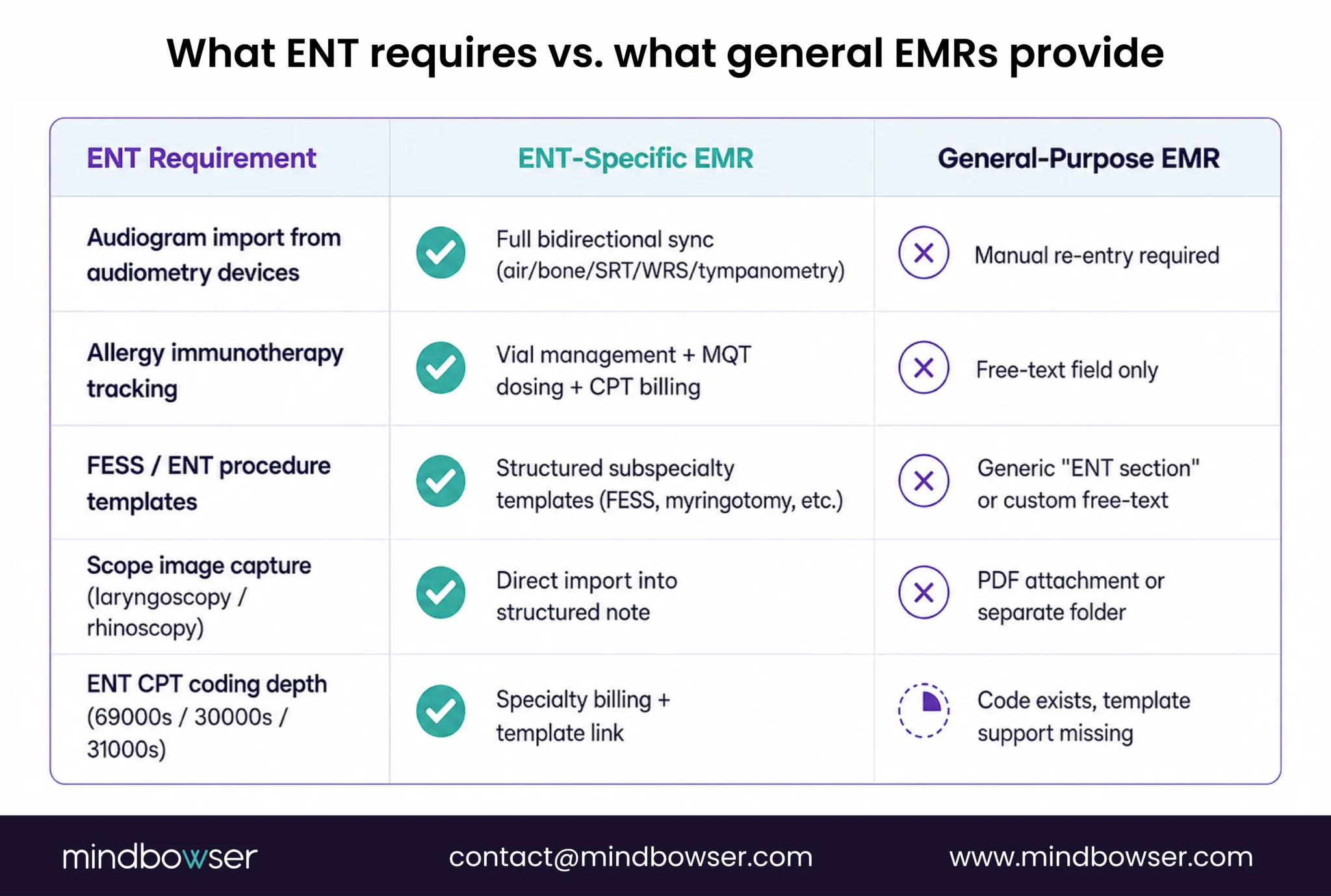
The short answer: otolaryngology has more subspecialties under one roof than almost any other field. The American Academy of Otolaryngology-Head and Neck Surgery (AAO-HNS) formally recognizes seven subspecialty areas within ENT: rhinology, otology, laryngology, head and neck surgery, allergy, sleep medicine, and facial plastic and reconstructive surgery. Each has its own documentation pattern. A general EMR’s “otolaryngology section” typically covers one, maybe two.
The practical gaps show up in four places:
1. Audiogram integration. Audiometry devices (audiometers, tympanometers, auditory brainstem response [ABR] equipment) generate structured data across air conduction, bone conduction, speech reception threshold (SRT), word recognition score (WRS), and acoustic reflexes. The American Speech-Language-Hearing Association (ASHA) sets the documentation standards for these measurements.
In an integrated ENT EMR, this data imports directly from the device and populates the chart. In a general EMR, it requires manual re-entry: every value, every visit, every patient.
2. Allergy immunotherapy. This is a completely separate clinical workflow: vial formulations, Modified Quantitative Testing (MQT) dosing algorithms, shot administration schedules, patient reaction records, and antigen billing under Current Procedural Terminology (CPT) codes 95115 and 95117 (verify current rates at CMS.gov before billing). Most general EMRs treat allergy immunotherapy as a free-text field. That’s not a documentation nuisance; it’s a patient safety issue when dosing records are incomplete.
3. Surgical procedure templates. Functional endoscopic sinus surgery (FESS), septoplasty, turbinate reduction, myringotomy, tympanoplasty: each requires a structured operative note template that a generic “otolaryngology section” doesn’t include. Practices end up building their own templates in free text, which defeats the purpose of structured data.
4. Scope imaging. Laryngoscopy, stroboscopy, and rhinoscopy generate images and video that need to live in the patient chart alongside the clinical findings, not in a separate folder, not attached as a PDF. Vocal fold assessment, stroboscopy findings, and endoscopic images need to be part of the structured note, not an afterthought.
A general EMR can handle some of this through workarounds. The question is whether your clinical team should spend their time on workarounds.
What Should an ENT EMR Actually Include?
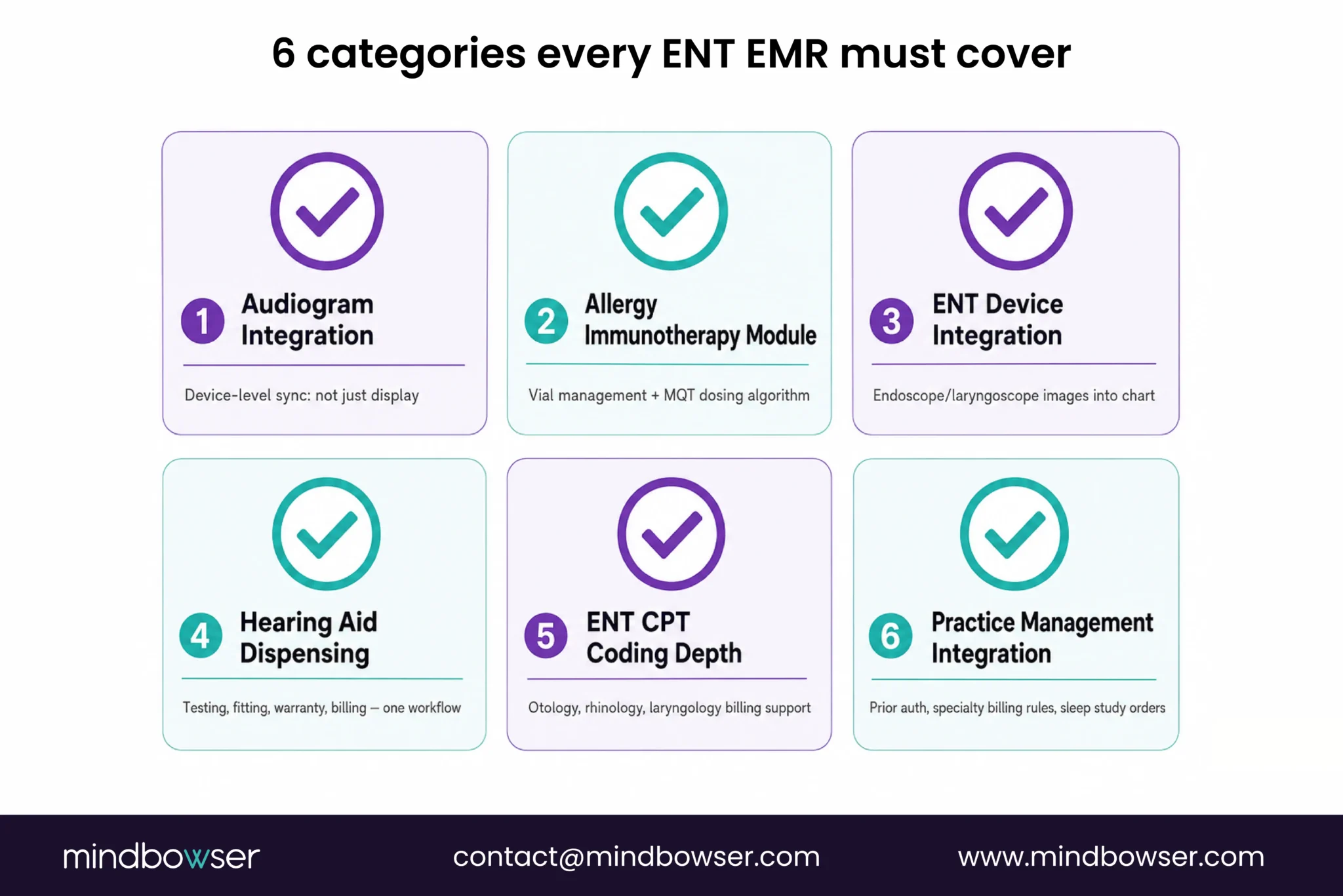
Most vendor demos show you the interface. These are the workflow questions to ask before you schedule one.
1. Audiogram integration: device-level, not display-only. Bidirectional sync with your specific audiometry hardware matters. Confirm that the EMR imports from your audiometer brand (not all integrations cover all devices), and that it captures the full ASHA documentation set: air conduction, bone conduction, SRT, WRS, tympanometry results, and acoustic reflex thresholds. If the vendor says “we support audiograms,” ask them to show you the import workflow from your device, not a demo with mock data.
2. Allergy immunotherapy module: structured, not free text. Vial management, MQT dosing calculation (the algorithm matters: errors here are clinical errors), shot administration records, reaction tracking per injection, and antigen billing with CPT 95115/95117 support. Ask specifically: does the allergy module integrate with the main chart, or is it a separate login?
3. Device integration for ENT procedures. Endoscopes, laryngoscopes, and rhinoscopes should push images and video directly into the patient chart, tagged to the visit date and procedure. If the workflow is “export from device, attach to chart manually,” that’s not integration; that’s a workaround with extra steps.
4. Hearing aid dispensing (if your practice dispenses). Audiology testing, initial fitting, trial period tracking, warranty management, and hearing aid billing are a separate workflow from the clinical side. Not every ENT practice dispenses, but for those that do, this is either baked into the EMR or it’s a separate system, and two systems mean two sources of truth.
5. ENT-specific CPT coding depth. The relevant ranges are broad: Otology (69000, 69979, including tympanoplasty, myringotomy, and cochlear implant procedures), Rhinology (30000, 30999, including FESS and septoplasty), and Laryngology (31000, 31899, including laryngoscopy and microlaryngoscopy). Verify current rates at CMS.gov. A general EMR may have these codes in its database but not the supporting template structure that makes coding accurate and fast.
6. Practice management integration. ENT-specific billing rules, prior authorization workflows for audiological testing, and sleep study ordering each have quirks that a specialty-matched practice management module handles better than a bolted-on general solution.
Which ENT EMR Fits Your Practice Type?
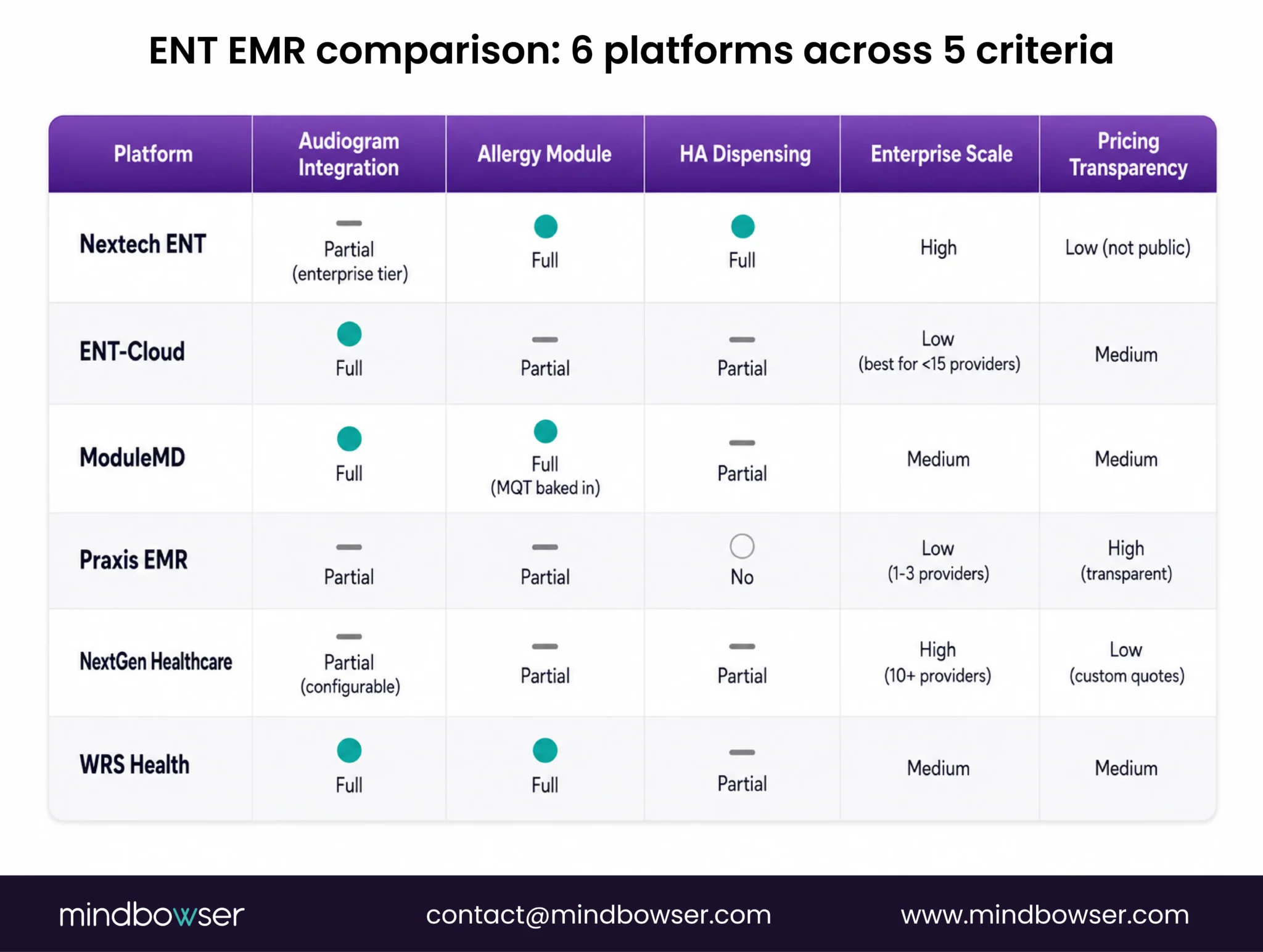
With more than 100 vendors claiming ENT support, the real shortlist is shorter. Here’s what each of the leading options does well, and where each stops.
Nextech ENT
Best for: Multi-specialty practices combining ENT and allergy immunotherapy under one roof.
Nextech is one of the more complete specialty EMR platforms for ENT groups that also run an allergy division. The allergy shot tracking module, hearing aid inventory, and sleep study integration are genuine features rather than add-ons. The trade-off: the full audiology integration typically requires the enterprise tier. Pricing scales with modules, and practices that only need core ENT documentation without allergy may find it more platform than they need.
ENT-Cloud
Best for: ENT-only practices, roughly 2- 15 providers.
ENT-Cloud is purpose-built for otolaryngology rather than a specialty configuration layered on a general platform. Separate modules for otology, audiology, rhinology, and laryngology are part of the base product, not premium add-ons. The trade-off is ecosystem breadth: for large multi-site groups or practices that need robust practice management at scale, the platform is smaller than NextGen or eClinicalWorks.
ModuleMD
Best for: ENT practices with heavy allergy immunotherapy volume.
ModuleMD was founded by allergists and has been in the ENT and allergy space for more than 20 years. The MQT dosing algorithm is embedded in the workflow rather than bolted on, which matters for practices where allergy immunotherapy is a significant revenue line. For ENT-only practices without an allergy division, the platform may be more allergy-focused than needed.
Praxis EMR
Best for: Independent ENT physicians, typically 1, 3 providers.
Praxis uses an AI-driven approach to documentation that learns from the physician’s own note patterns rather than forcing subspecialty templates. For solo and small-group ENT physicians who find template-driven systems limiting, this is a genuine differentiator. The trade-off: the learning curve is real, and practice management depth is thinner than enterprise options.
NextGen Healthcare
Best for: Large ENT groups (10+ providers) or health-system-affiliated ENT departments.
NextGen’s configurable template structure, built-in analytics, and revenue cycle management capabilities make it practical at scale. ENT-specific procedure workflows are configurable rather than out-of-the-box, which means implementation effort is higher, but the platform can grow with a large group. Cost scales accordingly.
WRS Health
Best for: Audiology-forward ENT practices where integrated audiogram and allergy immunotherapy workflows are the priority.
WRS Health combines audiogram integration and allergy immunotherapy in a single platform, which is less common than vendors make it sound. Verify the current KLAS rating and request references from audiology-forward practices before signing.
Discuss Your ENT EHR Requirements With Our Experts
When Does a Custom ENT EHR Make More Sense?
Off-the-shelf ENT EMR software works until it doesn’t. Otolaryngology is one of the specialties where the break point comes earlier than practices expect, because the subspecialty combinations create documentation requirements that no single vendor has fully solved.
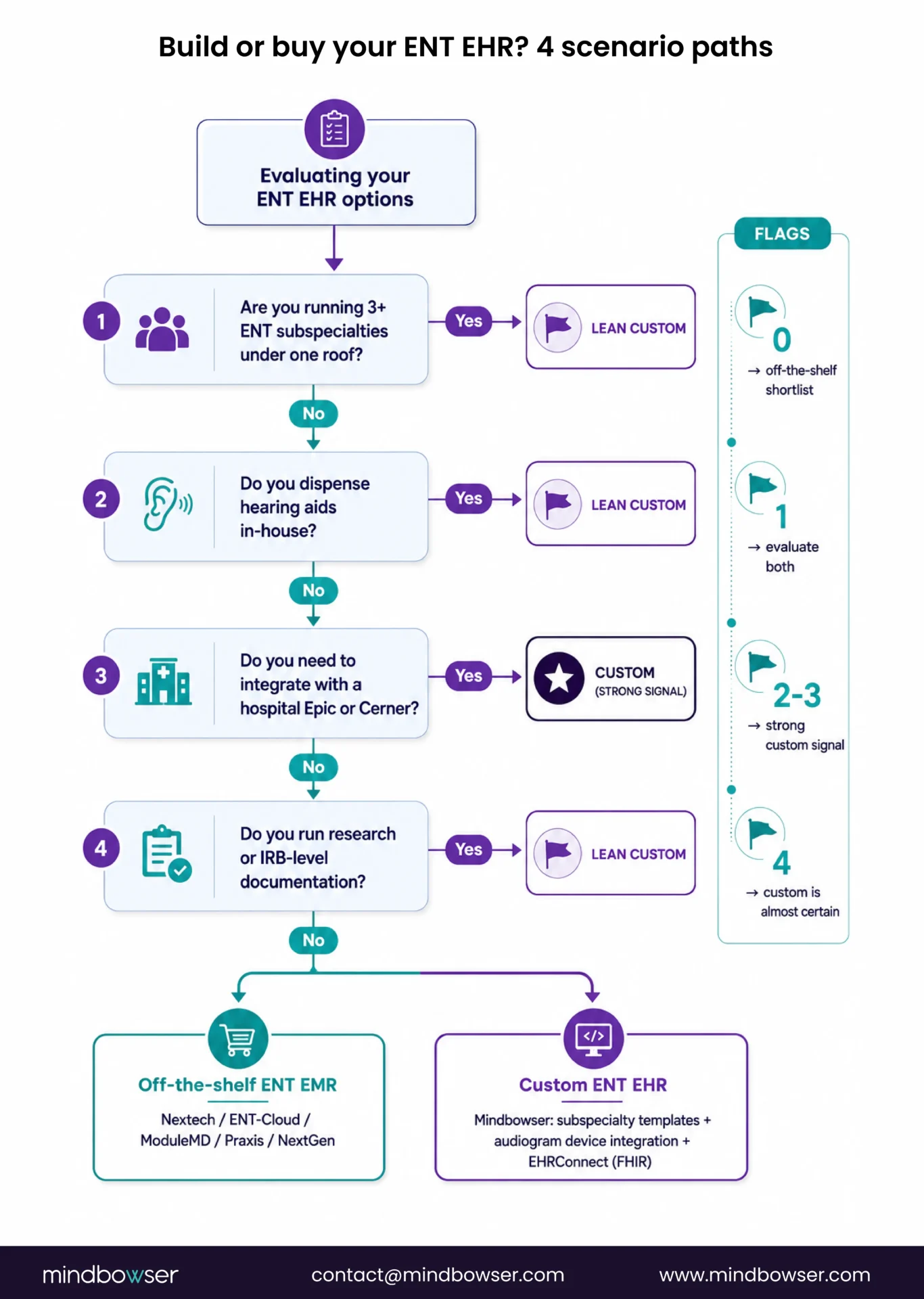
Four scenarios consistently point toward a custom build:
1. Multi-subspecialty ENT groups. A practice running rhinology, otology, laryngology, allergy, and a sleep program under one roof has five distinct documentation patterns, five sets of procedure templates, and five billing workflows. Off-the-shelf platforms solve two or three of these cleanly. The rest require workarounds, and workarounds accumulate into clinical friction that compounds over years.
2. Practices with in-house hearing aid dispensing. When audiology testing, initial fitting, trial period management, warranty tracking, and hearing aid billing need to live in one connected workflow (not split across an EMR, a separate HA software, and a billing platform), the integration complexity typically exceeds what off-the-shelf solutions support. A custom build connects these as a single workflow from day one.
3. Academic ENT departments. Research protocols, Institutional Review Board (IRB) documentation requirements, outcomes tracking alongside clinical care, and the reporting structures that grant-funded programs require don’t fit into standard EMR templates. Academic ENT departments building a custom system can design the research workflow into the clinical record rather than maintaining parallel systems.
4. ENT practices integrating with a hospital’s Epic or Cerner instance. This is where the custom path has the clearest return. A specialty-depth ENT EHR on the practice side needs to exchange structured data (audiogram results, procedure notes, allergy immunotherapy records) with the health system’s record. Mindbowser’s EHRConnect accelerator compresses this Fast Healthcare Interoperability Resources (FHIR)-based integration from a months-long custom build to a weeks-long configuration. The result is specialty documentation depth at the practice level with clean bidirectional data flow to the hospital EHR.
For ENT groups evaluating this path, the adjacent evaluation is worth running in parallel: how headless EHR platforms like Medplum position against traditional custom builds, and what Epic integration actually involves for a specialty practice.
What Mindbowser builds for custom ENT EHR implementations: subspecialty-specific documentation templates, audiogram device integration (bidirectional, device-matched), allergy immunotherapy module with MQT dosing workflow, hearing aid dispensing workflow, Epic and Cerner FHIR integration via EHRConnect, and AI Medical Summary for automated ENT charting that reduces documentation time per visit.
How Do You Migrate to a New ENT EMR Without Losing Audiogram History?
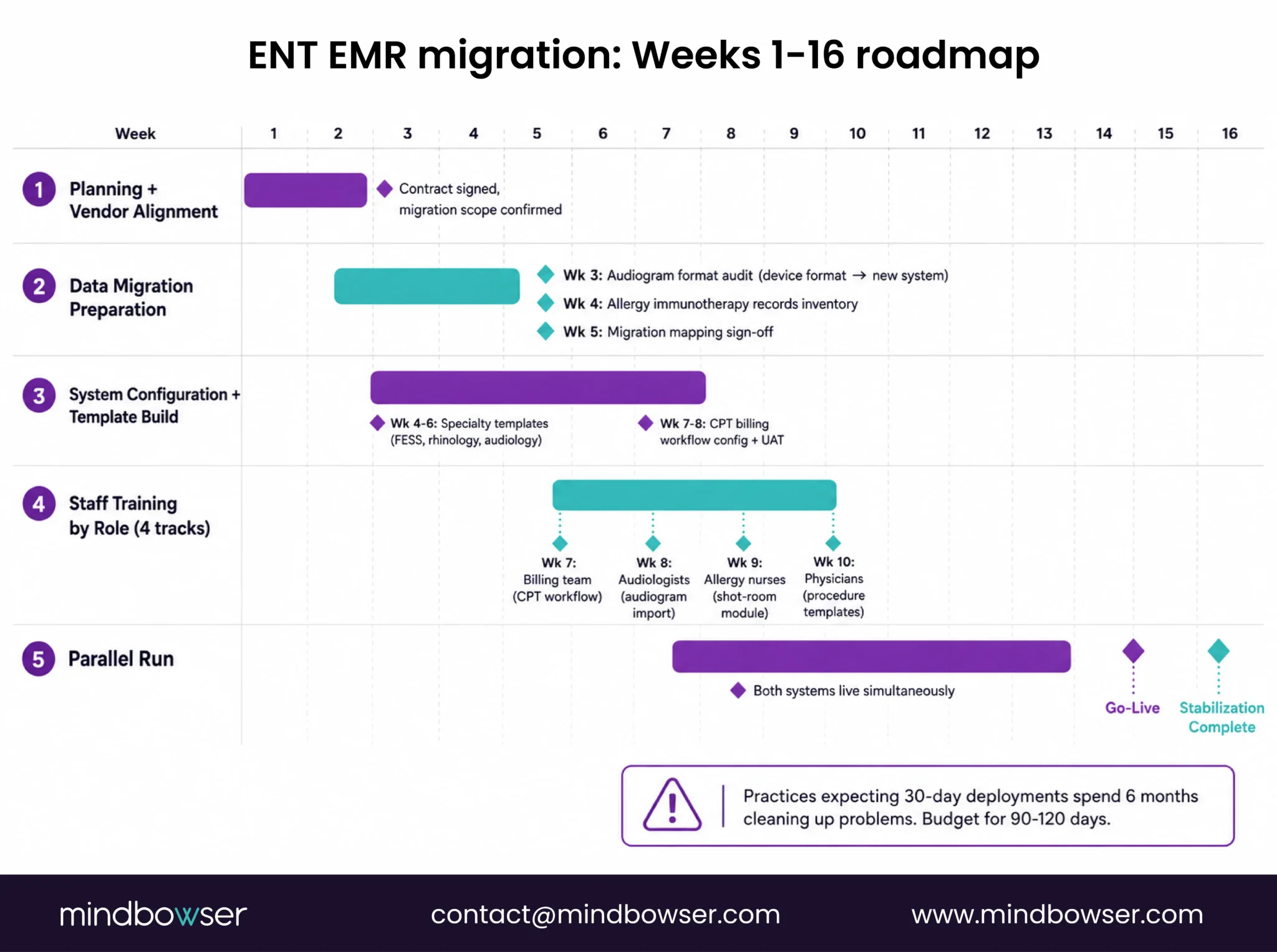
The question most ENT practices avoid until it’s too late: what happens to 10 years of audiogram records, allergy vial histories, and procedure imaging when you switch platforms?
Data migration is where ENT EMR transitions most commonly go wrong, and where due diligence before signing pays off.
1. Audiogram history is the highest clinical risk. Serial audiometry data is the foundation of longitudinal hearing assessment. Losing the baseline audiogram from five years ago means losing the comparison point for today’s results. Before signing with any new platform, ask the vendor to walk through their historical audiogram import process specifically, not a generic “we support data migration.” Ask: what formats do you accept, what fields map over, and what gets lost?
2. Allergy immunotherapy records are equally critical. Vial formulations, dosing history by date, and patient reaction records need to transfer as structured data, not as a PDF attachment. If the new platform can’t import allergy immunotherapy records in a structured format, your allergy nurses are re-entering years of history by hand before the system goes live.
3. Parallel run period: 30, 60 days minimum. Audiologists, allergy nurses, and physicians have different charting habits and different tolerances for workflow disruption. A parallel run (where both systems are active and each patient encounter is documented in both) is standard practice for specialty EMR migrations. Budget for it.
4. Train by role, not by department. The billing team needs to learn the new CPT workflow. Audiologists need to learn the new audiogram import and documentation workflow. Allergy nurses need the shot-room module. Physicians need the procedure templates. A single all-staff training session covers none of these adequately. Plan separate tracks.
5. Realistic go-live timeline: 90- 120 days from contract to full go-live for a specialty ENT EMR implementation. Practices that expect 30-day go-lives typically spend the following six months cleaning up data and workflow problems that a proper implementation timeline would have prevented.
The EHR implementation guide covers the full implementation planning framework in more depth.
Your ENT EMR Should Fit Your Subspecialties, Not the Other Way Around
The right ENT EMR decision depends on three things: your subspecialty mix, whether you dispense hearing aids, and whether your practice integrates with a hospital EHR. A two-physician ENT-only practice and a 15-provider multi-subspecialty group with an allergy division and a sleep program have genuinely different requirements, and the platforms that serve each well are different.
For ENT-only practices, ENT-Cloud and Praxis EMR offer the tightest specialty fit without unnecessary complexity. For ENT plus allergy, Nextech and ModuleMD are the strongest options. For large groups or health-system-affiliated ENT departments, NextGen provides the enterprise infrastructure. When the subspecialty combination, dispensing requirements, or hospital integration depth exceeds what any off-the-shelf platform handles cleanly, a custom build is worth the evaluation.
One forward consideration: AI ambient documentation is expanding into ENT workflows. Automated audiogram summary generation, AI-assisted allergy dosing calculations, and real-time procedure note documentation are moving from experimental to available. The EMR you select now should have a development roadmap that includes these capabilities, or you’ll be evaluating platforms again in three years.
The answer depends on practice type. ENT-only practices are best served by ENT-Cloud or Praxis EMR. Practices combining ENT and allergy immunotherapy should evaluate Nextech and ModuleMD. Large groups or health-system-affiliated ENT departments typically fit NextGen Healthcare. Custom EHR development makes sense when multi-subspecialty documentation requirements, in-house hearing aid dispensing, or hospital EHR integration complexity exceeds what off-the-shelf platforms handle.
Purpose-built ENT EMRs can import audiogram data directly from audiometry equipment, including air conduction, bone conduction, speech discrimination scores, and tympanometry results, into the patient chart. General-purpose EMRs with ENT modules may not support this at the device level. Before signing, ask the vendor to demonstrate the import workflow from your specific audiometer brand, because integrations vary by device manufacturer.
Cloud-based specialty ENT EMRs typically run $300$800 per provider per month, depending on module selection, number of providers, and whether practice management is bundled. Custom ENT EHR builds typically range from $150,000 to $500,000 depending on scope, integrations, and subspecialty complexity. The better comparison is total cost over five years, including implementation, training, integrations, maintenance, and ongoing support.
Common ENT procedure ranges include Otology codes 69000–69979, Rhinology codes 30000–30999, and Laryngology codes 31000–31899. Practices with an allergy division may also use CPT 95115 and 95117 for allergy immunotherapy administration. Current coding, bundling, and reimbursement requirements should always be verified against official CMS and CPT guidance before billing.
An ENT practice should consider a custom EHR when three or more of the following apply: multiple ENT subspecialties with distinct documentation requirements, in-house hearing aid dispensing that requires an integrated workflow, clinical research protocols that do not fit standard EMR templates, integration with a hospital’s Epic or Cerner environment, or allergy immunotherapy workflows that off-the-shelf systems cannot support adequately.