













 BLOGS
BLOGS  NEWSROOM
  CASE STUDIES
  WEBINARS
  PODCASTS
  ASSET HUB
  EVENT CALENDAR

















TL;DR
- No single “best” EHR six commercial platforms (athenaOne, NextGen, eClinicalWorks, Epic/OCHIN, Oracle Health, Netsmart) plus OpenEMR all bolt on FQHC compliance rather than being built around it natively.
- Score vendors against 4 FQHC-specific criteria, not generic “ease of use”: UDS+ native reporting, 340B split-billing accuracy, sliding-fee-scale documentation, and whole-person-care integration across service lines.
- OpenEMR is a real option, not a footnote 5,000+ US installs, viable if the health center has (or can hire) technical capacity to own configuration and 340B/UDS customization.
- The gap nobody’s shortlist solves: referral coordination across co-located service lines (medical/dental/behavioral health) still a sticky-note-and-fax problem at most FQHCs, regardless of which EHR they pick.
- Custom build is the fallback, not the default only worth it when a health center’s service mix, grants, or reporting needs genuinely don’t map to any commercial or open-source option.
Every FQHC technology committee I’ve sat across the table from ends up asking the same question in a different order: do we buy something built for us, or do we make something we already have work harder? I’ve watched this play out at three different community health centers over the past two years, and the honest answer is that most of them are asking the wrong first question. The right first question isn’t “which EHR is best.” It’s “which criteria actually decide this for a federally qualified health center,” because that list is shorter and stranger than most vendor pitches let on.
Here’s what I mean, and let me correct myself as I say it: the first question isn’t even “which criteria matter.” Most technology committees can list the criteria by the second meeting. The real failure point is that nobody weights them against the health center’s actual service mix before scoring vendors, so a single-site medical-only clinic and a five-site behavioral-health-integrated FQHC end up scoring the same six vendors the same way, which makes no sense once you say it out loud.
A Federally Qualified Health Center runs on HRSA’s Health Center Program requirements, which means your EHR has to do things a private cardiology group’s system never has to touch: submit Uniform Data System reporting, track 340B drug pricing eligibility down to the encounter, document sliding-fee-scale income verification for every uninsured visit, and usually coordinate care across three or four co-located service lines (medical, dental, behavioral health) that a commercial system was never designed to talk to at once.
Get that list wrong at the shortlist stage, and you’ll spend 18 months implementing a system that can technically run your clinic but can’t run your compliance reporting.
What Makes FQHC EHR Procurement Different
An FQHC EHR needs to natively support four things a general-purpose system treats as an afterthought: UDS and UDS+ patient-level reporting, 340B split-billing logic, sliding-fee-scale documentation tied to income verification, and whole-person-care workflows across co-located service lines. Get any one of these wrong and you’re building a manual workaround your staff will hate within a quarter.
Start with UDS: HRSA requires every federally funded health center to submit annual Uniform Data System reports, and the reporting standard changed meaningfully for CY2024 data: HRSA’s UDS+ initiative moved health centers from aggregate table submissions to patient-level data extraction, with the filing deadline landing April 30, 2025. That’s not a cosmetic change. It means your EHR has to expose patient-level clinical and demographic data in the exact structure HRSA’s submission tool expects, not just produce a summary PDF at year-end.
A system that handles this well saves your quality team weeks of manual reconciliation every spring. A system that doesn’t turns UDS season into an annual fire drill.
Then there’s 340B: The HRSA Office of Pharmacy Affairs administers the 340B Drug Pricing Program, which lets covered entities, FQHCs included, buy outpatient drugs at reduced prices. The EHR’s job here is split-billing accuracy: correctly flagging which encounters qualify for 340B pricing and which don’t, because getting this wrong invites an audit, not just a billing correction. Sliding-fee scale works the same way in miniature.
Every uninsured or underinsured patient needs income-based fee documentation tied to the visit, and if that data lives in a spreadsheet next to the EHR instead of inside it, your compliance risk goes up every time someone forgets to update the spreadsheet.
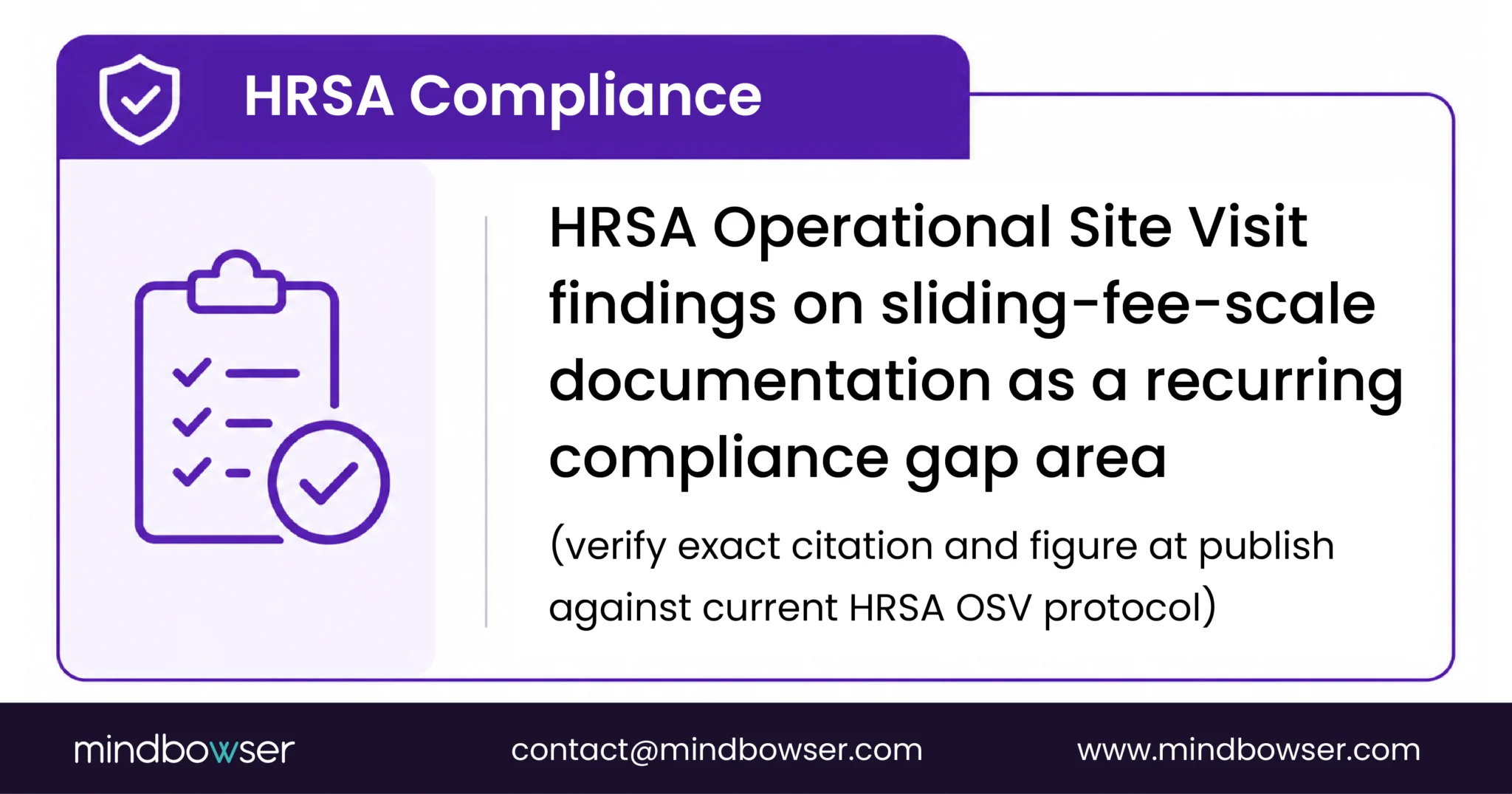
None of this is exotic: It’s just specific, and specific is exactly what most FQHC EHR content skips.
The Commercial Shortlist: What athenaOne, NextGen, eClinicalWorks, Epic, Oracle Health, and Netsmart Actually Offer
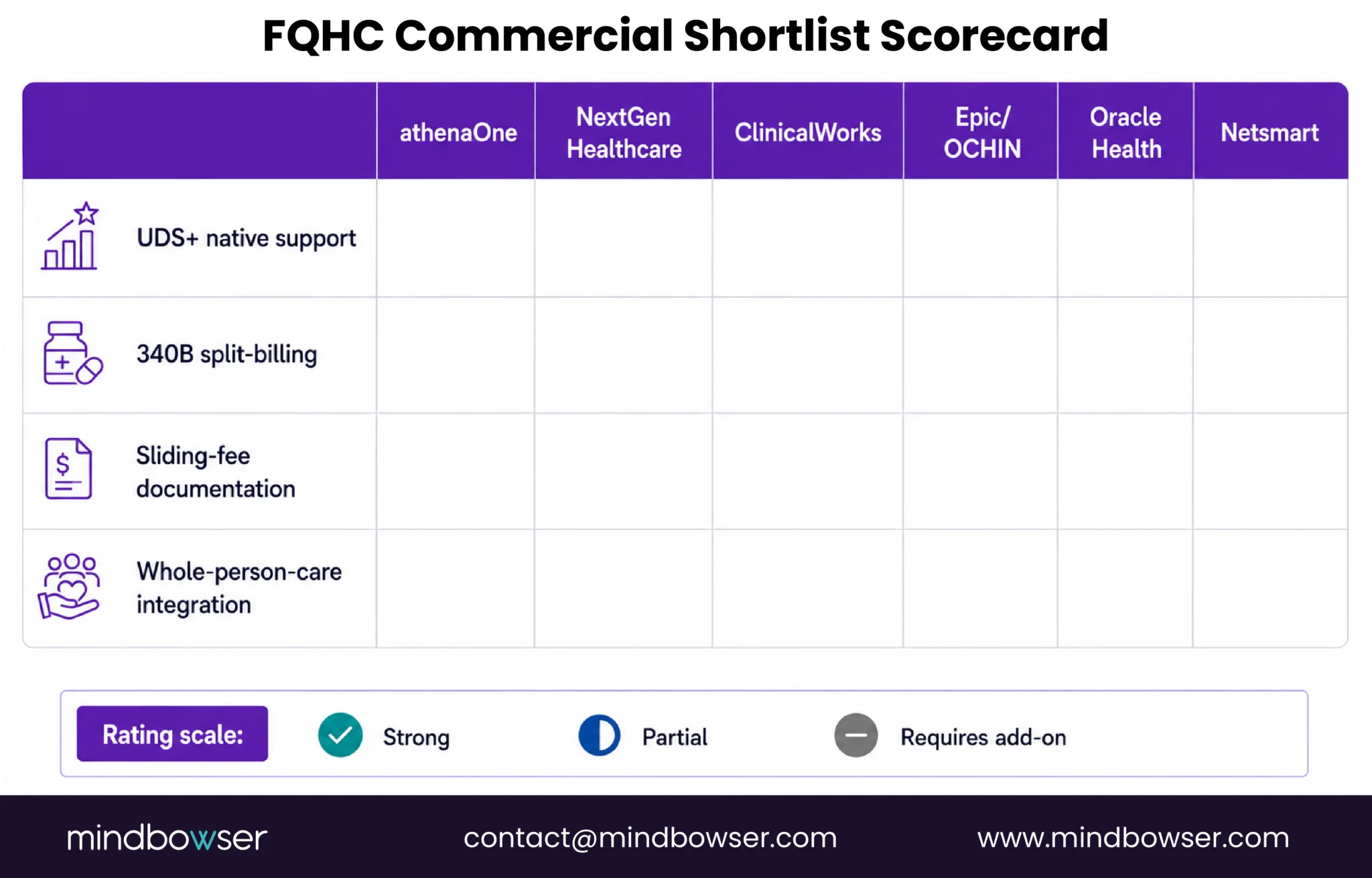
Six commercial systems show up on nearly every real FQHC shortlist I’ve seen: athenaOne, NextGen Healthcare, eClinicalWorks, Epic (usually accessed through OCHIN or Community Connect rather than a direct license), Oracle Health, and Netsmart. Naming them isn’t an endorsement. It’s the starting point a buyer actually needs, because “purpose-built platforms” isn’t a shortlist you can score anything against.
NextGen markets directly to the FQHC segment and names UDS, HRSA, and CMS reporting explicitly in its product materials, which tells you where its product team has spent engineering time. KLAS Research’s FQHC Technology 2023 report scored vendors specifically on how well they serve health centers’ unique needs, and the coverage I’ve seen cited from that report (KLAS’s own report sits behind a paywall, so treat the specific scores as) put NextGen ahead on functionality and UDS-reporting fit, with eClinicalWorks scoring lower on overall value despite broad feature coverage.
eClinicalWorks has also issued its own press releases claiming HRSA UDS-submission approval (a vendor claim, not independent verification, so weigh it accordingly).
athenaOne leans on its cloud-native, always-updated model, which matters for a health center without a dedicated IT team to manage version upgrades. Oracle Health (the former Cerner) and Netsmart both show up more often at multi-site or behavioral-health-integrated FQHCs, where Netsmart’s clinical documentation heritage in behavioral health can be a real advantage if your health center runs integrated primary care and behavioral health under one roof.
Neither shows up as often on smaller, single-site FQHC shortlists, and I think that’s a licensing-cost story more than a capability gap, worth confirming directly with each vendor rather than assuming.
Epic deserves its own paragraph because FQHCs rarely license it directly. What Epic actually is, and how community health centers typically access it through OCHIN or Community Connect, matters more than the brand name. A TechTarget piece on FQHC EHR satisfaction found Epic-via-OCHIN scoring well on functionality and user satisfaction among health centers that had access to it, which tracks with what I’ve heard directly: the shared-services model spreads Epic’s cost across a network of health centers, which is the only way most FQHCs get access to Epic’s depth without an enterprise budget.
I’ll say the quiet part here. None of these six vendors built their core architecture around a 340B split-billing rule or a sliding-fee-scale workflow. They bolted it on, because FQHCs are a real but secondary market for every one of them. That’s not a knock. It’s context that should shape how hard you push in the demo.
One more thing worth knowing before you sit through six demos: switching EHRs at an operating FQHC is its own project, separate from picking the vendor. HRSA has published specific guidance for health centers switching EHRs, and the detail that trips up most technology committees is timing the cutover against UDS reporting season. Switch mid-cycle and you’ll be reconstructing patient-level data across two systems for the same reporting year.
Every vendor’s sales team will tell you their migration is fast. Ask them specifically how they’ve handled a UDS-cycle-spanning cutover before, not just how fast the data migration runs.
Where OpenEMR and Open-Source Still Belong
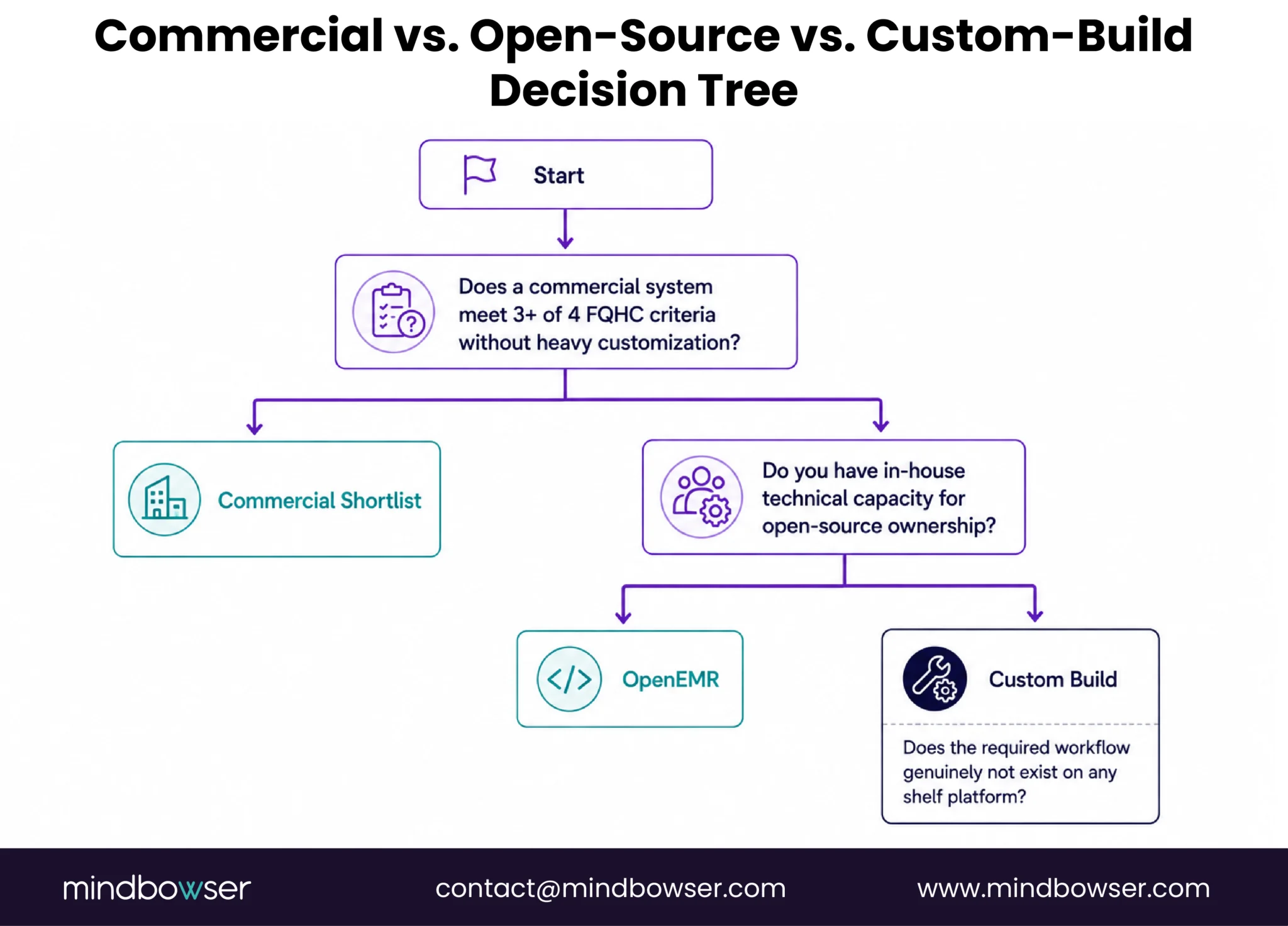
The open-source fork isn’t a footnote for FQHCs the way it is for most healthcare buyers. It’s a real option, because FQHCs are exactly the budget-constrained, technically-capable-enough buyer profile open-source EHRs were built for. OpenEMR runs in more than 5,000 US installations and touches over 30 million patients, and a meaningful share of that install base is community health centers doing exactly what your technology committee is evaluating right now.
I’m not going to re-argue open-source versus commercial in this piece. That decision, OpenEMR versus Medplum versus a fully custom build, deserves its own depth, and we’ve written the full open-source shortlist comparison separately if you’ve already decided open-source is the right fork for your health center. What belongs here is the decision point one step earlier: does your health center have (or can it hire) the technical capacity to own an open-source deployment, and does the total cost of ownership actually beat a commercial license once you count staff time?
If OpenEMR is the direction, the FQHC-specific mechanics, PPS and GBR billing logic, 340B configuration, sliding-fee workflows, and realistic multi-site timelines are covered in detail in our full OpenEMR implementation guide, including the 16-24-plus week timeline and $50K-$100K-plus implementation cost range that a real multi-site FQHC build tends to land in. That guide answers the “how do we actually build this” question. This piece answers “should OpenEMR even be on our shortlist,” which is a different question asked earlier in the process.
Planning an FQHC EHR Implementation? Talk to Our Healthcare Experts
The Evaluation Framework: Scoring the Shortlist Against FQHC Reality
Every FQHC buyer’s guide I found on page one scores vendors against generic criteria: ease of use, cost, support quality. None of them score against the four things that actually decide whether an FQHC can operate compliantly on day one. Here’s the framework I’d actually use.
UDS+ native support: Can the system export patient-level data in the structure HRSA’s submission tool expects, or does your quality team still build a spreadsheet bridge every spring?
340B split-billing accuracy: Does the system flag 340B-eligible encounters automatically at the point of care, or does someone reconcile it after the fact?
Sliding-fee-scale documentation: Is income verification captured inside the clinical workflow, tied to the encounter, or does it live in a separate system your billing team has to cross-reference?
Whole-person-care integration: If your health center runs primary care, dental, and behavioral health under one roof, does the system actually let a care team see across those service lines, or does each department run its own module with its own login?
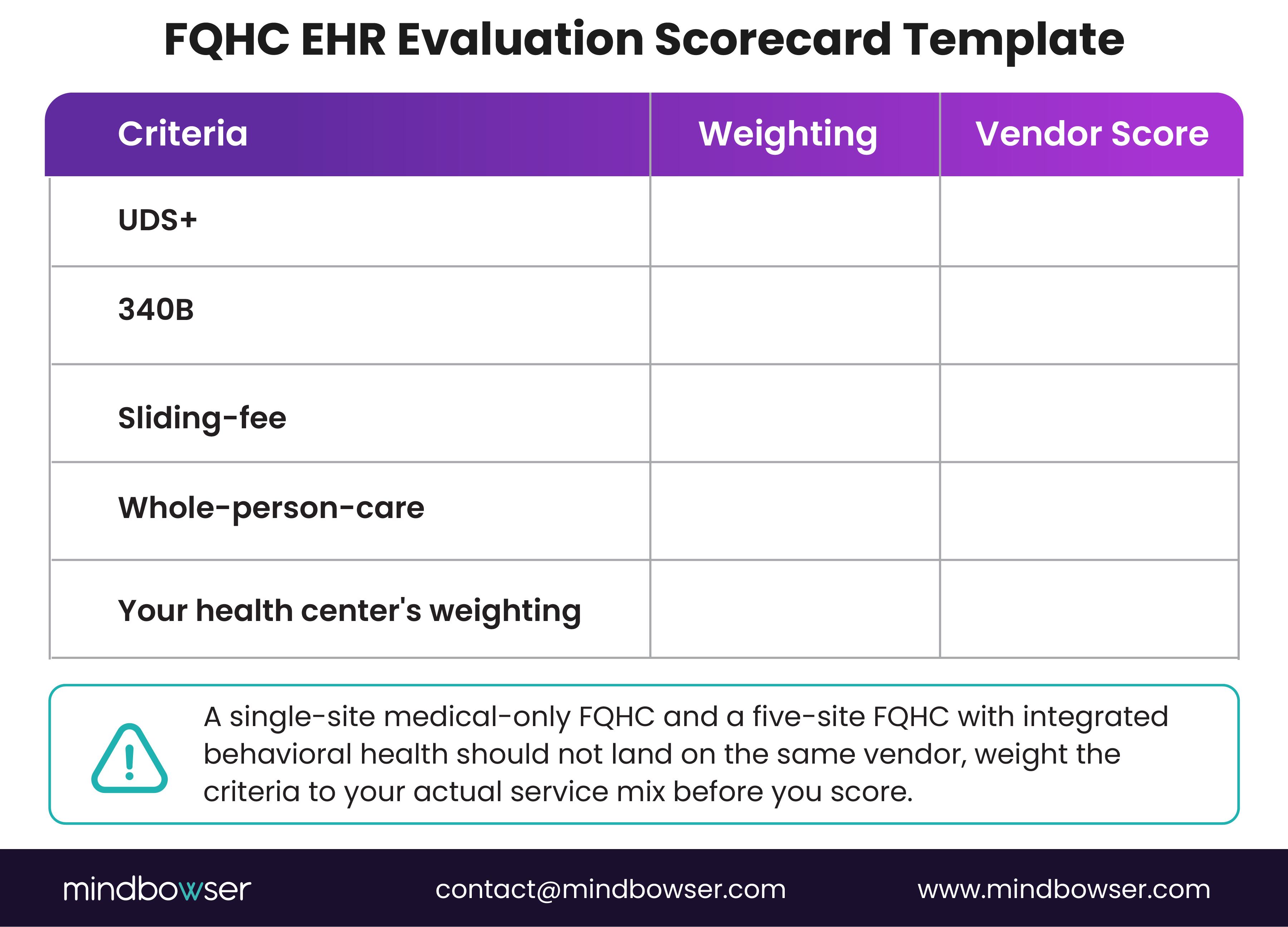
Score all six commercial vendors plus OpenEMR against those four criteria, weighted by your health center’s actual service mix, and you’ll get a materially different ranking than any generic “best EHR” listicle produces. A single-site medical-only FQHC and a five-site FQHC with integrated behavioral health should not end up with the same answer, and if your evaluation spreadsheet gives them the same answer, the spreadsheet is wrong, not the vendors.
The Honest Gap: Referral Coordination Nobody’s Shortlist Solves
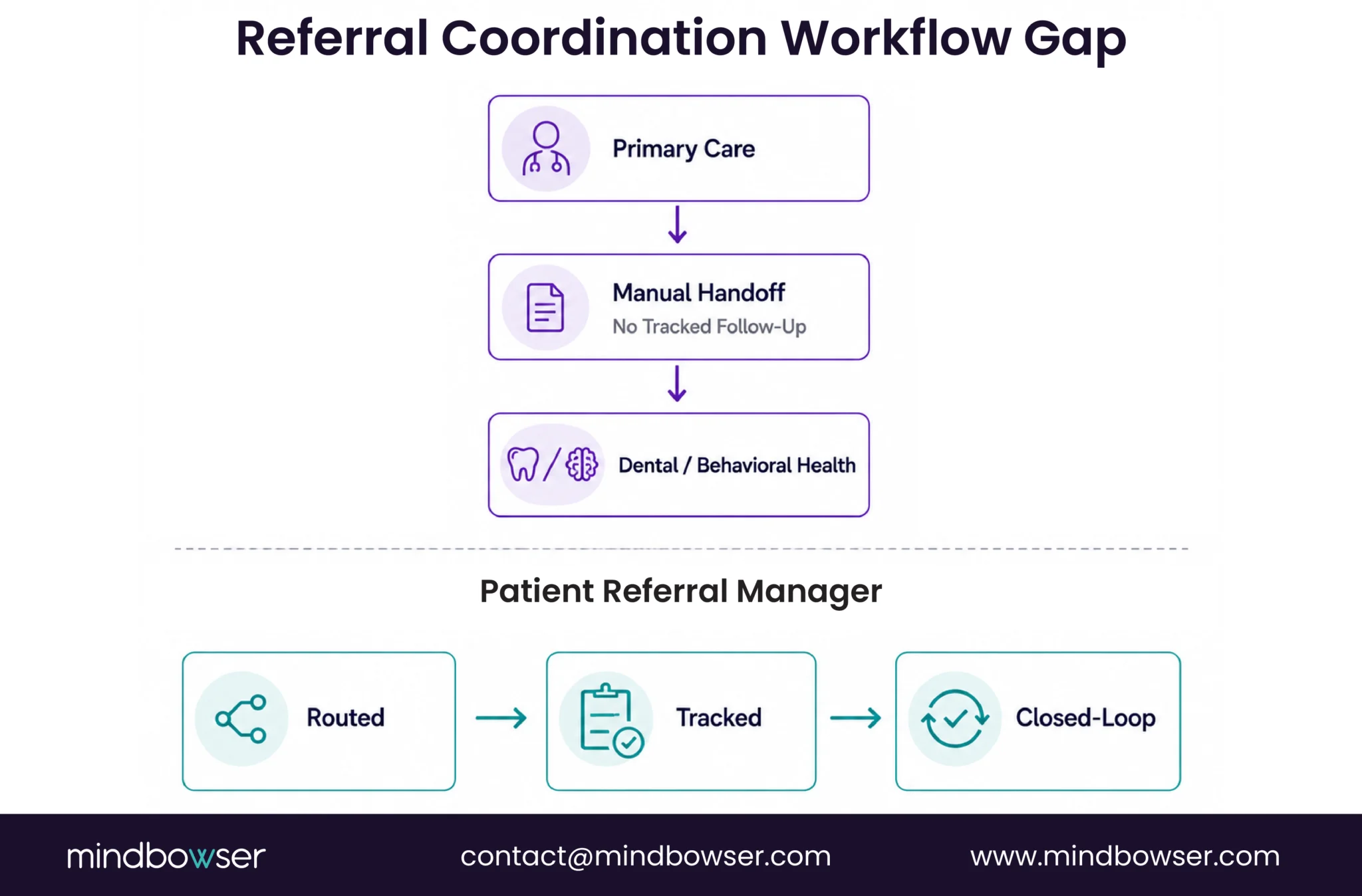
Here’s the part that doesn’t show up in any vendor demo. I’ve sat in on FQHC technology committee meetings where the EHR conversation is going fine, UDS reporting checks out, 340B logic checks out, and then someone asks how a referral from primary care to the on-site behavioral health team actually gets tracked. The room goes quiet, because the honest answer at most health centers is: a sticky note, a fax, or a phone call, and nobody owns making sure the loop closes.
This is the gap none of the six commercial systems or OpenEMR solve out of the box, because referral coordination across co-located but organizationally separate service lines isn’t a core EHR function. It’s a workflow layer that sits on top. Mindbowser’s Patient Referral Manager is built specifically for this: capturing, routing, and tracking every referral through one guided flow on HIPAA-compliant, SMART on FHIR and HL7-based infrastructure, so a referral from your medical team to your dental or behavioral health team doesn’t depend on someone remembering to follow up.
For a health center where 30-40% of patients touch more than one service line in a year, that’s not a nice-to-have. It’s the difference between “whole-person care” as a mission statement and whole-person care as something that actually happens.
Sliding-fee-scale intake has a similar honest gap. Income verification at registration is where a lot of FQHC compliance risk actually starts, not because the rule is complicated but because paper intake forms get lost, mistyped, or filled out incompletely at a busy front desk. Patient Questionnaire Form handles this as logic-driven digital intake with real-time validation and direct FHIR submission into the EHR, which closes the gap between “we have a sliding-fee policy” and “we can prove every uninsured visit was documented correctly if HRSA asks.”
Build vs Buy: When the Answer Is Neither Shortlist
Sometimes the honest answer to “which EHR should we buy” is that none of the six commercial systems and no reasonable open-source configuration actually fits your health center’s specific service mix, grant structure, or multi-site reporting needs. That’s not a common outcome. Most FQHCs fit reasonably well on the commercial or open-source shortlist above. But when a health center’s requirements genuinely don’t map to any existing system, our custom EHR development work exists for that case, not as a default answer, but as the fallback when the shortlist genuinely comes up empty.
The build-vs-buy decision itself is worth walking through before you get to that point, and the honest budget conversation, what a custom build actually costs against what a commercial license runs over five years, lives in our EHR cost guide. I’d rather a technology committee spend an afternoon with that math than discover the real number 14 months into a build.
How Mindbowser Helps
- I want to be direct about what Mindbowser has and hasn’t built for FQHCs specifically, because overclaiming here would undercut the entire point of this piece. We don’t have a named domestic FQHC EHR deployment to point to.
- What we do have is a national government EHR build, a country-scale system built for a government health system that carried its own version of compliance-heavy, budget-constrained, multi-site complexity: clinical infrastructure built from scratch for an entire country’s public health system, with the same underlying challenge an FQHC technology committee faces, making one system serve care delivery, reporting, and compliance at once, without an enterprise IT budget behind it.
- That’s not FQHC-specific proof. I’d rather say that plainly than stretch it into a claim it doesn’t support.
What it does show is that we’ve built country-scale, compliance-heavy clinical systems from scratch, which is a different skill than customizing an off-the-shelf EHR. If your health center’s shortlist evaluation turns up a genuine gap in referral coordination, sliding-fee intake, or a reporting requirement none of the six commercial systems handle cleanly, that’s the kind of problem our accelerators and custom development work are built to close, not by replacing your EHR, but by wrapping the workflow layer your EHR was never going to solve on its own.
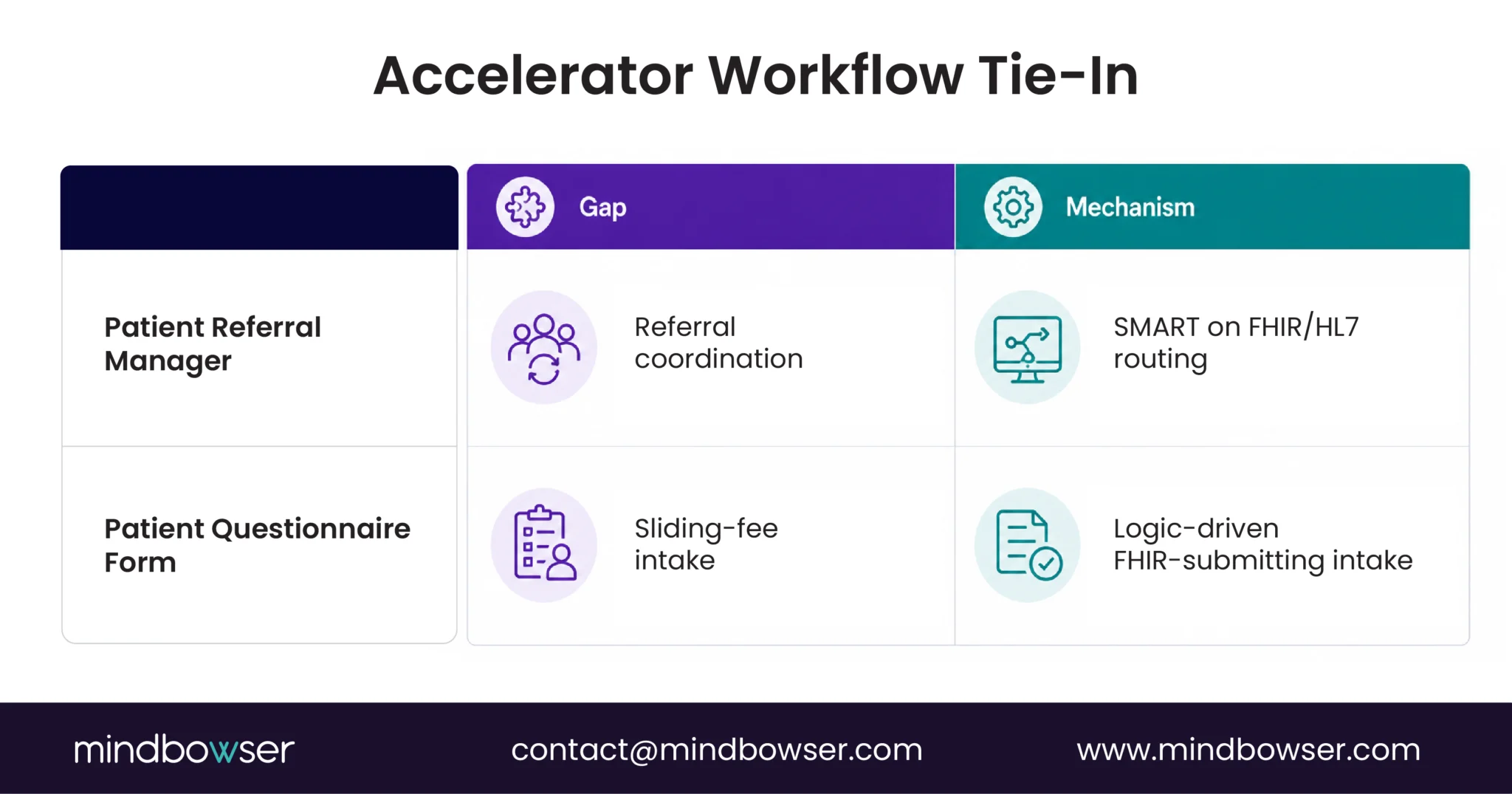
Where a step in your workflow doesn’t have a packaged accelerator, I’d rather tell you that directly than force-fit one. Referral tracking and sliding-fee intake do; a fully custom 340B rules engine tuned to your specific payer mix usually doesn’t, and that’s a custom-build conversation, not a shelf item.
The Shortlist Question You Actually Needed Answered
If you came into this piece hoping for a single “best EHR for FQHCs” answer, I’ll give you the honest one: it depends on your service mix, your site count, and whether you have technical staff who can own an open-source deployment. What I can tell you with more confidence is the four criteria that should decide it, UDS+ native support, 340B split-billing accuracy, sliding-fee documentation, and whole-person-care integration, and that no vendor demo will volunteer where they fall short on any of the four unless you ask directly.
What I still haven’t seen solved cleanly by any commercial system, OpenEMR included, is referral coordination across co-located service lines. If your health center has found a system that closes that loop without a bolt-on tool, I’d genuinely like to hear how. That’s an open question for me too, not a rhetorical one.
If your technology committee is building a shortlist right now and wants a second set of eyes on where a specific vendor is honest versus where it’s overselling its FQHC fit, start a conversation with our team. And if the gap you’ve found isn’t a vendor problem but a workflow nobody’s built for yet, request an assessment and we’ll tell you plainly whether it’s a packaged fix or a custom one.
There’s no single dominant system across the roughly 1,400 FQHCs in the US. NextGen and eClinicalWorks have historically had strong FQHC market share due to early HRSA-focused positioning, athenaOne has grown share with its cloud-native model, and a meaningful share of health centers run OpenEMR, particularly smaller or budget-constrained sites. Multi-site FQHCs increasingly access Epic through OCHIN’s shared-services model rather than direct licensing.
Yes, and thousands already do. The real question isn’t capability, OpenEMR handles core clinical workflows well, it’s whether your health center has (or can hire) the technical staff to own configuration, updates, and 340B/UDS customization in-house. If not, a commercial system’s built-in support may be worth the license cost. Our open-source EHR comparison walks through this trade-off in more depth.
No single EHR is mandated for 340B participation, but your system needs accurate split-billing logic to correctly identify 340B-eligible encounters at the point of care. Getting this wrong doesn’t just cost money in incorrect pricing, it invites HRSA audit scrutiny, so this is a criterion to test directly in every vendor demo, not take on faith from a sales deck.
Realistically, 6 to 12 months for a commercial-to-commercial migration, and often longer for a multi-site health center moving to or from an open-source platform, largely driven by data migration complexity and staff retraining across sites. HRSA has published specific guidance for health centers switching EHRs, and any credible vendor implementation timeline should account for parallel-running your old and new systems during UDS reporting season rather than switching mid-cycle.