













 BLOGS
BLOGS  NEWSROOM
  CASE STUDIES
  WEBINARS
  PODCASTS
  ASSET HUB
  EVENT CALENDAR

























TL;DR
- APCM is a per-patient-per-month bundle, live since January 2025, with no time tracking. That is the whole point of it.
- Three tiers, chosen by chronic condition count and Qualified Medicare Beneficiary (QMB) status: G0556, G0557, G0558.
- 2026 national non-facility rates: $16.37, $53.78, $117.24. Facility rates are lower, and on Level 3 the facility rate is 38% below the non-facility one.
- Office-based APCM went up in 2026. Hospital-outpatient APCM went down. Physician work did not change.
- The concurrency restriction binds the practitioner, not the practice. Several widely-cited guides state it the other way.
- Of the five routes to satisfying APCM’s reporting requirement, two ended during 2025.
What APCM is, and the one thing that makes it different
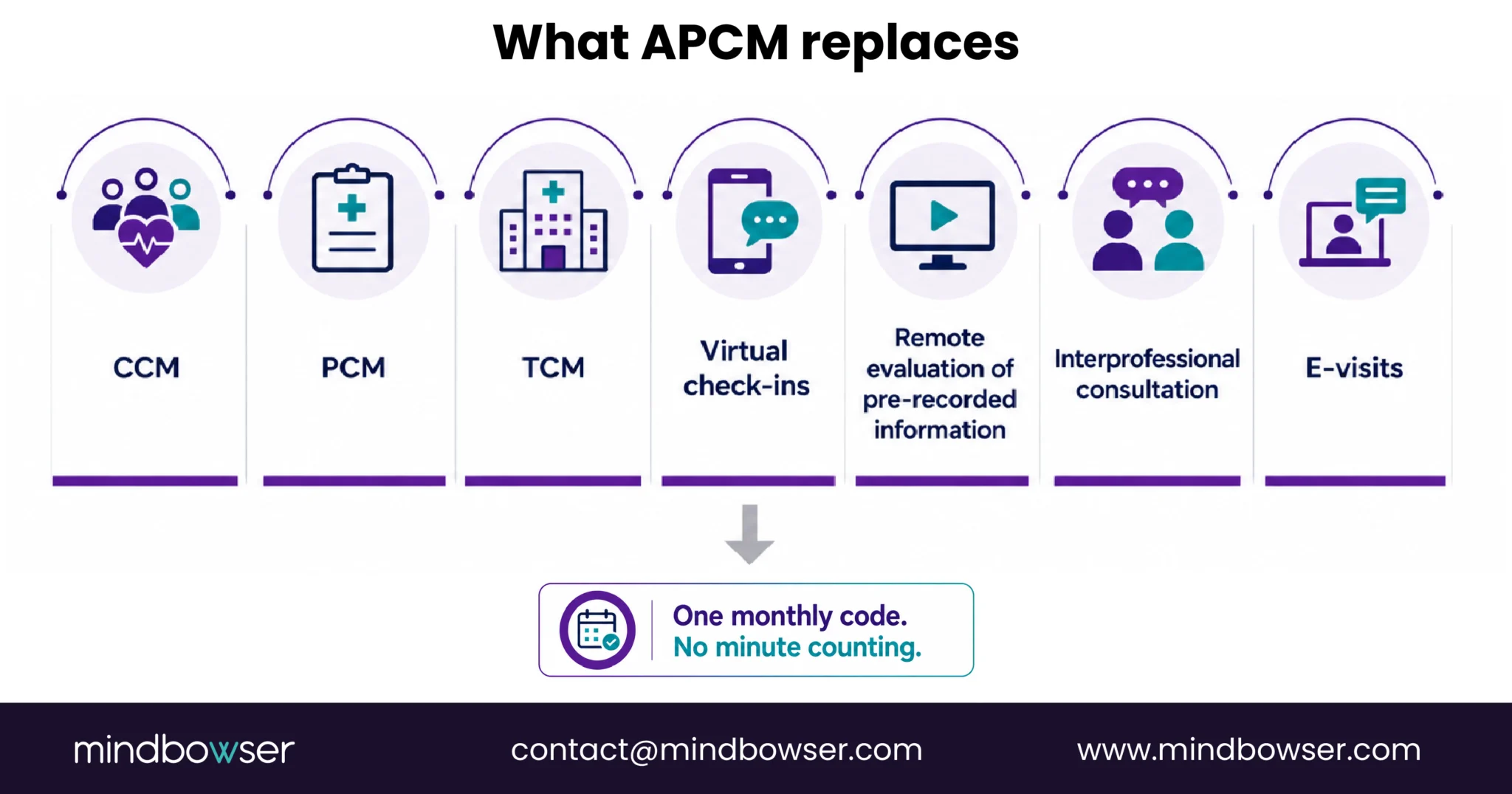
Every other care management code Medicare pays for asks you to count minutes. Advanced Primary Care Management doesn’t. That single change is why it exists, and it moves the operational work somewhere practices rarely look for it.
It’s also a young program, which has a specific consequence for anyone reading up on it: a lot of what’s published about APCM was written against the proposed rule, or against 2025 rates, or against a restriction CMS considered and then dropped. Several of the sections below correct something that is widely repeated. Where that happens, the primary source is cited so you can check it rather than take our word for it.
APCM was created by the CY 2025 Physician Fee Schedule final rule at 89 FR 97859, effective 1 January 2025. That citation matters, because a good deal of published guidance attributes APCM to the CY 2026 rule. The 2026 rule re-priced the codes and added behavioral health add-ons. It didn’t create the program.
The bundle folds in elements of chronic care management (CCM), principal care management (PCM), transitional care management (TCM) and four communication technology-based services: virtual check-ins, remote evaluation of pre-recorded patient information, interprofessional consultation and e-visits. You bill it once per patient per calendar month. Participation is optional: a practice can keep billing the individual time-based codes if those describe its work better.
The three tiers, and who lands in each

The tier is decided by two facts about the patient, and by neither the time you spent nor the intensity of the month.
G0556 (Level 1) covers patients with one or fewer chronic conditions. G0557 (Level 2) covers patients with two or more. G0558 (Level 3) covers patients with two or more who also hold QMB status.
A qualifying chronic condition is one expected to last at least 12 months or until the patient’s death, and which places them at significant risk of death, acute exacerbation or decompensation, or functional decline. That’s the same standard CCM uses, so a practice already running CCM isn’t learning new eligibility criteria here.
The QMB tier carries something worth planning around. QMB patients can’t be billed Medicare cost-sharing on any Part A or Part B service, APCM included. So the highest-paying tier is also the only one where the patient owes nothing and there is no collection conversation to have. For practices that have watched cost-sharing suppress CCM enrollment, that is a meaningful difference.
One combination the tier table does not obviously cover: a QMB patient with one or no chronic conditions bills G0556, not G0558. The Level 3 code requires QMB status and two or more conditions, so QMB alone doesn’t lift a patient out of Level 1.
You can confirm QMB status three ways: the HIPAA Eligibility Transaction System (HETS), your Medicare Administrative Contractor’s provider portal, or your state Medicaid eligibility verification system.
The part that catches teams out is that neither input is stable. A patient picks up a second chronic condition in March and moves from G0556 to G0557. A patient’s income or assets change and QMB eligibility moves independently of anything clinical. Neither event fires an alert in a typical EHR. Practices that check tier assignment at annual review rather than when the underlying data changes end up billing a tier that was correct when someone last looked.
What APCM pays in 2026

Most published APCM rates give one number per code. There are two.
Medicare prices APCM in both facility and non-facility settings. CMS’s guidance is that the place of service on the claim reflects where the billing practitioner would ordinarily provide face-to-face care to that patient. Quote a single figure in a business case and the number can be off by more than a third.
The table below also carries three codes that are new for 2026: G0568, G0569 and G0570, the optional behavioral health add-ons, covered in the next section.
Check Your APCM Documentation Before an Audit
The three behavioral health add-on codes, new for 2026
CY 2026 added three optional add-ons that let a practice layer behavioral health onto APCM without going back to counting minutes. G0568 covers the initial month of Collaborative Care Model work, G0569 covers subsequent months, and G0570 covers general behavioral health integration.
Three rules govern them, and all three apply everywhere, not just in the settings discussed later:
- Each can only be billed when an APCM base code is billed by the same practitioner in the same month. They are add-ons, not standalone services, and a claim carrying one without a base code is the predictable denial.
- They carry no time thresholds. That’s the point of them. The time-based requirements on CPT codes 99492, 99493 and 99484 still apply when those codes are billed on their own, outside APCM (90 FR 49470).
- CMS deliberately did not create an add-on for CPT 99494, because that code describes additional time and these codes don’t count time.
Two of them pay more than the highest APCM base tier, which surprises people. It follows from the crosswalk: G0568 and G0569 are valued against 99492 and 99493, which describe substantial monthly behavioral health work in their own right. One oddity: the facility and non-facility rankings differ between G0568 and G0569, and that isn’t a transcription error. G0569 carries the higher physician work value while G0568 carries the higher non-facility practice expense, so which one pays more depends on the setting.
Why office and hospital rates moved in opposite directions
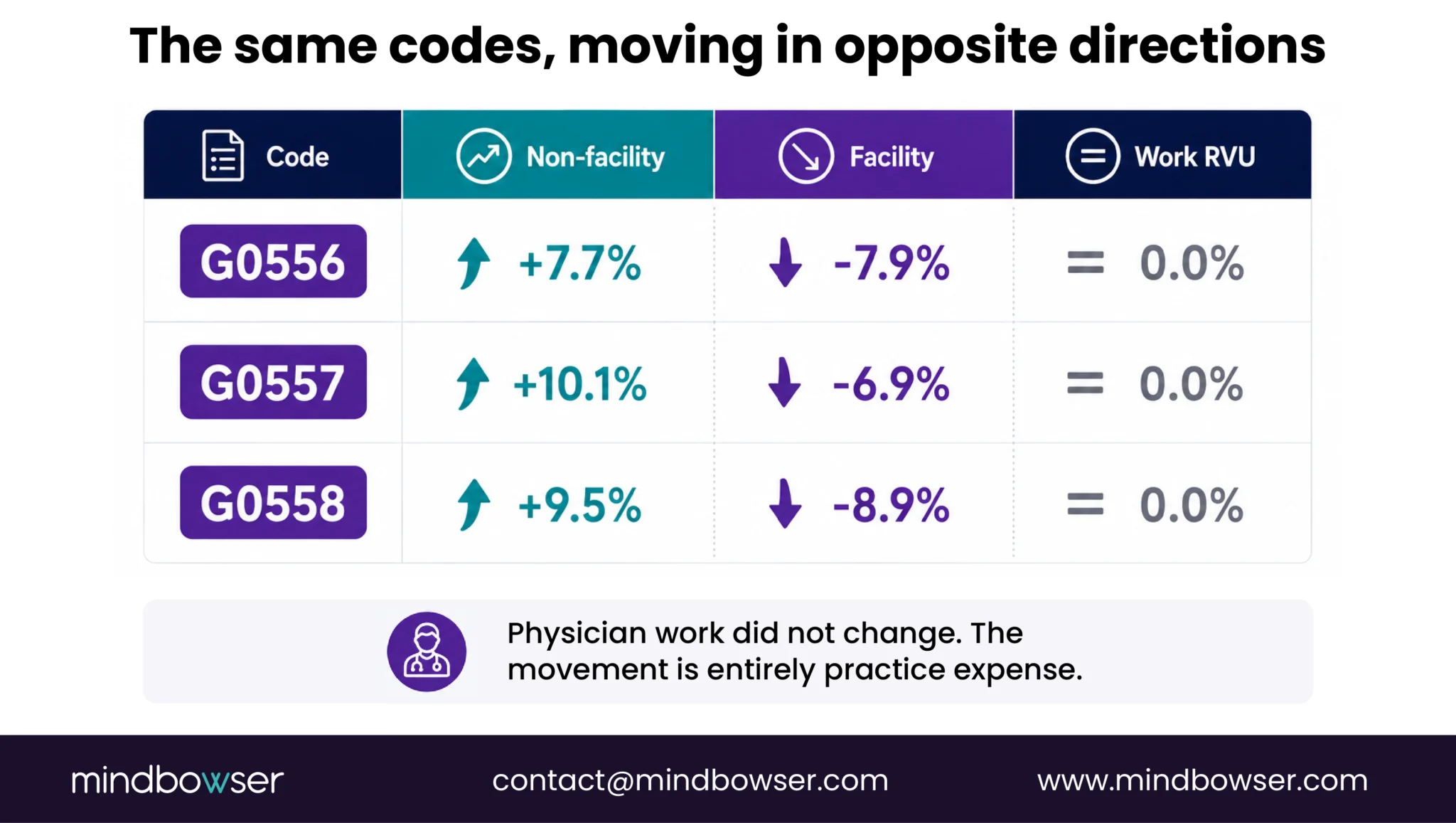
Office-based APCM pays more in 2026 than it did in 2025. Hospital-outpatient APCM pays less. Non-facility rates rose between 7.7% and 10.1%; facility rates fell between 6.9% and 8.9%, on the same three codes, in the same year.
Neither the conversion factor nor physician work explains it. The conversion factor rose 3.26%, which is the wrong size and the wrong direction to account for a facility decrease. And the work relative value units are unchanged: 0.25, 0.77 and 1.67 for the three codes in both 2025 and 2026. What moved is practice expense. The CY 2026 rule reallocated practice expense toward office-based settings, and the APCM codes moved with it.
This matters if you run APCM across both settings, because the same code is moving in opposite directions depending on where the billing practitioner sits. A single blended assumption in a 2026 budget will be wrong on both halves.
The same pattern shows up in transitional care management: on the same fee schedule files, 99495 rose 9.4% in the office, from $201.20 to $220.11, and fell from $134.24 to $122.24 in the facility setting. This is a fee schedule shift rather than an APCM quirk, which also means it can move again in CY 2027.
The 13 service elements: availability, not delivery
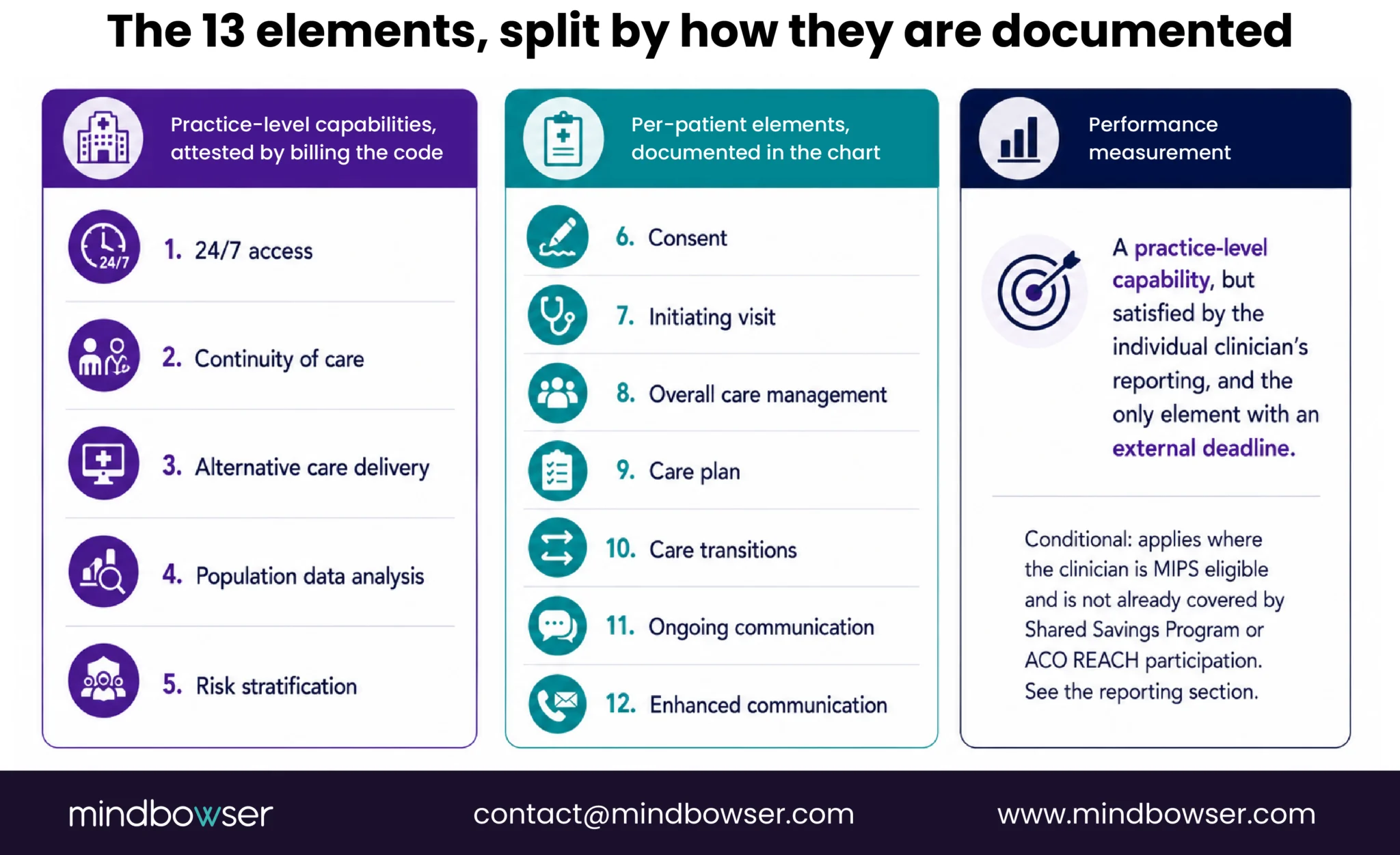
This is the requirement most practices misread, and the misreading creates work that Medicare never asked for.
APCM has 13 service elements. You don’t have to deliver all 13 to every patient every month. CMS was direct about it: not all elements must be furnished during any given calendar month. Some months a patient has no care transition to manage, so there’s nothing to manage. What you must have is the capability to furnish each element when a patient needs it.
The 13 elements are: consent; an initiating visit for new patients; 24/7 access for urgent needs; continuity of care with a designated care team member; care delivered in alternative ways to office visits; overall care management covering medical and psychosocial needs; an electronic patient-centered care plan; coordination of care transitions; ongoing communication with other providers and community services; enhanced asynchronous communication opportunities; population data analysis to find care gaps; risk stratification of the practice panel; and performance measurement.
The distinction that saves real effort is which of those get documented where. One element sits awkwardly across the split and gets its own section below. Performance measurement is a practice-level capability, but the reporting that satisfies it is done by the individual clinician, and it’s the only element with a calendar deadline attached.
Practice-level capabilities are not documented per patient per month. CMS said it doesn’t expect a practice to record in each patient’s chart, every month, that the practice has 24/7 access. By billing the code, the practitioner attests that the requirements in the descriptor are met. What does belong in the chart is the actual interaction: if a patient reached the after-hours line, that conversation is documented. Teams building an audit-ready documentation posture often over-document the practice-level half and under-document the per-patient half.
One requirement changed between the proposed and final rules, and guidance written from the proposal still carries the stricter version. CMS proposed that 24/7 access include real-time access to the patient’s medical record, then removed it. Smaller practices relying on third-party after-hours coverage said real-time record access wasn’t feasible, and CMS agreed. What the final rule requires instead is that the after-hours responder documents and communicates the interaction back to the care team, and that it lands in the patient’s record.
Consent and the initiating visit
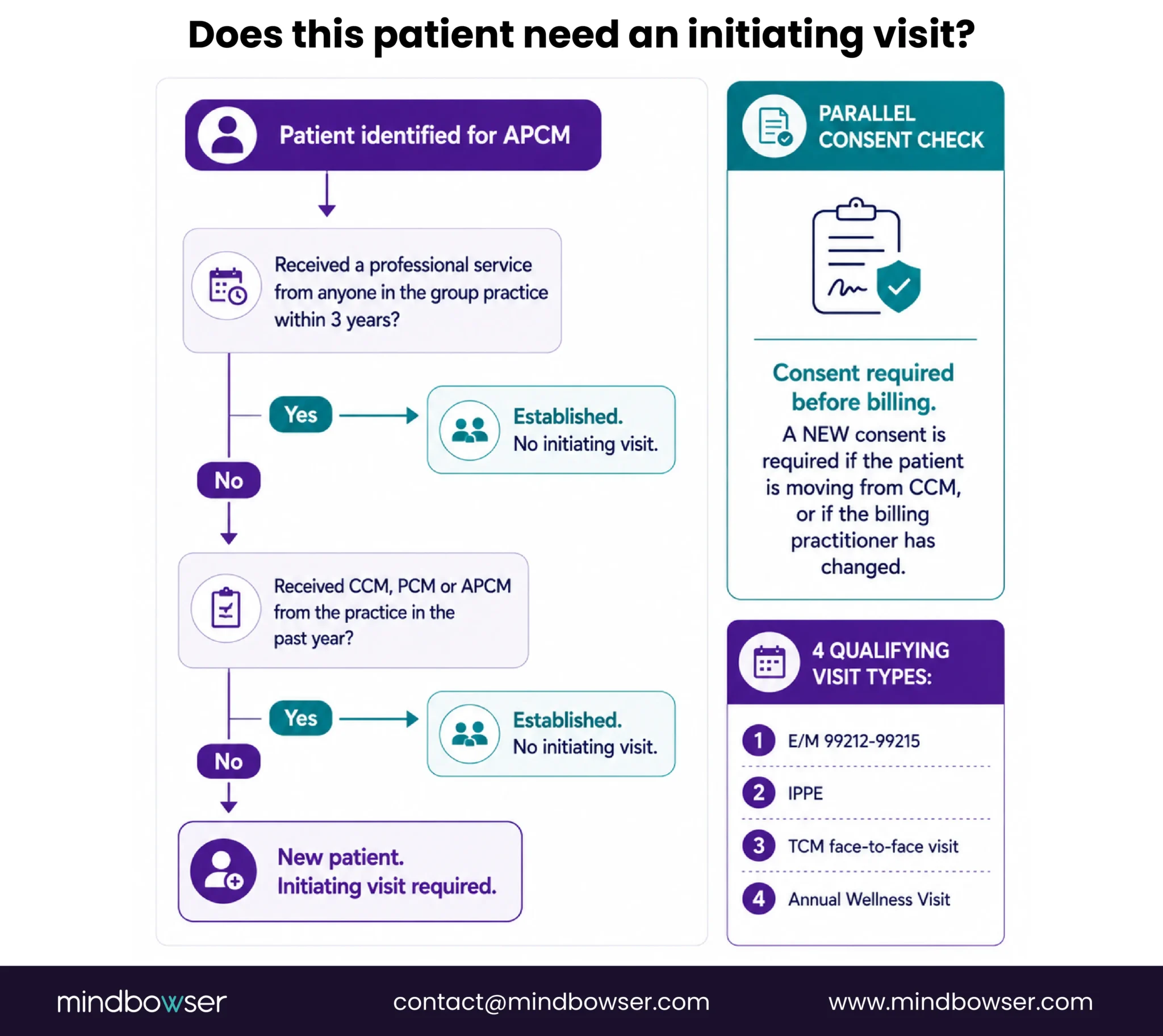
Two places practices lose APCM months before they have started.
Consent may be verbal. It doesn’t have to be written, though you can obtain written consent if you prefer. It must be documented in the medical record, and it must cover four things: that only one practitioner can furnish and be paid for APCM in a calendar month, that the patient may stop at any time effective at the end of the month, that cost-sharing may apply, and that the patient accepted or declined. The cost-sharing line stays in the script even for QMB patients, who are protected from it, because the consent requirement is written against the service rather than the patient’s coverage.
An existing CCM consent doesn’t carry over. CMS addressed this directly: a patient moving from CCM to APCM requires a new consent. A new consent is also required whenever the billing practitioner changes. Practices running an established chronic care management program should expect to re-paper the panel rather than migrate the paperwork.
The initiating visit is required only for new patients, meaning someone who has not received a professional service from the practitioner, or anyone else in the same group practice, within the previous three years. Qualifying visits are an evaluation and management visit at levels 2 through 5 (CPT 99212 to 99215), the Initial Preventive Physical Examination (IPPE), the face-to-face visit within TCM, and the Medicare Annual Wellness Visit.
The Annual Wellness Visit is a late addition. CMS didn’t include it in the proposed rule, commenters pointed out the omission, and CMS agreed it had been an oversight. It counts only where the practitioner furnishing the visit is the same one who will furnish APCM. A care plan developed during that visit can also satisfy the APCM care plan element, which makes the AWV an efficient entry point into the program. If you are starting from a blank page, a worked care plan example is a reasonable template to adapt.
No initiating visit is needed for established patients, and there’s a second exemption: a patient who received CCM, PCM or APCM from the practice within the previous year is treated as established, regardless of when they were last seen.
Get Help Scoping Concurrency Logic Behind Your APCM Billing.
Who can bill it
Physicians and non-physician practitioners can bill APCM: nurse practitioners, physician assistants, certified nurse midwives and clinical nurse specialists. Certified nurse midwives are on that list and are frequently left off published summaries.
The services themselves are usually furnished by clinical staff incident to the billing practitioner’s professional services. APCM is a designated care management service, which means auxiliary personnel can provide it under general supervision. The billing practitioner doesn’t need to be in the office suite. Practices already running CCM under the same supervision standard will recognize the arrangement, and most care management software already models it.
Specialists aren’t excluded. This is stated more restrictively almost everywhere than the rule supports. CMS said plainly that it isn’t limiting APCM services to practitioners in specific specialties, and named obstetrics and gynecology and cardiology as examples of specialties that sometimes function as primary care. What decides it is the role: whether that practitioner is responsible for all of the patient’s primary care and serves as the continuing focal point for all needed health care services.
Only one practitioner may bill APCM for a patient in a given month. That doesn’t stop the patient’s other providers from billing other care management services when medically necessary.
What you can and cannot bill alongside APCM
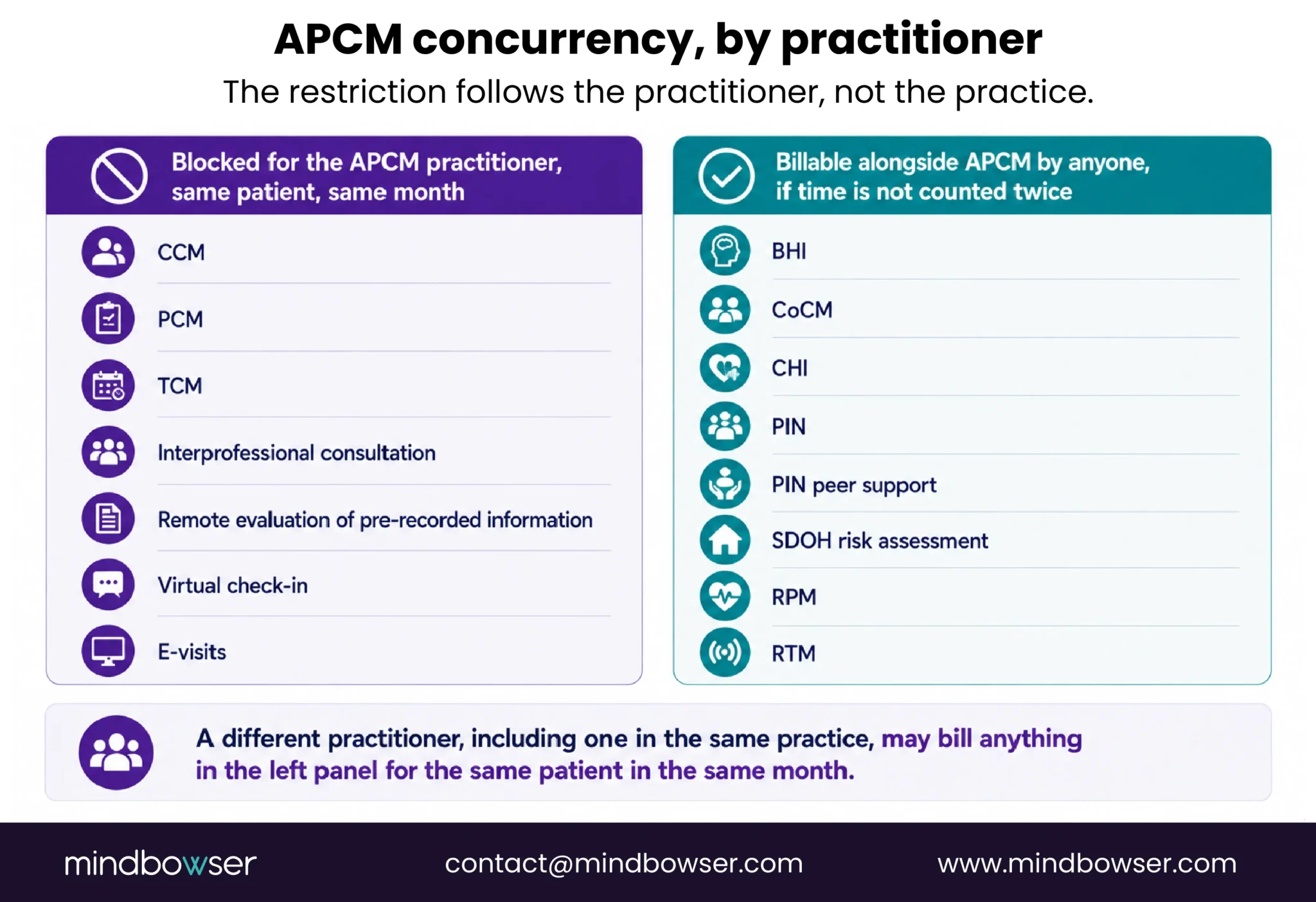
Here is the most repeated error in published APCM guidance, and it is expensive in both directions.
The common statement is that APCM cannot be billed with CCM, PCM or TCM in the same month. Several widely-cited vendor billing guides put it exactly that way, without qualification. Stated flatly, it’s wrong. CMS proposed a restriction that would have applied across an entire practice, and then declined to finalize it after commenters explained what it would do to multispecialty groups.
What CMS finalized is narrower. The restriction applies only to the one practitioner furnishing APCM.
For the practitioner billing APCM, these can’t also be billed for that patient that month: CCM, PCM, TCM, interprofessional consultation, remote evaluation of pre-recorded patient information, virtual check-ins and e-visits. Those services are bundled into the APCM payment already.
For any other practitioner, including one in the same practice, those same services may be billed for the same patient in the same month when medically necessary. CMS worked the example itself: an oncologist can provide and bill TCM for a patient recently discharged after an admission related to chemotherapy side effects, while a different practitioner in the same practice continues to furnish APCM for that patient during the same month.
A separate set of services can be billed alongside APCM outright, by the APCM practitioner or anyone else, as long as time and effort are not counted twice: behavioral health integration and the Collaborative Care Model, community health integration, principal illness navigation and its peer support variant, the social determinants of health risk assessment, and both remote physiologic monitoring and remote therapeutic monitoring. CMS considered whether these duplicated APCM and concluded they complement it.
Interprofessional consultation codes deserve a specific note, because they appear on the blocked list above and CMS clarified them separately. The consulting specialist can bill those codes while another practitioner furnishes APCM. The consultant simply mustn’t also be furnishing APCM to that patient.
The reporting requirement, and the two pathways that no longer exist

The 13th service element is the only one with an external deadline attached, and the rule’s own list of ways to satisfy it has quietly shrunk.
Performance measurement asks that the practice be assessed on primary care quality, total cost of care, and meaningful use of certified EHR technology. A clinician who is eligible for the Merit-based Incentive Payment System (MIPS) satisfies it by registering for and reporting the Value in Primary Care MIPS Value Pathway (MVP) for the year in which they bill APCM.
Registration is a window, and it closes. A MIPS eligible clinician must register for the MVP between 1 April and 30 November of the performance year, then submit data between January and March of the following year. Bill APCM through a year without registering inside that window and the performance measurement element can’t be satisfied for it retroactively. The window closes on 30 November of the year you are billing in, which means a practice that starts APCM in January has until the end of November to register for that same year.
CMS also allowed the element to be satisfied by participating in one of four programs: the Medicare Shared Savings Program, ACO REACH (Realizing Equity, Access, and Community Health), Making Care Primary, or Primary Care First.
Two of those four have ended. CMS announced on 12 March 2025 that Making Care Primary would end early on 30 June 2025. Primary Care First states that its final performance period ended on 31 December 2025. Both were named in the CMS Innovation Center’s model portfolio changes. Only the Shared Savings Program and ACO REACH remain.
The rule text still lists all four, so guidance written from it still lists all four. If your plan for satisfying this element was participation in Primary Care First or Making Care Primary, that plan expired and the MVP registration window is now the route.
Two clarifications.
These are alternatives, not additional requirements. Some published guidance says practices billing APCM must report the MVP and participate in an ACO or one of the models. That would exclude most independent practices from APCM entirely, and it isn’t what the rule says. Either route satisfies the element.
And the element does not apply at all to clinicians who are not MIPS eligible. That includes those who earned Qualifying Participant status through an Advanced Alternative Payment Model, those newly enrolled in Medicare during their first year, and those below the low-volume threshold. CMS stated this explicitly.
One claim to treat carefully: we found no provision in either rule allowing CMS to withhold APCM payment for incomplete MVP reporting, and it is asserted in several published guides without a citation. Incomplete reporting affects the MIPS payment adjustment, which is a separate mechanism operating on a different timeline.
APCM or CCM: which patients belong where

Most APCM-versus-CCM comparisons put APCM next to what CCM could pay at its ceiling. The more useful comparison is against what your practice actually captures under CCM today.
APCM’s eligibility is broader. Any Medicare patient can be enrolled, including the population with one or no chronic conditions, which generates no CCM revenue at all because CCM requires two or more. For a practice with a large, relatively healthy Medicare panel, that segment is currently invisible to care management billing.
CCM can pay more per patient where a practice consistently reaches its time thresholds and layers on add-on codes for additional time. That’s a real ceiling, and some practices reach it. The honest question is whether yours does, every month, across the panel. For a practice that has never reliably logged 20 minutes per patient per month, the real choice is between a guaranteed monthly rate and whatever partial capture its documentation discipline currently produces.
Which makes this a patient-by-patient segmentation exercise. Practices commonly run both models at once, splitting the panel by which one fits which patient, and revisiting the split as the panel changes.
For how CCM’s own 2026 payment structure works, our chronic care management billing guide and Medicare chronic care management pay rates cover the time thresholds and add-on structure, and our CCM billing overview walks the claim mechanics.
FQHCs and RHCs
Federally qualified health centers and rural health clinics bill APCM using the same three base codes, paid at the PFS national non-facility rate, in addition to the otherwise billable visit. CMS’s APCM FAQ confirms they can bill with or without a qualifying visit.
The G0511 transition is finished. G0511, the bundled care coordination code these settings previously used, stopped being billable after 30 September 2025, following two extensions from the original January 2025 date. One note for anyone cross-checking: the CY 2026 final rule’s summary of that history says the second extension ran to 1 September, while the CMS operational notice announcing it says 30 September. The operational notice is the one providers acted on.
Three further changes took effect on 1 January 2026 and get less coverage. The first two exist because of APCM: CMS unbundled these codes so the services APCM absorbs can be identified individually on an FQHC or RHC claim, which is what unbundling G0511 was for.
- G0512 was unbundled. These settings now bill the individual Collaborative Care Model codes 99492, 99493, 99494 and G2214 rather than the single bundled code.
- G0071 was unbundled. Virtual communication and remote evaluation services are now billed as G2010, G2250 and CPT 98016 individually.
- The three new APCM behavioral health add-ons apply here too. An FQHC or RHC furnishing APCM may report G0568, G0569 or G0570 when integrating behavioral health.
The same universal rule applies here as anywhere else: each add-on needs a base APCM code from the same practitioner in the same month.
Our CCM codes and CPT variants guide covers the FQHC and RHC code set in more depth.
What nobody knows yet
There is no APCM utilization data at all.
The CMS Medicare Physician and Other Practitioners dataset returns zero rows for G0556, G0557 and G0558 at national level. That says nothing about the program’s uptake. The most recent published year is 2024, and APCM launched in January 2025. Any figure you see quoted for how many practices bill APCM, or how many patients are enrolled, is an estimate rather than a measurement. The 2025 claims year should start to close that gap when it publishes.
What running APCM actually asks of a practice
The absence of utilization data doesn’t stop you scoping the work, because the requirements are all in the rule. What APCM asks a practice to operate is a different shape from what CCM asked.
Tier status has to re-evaluate when a diagnosis lands or a QMB flag moves, rather than at an annual review. Consent has to know when the billing practitioner changed, because that invalidates it. Somebody has to own the MVP registration date. And the concurrency check has to run per practitioner rather than per practice, which is the opposite of how most claim edits are configured, and a claim edit written at practice level will reject claims the rule permits.
Where that work needs current condition and eligibility data out of Epic, Cerner, athenahealth or whatever system a practice runs, ConnectHealth provides that connectivity. The rest is a custom build. There is no packaged component for APCM tier recalculation or per-practitioner concurrency logic. The rules are specific enough, and the panel-level variation wide enough, that this is logic built for a particular practice rather than configured from a catalog.
If you are scoping that work, our custom healthcare software development and healthcare software development teams can look at what your current stack already covers.
The Real Work Behind APCM Adoption
APCM removes the one thing every other care management code demands: minute-by-minute tracking. What replaces it isn’t simpler, just different. Tier assignment has to move when a diagnosis or a QMB status changes, not once a year. Consent has to reset when the billing practitioner changes. The concurrency rule runs per practitioner, not per practice, which most claim-edit systems aren’t built for. And the reporting requirement carries a hard date that two of its five original pathways no longer satisfy.
None of that is a reason to sit APCM out. For any Medicare patient with one or no chronic conditions, it’s the only care management code that pays at all. For a practice that has never reliably hit its CCM time thresholds, a flat monthly rate is often the better bet than partial capture. The work is scoping tier logic, consent triggers, and concurrency checks against your specific patient panel and your specific EHR, not adopting a template.
That’s exactly where a connected data layer earns its keep. Get in touch to see what your current stack already handles and where the gaps sit.