








 BLOGS
BLOGS  NEWSROOM
  CASE STUDIES
  WEBINARS
  PODCASTS
  ASSET HUB
  EVENT CALENDAR
















TL;DR
- Data format mismatches are the core technical blocker: HL7v2 feeds and older proprietary schemas don’t map cleanly to FHIR R4 without middleware or custom transformation layers.
- Interoperability compliance gaps (FHIR/HL7 standards) create both technical debt and regulatory exposure, especially for orgs still on Cerner DSTU2 or pre-2015 EHR editions.
- Phased cutover and user retraining add operational risk to dual-system environments during transition, strain staff, introduce data sync errors, and extend timelines if not planned tightly.
- ConnectHealth’s pre-built Epic connectors reduce integration build time significantly, purpose-built for HL7v2-to-FHIR R4 handoffs, dual-EHR environments, and Epic API compliance.
The ongoing argument between Epic integration and legacy systems is an example of the crucial choices businesses consider to keep up with technology improvements.
The nature of legacy systems must be understood before we can close the gap.
The agencies estimated that the combined operating and maintenance costs of these legacy systems, which ranged in age from around 8 to 51 years, were approximately $337 million per year.
Although legacy systems have traditionally served businesses well, they often struggle to keep up with evolving business requirements and technological advancements, such as Epic integration.
Integrating Epic systems brings significant benefits, including better patient outcomes and improved operational efficiency. Interoperability is crucial in this process, and APIs play a vital role in Epic integration and in establishing reliable data exchange across different systems.
It ensures that patient information is accurate and up-to-date, supporting enhanced decision-making and speeding up healthcare delivery.
What Healthcare Businesses Can Achieve with Epic’s Integration?
Healthcare practitioners can effectively handle patient data retrieval and expedite appointment scheduling in integration by utilizing API features.
APIs are important in Epic integration since they allow for more efficient data transmission and functionality. They provide accurate and up-to-date patient information, ensuring smooth communication across disparate healthcare systems.
Healthcare providers may improve patient care coordination, speed up workflow, and lessen administrative responsibilities by leveraging these healthcare APIs.
AI-powered solutions also automate the taking of clinical notes, enhancing documentation accuracy and supporting patient diagnosis based on organized interactions.
1️⃣ Patient Data Retrieval and Management
APIs enable reliable retrieval and management of patient data across healthcare systems. For instance, in EHR integrations, APIs facilitate secure access to comprehensive patient records, allowing healthcare providers to view medical histories, treatment plans, and diagnostic results in real time. This capability supports informed decision-making and enhances care coordination.
2️⃣ Appointment Scheduling and Order Entry
APIs speed up appointment scheduling and order entry processes within healthcare API workflows. Additionally, healthcare APIs facilitate order entry for medications, tests, and procedures, ensuring accuracy and reducing administrative overhead.
3️⃣ AI Use Cases in Clinical Notes
AI-powered tools in Epic Integration transform clinical note-taking processes. These tools can automatically transcribe and summarize physician-patient interactions, generating structured notes for initial diagnoses. It enhances efficiency in documentation, improves data accuracy, and supports clinical decision-making by providing insights into patient conditions and treatment plans.
Navigating the Conversion Challenge: From Legacy to Modern Epic Integration
Transitioning from legacy systems to modern FHIR standards poses challenges in healthcare IT. It involves overcoming compatibility issues, migration complexities, and ensuring interoperability across platforms for reliable Epic integration and improved data exchange.
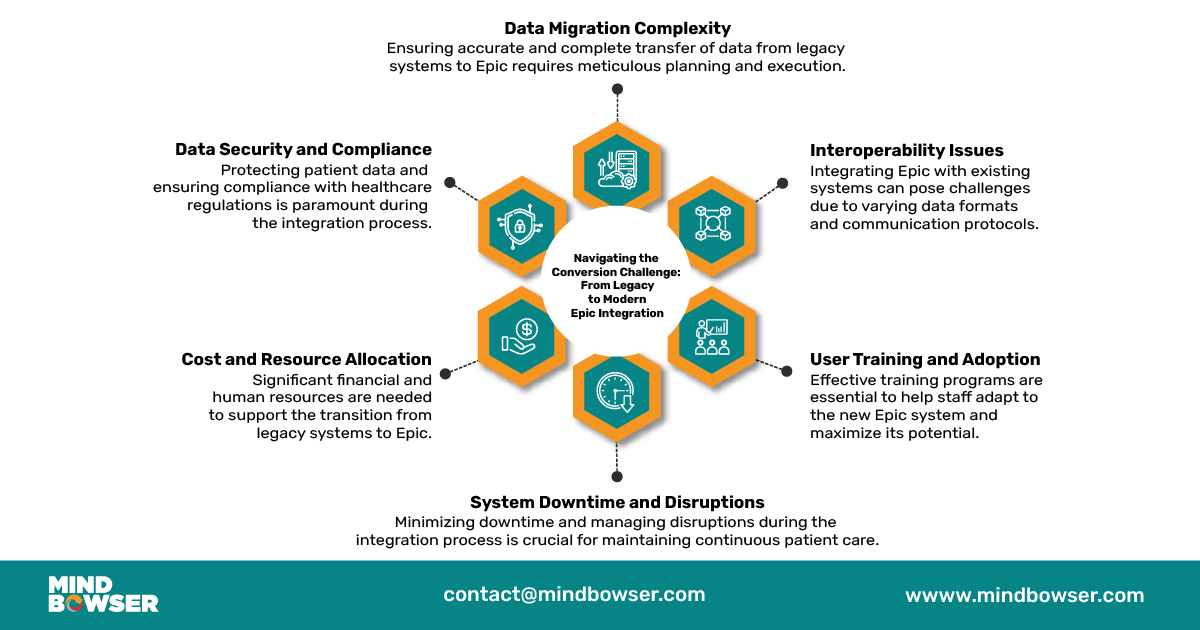
Here are a few Legacy to modern epic integration challenges to consider:
1. Data Migration Complexity
Migrating data from legacy systems to Epic’s modern platform involves dealing with diverse data formats, structures, and volumes. Ensuring accurate and reliable data migration requires careful planning, robust tools, and expertise to avoid data loss, corruption, or inconsistencies.
2. Interoperability Issues
Legacy systems often lack standardized data exchange protocols, making it difficult to achieve reliable interoperability with modern Epic systems. Addressing these issues requires implementing APIs, data mapping, and compliance with standards like HL7 and FHIR to enable smooth communication between disparate systems.
3. User Training and Adoption
Transitioning to a new system like Epic necessitates extensive user training to ensure staff can effectively use the new tools. Resistance to change and the learning curve can slow down the adoption process, impacting overall productivity and patient care initially.
4. System Downtime and Disruptions
Integrating Epic with existing legacy systems can lead to system downtime and operational disruptions. Minimizing these disruptions requires meticulous planning, testing, and phased implementation to ensure continuity of care and administrative functions.
5. Cost and Resource Allocation
Upgrading to Epic involves a significant financial investment and resource allocation. This includes costs for software, hardware, training, and ongoing maintenance. Proper budgeting and resource management are essential to ensuring a smooth and cost-effective transition.
6. Data Security and Compliance
Maintaining data security and regulatory compliance during the transition is paramount. Legacy systems may have outdated security measures that need upgrading to meet modern standards. Ensuring data privacy, HIPAA compliance, and implementing robust security protocols are crucial to protecting patient information during and after the integration process.
Strategies for Successful Epic Integration Migration to Newer Standards
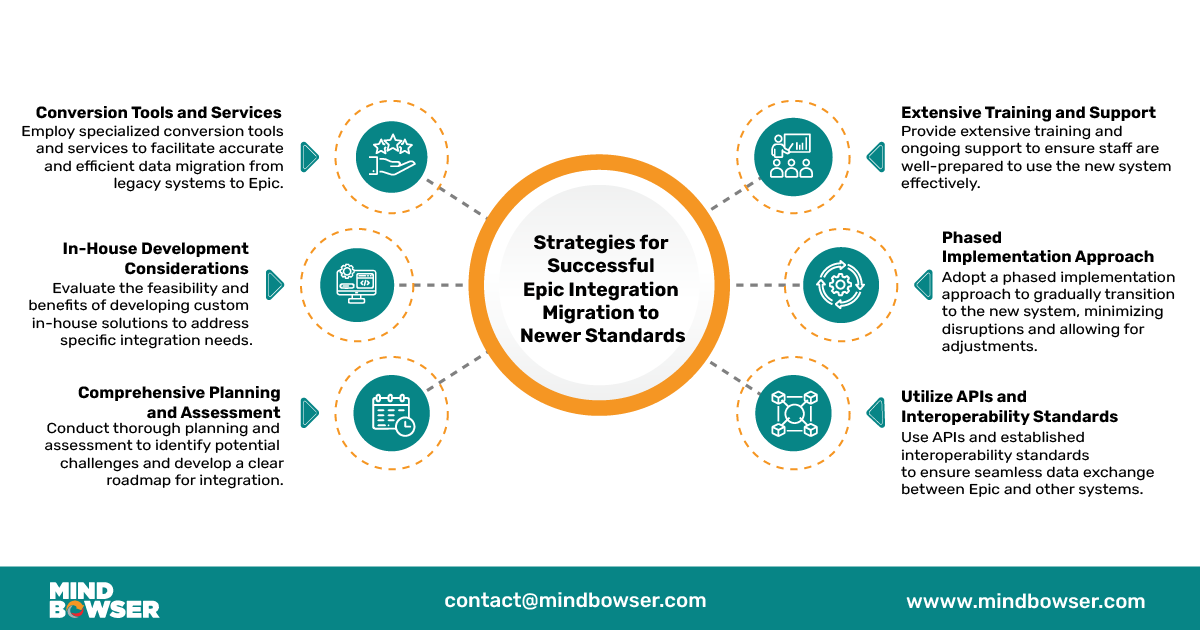
✅ Conversion Tools and Services
Using effective conversion tools and services is crucial for migrating to newer FHIR and HL7 standards in healthcare IT. These tools facilitate data mapping, transformation, and validation, ensuring compatibility and compliance with updated regulations. Partnering with experienced Epic integration providers can speed up this process, offering specialized expertise and tailored solutions to handle complexities efficiently.
✅ In-House Development Considerations
In-house development involves customizing solutions to meet specific healthcare IT needs during migration. It allows for tailored integration, addressing unique system requirements, and optimizing performance.
Careful planning and expertise in standards compliance are essential to mitigate risks and achieve a reliable transition to newer healthcare IT standards. Partnering with an experienced team like ConnectHealth can accelerate this process with specialized expertise, pre-built FHIR connectors, and a faster path through the complexity.
✅ Comprehensive Planning and Assessment
Start with thoroughly assessing existing legacy systems to understand the data structures, workflows, and potential integration challenges. Develop a detailed migration plan outlining each step, timeline, resource allocation, and risk management strategy. This planning phase should involve key stakeholders to ensure all aspects of the transition are covered.
✅ Utilize APIs and Interoperability Standards
Use modern APIs and interoperability standards like HL7 and FHIR to facilitate reliable data exchange between legacy systems and Epic. These standards help bridge the gap between different data formats and communication protocols, ensuring smooth integration and real-time data sharing.
✅ Phased Implementation Approach
Implement the migration in phases rather than attempting a full-scale transition at once. This approach minimizes disruptions and allows for continuous monitoring and adjustment. Start with less critical components and gradually move to more essential systems, ensuring each phase is thoroughly tested and validated before moving on.
✅ Extensive Training and Support
Provide comprehensive training for all users, including administrative staff, clinicians, and IT personnel. Ensure that everyone understands the new system’s functionalities and benefits. Offer continuous support and resources post-implementation to address any issues promptly and to help users adapt to the new system effectively. This strategy helps overcome resistance to change and ensures smoother adoption of the new platform.
Case Studies: Real-World Examples of Successful Conversion
In navigating the complexities of Epic integration, healthcare organizations facing challenges with legacy data have implemented strategic solutions to ensure smooth transitions and optimize operational efficiency.
For instance, a major hospital network in California adopted advanced data transfer methods to successfully migrate from outdated systems to Epic. Focusing on data purification, mapping, and validation ensured accuracy and compliance with Epic’s standards, minimizing disruptions to patient care and administrative processes.
Similarly, the platform developed by Mindbowser optimizes efficiency for 300,000 pregnant patients monthly across 2,500 hospitals and 30,000 obstetric providers. Using integrated workflow and EMR-integrated billing tools, it speeds up care coordination and administrative tasks, markedly improving patient outcomes and operational effectiveness in prenatal care and obstetrics.
Conclusion
It’s important to consider interoperability while creating your software to ensure smooth Epic integration in the future. Through adherence to industry-standard data formats and protocols, such as FHIR and HL7, developers can guarantee interoperability with a variety of healthcare IT systems. It guarantees lifespan and usefulness in a changing digital health ecosystem while simultaneously improving scalability and flexibility and preparing apps for upcoming developments in healthcare technology.
Hospitals’ attempts to improve patient care standards and speed up operations rely heavily on the integration of Epic EHRs. Hospitals may improve data management and network interoperability considerably by coordinating technology with organizational objectives and patient care plans.
Improved clinical decision-making and operational effectiveness are made possible by this integration, guaranteeing prompt and efficient patient care. Hospitals can accelerate these goals by working with ConnectHealth Mindbowser’s interoperability accelerator built for Epic environments.