

 BLOGS
BLOGS  NEWSROOM
  CASE STUDIES
  WEBINARS
  PODCASTS
  ASSET HUB
  EVENT CALENDAR




















TL;DR:
Healthcare interoperability is shifting from a big-system luxury to a baseline capability. FHIR, TEFCA, CMS mandates, and pre-built integration platforms are making it faster and cheaper to connect systems — across hospital networks, small practices, and international providers. This guide covers the key trends and what they mean for your organization.
I. Emerging Trends in Interoperability
Emerging trends in interoperability are transforming healthcare, promoting direct data exchange, improving patient care, and fostering collaboration among providers through practicle technologies and standardized protocols.
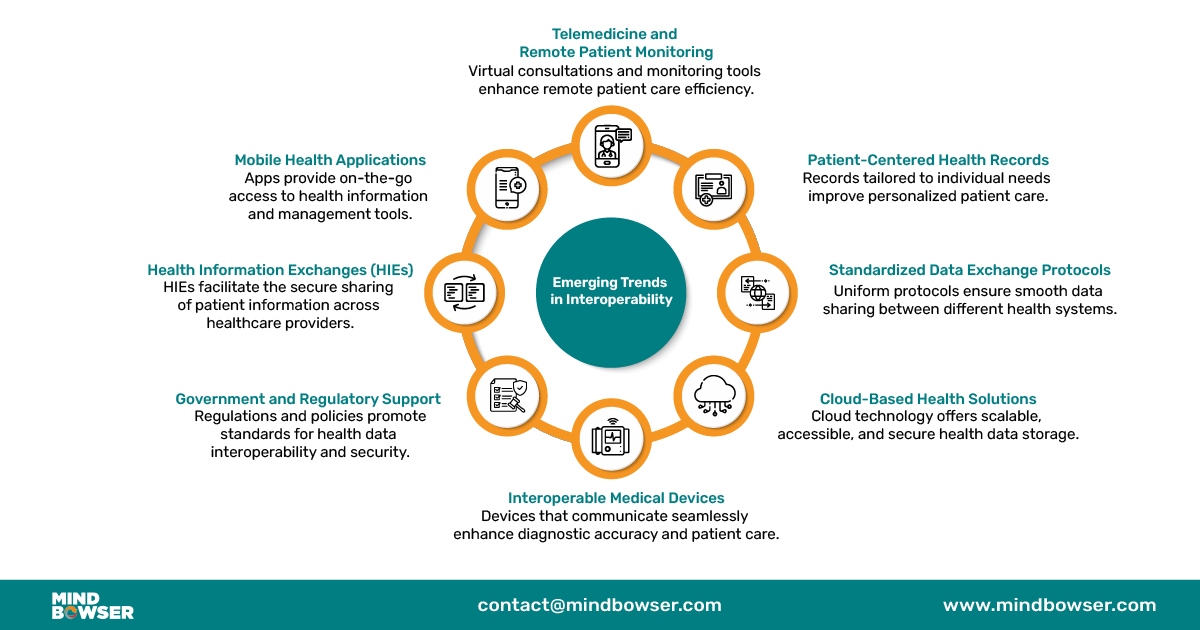
Here are a few more emerging trends in interoperability:
🔮 Telemedicine and Remote Patient Monitoring
The rise of telemedicine and remote patient monitoring has underscored the need for reliable data exchange. These technologies enable patients to receive care remotely, requiring integrated systems to ensure that healthcare providers have access to up-to-date patient information for effective treatment.
🔮 Patient-Centered Health Records
Increased patient access to personal health records allows for greater involvement in healthcare decisions. Patients can share their data with multiple providers, ensuring continuity of care and improving the overall healthcare experience.
🔮 Standardized Data Exchange Protocols
The development and adoption of standardized data exchange protocols, such as FHIR, are crucial for ensuring consistent and accurate data sharing across different healthcare systems. This standardization simplifies integration processes and supports effective communication between diverse healthcare applications.
🔮 Affordable Integration for Smaller Providers
As pre-built platforms replace 6-month custom builds, interoperability stops being a big-system privilege. Small, rural, and international providers can now connect for a fraction of historical cost — arguably the biggest shift of the next five years.
II. Future Benefits of Interoperability
✅ Enhanced Patient Outcomes
Interoperable systems enable healthcare providers to access complete and up-to-date patient information. Such simple access allows for more accurate diagnoses, timely interventions, and personalized treatment plans, ultimately improving patient health and experience.
✅ Increased Efficiency
Future interoperability reduces administrative burdens by automating data exchange and minimizing manual entry. This streamlined workflow lets healthcare professionals concentrate more on patient care, boosting overall productivity within healthcare facilities.
✅ Better Decision-Making
Access to comprehensive patient records and real-time data supports informed clinical decisions. Interoperable systems allow providers to track patient progress, identify health trends, and make evidence-based treatment choices, thus enhancing the quality of care.

IV. How Mindbowser Helps You Build for What’s Next
The future of interoperability rewards teams that can connect fast and cheaply, not just the ones with enterprise budgets. Mindbowser’s ConnectHealth platform is built for that — pre-built FHIR and HL7 connectors deployed in your own cloud, so you ship integrations in days and keep up as standards evolve.
The future of interoperability in healthcare involves more advanced integration of systems and technologies that facilitate the direct exchange and use of patient data across various platforms. This progress aims to improve patient care, enhance efficiency, and support better decision-making in the healthcare industry.
Interoperability will significantly benefit patient care by providing healthcare providers with access to complete and up-to-date patient information. This access allows for more accurate diagnoses, timely interventions, and personalized treatment plans, leading to better health outcomes and improved patient satisfaction.
Emerging technologies such as artificial intelligence, blockchain, and telemedicine are expected to play a crucial role in future interoperability. These technologies will drive advancements in data exchange, support real-time patient monitoring, and improve the overall management of health information.
Key challenges to achieving future interoperability include the need for standardized data formats, the integration of disparate systems, and ensuring data security and privacy. Addressing these challenges requires coordinated efforts among healthcare providers, technology vendors, and policymakers.
Organizations can prepare for future interoperability by adopting standards like FHIR, investing in flexible and scalable technologies, and fostering collaboration among stakeholders. Staying updated with industry trends and participating in interoperability initiatives will also be crucial for successful integration.