BLOGS
BLOGS  NEWSROOM
  CASE STUDIES
  WEBINARS
  PODCASTS
  ASSET HUB
  EVENT CALENDAR





















TL;DR
- Vendor lock-in is the trap: sequential integrations, rotating engineers, and inconsistent pricing stall scaling health tech platforms.
- The fix is owning your IP and infrastructure, not renting middleware.
- ConnectHealth deploys pre-built EHR connectors inside your own environment, so you keep control
If you’re immersed in the challenges of health tech innovation scaling AI-native platforms, integrating with complex EHR systems, and striving to accelerate progress beyond the limitations of your current vendors then this story will resonate deeply with you.
It began with a conversation that mirrored the frustrations of many digital health leaders: sluggish timelines, inconsistent engineering teams, and a complete lack of clear integration roadmaps. Meanwhile, high-stakes deals and key partnerships were teetering on the edge of collapse, all because progress was hindered at every turn.
Does this sound familiar? Let’s break down what’s slowing down your teams and how the right partner can help you overcome these obstacles.
The Hidden Cost of Vendor Dependency
As health tech startups scale, especially when integrating with enterprise health systems, many opt for third-party integration platforms like Redox or partner vendors that promise “plug-and-play” solutions. On the surface, these vendors seem like the ideal choice: they claim expertise in EHR integration, offer initial connections, and promise long-term partnerships.
However, the truth is, they often fail to meet expectations.
Take, for instance, a recent conversation with a digital health company facing exactly this situation. Initially, they were confident in their vendor’s ability to manage integrations. The vendor was experienced, and the early connections worked as promised. But as the company tried to scale, speed became a major bottleneck.
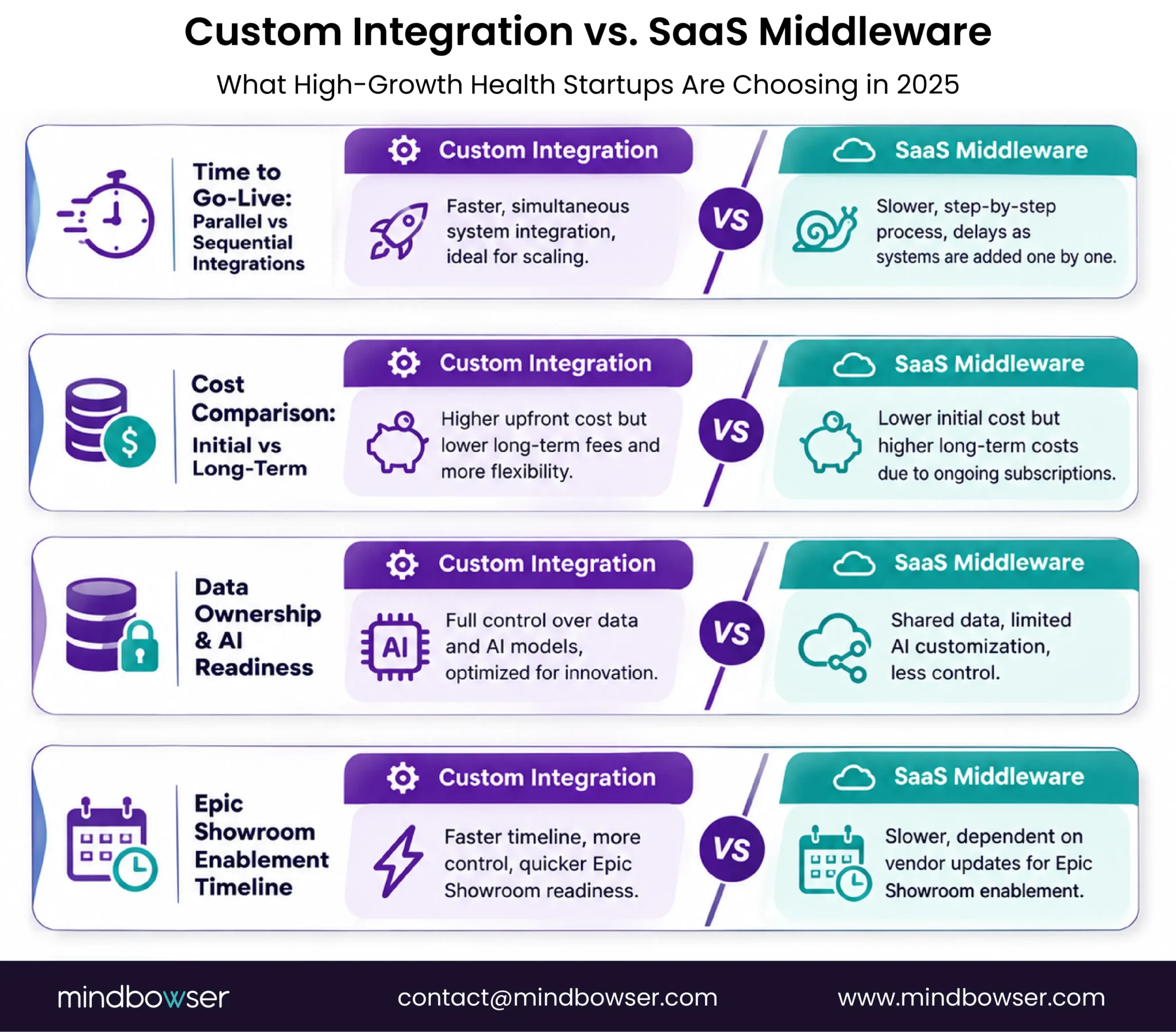
Integrations were added sequentially rather than in parallel, engineers rotated out midway through projects, pricing was inconsistent, and the promised self-service tools left the team more dependent on the vendor than ever. Ultimately, while the company had contracts across multiple Epic-based sites, they couldn’t move forward with a much-needed showroom listing because their integrations had stalled.
The frustration was palpable: a care navigation and AI platform was being held back by backend inefficiencies. Vendors had become a roadblock instead of a support system.
Build It. Own It. Scale It.
This is where Mindbowser makes a difference. We offer a radically different approach one that focuses on helping you build and own your own intellectual property (IP), rather than depending on third-party vendors.
We’re not just about integrations. We help you design your system from the ground up, using FHIR-native interoperability, a scalable data architecture, and AI-readiness at every step of the process.
Here’s what we bring to the table:
- Pre-built EHR integrations with Epic, Cerner (Oracle Health), and Athenahealth
- Sandbox environments and solution accelerators are available from day one
- Built-in HIPAA and ONC compliance
- Full control over your data and infrastructure no vendor lock-in
At Mindbowser, you don’t have to choose between speed and control. We deliver both.
Related Read: Epic EHR Integration Strategies: Best Practices & Tips
Accelerating AI-Native Workflows—The Right Way
The health tech platform we collaborated with was fully AI-native, using cutting-edge tools like conversational agents, ambient scribe technology, and proactive patient engagement solutions. However, their next big challenge was integrating these advanced AI capabilities across health systems in real-time, powered by live EHR data, social determinants of health (SDOH) insights, and dynamic care workflows.
To make that a reality, the platform needed custom-built FHIR engines and data lakes for each site, leveraging RAG (Retrieval-Augmented Generation) pipelines to deliver care recommendations. On top of that, automating care navigation with large language models (LLMs) and triggering post-visit workflows based on real patient behaviors were non-negotiable goals.
Mindbowser’s expertise in intelligent care orchestration, AI guardrails, and LLM fine-tuning meant we could plug into their system seamlessly and start delivering on day one.
Why This Matters: The Future Is Not SaaS It’s Strategic Control
SaaS integration tools may offer a quick solution, but they fall short in terms of depth, agility, and ownership three critical factors for innovative companies.
Today, with value-based care, CMS bundles, and real-time SDOH-driven interventions gaining prominence, having control over your integration stack isn’t just beneficial it’s a competitive advantage.
If you’re working toward Epic Showroom readiness, ONC certification, or even advanced AI model training, must own your data pipeline. The future of health tech requires complete control over your data flow and integration stack.
Real Help, Real Fast: What We Bring
Mindbowser isn’t just about solving the technical challenges. We provide real solutions for real problems.
- Proprietary EHR API support, including MyChart and patient-facing apps
- Data normalization and HL7-to-FHIR conversion
- Pre-built AI recipes for evidence checks, discharge planning, and follow-ups
- Healthcare-native QA & automation to prevent critical bugs post-launch
- Custom dev support for mobile, cloud, HIPAA infrastructure, and more
We are your trusted partner to build, own, and scale your digital health platform, ensuring that you not only survive but thrive in a rapidly evolving healthcare landscape.
If you’re scaling in healthcare and your AI platform is being held back by integration delays, lack of control, or inflexible vendors it’s time for a change.
Ready to take control of your integration roadmap?
Start your transformation today let’s put your AI solution where it belongs: The Center Stage
Vendor lock-in happens when a health tech platform depends on a third-party integration vendor for EHR connectivity and loses the ability to move fast or independently. It shows up as integrations added sequentially instead of in parallel, engineers rotating off projects mid-build, inconsistent pricing, and self-service tools that end up creating more dependency instead of less. The result: deals and partnerships stall because the integration layer, not the product, becomes the bottleneck.
It depends on how central integration speed is to the business. Off-the-shelf middleware can get a first connection live quickly, but it trades away long-term control: you inherit the vendor’s roadmap, pricing, and turnaround time. Building on a FHIR-native architecture you own costs more upfront but means you control the timeline for every new EHR connection, don’t depend on a vendor’s engineering bandwidth, and can move at the pace enterprise deals actually require.
The Epic Showroom is Epic’s curated marketplace of third-party apps that health systems can discover and connect to directly inside Epic. Getting listed requires a working, tested integration with Epic-based sites, which means a platform with contracts across multiple Epic sites but a stalled or vendor-dependent integration layer can’t move forward with a showroom listing even if the product itself is ready. Integration speed is a prerequisite for showroom readiness, not a separate workstream.
It means the FHIR engines, data lakes, HL7-to-FHIR conversion, and API connections that move patient data between your platform and EHRs like Epic, Cerner, and Athenahealth live in your own environment, not inside a vendor’s black box. You control uptime, response time to new integration requests, and how the data architecture evolves as you add sites, instead of waiting on a vendor’s roadmap or support queue.