BLOGS
 NEWSROOM
 CASE STUDIES
 WEBINARS
 PODCASTS
 ASSET HUB
 EVENT CALENDAR



























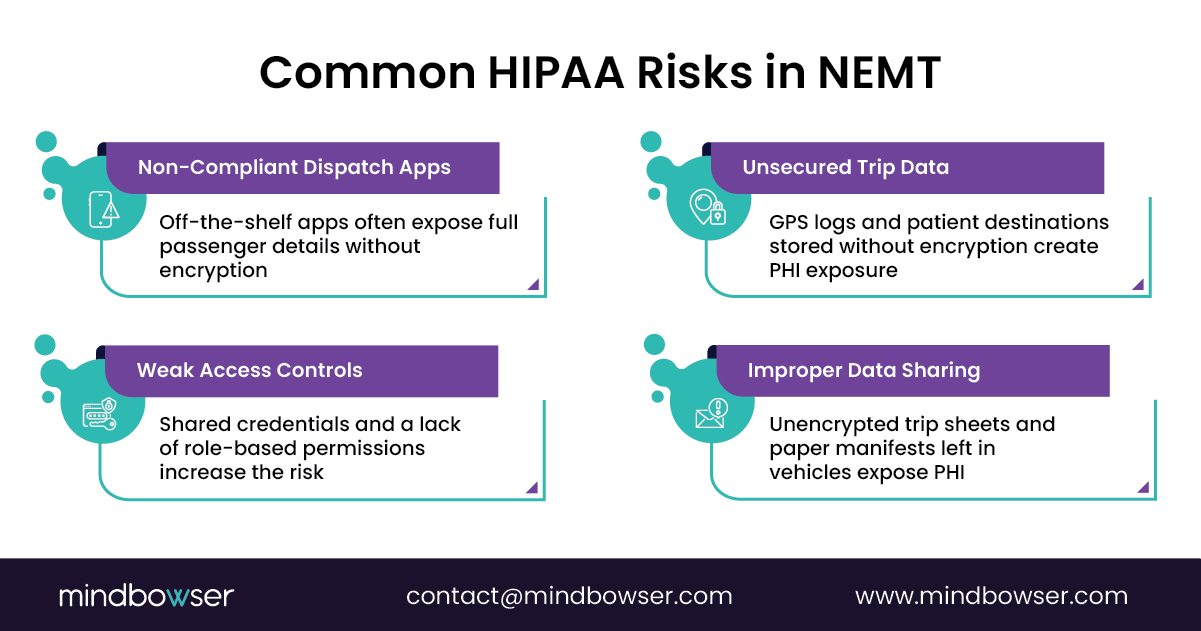
Common HIPAA Risks in NEMT Operations
Many NEMT providers underestimate the ease with which a HIPAA violation can occur in their daily operations. A misplaced trip sheet, a shared password, or an unencrypted dispatch app may seem like small oversights, but each represents a major compliance failure. For transportation companies handling Medicaid trips, these risks are magnified because every trip involves Protected Health Information (PHI). Below are the most common areas where NEMT providers face vulnerabilities.
A. Using Non-Compliant Dispatch Applications
- Off-the-shelf tools may not be designed for healthcare. Many transportation companies use generic logistics or taxi dispatch software. While these tools can schedule rides, they often lack encryption and role-based access controls required under HIPAA.
- Unrestricted access creates unnecessary exposure. In some cases, drivers can see all passenger details, including names, addresses, and destinations, even when the information is not relevant to their trip. This practice violates the principle of minimum necessary access under HIPAA.
- Case in point: unsecured driver apps. When a driver app gives every driver visibility into the full passenger roster instead of just their assigned trips, that’s a direct violation of HIPAA’s minimum-necessary-access principle — and an unencrypted app compounds the exposure.
B. Unsecured Trip Data
- Trip information is more than logistics. Every pickup and drop-off address reveals a patient’s interaction with healthcare, such as a dialysis center or oncology clinic. Without encryption, these logs are vulnerable to unauthorized access.
- Shared servers compound the risk. Storing data on shared or public servers without adequate protection makes it easy for hackers or unauthorized users to retrieve sensitive trip information.
- Real-world consequence. Storing route histories on open cloud storage without authentication means trip data tied to real patients and their care can be pulled by anyone who finds the link. Medicaid auditors treat this as a reportable PHI exposure, not a technical footnote
C. Weak Access Controls
- Shared logins erode accountability. Many small providers use one dispatcher or driver login for multiple users. This prevents tracking of who accessed or modified records, which is a direct violation of HIPAA requirements.
- Lack of role-based permissions increases exposure. A driver should only see the trips assigned to them. Dispatchers should not access billing records without authorization. Without structured role-based access, every staff member can see more data than necessary.
- Audit failure example. When every dispatcher and driver logs in under the same shared account, there’s no way to prove who accessed or changed a patient’s ride schedule. That lack of traceability is itself a HIPAA violation, and it’s the first thing an auditor checks.
- Training closes the gap access controls can’t close alone. Staff should complete HIPAA security training on hire and at least annually afterward role-based access limits exposure, but only ongoing training keeps staff from creating new exposure through mishandling
D. Improper Data Sharing Practices
- Emailing trip sheets without encryption. Sending schedules through regular email is one of the most common HIPAA violations in NEMT. Unless emails are encrypted and secured, they expose PHI to unauthorized access.
- Paper logs left unsecured. Printed manifests often remain in vehicles, allowing anyone who enters the car to view sensitive patient information.
- Failure to follow chain-of-custody protocols. Printed manifests kept in a vehicle are a breach waiting to happen — if the car is stolen, the records inside it are now an unsecured PHI disclosure, no matter how the loss occurred
These risks illustrate a central truth: compliance is not just about policies on paper; it is about how everyday technology and workflows are managed. Each weak point, whether a driver’s unsecured mobile app or an untracked paper manifest, is a potential HIPAA violation. For providers dependent on Medicaid contracts, even a single lapse can jeopardize their business.
What we build. Mindbowser builds custom, EHR-connected NEMT platforms: Medicaid billing, dispatch, and FHIR/HL7 integration with Epic, Cerner, and athenahealth, on a HIPAA-compliant architecture. Deep EHR integration is something off-the-shelf NEMT tools don’t do.
What operators tell us. A New York Medicaid NEMT operator came to us to replace third-party billing software, fighting prior-authorization timing, GPS-to-billing reconciliation, real-time eligibility, and denial leakage. These are the gaps custom software is built to close.
Real Cost of HIPAA Violations
For many NEMT providers, HIPAA may seem like a distant regulatory requirement until a violation occurs. At that point, the financial and reputational consequences can be devastating. HIPAA penalties are structured to scale with the severity of the violation; however, even the lowest fines can be enough to put pressure on small and mid-sized transportation operators. Beyond the numbers, the hidden costs include loss of trust, damaged contracts, and long-term business disruption.
A. Civil and Financial Penalties
- Fines range from minor to catastrophic. Civil penalties for HIPAA violations now run from $145 to $73,011 per violation, scaling up by culpability tier. A single mistake repeated across multiple trip logs or dispatch records can still result in fines of hundreds of thousands of dollars
- Annual maximums can cripple a provider. Uncorrected willful neglect carries a calendar-year cap of $2,190,294 per provision (HHS, 45 CFR 102.3, adjusted January 28, 2026). For an NEMT operator dependent on Medicaid reimbursements, a fine of that size can erase margins for years and force cutbacks in staff or fleet size.
- Historical enforcement cases demonstrate the risk. OCR enforcement actions have resulted in multimillion-dollar settlements against healthcare entities for unencrypted devices containing PHI — portable laptops, workstations, and USB drives lost or stolen outside the clinic. The same exposure applies to any NEMT operator: driver devices, dispatch systems, and billing platforms that carry member data without encryption are the same class of risk, just on wheels.
B. Loss of Medicaid and Healthcare Contracts
- Medicaid contracts often contain compliance clauses. If a provider fails to meet HIPAA standards, state agencies and managed care organizations reserve the right to suspend or terminate contracts.
- Termination risk is not theoretical. Several states have removed transportation vendors from their approved provider networks after repeated compliance issues. Losing a Medicaid contract does not just affect revenue; it also damages credibility with other healthcare partners.
- Ripple effect on partnerships. Hospitals, dialysis centers, and clinics are reluctant to refer patients to a provider known for compliance failures. Once trust is lost, it is difficult to rebuild, even if corrective measures are implemented.
C. Reputational and Operational Damage
- Public perception is difficult to recover. News of a HIPAA violation often becomes public, especially when patient data is exposed. For community-based providers, this can erode patient confidence and reduce willingness to use transportation services.
- Increased oversight consumes resources. Once a provider has been cited, they may be subject to ongoing monitoring by regulators. This often requires additional reporting, investment in security upgrades, and administrative oversight that takes time away from daily operations.
- Employee morale can suffer. When drivers, dispatchers, and administrative staff feel blamed for compliance failures, morale declines. Retention becomes more challenging, and turnover introduces new risks as inexperienced staff handle sensitive data.
D. Long-Term Business Consequences
- Audit readiness becomes a survival issue. A provider that fails one audit often enters the next one under heavier scrutiny. Each subsequent review becomes harder to pass, further straining operations.
- Investment and growth opportunities shrink. Non-compliant providers may be excluded from new Medicaid initiatives, grants, or pilot projects focused on innovation in transportation.
- Insurance and liability costs rise. Providers that experience a HIPAA violation may face higher premiums for professional liability or cybersecurity insurance. These added costs create long-term financial pressure.
The financial impact of HIPAA violations is only part of the story. The real cost is the loss of confidence from patients, partners, and payers. For NEMT operators, contracts are won and maintained based on trust that services are safe, reliable, and compliant. Once that trust is broken, rebuilding it requires years of consistent effort and significant investment.
Looking to Build Custom HIPAA Compliant NEMT Software?
Key Features of HIPAA-Compliant NEMT Software
The weakest link in many NEMT operations is the software used for scheduling, dispatching, and billing rides. Even well-intentioned providers who train their staff on compliance can fail audits if their technology does not meet HIPAA standards. The right NEMT platform needs to be built with compliance at its core rather than treated as an afterthought. Below are the critical features every provider should demand from their dispatch and billing systems.
A. Encryption for Data Protection
- Data in transit must be encrypted. When trip details are sent from dispatchers to drivers, the information should travel through secure channels such as Transport Layer Security (TLS). Without encryption, PHI like addresses and Medicaid IDs can be intercepted.
- Data at rest requires strong safeguards. Information stored within the software must be encrypted using standards such as AES-256. This ensures that even if servers are compromised, the patient data remains unreadable.
- Practical example. A compliant platform encrypts all manifests, ensuring that even administrators cannot access PHI without the proper authorization keys. This protects against both internal and external breaches.
B. Role-Based Access Control (RBAC)
- Drivers should only see what is relevant to them. A properly configured system allows drivers to access only their assigned trips. They should not have visibility into the full patient roster, which reduces unnecessary exposure of PHI.
- Dispatchers and billing teams require separate permissions. Dispatch staff require trip scheduling details but should not have access to sensitive billing records. Similarly, billing teams should not have access to real-time GPS data unless it is needed for claim validation.
- Controlled access strengthens accountability. By assigning roles and permissions, every action in the system can be tied to a specific user, which is a critical part of HIPAA audit requirements.
C. Audit Trails That Hold Up Under Review
- Every action must be logged. HIPAA requires a record of who accessed PHI, when they accessed it, and what changes were made. This creates transparency and accountability within the organization.
- Tamper-proof logs are essential. The system should prevent users from deleting or altering access logs. Immutable audit trails ensure that records can withstand regulatory scrutiny.
- Audit readiness in practice. A Medicaid auditor should be able to see, with one report, who viewed a patient’s ride details and when. If a driver accesses information outside of their assigned trips, the system should automatically flag the event.
D. Data Retention and Disposal Policies
- Secure archiving protects historical data. NEMT providers are required to retain records for specific periods, typically as mandated by state Medicaid rules. Software should include secure storage that complies with retention standards.
- Automated deletion reduces risk. Once the retention period ends, data should be securely deleted rather than stored indefinitely. Keeping records longer than necessary creates unnecessary exposure.
- Policy alignment. Providers should align system data retention with both state regulations and HIPAA guidelines to ensure no gap exists between contractual obligations and software capabilities.
E. Breach Notification Readiness
- Real-time alerts protect against unauthorized access. If an unusual login occurs or PHI is accessed by unauthorized personnel, the system should send immediate alerts.
- Incident response is built into workflows. HIPAA requires providers to notify affected individuals and regulators when breaches occur. Having automated reporting tools simplifies this process and ensures compliance deadlines are met.
- Preparedness reduces liability. Providers that can demonstrate strong breach detection and notification capabilities are often treated more favorably during audits and investigations.
- The clock starts fast. HIPAA requires notifying affected individuals and, in most cases, HHS within 60 days of discovering a breach. Software that automates breach reporting removes the risk of missing that window under pressure.
F. Secure Hosting Environments
- Cloud providers must be HIPAA-compliant. Platforms hosted on infrastructure like AWS or Azure should operate under a Business Associate Agreement (BAA). This ensures that cloud vendors are also responsible for securing PHI.
- Physical and virtual safeguards. Hosting environments should include intrusion detection systems, firewalls, and regular vulnerability scans to ensure optimal security. These protections extend compliance beyond the software to the full technology stack.
- Independent certifications strengthen credibility. SOC 2 and HITRUST certifications demonstrate that the hosting environment has been independently validated for security and compliance standards.
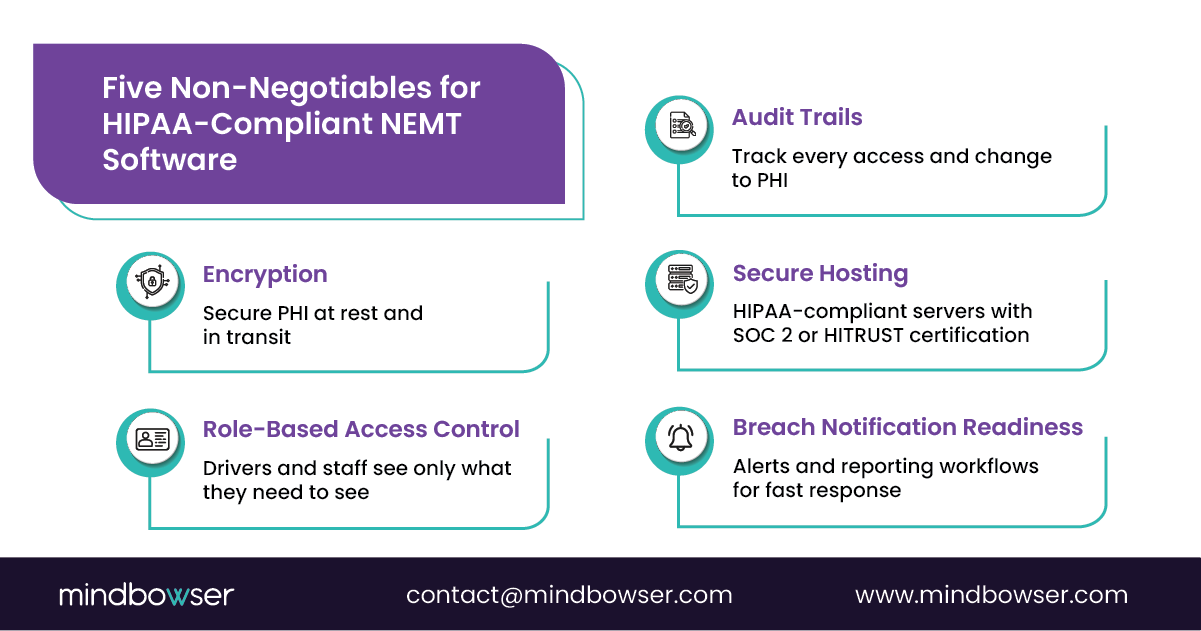
HIPAA-compliant NEMT software is not about adding a single layer of security. It involves designing the entire system with compliance integrated into scheduling, dispatching, billing, and reporting. By demanding encryption, role-based access, audit trails, secure hosting, and breach readiness, providers protect their patients, their contracts, and their long-term business viability.
G. Multi-Factor Authentication for Staff
- Passwords alone aren’t enough. MFA requires staff to confirm their identity with a secondary method a code sent to a phone or a biometric scan before reaching PHI.
- It closes the credential-theft gap. Even if a password is compromised, MFA stops that credential from being enough on its own to access patient data.
- It strengthens audit posture. Demonstrating MFA to a Medicaid auditor or OCR investigator signals the provider is taking active steps to secure PHI, not just checking a compliance box.
The compliance layer inside NEMT billing
An NEMT claim carries PHI: member identity, diagnosis context, pickup and drop-off (often a treatment facility), and the trip record itself. That makes the 837P a HIPAA surface, not just a billing artifact. State Medicaid audits and OIG reviews turn on documentation, and the gap is well-documented: an OIG review of one state’s NEMT program found 86 of 100 sampled trips noncompliant, with all 100 lacking adequate driver or vehicle documentation. The compliance job is to keep the PHI in the claim protected in transit and at rest, and to keep the documentation that survives an audit: authorization reference, trip verification, and signature, tied to the claim.
Get ahead of the specific Medicaid NEMT billing documentation gaps that trip up most audits
PHI in transit, the part people miss
The transport itself moves PHI around a city. Driver devices, dispatch messages, GPS pings tied to a member and a destination, all of it is PHI in motion. HIPAA’s Security Rule applies to that mobile surface the same way it applies to the server. Encryption on the device and in transit, access controls on the driver app, and audit logging of who saw what are not optional add-ons.
And to be precise about scope: this is a HIPAA obligation, not an EVV one.
see our breakdown of AI-driven dispatch and EVV compliance for how the two interact in practice
NEMT is outside the federal EVV mandate. Trip verification is a state and broker requirement; PHI protection is a HIPAA requirement. Both apply, for different reasons.
Accessibility data is PHI too
When a member’s record notes a wheelchair, a stretcher, a service animal, or a cognitive accommodation, that is protected health information driving a transport decision. Software that stores and routes on accommodation needs has to treat that field with the same protection as a diagnosis code. It looks like a logistics attribute. It is a health attribute.
Why Off-the-Shelf Systems Don’t Cut It?
At first glance, generic transportation or logistics software may seem like a quick solution for NEMT providers. These platforms often advertise features like trip scheduling, routing, and billing. However, they are typically designed for industries such as taxi services, delivery fleets, or rideshare operations, not for healthcare. The difference is critical because handling patient data requires compliance with strict HIPAA and Medicaid regulations. Off-the-shelf systems often lack these safeguards, exposing providers to significant legal and operational risks.
A. Designed for Logistics, Not Healthcare
- Focus on efficiency over compliance. Most off-the-shelf solutions are designed to optimize logistics operations, such as package delivery or passenger transportation. They prioritize route planning and fleet utilization but fail to incorporate PHI security standards.
- Limited understanding of healthcare workflows. Healthcare transportation involves unique elements such as Medicaid eligibility verification, prior authorization workflows, and compliance reporting. Off-the-shelf systems rarely support these requirements, leaving providers to create manual workarounds.
- Gaps in security design. While some platforms claim to secure data, few are built with healthcare-grade encryption, audit trails, or breach notification protocols. This creates vulnerabilities that can be costly during audits.
B. Lack of HIPAA Business Associate Agreements (BAAs)
- The importance of a BAA. A BAA is a legally binding contract that confirms a software vendor accepts responsibility for handling PHI in compliance with HIPAA. Without it, liability for a breach falls entirely on the NEMT provider.
- Off-the-shelf vendors often refuse to sign BAAs. Many commercial dispatch software companies are not positioned as healthcare vendors. As a result, they will not sign a BAA, leaving providers unprotected in case of an incident.
- Risk transfer to providers. Without a signed BAA, Medicaid and healthcare partners see the provider as the sole responsible party. This makes contract retention far more difficult.
C. Inability to Adapt to Regulatory Changes
- Healthcare regulations evolve frequently. Medicaid agencies regularly update billing rules, trip verification requirements, and compliance standards. Providers need software that adapts quickly to these changes.
- Off-the-shelf systems are slow to update. Because they are built for a broad market, generic vendors often do not prioritize healthcare-specific updates. A new Medicaid claim submission rule may take months to implement, during which time providers risk having their claims denied.
- Operational consequences. Generic dispatch vendors are slow to adapt to new Medicaid claims APIs because healthcare isn’t their core market. When an update lags, staff fall back to manual claims entry and manual entry is where documentation gaps and missed deadlines compound into real reimbursement loss
D. Contract Risks with Medicaid and Healthcare Partners
- Compliance clauses are non-negotiable. Medicaid and managed care contracts require that subcontractors use HIPAA-compliant systems. Using a non-compliant platform can result in termination of agreements.
- Failure during audits. If a state Medicaid agency discovers that a provider is using generic dispatch software without HIPAA safeguards, the contract may be suspended immediately.
- Lost opportunities. Providers that rely on off-the-shelf platforms often lose competitive bids to operators who can prove that their systems are fully compliant and audit-ready.
The bottom line is clear: generic logistics software cannot meet the compliance, security, and audit requirements of NEMT operations. Providers who rely on these tools put their contracts, revenue, and reputation at risk. Only healthcare-specific platforms designed with HIPAA compliance at their foundation can ensure long-term success in this industry.
How Mindbowser Builds HIPAA-Compliant NEMT Software?
When evaluating technology partners, one of the most important questions for NEMT providers is whether compliance is built into the software’s foundation or added later as an afterthought. At Mindbowser, the approach begins with building a custom, HIPAA-compliant NEMT platform from a compliance-first architecture. Every design decision, from data encryption to user access controls, is guided by HIPAA and CMS requirements. This ensures that providers can focus on transportation operations while knowing that their software environment is secure and audit-ready.
A. Compliance-First Architecture
- Security embedded from the ground up. The system is not only built to handle dispatch and billing but also designed to safeguard Protected Health Information (PHI) at every step. Encryption, secure hosting, and monitoring tools are implemented during development, not as afterthoughts.
- Alignment with HIPAA and CMS rules. Features such as PHI access logging, retention policies, and breach notification readiness are part of the standard design, making it easier for providers to demonstrate compliance during Medicaid audits.
- Built to evolve. Compliance requirements are not static. Mindbowser platforms are built to update in tandem with state regulations and federal rules without a vendor update cycle, reducing the risk of software obsolescence.
B. Industry-Recognized Compliance Controls
- HIPAA safeguards combined with SOC 2 standards. Beyond basic HIPAA encryption, the platforms include SOC 2 controls for data handling, monitoring, and risk management. This provides an additional layer of credibility during audits and partner evaluations.
- Role-based access management. Drivers, dispatchers, billing staff, and administrators receive permissions tailored to their roles. This principle of least-privilege access minimizes unnecessary exposure of PHI.
- Audit Trails That Hold Up Under Review. Every record access is logged in a tamper-proof format that can be exported to meet the requirements of Medicaid and CMS. Providers are equipped with evidence for audits without needing manual recordkeeping.
C. Business Associate Agreements (BAA) Included
- Shared accountability. Mindbowser signs a Business Associate Agreement with every provider, ensuring both parties are legally responsible for safeguarding PHI.
- Clear compliance partnership. The BAA assures providers that the vendor is not disclaiming responsibility for breaches or mishandling of patient data.
- Trust is built into contracts. With a signed BAA, NEMT operators can approach payers and Medicaid agencies with confidence that their software partner is aligned with federal compliance standards.
- Retention isn’t open-ended. HIPAA requires BAAs and related compliance documentation to be retained for a minimum of 6 years. Mindbowser’s platforms are built to retain and produce this documentation automatically, so providers aren’t scrambling to reconstruct records during an audit
D. Support During Medicaid and State Compliance Audits
- Audit preparation assistance. Providers receive guidance on how to generate required reports, such as trip logs, access histories, and claim submission records.
- On-demand compliance documentation. The software features include those that facilitate the demonstration of encryption protocols, data retention policies, and breach response procedures.
- Consultative support. Beyond the technology, the team provides insights on aligning workflows with regulatory expectations, which strengthens the provider’s position during reviews.
E. Full IP Ownership for Providers
- Avoiding vendor lock-in. Unlike many off-the-shelf solutions, Mindbowser grants providers full ownership of the source code and intellectual property.
- Compliance roadmap in the provider’s control. Since the provider owns the software, they can adapt it to future Medicaid requirements without waiting for a vendor update cycle.
- Long-term sustainability. Ownership allows providers to scale, integrate, and modify their systems without contractual or licensing restrictions that could threaten compliance in the future.
The Mindbowser approach reflects a core principle: compliance is not a feature that can be turned on or off. It serves as the foundation for how the entire system is built, maintained, and audited. By combining HIPAA and SOC 2 controls, signing BAAs, supporting Medicaid audits, and giving providers full ownership of their software, Mindbowser delivers a platform that reduces compliance risks while strengthening long-term business resilience.
Run your platform against the controls above. Where you can't check a box, that's your audit exposure. Let's close it.
Checklist for NEMT Providers
A compliance checklist is one of the most powerful tools an NEMT provider can use to protect their business. Medicaid agencies and healthcare partners expect transportation vendors to prove that their software is secure, audit-ready, and aligned with HIPAA requirements. The following checklist can be used as both an internal audit guide and a vendor evaluation tool when selecting new dispatch or billing platforms.
A. Data Security and Encryption
- Does your dispatch app encrypt PHI in transit?
All communications between dispatchers, drivers, and back-office staff should be protected with Transport Layer Security (TLS). If trip details can be intercepted through unsecured Wi-Fi or mobile networks, the system is not compliant. - Is all stored data encrypted at rest?
Patient trip histories, billing records, and driver logs must be encrypted with standards such as AES-256. Data stored without encryption leaves PHI vulnerable to theft. - Have you verified encryption protocols with your vendor?
Providers should not rely on assumptions. Vendors must document the encryption methods and confirm compliance during audits.
B. Role-Based Access Control
- Do drivers only see relevant trip data?
Drivers should only access information about their assigned trips. If they can see the full roster of patients or trips, the system violates the HIPAA principle of minimum necessary access. - Are permissions defined for each role?
Dispatchers, billing staff, and administrators should have distinct levels of access to ensure security and maintain confidentiality. Role-based controls prevent unnecessary exposure and reduce insider threats. - Are login credentials unique and traceable?
Shared logins weaken accountability. Every user should have a unique ID so that actions can be tracked and tied to individuals.
C. Audit Trails and Logging
- Can you generate audit logs for each trip?
A compliant system must show who accessed a patient’s trip details, when they accessed it, and what changes were made. - Are audit logs tamper-proof?
Logs should be immutable and exportable for state Medicaid or CMS audits. Editable or deletable logs are not acceptable under HIPAA. - Is reporting automated and ready for audits?
The system should enable the quick generation of reports, allowing providers to demonstrate compliance without having to scramble to collect records.
D. Vendor Accountability and Agreements
- Does your vendor provide a signed BAA?
A Business Associate Agreement is mandatory. Without it, providers assume full liability for any PHI breach. - Is the vendor proactive in compliance updates?
Regulations change, and vendors must release timely updates that align with Medicaid rules and HIPAA requirements. - Do you have written confirmation of compliance controls?
Providers should request written documentation, including penetration testing results, security certifications, and data protection policies.
E. Infrastructure and Hosting
- Is your system hosted on a HIPAA-compliant cloud infrastructure?
Platforms hosted on AWS, Azure, or other enterprise-grade environments must be configured for HIPAA compliance with signed BAAs. - Are backups encrypted and tested?
Providers should confirm that data backups are secured and that recovery procedures are tested regularly to prevent data loss during outages. - Does the hosting environment meet industry certifications?
Look for SOC 2 Type II or HITRUST certifications that demonstrate rigorous external validation of security controls.
HIPAA + Medicaid NEMT Compliance Checklist
Conclusion
For NEMT providers, HIPAA compliance is not just a regulatory requirement but the foundation of business sustainability. Every ride involves patient information such as names, Medicaid IDs, and healthcare destinations, which qualifies as Protected Health Information. Using non-compliant software exposes providers to fines that can reach $73,011 per violation, and up to $2,190,294 for uncorrected willful neglect, and puts Medicaid contracts at risk.
The solution lies in adopting HIPAA-compliant NEMT software that ensures the encryption of data, role-based access controls, audit trails, secure hosting, and readiness for breach notification. Beyond reducing risk, compliance strengthens relationships with Medicaid agencies, managed care organizations, and healthcare partners. Providers that embrace compliance-first systems position themselves not only to survive audits but also to thrive as trusted partners to the hospitals, payers, and Medicaid agencies that refer patients to them.