













 BLOGS
BLOGS  NEWSROOM
  CASE STUDIES
  WEBINARS
  PODCASTS
  ASSET HUB
  EVENT CALENDAR




















TL;DR
- A FHIR-ready architecture means your systems can exchange clinical data via standardized FHIR R4 APIs required by ONC’s Cures Act mandates
- 5 steps: evaluate current state → select FHIR strategy → map your data → build and test integration → deploy and monitor
- 7 challenges: legacy systems, data mapping, privacy/security, resource constraints, standardization, scalability, regulatory compliance
- The data-mapping step is where most builds stall. AI-native mapping tools (ConnectHealth Helix AI) collapse it from weeks to days
Preparing your architecture for FHIR is important for achieving effective healthcare interoperability. A FHIR-ready architecture ensures that healthcare applications can communicate with each other, share data accurately, and maintain the integrity of patient information.
FHIR is a standard framework created by HL7 for exchanging healthcare information electronically. It simplifies the integration of healthcare systems by providing a set of resources and APIs that facilitate data sharing between different healthcare applications.
FHIR’s modular approach allows developers to build applications that can work with diverse data sources, promoting interoperability and ensuring patient data is accessible and usable across different platforms and systems.
The preparation involves implementing standardized data formats, secure APIs, and protocols that support efficient data exchange. By adopting a FHIR-ready architecture, healthcare organizations can improve patient care, simplify operations, and comply with regulatory requirements for data sharing and privacy.
Let’s learn more about FHIR-ready architecture:
What is FHIR?
FHIR aims to improve the EHRs by providing a consistent, flexible framework for sharing data between various healthcare systems. FHIR-ready architecture simplifies the integration of various healthcare applications using modern web-based technology, making it easier for developers to create interoperable solutions.
The key components of FHIR include resources, data formats, and APIs. Resources are the fundamental building blocks of FHIR, representing individual pieces of healthcare data such as patients, medications, and diagnoses. Each resource has a standard structure and format, which ensures consistency across different systems.
Data formats in FHIR are designed to be simple and easy to parse, often using JSON or XML. The APIs provided by FHIR allow developers to interact with resources, enabling data retrieval, updates, and searches. These components work together to create a standardized approach to healthcare data exchange.
The benefits of utilizing FHIR for healthcare data exchange are numerous. It makes it easier for disparate EHR systems to communicate with one another, guaranteeing that patient data is consistent and available across several channels. This interoperability improves the accuracy and efficiency of patient care by providing healthcare providers with comprehensive and up-to-date information.
Overall, FHIR enhances the ability of healthcare systems to share and utilize data effectively, leading to better patient outcomes and more efficient healthcare delivery.
Integrating with FHIR is crucial for healthcare providers, as it ensures smooth data exchange and interoperability between different healthcare systems. Let’s discuss why we need to integrate with FHIR.
What is FHIR R4 and Why Does It Matter for Architecture?
FHIR R4 (Release 4, published 2019) is the current production standard version of FHIR and the baseline required by ONC’s 21st Century Cures Act API mandates. Any new FHIR-ready architecture should target R4 unless a specific EHR, for example, older Cerner deployments, still exposes DSTU2 endpoints.
R5 is now available, but most commercial EHRs have not yet fully adopted it. Building to R4 + US Core 4.0.0 profile gives you maximum EHR compatibility today while remaining on the standards upgrade path.
When Mindbowser architects a FHIR-ready system, R4 (specifically US Core 4.0.0 profile) is the default target.
Understanding the FHIR Data Model: Resources and Structure
The FHIR data model is organized around “resources,” discrete, typed objects each with a standardized JSON/XML schema and a RESTful endpoint. This is the structural break from HL7 v2, where data is embedded in pipe-delimited segments with no standard API.
| Resource | What it represents | Common source | Example endpoint |
|---|---|---|---|
| Patient | Demographics | Registration ADT | GET /Patient/{id} |
| Observation | Lab results / vitals | ORU feed | GET /Observation?patient={id} |
| MedicationRequest | Prescriptions | ORM | GET /MedicationRequest?patient={id} |
| Condition | Diagnoses | Problem list | GET /Condition?patient={id} |
| DocumentReference | Clinical docs | MDM | GET /DocumentReference |
| AllergyIntolerance | Allergies | Allergy list | GET /AllergyIntolerance |
A FHIR-ready architecture maps every clinical data type it handles to the appropriate FHIR resource before writing a line of integration code.
FHIR Implementation Guides, US Core Profiles, and Bundles
Implementation Guides (IGs)
A FHIR IG is a published specification that constrains FHIR for a specific use case. US Core is the foundational IG for US interoperability, required by ONC. Other major IGs: Da Vinci (payer-provider), mCODE (oncology), Argonaut (app development). Any FHIR-ready system should declare which IGs it conforms to.
US Core Profile
US Core 4.0.0 (aligned with FHIR R4) defines the minimum required elements for Patient, Observation, Condition, and ~20 other resources. If your system doesn’t meet US Core, it cannot pass ONC certification.
FHIR Bundle
A Bundle is FHIR’s envelope for sending multiple resources in one API call used for transaction sets, document exchange, and search results. Teams building bulk-export or batch-processing pipelines deal with Bundles heavily.
During architecture planning, Mindbowser maps each data flow to its target IG profile and bundle type before writing the first integration spec.
Integrating with FHIR is crucial for healthcare providers, as it ensures smooth data exchange and interoperability between different healthcare systems.
Why Integrate with FHIR?
Integrating with FHIR is crucial for improving data exchange and interoperability in healthcare systems. FHIR provides a standardized framework for sharing health information across different platforms, which simplifies the process of connecting various healthcare applications.
Here are a few points we can consider:
- Standardized data exchange: one FHIR API works across Epic, Cerner, Meditech, and most modern EHRs — no custom mapping per system.
- Regulatory alignment: ONC Cures Act mandates FHIR R4 for patient-access APIs; CMS requires it for payer-provider data exchange.
- Faster data retrieval: RESTful FHIR endpoints return JSON in milliseconds vs HL7 v2 file batches.
- Reduced integration cost: pre-built FHIR resources replace custom point-to-point interfaces, cutting integration time and maintenance.
- Interoperability with new tech: wearables, AI tools, and remote monitoring devices increasingly speak FHIR natively.
5 Steps to Integrate Healthcare Data Architecture with FHIR
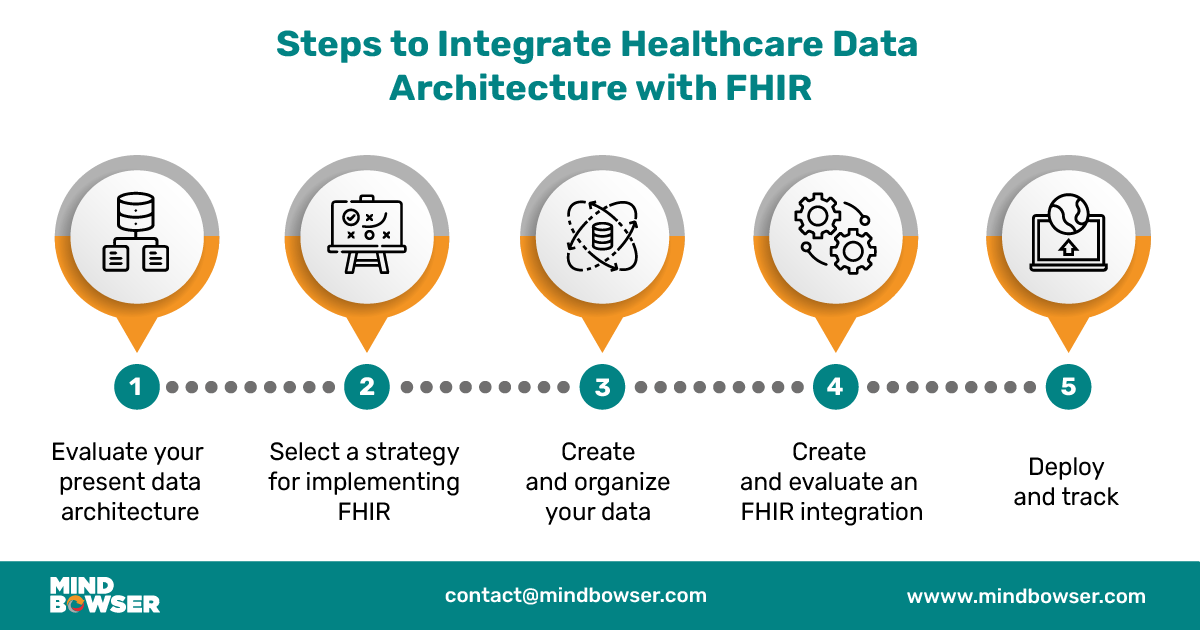
Evaluate Your Present Data Architecture
Start by thoroughly assessing your current data architecture to identify existing capabilities and gaps in interoperability. This evaluation helps understand how well your system can support FHIR standards and what modifications might be necessary. Focus on data storage formats and existing integration points to ensure a smooth transition. Recognizing these factors early on will help streamline the subsequent steps in the integration process.
Select a Strategy for implementing FHIR
Choosing the right implementation strategy is critical for successful FHIR integration. Options include incremental adoption, where FHIR is gradually incorporated into existing systems, or a full-scale overhaul for immediate compliance. Consider factors such as budget, resources, and the complexity of your current systems. Involving stakeholders in this decision-making process ensures that the chosen strategy aligns with organizational goals and capabilities, facilitating a smoother integration.
Create and Organize Your Data
Prepare your data for FHIR integration to structure it according to FHIR resources and standards. This step includes mapping existing data to FHIR formats, ensuring consistency and accuracy. Organizing data effectively helps reduce errors and enhance interoperability. Additionally, it’s essential to establish data governance protocols to maintain data quality and compliance with FHIR specifications, which is vital for successful integration and ongoing data management.
Create and Evaluate an FHIR Integration
Developing and testing your FHIR integration is crucial for ensuring it functions correctly within your healthcare data architecture. This involves creating APIs that adhere to FHIR standards and conducting rigorous testing to identify and resolve issues. Testing should cover various scenarios to ensure reliability, security, and performance. Engaging with healthcare professionals during this phase can provide valuable feedback, ensuring the integration meets practical needs and improves overall functionality.
Deploy and Track
After successful development and testing, deploy the FHIR integration into your live environment. This phase includes monitoring the integration to ensure it operates smoothly and meets performance expectations. Regular tracking helps identify potential issues early and allows for timely interventions. Additionally, continuous monitoring ensures compliance with evolving FHIR standards and helps maintain data integrity and security, ultimately supporting effective healthcare data management.
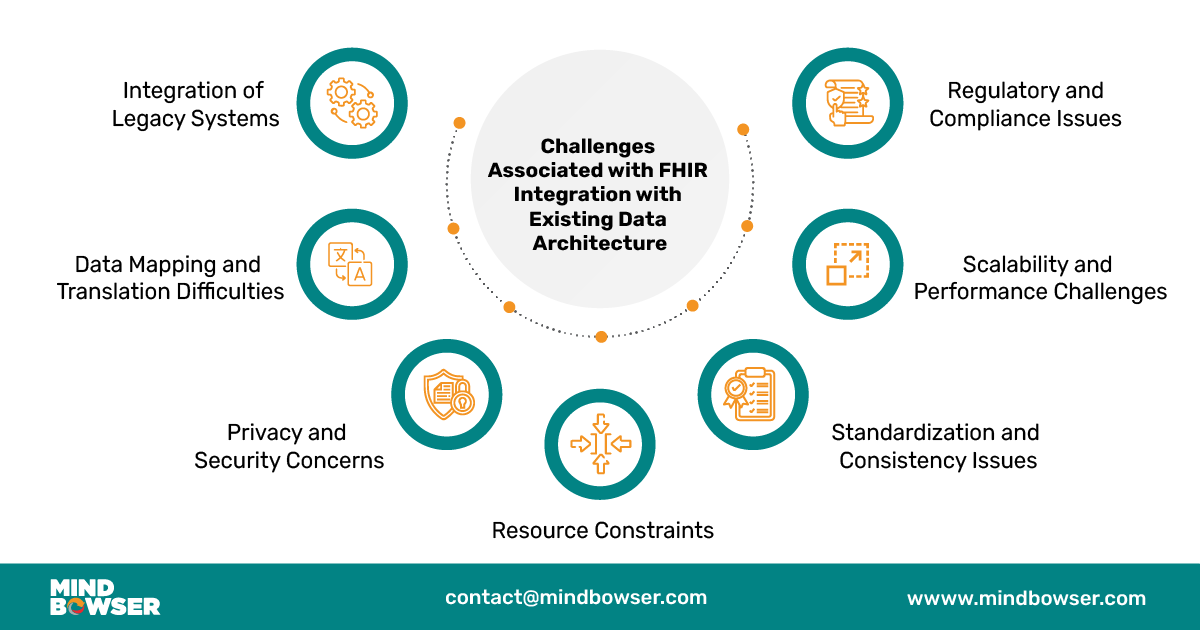
Integration of Legacy Systems
Incorporating FHIR with legacy systems can be challenging due to outdated technologies and incompatible data formats. These older systems often lack the flexibility to support modern standards like FHIR, making integration complex and time-consuming. Retrofitting legacy systems requires extensive modifications, which can be costly and may disrupt existing workflows. Ensuring smooth interoperability between new and old systems demands careful planning and significant technical expertise.
Data Mapping and Translation Difficulties
Mapping and translating data to FHIR standards involves converting various data formats into a unified structure. This process can be complex, as different systems may use diverse schemas and terminologies. Ensuring accuracy during data mapping is crucial to maintaining data integrity and avoiding information loss. Inconsistent data formats and varying levels of data quality further complicate the translation process, necessitating thorough validation and testing.
Data mapping is where most FHIR-ready projects stall — converting legacy schemas and terminologies into FHIR resources by hand, system by system. ConnectHealth’s Helix AI builds that mapping in plain English, with pre-built connectors for 20+ EHRs, which collapses the slowest step from weeks to days for teams without a dedicated integration engineer.
Privacy and Security Concerns
Ensuring privacy and security during FHIR integration is paramount, as healthcare data is highly sensitive. Implementing FHIR requires strong security measures to protect patient information from breaches and unauthorized access. Compliance with regulations such as HIPAA adds additional layers of complexity. Maintaining data privacy while enabling interoperability involves stringent encryption, access controls, and regular security assessments to protect against potential vulnerabilities.
Resource Constraints
Integrating FHIR with existing systems often demands significant resources, including time, money, and skilled personnel. Limited availability of these resources can hinder the integration process, causing delays and potentially compromising the quality of the implementation. Organizations must carefully allocate and manage resources to balance day-to-day operations with the demands of FHIR integration. Efficient resource management ensures a successful and timely transition to FHIR standards.
Standardization and Consistency Issues
Achieving standardization and consistency across various healthcare systems is a significant challenge. Different organizations may interpret FHIR standards differently, leading to inconsistencies in data exchange and interoperability. Establishing a common understanding and uniform implementation of FHIR is essential to ensuring smooth data sharing. This requires ongoing collaboration and communication among healthcare providers, developers, and standards organizations.
Scalability and Performance Challenges
Integrating FHIR into existing data architectures can strain system scalability and performance. Handling large volumes of healthcare data while maintaining fast response times and efficient processing is crucial. Ensuring that integrated systems can scale to meet growing demands without compromising performance requires careful planning, optimization, and continuous monitoring to address potential bottlenecks and inefficiencies.
Regulatory and Compliance Issues
Navigating the complex regulatory and compliance requirements is a major challenge in FHIR integration. Different regions and countries have varying regulations governing healthcare data exchange and interoperability. Organizations must stay informed about evolving regulatory requirements and adapt their systems accordingly to maintain compliance and avoid legal repercussions.
FHIR-ready architecture in production
A maternal care platform needed FHIR R4 bidirectional write-back embedded directly in Epic’s clinical workflow SMART on FHIR Vendor Services certification was the target. The architecture challenge wasn’t the FHIR spec itself; it was bridging the gap between what FHIR R4 allows and what Epic’s Vendor Services API actually exposes at the write-back layer. Mindbowser built the integration, passed Epic App Orchard certification, and the platform went live with real-time EHR write-back. The clinical outcome: 15% improvement in delivery outcome metrics tied to better data availability at the point of care.
That’s what FHIR-ready architecture looks like when it has to survive EHR certification, not just pass a spec test.
Two FHIR architecture paths with Mindbowser
- Track 1 ConnectHealth (pre-built accelerator): Pre-configured FHIR R4 adapters for Epic, Cerner, Athenahealth, and eCW. The architecture is already built SMART on FHIR launch, Bulk Data ($export), bidirectional write-back, and terminology mapping. You configure it to your environment rather than designing from scratch. Faster to production.
- Track 2 Custom FHIR architecture: For health systems and digital health companies with multi-EHR orchestration, research pipeline requirements, or architecture constraints that an accelerator can’t satisfy. Full design-and-build API layer, security model, data normalization, and EHR certification workflow.
How Mindbowser Helps You Build a FHIR-Ready Architecture
Mindbowser takes you from assessment to live integration on the same 5-step path above. ConnectHealth, our healthcare integration platform, ships pre-built connectors for 20+ EHRs, deploys inside your own AWS VPC so PHI never leaves your environment, and builds FHIR mappings in plain English with Helix AI. When a step needs custom engineering, our FHIR team builds it on the R4/US Core foundation.
FHIR (Fast Healthcare Interoperability Resources) is a standard for exchanging healthcare information electronically, promoting interoperability and enabling smooth data sharing across systems.
Start by assessing your current systems, identifying gaps in interoperability, and ensuring your data models align with FHIR standards.
The timeline varies depending on system complexity, but it generally involves a phased approach, including planning, development, testing, and deployment.
Common challenges include data mapping, system compatibility, and ensuring security. These can be managed through careful planning, thorough testing, and regular updates.
Yes, training is essential to help your team understand FHIR standards, use new tools, and adapt to changes in workflow to fully leverage FHIR’s capabilities.
No, FHIR is a data-exchange standard, not a compliance framework. But it makes compliance significantly easier: standardized data formats reduce the custom-integration surface where PHI is most at risk, and FHIR’s built-in security model (SMART on FHIR, OAuth 2.0) aligns with HIPAA’s technical safeguards.