











 BLOGS
 NEWSROOM
 CASE STUDIES
 WEBINARS
 PODCASTS
 ASSET HUB
 EVENT CALENDAR


















TL;DR
- Decide server or cloud, and how many locations you’ll run in three years, before you compare brands. Those two answers rule out half the list.
- Dentrix and Dentrix Ascend are separate Henry Schein One products: Dentrix installs on office computers, Ascend runs in the browser. Dentrix Enterprise is a third product, for large groups and community health centers.
- As of October 2026, three of the eight publish a price: Open Dental ($199 a month per location for the first year, then $149), Ascend’s Starter package ($199 a month for the first year) and CareStack (from $829 a month). The rest quote.
- Imaging, patient messaging and eligibility checks are built in on some systems and paid add-ons or bridges on others. Compare the modules you’ll actually pay for.
- Before you sign, find out how the PMS lets other software in and how your data gets out if you leave.
Dentrix and Dentrix Ascend come from the same company and run on different foundations. Henry Schein One describes Dentrix as “installed locally on office computers” and Ascend as “100% cloud-based.” For a practice planning a second office, that difference decides where every location’s records will live.
Systems that look alike in a feature list differ on deployment, on who they’re built for, on whether the vendor tells you a price, and on how other software gets in. Every vendor fact below comes from the vendor’s own pages, dated October 2026, and where a vendor doesn’t publish something, the guide says so.
We build software that connects to these systems, so the dental PMS integration side of the choice gets its own section.
This guide compares what vendors publish. Support quality, uptime and how easy the front desk finds each system aren’t in it: get those from reference calls with practices your size, a demo run on your own workflow and a test conversion of your own data.
How to Choose Dental Practice Management Software: Five Questions to Answer First
The brand is the last decision. Answer these five, in this order, and half the list drops away before you compare features.
- Server in the office, or cloud? A server system keeps the database on hardware you own and maintain. A cloud system runs in a browser and the vendor runs the servers. This one answer splits the eight systems into two groups.
- One office, or many? Ask whether every location will share one database or each office keeps its own. Groups are getting more common: in 2024, 16.1% of U.S. dentists worked in a DSO-affiliated practice, more than double the 7.2% of 2015, and 26.5% of dentists up to 10 years out of dental school were DSO-affiliated, according to the ADA Health Policy Institute’s U.S. Dentist Workforce report (September 2025). If a second location is in your plan, read our guide to DSO technology alongside this one.
- General dentistry, or a specialty? Orthodontic practices have their own systems, such as Dolphin Management, and some general systems now carry ortho modules: Henry Schein One added one to Ascend in June 2026, and Planet DDS lists an ortho module in Denticon. Labs and ortho offices have different workflows again, covered in dental lab and orthodontic software.
- What has to connect? List the imaging sensors and software you already own, your clearinghouse, your texting tool, and any product your own team is building. Each one needs a route into the PMS.
- How does your data get out? Ask before you sign, while the vendor still wants your business.
A starting shortlist by situation
If you want names before you read the profiles, start here. Each pick comes from what the vendor says the product is built for, or from a price it publishes, so treat it as a starting shortlist; the order inside each row carries no weight.
| Your situation | Start with | Why, in the vendor’s own terms |
|---|---|---|
| One office, watching cost | Open Dental · Ascend Starter | Open Dental publishes $199 then $149 a month per location (fees); Ascend Starter is $199 a month for the first year for practices under 500 patients a year (release) |
| One office, staying on a server | Dentrix · Open Dental (self-hosted) · Eaglesoft | Henry Schein One describes Dentrix as “Ideal for: Solo and small group practices” (Dentrix or Ascend); Open Dental is self-hosted by default, “for practices of any size” (Open Dental); Eaglesoft runs on an office server, and Patterson’s reachable pages don’t state a target practice size |
| One office, wants cloud | Curve Dental · Ascend by Dentrix · CareStack | Curve’s site is organized for “Independent Practice” and “Dental Startups,” and it runs “entirely in the cloud” (Curve); Ascend is “100% cloud-based” for “All practice types” (Dentrix or Ascend); CareStack names single offices alongside groups (CareStack) |
| 2-5 locations | Ascend by Dentrix · Curve Dental · Denticon | Ascend is positioned for “multi-location and DSOs”; Curve has a dedicated “Multi-Location Practice” offer (Curve multi-location); Denticon sells plans sized for 1-2 and 3-19 locations (Denticon plans) |
| A DSO with 20+ locations | Denticon · Dentrix Enterprise · CareStack | Planet DDS calls Denticon “the practice management system built to help DSOs scale,” with an Enterprise plan for 20+ locations (Denticon); an older Henry Schein One page describes Dentrix Enterprise as built for “Large Groups, Dental Corporations, and Community Health Centers” (which Dentrix); CareStack names “growth-stage DSOs with 5 to 500+ locations” (CareStack company page) |
| Orthodontics | Dolphin Management · Ascend by Dentrix · Denticon | Dolphin Management is “a full-featured orthodontic practice management system” (Dolphin); Henry Schein One added an orthodontics module to Ascend in June 2026 (release); Planet DDS says “The ortho module drives superior efficiency and multi-specialty teamwork” in Denticon (Denticon) |
Vendor pages, October 2026. A vendor that says it serves “all practice types” qualifies for every row, which is why Ascend appears in four of the six.
Cloud-Based Dental Practice Management Software vs. a Server in the Office
Four of the eight run in a browser from day one: Ascend, Denticon, Curve and CareStack. The other four began on a server in the office, and two of those vendors, Open Dental and Dolphin, now sell a hosted version.
Here’s how each vendor describes its own deployment, as of October 2026:
| System | Owner | How the vendor describes deployment |
|---|---|---|
| Dentrix | Henry Schein One | “Installed locally on office computers”; data on “Local servers (practice-managed)” (Dentrix or Ascend) |
| Ascend by Dentrix (Dentrix Ascend) | Henry Schein One | “Ascend is 100% cloud-based” (Ascend) |
| Eaglesoft | Patterson Dental | Server-based: Patterson’s support documentation describes installing “the Eaglesoft Server” (Patterson support portal, login required) |
| Open Dental | Open Dental Software | Self-hosted by default; Open Dental Cloud is “a hosted solution managed by Open Dental Software,” “only available for US customers” and “in limited release” |
| Denticon | Planet DDS | “Denticon is our cloud-based dental practice management software” (Denticon) |
| Curve Dental | Curve Dental | “Curve runs entirely in the cloud through your browser, so it works on Mac, PC, and Chromebooks with no local server to maintain” (Curve) |
| CareStack | CareStack | A “cloud-based SaaS platform” (CareStack company page) |
| Dolphin Management | Patterson (Dolphin Imaging and Management Solutions) | Office server by default; Dolphin Cloud Subscription is hosted “without the need of a local server”; Dolphin Blue is “a web-based application hosted on the Microsoft Cloud” |
- What a server costs you that the license doesn’t show. You own the hardware, the backups, the Windows updates, the restore test and the security of the server. Open Dental’s hosted option shows what the vendor charges to take that off you: Open Dental Cloud hosting runs from $250 a month (small package) to $2,370 a month (enterprise package), on top of the software fee.
- What the cloud costs you instead. Your internet connection becomes part of the front desk. Ask each cloud vendor what staff can do when the connection drops, and whether a backup line is worth it for your office.
- HIPAA applies either way. A cloud PMS vendor stores your patients’ records, so it’s your business associate: the HIPAA definition at 45 CFR 160.103 names “practice management” among the functions that make a vendor one. The rules then require a written business associate agreement before it holds that data (45 CFR 164.502(e)). On a server system, the same applies to any IT company that manages your server or backups.
What to Compare Beyond the Feature List
Every system here schedules, charts and bills. The differences sit in what’s native, what’s an add-on and what’s a bridge to someone else’s software.
Charting and perio
Every system that publishes its clinical modules charts teeth and records perio exams. The newer split is voice charting. Henry Schein One lists Voice Perio as “natively built, hands-free periodontal charting” in Ascend (June 15, 2026 release), while its Dentrix page marks voice charting “coming soon” (Dentrix clinical tools). Planet DDS lists “hands-free periodontal charting by voice” in Denticon, Curve offers voice perio through an integration with Bola AI, and CareStack lists AI voice perio charting on its Intelligence plan, not Essentials (CareStack pricing). Open Dental’s manual says voice perio charting isn’t available to Open Dental Cloud users (Open Dental manual).
Imaging: native or a bridge
Imaging is where a PMS choice gets expensive to undo, because your sensors, cameras and years of X-rays have to keep working. Ask two things: does the PMS capture and store images itself, and if it uses a bridge to separate imaging software, where are the images stored?
- Dentrix: “Built-in Dentrix Imaging” (Dentrix).
- Ascend: “Advanced dental imaging built directly into Ascend,” with Detect AI “powered by Videa” as an integrated third-party tool (Ascend clinical tools).
- Eaglesoft: Eaglesoft Advanced Imaging, with Pearl’s Second Opinion detections added inside it (Patterson, July 30, 2024).
- Open Dental: both. “2D Imaging is built into Open Dental,” and the vendor also lists hundreds of program bridges to third-party imaging software (Imaging Module).
- Denticon: Planet DDS calls its imaging “native to Denticon,” delivered through its Apteryx XVWeb product, with Pearl’s imaging AI as an add-on (Denticon plans).
- Curve: “native dental imaging” captured direct to the cloud (Curve imaging).
- CareStack: its pricing page lists “FDA-Cleared Native Imaging” (CareStack pricing), while its imaging feature page describes access to images “through a ‘bridge'” to popular imaging software (CareStack imaging). Ask which applies to your plan and your sensors.
- Dolphin: Dolphin Imaging is a separate product, described as “an FDA-cleared Class II medical device,” with Dolphin Management as its companion (Dolphin).
Cloud imaging has its own trade-offs (upload speed, file sizes for CBCT, retention), covered in cloud dental imaging software.
Billing, claims and eligibility
Every system that publishes its billing modules sends electronic claims. Where they differ is how much of the insurance work happens inside the PMS. Henry Schein One lists “built-in eligibility, claims, and patient billing and payments” for Dentrix (Dentrix) and “automate eligibility checks, claims, ERAs and payment posting” for Ascend (Ascend).
Curve’s pricing page includes “Unlimited eClaims, ERA, and Eligibility” (Curve pricing). CareStack lists “Real-Time Insurance eligibility” and “ERAs with Automated Claim Posting” (CareStack pricing). Open Dental sends e-claims through “20+ Clearinghouses” (Open Dental).
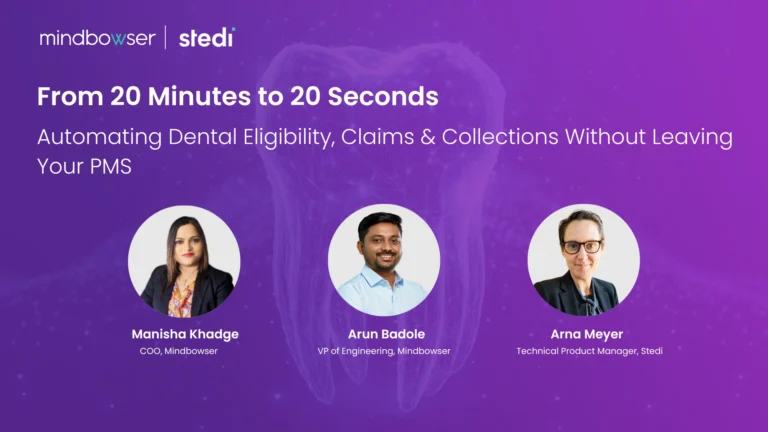
Two things decide whether this saves your front desk time: which clearinghouse sits behind the PMS (see dental clearinghouses), and whether verified benefits get written back into the patient’s record or retyped by hand. If eligibility checks are the slow part of your day, dental insurance verification automation covers what changes when the check runs at booking, and our dental eligibility automation webinar shows a Mindbowser build doing it live on Open Dental, co-presented with Stedi’s product team.
Patient engagement
Texting, reminders, online booking and forms are where add-on fees pile up. Henry Schein One’s own comparison is the clearest example: for Dentrix, “Patient engagement: Add-on tools available”; for Ascend, “Built-in SMS/email, online scheduling, reminders” (Dentrix or Ascend).
Open Dental prices its eServices separately, with a bundle at $165 a month per location (Open Dental fees). Curve, CareStack and Denticon list texting and reminders inside their plans. For how recall and reminders should write back to the appointment, read dental recall and patient engagement software.
Reporting across locations
For a single office, built-in reports are enough. For a group, the question is whether one report can cover every location without exporting to a spreadsheet. Henry Schein One places “enterprise reporting” in Ascend’s Accelerate package (March 10, 2026 release); CareStack lists “Location ScoreCards” (CareStack pricing); Planet DDS sells a dashboard bundle for Denticon (Denticon plans); Curve includes business analytics dashboards and reporting in its plans (Curve pricing).
For desktop Dentrix, Henry Schein One says two things: its comparison page lists “Limited multi-location support” (Dentrix or Ascend), while dentrix.com lists “dashboards, and multi-location reporting” (Dentrix). Ask which one applies to your plan.
Eight Dental Practice Management Systems, in Each Vendor’s Own Words
Listed alphabetically. Each profile gives the vendor’s own description, its deployment, who the vendor says it’s for, whether a price is public and how other software gets in. All as of October 2026.
CareStack
- What CareStack says it is: “Scalable Practice Management for DSOs, Multi-Location Groups and Single Offices” (CareStack).
- Deployment: cloud.
- Built for: groups, DSOs and single offices, including specialists; the vendor names “growth-stage DSOs with 5 to 500+ locations” (CareStack company page).
- Price published? Starting prices, yes: Essentials from $829 a month and Intelligence from $1,299 a month, with custom plans by locations and providers (CareStack pricing).
- How other software gets in: a developer program with fees as published on the developer portal, whose footer is dated 2023 ($5,000 registration, $60 per location per month), and sandbox access after a mutual NDA (CareStack developer portal).
Curve Dental
- What Curve says it is: “the AI-powered, cloud-based dental practice management platform that connects clinical care, scheduling, insurance, billing, payments, patient engagement and more in one system” (Curve).
- Deployment: browser only, no local server.
- Built for: the site is organized for “Independent Practice,” “Multi-Location Practice” and “Dental Startups” (Curve, Curve multi-location).
- Price published? No. “Pricing depends on practice size and the features you need” (Curve pricing).
- How other software gets in: practice-sponsored. Curve’s help center says third parties “who are not directly a Curve Customers will not be granted API documentation upon request” (Curve help center), so the practice requests access for its vendors.
Denticon
- What Planet DDS says it is: “the practice management system built to help DSOs scale” (Denticon).
- Deployment: cloud.
- Built for: dental groups, DSOs and orthodontic groups, with plans sized at 1-2, 3-19 and 20+ locations (Denticon plans). Planet DDS states that “more than half of the largest sixty DSOs in North America already run on Planet DDS” (July 17, 2026 release), a vendor claim.
- Price published? No. Plans are named with “Talk to Sales.”
- What’s new: DentalOS, a platform layer over Denticon and Planet DDS’s ortho product, launched July 17, 2026 “at no additional cost” to customers, with five add-on suites.
- How other software gets in: the Planet DDS API Program, a developer program with portal approval; fees aren’t published, and its webhook API is listed as in development (Denticon API portal).
Dentrix
- What Henry Schein One says it is: “the all-in-one dental practice management platform that connects every part of your business” (Dentrix).
- Deployment: installed on office computers, data on practice-managed servers.
- Built for: “Ideal for: Solo and small group practices,” with “Limited multi-location support” (Dentrix or Ascend).
- Price published? No. Packages are named, with “Request a Demo.”
- How other software gets in: the Dentrix API Program inside the Henry Schein One API Exchange: application, use-case review, a signed agreement, then “$5,000 READ, $5,000 WRITE” one-time fees plus a monthly royalty, built for on-premise integrations (Henry Schein One’s older developer FAQ page).
Ascend by Dentrix (Dentrix Ascend)
- What Henry Schein One says it is: “the cloud-based, all-in-one dental practice management system” (Ascend). Henry Schein One renamed Dentrix Ascend “Ascend by Dentrix” in a brand refresh (October 23, 2026 release).
- Deployment: browser.
- Built for: “All practice types, including multi-location and DSOs” (Dentrix or Ascend). An orthodontics module was added in June 2026.
- Price published? One package: “For practices with fewer than 500 patients annually, Ascend Starter is $199 per month for the first year,” with $0 setup (October 23, 2026 release). The Essentials, Pro and Accelerate packages are quoted (why Ascend).
- How other software gets in: the Ascend API Program: $5,000 registration plus $47 per location per month, a REST API through a developer program, webhooks and a 60-day sandbox (Henry Schein One’s older developer FAQ page).
Henry Schein One also states that Dentrix and Dentrix Ascend serve more than 48,000 US practices and 90% of the top 50 DSOs (March 10, 2026 release), a vendor claim covering both products.
Dentrix Enterprise, the third Henry Schein One product, is described on an older Henry Schein One page as “The Best Dental Software Solution for Large Groups, Dental Corporations, and Community Health Centers” (which Dentrix). The current site describes it as built on “a convenient centralized SQL database,” with HL7 links to “40+ medical systems” (Dentrix Enterprise). Pricing goes through a Henry Schein representative.
Dolphin Management
- What Patterson says it is: “a full-featured orthodontic practice management system… especially if you have high-volume, multiple locations and multiple practitioners” (Dolphin).
- Deployment: office server, the hosted Dolphin Cloud Subscription, or browser-based Dolphin Blue.
- Built for: orthodontic and ortho-pediatric practices. E-claims and patient texting run through Dolphin’s electronic-services partners.
- Price published? No. “Ask your Dolphin Rep.”
- How other software gets in: Dolphin states that “Software written by other companies that properly integrates with Dolphin via the API may be supported,” but publishes no developer program; integrations run through named partners (Dolphin Cloud).
Eaglesoft
- Owner: Patterson Dental, part of Patterson Companies, which completed its acquisition by Patient Square Capital on April 17, 2025 (Patterson, April 22, 2025). In April 2026 Patterson named a new head of dental software, saying “we overhaul and invest more deeply in our software strategy” (Patterson, April 23, 2026).
- Deployment: office server (Patterson support documentation, login required).
- Imaging: Eaglesoft Advanced Imaging, with Pearl’s AI detections inside it (July 2024).
- Price: ask your Patterson representative for a quote.
- How other software gets in: the Patterson Innovation Connection, a gated partner program with a vendor request form, for Eaglesoft 18 and later; fees aren’t published (Patterson support portal, login required).
Open Dental
- What Open Dental says it is: highly customizable dental practice management software “at an affordable price for practices of any size” (Open Dental).
- Deployment: self-hosted by default, or Open Dental Cloud (US only, limited release).
- Built for: any size, including multiple locations (Open Dental multiple locations).
- Price published? Yes. In the US, $199 a month per location for the first 12 months (up to 3 providers), then $149, plus $20 a month for each provider over 3 (Open Dental fees).
- License: no longer open source. “In version 24.4, the Open Dental license changed from open source GPL to proprietary,” and the vendor adds that “There was no change in price, support, database access, or how the software was used” (Open Dental license). Version 24.4 was released as stable on March 20, 2025.
- How other software gets in: a public, documented API with per-location tiers paid by the developer, from a free read-only tier to $35 a month per location (Open Dental API permissions).
For developers, there’s more on Open Dental’s API in depth.
Planning a Dental PMS Migration? Talk to Our Experts About Your Integration
Head-to-Head: Eaglesoft vs. Dentrix, Dentrix vs. Dentrix Ascend and More
Each of these comes down to one or two questions about your practice.
Eaglesoft vs Dentrix
Both run on an office server, and both are tied to a dental distributor: Dentrix to Henry Schein through the Henry Schein One joint venture, Eaglesoft to Patterson. The practical differences show up in three places:
- Imaging hardware you already own. Check that your sensors and cameras work with the PMS’s imaging, or with a bridge, before you compare anything else.
- Who you already buy from. If your equipment and service contracts sit with Henry Schein or Patterson, ask what changes in support if you pick the other’s software.
- How other software gets in. Both run gated partner programs (the Dentrix API Program and the Patterson Innovation Connection), so a tool you want to add has to be enrolled with that vendor.
Neither vendor publishes a price, so get both quotes on the same basis: number of locations, providers and the add-ons you’ll use.
Difference between Dentrix and Dentrix Ascend
Henry Schein One answers it directly: “Dentrix is installed locally and gives you full control over your systems. Ascend is cloud-based, offering flexibility, scalability, and easier access from anywhere” (Dentrix or Ascend). They are separate products with separate feature lists: Dentrix lists patient engagement as add-on tools, Ascend lists it as built in.
There is no cloud version of desktop Dentrix: asked whether Dentrix can be used remotely, Henry Schein One replies “Not natively. Dentrix requires local installation and remote access setups.” Practices moving across can use the vendor’s “guided migration services to help you move your patient data, images, and history.”
Open Dental vs Eaglesoft
Both usually run on an office server. Open Dental publishes its price and documents its database: the vendor writes that it gives dentists “full access to their data” through “good documentation of the database tables along with read access to the database” (Open Dental license).
Eaglesoft’s sourced strength is imaging: Patterson’s Eaglesoft Advanced Imaging adds Pearl Second Opinion “real-time clinical detections directly to X-rays captured and presented in Eaglesoft” (Patterson, July 30, 2024), and outside software comes in through a gated partner program. If price transparency and direct data access matter most, start with Open Dental’s published terms; if built-in imaging with AI detection matters most, put Eaglesoft’s quote next to it and compare line by line.
Denticon vs Dentrix
This pairing compares a cloud platform built for groups with a server system aimed at solo and small practices. For a group, the fairer comparison is Denticon against Ascend or Dentrix Enterprise. Ask each the same questions: one database across locations or one per office, what group reporting is included, and how a newly acquired office gets converted (Planet DDS publishes an average of “60 days for the solo practice and 8 weeks per location” for its implementations, Denticon).
Dentrix vs Eaglesoft vs Open Dental
| Dentrix | Eaglesoft | Open Dental | |
|---|---|---|---|
| Owner | Henry Schein One | Patterson Dental | Open Dental Software |
| Runs on | Office server | Office server | Office server, or Open Dental Cloud (US, limited release) |
| Price public? | No | Quote from Patterson | Yes: $199, then $149 per location per month |
| Imaging | Built in | Built in (Eaglesoft Advanced Imaging) | Built in 2D + bridges |
| Route for other software | Gated program, $5,000 read + $5,000 write + royalty | Gated partner program, fees not published | Public API, per-location tiers |
| Data access | No public statement | No public statement | Documented tables with read access |
What Dental Practice Management Software Costs, and Which Vendors Publish a Price
Three of the eight publish a number. The rest quote. As of October 2026:
| System | Published price |
|---|---|
| Open Dental | US: $199 per location per month for the first 12 months (up to 3 providers), then $149; $20 per month for each provider over 3. Open Dental Cloud hosting extra: $250 to $2,370 a month (fees, cloud) |
| Ascend by Dentrix | Ascend Starter only: $199 a month for the first year for practices with fewer than 500 patients a year, $0 setup (October 23, 2026). Other packages quoted |
| CareStack | Starting prices: Essentials from $829 a month, Intelligence from $1,299 a month; custom plans by locations, chairs and providers (pricing) |
| Dentrix · Dentrix Enterprise · Denticon · Curve · Dolphin | Quote only |
| Eaglesoft | Quote from Patterson |
A published starting price and the price you pay are two different numbers. Get every quote on the same basis, with these lines filled in:
- License basis: per location, per provider, per user or per chair.
- Support and updates: included or separate.
- Add-ons you’ll actually use: texting, online booking, forms, imaging AI, e-prescribing. Open Dental’s fee page, for example, lists its eServices bundle at $165 a month per location and AI image analysis at $149 a month per location.
- Hosting or hardware: the server, backups and IT support for a server system; the hosting fee for a hosted one.
- Data conversion: Open Dental puts “the typical cost for a United States customer” at “$1450 per database” (conversions).
- Training and implementation fees.
- Clearinghouse and e-claims fees, if they’re not included.
- Contract term and exit terms, including what you pay to get your data out.
Any total you build from published prices is an estimate; vendors price by practice size and features.
How Each PMS Lets Other Software In, and How Your Data Gets Out
Your PMS will need to talk to your imaging software, your clearinghouse and your messaging tool, and a growing group will want a data warehouse across locations. Each vendor opens that door differently. For a practice, the route decides which tools you can add later, how long that takes and whether the tool can write back into the chart or only read from it. The table below is the detail a product team or tool vendor needs; for a practice, the column to read is the type of route.
| System | Route for other software (as published) |
|---|---|
| Open Dental | Public, documented API; per-location tiers paid by the developer, from a free read-only tier to $35 a month |
| Dentrix | Dentrix API Program: application, review, signed agreement; $5,000 read + $5,000 write one-time plus a monthly royalty; on-premise (older FAQ page) |
| Ascend by Dentrix | Ascend API Program: $5,000 plus $47 per location per month; REST API through a developer program, webhooks, sandbox (older FAQ page) |
| CareStack | Developer program: $5,000 plus $60 per location per month (portal footer dated 2023); sandbox after NDA |
| Denticon | Planet DDS API Program: application and approval; fees not published; webhooks in development |
| Eaglesoft | Patterson Innovation Connection: gated partner program; fees not published |
| Curve | Practice-sponsored: the practice requests API access for its vendor |
| Dolphin | An API exists; no developer program published; integrations through named partners |
The full route for each system, with fees, write-back depth, events and test environments, is in our dental PMS integration matrix, and what each route takes to build is on our dental PMS integration page. If you’re adding an AI phone agent, AI receptionists and the PMS walks through what booking and confirmation need from each system.
Open Dental is the PMS we’ve delivered on in production. What that route looks like: for a multi-location family dentistry practice running Open Dental, we built the integration that replaced manual payer-website lookups with real-time eligibility checks and wrote verified benefits back into the PMS. It saves 15-20 minutes per eligibility verification, with about 40% less administrative burden and 60% fewer data-entry and verification errors (automated insurance verification for a dental practice).
Getting your data out. Two vendors address data access on their public pages: Open Dental documents its database tables with read access, and Henry Schein One says Dentrix Enterprise “helps you own your data” (Dentrix Enterprise). For every system, get these answers in writing before you sign:
- In what format do I get a full export, and is it every table or a summary?
- Do images come out in a standard format such as DICOM, or the vendor’s own?
- Do perio charts, ledger history and clinical notes come with it?
- What does the export cost, and how long does it take?
- When I add a third-party tool, who holds the API credentials and the business associate agreement: the practice or the vendor?
Connecting to medical systems. Dental groups inside health systems and community health centers need the dental record to reach the medical one. Henry Schein One lists HL7 links to “40+ medical systems” for Dentrix Enterprise (Dentrix Enterprise). Health systems on Epic have Epic’s own dental module, explained in Epic Wisdom for dental groups on Epic.
ConnectHealth, for the medical side. If your group or product also has to reach medical EHRs, ConnectHealth handles that side: it connects to 20+ EHRs, including Epic and athenahealth, and deploys in your own cloud. Run it yourself, or have us build on it. See ConnectHealth for Epic and athenahealth.
Switching Dental Practice Management Software Without Losing Your History
Every vendor here offers to convert your data from your current system. What they publish about it differs:
- Open Dental: “Conversions from 200+ Dental PMS,” typically “$1450 per database” in the US (conversions).
- Curve: “converted data from OVER 90 practice management software products, both server-based and cloud-based… 7,500+ conversions” (Curve data conversion).
- Denticon: “converting from over 60 different systems,” with an average of “60 days for the solo practice and 8 weeks per location” (Denticon).
- CareStack: “converted data from over 60 practice management software systems” (CareStack data conversion).
- Henry Schein One: a data conversion run with its team for Dentrix (Dentrix onboarding), and guided migration from Dentrix to Ascend.
Whichever system you pick, five steps protect your history:
- Run a test conversion on your own data before you sign off the cutover date, and check a handful of real patients end to end.
- Confirm how images move, and in what format, because images often live outside the PMS database.
- Check perio charts, the ledger and insurance history for those test patients, not just names and appointments.
- Train the front desk on the new system before go-live, using the converted test data.
- Keep the old system readable for a set period after cutover, so staff can look up anything that didn’t convert cleanly.
Running a group across more than one PMS? Book a call about one data layer across locations.
When None of Them Fits How You Work
For most practices, one of these eight will fit, and buying is the right call. The category is also moving fast, so a dated decision ages:
- Henry Schein One renamed Dentrix Ascend “Ascend by Dentrix” and launched a $199 starter package on October 23, 2026 (release).
- Planet DDS put DentalOS over Denticon on July 17, 2026 (release).
- Open Dental’s license went proprietary in version 24.4 (stable March 20, 2025), and its US price rose for new offices on February 2, 2026 (license, fees).
- Voice charting is arriving across vendors, from Ascend and Denticon to Curve’s Bola AI integration.
Re-check prices, package names and integration routes before you sign; they’re the facts most likely to have changed.
Some teams need software none of the eight offers: a dental product company building its own platform, or a group whose workflow sits across several PMSs. For those teams, we offer dental software development for dental product companies and DSOs, and dental PMS integration for products that have to connect to the PMS their customers already run.
Building a dental product that has to work with these systems? Book a call and we’ll map the integration routes for your PMS list.
For the wider picture, from imaging and AI to teledentistry, read our dental technology guide.