











 BLOGS
 NEWSROOM
 CASE STUDIES
 WEBINARS
 PODCASTS
 ASSET HUB
 EVENT CALENDAR














TL;DR
- A DSO handles nonclinical work for dentist-owned practices, usually under a long-term management services agreement. Dentists keep clinical decisions.
- 16.1% of U.S. dentists were DSO-affiliated in 2024, and 26.5% of dentists up to 10 years out of dental school.
- A group that grows by acquisition inherits every practice management system (PMS) its offices ran. That is the core technology problem.
- The order we recommend: a data layer across every PMS first, PMS consolidation later, office by office. Many groups convert the PMS at integration instead.
- Buy the PMS, the clearinghouse, and the imaging. Build the layer that joins them.
A DSO is a company that runs the business side of a dental practice so the dentists don’t have to. Billing, hiring, marketing, purchasing and IT sit with the DSO; clinical decisions stay with licensed dentists. In 2024, 16.1% of U.S. dentists worked in a DSO-affiliated practice, more than double the 7.2% of 2015, according to the ADA Health Policy Institute’s U.S. Dentist Workforce report (September 2025).
Most of what’s written about DSOs is for dentists deciding whether to join one or sell to one. This guide is for the people who have to make a DSO run: the operations, finance, and IT leaders of a group that keeps adding offices, and the software companies selling to them.
What Is a DSO in Dentistry?
A DSO (dental support organization, also called a dental service organization) is a company that manages the nonclinical side of dental practices, such as billing, human resources, marketing, IT and purchasing, while licensed dentists make the clinical decisions. The ADA Health Policy Institute counts a practice as DSO-affiliated when “some outside entity managed” some or all of those functions (ADA News, November 17, 2025).
The two names mean the same thing. The ADA’s research arm says “support”; many groups and recruiters say “service”. I’ll say DSO from here.
The structure is what makes DSO dentistry different from a big practice. There are usually two legal entities:
- The dental practice, owned by one or more licensed dentists. It employs the clinicians and holds the patient relationship.
- The DSO, which can have outside investors, including private equity. It owns or leases the business side: the office lease, equipment, software and back-office staff.
A long-term management services agreement (MSA) ties them together. The DSO runs the agreed nonclinical work and charges the practice a management fee. That fee, plus scale (group purchasing, shared billing and payer contracting, one marketing team for many offices), is how a DSO makes money.
Why two entities? States set their own rules on who may own a dental practice, and many limit ownership to licensed dentists. The rules differ state by state, so read your own state’s dental practice act and board rules, with counsel. Nothing here is legal advice.
Dental DSO vs. Group Practice vs. DPO
People use the three terms interchangeably. For anyone planning systems the differences matter, because each one starts from a different technology position.
| Group practice | Dental DSO | DPO (as some groups use it) | |
|---|---|---|---|
| Who owns the practice | The dentists | Dentists own the practice; the DSO owns the business side | Dentists, partnering with a support company |
| Who runs the back office | The practice itself | The DSO, under an MSA | The partner company |
| Who decides clinical care | Dentists | Dentists | Dentists |
| Typical starting point for systems | Often one PMS, chosen together | Many PMSs, inherited with each acquisition | Varies, depends on how much the partner standardizes |
DPO is not a regulated category. MB2 Dental, for example, calls its model a dental partnership organization and says that “the dentist retains both their image and control over their practice.” Read the agreement. What matters is who owns what, who runs which function and who chooses the software.
How Big DSOs Are Now
The share has more than doubled in a decade. HPI’s workforce report puts DSO affiliation at 7.2% of U.S. dentists in 2015, 13.8% in 2023 and 16.1% in 2024. Some widely read explainers still quote the 2019 figure of about 10%; the 2024 number is the current one.
Younger dentists drive it. In 2024, 26.5% of dentists up to 10 years out of dental school were affiliated with a DSO, HPI reports, against 14.4% of those 11 to 25 years out and 9.1% of those more than 25 years out. The growth isn’t even, either: HPI shows the biggest increases since 2015 in Colorado and Oklahoma.
At the top end, the largest support more than a thousand offices: Heartland Dental, for example, lists 1,900+ supported practices on its site (October 2026).
If you’re a dentist weighing a DSO job or a sale, the ADA’s DSO 101 covers benefits, drawbacks and contract questions. If you run a group, or build software for one, here’s the software we build for groups like these.
The Technology Problem Every Growing DSO Inherits
“Currently, we have eight different practice management systems [PMS], and it’s a burden on our team to pull data.” That’s Andrew Jones, COO of Imagen Dental Partners, in a DrBicuspid roundup of DSO leaders’ 2025 technology plans (November 20, 2024). In the same piece, Leslie Soto of Five Point Dental Specialists said “the biggest initiative is we’re changing practice management systems,” and Altius Dental’s CEO, Kumar Barot, said “we’re looking at moving to a cloud-based PMS.”
When a DSO acquires a practice, the practice arrives with the PMS it already runs, on whatever server it runs on. Take a group that has bought 20 offices in four years. It might run Dentrix at eight of them, Eaglesoft at five, Open Dental at four, Dentrix Ascend (now marketed as Ascend by Dentrix) at two and Denticon at one. That’s five systems, five data models, five ways to export a report, and no single answer to “what did we collect last week?”
The order we recommend has two steps:
- A data layer that reads every PMS. The group gets one view of production, collections and schedules now, without waiting for any office to change systems.
- PMS consolidation, office by office. Moving an office to the group’s standard PMS means converting its data and retraining its staff. That’s a project per office, so it runs on the group’s own calendar, often over years.
Why this order: the board wants the group view this quarter, and each conversion runs on its own timeline. Many groups do convert an office’s PMS at integration instead, and that works when conversion capacity keeps pace with the deals.
Ready to Connect Your DSO's Disconnected Systems? Let's Talk
The DSO Technology Stack, Layer by Layer
Draw a DSO’s systems as layers and the hard part shows up between them, where one system has to hand data to the next. There are six.
Layer 1: The PMS at each office
This is where the schedule, chart, ledger and claims start. Each PMS has its own way in. Open Dental has an API we’ve built against in production (our Open Dental production build); Dentrix, Dentrix Ascend, Eaglesoft, Denticon, Curve, and CareStack each have their own access route, and the desktop systems need a small service installed at each office to read the local database.
Health-system dental departments run Epic Wisdom instead, which is its own path (Epic Wisdom explained).
Layer 2: The front office at scale
A central call team, online booking, reminders and recall across every office. Each of these writes into a different PMS, and a booking that doesn’t reach the PMS schedule is a double-booking waiting to happen.
Layer 3: The central billing office
Many DSOs pull billing out of the offices and into one team. That team needs insurance verification across every location from one queue, claims sent through a clearinghouse (how dental clearinghouses work), and payments posted back to each office’s ledger. Outsourced billing and coding services are covered on the dental revenue cycle management page.
Layer 4: The data layer
This is the piece the operators above are asking for. It reads each PMS on a schedule and maps patients, providers, appointments, procedures and payments into one model, so a procedure means the same thing whether it came from Dentrix or Open Dental. On top of it sit the group reports: production, collections and chair utilization by location, provider and day.
Two checks decide whether anyone trusts it: record counts that match each source PMS, and a clear owner for each definition (“collections” means one thing, everywhere). For the analytics side, see our healthcare analytics consulting.
Layer 5: Identity and access
Staff float between offices, regional managers see many, and people leave. The HIPAA Security Rule requires a unique name or number for each user and audit controls that record activity in systems holding patient data (45 CFR 164.312). Across five PMSs, the practical way to meet that is one identity per person, a role per office, and an offboarding step that reaches every system. Removing access the day someone leaves is good practice; the rule lists termination procedures as an addressable specification (45 CFR 164.308).
HHS proposed tighter Security Rule requirements on January 6, 2025 (90 FR 898), and its regulatory agenda lists the final rule for July 2027 (reginfo.gov). More on HIPAA-compliant software development and managed IT for healthcare groups.
Layer 6: Imaging and AI across offices
X-rays and scans live in imaging systems bridged to each PMS. Moving them to cloud dental imaging lets one clinician read a scan from another office, and it makes imaging AI across the group easier to run. AI work that touches the chart is covered on our dental AI development page.
Worked Example: An Acquired Office Joins the Group
Back to the 20-office group. Its standard PMS is Dentrix Ascend. Office 21, just acquired, runs Eaglesoft on a server in the back room. Here’s the order we’d run it. (The group and office are illustrative.)
- Day 1: people and access. Every staff member at office 21 gets an account in the group’s identity system, with an office-level role. The old shared logins on the Eaglesoft server are listed and retired as replacements go live. Nothing else changes for the patients.
- Week 1: data. A small service installed at office 21 reads the Eaglesoft database on a schedule and feeds the data layer. Before anyone looks at a dashboard, last month’s production and patient counts are compared between Eaglesoft and the data layer. When they match, office 21 appears in the group reports next to the other 20. When they don’t, it stays out of the group numbers until the mapping is fixed, so one office never skews the board report.
- Weeks 2-4: billing. Tomorrow’s schedule at office 21 now runs through the central eligibility queue overnight. Claims go out through the group’s clearinghouse once the office is enrolled with it. Exceptions land with the central billing team, tagged “office 21”.
- Months 2-3: the PMS decision. With reporting and billing already centralized, the group can decide calmly whether office 21 converts to Dentrix Ascend this year or stays on the data layer until the next conversion wave.
Every step has a check before the next one starts. That’s what keeps a fast acquisition pace from turning into a reporting mess.
What to Buy, What to Build, and Who Builds It
Most of a DSO’s stack should be bought. PMSs, clearinghouses, imaging systems, phone systems and payroll are mature products, and a group rarely gains anything by rebuilding them.
What’s left depends on your particular mix of offices and systems:
- the data layer across the PMSs you actually run
- the group reports your board and lenders ask for
- the central exception queue for eligibility and claims
- the write-back between your tools and each office’s PMS
Dental analytics products that read several PMSs exist, and if one fits, buy it. Before you do, check four things: whether it writes back into each office’s PMS or only reads from it, whether you can set your own metric definitions, whether you can export the data and keep it, and which of your PMSs it doesn’t read.
Build where the answers fall short. That’s the layer we build for a group like this: the reporting layer across PMSs, a central billing queue, and eligibility checks run at scale across locations. Engagements start with a 6-week discovery and run in 2-4 week sprints, and we sign a business associate agreement (BAA) with you.
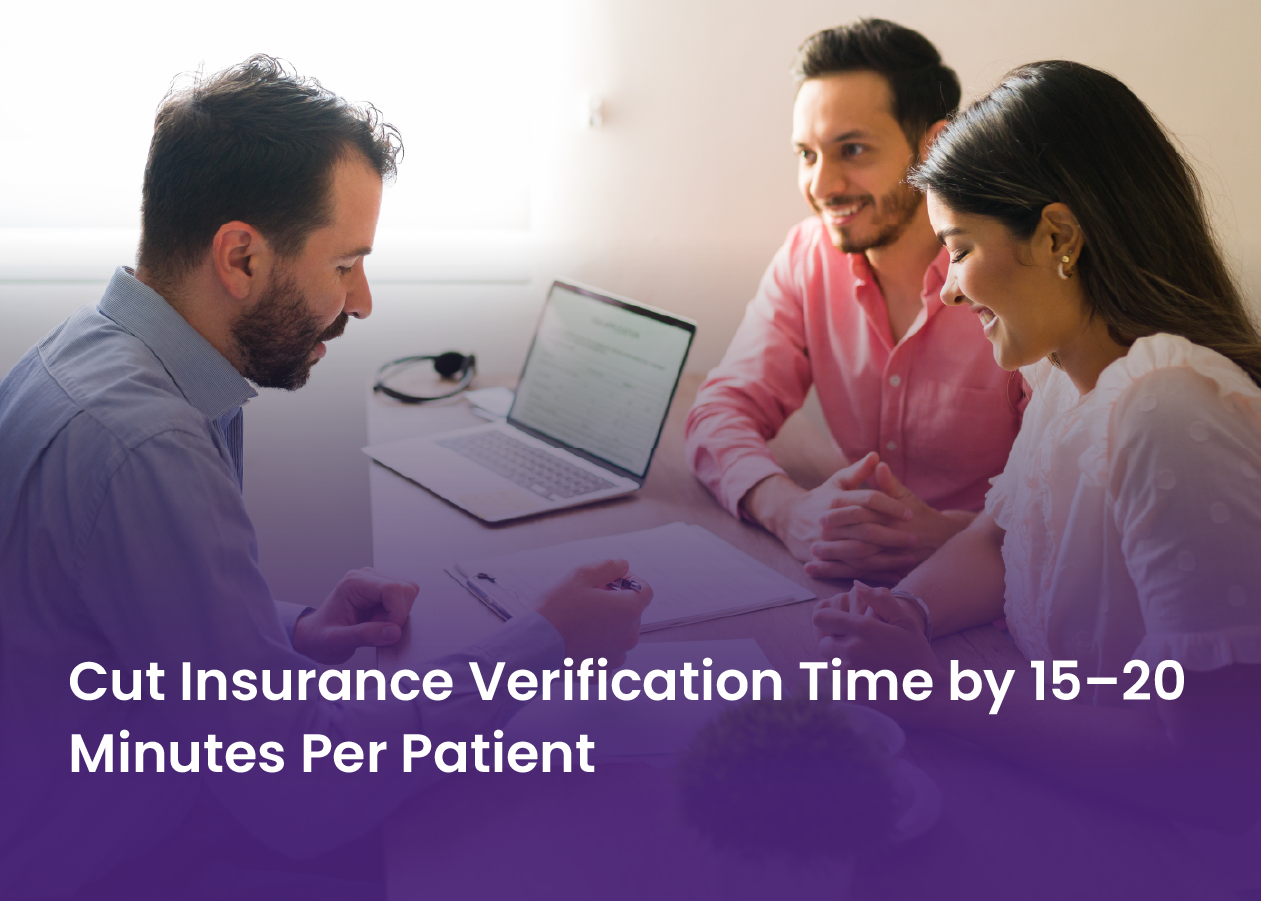
Two pieces of delivered work sit closest to this. For a multi-location family dentistry practice running Open Dental, we built real-time eligibility verification from Open Dental to Stedi, replacing manual payer-website lookups: 15-20 minutes saved per check, about 40% less administrative work and 60% fewer data-entry and verification errors (read the Open Dental eligibility case study).
And for a dental membership-plan platform serving DSOs and their practices, we ran a design sprint and rebuilt the website with separate B2B and B2C information architecture (the dental membership platform rebuild). For every other PMS, we build to that vendor’s route. The full build menu is on our dental software development page.
If you’d rather run it yourself: ConnectHealth
ConnectHealth, our integration platform, has insurance eligibility as a ready workflow step. Its eligibility node runs X12 270/271 checks (the standard eligibility request and response) on Stedi’s network, and the platform deploys into your own cloud environment, so patient data stays there. Run it yourself, or have us build on it. See the ConnectHealth eligibility verification integration.
If You Sell Software to DSOs
A DSO evaluates software differently from a single practice. In the DrBicuspid roundup, Areo Dental’s co-CEO, Dr. Anushka Gaglani, said, “Operationally, we’re looking for an automated solution that can do insurance breakdowns and write them back into our PMS,” and Tend’s chief dental officer, Dr. Chris Salierno, said he’s interested in AI developers “who are integrating with the PMS more deeply.” Expect questions like these:
- Which PMSs do you support, and which don’t you? A group on five systems needs a straight answer per system, with the access route for each one.
- Do you write back, or only read? Data that stops at your dashboard means staff retype it.
- One login across our offices? Single sign-on (SSO) with a role per office.
- Can we see it by location and for the group? Both views, from the same numbers.
- Will you sign a BAA? If you touch patient data, yes.
- What happens when a PMS updates? Who notices, who fixes it, how fast.
If your product is an AI receptionist, the specific integration questions are in our guide to AI receptionists and the PMS.
First 90 Days: A Technology Checklist for a Growing DSO
If you’re about to close your fifth acquisition, or your fiftieth, this is the list to run before the next one:
- Inventory every PMS: vendor, version, where it’s hosted, who has admin rights at each office.
- One identity system for all staff, with a role per office and a same-day offboarding step that covers every system.
- A data layer reading every PMS, with record counts reconciled against each source before the reports go to leadership.
- One written definition for each group metric (production, collections, chair utilization).
- A central eligibility queue for tomorrow’s schedule at every office.
- A known clearinghouse for every office, and a plan to bring new offices onto the group’s.
- A standard PMS picked, and a conversion order by office.
- A signed BAA with every vendor that touches patient data.
- A date in the calendar to re-check access controls when the HIPAA Security Rule final rule lands.
Work down the list in that order, and each new office plugs into a group that already knows how to absorb it.
To watch the eligibility step run, our dental eligibility automation webinar, co-presented with Stedi’s product team, shows our Open Dental build checking eligibility and writing verified benefits back into the PMS, live.