













 BLOGS
BLOGS  NEWSROOM
  CASE STUDIES
  WEBINARS
  PODCASTS
  ASSET HUB
  EVENT CALENDAR





















TL;DR
- The word “cloud” covers three meaningfully different EHR architectures: SaaS multi-tenant (athenahealth, DrChrono), single-tenant hosted (eClinicalWorks), and FHIR-native (Medplum, Canvas Medical).
- Picking the wrong deployment model costs more than the subscription ever will. HIPAA compliance in the cloud is a three-layer responsibility most operators only think about once.
- Includes the inflection point where a FHIR-native custom build beats a licensed platform.
Not all cloud EHR software is the same. The word “cloud” covers three meaningfully different architectures, and picking the wrong one costs you more than the subscription ever will.
I’ve spent the last decade building EHR systems and evaluating enterprise cloud deployments. The question I hear most often isn’t “which cloud EHR is best?” It’s “why do I feel like I’m locked into the wrong choice the day after signing?”
The answer: Most healthcare IT leaders and practice operators don’t distinguish between the three types of cloud EHR until after they’ve already committed. They see “cloud” and assume it means data portability, modern APIs, and flexibility. Sometimes it does. Often, it means a legacy system moved to a hosted server, API access locked behind per-call fees, and a vendor who controls your upgrade schedule.
Here’s what actually matters when you’re evaluating cloud-based EHR software in 2026.
- Quick breakdown by deployment model: SaaS multi-tenant cloud (athenahealth, DrChrono) gives you speed and low upfront cost. Single-tenant hosted cloud (eClinicalWorks) gives you customization. FHIR-native cloud (Medplum, Canvas Medical) gives you ownership and architectural flexibility. Which one wins depends entirely on whether you value speed, customization, or control more.
- HIPAA compliance in the cloud is a three-layer responsibility: your cloud infrastructure provider’s BAA, your EHR vendor’s BAA, and your own internal controls. Most practice operators only think about one of them.
- When building a custom cloud EHR makes more sense than buying: when your specialty workflow doesn’t fit a vendor template, when per-API-call fees compound into a second EHR bill, when you’re building a platform, not just running a practice.
I. What Is Cloud-Based EHR Software, and Why Does the Deployment Model Matter?
For most of the last decade, the cloud vs on-premise choice was purely financial. Move to the cloud, lower your capital costs, let someone else manage infrastructure. That was the pitch.
In 2026, that’s still true. But it’s no longer the whole story. How a vendor implements cloud fundamentally affects your ability to integrate other tools, own your data, and control your future.
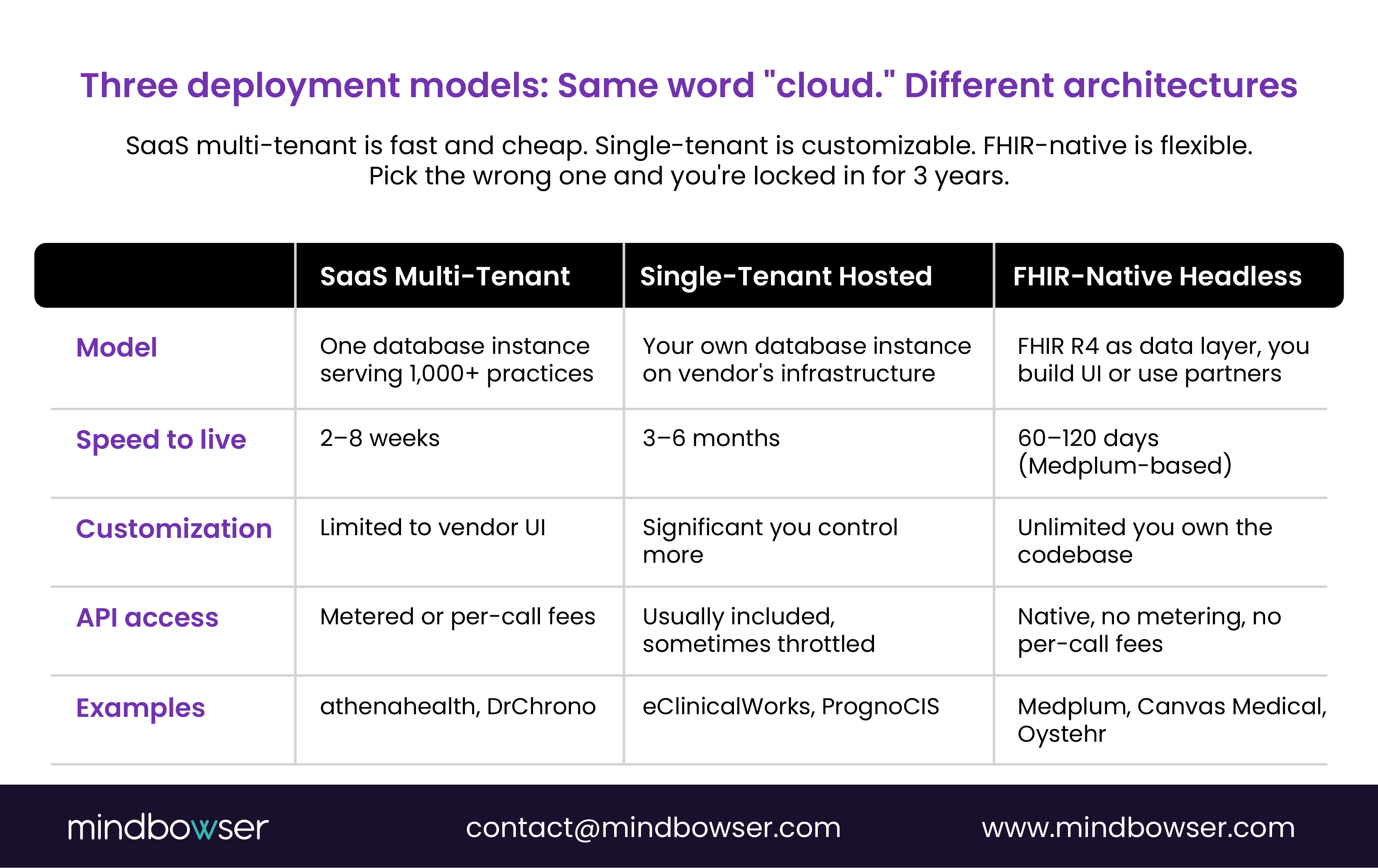
There are three deployment models, and they’re not equally “cloud.”
- SaaS multi-tenant cloud: One application instance serving multiple practices. Athenahealth and DrChrono operate this way. Automatic updates, low upfront cost, vendor controls the infrastructure. Trade-off: your data lives in a shared database with 10,000 other practices. Customization is limited to what the vendor’s UI allows. API access is often restricted or metered.
- Single-tenant hosted cloud: Your own database instance, hosted by the vendor or a third party. eClinical Works offers this. More customization than multi-tenant SaaS. Your data is yours alone. Trade-off: higher upfront cost, longer implementation timeline, still dependent on the vendor’s release schedule.
- FHIR-native headless cloud: Your data model is FHIR-native from the ground up (Medplum, Canvas Medical, Oystehr). No vendor database lock-in. APIs aren’t an afterthought; they’re the architecture. Trade-off: requires engineering depth. More moving parts. You’re responsible for more of the stack.
The ONC’s USCDI v3 mandate (89 FR 1192, effective 2026) requires all certified EHRs to support FHIR R4 APIs aligned to specific data classes. A multi-tenant SaaS system can be certified. A FHIR-native cloud can be certified. They’re architecturally different animals with the same label.
For a detailed look at how deployment models map to use cases, see types of EHR systems.
II. How Does a Cloud EHR Compare to an On-Premise System?

Cloud isn’t just hosting. It’s a data access model, an update model, and a recovery model.
- Uptime and reliability: 99.9 percent uptime sounds solid until you do the math. That’s 8.7 hours of allowable downtime per year. If your EHR goes down during patient hours, you don’t get those hours back. On-premise, you control the infrastructure. You also carry the risk when it fails.
- Update cycles: Cloud means automatic updates without your input. You upgrade when the vendor decides. On-premise, you control the upgrade timeline. You also carry the security risk of staying on an old version.
- Cost model: Cloud is subscription. You never own the system. On-premise requires capital upfront. Over three years, cloud often wins on cash flow. Over five years, on-premise often wins on total cost if the system doesn’t need replacement.
- Data access and API availability: Cloud vendors can meter API access. Some charge per call. On-premise, you own the system. APIs are yours to expose or restrict as you see fit.
According to HIMSS 2024 data, 71 percent of health systems now use some form of cloud-based EHR or cloud-hosted EHR. But “using cloud” ranges from running a legacy on-premise system on hosted servers to building FHIR-native cloud-first applications. The category is too broad to mean much anymore.
Still Unsure Which EHR To Pick? We Give You an Honest Read
III. What Criteria Should You Use to Evaluate Cloud EHR Software?
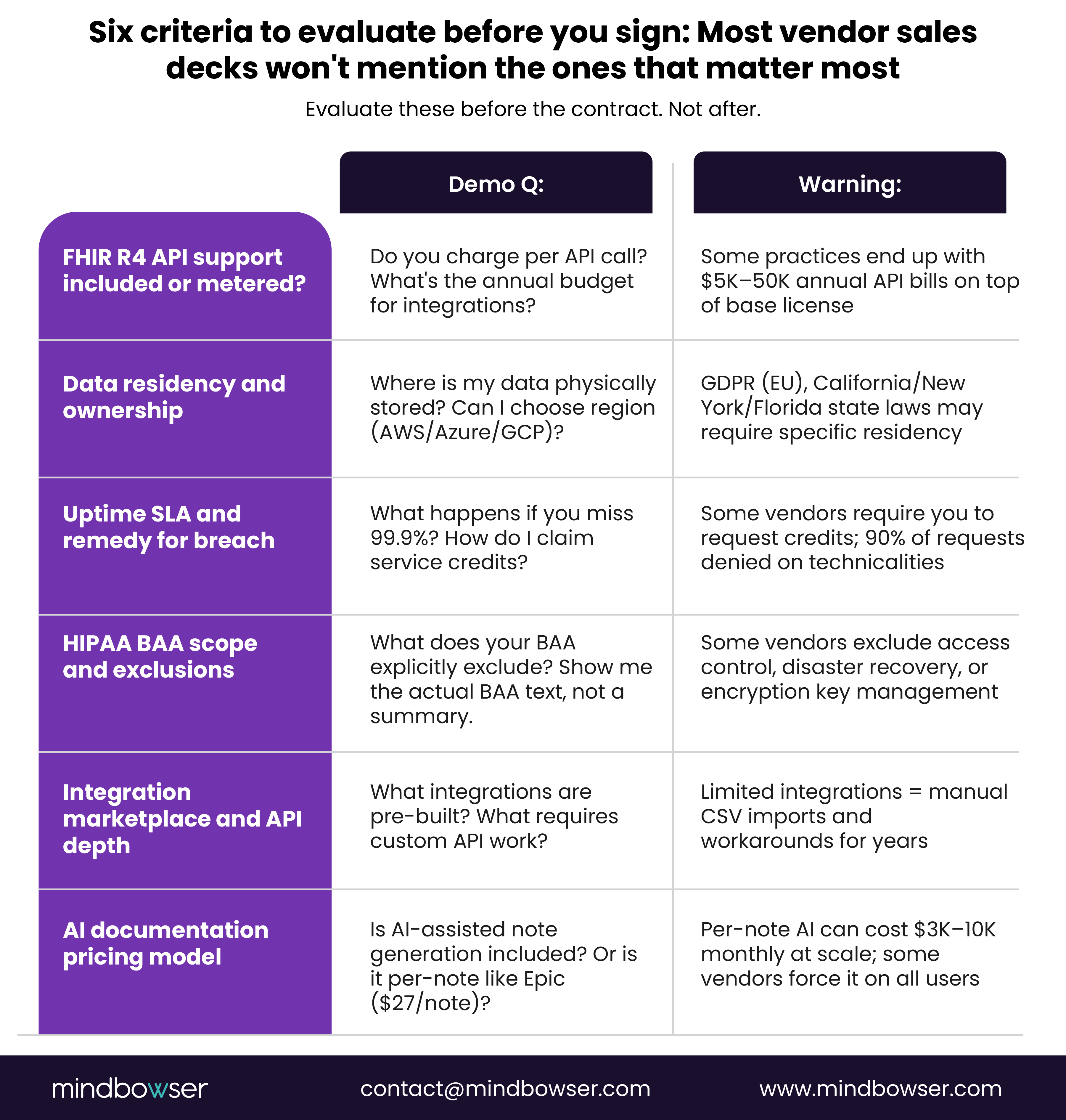
The vendor’s sales deck will show you a feature grid. It’s not useless, but it won’t tell you the things that matter most. Here are the six criteria I actually use.
- FHIR R4 API support, and whether it’s included or metered: ONC requires it. But “supports FHIR” is vague. Does the vendor expose all data through FHIR APIs? Is API access included in your license, or charged per call? Some practices end up with $5K to $50K annual API bills on top of their base EHR license.
- Data residency and ownership: Where is your data physically stored? If you operate in multiple states, state-level health privacy laws apply (California, New York, Florida all have stricter rules than HIPAA). Ask the vendor for a data residency map in writing. If they won’t commit, that’s a red flag.
- Uptime SLA and remedy for breach: 99.9 percent is standard. 99.95 percent is premium. Ask what happens if they miss it. Some vendors require you to request service credits. Some deny 90 percent of requests on technicalities.
- HIPAA BAA scope and exclusions: Ask for the actual BAA text before you sign the main contract. Some vendors explicitly exclude responsibility for access control enforcement. Some exclude disaster recovery. Some exclude encryption key management. This is where lock-in clauses hide.
- Integration marketplace and API depth: Can the system speak to your billing system, lab management, pharmacy, wearable devices, custom analytics? This is invisible until you’re three months in and your revenue cycle team is still manually uploading files.
- AI documentation pricing model: Epic charges $27 per AI note. Ask whether AI is included in your base license or metered per note, and whether you can use a different AI vendor instead. Most vendors don’t allow this.
According to data from r/healthIT and health system procurement forums, the most common complaint after switching is not about features. It’s about API rate limits, HIPAA BAA surprises, and uptime SLA terms that sounded good until a vendor actually missed one.
IV. Which Cloud EHR Systems Are Actually Worth Evaluating?
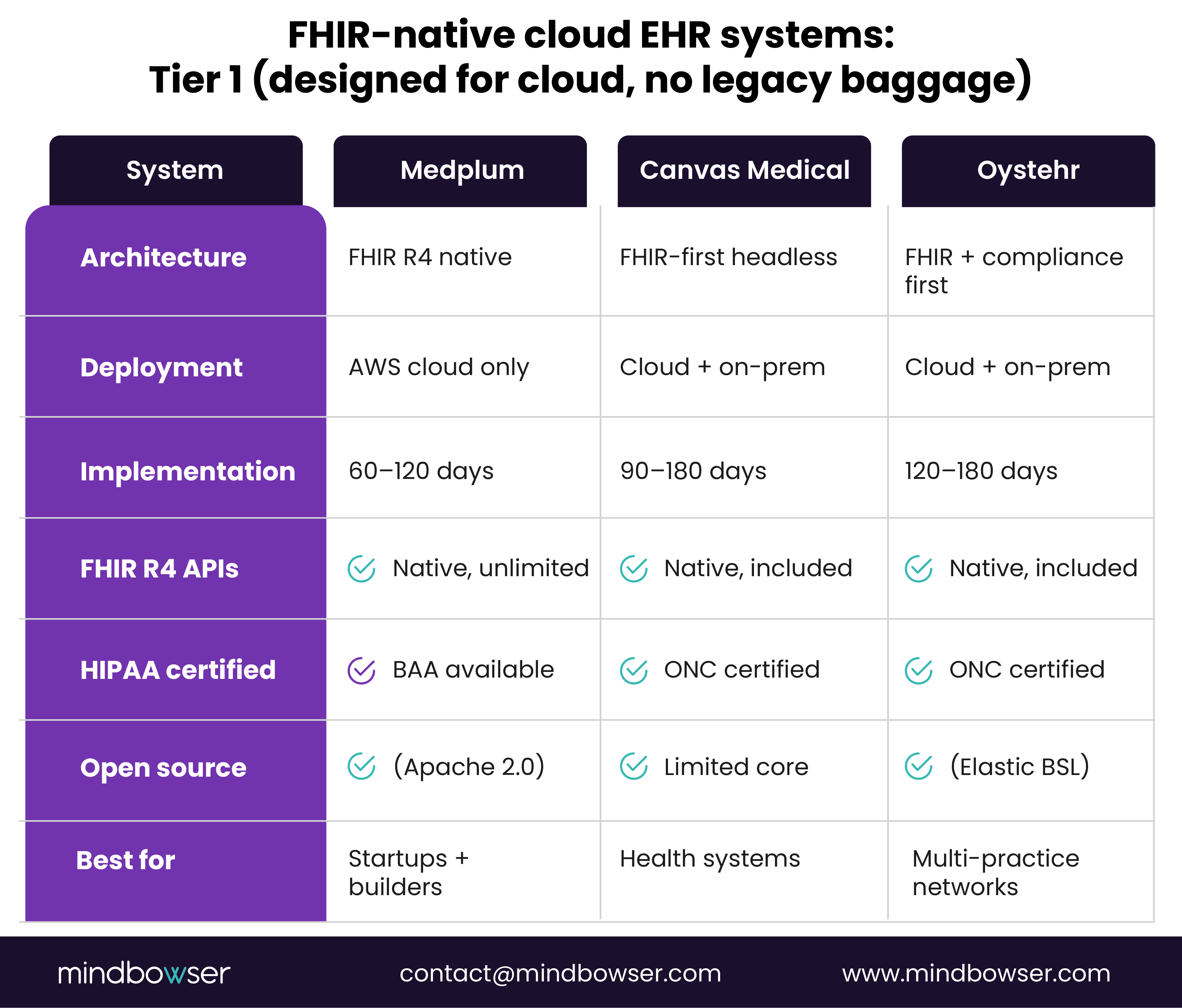
There are over 500 certified EHR vendors in the US. Most aren’t cloud-native. They’re legacy applications ported to hosted servers five or ten years ago and incrementally modernized ever since.
Tier 1: FHIR-Native Cloud From the Ground Up
These systems were designed for cloud and FHIR-first. No legacy baggage. No “we added APIs later” story.
- Medplum: For a specialty care organization, we built a full AI-native EHR on Medplum and GCP in under 90 days: 70 percent reduction in provider documentation time, 60 percent drop in post-visit task delays, and 50 percent increase in patient interaction through an AI inbound assistant. For a mid-size health system, we migrated a legacy EHR from Azure to AWS with a 30 percent infrastructure cost reduction and modernized the clinical workflows alongside it. We also built a national-scale EHR for an entire country’s public health system on a platform-based approach.
- Canvas Medical: Similar positioning to Medplum with a more opinionated UI layer. Designed specifically for primary care. Strong integration ecosystem.
- Oystehr: FHIR-native, stronger focus on multi-tenant marketplace architecture.
For a detailed comparison of FHIR-native platforms, see the headless EHR comparison guide.
Tier 2: Cloud SaaS With Genuine FHIR Support
- athenahealth (athenaOne): KLAS Research (2024) ranked it number 2 for cloud-based ambulatory EHR. Strong FHIR R4 support. API access included in higher tiers. Caveat: percentage-of-collections pricing means the vendor benefits when you grow revenue.
- DrChrono: Black Book Research (2024) ranked it number 1 for small practice usability in cloud. FHIR R4 built in. Transparent pricing. No per-call API fees.
- eClinicalWorks: KLAS (2024) ranked it number 2 for mid-market cloud ambulatory EHR. FHIR support is partial (not all data classes exposed through APIs). Legacy architecture shows in the UI.
Tier 3: Legacy on Cloud (Watch for Red Flags)
These are on-premise EHRs vendors moved to hosted servers to stay competitive. Technically “cloud,” but the architecture hasn’t changed.
If a vendor hasn’t published FHIR R4 API roadmaps for 2026, they’re here. If they’re metering API access or charging per call, they’re here. Ask: “When was your cloud architecture designed, and what core components have been rearchitected since?” If the answer is “none,” you’re looking at legacy on cloud.
For a more detailed comparison, see best EHR systems for small practices vs custom EHRs.
V. What Does HIPAA Compliance Actually Look Like in a Cloud EHR?
The biggest misconception in healthcare IT: picking a “HIPAA-compliant” cloud EHR means your practice is HIPAA-compliant. It doesn’t. Your compliance is only as good as the BAA you sign, plus the controls you implement on your end.
HIPAA in cloud is a three-layer stack, and you’re responsible for all three.
Layer 1: Cloud infrastructure provider BAA (AWS, Azure, GCP)
The cloud provider signs a BAA with your EHR vendor covering encryption at rest, encryption in transit, infrastructure-level access controls, and data center audit logging. You don’t sign this directly. But ask your EHR vendor to show you their infrastructure provider’s BAA terms: who holds the encryption keys, disaster recovery commitments, breach notification timelines.
Layer 2: EHR vendor BAA
Your EHR vendor signs a BAA with you covering what they do with your data, who can access it, what happens at breach, and what happens if the vendor gets acquired. This is where most surprises hide. Some vendor BAAs explicitly exclude access control enforcement. Some exclude encryption key management. Some require you to request breach notification rather than automatically providing it. Read the actual BAA text.
Layer 3: Your practice’s internal controls
Access controls, MFA, role-based access, audit logging: this is on you. If your staff member leaves and still has access for three weeks, that’s a breach of your controls, not the vendor’s.
The 2025 HIPAA Security Rule update (90 FR 898) tightened these requirements and specifically calls out vulnerability scanning and penetration testing for cloud environments.
PHISecure is our production-ready HIPAA data handling layer for cloud deployments: encryption, access control enforcement, audit logging. It’s included in every custom cloud EHR build.
For a deeper dive, see the EHR security architecture guide.
VI. When Does Building a Custom Cloud EHR Make More Financial Sense Than Buying?
This isn’t the question to lead with. For most organizations, buying makes sense. The alternative requires engineering depth, time, and risk tolerance.
But there’s a real segment of healthcare operators for whom custom is the sharper move.
The pain point: specialty workflow doesn’t fit any vendor’s template. Customization reaches its ceiling and still falls short. The billing module doesn’t talk to the clinical module. API fees are $3K per month and climbing. The vendor controls the release cycle and you’re two years behind on features you need.
What’s already built: For a specialty care organization, we built a full AI-native EHR on Medplum and GCP in under 90 days: 70 percent reduction in provider documentation time, 60 percent drop in post-visit task delays, and 50 percent increase in patient interaction through an AI inbound assistant. For a mid-size health system, we migrated a legacy EHR from Azure to AWS with a 30 percent infrastructure cost reduction and modernized the clinical workflows alongside it. We built a national-scale EHR for an entire country’s public health system on a platform-based approach.
Pre-built components on every build:
- PHISecure: HIPAA-compliant data handling for cloud. Encryption, access control, audit logging, production-ready.
- AI Medical Summary: Embedded ambient AI documentation. No third-party subscription required.
- ConnectHealth: Integration layer for multi-EHR workflows.
If your practice needs a healthcare software development partner who understands the clinical layer as well as the engineering layer, that’s the distinction that matters.
ROI math: If your cloud EHR costs $400/month per provider in base fees plus $2K monthly in API overages plus staff time spent on workarounds, a custom cloud EHR often pays for itself in 18 to 24 months.
VII. What Questions Should You Ask a Cloud EHR Vendor Before You Sign?
Every cloud EHR vendor will tell you they’re the right fit. These six questions cut through the pitch.
1. What FHIR R4 APIs are included, and what’s behind a paywall?
Ask for the API pricing addendum to your contract. At $0.05 per call (common in the industry), data exports and integrations add up fast. Some practices end up paying more in API fees than in base EHR fees.
2. Where is my data stored, and who owns it?
Ask for a data residency map. Ask who owns the encryption keys. Ask what happens to your data if the vendor gets acquired. Most vendors will say, “It depends on the acquisition terms.” That’s a red flag.
3. What is your uptime SLA, and what’s the remedy if you miss it?
Ask for examples of recent SLA breaches and how they were handled. Ask whether downtime during maintenance windows counts against the SLA. Most vendors exclude planned maintenance. That’s a loophole worth asking about.
4. What does your HIPAA BAA cover, and what does it explicitly exclude?
Ask for the BAA text before you sign anything else. Have legal review it. Look for exclusions on access control enforcement, encryption key management, disaster recovery, and breach notification. Some BAAs require you to request breach notification rather than automatically providing it. This is the single most important document to read closely.
5. What is my data export format if I leave?
Can you export in a standard format (FHIR, HL7, CSV)? How long does it take? What does it cost? Ask for examples from recent customer exits. If they won’t answer, that’s your answer.
6. Is AI documentation included or billed per note?
Epic charges $27 per AI note. For a practice generating 50 notes per day, that’s $1,350 monthly just for AI. Ask whether you can opt out per user. Ask whether you can integrate a different AI vendor. Most cloud EHRs don’t allow this.
Ask all six questions in writing. Get written answers. If they won’t commit in writing, that’s your answer.
Cloud EHRs Should Give You Control
The right cloud EHR is not just the one that runs on remote servers. It is the one that gives you reliable access, clean integrations, clear data ownership, and the flexibility to grow without hidden fees or vendor lock-in. SaaS works for speed. Hosted cloud works for customization. FHIR-native cloud works when control matters most. The goal is not simply moving healthcare software to the cloud. It is building a system that helps teams work faster, protect patient data, and deliver care with fewer barriers.