





 BLOGS
BLOGS  NEWSROOM
  CASE STUDIES
  WEBINARS
  PODCASTS
  ASSET HUB
  EVENT CALENDAR























TL;DR
A CCM platform isn’t one feature, it’s five connected functions that have to work as one system: patient identification, consent and enrollment, care plan versioning, time tracking, and billing generation.
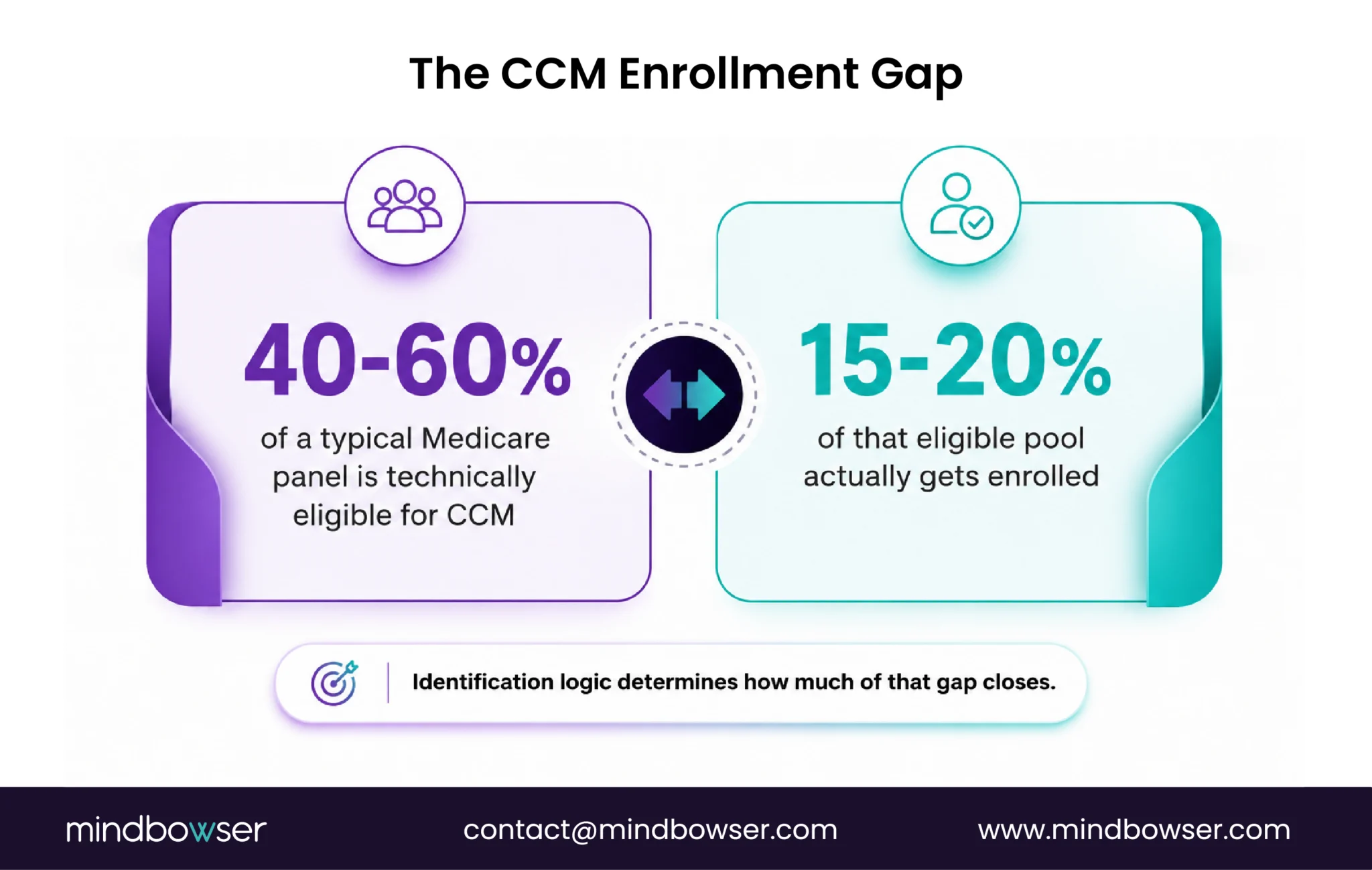
- Patient identification should pull from EHR problem list + utilization signals (ED visits, polypharmacy, lab trends), not diagnosis codes alone, roughly 40-60% of a Medicare panel is technically eligible for CCM, but real enrollment lands closer to 15-20% of that pool, and identification logic is what determines the gap
- Care plans need to be living, monthly-updated FHIR records, not a static template filled in once, this is the most common reason a program passes its first audit and fails a later one
- Time tracking has to capture minutes at the point of work, tied to a specific activity and staff member, reconstructing from memory at month-end is the top source of both under-billing and audit risk
- Billing generation should check eligibility, time thresholds, and concurrency conflicts before a claim goes out, not after a denial comes back
- Most commercial platforms handle time tracking and billing well since that’s what demos best, identification and care plan versioning are the weaker links and where real revenue/compliance risk actually sit
What “CCM Platform” Actually Has to Cover
A CCM platform isn’t one feature, it’s five connected functions that have to work together, not as separate modules bolted onto each other: patient eligibility identification, consent and enrollment management, care plan creation and versioning, time tracking tied to actual coordination activity, and billing code generation tied to that same documentation. A platform that does one or two of these well and treats the rest as an afterthought is the most common reason CCM programs underperform their revenue potential.
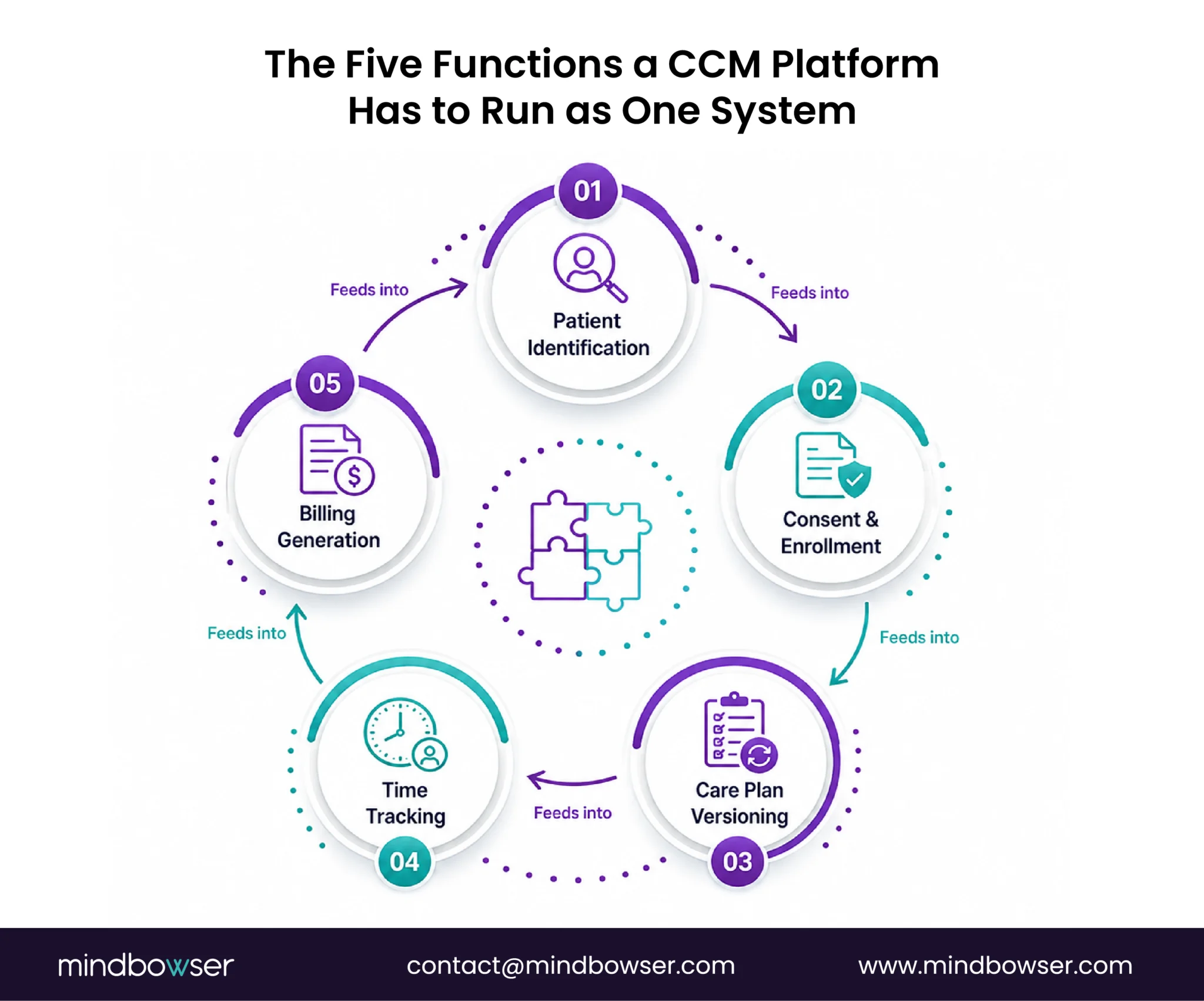
The Five Functions, and What Each One Actually Requires
Patient identification needs to query the EHR problem list combined with utilization signals (recent ED visits, polypharmacy, lab trends), not just diagnosis codes. This distinction matters more than it sounds: roughly 40-60% of a typical Medicare panel is technically eligible for CCM (two or more chronic conditions), but realistic enrollment even in a well-run program lands closer to 15-20% of that eligible population. Those are two different numbers describing two different things, eligible population size versus actual enrollment rate, and a platform’s identification logic determines how much of that 40-60% ever gets found and offered enrollment in the first place. Diagnosis-code-only identification catches the obvious cases and misses patients whose complexity shows up in utilization patterns before it shows up as a clean qualifying diagnosis.
- Consent and enrollment needs structured capture: date, method (verbal or written), revocation rights, and a record that survives an audit. This sounds simple and is where a surprising number of programs cut corners under time pressure, because it’s the least clinically interesting part of the workflow and the easiest to treat as a formality.
- Care plan creation needs to be a living, monthly-updated document tied to the patient’s actual conditions and goals, not a static template filled in once at enrollment and left alone. A platform that treats the care plan as a one-time form rather than a versioned, evolving record will pass an initial audit and fail a later one when the plan hasn’t been touched in eight months.
- Time tracking needs to capture minutes at the point of work, tied to a specific activity type and staff member, not reconstructed from memory at month-end. This is the single most common source of both under-billing (real work that never gets logged) and audit risk (logged time that doesn’t match a documented activity).
- Billing generation needs to populate from the clinical documentation that’s already there, checking eligibility, time thresholds, and concurrency conflicts (has another practitioner already billed this patient this month) before a claim goes out, not after a denial comes back.
Where Off-the-Shelf Platforms Typically Cut Corners
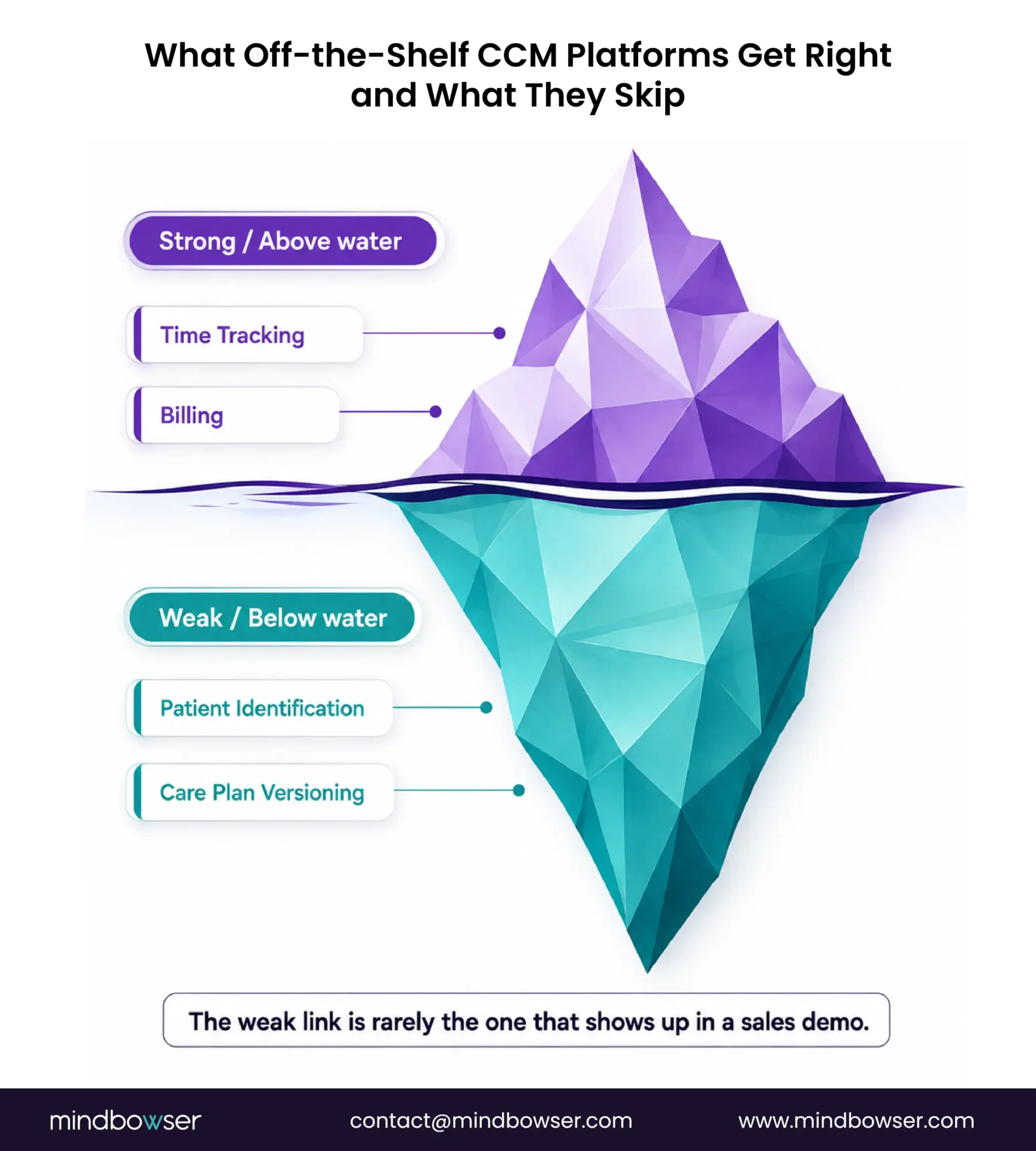
Most commercial CCM platforms handle time tracking and billing reasonably well, because that’s the most visible, most easily demoed part of the product. Patient identification and care plan versioning tend to be the weaker links, because they’re harder to demo and less immediately visible in a sales conversation, even though they’re where a lot of real revenue and compliance risk actually lives.
The strongest 2026 platforms are also expected to bundle CCM with RPM, RTM, PCM, TCM, and BHI from a single workflow rather than as separate add-ons, which raises the bar further on what “handles the five functions well” actually means once concurrent programs enter the picture.
Planning To Launch Or Upgrade A CCM Program?
What Happens When One Function Is Missing
The five functions aren’t equally visible in a sales demo, which is exactly why gaps in the less-visible ones persist for months before anyone notices. A platform with strong time tracking and billing but weak identification will show healthy per-patient revenue numbers while quietly leaving a large share of the eligible population unenrolled, a problem that looks like “the program is working” on a dashboard and “we’re leaving money on the table” in an actual chart review.
A platform with strong identification and enrollment but a static care plan will pass its first audit cleanly and then fail a later one when a reviewer asks for evidence of monthly updates that were never made. Neither gap shows up until someone specifically checks for it, which is why evaluating all five functions during procurement, not just the two that get demoed well, matters more than most buyers assume going in.
Configuration Questions Worth Asking Before You Commit
Does the platform support multi-specialty care plan templates, or one generic template stretched across every condition type? Can it manage CCM alongside PCM, RPM, and BHI concurrently without double-counting time or missing a concurrency conflict? Does patient identification pull from utilization data, or diagnosis codes alone, and what share of your actual eligible population (the real 40-60%, not an assumed number) does it surface? Is the care plan a living, versioned FHIR resource, or a static document reconstructed from a separate system?
How Mindbowser Approaches This
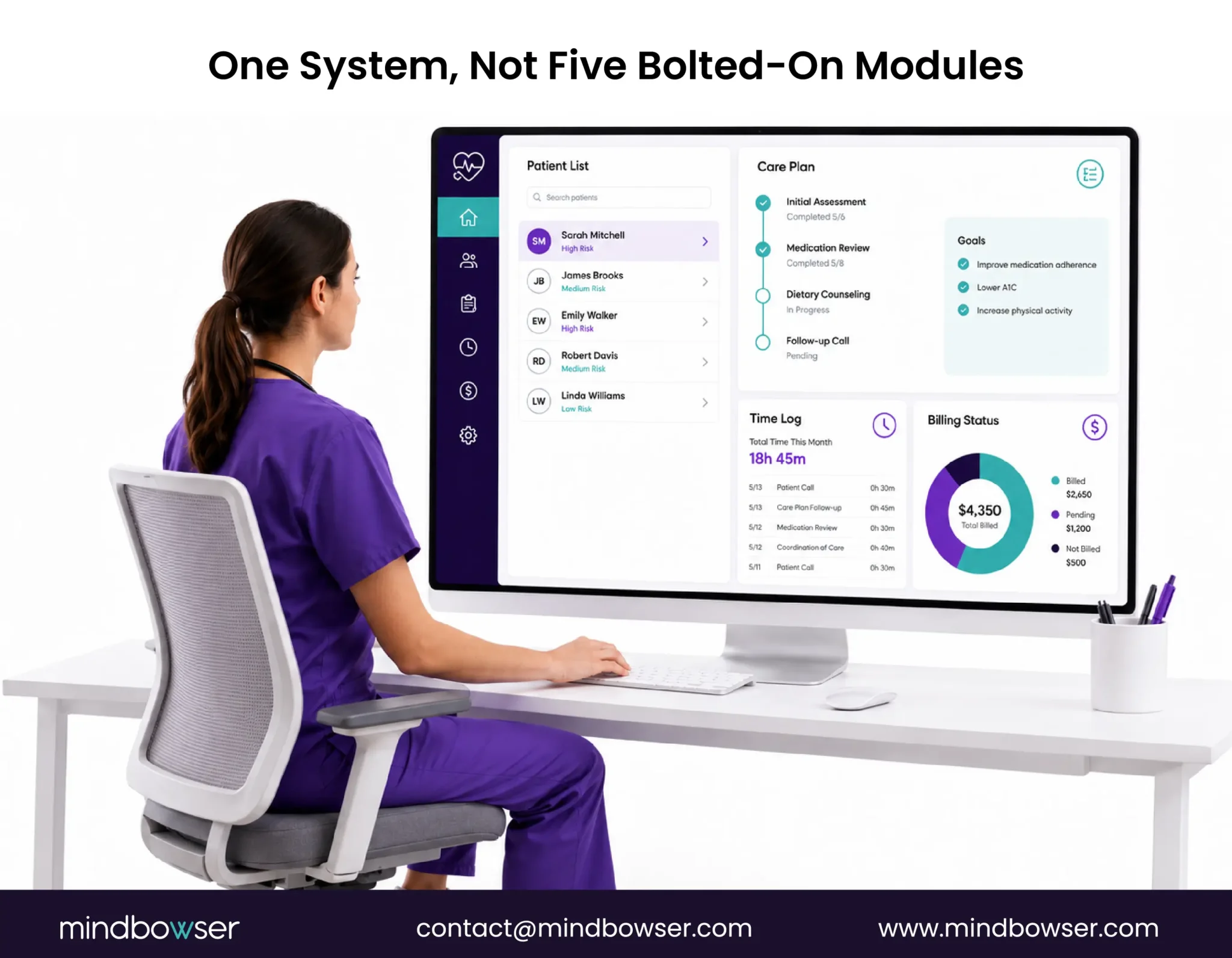
We build CCM platforms where all five functions are one connected system, not five separate modules that happen to share a login screen. Patient identification runs against real EHR data, not a diagnosis-code filter alone. Care plans are FHIR-native and versioned monthly. Time logging happens at the point of work. Billing generation checks eligibility and concurrency before a claim is ever submitted. CarePlan AI handles the care-plan-generation piece specifically, drawing from clinical documentation rather than a blank template.
Conclusion
A CCM platform is only as strong as its weakest of five functions, and the weak link is rarely the one that shows up in a sales demo. Time tracking and billing are the easiest parts to build and the easiest parts to sell, which is exactly why patient identification and care plan versioning are where most off-the-shelf platforms quietly fall short, and where the real revenue and audit risk live.
The fix isn’t picking a platform with the flashiest billing dashboard. It’s evaluating all five functions during procurement: does identification pull from utilization data or diagnosis codes alone, is the care plan a versioned FHIR resource or a static form, and does billing check concurrency before a claim goes out rather than after a denial comes back.
Mindbowser builds CCM platforms where identification, enrollment, care planning, time tracking, and billing run as one connected system, not five modules sharing a login screen.
Patient identification, consent and enrollment management, care plan creation and versioning, time tracking, and billing code generation, built as one connected workflow rather than separate modules.
CMS requires monthly updates to reflect the patient’s current status. A care plan built once at enrollment and never revisited will pass an initial review but fail an audit that checks for ongoing, dated updates.
Patient identification (often diagnosis-codes-only instead of combining problem list with utilization signals) and care plan versioning (often treated as a static document rather than a living, monthly-updated record).
If your patient population overlaps with RPM, PCM, or BHI, which is common for chronically ill Medicare patients, yes. A platform that only manages CCM in isolation will eventually hit a concurrency conflict it can’t detect.