














 BLOGS
BLOGS  NEWSROOM
  CASE STUDIES
  WEBINARS
  PODCASTS
  ASSET HUB
  EVENT CALENDAR
















TL;DR
- AI integrated with EHR systems automates intake, pre-fills clinical notes, and surfaces diagnostic insights in real time
- Clinicians can reclaim documentation time by reducing after-visit admin work
- This blog covers: AI’s role in mental health workflows, EHR integration challenges, PoC approach, and future direction
- Built for: mental health clinic operators, digital health builders, and EHR product teams
Imagine a mental health clinic where clinicians spend more time with patients and less on paperwork. This is the future of mental healthcare, and it’s closer than you think. Integrating AI into EHR systems is rapidly changing how mental healthcare is delivered. AI is not just streamlining patient intake and diagnostic processes; it’s making it easier for clinicians to access the data they need in real-time, allowing them to make faster, more accurate decisions.
AI and EHR integration promise to significantly enhance the efficiency of mental healthcare delivery, creating a more connected and patient-centered healthcare system. By automating administrative tasks, improving diagnostic accuracy, and facilitating better decision-making, this technology transforms workflows for patients and clinicians alike.
If you’re looking to enhance your healthcare workflows and explore the potential of AI-EHR integration, schedule a consultation today to learn how we can help you implement AI-driven solutions that transform the way you deliver care.
The Role of AI in Mental Healthcare
In mental health, administrative tasks can be overwhelming for clinicians, taking time away from patient care. AI platforms, such as chatbots and voice agents, are making a profound difference by automating patient intake processes. These platforms collect essential information from patients before their appointments, allowing clinicians to focus on diagnosis and treatment.
Studies show that A 2025 JAMA Network Open study found that ambient AI documentation was associated with decreased time spent in notes per appointment, improved clinician satisfaction, and reduced cognitive load. In mental healthcare, where documentation burden is especially high, AI-enabled EHR workflows can help clinicians spend less time on notes and more time with patients. This gives clinicians more time to focus on delivering quality care rather than dealing with paperwork, improving the patient experience, and boosting clinician satisfaction.
The ability to gather and analyze patient data quickly through AI helps improve diagnostic accuracy, which is especially important in mental healthcare. AI systems can analyze complex data, identify patterns, and offer insights that clinicians might miss during traditional assessments, leading to better patient outcomes.
Related Read: AI in Mental Health: How Chatbots and Virtual Assistants Are Changing Therapy
Overcoming the Challenges of EHR Integration
While AI platforms are powerful on their own, the real value is in integrating them with existing EHR systems. EHRs are the central hub for patient data, and for AI to be truly effective, it needs to be able to interact with EHRs in a seamless way.
A recent study by McKinsey’s latest research on generative AI in healthcare emphasizes that organizations are moving from experimentation toward ROI-focused implementation, with the greatest near-term value coming from workflow integration, administrative automation, and operational efficiency rather than standalone AI tools. This integration ensures that all patient data—from intake forms to diagnostic results, flows seamlessly through the EHR, allowing clinicians to access real-time information to make more informed decisions.
However, integrating AI with legacy EHR systems is no simple task. It requires collaboration between AI developers, healthcare providers, and EHR vendors to ensure smooth data transfer and interoperability. Data privacy and security concerns also need to be addressed, as patient data must be handled with the utmost care. Despite these challenges, the benefits of a fully integrated system far outweigh the obstacles, as it leads to better care coordination, faster decision-making, and improved patient outcomes.
Related Read: The Interoperability Challenge in Healthcare
Curious how AI fits into your existing EHR system?
Bringing AI and EHR Together
Developing a Proof of Concept (PoC) is one of the best ways to understand how AI and EHR systems can work together. A PoC allows healthcare providers to test how AI platforms can handle patient intake, update records, and assist with clinical note-taking—all while working within the existing EHR infrastructure.
With a PoC in place, healthcare providers can evaluate the effectiveness of the integration before committing to full-scale implementation. This step helps mitigate risk and ensures that the system meets the needs of both clinicians and patients. Once successful, full integration can proceed, streamlining workflows, automating tasks, and ultimately improving the quality of care provided.
Enhancing Workflows for Both Patients and Clinicians
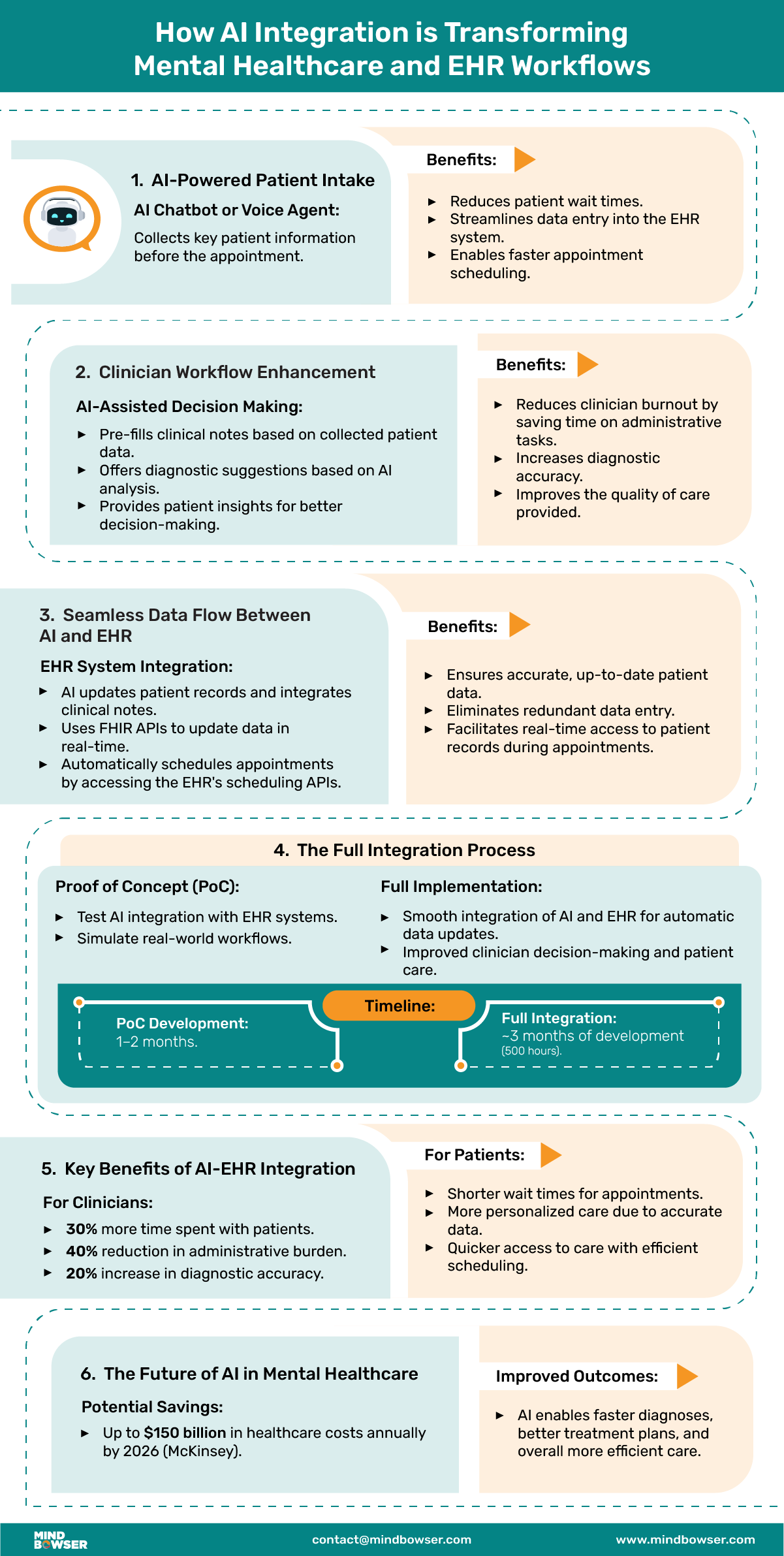
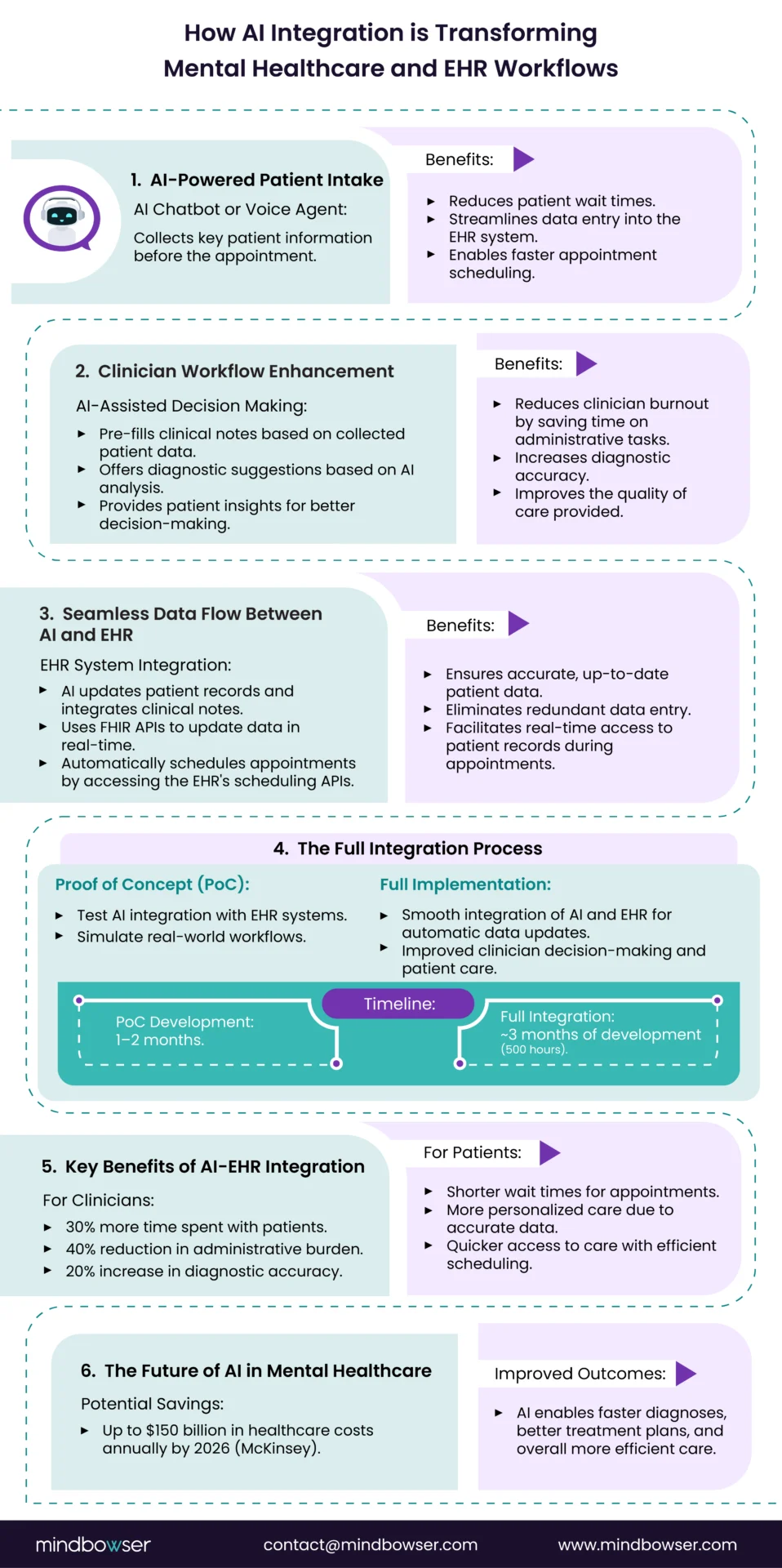
AI-EHR integration brings clear benefits to both patients and clinicians. For patients, the process begins with an AI-powered intake system that collects key information and securely updates the EHR. This reduces the time spent filling out forms and waiting for appointments, allowing patients to focus on receiving care.
For clinicians, AI reduces the time spent on administrative tasks, allowing them to focus on the clinical side of care. With AI pre-filling clinical notes, offering diagnostic suggestions, and providing valuable patient insights, clinicians are better equipped to make informed decisions quickly. This improves not only the quality of care but also reduces clinician burnout, a growing concern in the healthcare industry.
A recent survey by the American Medical Association found that 63% of healthcare providers believe that AI tools help improve their efficiency and job satisfaction. This is particularly important in the mental healthcare field, where clinicians often experience high levels of stress due to administrative overload.
The Future of AI in Mental Healthcare
As AI technology continues to evolve, the possibilities for mental healthcare are expanding. AI can help healthcare providers make more accurate diagnoses, automate administrative tasks, and provide better patient care. The integration of AI with EHR systems will play a crucial role in this transformation, ensuring that patient data is seamlessly shared across platforms and that clinicians have the tools they need to provide timely, personalized care.
According to a Accenture’s 2025 healthcare provider research reports that 83% of healthcare executives are piloting generative AI in pre-production environments, but fewer than 10% are investing in the infrastructure needed to support enterprise-wide deployment. For mental healthcare organizations, this signals a clear gap between AI experimentation and scalable EHR-integrated implementation.
Related Read: AI in the Doctor’s Office: How Artificial Intelligence is Transforming Healthcare Delivery
Conclusion
The future of mental healthcare is incredibly promising, thanks to AI integration with EHR systems. By automating administrative tasks, improving diagnostic accuracy, and providing real-time access to patient data, AI is revolutionizing the way clinicians deliver care. This technology is not just improving the efficiency of mental healthcare—it’s improving the quality of care and enhancing patient outcomes.
As AI continues to evolve and integrate with existing healthcare infrastructures, mental healthcare providers will have the tools they need to offer better care, faster decisions, and more personalized treatment. The path to AI-EHR integration may take time and effort, but the benefits will create a more connected, efficient, and patient-centered healthcare system.
If you’re looking to enhance your healthcare workflows and explore the potential of AI-EHR integration, schedule a consultation today to learn how we can help you implement AI-driven solutions that transform the way you deliver care.
AI platforms connect to EHRs via FHIR-compliant APIs. They pull patient data for context, push automated intake forms and clinical note drafts back into the record, and surface diagnostic flags — all within the clinician’s existing workflow, no separate login required.
Three main ones: legacy EHR systems that lack modern APIs, data privacy compliance, especially HIPAA and 42 CFR Part 2 for substance use record, and clinician adoption. Workflows have to be net-simpler, not just technically capable.
Yes, that is one of the clearest measurable wins. When AI automates intake, pre-fills notes, and handles documentation, clinicians spend less time on screens and more on patient care. AMA research shows physicians increasingly see AI’s value in reducing administrative burden.
A Proof of Concept, or PoC, is a scoped, low-risk build that tests whether AI and your specific EHR can work together before full investment. It validates data flow, integration points, and workflow fit without committing to full development. For mental health use cases, a PoC typically covers intake automation and one clinical decision-support module.
AI in mental health is designed to assist, not replace, clinical judgment. Compliant systems are built with HIPAA-grade data security, audit trails, and clear documentation that AI outputs are decision-support tools. The clinician retains full diagnostic authority.